












































































Article Contents:
- Wear diagnostics: when it's time to act
- Cracks: superficial vs. structural
- Chips: size matters
- Color loss: fading, yellowing, soiling
- Detachment from the wall: when the adhesive fails
- Biological damage: mold, fungus, insects
- Deformations: bending, twisting, warping
- Restoration of polyurethane molding: restoring the original shape
- Tools and materials for polyurethane restoration
- Elimination of minor scratches and abrasions
- Restoration of chips and cracks
- Restoration of large broken-off fragments
- Elimination of detachment from the wall
- Repainting polyurethane molding
- Restoration of wooden baseboards: working with a living material
- Tools and materials for wood restoration
- Removal of old coating: paint, varnish, wax
- Sanding: from coarse to perfect
- Filling cracks and chips in wood
- Restoration of chips and lost sections
- Painting, varnishing, oiling
- Professional restoration vs. DIY: where is the boundary of possibility
- What can realistically be done independently
- When a professional is necessary
- Hybrid approach: combining independent work and professional assistance
- Cost of restoration: an investment in durability
- Restoration of polyurethane molding
- Restoration of Wooden Elements
- Installation of polyurethane molding price of work
- Factors Affecting Cost
- Restoration vs. Replacement: An Economic and Environmental Dilemma
- When Restoration is More Beneficial
- When Replacement is More Beneficial
- Hybrid Solution: Partial Replacement
- Moisture Protection
- Protection from Mechanical Damage
- Controlling microclimate
- Timely Minor Repairs
- Frequently Asked Questions About Decorative Restoration
- Can stucco be restored without removing it from the wall?
- How long does a restored element last?
- Are restoration marks visible after the work is completed?
- How Long Does Restoration Take?
- Can painted elements be restored without repainting?
- What materials are best for DIY restoration?
- Is the restoration of gypsum stucco different from polyurethane stucco?
- Is priming necessary before painting restored elements?
- Can the color of elements be changed during restoration?
- Conclusion: Preserving the Past, Creating the Future
- STAVROS: A Partner in Preserving Beauty
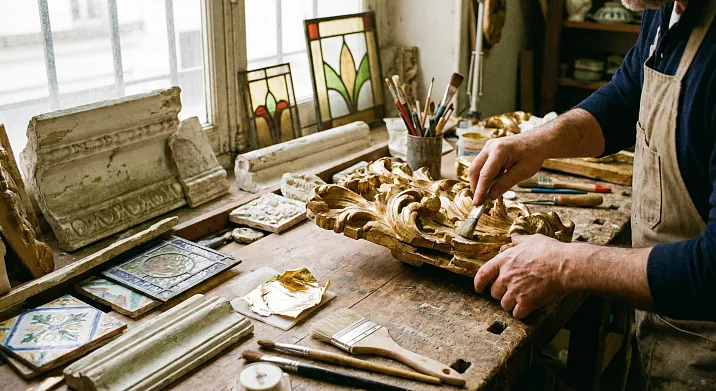
Time is relentless. It fades colors, bleaches shades, leaves scratches on surfaces, turning once flawless interior details into worn, lackluster elements. A pristine white cornice yellows. CarvedWooden baseboard becomes chipped.Polyurethane moldings cracks in the corners. And so you stand before a choice: throw it away and replace it with something new, or try to restore its former beauty?
Restoration of decorative elements— is not merely a technical process of repairing damaged parts. It is a philosophy of respect for objects, for the labor of the craftsmen who created these elements, for the history of your home. In an era of disposability, where it's easier to buy new than to fix old, restoration becomes an act of cultural resistance, a choice of conscious consumption, an affirmation of the value of durability.
But philosophy aside, practice is more important. Can a cracked molding truly be restored so that no damage marks are visible? Is it realistic to return a wooden baseboard darkened by time to its original color? What is the cost—in time, money, effort? What can be done independently, and where is a professional necessary? When does restoration make sense, and when is it simpler and cheaper to replace the element with a new one?
In this article, we will break everything down in order. We'll start with diagnostics—how to understand that decor needs restoration, which signs of wear are critical, and which can be ignored. We'll move on to polyurethane stucco restoration techniques: from fixing minor scratches to restoring broken-off fragments. We'll study the restoration of wooden elements: sanding, puttying, repainting, restoring wood grain. We'll compare professional approaches and DIY work. We'll analyze restorers' service prices. And in the end, we'll answer the main question: when is restoration more beneficial than replacement, and when is it better to simply buy new elements.
Ready to breathe a second life into your home's decor? Then let's begin this journey.


Wear Diagnostics: When It's Time to Act
Not every scratch requires restoration. Not every chip is a catastrophe. But how do you distinguish a cosmetic defect from serious damage requiring immediate intervention? How do you understand if an element is at the 'still okay' stage or has already crossed the 'urgent restoration needed' line?




Cracks: Superficial vs. Structural
A crack in a decorative element is not always a death sentence. There are superficial cracks, affecting only the paint layer or the top millimeter of material, and structural cracks, running all the way through the entire element.
A superficial crack is a thin, hairline crack, up to 1 millimeter deep. It's barely noticeable under side lighting. If you run your fingernail over it, it doesn't sink into the crack. Such cracks appear from paint shrinkage, temperature fluctuations, minor vibrations. They don't affect the element's strength, only its aesthetics. They are fixed with simple putty and repainting.
A structural crack is deep, 1-3 millimeters wide or more, running through the material's thickness. If you hold the element in your hands, the crack may slightly separate when flexed. Such cracks are critical: they weaken the structure, expand over time, and can lead to the element's complete destruction. They require serious repair with reinforcement, and sometimes—replacement of a fragment.
Where do cracks most often appear? In corners, at joints between elements, at attachment points to walls or ceilings, on long straight sections of moldings (due to thermal expansion). In wooden elements, cracks run along the grain, which makes them particularly dangerous—the wood can split in half.
Our factory also produces:


Chips: Size Matters
A chip is the loss of a fragment of material. The size of the chip determines the restoration method.
Microchip (up to 3 mm) — a tiny nick, usually on corners or edges of the profile. Filled with acrylic putty in one go, sanded and painted after drying. A 10-15 minute job.
Small chip (3-10 mm) — noticeable but not catastrophic. Requires two-stage puttying: the first layer slightly below the surface level, after drying — the second layer flush. Sanding, priming, painting. A 30-60 minute job including drying time.
Medium chip (10-30 mm) — serious damage. If a fragment of a relief ornament is lost, simple putty won't suffice—the shape will need to be restored by sculpting or casting. For wooden elements, gluing in a new piece of wood may be required. A job of several hours.
Large chip (over 30 mm) — often means it's easier to replace the entire element or its segment than to restore it. Restoration is possible but labor-intensive and expensive, only worthwhile for unique antique or exclusive elements.
Get Consultation
Color Loss: Fading, Yellowing, Soiling
The color of decorative elements changes over time. White paint yellows from ultraviolet light and tobacco smoke. Colored paint fades on the sunny side. The surface accumulates dust, soot, greasy deposits (in the kitchen), and stains from leaks.
Uniform yellowing — spreads across the entire surface. A white cornice becomes cream-colored, then yellowish. This is normal aging, remedied by repainting. Washing or bleaching is pointless—the yellowness has penetrated the paint layer.
Localized yellowing — spots, usually in areas where the element came into contact with water, glue, or other chemicals. May indicate substance penetration into the material. Repainting without primer may not help—stains can bleed through the new paint. A sealing primer is needed.
Fading — loss of color intensity, usually on illuminated areas. Blue becomes light blue, red becomes pink. Remedied by repainting in the original color. To prevent recurrence, lightfast paints with UV filters are used.
Soiling — an external layer of dirt that has not penetrated the material. Remedied by washing with special cleaners. If the soiling is stubborn (soot, nicotine), washing with degreasing followed by repainting will be required.
Detachment from the Wall: When the Adhesive Fails
Polyurethane moldingsand wooden elements are attached to the wall with adhesive (sometimes with additional fastening using nails or screws). Over time, the adhesive can lose its adhesion, and the element begins to come loose.
Localized detachment — the element has come loose on one section 10-50 cm long, the rest holds firmly. Causes: poor wall preparation in that spot, insufficient adhesive, substrate movement. Treated by local re-gluing: lift the loose section, apply fresh adhesive, press, and secure during drying.
Widespread detachment — the element is weakly attached over a large length, sags, and risks falling. Causes: complete loss of adhesion of the old adhesive, wall deterioration under the element, exceeding the permissible weight (e.g., heavy curtains hung on a cornice). Requires removal, cleaning of old adhesive, wall preparation, and reinstallation.
Complete detachment — the element has fallen. If it didn't break upon falling, it can be reinstalled. If broken—assess whether gluing the fragments is possible or if replacement is needed.
Biological Damage: Mold, Fungus, Insects
Wooden elements can suffer biological damage.
Mold and fungus — black, green, gray spots on the surface or in cracks. Appear in damp rooms (bathrooms, basements) or due to leaks. Surface mold is removed with antiseptic treatment. If fungus has penetrated the wood (mycelium inside, wood softened)—the element must be replaced, restoration is pointless.
Wood-boring insects — powderpost beetles, longhorn beetles, their larvae bore tunnels in the wood. Signs: small round holes on the surface (exit holes of beetles), wood dust under the element, a dull sound when tapped (wood is eaten away inside). If the damage is localized (a few holes), treat with insecticide, fill the holes, and continue use. If the wood is riddled through—replacement is inevitable.
Deformations: Bending, Twisting, Waviness
Long elements (baseboards, moldings, cornices) can deform.
Bending — the element has curved into an arc in the vertical or horizontal plane. Cause: change in wood moisture content (swelling or shrinkage), improper storage, insufficient fixation during installation. For wooden elements, sometimes straightening is possible by steaming and fixing in a straight position. For polyurethane—deformation is irreversible, replacement needed.
Twisting — the element is twisted along its longitudinal axis, like a propeller. Typical for wooden baseboards and slats, especially from unseasoned wood. Practically irreversible, replacement required.
Waviness — the element's profile is uneven, with periodic rises and dips. Cause: poor-quality manufacturing (uneven material density) or an uneven wall to which the element is glued. If the cause is the wall—upon removal and re-gluing onto a level base, the element will straighten. If the cause is the element itself—replacement.
Restoration of Polyurethane Molding: Restoring the Original Shape
Polyurethane is a modern material, strong, lightweight, moisture-resistant. But it's not eternal either. How to restore damaged polyurethane moldings, cornices, rosettes?
Tools and Materials for Polyurethane Restoration
Assemble your arsenal before starting work:
Acrylic putty is the main material for filling cracks and chips. Choose fine-grained, fast-drying putty for interior work. Color is not important (it will be painted anyway), but white is more convenient — you can see where it's already been puttied.
Sandpaper — grit P120 (coarse sanding), P180-P220 (finish sanding). For sanding textured surfaces, abrasive sponges that follow the profile shape are convenient.
Acrylic primer — applied before painting, improves paint adhesion, evens out absorbency.
Acrylic or latex paint — water-based, for interior work. Color is matched to the existing finish or chosen as a contrast (if you decide to repaint the entire element).
Polyurethane or acrylic adhesive — for gluing detached elements. 'Liquid Nails' for polyurethane is a proven option.
Putty knives — narrow (2-3 cm) for spot puttying, wide (6-10 cm) for large areas.
Brushes — for priming and painting relief. Narrow (1-2 cm) for hard-to-reach places, medium (3-5 cm) for the main work.
Acrylic sealant — white, for filling joints between elements after repair.
Eliminating minor scratches and scuffs
A scratch is a shallow surface damage, usually affecting only the paint and the top layer of material.
Step 1: Cleaning — wipe the scratch with a damp sponge, remove dust, let it dry.
Step 2: Puttying — with a narrow putty knife, apply a thin layer of acrylic putty along the scratch, pressing the material into the depression. Remove excess with the same knife by moving it across the scratch. The surface should be flush with the surrounding material or slightly higher (the putty will shrink as it dries).
Step 3: Drying — let the putty dry completely. Time depends on layer thickness and temperature: a thin layer (up to 1 mm) dries in 2-4 hours, a thick layer (3-5 mm) — 12-24 hours.
Step 4: Sanding — carefully sand the puttied area with P180-P220 sandpaper until perfectly smooth and flush with the surrounding surface. Sand with soft circular motions, without strong pressure.
Step 5: Priming — apply a thin layer of acrylic primer with a brush to the sanded area and 1-2 cm around it. Let it dry (1-2 hours).
Step 6: Painting — apply paint matching the element's color with a brush. The first layer is thin, semi-transparent. After drying (2-3 hours) — the second layer. If needed — a third. Blend the edges so the repaired spot doesn't stand out.
Restoring chips and cracks
A chip is larger than a scratch, a crack is deeper. The technology becomes more complex.
For small cracks (up to 1 mm wide):
Fill the crack with acrylic sealant, squeezing it from the tube with a thin nozzle directly into the crack. Smooth it with a finger (dampened with water), removing excess. Let it dry (12-24 hours). Paint over the sealant, having primed it first.
For wide cracks (1-3 mm):
Widen the crack with a sharp knife, creating a V-shaped profile (narrow at the surface, wide at depth) — this improves putty adhesion. Remove crumbs, vacuum. Apply primer inside the crack with a brush, let it dry. Fill the crack with putty, pressing it in with a putty knife to avoid voids. Remove excess. After drying — sanding, priming, painting.
For chips:
If a fragment of a flat surface is lost — apply putty in several layers (each layer no thicker than 3-5 mm, with intermediate drying), gradually building up the material to the level of the surrounding surface. Finish sanding, primer, paint.
If a fragment of a relief ornament is lost (part of a leaf, scroll, rosette) — restoration is more difficult. You can try to sculpt the shape from putty, using a symmetrical section as a model. Work with damp putty, shaping the relief with fingers, wooden modeling tools dampened with water. Let it dry, refine the shape with carving tools, sandpaper. Prime, paint. This is meticulous work requiring artistic skills.
Alternative: if you have a scrap piece of the same molding or can buy a piece — cut a fragment of the needed shape from it, glue it onto the chip location with polyurethane adhesive. After drying, putty the joints, sand the transitions, paint.
Restoring large broken-off fragments
If a piece several centimeters in size has broken off an element, but the piece itself is preserved — it can be glued.
Surface preparation — clean the fracture site on both parts from dust, old adhesive, grease. Wipe with alcohol or acetone (for degreasing), let it dry.
Applying glue — apply a thin layer of polyurethane glue (two-component epoxy or polyurethane 'liquid nails') to both fracture surfaces.
Joining — connect the parts, precisely aligning the fracture line. Press firmly for 30-60 seconds.
Fixing — secure the parts in the desired position. For straight elements — painter's tape wrapped around the gluing area. For three-dimensional elements — a rubber strap, clamps (with soft pads to avoid damaging the relief). Leave for 24 hours for the glue to fully polymerize.
Finishing — after removing the fixings, a thin line will remain at the gluing site, possibly with small glue protrusions. Scrape off the protrusions with a knife, fill the gluing line, sand, prime, and paint.
Fixing detachment from the wall
The element has come away from the wall, sagged, but not fallen. How to put it back in place?
Assessing the situation — determine which area is detached. Gently press on the element, check how much it moves, how far it has come away.
Local re-gluing (detachment up to 50 cm):
Carefully lift the detached section, creating a gap between the element and the wall (but do not tear it off completely). Using a narrow spatula or caulking gun, apply glue to the wall in the detachment area — in a zigzag pattern or dots. Press the element against the wall, firmly but without fanaticism (don't break it). Secure the position: for ceiling cornices — use props from below; for wall moldings — painter's tape applied to the element and the wall above. Leave for 24 hours. Remove the fixings, check the strength.
Removal and reinstallation (detachment over 50 cm):
Remove the element completely. Work carefully to avoid breaking it. Clean the back of the element and the wall of old glue using a spatula, sandpaper. Check the wall's strength — if it is crumbling, apply a deep-penetration strengthening primer. Apply fresh glue to the element (in a zigzag pattern along the entire length). Place it against the wall, press. Secure for 24 hours. Remove any squeezed-out glue, seal the joints with sealant.
Repainting polyurethane molding
Even if there is no damage, over time the molding loses its freshness — yellows, dulls, becomes covered with dirt that cannot be washed off. A complete repaint restores the elements to their original appearance.
Preparation:
Wash the molding with a soapy solution (soft sponge, warm water, liquid soap or detergent), rinsing off dust, soot, grease. Especially thoroughly in kitchens, where grease vapors settle on the molding. Rinse with clean water, allow to dry completely (12-24 hours).
Inspect for cracks, chips. If present — repair using the technologies above.
Protect adjacent surfaces — apply painter's tape to the wall right up against the molding, cover the floor, furniture with plastic sheeting.
Primer:
Apply acrylic primer with a brush (for relief molding) or a roller (for smooth surfaces). Primer creates a uniform absorbent surface, improves paint adhesion. One coat of primer is sufficient. Drying time 2-4 hours.
Painting:
Use acrylic or latex paint. Apply with a brush for relief (the brush penetrates all recesses of the ornament) or a roller for smooth surfaces. First coat — thin, semi-transparent. Do not try to cover everything in one go, there will be drips. Allow to dry (3-4 hours). Second coat — covering, dense. After drying, evaluate the result. If the old color shows through — apply a third coat.
Paint in the direction corresponding to the shape of the element: cornices — along, rosettes — radially from the center, moldings — along the profile.
Finishing:
After the paint has completely dried (24 hours) remove the painter's tape. If an uneven paint line has formed at the junction of the molding and the wall — carefully trim it with a blade.
Restoration of wooden skirting boards: working with a living material
Wood is alive. It breathes, absorbs and releases moisture, changes dimensions, reacts to temperature.Wooden baseboardIt serves for decades, but requires care, and in case of damage — competent restoration.
Tools and materials for wood restoration
Sander — orbital (eccentric) for flat surfaces, angle grinder (with a flap disc) for profiled surfaces. For small jobs, hand sanding is sufficient.
Sandpaper — set of grits P80 (coarse, for removing old coating), P120 (medium, for leveling), P180-P220 (finish, for smoothness under painting), P240-P320 (fine, for smoothness under varnishing or oil).
Wood filler — special, for interior work. Color is matched to the wood tone (if a transparent finish is planned) or white is taken (if painting is intended). Available as acrylic (fast-drying, for painting) and polymer (elastic, for varnish).
Wood glue — PVA for wood or polyurethane, for gluing cracks, attaching inserts.
Stain — for tinting wood, if needed to match the color of the repaired area to the rest of the skirting board.
Wood primer — if painting is planned, primer improves paint adhesion, seals the pores.
Paint, varnish, or oil — the choice depends on the desired finish. Paint (acrylic or alkyd) completely conceals the wood. Varnish (polyurethane, acrylic) creates a transparent glossy or matte coating, preserving the grain. Oil (linseed, tung, special wood oils) penetrates the wood, protects from within, and creates a silky matte surface.
Chisels, carving tools — for cutting out damaged areas, shaping the profile during repair.
Removing old coating: paint, varnish, wax
Before restoring wooden elements, it is often necessary to remove the old coating that has cracked, peeled, or darkened.
Mechanical removal (sanding):
The simplest method. Use a sander with P80-P100 sandpaper to remove the paint/varnish layer down to the wood. Work along the grain (parallel to the baseboard) to avoid leaving deep scratches across it. Sanding creates a lot of dust — work with a respirator and protect the area with plastic sheeting.
Disadvantages: not only the coating is removed, but also the top layer of wood (0.3-0.5 mm). With repeated restorations, the element becomes thinner and the profile blurs. Sanding is difficult for cleaning deep recesses in carvings and profiled areas.
Chemical removal (paint stripper):
Special compounds (paint/varnish strippers) soften the old coating, which is then scraped off with a putty knife. Apply the stripper with a brush in a thick layer, leave for 15-30 minutes (time depends on coating thickness), then scrape off the softened paint with a putty knife or wire brush. Residues are washed off with water or solvent (read the stripper instructions).
Advantages: only the coating is removed; the wood is not worn down. The stripper penetrates recesses, cleaning the entire surface.
Disadvantages: caustic chemicals, unpleasant odor, need for protection (gloves, respirator, ventilation). After stripping, the wood swells from moisture and requires drying (24-48 hours) before subsequent operations.
Thermal removal (heat gun):
Old paint is heated with a heat gun to the softening temperature (150-250°C), then scraped off with a putty knife. Effective for thick, multi-layer coatings.
Disadvantages: risk of scorching the wood (dark spots appear), fire hazard (especially on dry, old wood). Not suitable for carved elements (difficult to heat recesses evenly).
Sanding: from coarse to perfect
After removing the old coating (or if the baseboard is initially uncoated but the surface is damaged) — sanding.
Coarse sanding (P80-P100): Removes coating residues, deep scratches, levels the surface. Work along the grain with long strokes. Do not linger in one spot — a depression will form.
Medium sanding (P120-P150): Smoothes marks from coarse sanding, levels the relief. The surface becomes even but still rough.
Finish sanding (P180-P220): Creates a smooth surface ready for painting.
Fine sanding (P240-P320): Only if a transparent finish (varnish, oil) requiring perfect smoothness is planned. The wood becomes silky and pleasant to the touch.
After each sanding stage, remove dust with a vacuum or damp cloth (wrung out to avoid wetting the wood excessively). Dust left on the surface will create unevenness under the coating.
Filling cracks and chips in wood
Cracks in wood are natural, especially if the wood dried unevenly. But a crack weakens the structure, spoils the appearance, and accumulates dirt.
For thin cracks (up to 1 mm):
Fill the crack with liquid wood glue (PVA, diluted with water to a milk-like consistency). Apply the glue with a syringe without a needle or a thin brush. Wipe the surface to remove excess glue. Clamp the crack with a clamp (if the element is removable) or tightly wrap with twine (if in place). Leave for 12-24 hours. The glue will penetrate the crack and bond the edges. After drying, the crack is almost invisible.
For wide cracks (1-3 mm):
Fill with wood filler. Press the filler into the crack with a narrow putty knife, filling it completely. Remove excess by running the knife along the crack. After drying (depends on depth, usually 2-12 hours), the filler will shrink — apply a second layer. After complete drying, sand flush with the surface.
If a transparent finish is planned, the filler color must match the wood color. Difficult to match perfectly — you may need to tint with stain after sanding to even out the shade.
For deep cracks and splits:
If the crack is deep (through), filler won't hold — reinforcement is needed. Widen the crack, creating a cavity inside that is wider than at the surface (reverse wedge). Prepare epoxy glue (two-component, with sawdust as filler — creates a strong mass similar in properties to wood). Fill the crack with glue, pressing to fill all voids. Level the surface. After the epoxy fully cures (24 hours), sand.
For cracks threatening to split the element in half, additionally insert a thin pin (wooden dowel or metal rod) across the crack: drill a hole across the crack, insert the pin with glue, fill around with filler, sand.
Restoring chips and missing sections
If a piece has chipped off a wooden element but is preserved — glue it with woodworking or polyurethane glue, as described for polyurethane. Clamp with a clamp until dry.
If the piece is lost — it will have to be restored.
For small chips (up to 10 mm):
Wood filler. Apply in layers, each layer 3-5 mm, with intermediate drying. After complete drying, shape the profile with a carving tool, chisel (if the chip is on a profiled section), then sand. Stain to match the wood color.
For medium and large chips (more than 10 mm):
Gluing in a new piece of wood. Cut out the damaged area with a chisel, creating a smooth cavity with vertical walls. From wood of the same species, cut an insert that fits precisely in size and grain direction. Glue the insert with woodworking glue, clamp. After drying, shape the profile (if needed), sand, stain.
For carved elements (if part of the carving is lost) — restoration by carving. Requires wood carving skills. Glue a piece of wood into the missing area, then carve the ornament with carving tools, copying a symmetrical section. Or consult a professional carver.
Painting, varnishing, oiling
After sanding and filling — final coating.
Painting:
Prime the wood with wood primer (acrylic or alkyd). The primer seals the pores, evens out absorbency, improves paint adhesion. One or two coats with intermediate drying of 2-4 hours. After the primer dries, light sanding with P220 (removes raised fibers). Paint with acrylic or alkyd paint in 2-3 coats. Between coats — drying for 4-6 hours (acrylic) or 12-24 hours (alkyd). The final coat should be without drips, even.
Lacquering:
Without primer (varnish is applied directly to the wood). First coat — primer varnish (thin varnish or varnish diluted 10-20% with solvent). It penetrates the wood, creates a base for subsequent coats. After drying (4-12 hours, depending on the varnish type) — light sanding with P320 (removes raised fibers, creates smoothness). Application of main varnish coats (2-3 coats) with intermediate drying. The last coat — without sanding. Use varnish appropriate for the operating conditions: for baseboards — wear-resistant parquet varnish.
Oiling:
Oil is applied to bare wood (without primer). The wood must be perfectly clean, degreased. Apply oil generously with a brush or cloth, let it soak in for 15-30 minutes. Wipe off unabsorbed oil with a dry cloth (if left, it will become a sticky spot). After 12-24 hours, apply a second coat. Usually 2-3 coats are sufficient. Oil preserves the natural look of the wood, emphasizes the grain, creates a matte silky surface. Disadvantage: less protection compared to varnish, requires renewal every 2-3 years.
Professional restoration vs. DIY: where is the boundary of possibility
A question that concerns everyone: can you do it yourself or do you need a specialist?
What you can realistically do yourself
With good instructions, patience, and care, you can do the following yourself:
-
Fix minor scratches, scuffs (filling, sanding, touch-up painting)
-
Seal narrow cracks (filling with sealant or filler)
-
Glue back a detached section of molding or baseboard (applying glue, pressing, fixing)
-
Fill and paint over small chips (up to 10-15 mm)
-
Completely repaint an element (if there is no complex relief)
-
Sand and coat a flat wooden baseboard with varnish/oil
Condition for success: carefulness, following instructions, quality materials, sufficient time (don't rush, let each layer dry).
When a professional is necessary
Consult a specialist if:
-
The damage is complex (large chip with loss of carved ornament, deep crack requiring reinforcement)
-
Wood carving restoration is required (carving skills are needed)
-
The element is antique, valuable (a restoration mistake can devalue the item)
-
Need to match an exact color/shade (professional tinting, patination)
-
Damaged element is located high up, in a hard-to-reach place (ceiling rosettes, high cornices — scaffolding and safety equipment required)
-
Complex structures require dismantling (multi-level cornices with lighting, built-in elements)
-
You don't have the tools (buying them for a one-time job is not cost-effective)
-
You don't have the time or confidence in your abilities
A professional restorer has experience, specialized tools, knows material intricacies, and can perform complex operations (casting missing plaster fragments from a mold, wood carving, artistic painting). The result is guaranteed to be high-quality, with a work warranty.
Hybrid approach: a combination of DIY work and professional assistance
The optimal strategy for many: do simple operations yourself, delegate complex ones to a professional.
For example: you want to restore a wooden carved baseboard with several damages. You fix minor scratches and cracks yourself (filling, sanding). A large chip with a lost part of the carving is given to a carver for restoration. After the element is returned, you do the final finishing (sanding, varnishing) yourself.
Or: a polyurethane cornice with yellowed paint and several cracks. You fill the cracks yourself. Painting the entire cornice (it's long, under the ceiling) is ordered from professionals with scaffolding and a spray gun — they will do it quickly and evenly.
This way you save money (don't pay for simple operations) and get quality (professionals handle the complex).
Cost of restoration: an investment in longevity
Prices for restoration work vary depending on region, complexity, and volume. Here are approximate ranges (relevant for 2026, Moscow and the region; 20-40% cheaper in other regions).
Restoration of polyurethane molding
-
Eliminating a scratch, crack (up to 10 cm long): 200-400 rubles per piece
-
Filling a chip (up to 30 mm): 400-800 rubles
-
Restoration of a large chip with ornament molding (30-100 mm): 1500-5000 rubles (depends on ornament complexity)
-
Gluing a detached section of cornice/molding (linear meter): 300-600 rubles
-
Complete repainting of molding/cornice (linear meter, including preparation): 500-1000 rubles
-
Repainting a ceiling rosette (diameter 30-60 cm): 1500-3000 rubles
Restoration of wooden elements
-
Removal of old coating (linear meter of baseboard): 400-800 rubles (mechanical), 600-1200 rubles (chemical)
-
Sanding (linear meter): 300-600 rubles
-
Filling cracks, chips (up to 10 pieces per linear meter): 200-400 rubles
-
Restoring profile with filler (linear meter): 800-1500 rubles
-
Gluing in a wooden insert (chip 20-50 mm): 1000-2500 rubles
-
Restoration of carving (fragment 50×50 mm): 3000-10000 rubles (depends on complexity)
-
Painting (linear meter of baseboard): 400-700 rubles
-
Varnishing (linear meter): 500-900 rubles
-
Oiling (linear meter): 400-700 rubles
polyurethane molding installation work price
If during restoration it turns out that an element is easier to replace than to restore:
-
Installation of ceiling cornice (linear meter): 400-800 rubles (excluding material cost)
-
Installation of wall molding (linear meter): 300-600 rubles
-
Installation of ceiling rosette (piece): 1500-3000 rubles
-
Installation of wooden baseboard (linear meter): 500-900 rubles
Factors Affecting Cost
Complexity of damage — the deeper and more extensive the damage, the more expensive. Restoring carved ornamentation is 5-10 times more expensive than filling a simple crack.
Accessibility of the element — work at height (ceiling elements) is 30-50% more expensive (scaffolding required, more time).
Volume of work — when restoring a large number of elements, the price per unit decreases (the craftsman works more efficiently, no costs for a one-time visit).
Urgency — express restoration (in 1-2 days instead of the standard 5-7) will cost 1.5-2 times more.
Region — Moscow and St. Petersburg are the most expensive. Regional cities are cheaper. Rural areas — it's difficult to find a specialist, but if you do, prices are lower.
Restoration vs. Replacement: An Economic and Environmental Dilemma
The main question: is it worth restoring or is it easier to buy a new element?
When restoration is more cost-effective
Damage is local, minor — one crack, a few chips. Restoration will cost 500-2000 rubles. A new element (baseboard, molding) costs from 300 rubles per linear meter + installation 500-800 rubles. If a small area is damaged, it's cheaper to repair.
The element is unique — antique, vintage, custom-made, no longer produced. Even if restoration is expensive, there is simply no replacement. Or replacement will be even more expensive (ordering a copy from a custom sketch).
The element is integrated into a complex structure — removal would require disassembling part of the interior (multi-level ceiling, built-in lighting, joining with other elements). On-site restoration is cheaper and easier.
Environmental considerations — throwing away the old and buying new consumes resources and generates waste. Restoration is more eco-friendly.
Emotional value — the element is connected to the history of the house, memories. You want to preserve the original.
When replacement is more cost-effective
Damage is multiple, extensive — the element has cracks, chips, delamination along its entire length. Restoration will cost more than a new element.
Damage is structural — the element is broken, split, has lost strength. Restoration will have a temporary effect; in a year or two it will happen again. A new element will last for decades.
The element is standard, readily available — standard molding, mass-produced baseboard. The exact same one is sold in stores for 200-500 rubles per linear meter. Restoring that same meter costs 1000-2000 rubles. Not economically viable.
You want to change the design — you're tired of the old cornice, you want a different profile, color, style. Restoration will return the old look. Replacement is an opportunity to update the interior.
The element is made of low-quality material — cheap foam, fragile low-quality plaster. Restoring such a thing is throwing money away; the material will continue to deteriorate. Better to replace with quality polyurethane or wood.
Hybrid solution: partial replacement
A compromise between full restoration and full replacement is partial replacement. The damaged section of the element (on
Protection from moisture
Polyurethane is moisture-resistant, but prolonged exposure to water (leaks, condensation) can damage the adhesive it's attached with. Wood swells, rots, and gets moldy from moisture.
Eliminate sources of moisture: fix leaking faucets, improve ventilation in bathrooms, prevent condensation on windows. If an element gets wet (leak, wet cleaning), dry it (natural drying or warm air from a hairdryer on low power).
Protection from mechanical damage
Baseboards suffer from vacuum cleaners, mops, furniture legs. Moldings at hand level — from accidental impacts, scratches from sharp objects.
Be careful when cleaning. Use vacuum attachments with a soft brush. When rearranging furniture, protect baseboards with cardboard. On corners, especially those prone to impact, you can install transparent protective covers (plastic corner guards).
Microclimate control
Sudden fluctuations in temperature and humidity are harmful, especially to wood. Wood expands when moistened and contracts when drying — cracks and deformations appear.
Maintain a stable microclimate: temperature 18-24°C, humidity 40-60%. Use humidifiers in winter (when heating dries the air) and dehumidifiers/air conditioners in summer (during humid weather).
Timely minor repairs
Notice a scratch — fill and touch it up immediately. See a crack starting — seal it right away. A minor defect fixed today won't develop into major damage tomorrow.
Putting off repairs "for later" leads to a small problem turning into a big one. A crack widens, a chip grows, a detached section falls off completely. What could have been fixed in an hour for 500 rubles will require a day's work and 5000 rubles.
Frequently asked questions about decorative restoration
Can stucco be restored without removing it from the wall?
Yes, most damage can be restored in place. Removal is only required for complete detachment or if access to the back side is needed (e.g., for gluing a major split). On-site work is simpler and cheaper.
How long does a restored element last?
With quality restoration and proper use — for decades. Filled cracks won't reopen (if the cause of the crack is eliminated). A repainted surface lasts as long as new paint. Glued fragments hold stronger than the original material (modern adhesives are stronger than polyurethane and wood).
Are restoration traces visible after the work is completed?
Depends on the craftsman's skill and the complexity of the damage. With professional restoration of minor and medium defects, traces are invisible — the repaired area is indistinguishable from the rest. When restoring major losses (especially carved decor), slight differences in detailing are possible, but they are only noticeable upon close inspection.
How long does restoration take?
Minor repairs (scratches, cracks) — 1-2 days (including material drying time). Medium repairs (chips, detachments) — 3-5 days. Complex (restoring carving, multiple damages) — 1-2 weeks. Repainting all elements in a room — 5-7 days.
Can painted elements be restored without repainting?
Yes, if the rest of the surface is in good condition. The repaired area is touched up to match the existing paint. With professional tinting, the shade difference is unnoticeable. But if the paint is yellowed or faded everywhere — it's better to repaint entirely, otherwise the new area will stand out with its freshness.
What materials are best for DIY restoration?
For polyurethane: acrylic putty (fast-drying, easy to sand), acrylic sealant (elastic, doesn't crack), acrylic paint (odorless, dries quickly). For wood: polymer putty (elastic, works with wood movement), PVA wood glue, acrylic paint or polyurethane varnish (wear-resistant).
Does restoring plaster stucco differ from polyurethane?
Yes, plaster is brittle, absorbs moisture, and is afraid of impacts. Putty — plaster-based, specifically for plaster. Gluing — with plaster glue or alabaster. Primer is mandatory (plaster absorbs paint heavily). Plaster restoration is more complex and requires more experience. Polyurethane is simpler to work with.
Is priming necessary before painting restored elements?
Yes, primer is mandatory. It evens out absorbency (puttied areas absorb paint more than undamaged ones), improves adhesion, and reduces paint consumption. Without primer, paint will apply unevenly, and puttied areas will stand out as matte spots.
Can the color of elements be changed during restoration?
Of course. Restoration with repainting is an excellent moment to change the color. Tired of white — paint it beige, gray, even a color (if it suits the interior). The main thing is quality preparation (cleaning, priming), then the new color will apply evenly and hold firmly.
Conclusion: preserving the past, creating the future
Restoration of decorative elements— is more than a technical process. It's an act of respect for craftsmanship, for materials, for the history of your home. In a world where everything becomes disposable, where it's easier to throw away and buy new than to repair the old, restoration is an affirmation of different values. Values of durability, quality, conscious consumption.
Every element of interior decor —Polyurethane moldings, carvedWooden baseboard, an elegant rosette — was created with care. Polymerized in molds, carved with chisels, sanded by hand, painted layer by layer. In every detail — the labor of craftsmen, production technologies, materials extracted from the earth's depths or grown by trees for decades.
When an element is damaged by time, careless handling, or accident — we have a choice. Throw away and replace? Or bring it back to life? The first path is simpler, faster. The second — is more correct, more meaningful, often more economical.
We've examined restoration technologies from basic (eliminating scratches) to complex (restoring carving). Learned what can be done independently and where a professional's hand is needed. Understood when restoration is more profitable than replacement, and when the opposite is true. Studied the cost of work, prevention methods, and answered practical questions.
The main takeaway: restoration is accessible. It is not an esoteric art requiring years of training. Basic operations can be performed by any attentive person with the right skills. Complex operations will be handled by professionals for a reasonable price. The result is preserved decor, extended lifespan of elements, resource savings, and the satisfaction of doing the work yourself.
Next time you see a crack on a cornice or a chip on a baseboard, don't rush to the store for a new one. Stop, assess the damage. Perhaps the element can be saved. Perhaps after a few hours of work, it will be as good as new. And you will know: this detail has passed through your hands, given a second life thanks to your care.
Restore. Preserve. Extend the life of things. In this lies wisdom, savings, ecology, and respect for the work of predecessors.
STAVROS: a partner in preserving beauty
When it comes to decorative elements of the highest quality, deserving careful handling and professional restoration when necessary, the name STAVROS is spoken with respect. A company that has been creating interior decor for over two decades understands the value of every detail and the importance of its longevity.
Polyurethane molding STAVROS— these are not fragile polystyrene elements that crumble at a touch. This is a dense composite (density 200-280 kg/m³), capable of serving for decades without losing shape or detail. The production technology includes factory priming — every element leaves the conveyor already primed, ready for final painting. This simplifies both the initial finishing and future restoration: there is no need to specially prime the material before repair.
Ceiling cornices with widths from 40 to 300 millimeters — for spaces of any scale. Wall moldings in over 150 profiles — from minimalist to ornate. Rosettes with diameters from 200 to 1200 millimeters — for central ceiling compositions. Pilasters, half-columns, brackets, corner elements — a full range for creating classic interiors with stucco decor.
The quality of STAVROS polyurethane is such that with proper use, restoration is practically not needed for decades. But if damage does occur (mechanical, from moving furniture, repair work) — restoration will not be difficult. The material is perfectly filled with acrylic compounds, firmly glued with polyurethane adhesives, and excellently painted with any interior paints.
wooden baseboards STAVROS— is solid wood of valuable species: oak, ash, beech, larch. The wood undergoes chamber drying to a moisture content of 8-12%, guaranteeing dimensional stability during use. Baseboards do not deform, do not crack (under normal room microclimate), and preserve the profile geometry for decades.
Baseboard heights from 60 to 200 millimeters — from compact modern to classic tall. Profiles are diverse: simple rounded for minimalism, complex multi-step for classic, with a cable channel for functionality. Plank lengths up to 3 meters — minimal joints during installation, maximum aesthetics.
STAVROS wooden baseboards are supplied sanded, ready for final finishing. You choose: paint (acrylic, alkyd — any shade from the RAL catalog), varnish (preserving the natural color and wood grain), oil (eco-friendly finish emphasizing the beauty of the fibers). Pre-painted baseboards are also available — STAVROS specialists will apply the coating at the factory, and you will receive a ready element requiring only installation.
If after years the need for restoration arises — solid wood responds gratefully to restorative procedures. The old coating is removed, the wood is sanded, damages are filled, a new coating is applied — and the baseboard looks as if just manufactured. Quality wood withstands multiple restoration cycles without losing its properties.
Professional consultations — the STAVROS team doesn't just sell products but assists at all stages. Consultants will select elements for your project, calculate the required quantity considering cutting allowances, recommend compatible materials for installation and finishing. If restoration is needed — they will advise which materials to use, which specialists to contact, how to perform simple operations yourself.
Installation services — if you don't want to install or restore elements yourself, STAVROS installation teams will perform all work.polyurethane molding installation work price— is transparent, fixed in the contract, and does not change during the process. Masters with years of experience will install cornices with perfectly straight lines, moldings with invisible joints, rosettes with precise centering. After installation — final finishing (joint filling, priming, painting) to a fully ready state.
Quality guarantee — a manufacturer's warranty is provided for all STAVROS products. If a manufacturing defect (size inaccuracy, material defect, geometry violation) is discovered during the warranty period — the element will be replaced free of charge. For installation work — a performer's warranty: if an element comes unglued, joints separate, paint peels due to poor installation — free repair will be performed.
Delivery across all of Russia — the STAVROS logistics network covers all regions. Elements are packed in durable packaging (cardboard with cushioning inserts for polyurethane, crating with fixation for wood), preventing damage during transport. Partnership with leading transport companies ensures delivery in optimal terms: Moscow and region — 1-2 days, regions — 3-7 days. Delivery by STAVROS own transport (within Moscow region) with unloading and floor delivery is possible.
Showrooms in Moscow — we invite you to visit exhibition halls featuring hundreds of samples of stucco and wooden elements. You can see molding profiles in person, assess finish quality, touch the material, compare different options. STAVROS designers will give a tour of the exposition, help select elements, create a 3D visualization of your interior with the chosen decor.
Create interiors that will serve for generations. Choose elements worthy of restoration, not replacement. Trust STAVROS quality — quality that is not ashamed to restore, that deserves a second, third, tenth life. Because true beauty does not age, it only acquires a patina of time, becoming even more valuable.


