












































































Article Contents:
- What is an MDF slatted wall panel: the material without illusions
- MDF vs solid wood: not a competition, but a choice for the task
- MDF slatted panel parameters: what affects the final look
- Slat width: the rhythm that sets the character
- Gap width: air between the slats
- Height of the slatted field
- Slat orientation
- Color solutions for MDF slatted wall panels
- White monochrome: impeccable classic
- Black maximalism: bold choice
- Gray neutrality: universal solution
- Color accent: when the wall speaks
- Two-tone solution: battens and backing in different tones
- MDF batten panel: purchase formats
- Modular wall batten panel: ready-made block
- Linear battens: layout freedom
- Batten panels for painting: blanks without finish layer
- MDF wall batten panels in interior: specific scenarios
- Living room: white MDF slats behind the sofa
- Bedroom: gray horizontal slats behind the bed
- Hallway: dark MDF slats as an accent for the entrance area
- Study: black slats and video intercom
- Restaurant: gray MDF slats in a modern cafe
- Acoustic MDF slat panels: function + aesthetics
- Installation of MDF slat panels: error-free technology
- Wall preparation
- Marking
- Fasteners for MDF slat panels
- Template for gap
- Finishing the Perimeter
- What else can be done with MDF slats: unconventional applications
- Slatted facade of a built-in wardrobe
- MDF slatted partition
- MDF slatted ceiling panels
- Calculating the quantity when purchasing MDF slatted panels
- Frequently Asked Questions
- Why are MDF slats better than wooden slatted panels?
- Can MDF slats be painted after purchase?
- Are MDF slatted wall panels suitable for bathrooms?
- How often should the coating of MDF slatted panels be renewed?
- Can MDF slats be mounted on drywall?
- What does 'MDF slatted panel on a backing' mean?
- Can MDF slatted panels be painted in two colors (slats and backing in different tones)?
- Conclusion

There are questions that seem simple—but behind them lies a whole world of nuances. 'Buy MDF slatted wall panels' is one such query. It seems straightforward: go to a website, choose, pay, wait for delivery. But those who approached the purchase exactly like that—without understanding the parameters, without knowledge of the material and installation—ended up with disappointing results. The slats 'shifted' due to humidity, the color turned out different from what was on the screen, the width didn't create the expected rhythm.
This article is written for those who want to buy MDF slatted wall panels consciously. To understand the material from the inside. To choose the right parameters. To get exactly the result that inspired you to make this choice. Without disappointments and rework.
MDF slats are not a compromise or a budget replacement for natural wood. They are an independent material with their own logic, advantages, and aesthetics. By mastering this logic, you'll gain a tool that, in skilled hands, creates interiors at the level of a professional design bureau.
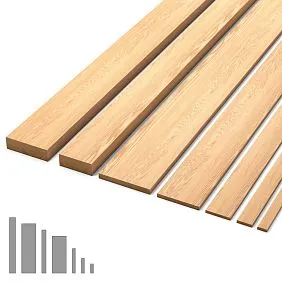
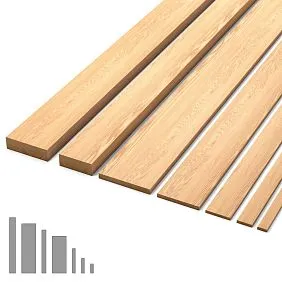

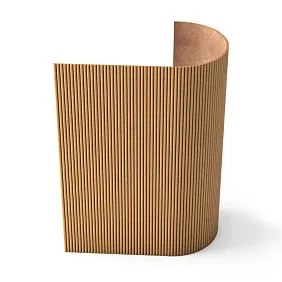
What is an MDF slatted wall panel: the material without illusions
MDF (Medium Density Fibreboard) is a medium-density fiberboard. It is produced by pressing wood fibers under high temperature and pressure with the addition of a binder. The result is a homogeneous, stable, geometrically precise material without knots, cracks, or natural defects.
An MDF slatted panel consists of MDF strips cut with precise geometric parameters, mounted on a backing (or installed individually) with a specified gap spacing. It is precisely the homogeneity of MDF that makes it an ideal material for the slatted pattern: each slat is geometrically precise, without bends or warping.
The key property of MDF slatted panels is color flexibility. The MDF surface perfectly accepts any paint coating: matte enamel, semi-matte varnish, high-gloss paint. Any RAL color, any NCS color, any shade from the Farrow & Ball catalog—MDF reproduces it accurately and evenly. It is this quality that makesMDF slatted wall panelsindispensable in monochrome, meticulously calibrated interiors where color accuracy is critical.
But MDF is not wood. There is no natural fiber pattern, no tactile warmth of solid wood, no scent of oak or pine. It's geometry and color—and in these two dimensions, MDF slats have no equal.




MDF vs. solid wood: not a competition, but a choice based on the task.
One of the most common questions when buying slatted panels: what's better—MDF or solid wood? The correct answer: it depends on the task.
| Criterion | MDF | Solid wood |
|---|---|---|
| Natural fiber pattern | Absent | Yes, unique |
| Color accuracy | Any RAL/NCS color | Limited by tinting |
| Geometric precision | Maximum | High |
| Stability at humidity | Average (not for wet areas) | Higher with proper treatment |
| Tactile | Smooth surface | Living wood texture |
| Cost | Below | Higher |
| Application | Monochromatic modern interiors | Natural, biophilic interiors |
Choose MDF if:
-
You need an exact color (white, black, gray, pastel, any shade)
-
Interior — minimalist, modern, monochromatic
-
Geometric perfection of the surface is important
-
Budget is limited
Choose solid wood if:
-
Natural wood grain and tactility are important
-
Interior — natural, Scandinavian, loft, biophilic
-
Ready to invest in higher price category material
MDF Slatted Wall Panel— is a conscious choice by a professional, not a 'compromise due to price'. Leading design studios use MDF slats precisely because for their concept — color accuracy is more important than natural grain.
Our factory also produces:


Parameters of MDF slat panels: what influences the final look
Buying MDF slat panels is not just about choosing a color. Specific numbers stand behind the final look. Changing one parameter by a few millimeters drastically alters how the surface will appear.
Get Consultation
Slat width: the rhythm that defines character
Slat width is the first number you choose. It determines the 'scale' of the slat pattern.
15–20 mm — very thin slats. The surface is perceived almost as textile: a fine, delicate rhythm. For small rooms up to 14 sq. m and low ceilings (2.3–2.5 m). On white slats — the effect of 'vertical fabric' on the wall.
25–35 mm — the standard 'medium' width. Universal for most living spaces (living room, bedroom, hallway). Expressive enough to create a slatted look, yet delicate enough not to overwhelm the space.
40–50 mm — expressive width for spacious rooms. On dark tones — monumental and strong. On light tones — architectural and clean.
55–70 mm — wide slats for high ceilings and large volumes: restaurant halls, office lobbies, double-height spaces. In residential rooms with a 2.6 m ceiling — can feel 'overwhelming' in scale.
Practical rule: ceiling height in cm ÷ 10 = maximum slat width in mm. With a 260 cm ceiling: maximum 26 mm — this is a delicate slat. With a 300 cm ceiling: up to 30 mm. With 350 cm: 35–40 mm and above.
Gap width: air between slats
Gap — the space between slats. It determines the 'density' of the surface and the degree of substrate visibility.
-
Gap 10–12 mm — narrow. The surface is dense, the substrate is almost invisible. Slats dominate.
-
Gap 15–18 mm — standard balanced. The substrate is present as a delicate accent.
-
Gap 20–25 mm — wide. The substrate is actively visible. With a dark substrate — clear dark stripes between slats create a pronounced contrast.
-
Gap equal to the slat width (30/30, 25/25) — 'openwork' rhythm. Slat and gap are equal. A feeling of lightness and airiness.
Substrate color with a wide gap is crucial. Black substrate + white MDF slats with a 20 mm gap = graphic black-and-white pattern, maximally contrasting. Gray substrate + white slats with a 15 mm gap = soft delicate rhythm. When choosing parameters — always think about the gap and substrate together.
Height of the slatted field
Full wall height (from floor to ceiling) — creates the maximum effect. Slats 'pull' the space upward, the ceiling visually rises. For residential spaces with ceilings 2.5–2.7 m — the most advantageous solution.
Two-zone solution — slats on the lower part of the wall up to a height of 90–120 cm (wainscoting), the upper part of the wall — neutral. A classic, architecturally sound approach. Requires a horizontal molding at the zone boundary.
Accent strip — a slatted field only in a specific horizontal zone of the wall (for example, behind the bed headboard from the mattress height to the ceiling). A focal point without full coverage.
Slatted 'island' — a slatted field on part of a wall without reaching the corners. Bounded by a frame of moldings — wooden orpolyurethane cornice. Picture principle.
Slat orientation
Vertical slats — a classic. Draw the eye upward, 'increase' height. For most rooms — preferable.
Horizontal slats — expand the space. For long and narrow rooms, to create a 'horizontal horizon' in a space with high ceilings. Horizontal white MDF slats in a bedroom — a calm, meditative look.
Diagonal slats — dynamism, non-standard. For accent zones and non-standard architectural solutions. Require 20–25% additional material reserve for trimming.
Color solutions for MDF slatted wall panels
Color flexibility — the main competitive advantage of MDF over solid wood. Let's consider the main color strategies.
White Monochrome: Impeccable Classic
White MDF battens (RAL 9016 or RAL 9010) on a white or light gray substrate. A minimalist look where the batten relief creates a play of shadows—the surface is 'alive' yet completely neutral in color.
This is the choice for interiors where the wall should be a backdrop, not an accent. White battens do not compete with furniture, art, or colored accents. They simply organize the space—delicately, architecturally, professionally.
Perfect for: children's rooms, small bedrooms, studies, hallways in studio apartments.
Black Maximalism: A Bold Choice
Black MDF battens (RAL 9005 or anthracite RAL 7016) on a black substrate. Full monochrome—the batten relief is visible only under sharply directed lighting. A strong, intense look.
For those who know what they're doing. A black batten wall requires boldness in other interior elements—or, conversely, complete neutrality in everything else. Black battens + light floor + white ceiling = maximum contrast, which works in large spaces.
Perfect for: a man's study, home theater, meeting room, bar area of a restaurant.
Gray Neutrality: A Universal Solution
Gray tones of MDF—NCS S 3000-N (light gray), NCS S 4500-N (medium gray), RAL 7040 (window gray), RAL 7016 (anthracite)—are the workhorse of the designer's toolkit.
Gray MDF battens don't 'shout'—they are present. They create an architectural backdrop without visual 'noise'. Gray batten wall + wooden floor + white ceiling + beige upholstered furniture = a neutral Scandinavian look in the best sense.
Perfect for: living room, bedroom, open-plan layout, office.
Color accent: when the wall speaks
Dusty pink (Farrow & Ball Mizzle or similar), sage green (Farrow & Ball Lichen), deep blue (RAL 5011), terracotta (NCS S 4040-Y50R) — colored MDF battens as an accent element.
One wall with colored MDF battens is a powerful design technique. The colored batten surface 'takes the floor' in the interior—the rest of the space should be neutral. For children's and teenagers' rooms—colored battens as an opportunity to create bright personalization without heavy investment.
Two-tone solution: battens and backing in different tones
White battens + dark gray backing — modern and graphic. Gray battens + black backing — strict and architectural. Pastel battens + white backing — delicate and soft.
The two-tone principle maximizes the 'readability' of the batten pattern. It is precisely the contrast between the batten and the gap that makes the batten surface visually active. With a single-color solution (battens = backing) — the relief is only perceived through shadows.
MDF batten panel: purchase formats
buy MDF slatted panelsare available in different formats. Understanding the difference between them is practically important for calculating your order.
slatted modular wall panelReady-made panel
A modular slatted panel is a ready-made module: slats are factory-fixed to a backing with a preset gap spacing. Backing formats are standard (typically 1200 × 2400 mm or 600 × 2400 mm). The module is mounted to the wall as a whole block.
Advantages of the modular format:
-
Precise factory gap between slats—no manual spacing with a template
-
Fast installation (less time for setup)
-
Simple quantity calculation (area ÷ module area)
-
Uniform pattern across the entire surface
Limitation: module = fixed format. Non-standard room sizes require trimming modules at the edges.
Linear slats: layout freedom
Individual slats of specified length (2400, 3000 mm) without backing. Mounted on a pre-installed frame or directly onto a flat wall. Gap is set manually—using a template.
Advantages of batten strips:
-
Flexibility in parameters (any strip width, any gap)
-
Possibility of non-standard solutions (diagonal, different heights of the batten field)
-
Easier to transport
Limitation: installation requires more time and precision.
Batten panels for painting: blanks without a finish layer
MDF battens on a backing without finish coating - primed blanks for DIY or professional painting. Choose this option if:
-
You need an exact color from a non-standard catalog
-
You want to paint the battens the same color as other interior elements (walls, furniture)
-
You plan professional painting in a spray booth for perfect uniformity
Paintable lath panels— the most flexible option for projects with custom color solutions.
MDF slatted wall panels in interior design: specific scenarios
Abstract musings about the beauty of slatted panels are nothing without concrete examples. Let's examine real design scenarios, described with visual precision.
Living room: white MDF slats behind the sofa
Living room 22 sq. m, ceiling 2.65 m, white walls, light oak parquet floor. Wall behind the sofa — vertical MDF slats 30 mm wide, 15 mm gap, color RAL 9010 (warm white). Backing — dark gray felt. Height: floor to ceiling.
Hidden cornice lighting above the slatted field: LED strip 2700 K. Dimmer — smooth adjustment from full off to maximum brightness.
Daytime: white slats on a dark gray backing — a delicate graphic pattern. The relief is discernible through thin shadows in the gaps under side daylight. Evening with cornice lighting: warm light glides down the white slats, gaps darken — the surface becomes three-dimensional.
This look works because the white slats don't 'consume' the interior's color — they add architecture without adding tone. Furniture of any color, any accents — everything reads clearly against the white slatted wall without competition.
Bedroom: gray horizontal slats behind the bed
Bedroom 16 sq. m, ceiling 2.7 m. Wall behind the bed — horizontal MDF slats, width 40 mm, gap 18 mm, color NCS S 3000-N (light gray). Backing — white. Height of the slatted field: from 1.4 m (approximately from the pillow level) to the ceiling.
Molding at the lower boundary of the slatted field:Polyurethane moldingmatching the slats.
Horizontal gray slats above the bed create a calm, almost meditative image. The horizontal line is calming—this is not accidental but a principle: horizontal lines are associated with peace, the horizon, and rest. The light gray surface is neutral, not 'oppressive.' Perfect for sleep.
Hallway: dark MDF slats as an accent for the entrance area
Hallway 5 sq. m, ceiling 2.6 m. End wall—vertical MDF slats 25 mm wide, 12 mm gap, color RAL 7016 (anthracite). Backing—black. On the slatted wall—a round mirror in a brass-colored metal frame.
What does the person entering see? A dark slatted 'background' with a mirror—a strong, memorable image. The dark slatted wall in a small hallway does not 'oppress'—it creates depth. The gaps recede into the black backing—the surface appears volumetric, receding inward.
Floorsolid wood baseboardDark walnut color completes the perimeter—a unified dark tone from the floor to the slatted field.
Study: black slats and video phone
Home study 12 sq. m. Wall behind the desk (background for video calls)—vertical MDF slats 35 mm wide, 20 mm gap, color RAL 9005 (deep black). Backing—black felt. Hidden cornice with 3000 K LED strip.
Black slats + warm cornice light = professional and authoritative background for business video calls. The interlocutor sees: a restrained, stylish, architectural space. This works as a non-verbal statement about the owner's quality and professionalism.
Restaurant: gray MDF slats in a modern cafe
A small cafe of 45 sq. m. Three walls are vertical MDF slats 40 mm wide, with a 20 mm gap, in Farrow & Ball Mole's Breath color (a warm gray-brown). The backing is dark brown. Track spotlights are angled at 35° to the walls.
Gray slats with a warm undertone on a dark brown backing create a cozy, intimate look. Not white neutrality or black severity, but a warm gray that fosters a sense of 'one's own place.' This is precisely the image that builds visitor loyalty and the desire to return.
Acoustic MDF slatted panels: function + aesthetics
acoustic slat panels— this is a separate category where MDF slats work not only aesthetically but also functionally.
An acoustic slatted panel consists of MDF slats + an acoustic backing (felt with a high sound absorption coefficient). The slats diffuse sound, the backing absorbs it—together, this reduces reverberation in the room.
Where this is important:
-
Home theater — reverberation ruins the quality of movie sound. Acoustic MDF slatted panels on the walls of a home theater are a functional and aesthetic solution at the same time.
-
Home recording studio — acoustic control is critical. Gray MDF slats on acoustic felt are a professional acoustic 'treatment' material in a minimalist design.
-
Meeting room — reverberation reduces the quality of discussions. Acoustic MDF slatted panels make conversation comfortable—every voice is heard clearly, without reflections.
-
Restaurant — a high noise level in a restaurant is one of the main reasons for not returning. Acoustic slatted panels reduce noise and create a comfortable atmosphere.
Sound absorption coefficient with acoustic felt underlay (density 1500 g/m²) — 0.6–0.8 in the 500–2000 Hz range. For rooms with problematic acoustics — the effect is noticeable from the first listening after installation.
Installation of MDF slatted panels: error-free technology
Purchasing MDF slatted panels is only the first step. Proper installation is the key to durability and aesthetic results. Let's examine professional technology.
Wall preparation
The wall must be:
-
Dry: base moisture content not exceeding 4%. Fresh plaster — minimum 4 weeks before installation.
-
Level: permissible deviation 3 mm over 2 linear meters for direct installation. For greater deviation — installation on a frame.
-
Clean: dust, oil stains, old wallpaper — everything must be removed.
Marking
Marking is the foundation of precise results. A laser level is mandatory. The first slat must be strictly vertical (or horizontal — depending on orientation). Deviation of the first slat = accumulated error across the entire surface.
For vertical installation: first slat from the corner. Check the corner — it may be 'out of square' (not exactly 90°). If the corner is crooked — step back 5–8 mm from the corner and start the slat from the laser vertical line, not from the corner.
Fastening MDF slatted panels
Attachment methods:
-
MS polymer adhesive + finishing nails: primary method for smooth walls. Adhesive is applied in a serpentine pattern to the back of the batten, the batten is pressed against the wall, finished with a nail gun.
-
Frame made of timber or metal profile: for uneven walls, when utilities need to be placed behind battens, when installing recessed lighting.
-
Clips: for modular installation. Provide the possibility of dismantling.
MDF battens when installing with adhesive: hold each batten pressed for at least 60 seconds. MS polymer sets quickly but requires 24 hours for full curing. Do not create load on the surface during the first day.
Gap template
The only tool guaranteeing equal gap across the entire surface is a physical template. A plastic or metal spacer of the required thickness is inserted between each pair of battens during installation. No 'by eye' — only template.
Perimeter Completion
After installing all battens — cornice along the top edge.a polyurethane cornice40–60 mm wide covers the top end of the battens and creates a clean transition to the ceiling. For light cornices — cornice with a groove for LED strip.
Solid wood floor skirting boardin the tone of the battens — bottom finishing. Choose a skirting board that fits flush to the bottom end of the battens without a gap.
With a two-zone solution:Polyurethane moldingalong the horizontal border between the slatted field and the upper wall zone.
Detailed installation technology is in thestep-by-step guide for installing slatted panels.
What else can be done with MDF slats: unconventional applications
slatted panels for wall finishing— this is not the only use for MDF slats. Let's consider unconventional formats.
Slatted facade of a built-in wardrobe
MDF slats on the facade of a built-in wardrobe — a decorative technique where the wardrobe 'merges' with the wall. The slats on the wardrobe doors are identical to those on the wall — the wardrobe disappears, and the wall looks like a unified slatted field. Functionality is preserved, and the visual 'noise' of the furniture is eliminated.
Wooden furniture handleson the slatted wardrobe facade — vertical slat handles matching the panels. A minimalist solution where the handle is indistinguishable from the decor.
MDF slatted partition
MDF battens in the partition between zones are not just a wooden option. White MDF battens in a kitchen-living room partition create a clean, modern look of 'airy' zone demarcation.
Unlike a wooden partition, MDF is easier to fit to non-standard sizes, simpler to process and install.
Ceiling MDF batten panels
MDF battens on the ceiling follow the same principle as on walls, but with additional technical requirements (horizontal installation, increased demands on fastener rigidity). White MDF batten ceiling + white walls = an absolute minimalist 'cocoon'. More details inthe complete guide to DIY batten panels.
Calculating the quantity when purchasing MDF batten panels
Accurate calculation means money in your pocket. Under-ordering creates the problem of finding additional material with an identical tone. Over-ordering means unnecessary expenses. How to calculate correctly.
For linear battens:
-
Measure the width of the batten field (wall width minus corner profiles)
-
Divide the width by (batten width + gap) to get the number of battens
-
Multiply by the height of the slatted field = total linear footage
-
Add 15% reserve (straight walls) or 20% (corner solutions, diagonal)
For modular panels:
-
Area of the slatted field (sq. m)
-
Divide by the area of one module
-
Round up to the nearest whole number
-
Add 1 module as reserve
For two- or three-color solutions — calculate slats and underlay separately.
Frequently asked questions
How are MDF slats better than wooden slatted panels?
Better — is not the right word. MDF slats — are different. Advantages of MDF: color accuracy (any RAL/NCS), geometric uniformity, lower cost. Advantages of solid wood: natural grain, tactile feel, wood scent, durability. Choice — based on the task and aesthetics.
Can MDF battens be painted after purchase?
Yes. Primed MDF battens without a finish coat are an optimal blank for DIY or professional painting. The surface of MDF after painting with acrylic or alkyd matte paint is even and pore-free.
Are MDF slatted wall panels suitable for the bathroom?
Standard MDF — no. For the bathroom, you need moisture-resistant MDF (V-MDF) with increased resistance to moisture. But even moisture-resistant MDF is not recommended for direct contact with water — only for areas with high humidity (without direct splashes).
How often should the coating of MDF slatted panels be renewed?
With a high-quality factory coating (alkyd or polyurethane paint) — renewal is not required for years. With DIY painting using acrylic paint — 5–7 years of active use without visible changes.
Can MDF battens be mounted on drywall?
Yes. Drywall is a good base for MDF battens. Use MS-polymer adhesive + finishing nails into the profile behind the drywall. Important: weight per linear meter of batten × number of battens = load on the drywall base. For heavy and tall slatted fields — mount with anchors going into the load-bearing profile, not just into the drywall.
What does 'MDF slatted panel on a backing' mean?
The battens are already fixed to a backing (MDF or plywood) under factory conditions with a set gap. Mounted as a whole module — as one element. Unlike linear battens, which are mounted individually.
Can MDF slatted panels be painted in two colors (slats and backing in different tones)?
Yes. This is a popular technique. The technology: first, the backing is painted in the desired tone, after drying — the slats are mounted and painted separately. Or: slats and backing are painted before assembly — each element in its own tone.
Conclusion
MDF slatted wall panels are not just a cladding material. They are a tool for creating an image: clear, color-accurate, geometrically flawless. In the right hands and with the correct choice of parameters —MDF Slatted Wall Panelcreates interiors at the level of a professional bureau.
To buy MDF slatted wall panels means choosing not just a product, but an architectural solution. With properly selected color, parameters, finishing elements:polyurethane cornices and moldings, solid wood baseboardmatching the tone andwooden furniture handles— this is a system that creates a complete, professional space.
The full range of slatted panels, finishing systems, and decorative interior elements — in the STAVROS company catalog.
STAVROS — production of decorative interior solutions with impeccable quality. Slatted panels made of solid oak, ash, birch, and pine, MDF slats for painting and with a finish coating,acoustic slat panels, modular wall systemsCornices, moldings, baseboards, and furniture elements made from solid wood — everything to make your slatted wall look exactly as you imagine: precise, beautiful, professional.


