Article Contents:
- Why slatted wall panels are specifically suitable for interior finishing
- How interior wall finishing with slatted panels differs from other solutions
- Which materials are better for interior finishing: MDF or oak
- MDF slatted wall panels for interior finishing
- Oak slatted wall panels
- Which constructions to choose for interior walls
- Rigid slatted panels on MDF backing
- Flexible slatted panels on fabric backing
- Panels made of half-round battens
- Where slatted wall panels work best inside a room
- Slatted wall panels for the living room
- Slatted wall panels for the bedroom
- Slatted wall panels for the hallway and corridor
- Slatted wall panels for the TV zone
- Slatted wall panels for the study
- Slatted wall panels for offices, restaurants, and showrooms
- What slatted panels provide inside a room besides decoration
- How profile, spacing, and direction change the interior space
- Profile
- Slat spacing
- Installation direction
- For painting or in natural finish
- How to choose slatted panels for interior finishing for a specific task
- What you need to know about installation before choosing a panel
- Mistakes when choosing slatted wall panels for interior finishing
- Where to buy slatted wall panels for interior finishing
- About the Company STAVROS
- FAQ: answers to popular questions about slatted wall panels for interior finishing

A wall is not just a boundary between a room and the outside. Inside a room, it becomes an architectural tool: it shapes proportions, controls light, creates rhythm, and defines the emotional tone of the space. That is precisely whyslatted wall panels for interior finishinghave long moved beyond a decorative technique — they are a full-fledged architectural system that works from within, in a living space, under real lighting, surrounded by furniture, people, and everyday life.
But before moving on to the selection, it's worth honestly answering the question: why slats specifically? How are slatted panels for interior wall finishing better than a smooth painted surface, decorative plaster, or simple cladding? And which material suits your interior best — paintable MDF or solid oak? Rigid panel or flexible? Rectangular profile or half-round?
This article is a comprehensive guide to choosing slatted wall panels for interior wall applications. From understanding the construction to specific room-by-room scenarios. From the most common mistakes to the exact address where to buy everything.


Why slatted wall panels are specifically suitable for interior finishing
Inside a room, a wall functions completely differently than outside. There are no direct atmospheric loads here—rain, frost, ultraviolet light. However, there is something more subtle and demanding: the gaze. A person inside a room sees the wall from a distance of 50 centimeters to 6 meters—and all this time the surface must be interesting, proportionate, and architecturally justified.
A flat wall is the zero level. A smooth surface without relief. It can be painted, wallpapered, or plastered with texture. All of this works. But all of these are two-dimensional solutions: they add color or texture but do not create physical depth.
A slatted panel on a wall is the third dimension. The relief of the slats forms a real shadow that exists in space, not printed on the surface. With side lighting, each slat casts a shadow into the gap—and the wall 'breathes.' This is a living, changing surface: in the morning under soft diffused light, it looks one way; in the evening under directional lighting, it looks completely different.
It is precisely for this three-dimensional architectural work that slatted wall panels are chosen for interior finishing. Not for 'beauty in photos,' but for real presence in space.
Four reasons why slats work better indoors than alternatives:
-
Managing the perception of proportions. Vertical slats literally add height—the gaze moves upward. Horizontal slats expand the room. This is not an illusion: it's the physiology of perception, which professional designers use as a working tool.
-
Rhythm as an organizing principle. The uniform alternation of slat and gap creates rhythm—an ordered structure that psychologically 'calms' the space and makes it cohesive.
-
Integration with lighting. A slatted surface and built-in lighting are a complementary pair: light reveals the relief, relief organizes the light. Such synergy is impossible to achieve with a flat wall.
-
Acoustic effect. A relief surface scatters sound waves—reduces reverberation, decreases echo. In rooms with hard floors and high ceilings, this is a tangible improvement in comfort.




How interior wall finishing with slatted panels differs from other solutions
This question deserves an honest, direct comparison—without marketing hype.
Wall painting is the simplest and most affordable solution. A smooth surface + any color from the RAL or NCS catalog. Minus: no relief, no physical depth, no accent. A flat painted wall is a neutral background, nothing more.
Decorative plaster is a textured surface that creates visual interest. But plaster texture is organic, chaotic—it creates a natural image, not an architectural one. Slats provide geometric order, which plaster does not offer.
Smooth wall panels (PVC, MDF without relief) are monolithic cladding. Plus: fast, even, technical. Minus: no rhythm, no chiaroscuro, no three-dimensionality. This is a closed surface, not a living one.
Piece-by-piece slat installation can create a similar effect, but with incomparably greater labor intensity. Each slat must be leveled, the gap maintained, and parallelism controlled. On a large wall, errors accumulate. A ready-made modular panel provides factory precision in spacing without manually aligning each element.
A slatted wall panel in a ready-made module is a systemic solution: the slats are already fixed to a backing with precise spacing, the modules join without pattern misalignment, and installation is significantly faster. The result is predictable, repeatable, and looks like professional finishing.
Exactly thereforeinterior wall finishing with slatted panelsin a ready-made modular format is not just aesthetics, but an engineering-justified choice for those who want to achieve a precise and stable result.
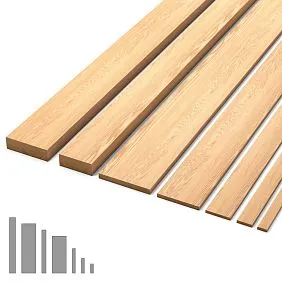
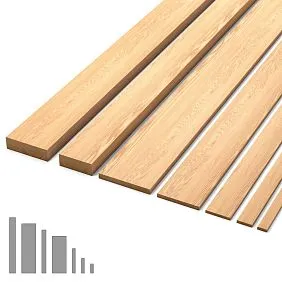
Our factory also produces:
Which materials are better for interior finishing: MDF or oak
This is a key selection question. And it has no universal answer—only the correct answer relative to a specific task.
Get Consultation
MDF slatted wall panels for interior finishing
MDF is a pressed material with a homogeneous structure, density of 750–850 kg/m³. Without natural defects, without pattern variation, with a perfectly smooth milled surface. It is precisely this homogeneity that makes MDF an ideal carrier for painting.
MDF slatted wall panels are the correct choice when:
-
A precise RAL or NCS color is needed. Paint from the catalog adheres to MDF without tone deviations—this is important for project work when the color is agreed upon in advance.
-
A monochrome look is needed. A panel matching the wall color: the relief is read only through shadow, with no color break. This technique works exclusively with paintable MDF.
-
Geometric stability is important. MDF does not have natural stresses that can lead to warping.
-
Flexibility in color solution is needed. Repainting without dismantling—at any time, when the interior changes.
-
Style is minimalism, neoclassical, contemporary, modern classic.
BuyWhite slatted wall panelsMDF slatted panels are one of the most in-demand requests: this is a basic solution for neoclassical and light interiors, where the panel creates relief without a color accent. RAL slatted panels in corporate colors are the standard for office spaces with brand identity.
Oak slatted wall panels
Solid oak is a living natural material with a density of 700–750 kg/m³, its own grain pattern, and a tactility that cannot be reproduced by any synthetic analogue. Each slat is unique: the grain pattern never repeats.
Oak slatted wall panels are the right choice when:
-
You need a natural texture — live grain under oil or varnish.
-
Tactility is important. The open pore of oiled oak provides a physical sensation of naturalness.
-
You need a premium visual image without monochrome, achieved through the material.
-
The interior is built on natural materials: stone, linen, leather, raw metal.
-
Style — Scandinavian, Japandi, loft, organic minimalism, eco.
-
You need durability and repairability: oak panels can be sanded and refreshed without dismantling.
Wooden oak slatted wall panels for tinting — in Scandinavian gray, honey, dark tobacco, or natural golden — provide a fundamentally different visual language compared to MDF. Here, the accuracy of the color is not as important as the liveliness of the material.
The key difference between MDF and oak: MDF is about color and geometry. Oak is about texture and tactility. Both are correct. Confusing them means getting something you don't need.
Which structures to choose for interior walls
The structure determines the physical possibility of installation. This is not an aesthetic parameter — it is a technical question of compatibility with the geometry of your wall.
Rigid Slat Panels on MDF Backing
Standard structure for straight, even surfaces. The slats are fixed to a rigid MDF backing with precise factory spacing. The module is installed on the wall as a single unit — quickly and accurately.
Rigid slatted wall panels are suitable for: main walls in living rooms, bedrooms, studies, hallways; TV zones; ceiling areas with frame mounting; furniture fronts; wardrobe systems; office partitions. This is the most common and technologically simple solution.
What's important to understand: a rigid structure does not bend. A radius wall, column, or arch is a physically different structure.
Flexible Slat Panels on Fabric Backing
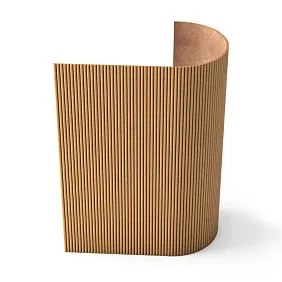
The slats are fixed to a fabric base with a gap sufficient for bending without deforming the pattern. The panel wraps around any radius: a column, arched opening, rounded corner, curved furniture front — the pattern of the slats continues through the bend continuously, without breaks or deformations.
Flexible slatted panels on a fabric base are the only correct solution forslatted panels for radius surfacesand rounded corners. Using rigid modules on a radius is a mistake that leads to deformation, open gaps, and loss of slat geometry.
Where it's especially valuable: hotel lobbies with columns, restaurant halls with arched spans, office receptions with rounded counters, apartments with non-standard layout solutions.
Panels made of half-round molding strips
Profile as a structural choice. A rounded molding creates a fundamentally different play of light: soft, smooth, without sharp shadows. This is not rigid graphics, but delicate surface plasticity.
Panels made of semi-circular moldings for interior finishing — a choice for rooms with a warm, homely character: bedroom, home library, children's room, living room with a cozy atmosphere. In commercial spaces — for restaurants and hotels with a natural stylistic language.
Where slatted wall panels work best indoors
Slatted wall panels for the living room
The living room is the main architectural space of a house or apartment. Here, the accent wall behind the sofa or the TV zone is the conceptual center of the entire interior. Slatted panels for an accent wall in the living room work to their full potential: relief, play of light and shadow, integration with LED lighting — all create an image perceived as expensive and well-thought-out.
For a living room with an open layoutslatted panels for zoningThey allow you to mark the boundary between the relaxation area and the dining room or kitchen — without a partition, only through a change in finish. This is architectural zoning without losing light and openness.
A rectangular or trapezoidal profile in dark MDF (anthracite, graphite) or natural oak — two poles of the living room. The first is strict and graphic. The second is warm and organic.
Slatted wall panels for the bedroom
The bedroom is a space of silence. Here, slatted panels for interior walls work on the principle of 'the more delicate, the better.' A semi-circular profile, a neutral warm tone, a moderate slat spacing. The wall behind the bed headboard is the main object of the bedroom: it determines whether the room will feel like a place of restoration or an exhibition hall.
A hidden LED strip along the top perimeter of the panel in the bedroom — a simple technique that creates a 'hotel effect': a soft halo of light behind the slats visually separates the wall from the ceiling and gives the space depth.
Slatted wall panels for the hallway and corridor
The hallway is the first and last point of impression. Vertical slats on the end wall of the hallway immediately change it: the space stretches, acquires direction and character. For a narrow, long corridor — slatted wall panels for the corridor in a horizontal orientation on the end wall stop the perspective, making the space more proportionate.
A practical argument: the lower part of the wall with slatted cladding (height 100–120 cm) is significantly more resistant to mechanical impact from bags, umbrellas, and accidental touches than a painted surface.
Slatted wall panels for the TV zone
The TV zone is a specific task. Dark MDF in anthracite or matte black is the best background for the screen: it removes the feeling of a 'glued-on TV' and makes the screen part of the architectural solution. Slatted wall panels for the TV zone with integrated niches for equipment and acoustics — a functional and aesthetic solution simultaneously.
Slatted wall panels for the study
The study requires concentration and status. The wall behind the desk made of dark oak (wenge, tobacco) with a rectangular profile — a strict, collected image. The textured surface diffuses sound — this is especially important for a study with video calls: less echo, better call quality.
Slatted wall panels for offices, restaurants, and showrooms
Commercial spaces are a different level of requirements. Here, slatted wall panels for interior finishing solve three tasks simultaneously: the visual image of the brand, acoustic comfort, and durability.
Slatted wall panels for the office in neutral MDF matching the corporate RAL color — this is branding the space through architecture, not through stickers and prints.
Slatted wall panels for the restaurant made of natural oak under warm light — create an atmosphere that cannot be achieved with synthetic materials. The guest feels naturalness and warmth even before tasting the food.
Slatted wall panels for the showroom — this is an 'expensive' neutral background that favorably showcases any product: furniture, clothing, jewelry, equipment. Neutral MDF panels or natural oak create context without competing with the merchandise.
What do slatted panels provide inside a room besides decoration
This is a question rarely asked out loud but always implied. Okay. We answer directly.
Accent architectural surface. A slatted panel creates a semantic center in the room: the gaze fixes on the living textured surface, the space gains focus. Without an accent surface, most interiors look unfinished.
Zoning without walls. A slatted surface as a boundary between functional zones — this is architecture without physical partitions. Light passes through, the space remains open, but the division is clearly readable.
Slatted panels for concealing wall irregularities. Frame mounting of the panel evens out the visual plane regardless of the condition of the base. Old walls with a curvature of 10–15 mm are covered with a panel on a frame — and the finish surface is perfectly smooth.
Slatted panels for masking utilities. The gap between the frame and the wall is a ready-made technical channel for electrical wiring, internet cables, and climate system pipelines. No chasing, no patches — everything is hidden behind the textured surface.
Slatted panels with lighting. A hidden LED strip in the gaps between the slats or behind the top perimeter of the panel — this is an additional layer of lighting without visible fixtures. In the evening, a slatted wall with lighting and a slatted wall without it — these are two completely different spaces.
Slatted panels for interior acoustics. The textured surface diffuses sound waves. In rooms with concrete walls, wooden floors, and glass facades, reverberation is a serious problem. Slatted panels on several walls significantly reduce echo and improve acoustic comfort. This is especially important for meeting rooms, home theaters, and studios.
Managing the perception of space. A dense rhythm of slats makes the wall visually rich — suitable for accent zones in large rooms. A sparse spacing — a calm, airy surface for small and cozy spaces. This is a direct tool for correcting the perception of a room's scale.
How profile, spacing, and direction change the interior space
Three parameters that determine exactly how your wall will look — and feel — under real lighting in a real room.
Profile
Rectangular bead — clear edges, sharp shadows in the gaps. With side lighting, the wall acquires a strict graphic pattern. This is a profile for architectural precision: minimalism, neoclassicism, modern classic, office spaces. Disciplined, restrained character.
Semi-circular molding — soft, smooth shadows. Light glides over the convexity of the slat without sharp edges. The surface appears warmer, more delicate, more plastic. The right choice for residential spaces with a homely character. In natural oak, the semi-circular profile is one of the warmest and most natural interior looks.
Trapezoidal molding — an intermediate option. More expressive relief than the semi-circle, but without the sharp graphics of a rectangle. Works well in lofts, modern restaurants, active commercial spaces.
Slat spacing
Spacing is the distance from the center of one slat to the center of the next. The smaller the spacing (thin slats, small gap), the denser and richer the pattern. The larger the spacing, the more airy and monumental the surface.
For small residential spaces (up to 15 sq.m.): thin slats, moderate spacing — the surface is delicate, not overloaded. For large halls, lobbies, open spaces: wide spacing, large slats — monumental and convincing.
Installation direction
| Direction | Visual effect | Where it's appropriate |
|---|---|---|
| Vertical | Look upward, space appears taller | Low ceilings, small living rooms, hallways |
| Horizontal | Look sideways, space appears wider | Narrow corridors, end walls |
| Diagonal | Dynamics and tension | Commercial accents, lobbies, showrooms |
Vertical slatted wall panels are the most popular format for interior finishing. They literally 'add height' to rooms with ceilings of 2.4–2.6 m — an effect critically important for standard apartments.
For painting or with a natural finish
This choice complements the main one — MDF or oak — and sets the final character of the surface.
MDF for painting is the most flexible scenario. Slatted panels for painting for interior finishing are supplied primed or with a base coat. You paint them on-site in the desired shade or order pre-painted panels from the factory in an exact RAL or NCS color.
NCS slatted panels are the standard for interior projects with a professional color system: the designer coordinates the palette via the NCS catalog, the manufacturer paints to the exact code. No deviations.
Pre-painted slatted panels in finished form are a convenient choice for large orders: all modules are from the same batch, same shade, with no risk of mismatch.
Natural oak — here the logic is different. Oak panels with tinting for interior design: Scandinavian gray, warm honey, dark wenge, light bleached — each shade preserves the visible grain. This is not paint, but tinting: color is present, but the natural texture remains.
How not to make a mistake with color: always view samples in the actual lighting conditions of your space. A warm yellow lamp makes cool gray oak appear warm. Cold daylight makes warm honey oak appear neutral. A monitor cannot convey this — only a physical sample.
How to choose slatted panels for interior finishing for a specific task
A simple decision matrix:
Need minimalism with precise color → MDF for painting in RAL/NCS. Rectangular profile. Monochrome.
Need warm natural texture → Oak with oil or tinting. Semi-circular or rectangular profile. Vertical.
Straight, even walls → Rigid panel on MDF backing. Quick installation, precise geometry.
Columns, arches, radius corners → Flexible fabric-backed slatted wall panels. Only they ensure a continuous pattern across the bend.
Need a soft, delicate surface → Panels made of half-round beading. Bedroom, nursery, cozy living room.
Need a strict, graphic look → Rectangular profile. MDF in a dark tone or lacquered oak.
Small room (up to 12 sq.m.) → Thin slats, moderate spacing. Do not overload the space with a large rhythm.
Large hall, lobby, commercial space → Wider slats, expressive spacing. The scale of the relief corresponds to the scale of the room.
What you need to know about installation before choosing a panel
Installation affects the choice of construction — and this needs to be understood before ordering, not after receiving the product.
Flat wall (deviation up to 3–5 mm) — installation with adhesive or finish nails directly. The rigid panel fits tightly to the base, holds securely. The fastest and most economical option.
Curved wall (deviation 5–15 mm or more) — a frame is needed. Metal or wooden lathing is leveled. Panels are mounted on guides. The gap between the frame and the wall is a technical channel for utilities.
When irregularities are better solved with a modular system. Slatted panels for concealing wall irregularities — this is not a marketing ploy. A rigid module on a frame creates a flat plane over any curvature. Plastering to a perfect state is not necessary.
Flexible panels — only adhesive according to the surface shape. A frame is not used on radii: the flexible module must tightly wrap around the base.
Hidden fasteners — clips or clamps. The fasteners are not visible on the final surface. Suitable where the surface will not be repainted. When installing with finish nails — small points that are covered with putty and repainting.
Ceiling installation — only a frame with load calculation. Oak panels are heavier than MDF — this must be considered when choosing load-bearing elements and fasteners.
Mistakes when choosing slatted wall panels for interior finishing
These mistakes are solved at the selection stage. After installation — only a complete redo.
First mistake: choosing based on a photo without understanding the material. A photo on a monitor is not the material. Oak grain is variable: different boards differ in tone and fiber character. MDF in the same RAL looks different under different lighting. A sample is mandatory.
Second mistake: too active relief in a small room. Large slats with wide spacing in a 10–12 sq.m. room overwhelm the space. A thin profile, moderate gap — the correct proportion for small rooms.
Third mistake: oak in an already overloaded wooden interior. Oak on the wall + oak floor + oak doors without a single tonal logic — visual chaos. Either all wooden elements are coordinated by species and tone, or the wall should be neutral MDF.
Fourth mistake: wrong profile. Rectangular beading in a nursery — a sharp pattern where softness is needed. Half-round in a meeting room — too cozy for a business context.
Fifth mistake: rigid panel on a radius. A rigid module on a column or arch deforms, slats separate, geometry is disrupted. Only flexible fabric-backed panels.
Sixth mistake: ignoring lighting. A slatted panel without proper lighting — half the loss of meaning. Relief only lives in directed or side light. Lighting must be planned simultaneously with choosing the panel.
Seventh mistake: unrelated color. MDF in a random shade that does not relate to the walls, floor, or furniture — creates a visual break. The panel color is chosen in the context of the entire room's color scheme.
Where to buy slatted wall panels for interior finishing
The choice is made — all that's left is to proceed to purchase.slatted panels for walls in the STAVROS catalog cover the entire range of solutions for interior finishing.
In the assortment:
-
MDF for painting — for precise color by RAL/NCS, monochrome interiors, modern styles.
-
Solid oak — for live natural texture, tactility, and long-term quality.
-
Rigid panels on MDF backing — for all straight walls: residential and commercial spaces, ceilings, furniture fronts.
-
Flexible panels on fabric backing — for columns, arches, radius corners, non-standard geometry.
-
Panels made of half-round battens — for soft, delicate relief in living spaces.
In addition to slatted panels, the STAVROS catalog featuresSolid wood molding— skirting boards, moldings, and cornices for a unified interior finishing system. Slatted panels + trim in one material and tone — this is a complete interior, not a set of random elements.
Solutions are suitable for residential interiors (apartments, houses, apartments) and commercial facilities (offices, restaurants, hotels, showrooms, meeting rooms). Delivery — throughout Russia.
About the company STAVROS
Behind every good interior solution stands a manufacturer with real production culture. This is not a poetic exaggeration — it is a practical condition for quality finishing.
STAVROS is a Russian manufacturer of MDF and solid wood products for interior finishing. The company produces slatted wall panels, wooden trim, cornices, moldings, and skirting boards — a full range for a unified interior finishing system. Not disparate products from different suppliers, but a coordinated system in a single material language.
The STAVROS standard — profile precision, pitch control, quality of end and backing processing, honest description of material properties. Rigid and flexible constructions, paintable MDF and solid oak, standard and custom formats — all are presented in the catalog and backed by real production.
It is precisely this approach that makes the difference between a wall that looks good on the day of installation and a wall that continues to look right after five years.
FAQ: answers to popular questions about slatted wall panels for interior finishing
Can slatted wall panels be used in the bathroom?
Standard MDF — no: regular moisture destroys it. For bathroom areas with minimal water contact — only moisture-resistant HMR-MDF. Oak in the bathroom — only in dry zones with moisture-resistant varnish.
How long will MDF slatted wall panels last?
With careful use and periodic repainting — 10–15 years or more. MDF is not afraid of normal household loads; problems arise only with systematic exposure to moisture.
Is special equipment needed for installation?
No. On a flat wall — mounting adhesive and finishing nails (pneumatic nailer or hammer). For frame mounting — screwdriver, hammer drill, level. This is standard construction tooling.
Are slatted panels suitable for the ceiling?
Yes — with frame mounting and load calculation. Oak panels are heavier than MDF: this must be taken into account when designing the load-bearing system.
How to choose the slat pitch for a specific room?
Guideline: slat width 20–40 mm + gap 15–25 mm for rooms up to 15 sq.m. For larger halls — slat width 40–60 mm + gap 25–40 mm. Look at samples at real scale: on a small sample, a large pitch looks different than on a large wall.
Can panels of non-standard size be ordered?
Clarify when ordering. Non-standard sizes are possible with custom production, which affects cost and manufacturing time.
What is better: pre-painted panels or paintable ones?
Pre-painted — convenient for large volumes: all modules from one batch, uniform tone. Paintable — when the exact color is coordinated on-site or when future finishing updates are planned.