Article Contents:
- Why slatted panels became an architectural, not just decorative solution
- How slatted wall panels change the perception of interior space
- Vertical: space stretches upward
- Horizontal: space expands
- Dense rhythm and sparse rhythm
- Chiaroscuro as a tool for volume
- Slatted panels not in a vacuum: how they combine with other interior finishing elements
- Panels and baseboard: a unified line or intentional break
- Panels and moldings: contrast or support
- Panels and hidden doors: seamless geometry
- Panels and furniture fronts: material rhyme
- Panels and partitions: zoning without walls
- Panels and architectural lighting
- When slatted wall panels are truly appropriate in interior finishing
- What tasks do slatted panels solve besides decoration
- Material as part of the overall interior concept: MDF or oak
- When MDF enhances the interior
- When oak gives more than MDF
- How profile, pitch, and module define the character of a wall
- How to use slatted wall panels in different types of interior spaces
- Living room: architectural centerpiece
- Bedroom: soft relief and depth
- Entryway: first impression and visual discipline
- Study: status and concentration
- Office and meeting room: brand image and acoustic comfort
- Showroom and boutique: material as manifesto
- Rigid and flexible panels in interior finishing: how space dictates construction
- What ruins an interior even with good panels
- How to integrate slatted wall panels into a cohesive interior finish
- Where to look for interior finishing solutions
- About the Company STAVROS
- FAQ: Answers to Popular Questions

There is a question worth asking yourself before you start choosing materials, looking at colors, and calculating square meters. The question is simple: do you want to cover a wall — or create a space?
Becauseslatted wall panels for interior finishing— it's not cladding. It's not a background. It's not about 'making it look nice.' It's an architectural tool that works from within the room: it manages light, sets rhythm, creates depth, and transforms a flat wall into a three-dimensional architectural plane with character.
That's why thinking about slatted panels in isolation — detached from lighting, furniture, baseboards, room proportions, and the overall material language of the interior — means settling for half the result from the start. Or even ruining what could have turned out well. This article is about how slatted wall panels fit into interior architecture: not as a trendy element, but as a systemic part of a holistic space.


Why slatted panels have become an architectural, not just a decorative, solution
About twenty years ago, a wall panel was an answer to a specific technical question: how to cover an unsightly wall quickly and cheaply. Decorative PVC, laminate on the wall, MDF with photo printing — all these were tools of concealment, not form-making. The wall simply disappeared behind the cladding.
A slatted surface works differently. It doesn't hide the wall — it transforms it. Parallel slats with equal spacing create a linear geometric structure that comes alive with side or directional lighting: each slat casts a shadow into the gap, the surface gains depth, volume, sculptural quality. This is no longer 'cladding' — it's an architectural plane with its own character.
It is precisely this shift — from concealment to form-making — that turned slatted panels from a decorative solution into an architectural tool. The modern interior relies less and less on random decorative accents and more and more on systemic geometry: the rhythm of surfaces, material coherence, the integrity of the architectural language. In this context, the slatted structure is not an ornament, but an organizing principle.
Slatted wall panels for interior finishing have firmly entered the language of modern design since 2020–2021 and have maintained their position to this day — not because it's a 'trend,' but because they solve real spatial problems. Visual expansion. Vertical dynamics. Accentuation. Zoning. Partial acoustic effect. Integration with lighting. These are tools that don't become outdated with trends.




How slatted wall panels change the perception of interior space
This is perhaps the most underestimated aspect of choosing slatted finishing. Most people think about color and material. Few think about how exactly oriented slats physically change the feeling of a room. And in vain.
Our factory also produces:
Vertical: space stretches upward
Vertical slats — the most common orientation and the strongest spatial technique. The eye, sliding along vertical lines, instinctively moves from floor to ceiling. The room seems taller. For apartments with standard ceiling heights of 2.5–2.7 m, this effect is critically important: properly chosenslatted panels for interior wall finishingliterally 'lift' the ceiling without a single construction tool.
Get Consultation
Horizontal: space expands
Horizontal slats — the opposite effect. The eye moves left and right, the space seems wider. This is a technique for narrow corridors, elongated bedrooms with an accent wall at the end, small living rooms where you need to add a sense of air and horizontal freedom.
Dense rhythm and sparse rhythm
The spacing between slats is the level of 'tension' of the surface. Thin slats with a small gap create a dense, rich, graphically active pattern: the wall 'works,' attracts the eye, holds attention. Wide slats with a large gap — a calm, monumental surface with air between the battens.
The rule of scale: a dense rhythm is appropriate on large areas where it has 'room to unfold.' In a small room, a dense rhythm presses on the space, creates excessive tension. For a room up to 12–15 sq.m. — moderate spacing, delicate profile.
Chiaroscuro as a tool of volume
This is where a slatted surface has no equal. Neither paint, nor plaster, nor a smooth panel gives what relief gives with proper lighting. Side directional light — and each slat gains a shadow side. The surface 'breathes.' It's a living, changing geometry: in the morning with diffused light the wall is calm, in the evening with directional fixtures — sculptural.
That's why lighting andslatted wall panels in the interiorneed to be planned simultaneously — otherwise you lose half the effect. Hidden LED strip behind the top perimeter of the panel, directional spotlights with a side angle, built-in lights in niches — each of these techniques reveals the slatted relief in its own way.
Slatted panels not in a vacuum: how they combine with other interior finishing elements
This is where the difference lies between 'installed panels' and 'created an interior.' A slatted surface on a wall is one variable in the equation. The result depends on how it relates to everything else.
Panels and baseboard: a unified line or an intentional break
Baseboard — the boundary between wall and floor. This is precisely where the material language of the space begins or collapses. Oak slatted panel + oak baseboard with a coordinated profile = a unified system where the wall and floor speak the same language.
Wrong scenario: oak slatted panel + white plastic skirting board. This is not a 'neutral solution' — it's an architectural break that destroys the integrity of the surface.
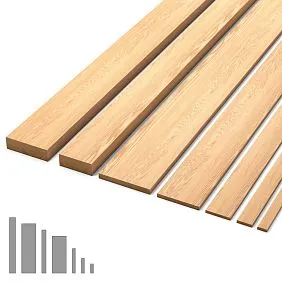
In the STAVROS catalog, in the section wooden trim wooden baguettes, moldings, and skirting boards are presented — made from the same species (oak, beech) as the slatted panels. This is a direct opportunity to create a unified material language: slats on the wall + skirting board at the bottom + molding at the top — all in one species, one tone, one production standard.
Panels and moldings: contrast or support
The molding above the slatted panel is a 'cap' that completes the solution. Without it, the slatted surface visually 'breaks off' into a smooth wall without a transition. With a correctly chosen molding — it's a finished architectural system with a starting point, middle, and completion.
Wooden Mouldings made from solid oak or beech above the slatted panel is not just about aesthetics. It's a functional element that masks the upper end of the panel and sets a horizontal boundary for the relief surface. In a neoclassical interior, the molding above the panel looks like part of an architectural order. In minimalism — like an intentional clean transition line.
Panels and hidden doors: seamless geometry
One of the strongest architectural techniques with slatted panels is integrating hidden doors into a slatted wall. A door covered with a slatted panel matching the main panel's tone completely disappears into the wall. The gap between the door and the wall is masked by continuing the slatted pattern. The room acquires a solid, monolithic appearance without visual interruption.
This solution requires precise production calculation — the pattern of slats on the door must continue the wall pattern without shifting the step. Therefore, ordering slatted panels for the wall and slatted panels for hidden doors must be done simultaneously, from the same batch.
Panels and furniture fronts: material rhyme
Slatted texture on the wall + slatted fronts of cabinets or wardrobes = a material rhyme that unites the wall and furniture into a single architectural system. This is not 'too many slats' — it's when the material language is consistent and recognizable.
Condition for success: the slats on the wall and the slats on the furniture must be coordinated in profile, step, and tone. If the wall has a rectangular batten with a 40 mm step, a semicircular batten with a 60 mm step should not appear on the furniture. Two different patterns side by side are architectural noise.
Panels and partitions: zoning without walls
A slatted partition is a separate architectural tool. But when a slatted partition continues the pattern of a slatted wall — that's a different level. The space is divided into zones but connected by a unified rhythm of the slatted surface. Light passes through the gaps, visual connection between zones is preserved, and the feeling of openness is not lost.
Slatted panels for zoning in open-plan living rooms are one of the most in-demand scenarios. Kitchen and dining area, living room and work zone, children's corner in a common space — a slatted plane marks a boundary without a solid wall.
Panels and architectural lighting
Integrating lighting into a slatted system is not an additional bonus, but part of the architectural concept. Hidden LED strips around the panel's perimeter (top and bottom) provide a soft, diffused halo. Recessed spotlights in the gaps between slats create directed accent lighting. Bottom lighting turns the lower part of the slatted wall into a source of soft 'floating' glow.
Slatted panels with lighting are not just spectacular. They are functional: correctly positioned lighting solves the task of illuminating an area without visible fixtures on the ceiling.
When slatted wall panels are truly appropriate in interior finishing
This is a question not so much of taste as of architectural logic. A slatted surface is not justified everywhere and always.
When an accent surface is needed. A room without an accent is a visually flat, 'untidy' space without a visual anchor. A slatted wall behind a sofa, behind a desk, behind a bed headboard creates this accent — substantial, architectural, without unnecessary decorations.
When a room is too 'empty' and characterless. Four white walls, a flat ceiling, laminate flooring. Everything is correct, but bland. One slatted plane radically changes the situation: rhythm, depth, and character appear.
When zones need to be divided without losing light. A slatted plane allows diffused light to pass through the gaps. It's a boundary that is visible but doesn't create solid isolation. Perfect for open-plan layouts.
When the interior lacks depth. All surfaces are equally flat — there is no relief, contrast, or play. Slatted texture in one of the key places gives the space the necessary third dimension.
When slatted finishing is not appropriate. In a very small room with active relief — the space becomes overloaded. In a room with already rich textured finishing on all walls — slats become an extra voice in an overcrowded choir. On bathroom walls without moisture-resistant MDF — the material will suffer.
What tasks do slatted panels solve besides decoration
An honest breakdown of practical functions — without marketing exaggerations.
Visual correction of proportions. Described above, but worth repeating: this is a real function, not just a fancy word. Vertical adds height. Horizontal adds width. It works.
Zoning of space. A slatted plane as an architectural boundary between functional zones — without a partition, without losing openness, with rhythmic continuity.
Masking of unevenness and utilities. Frame mounting of a slatted panel hides a crooked wall and simultaneously creates a technical channel for wiring, cables, pipes. This is not a 'patch,' but a systemic engineering solution.
Slatted panels for interior acoustics. The textured surface scatters sound waves — disrupting their direct reflection from a flat wall. In spaces with high ceilings, concrete floors, and glass facades, reverberation is a serious problem. Slatted panels on several walls significantly reduce echo. The effect is enhanced if a layer of sound-absorbing material is placed behind the panel backing: mineral wool or acoustic foam.
Creating a background architecture for furniture and lighting fixtures. A slatted wall is an active neutral background. Against it, furniture and objects look more expressive than on a smooth painted surface — precisely because the background is alive but does not compete with the objects.
A more cohesive and expensive-looking space. This is not a measurable parameter, but a real observation: a space with slatted cladding is perceived as more refined, expensive, and architecturally meaningful. This effect is a consequence of the systematic application of slatted panels in combination with proper lighting and coordinated adjacent materials.
Material as part of the overall interior concept: MDF or oak
The choice of material is not a question of budget or quality. It is a question of the architectural role the panels are to play in a specific interior.
When MDF enhances the interior
MDF slatted wall panels for interior cladding— is a tool for color control. MDF with a density of 750–850 kg/m³ has a homogeneous structure without natural defects and perfectly reproduces any color from the RAL or NCS catalog. This is important for project work where the color is agreed upon in advance and must be reproduced accurately.
MDF enhances the interior where monochrome is needed — a panel matching the wall color, relief without a color break. This is a technique that works exclusively with paintable MDF. In minimalism, it creates a wall with 'pure relief' — visible only through the play of shadow, not through color.
MDF is the right choice for modern classic, minimalism, contemporary, and neoclassical styles. For spaces where the wall must be a precise, controllable tool without natural variability.
When oak offers more than MDF
Oak slatted wall panels are a material with its own voice. Oak density of 700–750 kg/m³, unique grain pattern, the tactility of open pores under oil — all of this cannot be reproduced by any synthetic analogue.
Oak offers more where the interior is built around natural materials: stone, linen, leather, raw metal. Here, MDF would look out of place — too 'engineered', too monolithic. Oak fits in organically because it is part of the same natural theme.
Solid oak wooden slatted wall panels for tinting — in Scandinavian gray, golden natural, dark tobacco, or bleached white — provide a fundamentally different visual language compared to MDF. Each slat differs from its neighbor in grain pattern, and it is precisely this variability that creates a living, warm, 'breathing' surface.
Oak is for Scandinavian style, Japandi, loft, organic minimalism, eco-interiors, and any space where natural material is the main theme.
How profile, pitch, and module define the character of a wall
Three parameters that determine the final 'voice' of a slatted surface. No less important than the choice of material.
Semi-circular profile — soft, delicate, warm. The rounded cross-section of the batten diffuses light smoothly, without sharp shadows. The surface looks alive and plastic. The right choice for bedrooms, children's rooms, home libraries — spaces with a warm, domestic character. Oak with a semi-circular profile under oil is one of the most natural and tactilely rich interior images.
Rectangular profile — strict, graphic, architectural. Sharp edges provide clear linear shadows. With side lighting, the surface becomes a disciplined graphic pattern. For minimalism, neoclassicism, office spaces, studies, commercial interiors. A rectangular batten made of dark oak under matte varnish is one of the most 'mature' and convincing interior solutions.
Trapezoidal profile — an intermediate solution. More active relief than a semi-circle, but without the sharp graphics of a rectangle. The cross-section widening towards the backing creates complex, expressive chiaroscuro. For lofts, modern restaurants, showrooms with a dynamic character.
Seamless module joining — a fundamental quality parameter. If the slat pattern does not match when joining two adjacent modules — a noticeable seam appears on the wall, which destroys the integrity of the surface. Factory precision in the pitch of modular panels ensures joining without offset: the wall reads as a single continuous surface, not a set of separate sections.
| Parameter | Surface character | Recommended spaces |
|---|---|---|
| Semi-circular profile | Soft, warm, plastic | Bedroom, children's room, living room with a cozy atmosphere |
| Rectangular profile | Strict, graphic, architectural | Office, study, meeting room, loft |
| Trapezoidal profile | Dynamic, expressive | Restaurant, showroom, commercial accent |
| Fine pitch (up to 30 mm) | Dense, rich pattern | Large areas, accent walls |
| Wide pitch (40–60 mm) | Airy, monumental | Residential interiors, small spaces |
How to use slatted wall panels in different types of interior spaces
Living room: architectural centerpiece
The living room is a space whereslatted wall panels for interior wall finishingwork most convincingly. The wall behind the sofa or TV area is the semantic center of the room, around which everything else is organized. The slatted surface here creates an architectural focal point: the gaze is fixed, the space gains a reference point.
For a living room with an open plan, a slatted plane as a divider between the lounge and kitchen areas is architectural zoning without losing openness and light. The slats mark the boundary but do not create a solid wall.
Practical recommendation: hidden LED strip along the top and bottom perimeter of the slatted panel in the living room creates a 'floating' surface. In the evening — a completely different space compared to daytime. Two modes of life for one room.
Bedroom: soft relief and depth
The bedroom requires delicacy. Active, graphically rich relief is unnecessary here — it creates tension where silence is needed. A semi-circular profile, a neutral warm tone, a moderate pitch — this is the correct formula.
Slatted wall panels for the bedroom behind the bed headboard with built-in lighting along the lower perimeter — this is a hotel effect that is perceived as an expensive, thoughtful solution in a home interior. Soft upward lighting from below the panel emphasizes the relief and visually 'lifts' the wall.
Interior wall finishing with slatted panels in the bedroom is correctly limited to one accent wall — behind the bed. Covering all four walls with slats in the bedroom is overkill, creating excessive activity in a rest space.
Hallway: first impression and visual discipline
The hallway is the first and last point of contact with the space. It is here that the interior either declares its level or reveals indifference to details. A vertical slatted panel in the hallway immediately changes the scale of the space: a narrow corridor gains direction and character.
For very long corridors, horizontal slats on the end wall work as a visual 'stop': the perspective is halted, the space becomes proportionate.
Material for the hallway: oak with a hard lacquer finish or painted MDF with a durable coating. The hallway is a zone of mechanical loads: bags, clothes, strollers. The surface must be resistant to damage.
Study: status and concentration
The study is a space that conveys professional status through material language. The wall behind the desk is the main object. Rectangular molding made of dark oak with a matte lacquer finish, or MDF in deep anthracite — two correct poles for a study.
The slatted surface in the study also solves an acoustic task: the relief scatters sound, reducing echo. For home studies with video calls, this is practically important: less reverberation means better connection quality and speech perception.
Office and meeting room: brand image and acoustic comfort
Slatted wall panels for the office solve two tasks simultaneously. Visual: a reception wall, meeting room, or executive office in a slatted execution creates a company image without banners and corporate prints. MDF in a corporate RAL color is branding through architecture. Acoustic: a meeting room with slatted panels on several walls is significantly more comfortable in terms of sound.
Showroom and boutique: material as a manifesto
A showroom is a space where everything is subordinated to display. The backdrop wall must be simultaneously expressive and neutral: interesting in itself, but not competing with the merchandise. Slatted wall panels for a showroom are an ideal solution: a lively textured surface creates an 'expensive' context without drawing attention away from the product.
Slatted wall panels for a restaurant made of natural oak under warm light — this is an atmosphere that cannot be created with synthetic materials. The guest feels warmth and naturalness even before they have a chance to look around.
Rigid and Flexible Panels in Interior Finishing: How Space Dictates Construction
Construction is not a technical detail for building protocols. It is a direct consequence of your space's geometry.
Rigid slatted wall panels on MDF backing – when the wall is straight, even, without curves. Slats are fixed to a rigid backing with precise factory spacing. The module is installed on the base as a whole – quickly, accurately, stably. For straight surfaces, this is the optimal solution: maximum geometric precision with minimal installation effort.
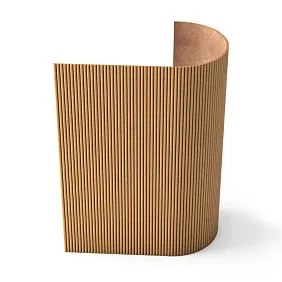
Flexible slatted wall panels on fabric backing – when the room's architecture contains curves that cannot be ignored. Columns, arched spans, rounded corners, curved furniture fronts. The flexible construction on fabric backing wraps around any radius without deforming the slats and without breaking the pattern.
Slatted panels for curved surfaces are not a specialized niche product. They are a solution for real spaces where architecture does not tolerate linear rigidity. A hotel lobby with round columns, a restaurant with arched vaults, an apartment with a non-standard layout – flexible construction is the only correct answer here.
Panels made of semi-circular battens – when you need soft, diffused light on the surface. The rounded profile scatters light smoothly, without sharp linear shadows. The surface looks warmer, livelier, more delicate. For living spaces with a natural material language – this is often the most precise choice.
What Ruins an Interior Even with Good Panels
This is an honest block. A good panel in the wrong context – money for rework.
Too many slats in one room. Four slatted walls in a small room – it's an overloaded, claustrophobic space. One accent slatted plane – that's architecture. Four – that's a cage.
Active dense rhythm in a small room. Large slats with wide spacing in a 10–12 sq.m. space feel oppressive, create excessive surface activity. For small rooms – a thin profile, moderate gap.
Unrelated color. MDF in a random shade that does not relate to the floor, walls, or furniture. The panel falls out of the overall color scheme and looks like a foreign object.
Conflict between slats and furniture geometry. Vertical slats on the wall + horizontal slats on the furniture front nearby – a visual conflict of two geometric directions. Either the wall and furniture in a unified rhythm, or at sufficient visual distance.
Poor side lighting. A slatted surface without proper lighting – loss of meaning. Without directional or side lighting, the relief is not readable. It's just 'something on the wall'.
Designer soup without a lid. Oak on a slatted wall + imitation stone on the next + brick on the third + concrete plaster on the fourth. Four different textures without a single material logic – that's chaos, not a 'rich interior'. The principle is one: no more than two or three material themes in one space, and all must be connected.
Incorrect spacing relative to scale. Slat spacing is a scale parameter. It must correspond to the size of the room. Large spacing in a small room – a mistake. Thin spacing in a huge hall – loss of expressiveness.
How to Integrate Slatted Wall Panels into a Cohesive Interior Finish
Final expert block. This is not about choosing a panel – it's about how to make the interior cohesive.
Unified material language. Slatted panels made of oak +Wooden trim from the same species + wooden floor or furniture with a coordinated tone. This is not 'too much wood' – it's a consistent material language where each element enhances the whole. Wooden moldings and trims in the tone of the slatted panels create a unified system of transitions between surfaces.
Unified color scenario. The panel color must be chosen in the context of the entire room's color scheme – considering the floor, walls, furniture, and textiles. A monochrome scenario (panel matching the wall color) requires paintable MDF. A contrasting accent – only if the contrast is justified by the overall concept.
Connection between wall and floor through the baseboard. The transition from the slatted panel to the floor through a correctly chosenWooden baseboard – this is not a technical detail. It's an architectural line that completes the vertical axis of the wall and transfers it to the horizontal plane of the floor. A baseboard in the panel's tone makes this transition seamless.
Where to leave a smooth plane and where to add relief. One of the main mistakes is the desire to cover the maximum wall area with slats. The correct strategy is relief where an accent is needed, a smooth surface where visual 'rest' is needed. A ratio of approximately 1:3 or 1:4: one slatted plane to three or four smooth ones.
Connection between panel and lighting – planned simultaneously. Not 'first the panel, then the light'. Lighting determines how the relief will look. Without this connection – half the architectural potential is lost. Hidden LED perimeter lighting, directional spotlights, side lights – all are part of a unified system, not separate solutions.
Architectural balance, not a fashionable element. A slatted panel must be justified by the space – its proportions, material theme, lighting scenario. If it's explainable – it's architecture. If it's 'because I saw it on Instagram' – it's a risk of getting an overcomplicated interior with an expensive slatted surface that is unrelated to anything.
Where to Look for Interior Finishing Solutions
The choice of construction and material is made. The next step is to move to a specific assortment.slatted panels for walls in the STAVROS catalog are presented in all formats described in this article:
-
MDF for painting – for precise RAL/NCS colors, monochrome and minimalist solutions;
-
solid oak – for natural texture, tactility, and long-term quality;
-
rigid panels on MDF backing — for straight walls of any scale;
-
flexible panels on fabric backing — for columns, arches, radius surfaces;
-
panels made of semi-circular battens — for soft, delicate chiaroscuro;
-
solutions for residential and commercial interiors of any complexity.
Complement slatted panelswooden molding— with skirting boards, moldings, and wooden baguettes from the same wood species — means obtaining a unified interior finishing system with a consistent material language. Not a set of random solutions from different suppliers, but an architecturally coordinated spatial envelope.
About the company STAVROS
When it comes to interior finishing, details decide everything. Profile precision, stability of the spacing from module to module, quality of end processing, reliability of the backing — these are not marketing words, but practical conditions ensuring that the installed wall will look correct today and in ten years.
STAVROS is a Russian manufacturer of MDF and solid wood products for interior finishing. The company produces slatted wall panels in rigid and flexible versions, MDF for painting and solid oak, as well as a full range of wooden trim — skirting boards, moldings, wooden baguettes, and decorative battens for a complete interior finishing system.
The STAVROS production standard includes precision of profile milling, control of batten spacing in each module, quality of backing and fabric base for flexible structures. Standard formats — for quick solutions. Non-standard sizes — by individual order subject to production run.
Delivery throughout Russia. Professional selection consultations — before placing an order. This is what a manufacturer looks like, with whom an interior project receives not just material, but an architecturally justified solution.
FAQ: Answers to popular questions
Can MDF and oak slatted panels be combined in one interior?
Theoretically — yes, but practically it is difficult. MDF and oak have different visual characters: one is engineered, the other is natural. To combine them, clear architectural logic is needed: different zones, different functions, intentional contrast. Random combination results in eclecticism.
How to calculate how many slatted panels are needed for an accent wall?
Width × height of the accent zone = area. Plus 10–15% for trimming and joints. Divide by the area of one module, round up. A reserve is mandatory: reordering from another batch carries the risk of color mismatch.
Is special wall preparation needed before installing panels?
For adhesive installation — the wall must be clean, dry, degreased, without crumbling fragments. A deviation of up to 3–5 mm is acceptable. More than 5 mm — frame installation is recommended.
Can slatted panels be installed on the ceiling?
Yes, with frame installation and load calculation. Oak panels are heavier than MDF — this must be considered when designing the ceiling's load-bearing system.
How to care for oak slatted panels?
Regular cleaning — dry or slightly damp soft cloth. Oil finish is renewed locally every 3–5 years without dismantling. Varnish finish is more wear-resistant; if scratches appear — local restoration.
Are slatted panels suitable for a children's room?
Yes — provided the correct finish is used. MDF with non-toxic matte enamel or oak with environmentally friendly water-based oil. Semi-circular profile — for a soft, delicate surface without sharp edges.
Why is it important to coordinate slatted panels with skirting boards and moldings?
Because skirting board and molding are architectural transitions between surfaces. An uncoordinated skirting board disrupts the integrity of the wall's vertical plane. A skirting board matching the tone and material of the slatted panel is an architectural completeness that is difficult to replace with anything else.