Article Contents:
- Why slatted wall panels: an honest talk about the mechanics of the effect
- Structural anatomy: what lies beneath the surface
- Slat: the profile decides everything
- Underlayment: rigidity or flexibility
- Slat material: wood or engineered material
- Complete classification: what types of slatted wall panels for walls exist
- Material in detail: what lies behind the choice of MDF or oak
- Why MDF for painting is a full-fledged designer choice
- Why oak array is not a luxury but natural honesty
- Batten spacing: from mathematics to atmosphere
- Batten orientation: vertical lifts, horizontal expands
- Styles and scenarios: where and how batten wall panels work
- Scandinavian Style
- Japandi
- Minimalism
- Neoclassicism and Modern Classicism
- Loft
- Organic modern interior
- Commercial premium
- Specific spaces: seven precise scenarios
- Living Room: Accent Wall
- Bedroom: Headboard
- Entryway: the first architectural signal
- Study: status and concentration
- Staircase flight
- Children's room: grow with your child
- Restaurant and cafe
- Finishing system: slatted wall panels don't work alone
- Lighting and slatted wall panels: an inseparable pair
- Technical checklist: eight parameters before ordering
- Installation: principles without which the result is unpredictable
- About the Company STAVROS
- FAQ: Answers to Popular Questions

There are interior solutions that look expensive regardless of actual cost. That work just as convincingly in a small one-room apartment as in a country mansion. That change the feel of a room without major renovation, without demolishing walls, and without a construction crew. Slatted wall panels are exactly such a solution.
But behind the apparent simplicity lies a deep system. The linear rhythm of battens isn't just 'pretty'. It's an architectural tool with clear mechanics: it controls light flows, visual proportions of space, acoustic properties of the room, and—most importantly—the emotional mood of those within the space. This is precisely what makesslatted wall panelssuch a universal and long-term solution.
This article isn't for those who want to 'see what it looks like'. It's for those who have already decided—and want to understand more deeply: how to choose correctly, how to avoid mistakes, how to get the maximum from this material. Here you'll find real technical parameters, style scenarios, a systematic view of finishing, and answers to questions that arise for anyone taking this solution seriously.


Why slatted wall panels: an honest conversation about the mechanics of the effect
Before talking about choice, you need to understand why this material works at all. What exactly happens to the wall when a slatted panel is mounted on it?
The answer lies in three words: relief, rhythm, light.
A smooth wall is a plane that remains a plane under any lighting. It reflects light uniformly across its entire area. The eye glides over it without stopping. Such a wall is a neutral background that does not participate in shaping the atmosphere.
A slatted wall panel adds a third dimension. Each slat, under side or directional lighting, casts a shadow into the gap. A continuous rhythmic relief emerges: light — shadow — light — shadow. The wall comes to life. It changes with the lighting angle, looks different in the morning than in the evening, different under artificial directional light than in diffused daylight. The surface gains depth — and with it, acquires character.
This is not a decorative technique for its own sake. It is an architectural logic that has been used for centuries in classical architecture: colonnades, pilasters, coffered ceilings — all operate on the same principle of rhythmic alternation of relief and shadow. The slatted wall panel is a modern interpretation of this same idea on the scale of a residential or commercial interior.




Constructive anatomy: what lies beneath the surface
Understanding what a product is made of means understanding how to work with it and what to expect from it.
Our factory also produces:
Slat: the profile decides everything
The slat is the main element. Its cross-section (profile) determines the character of the light and shadow and, consequently, the emotional image of the entire surface.
Rectangular profile — sharp edges, clear geometric shadow. Under side lighting, the surface acquires a strict, architectural, almost technical drawing-like character. No softness, no halftones — only precise lines. This is a profile for minimalism, loft, studies, meeting rooms, office spaces.
Semi-circular profile — rounded edges scatter light in an arc. The shadow is not sharp but smooth, with soft transitions. The surface looks organic, natural, warm — even if made of MDF. This profile is for living spaces with a cozy, homely character: bedroom, living room, children's room, library.
Trapezoidal profile — widening toward the base creates a multi-level, volumetric shadow. The surface is dynamic, with a pronounced decorative accent. This profile works in commercial spaces with high decorative intensity: restaurant, showroom, lobby.
Get Consultation
Backing: rigidity or flexibility
The backing determines on which surfaces the panel can be mounted.
MDF backing — rigid, flat, stable. For straight walls. Provides precise geometry, perfect module joining, long-term surface stability.
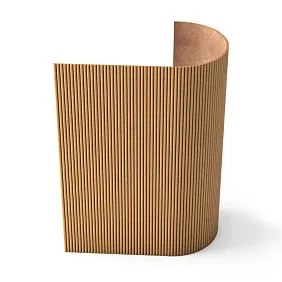
Fabric mesh base — flexible, allows the panel to bend with a radius from 100–150 mm. For columns, arches, rounded corners. The slats remain rigid — only the base provides flexibility. This is fundamental: the slat does not deform, the pattern does not distort.
Slat material: wood or engineered material
MDF 750–850 kg/m³ — homogeneous, defect-free, ideal for painting. Exact color per RAL/NCS. High geometric stability. Can be repainted without dismantling.
Solid oak — living wood grain texture, natural tactility, unique pattern of each slat. Wood density 700–750 kg/m³. Long lifespan with proper care. For interiors where natural material is a philosophy, not a compromise.
Complete classification: what types of slatted wall panels for walls exist
To avoid confusion in terminology when choosing — a summary table with clear criteria.
| Type | Underlay | Batten material | Application |
|---|---|---|---|
| Rigid for painting | MDF | MDF | Straight walls, any RAL |
| Rigid oak | MDF | Oak solid wood | Straight walls, natural look |
| Flexible for painting | Fabric | MDF | Columns, arches, radii |
| Flexible oak | Fabric | Oak solid wood | Curved surfaces, wood |
| Semi-circular profile | MDF or fabric | MDF or oak | Soft chiaroscuro, living spaces |
Material in detail: what lies behind the choice of MDF or oak
This choice is not about budget. It's about style, purpose, and long-term concept.
Why MDF for painting is a full-fledged designer choice
MDF is often perceived as a 'budget alternative to wood.' This is a mistake that needs to be corrected.
MDF with a density of 750–850 kg/m³ is an engineered material with controlled properties. Its structure is homogeneous at the molecular level: not a single knot, not a single resin pocket, not a single area with different density. It is this homogeneity that makes it ideal for painting: the paint applies evenly across the entire surface, and the color is predictable and reproducible.
What this means in practice: any color from the RAL catalog (over 200 standard shades) or NCS—accurately, without deviation, reproducible from the first batch to the next. A monochrome solution of 'wall matching the panel'—relief exists only through shadow, color unites surfaces into a single architectural whole. A two-color system—slats in one tone, the substrate (visible in the gaps) in another—creates optical depth.
Corporate RAL for an office space: slatted wall panels in the company's brand color at the reception or in a meeting room—this is branding through architecture. No posters, banners, or prints. Just the surface—and it speaks with the right voice.
Why solid oak is not a luxury, but natural honesty
Oiled oak is an open pore: the hand feels the fiber, feels the living material. No synthetic material can replicate this tactility—even veneer with the most realistic texture loses in the tactile dialogue. Oakslatted wall panels—is not an 'imitation of nature,' it is nature itself in architectural form.
Uniqueness of the pattern: two adjacent stiles never repeat each other. This creates a living, slightly unpredictable surface—that very natural variability that people intuitively feel as 'alive' and 'real.'
Durability: oak, with regular care (refreshing oil or varnish every 3–5 years), lasts for decades without loss of quality. The physical resource of solid wood is incomparable to most modern cladding materials.
Slat spacing: from mathematics to atmosphere
Spacing is the distance between adjacent slats. A technical parameter that directly defines the visual character of the surface.
Narrow spacing (15–20 mm): dense, rich rhythm. The surface is active, draws the eye, creates decorative tension. For spacious rooms and large accent planes.
Medium spacing (25–35 mm): balanced, universal rhythm. Works in most residential and commercial spaces. Moderate decorative activity.
Wide spacing (40 mm and above): airy, calm, monumental rhythm. The surface 'breathes.' For small spaces and delicate accent solutions.
Practical rule: the smaller the room — the wider the spacing. Aggressive dense rhythm in a small room creates visual noise. Sparse spacing in a compact space — calm decorative depth.
Slat orientation: vertical lifts, horizontal expands
This is a fundamental decision made before ordering — and it radically changes the spatial effect.
Vertical slats: the gaze moves from bottom to top. The room appears taller. For apartments with standard 2.7 m ceilings — the most valuable visual technique. Verticalslatted wall panel for walls— a standard solution for most residential and commercial projects.
Horizontal slats: the gaze moves left-right. The room appears wider. For narrow corridors, end walls of small rooms — a proven way to visually expand space without physical changes. Horizontal orientation is often used in Japandi and Scandinavian interiors — as a symbol of the natural horizon.
Diagonal orientation: a rare but powerful solution. Creates a sense of movement dynamics, a feeling of kinetics. For commercial spaces with unconventional concepts.
Styles and Scenarios: Where and How Slatted Wall Panels Work
Scandinavian style
Light oak with oil finish or MDF in linen/off-white tone. Vertical slats, thin rectangular or semicircular profile. Moderate spacing. Wall behind the sofa or in the bedroom. Nothing extra — only natural warmth and tranquility.
Japandi
Oak with Scandinavian gray tint or natural. Horizontal orientation — meditation in lines. Wide spacing, airy surface. Semicircular profile for soft organic shadow. Natural adjacent materials: raw concrete, linen textiles, matte ceramics.
Minimalism
MDF for painting in monochrome. Panel — matching the wall color, relief only through shadow. Rectangular profile. Strictly side or directional lighting — without it, the effect is zero. This is one of the most sophisticated and professionally looking interior techniques with minimal costs.
Neoclassicism and modern classicism
MDF for painting in a warm neutral tone or oak in 'tobacco' / 'cognac' tint. Rectangular profile. Moldings made ofwooden trim along the upper perimeter and side borders of the slatted plane.Wooden baseboard solid oak matching the slats' tone. The 'panel + molding + baseboard' system recreates the logic of classic wooden paneled walls — without literal reproduction of historical forms. Contemporary, architecturally sound.
Loft
Dark oak with matte varnish or MDF in anthracite / graphite. Aggressive rectangular profile, large spacing. Industrial details: black metal, exposed concrete nearby, textured plaster on adjacent walls. Slatted panel in a loft — not a soft accent, but a hard, characteristic, self-sufficient object.
Organic contemporary interior
Oak in natural tone with semicircular profile. Adjacent materials: raw stone, jute rug, handmade ceramics. Slatted wall — one of several natural voices. Does not solo, but participates.
Commercial Premium
Rich color (Bottle Green, Navy, Burgundy, Anthracite) or oak in dark tint. Built-in lighting — LED in gaps or directional spots above the panel. Coordinated metal details. Slatted wall panels as a marker of the object's level.
Specific spaces: seven precise scenarios
Living room: accent wall
One slatted plane changes the entire interior. Behind the sofa or in the TV area. The gaze gets a point of support. The rest of the space organizes around it. Light oak with side lighting — warm classic. Anthracite behind the TV in a white interior — a strict modern look.
Bedroom: headboard
The most delicate scenario. Tone — calm, neutral, soothing. Profile — semicircular. Lighting — LED strip along the lower perimeter of the panel. Soft upward glow emphasizes the relief and creates an intimate atmosphere.
Entrance hall: the first architectural signal
What does your entrance hall say? A slatted panel on the main or end wall — an immediate answer about the character of the entire interior. For a narrow corridor: horizontal orientation on the end wall visually expands the space.
Study: status and concentration
Wall behind the desk. Dark tone, rectangular profile, strictness. This is a background for video calls, saying 'here they work for results.' Plus — acoustic diffusion reduces reverberation: sound on camera and in life becomes cleaner.
Staircase flight
Vertical slatted wall panels for staircase flight walls create a continuous rhythmic background of movement from bottom to top. In combination withbalusters for staircasesfrom the same oak array — a unified wooden architectural theme that leads from one level to another.
Children's room: grow with your child
MDF for painting with non-toxic water-based enamels. Semi-circular profile without sharp edges. Pastel tones for younger ages, more active ones for teenagers. The main advantage: they grew up — repainted. No dismantling, no dust, no renovation.
Restaurant and cafe
Atmosphere is what brings people back. Warm oak under directed lighting, vertical rhythm, reduced acoustic load in the hall. Slatted wall panels in the restaurant are not wall finishing. This is managing the guest experience.
Finishing system: a slatted wall panel does not work alone
A professional interior result is a system. A slatted panel as an element in a system works an order of magnitude more convincingly than the same panel in a random environment.
Molding along the upper perimeter. A horizontal architectural line completes the slatted plane from above. The boundary between the relief and the smooth wall becomes meaningful, intentional.Wooden molding and cornicefrom the same wood species — a unified material language. In neoclassicism — a mandatory element. In minimalism — optional, but architecturally precise.
Baseboard. The lower horizontal boundary of the system.wooden baseboardfrom solid oak next to the oak slatted panel — a unified material image from floor to cornice.wooden skirting board purchasefrom the same solid wood — means completing the system with material precision. For MDF systems —buy MDF skirting boardpainted in the same color.
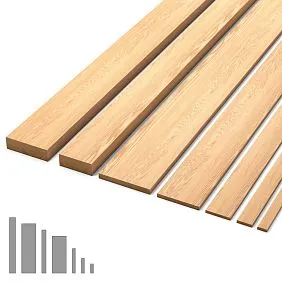
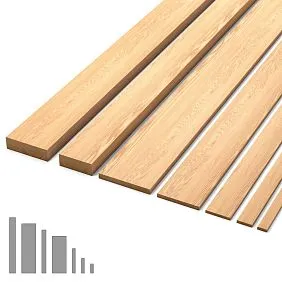
Wooden slat for additional elements. Corner transitions, window reveal slopes, non-standard sections.Buy wooden slatfrom the same wood species — means ensuring an inconspicuous, organic addition without a 'patchwork' feel.
Decorative overlays. In neoclassical and modern classic styles, the slatted surface as a central field is framed by horizontal and verticaldecorative inlays— a full-fledged architectural panel system with a 'frame' made of molding is created.
Furniture handles. If slatted panels are used on furniture fronts,Furniture Handlesin a coordinated material — metal matching the lighting tone, wood matching the slats — create a complete furniture image.
Classic furniture. In traditional spaces, slatted wall panels in warm oak tones create the perfect backdrop forclassic furniturewooden surfaces echo each other, creating a cohesive, materially connected look.
Lighting and slatted wall panels: an inseparable pair
Any professional will tell you: slatted wall panels are installed simultaneously with lighting planning. Not before, not after — simultaneously.
The reason is simple: slatted texture only exists in angled light. With uniform frontal lighting, the slats lose their shadow — the surface appears almost flat. You paid for texture — but got an imitation of texture.
Directional spotlights are the most effective tool. An incident angle of 30–45° to the surface. The shadow is sharp, the texture is sculptural. Adjustable spotlights allow you to change shadow intensity.
LED strip behind molding — downward diffused light. A soft halo. Suitable for bedrooms and living spaces with a cozy atmosphere.
LED in the gaps between slats — backlighting from within the panel. Creates a 'glowing' surface effect. An architectural, stage-like technique. For commercial projects and accent walls in residential interiors.
Warm or cool light? Oak — warm light (2700–3000 K). Enhances the natural warmth of wood. MDF for painting in neutral or dark tones — neutral light (3500–4000 K) for accurate color rendering.
Technical checklist: eight parameters before ordering
Before placing an order for slatted wall panels — eight specific questions for the manufacturer.
-
MDF substrate density — at least 750 kg/m³;
-
MDF slat density is a similar requirement;
-
Step accuracy — deviation no more than 0.5 mm (condition for seamless joining);
-
End treatment — sealed with primer or film;
-
Presence of a primer layer (for MDF for painting) — saves your time and material;
-
Base type — MDF (straight walls) or fabric base (curved);
-
Slat profile — clarify according to the catalog;
-
Compatibility with moldings — moldings, baseboards, slats from the same wood species.
Installation: principles without which the result is unpredictable
Installing slatted wall panels does not require specialized construction skills—but it does require following several fundamental rules.
Substrate: dry, clean, degreased. Plane deviation up to 3–5 mm — adhesive installation. More than 5 mm — frame installation on metal profiles with a spacing of 400–600 mm.
Adhesive installation: mounting adhesive is applied in a zigzag or dotted pattern. The panel is pressed and held for 5–10 minutes. For the top and bottom edges — finishing nails in areas that will be covered by molding and baseboard.
Frame installation: professional method. The plane is leveled independently of the wall. Allows for a technical gap for hidden wiring and sound-absorbing material.
Module joining: butt joint, without gaps. The slat pattern continues across the joint without offset — provided factory precision of spacing.
Painting (for MDF): before installation, in a spray booth. After installation with a roller — uneven coverage in gaps.
Finishing elements: molding along the top edge, baseboard at the bottom, corner elements for external and internal corners.
About the company STAVROS
Any product is a matter of production culture. Behind the precision of slat spacing, MDF density, edge processing, and coating stability lies a quality control system. Either it's absent — and then each batch is slightly different, joints are noticeable, edges swell. Or it's present — and the result is predictable, reproducible, professional.
STAVROS — a Russian manufacturer of MDF and solid wood products for interior finishing and furniture production. Slatted panels of all types and designs, a full range of millwork products, decorative overlays, stair elements, furniture decor and hardware. Over 4000 models, 20,000 modifications, 39 product groups.
MDF from European suppliers with a density of 750–850 kg/m³, climate-controlled wood drying chambers, a two-tier quality system (Standard and Prestige), control of spacing precision in each batch, manual processing of decorative elements.
Shipment from one piece — for those who value precision in details. Delivery across all of Russia. Specialist consultation before ordering.
FAQ: Answers to popular questions
What are slatted wall panels for walls and how do they differ from clapboard?
Clapboard is a solid cladding that covers the wall without gaps. Slatted panels are an open rhythmic relief with gaps between battens: the backing or wall is visible through the gaps, creating volumetric chiaroscuro. A fundamentally different decorative and spatial effect.
Is wall preparation needed before installing slatted panels?
Yes. The wall must be dry, clean, and degreased. Plane deviation over 5 mm — leveling or frame mounting. Crumbling plaster — preliminary reinforcement with deep-penetration primer.
Can slatted wall panels be installed in rooms with high humidity?
Standard MDF — only in rooms with normal humidity. Kitchen area — acceptable with high-quality coating. Bathroom — only moisture-resistant MDF (MDFV) with special coating. Sauna — only natural wood of special species.
How much does a slatted wall panel cost?
Cost depends on material (MDF or oak), type of construction (rigid or flexible), profile, and module size. Specific prices — on the STAVROS catalog page. Shipment from one piece allows calculating the cost precisely for your project.
How to correctly choose the color of MDF slatted panels?
Three approaches: monochrome (matching the wall color—relief through shadow), tonal accent (2–3 shades darker than the wall), contrasting accent (a fundamentally different color against neutral walls). For the first project—tonal accent: it rarely fails and always looks professional.
Can MDF slatted panels be repainted independently?
Yes. Light sanding of the old coating with P400 abrasive, priming, final painting. Spraying is recommended. DIY—possible with a paint sprayer or aerosol can for details. Professional results—in a workshop with a spray booth.
What is the warranty period for slatted wall panels?
Depends on the manufacturer and operating conditions. STAVROS is a professional manufacturer with a quality control system. Service life with proper installation and use: MDF for painting—10–15 years before coating renewal, solid oak—practically unlimited with care.