Article Contents:
- Why wood works differently in the bedroom than in other rooms
- The wall behind the bed: the main application point for slatted panels in the bedroom
- Parameters of slatted panels for the bedroom: width, spacing, orientation
- Slat width in the bedroom
- Gap spacing
- Slat orientation in the bedroom
- Material for slatted panels in the bedroom: what to choose
- Oak — natural classic
- Ash — light and resilient
- Pine — natural aromatherapy
- Birch — neutral purity
- Toning of slatted panels for the bedroom: how color affects sleep
- Lighting of slatted panels in the bedroom: three rules
- Slatted panels in bedrooms of different styles: specific looks
- Scandinavian bedroom with white slats
- Warm bedroom with oak in 'cognac' toning
- Minimalist bedroom with dark slats
- Neoclassical bedroom with slatted panels and molding
- Biophilic Bedroom: Nature as the Guiding Principle
- Slatted Panels in the Bedroom and the System of Finishing Elements
- Slatted Panels and Furniture in the Bedroom: Unity of a Natural System
- Bedroom Acoustics with Slatted Panels
- Installation of Slatted Panels in the Bedroom: Sequence and Nuances
- Preparation
- Acclimatization
- Marking
- Installation
- Finishing and Lighting
- Practical Tips for Choosing Slatted Panels for the Bedroom
- Frequently Asked Questions
- Slatted Panels in the Bedroom – Is It Too Active for a Resting Place?
- On the Entire Wall or Only Behind the Bed?
- Are Slatted Panels Suitable for a Small Bedroom?
- What color tone of slats is best for a bedroom?
- Is lighting needed for slatted panels in a bedroom?
- How to care for wooden slats in a bedroom?
- Can slatted panels be installed in a bedroom independently?
- Conclusion

The bedroom is the most personal space in the house. Not the living room, which is shown to guests. Not the kitchen, where life buzzes. The bedroom is the place you return to at the end of each day, where the morning begins, where the body and mind recover. That is why the bedroom should be treated with particular seriousness: every element of the finish here affects the quality of rest, the feeling of security, and the ability to relax.
Slatted panels in the bedroom are the choice of those who understand this connection between space and well-being. Wooden slats on the wall behind the bed are not a fashionable seasonal detail. It is a natural material, physiologically linked to a sense of peace. It is a texture that absorbs sound. It is a warm tone that calms the nervous system. It is the smell of wood—quiet, barely perceptible, but always present.
How to properly apply wooden slatted panels in a bedroom, what parameters to choose, how to combine them with lighting and other natural elements—this conversation is substantive, detailed, and honest.





Why wood in a bedroom works differently than in other rooms
There is a simple experiment: enter a room with wooden walls and stand there for five minutes. Then enter a room with white painted walls. The difference in sensations is instantaneous. A wooden surface creates a thermal and acoustic feeling of 'being wrapped up,' which synthetic materials do not reproduce.
This is not sentimentality—it's physiology. Wood disperses sound by absorbing reflections from walls. In a wooden space, there is less reverberation—less background noise. The brain stops constantly processing reflected sounds and gains the ability to relax more deeply.
Moreover, the warm tones of natural wood (yellow, brown, golden) are physiologically associated with sunset light—the time when the body prepares for sleep. This is an evolutionary reaction not subject to intellectual control. A wooden wall in the evening under warm light literally 'tells' the nervous system: time to calm down.
Exactly thereforeslatted panels in the bedroom— it's not just beautiful. It's functional in the most literal sense of the word.




Wall behind the bed: the main application point for slatted panels in the bedroom
Ask any interior designer where to place wooden slatted panels in the bedroom. The answer will be unanimous: the wall behind the bed headboard. This is an architecturally justified choice determined by several factors.
First, it's the wall seen by everyone in the bedroom. Upon entering the room, the gaze immediately fixes on the bed and the wall behind it—this is the natural focal point of the space. A slatted panel on this wall is the visual 'heart' of the bedroom.
Second, it's precisely the wall behind the bed that creates a sense of security. The human brain evolutionarily prefers sleeping against a wall—this is a safety instinct. A warm wooden slatted wall behind one's back enhances this feeling: 'behind me is a living, natural, reliable material.' The psychological comfort of sleep improves.
Third, the wall behind the bed is a place for integrating lighting. A hidden light cornice along the top edge of the slatted field with an LED strip directed downward along the slats—this is the perfect evening lighting for reading and falling asleep.
wooden lath panelson the wall behind the bed are mounted from floor to ceiling or only in the headboard area (from the mattress or slightly below to the ceiling). Both options are justified—the choice depends on the room's height and the desired degree of spatial 'envelopment.'
Our factory also produces:


Parameters of slatted panels for the bedroom: width, spacing, orientation
Choosing parameters is choosing an image. The same 'wooden slat wall' can look completely different depending on a few numerical values. In the bedroom, these differences are especially important: it is a space that should calm, not excite.
Get Consultation
Slat width in the bedroom
Narrow slats (15–25 mm) create a delicate, frequent rhythm. The surface looks thin, almost textile-like. In small bedrooms (12–18 sq. m) — the optimal choice: narrow slats do not 'weigh down' the space.
Medium slats (30–50 mm) — a universal choice. Wide enough for the natural wood grain to be clearly readable. Narrow enough to preserve rhythmic delicacy. For bedrooms 18–28 sq. m — the ideal range.
Wide slats (60–80 mm) — for spacious bedrooms with high ceilings (from 2.8 m and above). A monumental, calm rhythm. Each slat is a full-fledged architectural element.
Gap step
The gap between slats determines the 'density' of the slat field and the depth of shadows. In the bedroom, the recommendations are as follows:
-
Gap 10–15 mm with slat width 20–30 mm — dense, delicate rhythm, the surface is visually almost solid
-
Gap 15–20 mm with slat width 30–45 mm — classic balanced rhythm
-
Gap 20–30 mm with slat width 45–60 mm — expressive, with deep shadows
In the bedroom, an excessively wide gap (wider than the slat) is undesirable: the overly active contrast between the slats and the dark gap will be visually 'restless'. For a sleeping space, the rhythm should be calming and uniform.
Orientation of slats in the bedroom
Vertical slats are a classic for the bedroom. They stretch from floor to ceiling, visually increase height, create an image of a 'natural forest' — vertical tree trunks. A calming, meditative rhythm.
Horizontal slats in the bedroom are a non-standard solution. The horizontal is associated with the horizon, with relaxation, with the horizontal position of the body — that is, with sleep. Horizontal slats behind the bed are a psychologically 'correct' choice, although visually less common.
Diagonal slats in the bedroom — use with caution. The dynamics of the diagonal are not the best choice for a space intended for calming. If you really want them — only on one small surface, as an accent detail.
Material for slatted panels in the bedroom: what to choose
Oak — natural classic
Oak is the most popular material for slatted panels in the bedroom. The reasons are simple: rich natural grain, warm golden tone, high density (700–750 kg/m³), which ensures durability and good acoustic properties. Oak slats after oil coating are tactilely rich, slightly rough, warm to the touch. In the bedroom, where tactile sensations are important — this is a plus.
Oak finishes for the bedroom: natural (warm golden), 'bleached' (Scandinavian Nordic tone), 'cognac' (rich amber), 'tobacco' (warm dark brown). For a bedroom with a biophilic slant — natural or bleached tone. For a warm, intimate bedroom — cognac or tobacco.
Ash — light and resilient
Ash is lighter than oak, with a more contrasting, active grain pattern. The elasticity of ash means that slats made from it have a slight 'spring' when pressed—a pleasant tactile property. Bleached ash is one of the most popular choices for Scandinavian and Nordic bedrooms: white with a natural pattern, delicate and natural at the same time.
Pine — natural aromatherapy.
Pine slats in the bedroom are a special choice. Pine contains natural phytoncides that gradually evaporate into the room air at room temperature. The scent of pine is one of the most powerful natural relaxants. It's literal aromatherapy built into the wall.
Visually, pine is lighter than oak, with expressive knots and natural imperfections. When coated with clear oil—the natural tone remains unchanged. For an eco-bedroom or interiors in the wabi-sabi style—it's the perfect choice.
Birch — neutral purity.
Birch is dense, with a light, uniform tone and a subtle natural pattern. Without pronounced knots or strong color transitions. For a bedroom in a minimalist or Scandinavian style—birch provides a neutral natural background, not distracting, not dominating. Simply—clean, light, natural.
Toning of slatted panels for the bedroom: how color affects sleep.
This is not an abstract conversation about aesthetics—it's physiology. The color of surfaces in the bedroom affects nervous system activity and the quality of falling asleep.
Light tones (bleached, natural, light gray): expand the space, create a feeling of lightness, do not 'press' in a small room. Under warm evening lighting—they warm up, becoming cozier. For small bedrooms with low ceilings—the optimal choice.
Medium tones (cognac, walnut, tobacco): warm, enveloping, creating a 'nest' feeling. Visually 'narrow' the space, which in a large bedroom is a plus, but in a small one—can be overkill. In the evening under warm light—maximum coziness. Physiologically—the most 'sleep-inducing' tones.
Dark tones (anthracite, graphite, wenge): create a powerful architectural image but require sufficient lighting. A bedroom with dark slatted panels is a boudoir-like, adult, intimate image. Dark slats absorb light and create a sense of depth. For spacious bedrooms with good natural light — a strong and bold solution.
Physiological principle: the darker the bedroom walls, the stronger the warm evening light should be to create a cozy atmosphere. Dark slats without thoughtful lighting result in a cold, heavy space. With proper warm light — it's luxury.
Lighting slatted panels in the bedroom: three rules
First rule for the bedroom: evening lighting must be warm. The color temperature of light sources — only 2700 K. Cooler light hinders melatonin production and makes falling asleep difficult. Warm light on warm oak — the ideal physiological scenario.
Second rule: light sources should be hidden or not directed towards the eyes. Exposed bulbs and bright directional spotlights are enemies of quality sleep. For a bedroom with slatted panels: hidden light cornice, floor lamps with opaque shades, bedside sconces directed downwards.
Third rule: a mandatory dimmer. Smooth brightness adjustment allows gradually reducing lighting intensity as bedtime approaches. This is the simplest way to physiologically prepare the nervous system for falling asleep.
Hidden light cornice above the slatted wall. LED strip in the cornice along the top edge of the slatted field, directed downwards along the slats — this is the evening 'rain of light' that flows down the wooden slats. Warm, diffused, soft lighting. On a dimmer — adjustable from working brightness for reading to almost zero before sleep.
Built-in backlighting behind the slats. LED strip behind the slatted panel on the wall behind the bed: in the evening, when the main light is off — a quiet warm glow through the gaps between the slats. This is not task lighting — it's a nightlight on the scale of an entire wall. Creates a feeling of a 'glowing cocoon'.
Bedside sconces. Wooden sconces or sconces on a metal leg with a wooden accent — matching the tone of the slatted panels.decorative wooden elementsin the bedroom interior as a unified natural system: slats on the wall, wooden handles on nightstands, wooden sconces — all in the same tone and material.
Slatted wall panels in bedrooms of different styles: specific looks
Scandinavian bedroom with white slats
Bedroom 16 sq. m, white walls, light parquet. The wall behind the bed — vertical ash slats 25 mm wide, 15 mm gap, finish — white oil. Slat tone — warm white with a barely noticeable natural ash grain. Height of the slatted field — from the bed to the ceiling (1.4–1.5 m from the floor).
Bed with a linen headboard — natural linen. Bedding — white and gray, 100% cotton. Bedside tables — made of solid light oak. Wall sconces with white opaque shades.
Look: Nordic, natural, "breathable." White slats on a white wall — a delicate rhythm that is present but not dominant. A Scandinavian bedroom at its best.
Warm bedroom with oak in "cognac" stain
Bedroom 22 sq. m, walls in warm white color, oak parquet floor in natural tone. The wall behind the bed — vertical oak slats 40 mm wide, 20 mm gap, "cognac" stain. Height — from floor to ceiling (2.8 m).
Hidden top light cornice — LED strip 2700 K, dimmer. Bed with a mustard-colored soft headboard. Bedding — warm linen, "cappuccino" color. Floor rug — jute, natural tone.
Look: enveloping, rich, natural. Warm oak slats take on a golden tone in evening light — the space "warms up" to a state of perfect coziness. You want to stay in this bedroom.
Minimalist bedroom with dark slats
Bedroom 28 sq. m, ceiling 3 m, large windows. Walls — light gray. Wall behind the bed — horizontal oak slats 50 mm wide, 25 mm gap, 'anthracite' tint. Height of slatted field — from floor to ceiling.
Bed — no headboard, on a low base, black bedding with white. Bedside tables — black metal. One ceiling ring light fixture with a matte black frame.
Style: strict, adult, architecturally powerful. Dark horizontal slats across the entire wall create a sense of monumental sculpture in the bedroom. Large windows provide enough daylight so the dark slats don't 'eat up' the space.
Neoclassical bedroom with slatted panels and molding
Bedroom 20 sq. m, molded cornice along the ceiling, ceiling height 2.9 m. Wall behind the bed — vertical oak slats 35 mm wide, 15 mm gap, 'tobacco' tint, height 120 cm from the floor. HorizontalPolyurethane moldingat the border of the slatted field and the upper part of the wall.a polyurethane cornicealong the ceiling in a classic profile.
Bed with a high fabric headboard — color 'powder pink'. Bedding — snow-white cotton sateen. Bedside tables made of solid oak withwooden furniture handlesmatching the slats.
Style: elegant, feminine, rich. Slatted panels on the lower part of the wall — a modern interpretation of the classic tradition of wooden wainscoting panels. No literal historicity, but the entire spirit of classicism — in the material and proportions.
Biophilic bedroom: nature as the main principle
Biophilic design in the bedroom is the maximum saturation of space with natural materials, colors, shapes, and light patterns. Slatted panels are the primary tool.
Bedroom 18 sq. m. Two adjacent walls — both the wall behind the bed and the side wall — are clad with vertical pine slats in a natural tone (clear oil, no tint). Slats are 30 mm wide with a 20 mm gap. On the side slatted wall — hanging wooden shelves with live plants in hanging ceramic pots.
Floor — natural stone (travertine). Bedding — coarse linen in a natural color. Ceiling — dark gray concrete. Lighting — only warm, 2700 K, fully dimmable.
In such a bedroom, you wake up surrounded by the natural scents of pine and live plants, natural materials on all sides, delicate morning light on the wooden slats. This is literally a therapeutic space.
Slatted panels in the bedroom and the system of finishing elements
Proper finishing of the slatted field is a sign of a professional approach to bedroom finishing. This is precisely where an 'expensive' interior differs from a 'DIY' one.
Cornice along the top edge of the slatted field. Especially important in the bedroom: the transition from wooden slats to the ceiling without a cornice looks unfinished.a polyurethane corniceIn the tone of the slats or in the color of the ceiling — this is the final architectural touch. For light integration: a cornice with an internal groove for an LED strip — kills two birds with one stone.
Floor skirting board.solid wood baseboardIn the tone of the slatted panels — a unified natural transition from wall to floor. Skirting board height for a bedroom with slatted panels: 60–80 mm — classic. 100–120 mm — for high ceilings. A unified tone of the skirting board and slats creates a sense of architectural completeness.
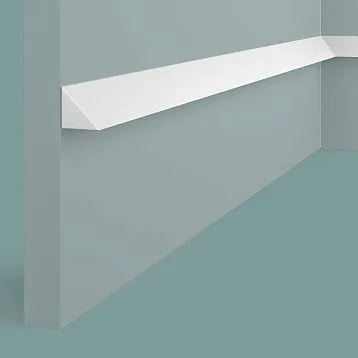
Moldings for a two-zone solution. If the slatted field occupies only the lower part of the wall (90–120 cm), a horizontalPolyurethane moldingAt the border of zones — mandatory. Without molding — the transition looks random. With molding — architectural.
Corner profiles. When finishing two adjacent walls with slatted panels — wooden corner profiles for internal corners. An open, unfinished internal corner is a gross installation error. A wooden corner profile matching the tone of the slats is a clean, professional solution.
Slatted panels and furniture in the bedroom: unity of a natural system
Wooden slatted panels on the wall work most expressively when the other natural elements in the bedroom are in color and material harmony with them.
Solid oak bedside tables matching the tone of the slatted panels — the perfect choice.Wooden Furniture HandlesOn the bedside tables and wardrobe — details that, upon closer inspection, are read as part of a unified natural system.
A floor of oak plank or parquet in the same tonal range as the slats — a unified natural 'bath' of wood on the floor and wall. If the floor tone is lighter than the slats — it's a classic 'earth-wood' contrast, justified by nature. If darker — a heavier, 'grounding' look.
Classic FurnitureWith wooden details matching the tone of the slatted panels: a bed with wooden sides, a chest of drawers with wooden legs, a dressing table in a wooden frame. This is not necessarily a match to the exact same tone — it's a coherence that creates a sense of thoughtfulness.
Acoustics of a bedroom with slatted panels
One of the most practical, yet rarely mentioned arguments in favor of slatted panels in the bedroom is acoustics. The textured surface of wooden slats scatters sound waves — instead of direct reflection (which a bare wall gives), diffuse scattering is created. Reverberation is reduced, and background noise in the room decreases.
This is especially important for bedrooms in urban apartments with parallel smooth walls: with flat walls, sound 'bounces' between them, creating a slight echo. A slatted panel on one of the walls breaks up this acoustic 'ping-pong'.
Additional acoustic bonus: the felt backing under the slats is a good sound absorber. The felt in the gaps between the slats and the wall absorbs some of the sound energy. For a bedroom adjacent to a noisy room or facing the street, this is an additional practical argument.
Installing slatted panels in the bedroom: sequence and nuances
Preparation
The wall behind the bed must be flat, dry, and free of moisture marks. If the wall is adjacent to a bathroom or kitchen, check the waterproofing: wooden slats will warp with systematic moisture exposure. Permissible irregularities for direct mounting are 3 mm per 2 linear meters. For greater unevenness, use a frame.
Acclimatization
Wooden slats in their packaging are brought into the bedroom and acclimatized for 48–72 hours. Room temperature should be 18–22°C, humidity 45–65%. Acclimatized slats will not warp after installation.
Marking
Marking the slat spacing — using a template made of plywood or a profile of the required thickness. The first slat — strictly level. Each subsequent one — with spacing controlled by the template. Check vertical (or horizontal) alignment — every three or four slats.
Installation
Mounting adhesive (MS polymer) — applied in zigzag strips to the back of the slat. Finish nails (brad nails) at an angle — for additional mechanical fixation. Nails in the bedroom — with a head that can be countersunk and filled or left as a decorative element (a checkerboard pattern of hammered nails is a design technique).
Finishing and lighting
After installing all slats — install the cornice, baseboard, corner profiles. Install lighting elements: profiles for LED strip in the cornice, connect to the power supply, dimmer. Test the lighting before finishing the ceiling.
Practical tips for choosing slatted panels for the bedroom
Order samples. The tint on the screen and in your hands are two different things. In the bedroom, where you spend a third of your life, the wood tone on the wall is critically important. Always request a physical sample and evaluate it under the exact lighting that will be in your bedroom in the evening.
Consider humidity. The bedroom is a room with normal humidity. Maintain 45–65% for stable condition of the wooden slats. An air humidifier in the winter is not a whim, but a necessity for wooden finishes.
Calculate extra. When ordering, calculate the area of the slatted field and add 12–15% for trimming. Slats from the same batch guarantee a uniform tone. Reordering from a new batch may differ.
Plan lighting in advance. If a hidden light cornice or built-in lighting is planned, this must be incorporated into the structure before installing the slats. Integrating lighting after installation is possible, but significantly more difficult.
Choose oil finish. In the bedroom — oil, not varnish. Matte oil preserves the natural look of the wood, the natural scent (in the case of pine), and the tactile texture. Varnish creates a polymer film that 'seals' the wood — it stops 'breathing' and loses its natural properties.
Frequently asked questions
Slatted panels in the bedroom — is that too active for a place of rest?
No, if the right parameters are chosen. A delicate step, a calm tone, vertical orientation, matte finish — a slatted wall in the bedroom calms, not excites. It is a natural, not synthetic material — physiologically, it is associated with peace.
On the entire wall or only behind the bed?
The wall behind the bed from the mattress to the ceiling is the optimal option. A full wall from floor to ceiling is for large bedrooms with high ceilings. A slatted panel only on the lower part of the wall is for a neoclassical approach.
Are slatted panels suitable for a small bedroom?
Yes. Choose narrow slats (20–25 mm), vertical orientation, light tone. Vertical light slats visually 'stretch' the height and add airiness to a small space.
What tone of slat is best for a bedroom?
Natural oak or warm tones (cognac, tobacco) — to create coziness and atmosphere. Whitewashed ash or whitewashed oak — for a Scandinavian and Nordic look. Dark tones (anthracite, graphite) — only with good lighting and sufficient area.
Is lighting needed for slatted panels in a bedroom?
Not mandatory, but highly desirable. A hidden light cornice above the slatted field is physiologically correct evening lighting and an architecturally complete solution. If possible — always install it.
How to care for wooden slats in a bedroom?
Wipe with a soft damp cloth as needed. Maintain room humidity at 45–65%. Slats with oil coating should be refreshed every 2–3 years by applying a thin layer of oil — this preserves the natural tone and protective properties. Lacquer coating — does not require refreshing.
Can slatted panels be installed in a bedroom independently?
With basic construction skills — yes. Installation on a flat wall using adhesive and finishing nails is a technically simple operation. The main thing is precise marking of the spacing and vertical control.
Conclusion
A bedroom with slatted panels is not just a beautiful renovation. It is a conscious choice of natural material for a space where the body recovers and the mind rests. Wood on the wall behind the bed — it's acoustics, tactility, scent, warmth of tone, and a natural pattern that lives with the light throughout the day.
Properly selected by parametersslatted panels made of solid oak or ash, skillfully finished, friezes, rosettes.andwith wooden floor skirting, complementedwooden furniture handleson nightstands and cabinets in a unified natural system — create a bedroom you'll want to wake up in every morning.
Full catalog of slatted panels, perimeter finishing systems, and natural interior solutions — in the assortment of STAVROS company.
STAVROS — production of decorative interior solutions of European quality level. Slatted panels made of solid oak, ash, birch, and pine with professional tinting and oil coating. Cornices, moldings, skirting boards, elements for stairs and furniture — everything needed to create a bedroom where natural material works for the quality of your sleep and your life.