Article Contents:
- The physics of light and wood: why it works so well
- Four fundamental ways to illuminate a slatted panel
- Method 1: LED strip behind slats (integrated lighting)
- Method 2: Hidden light cornice (top-down lighting)
- Method 3: Track or ceiling spotlights
- Method 4: Bottom-up lighting
- Wooden slatted panels with lighting: materials and their interaction with light
- Solid oak under directional light
- MDF battens for painting: light and color
- Felt underlay and background color
- Application scenarios for slatted panels with lighting
- Living room: slatted wall as an evening lighting accent
- Bedroom: lighting for the slatted wall behind the bed
- Study: accent wall with side lighting
- Hallway: bottom-up lighting along slatted panels
- Restaurant: slatted walls with track lighting
- Home theater: lighting as an immersion element
- Technical parameters of LED lighting for slatted panels
- Choosing LED Strips: Key Parameters
- Dimmer: An Essential System Component
- Power Supply: Calculating Wattage
- LED Strip Profiles
- Combining Lighting with Slat Panel Finishing Elements
- Integrating Lighting into a Smart Home System
- Mistakes When Creating Slat Panels with Lighting
- Slat Panels with Lighting and Other Natural Interior Elements
- Maintaining Slat Panels with Lighting
- Frequently Asked Questions
- Which LED Strip to Choose for Slat Panels?
- Is a dimmer needed for slatted panels with backlighting?
- Can I install backlighting behind slatted panels myself?
- Is LED backlighting behind wooden slats safe from a fire safety perspective?
- What color temperature is best for oak slatted panels?
- Can RGB tape be used behind slatted panels?
- How to combine slatted panel lighting with the main living room lighting?
- Conclusion
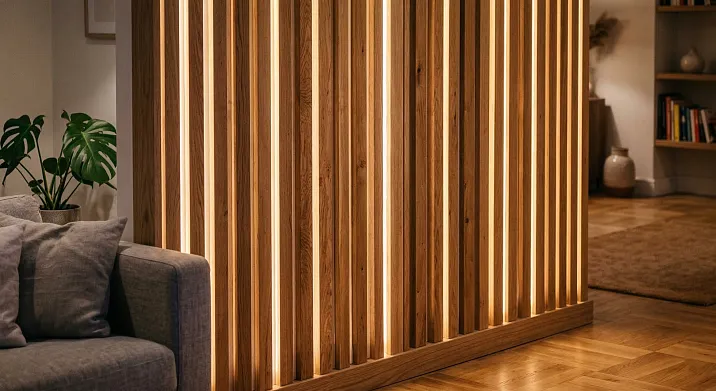
There are interiors that impress during the day. And there are interiors that come alive in the evening — when the main lights go off and what's hidden behind the slats turns on. Slatted panels with backlighting are exactly the second case. During the day — expressive wooden texture. In the evening — a living, glowing surface where light and shadow play out a scene that's hard to look away from.
The combination of wooden slats and LED backlighting is one of the most powerful visual tools in modern interiors. Not because it's trendy — although it's indeed at its peak. But because physics is at work here: light passing through the gaps between slats or skimming along their surface creates an effect that can't be reproduced by any other means. Neither wallpaper, nor paint, nor tiles can achieve what an illuminated wooden slatted field does.
About how this system works, what technical solutions exist, in which spaces it works best, and what mistakes to avoid — read in this detailed guide.
The physics of light and wood: why it works so well
Before discussing specific scenarios, it's worth understanding the principle. Why does a slatted wooden surface with lighting look so different from the same surface without it?
The answer lies in the relief. A slatted panel is not a smooth plane. It's a set of parallel protrusions (slats) and recesses (gaps). When a light source is placed behind this relief, each slat becomes a 'screen' onto which light falls from below or behind. Light passes through the gaps, creating glowing strips, while the slats themselves become dark silhouettes against a luminous background. This is pure graphics: a black-and-white rhythm in a nighttime interior.
When the light source is placed above the slats, the light 'washes' the surface from top to bottom. Each slat casts a shadow onto the next one. The surface becomes three-dimensional: the relief of the wooden slats, which during the day is simply perceived as texture, transforms in the evening into a volumetric sculpture of alternating light strips and shadows.
In both cases, the natural wood grain interacts with light as a living material: absorbing, reflecting, scattering. It is precisely this interaction that creates the image that cannot be reproduced with synthetic materials.
Slatted panels with lighting— is a system where material and light are designed together as a single solution. This is not 'slats to which light was added' — it's a 'light installation made of wood,' designed from the very beginning.




Four fundamental ways to illuminate a slatted panel
Before choosing the type of lighting, it's necessary to understand: the task you set for the lighting determines the method of mounting the light elements. All four main scenarios differ fundamentally in their results.
Our factory also produces:
Method 1: LED strip behind the slats (integrated lighting)
The LED strip is placed directly behind the slats — between the slats and the backing (felt or MDF) or between the backing and the wall. Light passes through the gaps between the slats and creates even glowing strips on the front plane of the panel.
Result: slats are dark silhouettes, gaps are glowing lines. With dark slats on a dark substrate — maximum contrast. With light slats — soft diffuse glow through the gaps. This is the most 'cinematic' scenario: a slatted wall in darkness looks like an architectural installation lit from within.
Technically: LED strip with a power of 7–14 W per linear meter, color temperature 2700–3000 K for warm wood. The strip is mounted in horizontal slots of the substrate or on wall-mounted brackets. Uniform lighting across the height of the slatted field is critically important: 'dips' in brightness in individual areas are immediately noticeable.
Get Consultation
Method 2: Hidden light cornice (top-down lighting)
The LED strip is mounted in a hidden light cornice along the top edge of the slatted field and directs light from top to bottom along the slats. The light source itself is not visible — only the result is seen: a uniform flow of warm light cascading down the slatted surface.
Result: each slat casts a soft shadow on the substrate behind, creating a subtle relief pattern. The surface looks voluminous and evenly lit at the same time. This is the most 'classic' and versatile scenario — it works in any interior style, from minimalism to neoclassicism.
Technically: a hidden cornice profile (aluminum or wood) with a groove for the LED strip. Distance from the strip to the slatted surface: 15–25 cm ensures uniform 'washing' without visible 'hot spots' near the cornice.
Method 3: Track or ceiling spotlights
Directional spotlights on the ceiling (track or recessed downlights) are aimed at a 30–45° angle to the slatted wall. The light source is external, above the slatted surface.
Result: harsh directional light creates sharp shadows in the gaps between slats. The wood grain pattern is 'revealed' with maximum detail. Changing the spotlight angle alters the character of the shadows. This is the most 'dynamic' scenario: the spotlight can be easily redirected, instantly changing the wall's appearance.
Technically: spotlights with a power of 7–15 W and a narrow beam angle (24–36°). Color temperature for oak and warm wood tones — 2700–3000 K. Distance from the ceiling to the slatted wall: the farther the spotlights are from the wall, the more uniform the lighting; the closer — the brighter the 'hot spot' at the top edge.
Method 4: Bottom-up lighting
An LED strip behind the baseboard or in a floor profile directs light from bottom to top along the slatted wall. This is a non-standard, 'inverted' scenario.
Result: shadows from the slats go upward, which is psychologically perceived as unusual—the familiar 'gravity' of light is disrupted. The effect is especially expressive when combined with top lighting: two opposing flows create a complex interplay of intersecting shadows.
Technically: an aluminum floor profile with a slot for the LED strip is mounted along the lower edge of the slatted field. The strip's power should be moderate (4–7 W/linear meter), otherwise the lower part of the slatted wall will be overexposed.
Wooden slatted panels with lighting: materials and their interaction with light
Not all materials 'accept' light equally. The choice of material for slatted panels with lighting influences the final appearance no less than the choice of lighting method itself.
Solid oak under directional lighting
Oak is the most 'photogenic' material for slatted panels with lighting. Medullary rays in radially cut oak, under side lighting, produce a characteristic 'moire' pattern—shimmering light strokes against a warm brown tone. This is natural optics that cannot be reproduced by any coating.
With a 'natural oak' or 'cognac' stain and warm light (2700 K)—oak 'warms up' to golden. With an 'anthracite' or 'graphite' stain and neutral light (3000–3500 K)—it becomes restrained and modern.
Solid oak slat panels— an optimal choice for systems with directional and hidden lighting, where the natural pattern of the material is important.
MDF battens for painting: light and color
MDF battens painted with white or dark matte enamel, combined with integrated LED lighting, create a clean graphic look: strict batten silhouettes against an evenly lit background. No natural wood grain—only geometry. For modern and minimalist interiors—the perfect combination.
White MDF battens with integrated warm LED lighting—a look popular in Scandinavian and 'pastel' interiors. Delicate glow through white stripes—soft and atmospheric.
Felt backing and background color
With integrated lighting (LED behind battens)—the backing color becomes the 'glow background' color. Black felt backing with warm LED strip behind battens: light appears warmer and more saturated against a dark background. White or light gray backing: more diffused, soft glow without sharp contrast.
Application scenarios for batten panels with lighting
Living room: batten wall as an evening lighting accent
The living room in the evening is a space for relaxation and conversation, where the main lighting is typically dimmed. It is in this mode thatSlatted panels with lightingreveal their maximum potential.
Specific scenario: accent wall behind the sofa—vertical dark oak battens 35 mm wide, 20 mm gap, 'anthracite' tint. Behind the battens—warm white (2700K) LED strip in horizontal grooves of the backing. Main living room lighting—dimmed. The batten wall lighting is turned on—and the living room instantly transforms: dark battens against a warm glowing background, soft reflected light on the sofa and floor, an atmosphere that no ceiling fixture can create.
A dimmer for the backlight is essential. The ability to smoothly adjust the brightness of the LED strip behind the slats allows you to control the atmosphere of the living room, from 'work' evening lighting to complete dimming for movies.
Bedroom: backlighting for the slatted wall behind the bed
A wall behind the bed headboard with slatted panels and hidden backlighting is a classic, proven solution. A hidden light cornice along the top edge of the slatted field directs warm light from top to bottom. In the evening, the slatted wall glows softly, creating a cozy 'dome' over the bed.
Color temperature in the bedroom is a fundamental issue: only 2700 K (maximum warm white). Cooler temperatures (3000 K and above) hinder falling asleep by increasing nervous system activity. Warm light is the physiologically correct choice for the bedroom.
Dimmer + timer: the ability to program a gradual fading of the backlight over 30–60 minutes is a feature that literally improves sleep quality.
Study: accent wall with side lighting
In a home study, a slatted wall behind the desk with track spotlights at an angle combines task lighting and an architectural accent in one. The spotlights are aimed at the slatted wall at a 35–40° angle. The wood grain is 'revealed' to the maximum. The wall becomes the visual focus of the workspace.
During video calls, a professional in a study with an illuminated slatted wall behind them projects an image of professionalism and thoughtful space. This is not decoration for decoration's sake: it is a working tool for shaping an image.
Hallway: bottom-up lighting along the slatted panels
In a hallway with vertical slatted panels on a long wall, built-in bottom-up lighting creates a non-standard, memorable image. The first thing a guest sees upon entering is a glowing slatted wall with inverted shadows. It is the space's 'greeting,' impossible to forget.
Technical: floor-mounted aluminum profile with a slot along the lower edge of the slatted field. Warm white LED strip, power 5–7 W/linear m. Dimmer: in the hallway with night mode — ability to reduce brightness to 10–15% for night lighting without turning on the main light.
Restaurant: slatted walls with track lighting
In a restaurant with wooden slatted panels on the walls, track spotlights directed at the slatted surfaces are a commercial interior standard. Directional light at a 45° angle to the slatted wall creates a lively, changing picture: when a waiter or guest passes by, their movement alters the perception of shadows on the slatted surface — the wall 'lives' along with the space.
For restaurants — color temperature 2700–3000 K, color rendering index Ra ≥ 90. Natural wood with a high color rendering index reveals its natural tone with maximum accuracy.
Home theater: lighting as an element of immersion
In a home theaterslatted wooden panels with lightingon the side walls — this is both a functional and atmospheric solution. Functionally: the acoustic properties of slatted panels reduce reverberation. Atmospherically: soft lighting of the side slatted walls creates a 'frame' around the screen, reduces the sharpness of contrast between the bright screen and the dark room — eye fatigue decreases.
Option with RGB strip behind the slats of a home theater: the lighting color changes depending on the scene on the screen. This is 'ambilight' technology in an interior execution — the slatted wall 'breathes' color along with the film.
Technical parameters of LED lighting for slatted panels
Choosing LED Strip: Key Parameters
| Parameter | Recommended Value | Impact on Result |
|---|---|---|
| Color temperature | 2700–3000 K (residential) / 3000–3500 K (work) | Warmth and atmosphere / task lighting |
| Color Rendering Index (Ra/CRI) | ≥ 90 (preferably ≥ 95) | Accurate wood tone reproduction |
| Power | 7–14 W/linear m (built-in) / 4–7 W/linear m (cornice) | Brightness and uniformity |
| Diode density | ≥ 60 diodes/linear meter | Uniformity without 'graininess' |
| IP rating | IP20 (dry residential) / IP44 (bathroom) | Moisture protection |
| Power supply voltage | 12 V or 24 V | 24 V — more uniform light on long runs |
Dimmer: mandatory system component
Recessed panels with lighting but no dimmer are like a piano without pedals: technically functional, but not unlocking its full potential. A dimmer allows smooth brightness control from 0 to 100%, creating different atmospheric scenarios depending on the time of day and task.
Types of dimmers:
-
Wall-mounted rotary dimmer — a classic, simple and reliable
-
Touch dimmer — modern look, touch control
-
Smart dimmer (Z-Wave, Zigbee, Wi-Fi) — control via smartphone, voice control, scenes and timers
-
Remote control — convenient for bedrooms (no need to get up)
Important: the dimmer must be compatible with the type of LED strip. Not all strips are dimmable by all dimmers — verify compatibility when purchasing.
Power supply: power calculation
Power supply wattage = total LED strip wattage × 1.3 (30% reserve for stable operation).
Example: a recessed wall 4 linear meters, strip 10 W/linear m = 40 W. Power supply: 40 × 1.3 = 52 W → choose 60 W.
The power supply must be placed in a ventilated space — not in a closed wooden box. Overheating of the power supply is the number one cause of premature system failure.
Profiles for LED strips
An aluminum profile for LED strips is an essential element of a professional lighting system. The profile performs three functions: mechanical protection of the strip, heat dissipation (away from the diodes), and an optical diffusing lens (a matte diffuser eliminates visible diode 'graininess').
For a concealed cornice: a profile with a 120° beam angle and a matte diffuser. For built-in lighting behind slats: a profile with minimal height (8–10 mm) to fit in the gap.
Combining lighting with finishing elements of slatted panels
Slatted panels with lighting are a system in which lighting elements are integrated into the architectural design. The finishing elements of the slatted field must 'accept' this design and work together with it.
Lighting cornice.a polyurethane corniceThe upper edge of the slatted field can simultaneously serve as a lighting cornice: the LED strip is mounted in a specially provided groove behind the cornice. Externally — a classic cornice. Functionally — a hidden directional light source for the slatted wall.
Skirting board with lighting.Wooden baseboardWith an aluminum profile for an LED strip in the lower part — implementation of bottom-up lighting. The profile is mounted behind the skirting board or integrated into its structure.Skirting made of solid woodA height of 80–100 mm provides sufficient space for placing a profile with an LED strip behind it.
Moldings in two-zone solutions. HorizontalPolyurethane moldingAt the boundary of the slatted field and the upper part of the wall in a two-zone solution, it can incorporate an LED strip — side lighting directed both downward onto the slats and upward onto the neutral wall.
Integration of lighting into a smart home system
Slatted panels with lighting in a smart home system represent a level of comfort that changes the daily usage scenario of the space.
Lighting scenarios. 'Evening' — slatted wall lighting turns on at 40% brightness, main light turns off. 'Movie' — lighting dims to 15%. 'Night' — lighting turns off completely. 'Morning' — lighting gradually increases from 0 to 60% over 20 minutes (light alarm). All scenarios are controlled by voice, smartphone, or automatically via timer.
Synchronization with curtains. When electric curtain tracks in the living room close — the lighting of the slatted panels automatically turns on to a set brightness percentage. The space 'reconfigures' for evening mode without human intervention.
Presence sensor. In the hallway — a motion sensor activates the slatted wall lighting upon entry and turns it off after a set time following departure. This is both convenient and economical.
Mistakes when creating slatted panels with lighting
LED strip that is too bright. 'The brighter, the better' is a false principle. An over-lit slatted wall loses volume: shadows disappear, the relief 'melts' in the light. Brightness should be moderate — so that shadows remain.
Uneven brightness along the strip length. When using a 12V strip on runs longer than 5 meters, voltage drop leads to noticeable brightness reduction towards the end. Solution: 24V strip (less voltage drop), powering from both ends, or splitting into several runs with separate power supplies.
Visible diodes without a diffuser. An LED strip without an aluminum profile with a matte diffuser creates 'graininess': instead of a uniform light strip, you see a chain of individual points. Especially noticeable on large gaps in slatted paneling.
Incorrect color temperature. Cool white (5000–6500K) on natural oak kills the natural tone, making the wood look 'dead' gray. For wood, only warm white (2700–3000K).
Lack of a dimmer. Fixed brightness for the backlight is a compromise: either too bright for evening ambiance or too dim for task lighting. A dimmer is not an option but a basic element of the system.
Power supply in an enclosed space. Heating without ventilation reduces lifespan and risks failure. The power supply must have access to air.
Installing the strip without prior testing. Always test the fully assembled system (strip + profile + dimmer + power supply) before final closure with slatted panels. Rework after installing the slats is a complex and costly operation.
Slatted panels with backlighting and other natural interior elements
Backlit wooden slats work most harmoniously in a space where natural material is present systematically—not just on one wall.
Wooden planksOn cabinet fronts matching the slatted panels, illuminated by built-in spotlights inside the cabinet—a unified natural lighting system. An open cabinet door with wooden slats and internal lighting is a beautiful interior detail.
balusters for staircasesMade of solid wood matching the slatted panels on the wall of a staircase landing with bottom lighting—vertical wooden silhouettes in warm upward light. This is an image that turns the staircase into an architectural event in the home.
Classic Furniturewith wooden details against a backdrop of illuminated slatted walls — a natural ensemble where light unites all wooden elements in a single warm tone.
wooden furniture handlesmatching the slats — a detail that becomes even more noticeable when illuminated: warm light 'reads' the wood texture on the handles just as it does on the wall slats.
Care for slatted panels with lighting
Slats. Maintenance of wooden slats with lighting is no different from regular ones: dust is removed with a soft, damp cloth. The LED strip behind the slats does not require regular maintenance — dust inside, in the gaps, can be removed with a narrow vacuum attachment on low power once every few months.
LED strip. The lifespan of a quality LED strip is 30,000–50,000 hours. At 4 hours of operation per day — 20–35 years. The actual reason for replacement before the term is typically the power supply (lifespan 5–10 years) or dimmer.
Power supply. Check once a year for overheating and functionality. Overheating to the touch is a signal for inspection or replacement.
Profile. The aluminum profile may darken over time from heat. The matte polycarbonate diffuser gradually yellows (after 5–10 years). The diffuser is replaced separately.
Frequently asked questions
Which LED strip to choose for slatted panels?
24 V strip, color temperature 2700–3000 K, color rendering index Ra ≥ 90, diode density ≥ 60/linear m, power 7–14 W/linear m for built-in lighting. Mandatory — aluminum profile with a matte diffuser.
Is a dimmer needed for slatted panels with lighting?
Absolutely essential. Without a dimmer, the backlighting for slatted panels is a fixed lighting option with no ability to control the atmosphere.
Is it possible to install backlighting behind slatted panels yourself?
Yes, with basic electrical skills. Installing an LED strip in a profile and connecting it to a dimmer via a power supply is a technically straightforward operation. Important: everything should be tested before the final installation of the slats.
Is LED backlighting behind wooden slats safe from a fire safety perspective?
When using a quality strip with the proper aluminum profile (for heat dissipation), a power supply in a ventilated space, and adhering to power specifications — yes, it is safe. LEDs at 12–24 V emit significantly less heat than halogen or fluorescent sources.
What color temperature is best for oak slatted panels?
2700–3000 K. Warm white brings out the natural golden tone of oak. Cooler temperatures 'kill' the warm tone, making the wood look gray and lifeless.
Can RGB strips be used behind slatted panels?
Yes, for spaces with a playful or entertainment purpose (home theater, children's room, game room). For living spaces — colored light is perceived as tiring with prolonged use. Recommendation: RGB+W (with a white channel) — the ability to use both colored and warm white modes.
How to combine the backlighting of slatted panels with the main lighting in a living room?
Two independent circuits: main lighting (ceiling fixtures) + slat panel backlighting, each on its own dimmer. In daytime mode — main light + slats without backlight. In evening mode — main light dimmed, slat panel backlighting — the main atmospheric source.
Conclusion
Slat panels with backlighting are not a decorative trick. It's a way to create a living architectural surface in your space that exists in time: changes with lighting, reacts to mood, controlled by voice or touch. In the morning — warm wooden slats in natural light. In the evening — a glowing installation where light and wood create an image that cannot be ignored.
A properly designed system —Solid oak slat panelswith professional tinting, high-quality LED strip with diffuser, concealed lightinga polyurethane cornice, Wooden baseboardmatching the slats and a smart-controlled dimmer — is a system that pays for itself every evening. Because a space that's pleasant to return to is not a luxury, but a quality of life.
Full rangeof solid wood slatted panels, polyurethane cornices and moldingsfor lighting solutions,wooden baseboardsandbalusters for staircases— in the STAVROS company catalog.
STAVROS — production of decorative interior solutions with European quality standard. Slat panels, perimeter finishing systems and decorative elements for residential and commercial spaces. For those creating an interior where light and wood work together — and make every evening beautiful.