Article Contents:
- Why choosing finishes in Saint Petersburg requires a special approach
- Which slat panels are relevant for apartments and houses
- Slat panels as an architectural tool, not just decoration
- What to choose for different areas of an apartment
- What to choose for a country house
- Why polyurethane, not a random decorative substitute
- Moldings: the fine graphics of space
- Ceiling rosettes: the center of the composition, not a random circle
- Overlays: an accent that must be justified
- Why this combination works so powerfully
- Scheme 1. Modern apartment
- Scheme 2. Neoclassicism without ostentatious pomp
- Scheme 3. Commercial interior
- Slatted panels: what to look for in person, not in fantasies
- Molding: where cheapness gives itself away instantly
- Quality is also a system, not just an individual product
- First mistake: buying only based on price per square
- Second mistake: trying to create 'expensive-luxurious' in a small space
- Third mistake: not considering the building style and character of the space
- Fourth mistake: ignoring light
- If you need a modern, calm interior
- If you need a warm and status interior
- If the budget is limited
- If the interior is commercial
- Step 1. Define the function of each plane
- Step 2. Choose the dominant language
- Step 3. Match the scale to the room
- Step 4. Check samples under real light
- Step 5. Choose a system
- Which slatted panels are better to choose for an apartment in St. Petersburg?
- Where is polyurethane molding appropriate in a modern interior?
- Can slats and molding be combined in one room?
- Which is More Important When Choosing: Price or Quality?
- Is this suitable for commercial spaces?
- Can molding be used beyond just classic styles?
- What to choose for a bedroom?
- What to choose for a living room?
- How to tell if molding is high-quality?
- How to avoid budget mistakes?
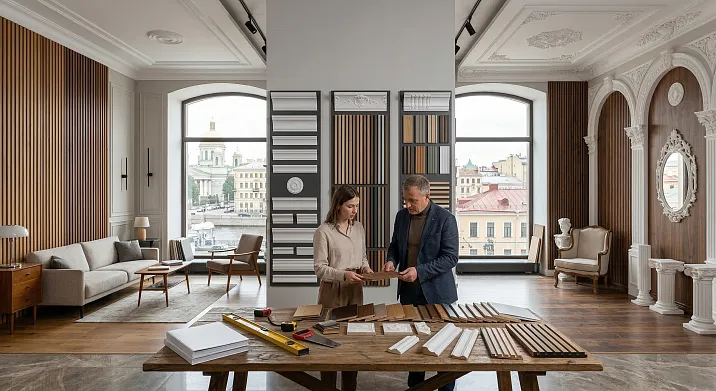
In St. Petersburg, interior design has long ceased to be just a collection of finishing materials. Here, in a city with architectural memory, flat walls almost always lose to relief. That's why queries like Buy slatted panels in St. Petersburg и polyurethane plasterwork in St. Petersburg are no longer about decorative whims. They're about finding a material capable of giving an apartment, house, or commercial space structure, depth, and a finished character.
When someone chooses finishes for a St. Petersburg interior, they almost always solve several tasks at once. The space needs to be made visually stronger. The material mustn't look random. It mustn't fall apart at the level of impression six months after renovation. And finally, it's not just about buying something beautiful, but assembling a coherent system: wall rhythm, ceiling logic, light architecture, the emotional tone of the room. That's precisely why the combination of slat panels and polyurethane molding has become one of the most powerful tools in modern interior finishing.
Slats work as rhythm. Molding works as graphics and accent. Together they provide what a smooth wall doesn't: volume, shadow, texture, direction of gaze, and a sense of finished composition. In the STAVROS catalog, slat panels are available in MDF versions for painting, solid oak, and flexible solutions for complex surfaces; polyurethane decor includes moldings, rosettes, overlays, and linear profiles for walls and ceilings.
But here's where the main point begins. The market is flooded with decorative tinsel. Some buy panels that are too coarse and end up with a heavy wall that feels oppressive. Others choose cheap molding with blurred relief and crooked geometry—and as a result, even a good renovation starts to look like a compromise. A mistake in such materials rarely looks like a disaster. It looks worse: like a pointless waste of money that doesn't give the interior any strength.
This article is needed to cut through the noise. Below is not a set of general phrases, but a detailed breakdown of what slatted wall panels to buy in St. Petersburg, what kind of polyurethane molding St. Petersburg to choose for ceilings and walls, how to combine them in one interior, how to check quality before purchase, and how to avoid sliding into cheap decorative noise.


Why choosing finishes in St. Petersburg requires a special approach
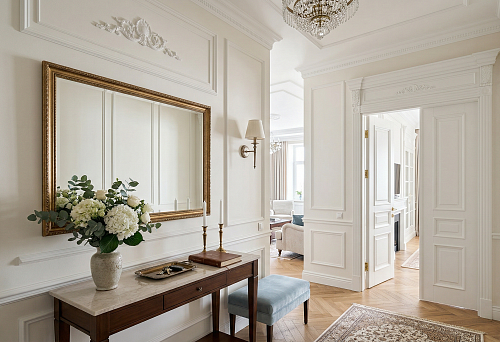
St. Petersburg is a city where the interior inevitably engages in a dialogue with the city's architecture. Even if we're not talking about old housing stock but a modern apartment, there's always an expectation of expressiveness in how space is perceived here. Smooth finishes without rhythm or accents are often seen as incomplete. At the same time, overloading with decor also looks alien. St. Petersburg doesn't suit vulgarity. It suits intelligent spatial plasticity.
That is why slatted wall panels to buy in St. Petersburg are often sought not for the sake of fashion, but for architectural logic. A slatted surface gives a space cohesion. It can stretch the height, discipline a long wall, frame a TV zone, and make a corridor not boring but directional. With skillful lighting, slats create relief that changes throughout the day. The interior begins to live, not just exist.
The situation with polyurethane moldings is similar, but their function is different. polyurethane plasterwork in St. Petersburg It is especially relevant where you need not just to add volume, but to introduce an architectural language: frames, division of planes, ceiling decoration, highlighting light fixtures, creating finished contours. This is not only about classic styles. Modern interiors also need graphics. It's just that this graphics becomes stricter, cleaner, more subtle.
There is also a purely practical layer. St. Petersburg apartments often suffer from complex initial conditions: elongated rooms, imperfect geometry, compromised ceiling heights, lack of natural light in certain areas, humidity fluctuations, the need to quickly finish without heavy wet processes. Against this background, slatted panels and polyurethane decor outperform many alternatives. They are easier to integrate into modern renovations, provide a quick visual effect, and allow achieving an expensive result without overly heavy technologies.




Which slatted panels are relevant for apartments and houses
Our factory also produces:


Slatted panels as an architectural tool, not just decoration
A bad approach to slatted panels looks like this: a person saw a picture, decided that slats are trendy, and bought the first thing they found. A good approach starts with a different question: what role will rhythm play in the interior? Should it stretch the height? Soften a long wall? Form a niche? Separate a work zone? Create an accent in the bedroom? Until there is an answer to this question, buying panels is a lottery with decorative consequences.
According to the STAVROS catalog, slatted panels are used in residential and commercial interiors, for TV walls, bedrooms, hallways, furniture facades, as well as in spaces with an increased role for acoustics. The catalog includes rigid panels on MDF backing, flexible panels on fabric backing, paintable models, and panels made of solid oak.
For apartments, several directions are most often chosen.
First - MDF panels for painting. This is a strong solution for cases where the interior is built not around wood texture, but around color, light, and plasticity. If you need the relief to be the main feature, not the wood grain, MDF for painting provides an almost perfect base. This is especially appropriate in modern interiors, in soft neoclassical styles, in projects with monochrome walls, where it is important to achieve a subtle architectural effect without the feeling of heavy wood cladding.
Second - oak panels. This is no longer just a finish, but a material with character. An oak slatted panel gives a space warmth, depth, and naturalness. It is especially strong in studies, bedrooms, living rooms, library areas, stairwell halls, as well as in prestigious commercial spaces where the interior should convey solidity, not a temporary designer whim.
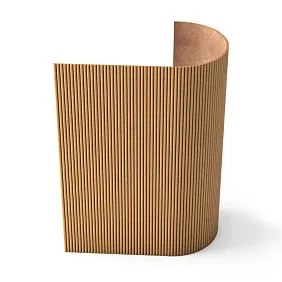
Third — flexible panels. They are underestimated until you encounter a column, a curved wall, an arch, or a radius furniture facade. And that's where the magic begins. A flexible panel solves the main issue of complex surfaces: how to maintain rhythm without a patchwork assembly. If a space has at least one curvilinear element, a regular rigid panel often breaks the composition, while a flexible one, on the contrary, makes it cohesive.
Get Consultation
What to choose for different areas of the apartment
For the hallway, panels that gather the space rather than consume it work best. Here, the slat spacing, relief depth, and color are especially important. Too wide a rhythm makes a narrow room even narrower. Too contrasting a wood grain can visually overload the entry area. Therefore, for urban hallways, light or paintable solutions are often chosen, which add volume without being overwhelming.
For the living room, panels most often become an accent in the TV area, sofa group, or fireplace composition. Here, you can allow more expressiveness: a darker color, a more active texture, a bolder slat spacing. But it's important to remember one rule: the accent wall should not compete with the furniture and lighting. If the sofa is complex, the textiles are active, and the lighting is already saturated, the slatted surface should be cleaner and stricter.
For the bedroom, the priority is different. Here, slats should not only decorate but also create a calm background. The best place is the wall behind the bed headboard. The worst solution is trying to cover everything around with slats because fashion whispered something foolish. The bedroom loves rhythm but dislikes aggression. Therefore, soft verticals, warm shades, panel compositions with limited area, and careful pairing with textiles and lighting work especially well here.
For the kitchen, not only beauty but also discipline is important. Slats in the kitchen work well in the dining area, on the end wall, around built-in furniture, on the island, or in zones where warmth needs to be added to a more technological interior. But they should be used wisely: not near splash zones without thoughtful logic, not as chaotic decoration on every other facade, but as a targeted tool.
What to choose for a country house
In a country house, panels can work on a larger scale. Where in a city apartment you have to fear overload, a house allows the space to breathe. Halls, stairwells, double-height living rooms, studies, bedrooms with high ceilings — all of these gratefully accept the rhythm of slats.
It is in a house that oak panels especially shine. Their naturalness, depth of texture, and visual solidity do not appear excessive. On the contrary, they support the very philosophy of the house as a space of stability, not a temporary urban shelter. But moderation is needed here too. If the house already has a lot of wood — floors, stairs, doors, furniture — the panels should either differ in tone or play with rhythm rather than texture.
What polyurethane molding to choose for ceilings and walls
Why polyurethane, not just any decorative substitute
Moldings have a reputation trap. Too many people still think it's either heavy classicism or an outdated palace attraction. In practice, it's the opposite. Modern polyurethane plasterwork in St. Petersburg — is one of the most flexible tools of interior architecture. It can be almost invisible if a clean graphic outline is needed. Or it can become an expressive plastic accent if the interior requires a more status-driven presentation.
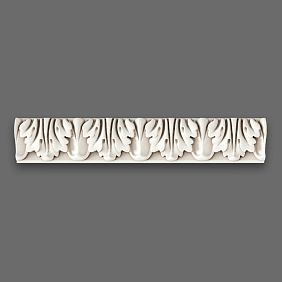
According to the STAVROS catalog, the polyurethane decor section includes moldings, cornices, rosettes, overlays, coffered elements, and other decorative items. A STAVROS article on moldings in St. Petersburg notes that the range includes cornices from 40 to 250 mm wide, rosettes from 250 to 1500 mm in diameter, moldings of various profiles, corner elements, columns, pilasters, and overlays.
Polyurethane is important for several reasons. First, it allows for clear geometry and neat relief. Second, it is lighter than heavy mineral analogs and easier to install. Third, it integrates smoothly into modern renovation scenarios where no one wants a prolonged circus with wet processes and excessive load on surfaces. And finally, it works in different styles—from soft modern classicism to a strict interior with minimalist graphics.
Moldings: the subtle graphics of space
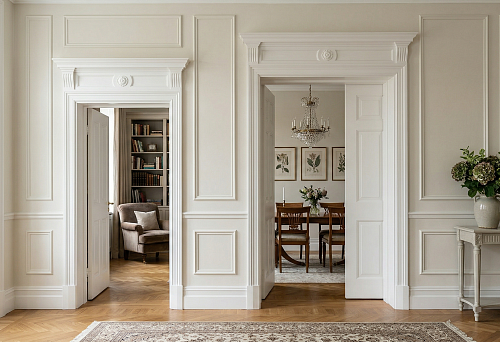
The most universal type of polyurethane decor is Moldings made of polyurethane. They don't require theatricality from the interior. They only require logic. A molding can divide a wall into tiers, frame a panel, create symmetry, form borders, support a tall door, make a ceiling look more cohesive, and a room—more expensive in appearance.
This is where many fail. They think molding is a secondary detail. No. It's a line that either disciplines the space or reveals a lack of taste. A profile that's too small on a large wall gets lost. One that's too large in a small room feels oppressive. One that's too ornamental in a modern interior looks like a foreign object. One that's too primitive in status-driven neoclassicism looks poor.
Good molding is one that looks like a natural part of the room's architecture, not a glued-on decoration.
Ceiling rosettes: the center of the composition, not a random circle
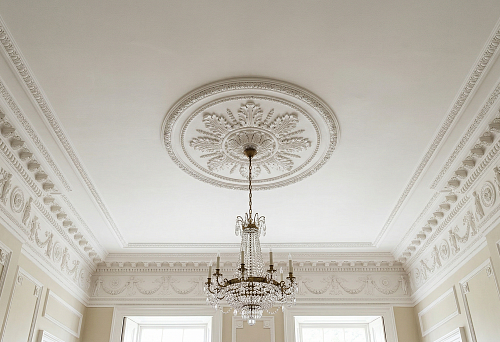
When an interior is built around a chandelier or an expressive pendant, the ceiling needs a focal point. That's what ceiling rosettesexist for. Their task is not just to cover a technical point. Their task is to create the center of gravity of the composition.
In an apartment with high ceilings, a rosette can give the room nobility without heaviness. In modern neoclassicism, it connects the light fixture and the ceiling plane. In an eclectic interior, it can work as a point that reconciles modern slats, soft furniture, and classical contours. But a rosette requires scale precision. A small rosette under a large chandelier looks pitiful. A huge rosette in a room with a low ceiling begins to suffocate the space.
Overlays: an accent that must be justified
If Sculptural decoration SPB is used to place point accents, overlays come into play. This is a more emotional tool. They are chosen for panels, door leaves, furniture fronts, wall compositions, mirror frames, and decorative nodes.
But here it's especially easy to slide into bad taste. An overlay should not be 'beautiful in itself,' but appropriate in scale, style, and place. In a modern interior, one well-thought-out overlay or a series of laconic elements often works better than a lush set for the sake of decoration itself. In neoclassicism, on the contrary, overlays can play richer, but only if supported by moldings, light, furniture, and the overall geometry of the room.
Combining slatted panels and stucco in one interior
Why this combination works so powerfully
Wood and polyurethane are materials from different worlds. One gives warmth and natural depth. The second gives profile clarity and architectural discipline. When they meet in one interior, that very tension arises on which good design rests: not chaos, but a dialogue of contrasts.
The featured article STAVROS on combining battens and moldings directly reveals the logic of this composition: the batten surface creates rhythm and depth, while moldings and other molding elements enhance volume and form the wall's framing architecture.
But they should be combined not on the principle of 'both this and that are beautiful.' You need to understand who is the main one in the composition.
If battens play the main role, the molding should work as a structure. It divides planes, frames a section of the wall, emphasizes the ceiling-wall junction, enhances the lighting area, but does not draw all the attention to itself.
If molding plays the main role, the panels become a rhythmic background. They add depth but do not compete with the classical contour.
If both materials start shouting at the same time, the interior turns into a decorative argument without an arbiter.
Scheme 1. Modern apartment
For a modern apartment, the following scheme works best. One accent wall is taken—for example, behind the TV or behind the bed. On it are installed slatted wall panels to buy in St. Petersburg can be in a smooth or wood-grain finish. A decorative museum is not built around this zone. Instead, thin Moldings made of polyurethaneare used on adjacent planes or in the logic of the wall, which add architectural quality.
What is the result? Battens provide depth. Moldings provide graphics. The room ceases to be flat but does not become heavy.
Scheme 2. Neoclassicism without ostentatious pomp
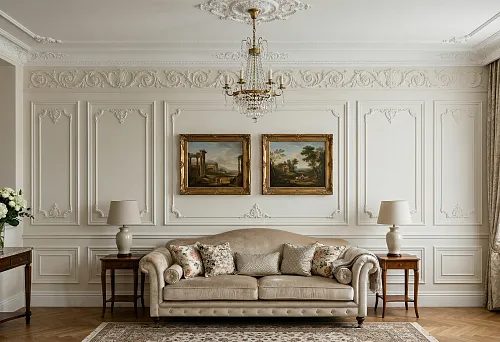
In neoclassicism, panels and moldings can work even more interestingly. For example, the lower or central part of the wall gets a slatted rhythm, and around it, a frame composition of moldings is built. The ceiling is supported by a cornice or a ceiling rosette for the chandelier. As a result, the interior gains both modern depth and classical completeness.
This works especially well in living rooms, dining rooms, studies, and master bedrooms. But only under one condition: color discipline. If you make both the slats dark and the moldings super-contrasting, and the furniture active, the interior will start to 'clatter.' Good neoclassicism always has an inner silence.
Scheme 3. Commercial interior
For commercial spaces — a salon, office, boutique, restaurant, reception area — the combination of panels and moldings works as a tool for branding the space. Slats quickly create a sense of designer finishing. Moldings form a status contour, especially in the entrance area, meeting rooms, reception, or photogenic spots.
Commercial interiors are not about decorative romance at all. They are about making an impression in seconds. If a visitor enters the space and immediately sees a cohesive, textured, expensive-feeling environment, trust grows before anything has been sold to them with words. That's why slatted wall panels to buy in St. Petersburg и polyurethane plasterwork in St. Petersburg — these are no longer just renovation products. They are tools of visual strategy.
How to assess quality before purchase
Slatted panels: what to look for in person, not in fantasies
Photography loves to deceive. Everything looks beautiful in a render. In reality, a cheap panel quickly reveals the truth. Therefore, the first rule is to evaluate not only the color but also the geometry.
A quality panel has a clean rhythm. The slat spacing is readable without visual dips. The edges are neat. The surface doesn't give a feeling of random, makeshift assembly. If the panel is for painting, it should be truly ready for a clean finish, not require half a lifetime of finishing. If it's oak, the texture should work as an asset, not as a cover for weak form.
It's important to look at the panel under side light. It's side light that reveals the truth about the relief. It shows how evenly the shadows work, if there are waves, how cleanly the profile reads. Slatted finishing is always a conversation between light and shadow. If it falls apart under light, no beautiful description will save it.
Molding: where cheapness gives itself away instantly
Polyurethane decor is evaluated by the same principles, but with different emphases. Quality molding has a clear profile. The ornament is not blurred. The edges are neat. The element doesn't look porous or plastic-toy-like. It's especially important to look at the joints and the repeatability of the form. If a molding reads differently in one section than in another, that's already a warning sign.
Good molding should have a relief that is neither dull nor screaming. It should be architectural. That is, it should work in the space, not separately from it. That's precisely why Sculptural decoration SPB you should choose not by the principle 'the more complex the pattern, the richer,' but by the principle 'how much does this profile truly enhance the interior.'
Quality is also a system, not just a separate product
There's another important thing that many ignore. A quality interior is assembled not from one successful element, but from a coordinated system. When you choose panels, moldings, sockets, and trims within a single logic, the chance for harmony increases many times over. When everything is bought chaotically—one slat from here, one molding from there, one socket from a completely different aesthetic—the interior begins to fall apart into pieces.
Therefore, it's better to choose not just individual items, but also the scenario of their joint work. This is especially important when it comes not to decorative trifles, but to large planes of walls and ceilings.
Mistakes when choosing cheap solutions
First mistake: buying only by price per square
Cheap finishing almost never loses at the checkout. It loses on the wall. When material is bought only by price, without considering geometry, texture, profile depth, and compatibility with style, it starts saving not money, but impression. And that is the most expensive saving.
Low-level slatted panels often look crude. Their rhythm is not noble, but intrusive. The surface is not assembled, but cheap to the touch. With moldings it's even worse: weak profile, unconvincing relief, plastic visuality, sloppy joints. As a result, the interior does not gain architectural quality. It gets decorative noise.
Second mistake: trying to make 'expensive-rich' in a small space
People sometimes take active slats, a large rosette, a massive cornice, ornamental overlays and try to shove all this into a room where there's already little air. This is not luxury. This is panic glued to the walls.
A small space requires fine work. It doesn't need more decor. It needs precision. One thoughtful rhythm, one competent frame, one justified ceiling accent. That's it. A good interior is not measured by the number of elements. It is measured by the accuracy of the hit.
Third mistake: not considering the building's style and the character of the space
In a historical house, some solutions work naturally, others look fake. In a modern new building — the opposite. St. Petersburg is especially sensitive to this. Space always has context. If an interior pretends there is no context, it becomes not bold, but deaf.
Mistake four: ignoring light
Reeded panels and moldings live by light. Without thoughtful lighting, even good material can lose half its power. With side lighting, the reeded surface comes alive. With the right chandelier, a rosette gains meaning. With soft accent lighting, moldings stop being just lines and start working as architecture. Ignoring this is like buying a musical instrument and not trying to tune it.
How to choose finishes to match style, budget, and purpose
If you need a modern, calm interior
Choose smooth or minimalist panels, MDF for painting, or a light wood palette. Use moldings in a strict, almost graphic key: thin moldings, clean frames, minimal ornament. In this scheme, the following work especially well Rafter panels и Moldings made of polyurethane in a restrained dialogue.
If you need a warm and status-worthy interior
Look towards oak reeded panels, deep wood tones, more expressive molding profiles, but without overload. Here you can connect ceiling rosettes and individual Polyurethane appliqués, if they truly support the overall composition.
If the budget is limited
Don't try to spread yourself too thin all at once. It's better to create one strong wall and one well-thought-out ceiling or wall accent than to scatter cheap decorative scraps around the room. With a limited budget, it's especially important to invest in elements that work on the forefront of perception: an accent wall, the main lighting zone, the primary visual axis of the room.
If the interior is commercial
The priority is durability, visual cleanliness, and instant impact. A commercial space should not demonstrate extravagance. It should demonstrate a level. And in this regard Buy slatted panels in St. Petersburg together with polyurethane stucco in St. Petersburg deliver an especially strong result: the interior is quickly read as cohesive, modern, and prestigious.
Practical selection algorithm before purchase
Step 1. Define the function of each plane
Not every wall has to be a hero. Sometimes one textured surface is enough to bring the room together. Determine where an accent is needed, where a background is needed, where the center of the composition is needed.
Step 2. Choose the dominant language
Will it be battens or molding? Who is the main character? While there is no answer, you risk assembling an interior from competing gestures.
Step 3. Match the scale to the room
Ceiling height, wall length, furniture volume, lighting scenarios—all of this should influence the choice of profile, batten spacing, and dimensions of the molding decor.
Step 4. Check samples under real light
Not under a catalog picture. Not under promotional lighting. But under the light in which the interior will live.
Step 5. Choose a system
Assemble materials so that they support each other. The internal logic of the interior is more important than the random beauty of individual elements.
Popular questions and answers
Which batten panels are better to choose for an apartment in St. Petersburg?
For an apartment, panels that do not overload the space usually work best: MDF for painting, light or medium-saturation wood tones, moderate batten spacing, clean geometry, and a clear role in the interior.
Where is polyurethane molding appropriate in a modern interior?
On walls as frames and moldings, on ceilings as cornices and rosettes, in lighting areas, on accent compositions, around slatted panels, in the design of doors, mirrors, and individual decorative elements.
Can slats and molding be combined in one room?
Yes, and it's advisable if the hierarchy is clear. One material sets the rhythm, the other provides architectural graphics. Together they create depth and completeness.
What is more important when choosing: price or quality?
In this category of finishing, quality is almost always more important. Poor-quality relief ruins the impression of the entire interior.
Is this suitable for commercial spaces?
Yes. Especially for offices, salons, boutiques, hotels, restaurants, waiting areas, and reception desks. Slats add depth, molding adds status and graphic precision.
Can molding be used not only in classic styles?
Yes. In a modern interior, it often looks even more impactful because it works as a pure architectural line without excessive decoration.
What to choose for the bedroom?
A slatted accent wall behind the headboard, a calm rhythm, soft shades, and restrained moldings. The bedroom loves expressiveness but hates noise.
What to choose for the living room?
Slats in the TV zone or on an accent wall, moldings for a frame structure, and a ceiling rosette for a light fixture if needed. Everything depends on the scale of the room and the style.
How to tell if the molding is of high quality?
By the clarity of the profile, the evenness of the surface, the neatness of the edges, the cleanliness of the relief, and the convincingness of the form under real lighting.
How not to make a mistake with the budget?
Focus on the main areas. One strong decorative element is always better than five weak ones.
Conclusion
Interior design does not tolerate randomness. Especially in Saint Petersburg, where space is almost always perceived not only with the eyes but also through cultural memory. That is precisely why the choice between a smooth wall and a textured finish is not a matter of a minor taste preference. It is a question of whether the room will live as architecture or remain just a box with a renovation.
If you need Buy slatted panels in St. Petersburg for an apartment, house, or commercial space, look not only at fashion but at rhythm, proportions, scale, and quality of execution. If you are choosing polyurethane molding in St. Petersburg, think not about 'decoration in general', but about the precise architectural role of each element. If you're looking for Sculptural decoration SPB, choose not a noisy pattern for the sake of effect, but a composition that enhances the space.
A strong interior is not built from random pretty things. It is built from materials that know how to work together. Slats provide rhythm. Polyurethane molding provides contour. Light provides volume. And a competent choice yields a result that needs no justification.
This is precisely the value of STAVROS. It's not just a product catalog, but a real database of solutions for interior architecture: Rafter panels, polyurethane moldings, Moldings, ceiling rosettes, applique and articles that help assemble not random decor, but a convincing interior. STAVROS is the choice for those who want not just to finish a renovation, but to obtain a space with character.