












































































Article Contents:
- Architectural mechanics of slatted panels: why it works
- Material: what is the fundamental difference between MDF and oak
- MDF for painting: color accuracy and engineering stability
- Solid oak: natural texture as a philosophy
- Structural types of slatted wall panels: what lies behind a simple name
- Rigid panels on MDF backing
- Flexible panels on fabric base
- Panels made of half-round battens
- Slat profile: three characters, three spaces
- Rectangular profile: architectural rigor
- Semi-circular profile: organic feel and warmth
- Trapezoidal profile: volume and dynamics
- Batten Spacing: The Mathematics of Rhythm
- Batten Orientation: Vertical or Horizontal
- Color and Wall Batten Panels in Interior Design: Application Strategies
- Monochrome: Relief Through Shadow
- Tonal Accent
- Contrasting Accent
- Two-Color System
- Wall Batten Panels in Interior Design: Ten Spatial Effects
- Interior Styles and Batten Panels: A Complete Application Map
- Minimalism
- Scandinavian Style
- Japandi
- Neoclassicism and Modern Classicism
- Loft
- Organic modern interior
- Art Deco
- Specific Spaces: Where Wall Batten Panels Are Used in Interior Design
- Living Room
- Bedroom
- Entry Hall
- Office
- Kitchen and kitchen island
- Children's room
- Staircase flight
- Bathroom
- Restaurant, cafe, bar
- Office and meeting room
- Finishing system: panel as part of the architectural whole
- Lighting and slatted panels: an inseparable pair
- Installation of slatted panels: what's important to know before starting
- Five critical mistakes in selection and installation
- Panel quantity calculation
- About the Company STAVROS
- FAQ: Answers to Popular Questions

There is a question that sooner or later everyone who takes interior design seriously asks themselves: why do some spaces feel complete, full, alive—while others, despite all the right furniture and good renovation, remain 'just rooms'? The answer almost always lies on the surface—literally. In how the walls look and feel.
Slatted wall panels in interior design are not a seasonal trend or decorative fashion. They are an architectural tool with a centuries-old history, modern production embodiment, and measurable spatial effect. The rhythmic linear relief on the wall changes how light lives in the room, how its proportions are perceived, how sound distributes in the volume, and how a person feels within it. This is not a metaphor—it's the physics and psychology of space.
This article is the most comprehensive guide on the topic. It covers all aspects: materials, constructions, profiles, styles, application scenarios, finishing system, installation, lighting, mistakes, calculations, and answers to the most common questions. Read sequentially or return to the needed section—the article is structured as an encyclopedia of the topic.


Architectural mechanics of slatted panels: why it works
Before discussing selection, it's worth understanding the mechanism. Whywall slat panels in interior designproduce such an effect — strong, unmistakably recognizable, yet non-aggressive?
A smooth wall is a flat plane. Under any lighting, it remains a plane: it reflects light uniformly across the entire area, does not catch the eye, and does not create depth. This is architectural neutrality — a background that does not participate.
A slatted surface is a relief. Each slat, under side or directional lighting, casts a shadow into the gap between adjacent battens. A continuous rhythm emerges: light — shadow — light — shadow. The surface gains depth. The eye, which glided over the smooth wall, now 'catches' on the rhythm and perceives the space behind it. The wall ceases to be a boundary — it becomes a volume.
Three components of the effect: relief creates shadow, shadow creates depth, depth creates a sense of space. It is in this chain that the entire secret of the appeal of slat panels lies.
Additional effect - acoustics. The textured surface scatters sound waves in multiple directions instead of reflecting them directly in one. In rooms with hard floors and flat walls, reverberation (echo during conversation) is a common problem. Slatted wall panels reduce it without special acoustic panels: the texture itself acts as a diffuser.




Material: what is the fundamental difference between MDF and oak
Material is the first decision in the selection chain. And there is no 'best' option here — there is the right one for a specific task.
Our factory also produces:
MDF for painting: color accuracy and engineering stability
MDF with a density of 750–850 kg/m³ is a homogeneous material without natural defects. A perfect surface for professional painting in any color from RAL or NCS catalogs. No knots, resin pockets, or areas with varying density — only a predictable, controlled result.
Main advantageMDF slatted panels— absolute color freedom. White, anthracite, bottle green, terracotta, sage, corporate office RAL — any shade is reproduced accurately and consistently from batch to batch. This makes MDF indispensable for monochrome solutions, corporate facilities, and interiors with strictly defined palettes.
Another rarely mentioned property: MDF can be repainted without dismantling. Want to change the concept after three years — light sanding, new primer, new color. The wall is refreshed, the panels stay in place.
Get Consultation
Solid oak: natural texture as philosophy
Oak is a species with a density of 700–750 kg/m³, a unique grain pattern, and natural tactility. Under open-pore oil, an oak batten is a surface you want to touch. This is not an aesthetic description: the tactility of wood is a real psychological comfort that synthetics cannot replicate.
Each oak batten carries its own grain pattern. Two adjacent battens never repeat each other. The surface is alive, slightly unpredictable — exactly what is commonly called 'natural variability' and what people intuitively perceive as a sign of genuine material.
| Criterion | MDF for painting | Solid oak |
|---|---|---|
| Color freedom | Any RAL/NCS | Natural tints |
| Natural texture | No | Yes, unique |
| Tactile | Homogeneous | Living, open pore |
| Repainting | Yes, without dismantling | No (varnish/oil refresh) |
| Monochrome to match the wall | Ideally | Difficult |
| Durability with care | 10–15 years before renewal | Practically unlimited |
| Application | Office, minimalism, corporate object | Japandi, Scandinavian, organic |
Structural types of slatted wall panels: what lies behind the simple name
"Slatted panel" is not a single product. It is a family of constructions united by a principle — parallel slats with equal spacing. Within the family — fundamental differences.
Rigid panels on MDF backing
Slats are fixed to a rigid MDF base with factory precision. The module is flat, stable, geometrically precise. Designed for flat surfaces: walls, partitions, furniture fronts. This is 90% of all applications — and precisely why the rigid panel is the industry standard.
The key parameter of a rigid panel is spacing precision. A professional manufacturer guarantees deviation of no more than 0.5 mm. This is the condition for seamless joining: slats of one module visually continue the slats of the adjacent one without offset. With unstable spacing, joints are visible — and this cannot be corrected by any installation skill.
Flexible panels on a fabric base
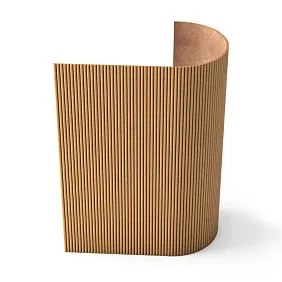
Slats are attached to a fabric mesh base. It allows the panel to bend with a radius from 100–150 mm without deformation of the battens. The flexible panel wraps around columns, arches, rounded corners, wave-shaped partitions.
For curved surfaces — this is the only professional solution. A rigid MDF panel cracks on a radius: this is the physics of the material, not a question of installer skill. The flexible construction provides a continuous slatted pattern even on the most complex geometry.
Panels made of half-round molding strips
A separate category by slat profile. Semi-circular cross-section — soft, diffused shadow without sharp edges. Available in rigid and flexible versions. For living spaces with a warm, natural atmosphere — this is the most organic choice among all profiles.
Rail Profile: Three Characters, Three Spaces
A profile is the cross-section of a rail. It defines exactly how light interacts with the surface—and thereby shapes the image of the entire space.
Rectangular profile: architectural strictness
Sharp, straight edges. Clear, rigid, 'drafting-like' shadows under side lighting. The surface is strict, disciplined, architecturally precise. Application: minimalism, loft, office, meeting room, restrained interpretation of neoclassicism, corporate spaces.
A monochrome white rectangular profile on a white wall is the highest form of minimalism: color disappears, leaving only the architectural graphics of shadow. This is what is commonly referred to as 'expensive simplicity.'
Semicircular Profile: Organic and Warm
Rounded edges. Light diffuses along the arc—shadows are smooth, soft, transitioning without sharp boundaries. The surface is natural, warm, cozy. Application: bedroom, living room with a soft character, children's room, home library, any spaces with an organic atmosphere.
Trapezoidal Profile: Volume and Dynamics
Flaring towards the base creates a multi-level, volumetric shadow. The surface is dynamic, with decorative weight. Application: commercial spaces with high decorative intensity—restaurant, showroom, boutique, lobby.
Rail Spacing: The Mathematics of Rhythm
Spacing is the distance between the centers of adjacent rails. A technical parameter with a direct influence on the visual character of the surface.
Narrow spacing (15–20 mm): dense, rich, active rhythm. The surface draws the eye, creating decorative tension. For large accent planes in spacious rooms.
Medium spacing (25–35 mm): universal, balanced rhythm. Works in most residential and commercial spaces. Moderate decorative activity without aggression.
Wide spacing (40 mm and more): airy, calm rhythm. The surface 'breathes'. For small rooms and delicate accent solutions where depth without tension is needed.
Practical principle: the smaller the room — the wider the spacing. In a small room, dense rhythm creates visual noise. Sparse spacing — calm spatial depth.
Slat orientation: vertical or horizontal
This is a spatial decision made before ordering. It changes the perception of a room radically — and requires no additional costs.
Vertical slats: the gaze moves from bottom to top. The room is perceived as taller. A standard solution for most applications — apartments with typical 2.7 m ceilings get a visual 'lift' in height.
Horizontal slats: the gaze moves horizontally. The room is perceived as wider. Ideal for end walls of narrow corridors, small rooms where width needs to be added without physical changes.
Diagonal slats: a rare solution. Creates dynamics, kinetics, a sense of movement. For non-standard commercial concepts.
Color and wall slat panels in interior design: application strategies
Monochrome: relief through shadow
A panel matching the wall color is a visual paradox: color unifies the surface, while relief exists only through shadow. Under uniform lighting, the surface appears almost homogeneous. With directional or side lighting, it comes to life. White monochrome in a white interior is a sophisticated, top-tier solution.
Tonal accent
Light-colored wall, panel 2–3 shades darker. The relief is perceived simultaneously through shadow and color. A restrained, professional, universally appropriate solution.
Contrast accent
Neutral walls. Slatted panel in a rich, deep color: anthracite, Bottle Green, Navy, Burgundy, Terracotta. The panel comes to the foreground, becoming the focal point of the space.
Two-color system
Slats in one color, backing (visible in gaps) in another. White slats on black backing: maximum graphic clarity. Gray slats on dark blue backing: unexpected depth. This is an advanced level of working with slatted panels, delivering a strong visual result.
Slatted wall panels in interior design: ten spatial effects
Let's list specifically what exactly changes when a slatted panel is mounted on a wall.
-
A flat wall transforms into a three-dimensional surface—the relief creates perceived depth;
-
The gaze gains a focal point—space organizes around the accent wall;
-
Vertical battens visually raise the ceiling;
-
Horizontal battens visually expand the room;
-
Directional lighting creates sculptural chiaroscuro—the wall changes throughout the day;
-
Acoustic reverberation decreases—sound comfort improves;
-
Integration of LED lighting creates architectural scenario lighting;
-
Zoning without partitions—the batten wall 'marks' a functional zone;
-
The first architectural signal upon entry—an entryway with a batten wall declares the character of the entire interior;
-
Material consistency—an oak panel rhymes with wooden furniture, painted MDF—with painted elements.
Interior Styles and Slatted Panels: A Complete Application Map
Minimalism
MDF for painting. Monochrome. Rectangular profile. Side or directional lighting is essential. This is a space where only architecture speaks: form, shadow, proportion. No decor—only surface.
Scandinavian style
Light oak with oil finish or MDF in linen/off-white tone. Vertical slats, semi-circular or rectangular profile. Warm lighting 2700–3000 K. Natural warmth, functional clarity, coziness without sentimentality.
Japandi
Oak with gray tint or natural. Horizontal orientation—a meditative horizon. Wide spacing. Semi-circular profile. Natural adjacent materials. Japanese restraint as a philosophy of space.
Neoclassicism and modern classicism
MDF for painting in a warm neutral tone or oak with a tint.Wooden molding and corniceAround the perimeter of the slatted plane.Floor wooden skirtingMade of solid oak. A complete architectural panel system 'cornice—slatted field—baseboard'—a modern interpretation of classic wooden panels without literal reproduction of historicism.
Loft
Dark oak with matte varnish or MDF in anthracite/graphite. Rectangular profile, large spacing. Industrial metal nearby. A slatted panel in a loft is not a soft accent, but a hard, self-sufficient object.
Organic contemporary interior
Oak in a natural tone with a semi-circular profile. Natural adjacent materials: stone, ceramics, linen. The slatted panel is one of the natural voices in a multi-material chorus.
Art Deco
MDF for painting in rich accent tones (black, dark green, burgundy, deep blue). Trapezoidal or rectangular profile. Metallic accents in gold, brass, or black chrome. Geometric expressiveness.
Specific spaces: where slatted wall panels are used in interior design
Living Room
Accent wall behind a sofa or TV. One slatted surface transforms the entire interior: the eye gains a focal point, the space acquires a center. Oil-finished oak with side lighting — timeless classic. Anthracite MDF behind the TV in a white interior — a strict modern look.
Bedroom
Wall behind the bed headboard. A delicate, intimate scenario. Semi-circular profile, neutral warm tone. LED strip along the lower perimeter of the panel — soft upward glow. The result — the atmosphere of a designer hotel with quite affordable investment.
Entryway
The first architectural signal.wall slat panels in interior designin the hallway immediately sets the level for the entire interior. For a narrow corridor: horizontal slats on the end wall visually expand the space. For a square hallway: vertical slats on the main wall — height and solemnity.
Office
Wall behind the desk. Status, concentration, acoustic comfort. Dark tone, rectangular profile. A background for video calls that speaks to a business level. The slatted relief reduces reverberation — the voice in the room and on camera becomes clearer.
Kitchen and kitchen island
Slatted MDF island fronts painted to match the kitchen furniture. Horizontal orientation visually stretches the island. Precise RAL color — consistency with the fronts and backsplash.
Children's room
MDF painted with non-toxic water-based enamels. Semi-circular profile — no sharp edges. Pastel for young children, more active tones for teenagers. The main advantage: they grow up — you repaint without dismantling.
Staircase flight
Vertical slats accompany the upward movement. Next tobalusters for staircasessolid oak — a unified wooden architectural theme that connects the levels.
Bathroom
Only moisture-resistant MDF (MDFV) with special coating. Forced ventilation. When properly executed — a durable, stylish surface.
Restaurant, cafe, bar
Atmosphere is the main product. Warm oak, directional lighting, acoustic diffusion. A slatted wall panel in a restaurant is managing the guest experience through architecture.
Office and meeting room
Corporate RAL. Business image. Acoustics. Slatted wall panels in office interiors are simultaneously branding, aesthetics, and function.
Finishing system: panel as part of the architectural whole
A slatted panel works most effectively not in isolation, but as part of a coordinated system. Here's how this system is built.
Molding along the top perimeter. A horizontal architectural line completes the slatted plane from above. Without molding, the textured surface 'breaks off' into a smooth wall — the boundary looks random.wooden moldingfrom the same wood species — a unified material language. MDF molding for painting in the same color — an invisible architectural 'cap'.
Floor baseboard. The lower boundary of the system.Floor wooden skirtingfrom solid oak next to an oak slatted panel — a unified material image from floor to upper boundary.Buy wooden baseboard from solid woodfor the oak system,buy MDF skirting boardfor painting — for the MDF system: consistency without random details.
Extension strip. Non-standard areas — corners, slopes, door/window surrounds.wooden plankfrom the same wood species — a seamless organic extension.
Decorative overlays. In neoclassical styleDecorative Insertscreate an architectural frame around the slatted field — horizontal and vertical trims transform a simply beautiful wall into a full-fledged paneled architectural system.
Furniture handles. Slatted furniture fronts +Furniture Handlesin a coordinated material — a complete furniture look without random details.
Classical furniture.Classic Furniturewith wooden elements next to an oak slatted wall — a material dialogue that enhances the value of both.
Stair balusters. Slatted wall panels in the stairwell +balusters for staircasesfrom the same solid wood — a vertical wooden theme, unified from the first floor to the top.
Lighting and slatted panels: an inseparable pair
A slatted wall panel in an interior without thoughtful lighting is only half the result. Maximum visual effect is achieved only with proper lighting.
Directional spotlights at a 30–45° angle to the surface. Clear, sculptural shadow. The relief is maximally expressive. Adjustable spotlights allow changing shadow intensity.
LED strip behind molding (downward light). Soft halo. Calm, cozy atmosphere. For bedrooms and living spaces.
LED in the gaps between slats. Backlighting from inside the panel — a 'glowing' surface effect. An architectural, stage-like, unconventional technique.
Warm or cool light: oak — warm (2700–3000 K), enhances natural warmth. MDF for painting in a neutral tone — neutral (3500 K) for accurate color rendering.
Installation of slatted panels: what's important to know before starting
Base preparation. Dry, clean, degreased. Plane deviation up to 3–5 mm — adhesive installation. More than 5 mm — frame installation on metal CD-profile with 400–600 mm spacing.
Adhesive installation. Mounting adhesive applied in a serpentine pattern on the substrate. The panel is pressed and held. Finish nails around the perimeter in areas concealed by molding and baseboard.
Frame installation. Metal profile on the wall. Panels are fastened with self-tapping screws through the substrate into the profile. The plane is controlled with a laser level. A technical gap for wiring and acoustic filling is possible.
Joining. Butt joint without a gap and without overlay strips. With precise factory spacing — a monolithic surface through any number of joints.
Painting MDF — before installation, by spraying. After installation with a roller — uneven coverage in gaps between slats. Professional result — only spraying before installation.
Finish elements. Molding along the top edge, baseboard at the bottom, corner joints — 45° on a miter box, acrylic sealant on joints with smooth walls.
Five critical mistakes in selection and installation
Mistake 1: cheap, loose MDF. Density below 700 kg/m³ — unstable material, swelling edges, poor fastening. Saving here means redoing it in a year.
Mistake 2: rigid panel on a curved surface. Rigid MDF does not bend. Only flexible panel on a fabric base for columns and arches.
Mistake 3: unstable slat spacing. Visible joints — an irreparable defect.
Mistake 4: lighting after installation. Slatted relief is almost invisible without side or directional lighting. Lighting is planned before installation.
Error 5: Inconsistent trim. Baseboards and moldings from a different product line disrupt the material integrity of the system.
Calculating the number of panels
Wall area (minus openings) ÷ area of one module = number of modules. The result is rounded up. Add 10–15% for cutting waste. Example: wall 4.5 × 2.7 m = 12.15 sq.m. Module 0.6 × 2.4 m = 1.44 sq.m. Needed: 12.15 / 1.44 = 8.44 → 9 modules. With 15% waste = 11 modules.
About the company STAVROS
The space in which a person spends their life defines their perception of that life. This is not pathos — it's architectural anthropology. And that is precisely why the materials from which this space is built matter: their precision, stability, durability, honesty.
STAVROS is a Russian manufacturer of MDF and solid wood products for interior finishing and furniture production. All types and constructions of slatted panels (rigid on MDF backing, flexible on fabric base, rectangular and semicircular profile), a complete line of coordinated trim, decorative overlays, stair elements, furniture decor and hardware.
Over 4000 models, 20,000 modifications, 39 product groups. MDF from European suppliers with a density of 750–850 kg/m³, climate-controlled wood drying chambers, two-level quality control system (Standard and Prestige), manual processing of decorative elements. Shipping from a single piece. Delivery across all of Russia. Specialist consultation before placing an order.
FAQ: Answers to popular questions
How do slatted panels differ from clapboard?
Clapboard is a solid cladding without gaps. Slatted panels are an open, rhythmic texture with gaps between the battens. A fundamentally different decorative and spatial effect: clapboard covers the wall, while slatted panels create an architectural surface with depth.
Are slatted wall panels suitable for small rooms?
Yes — with the correct choice of spacing and orientation. Wide spacing (35–40 mm) and horizontal orientation in a small room add visual volume. Narrow spacing and vertical slats are not recommended for spaces with a height of less than 2.5 m.
Can you install slatted panels yourself?
Yes, adhesive installation on a flat wall is accessible without special preparation. Frame installation requires experience working with metal profiles and a laser level.
How to care for oak slatted panels?
Dry or barely damp cloth for dust. Renew oil or varnish every 3–5 years depending on intensity of use. Abrasive agents are not permissible.
Can you combine slatted wall panels with a slatted ceiling?
Yes — and this is one of the strongest architectural techniques. When purchasing from one manufacturer, the slat spacing is automatically coordinated. The corner transition from wall to ceiling through a unified rhythm creates a monolithic sculptural image of the space.
Do you need to paint MDF panels before installation?
Strongly recommended — priming the ends and front surface before installation, final spray painting before installation. Painting after installation results in uneven coverage in the gaps.
Which manufacturer of slatted panels is the best?
Key parameters: MDF density 750–850 kg/m³, spacing accuracy no more than 0.5 mm, closed ends, availability of coordinated linear footage. STAVROS meets all these requirements and offers a complete finishing system from one production program.


