Article Contents:
- What exactly you're buying: a panel, not a random set of slats
- Which material to buy: MDF or solid oak
- When to buy MDF
- When to buy solid oak
- Which Slat Profile to Buy
- What dimensions, spacing and gaps to consider before buying slat panels
- Vertical or horizontal: what to buy for a specific wall
- Which panels to buy for different rooms
- Buy Slatted Panels for the Living Room
- Buy Slatted Panels for the Bedroom
- Buy slat panels for hallway and corridor
- Buy slat panels for office, meeting room and showroom
- When to buy rigid panels and when to buy flexible ones
- Buy panels for painting or in their natural state
- How to calculate the number of slatted panels before purchase
- What you need to know about installation before buying
- What determines the price of slatted wall panels
- Common mistakes when buying slatted wall panels
- Why buying through a catalog with a clear structure is more profitable
- Where to buy slatted wall panels
- FAQ: popular questions about buying slatted panels
- About the Company STAVROS

Here's an honest conversation you need before any purchase. Not about 'trends' and not about 'slats being everywhere now'. Before youbuy wall slat panels, you need to answer several specific questions: what exactly you're getting, what material, what profile, what size, what quantity, and where it will go. A mistake at any of these stages isn't a 'slightly worse result'. It's extra modules with nowhere to put them, a wall with the wrong rhythm, a rigid panel on a radius column, or MDF in a bathroom without moisture-resistant treatment. Rework costs more than any savings.
This article isn't an inspiring presentation about beautiful interiors. It's a practical guide to selection and purchase. Read in order or jump to the needed block — the structure allows both.



What exactly you're buying: a panel, not a random set of slats
The first and most important shift in understanding is the difference between buying slats individually and buying a ready-made slat panel as a modular element.
When a person buys individual slats, they take on the task of marking the spacing, leveling each plank, controlling the gap, joining at corners, and so on. It's time-consuming, requires high precision, and yields predictable results only in experienced hands. On a large surface, errors accumulate — and by the end, the pattern 'drifts'.
A ready-made slat panel is a solved geometric problem. Parallel slats are fixed to a load-bearing substrate with factory-set spacing. You get a module where the rhythm is already set by production. Your task is to install it level on the wall. Everything else is factory precision.
A key consequence: when buying a ready-made panel, the joints between modules on a large surface butt together — and the slat pattern continues without offset, without breaks, as a single whole.
Now about structural types, because this directly affects the purchase.
Rigid panels on MDF substrate — a basic solution for straight, flat surfaces: walls, ceilings, TV zones, furniture fronts. The module is rigid, geometry is stable, installation is fast and precise. If you have a straight wall — this is your option. If you buy rigid slat panels for a radius surface — they won't conform to the shape, will deform, or crack at bend points.
Flexible fabric-based panels — a solution for everything with curvature: columns, arches, rounded corners, curved furniture fronts. The fabric base allows the panel to wrap around any radius without distorting the slat pattern. Buy flexible slatted panels precisely where a rigid module physically doesn't fit the surface shape.
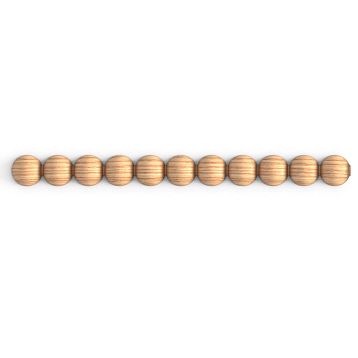
Panels made of semi-circular battens — the third structural type by profile. The rounded cross-section of the slat creates a fundamentally different play of light: soft, delicate, without sharp shadows. This is not just a 'different look' — it's a different visual character of the wall. Buy panels made of semi-circular battens where you need a warm, enveloping relief, not strict architectural graphics.




Which material to buy: MDF or solid oak
This is the main question of choice when purchasing. And it has no universal answer — only an answer relative to your specific task.
Our factory also produces:
When to buy MDF
MDF panel is an engineered material with a homogeneous structure, free from natural defects, with a perfectly smooth surface. The density of MDF in the STAVROS range is 750–850 kg/m³, which ensures precise profile milling and stable geometry for painting.
It is correct to buy MDF slatted panels in the following situations:
-
You need an exact color. MDF has no inherent texture that would affect the enamel tone. Paint from the RAL or NCS catalog applies evenly and reproduces the shade accurately. Buying RAL slatted panels for a designer's project — that's MDF, and only MDF.
-
You need a monochrome solution. Slats matching the wall color — a technique where the panel 'dissolves' into the surface, leaving only the relief. Without MDF for painting, this is impossible.
-
You need stable geometry. Under normal operating conditions, MDF does not change shape, warp, or crack.
-
Ease of updating is important. The panel can be repainted right on the wall — no dismantling needed. After a few years, a new color — the wall is updated without renovation.
-
A modern, laconic look is needed — minimalism, contemporary, neoclassical, monochrome.
Additionally: buying slatted panels for painting in white or a neutral shade is a basic classic for classical and neoclassical interiors, where all surfaces form a unified architectural shell.
Get Consultation
When to buy solid oak
Buy oak slatted panels when the interior calls for a natural material with its own voice. Oak is a species with a density of 700–750 kg/m³, featuring pronounced grain, a tactile surface, and a lively pattern. Under transparent oils — a warm golden tone. Under tinting compounds — cool Scandinavian gray, tobacco cognac, graphite, wenge.
You need to buy wooden slatted panels made from solid wood in the following cases:
-
The interior is built on natural materials — wood, stone, linen, leather.
-
Tactility is needed — a surface you want to touch.
-
A 'rich, living' look is needed without gloss and monochrome.
-
Style — Scandinavian, Japandi, eco, loft, organic minimalism.
-
The possibility of renewal through sanding and changing the oil is needed: buying oak slatted panels means buying a material that lives in the interior for decades.
Important note: buying solid wood slatted panels for an interior that already has many wood textures — wooden floor, wooden furniture, wooden doors — is a risk of overloading. Either all wooden elements must be coordinated by species and tone, or instead of oak, you should choose MDF in a neutral color.
Which batten profile to buy
The profile determines not the beauty of the panel in an abstract sense, but the character of light and shadow in your specific room. This is a technical choice with direct visual consequences.
Rectangular profile — the most common. Clear edges, sharp shadow lines in the gaps, strict architectural pattern. With side lighting, each protrusion casts a precise shadow — the wall gains graphic expressiveness. Suitable for minimalism, modern classic, neoclassical, office interiors, meeting rooms. This is an 'adult' profile without sentimentality.
Semi-circular profile (bead) — a fundamentally different light story. The rounded cross-section does not create sharp shadows: light glides smoothly over the convexity, creating a soft, delicate relief. A surface with semi-circular slats looks warmer, softer, more delicate. Ideal for bedrooms, children's rooms, living rooms with a warm atmosphere, Japandi and Scandinavian style.
Trapezoidal profile — an intermediate solution. The cross-section widening towards the base creates a shadow that is more dynamic than a semi-circle's, but softer than a rectangle's. Works well in lofts, modern classic, commercial spaces with an active atmosphere.
How not to make a mistake with the profile when buying — a simple rule: the smaller the room and the more domestic its character, the softer the profile should be. Buying a rectangular bead for a small children's room means getting a sharp geometric pattern where softness is needed. This works in a director's office, but not over a child's bed.
What dimensions, pitch, and gap to consider before buying slatted panels
This is where most people make a mistake: they buy 'by eye,' then they are short one module or have half left over.
Before buying, you need to know four parameters of the finished panel:
-
Module width — the horizontal size of the panel.
-
Module height is the vertical dimension (usually matching the wall height or a multiple of it).
-
Batten width is the cross-section of the glazing bead.
-
Batten spacing / gap is the distance between the slats.
The gap is not a decorative detail but a functional parameter. A narrow gap creates a dense, rich rhythm: the surface looks luxurious and delicate, but in small rooms it can feel 'overwhelming'. A wide gap brings airiness and lightness: the surface is more open, and the space doesn't feel overloaded. For small rooms, use narrow battens with a small but not overly tight spacing; for large spaces, you can go wider.
How to calculate the number of modules:
Take the wall area (width × height). Add 10–15% for cutting, complex nodes, and joints. Divide by the area of one module. Round up to the nearest whole number.
Example: a wall 4 × 2.7 m = 10.8 sq.m. + 15% = 12.5 sq.m. A module 0.3 × 2.7 m = 0.81 sq.m. Required: 12.5 / 0.81 = 15.4 → order 16 modules.
Stock is essential. Slatted wall panels are not a roll material sold by the meter. They are ready-made modules: an extra module is better than a missing one that would have to be reordered, potentially with batch variations.
Important rule: never buy 'approximately'. Gap and batten width parameters differ across product codes—visually similar panels can create a mismatched pattern at the joint if purchased from different batches.
Vertical or horizontal: what to buy for a specific wall
Mounting orientation is not just about 'I like vertical' or 'I want horizontal'. Each orientation creates a specific visual effect.
Vertical mounting — the eye follows the lines upward. The wall appears taller, the ceiling seems higher, and the space expands vertically. Critically important for rooms with a height of 2.4–2.6 m: vertical battens literally 'add centimeters' to the perceived height. This is the most popular scenario when purchasing wall batten panels.
Horizontal mounting — the opposite effect. The gaze moves sideways, and the wall is perceived as wider. The correct choice for a narrow room or a wall that needs to be visually 'widened' — a corridor, a partition wall, an end wall.
Diagonal mounting — the most dynamic option. Panels are mounted at an angle: this introduces movement and tension. Works as a strong accent — in a restaurant hall, showroom, lobby. Requires professional marking: diagonal is more complex to install at joints and corners. Not recommended for residential spaces without a design project.
Rhythm density when purchasing: you shouldn't choose the maximum density for a small room, guided by the idea that 'it looks better in photos'. Photography is a different scale. In a real space of 10–12 sq.m., a very dense rhythm feels oppressive. A wider spacing with a thin profile is the correct choice for small living areas.
Which panels to buy for different rooms
Buy slatted panels for the living room
Living room — the main 'showcase' of the interior. Here, the accent wall behind the sofa or the TV area is the architectural center of the entire space. It is most correct to buy batten panels for the living room floor-to-ceiling, vertically, with well-planned lighting.
For the TV area — dark MDF for painting in anthracite or graphite. Against its background, the screen doesn't 'stand out' but integrates into the architectural context. For the sofa wall — oiled oak or MDF in a neutral tone. Rectangular or trapezoidal profile. Integration ofwooden skirting boards and moldingsin a unified tone completes the living room finish as an integrated system.
Additionally, the living room often employs a zoning principle: slatted panels for zoning mark the boundary between the lounge area and the dining area in an open-plan layout—without a physical partition, only through a change in finish.
Buy slatted panels for the bedroom
The bedroom is a space of silence and delicate texture. Here, the wall behind the bed headboard is the main visual focal point. It's better to buy slatted panels for the bedroom with a semi-circular profile: the soft chiaroscuro of the semi-circular beading creates a warm atmosphere. The tone is neutral—smoky, beige, cream, or deep blue—depending on the concept.
Hidden LED lighting along the top perimeter of the panel, a wall in oak with tinted oil—this is the 'hotel effect' that people are willing to pay extra for. Buying oak slatted panels for the bedroom with a matte oil finish is one of the most mature and serene solutions in residential interiors.
Buy slatted panels for the hallway and corridor
The hallway forms the first impression. A narrow corridor with vertical slats on the end wall immediately transforms into a different space: it elongates, gains direction and character.
A practical argument for the hallway: the lower part of the wall with slatted cladding (height ~120 cm) is significantly more resistant to mechanical impact than a painted wall. The slats are not afraid of bags, umbrellas, and accidental bumps.
For the corridor—vertical slats on the end wall stop the long perspective, making the space more proportionate. The profile is rectangular for a stricter character, semi-circular for softness.
Buy slatted panels for the office, meeting room, and showroom
For the office—MDF for painting in neutral corporate tones or oak with a matte varnish. The rhythm of the slats organizes the space, creates a sense of order, and focuses attention. A work area with a slatted wall as a background is a psychologically focused environment.
Buy slatted panels for the meeting room with an acoustic effect—here, the textured surface scatters sound waves, reducing reverberation in a room with hard floors and a large area. Dark tones—strictness and status. Light tones—openness and collaboration.
Buying slat panels for a showroom is a matter of 'background' that doesn't compete with the product but creates the right context for it. Neutral MDF panels in the wall tone or oak under transparent oil—both options create a 'luxurious' environment without excessive activity.
When to buy rigid panels and when flexible ones
This question is important because the mistake here is not aesthetic but physical: a rigid panel on a radius column simply won't lay as it should.
Buy rigid slat panels when:
-
All your surfaces are straight: main walls, ceiling, niches, TV area, furniture fronts.
-
Maximum geometric precision and installation speed are needed.
-
The area is large—rigid modules quickly cover large planes.
Buy flexible slat panels when:
-
The project includes columns, arches, rounded corners, radius ends.
-
Continuous passage of the slat pattern through the bend is needed—without joints, without deformations.
-
Visual monolithic appearance of the surface is important regardless of shape.
Flexible fabric-based panel wraps around any radius: it does not crack, slats do not spread apart or come closer on the bend—their spacing remains constant. The result looks like expensive custom fabrication, although in fact it is a standard factory module with proper construction.
Buying slatted panels for radius surfaces and choosing a rigid option is a mistake that is difficult to correct without complete dismantling.
Buy panels for painting or in natural finish
This question clarifies the previous choice between MDF and oak, adding a third dimension—finish treatment.
Buying MDF slatted panels for painting means getting a neutral blank that you paint in the desired shade after or before installation. This is the most flexible scenario: color can be changed at any time without dismantling. For design projects requiring precise color matching—buying pre-painted slatted panels or panels for painting according to NCS and RAL is standard.
Buying white slatted panels is the most popular ready-made option for neoclassical and light monochrome interiors. Buying slatted panels in wall color is for a 'dissolving' monochrome effect, where texture is present but there is no color break.
Buying solid wood slatted panels in natural finish means getting a blank for final treatment with oil, varnish, or tinting. Clear oil gives a warm golden natural tone. Tinting oil—Scandinavian gray, wenge, tobacco, graphite. Varnish—a more formal and durable surface.
Both paths require one thing: do not rush with finish treatment until the final decision on the interior palette is made. Repainting a painted panel is easy. Changing the tone of tinted oak is more difficult.
How to calculate the quantity of slatted panels before purchase
Calculation is not math for math's sake. It's a specific protection against two scenarios: 'one module short' (ordering extra from another batch risks tone or pattern mismatch) and 'bought too much' (money wasted).
Calculation algorithm:
-
Measure the width and height of the wall (or the part you're finishing).
-
Subtract the area of openings — doors and windows.
-
Add 10–15% for trimming, complex patterns, mistakes, corner joints.
-
Find out the exact dimensions of one module from the manufacturer.
-
Divide the total area by the area of one module.
-
Round up.
For reference: a standard accent wall in a living room 3.5 m wide and 2.7 m high is about 9.5 sq.m. of clean surface + 15% margin = about 11 sq.m. to order.
For a corridor 6 m long and 2.5 m high (one wall) — 15 sq.m. + margin = about 17 sq.m.
For a bedroom with a headboard wall 2.2 m × 2.5 m — 5.5 sq.m. + margin = about 6.5 sq.m.
Why you can't buy 'approximately': module sizes vary across different SKUs. If you add modules from another SKU to already installed ones, the slat pattern may not align in pitch. This isn't noticeable to the eye when purchasing, but on the wall—it's immediately apparent.
What you need to know about installation before buying
We won't turn this section into a technical lesson. But there are a few things you need to understand before buying, because they affect the choice of construction.
Flat wall—can be installed directly. If the wall deviation does not exceed 3–5 mm, a rigid panel is mounted with mounting adhesive or finish nails without a preparatory frame. Fast, simple, reliable.
Uneven wall—a frame is needed. A metal or wooden batten is leveled independently of the base condition. Panels are mounted on the frame guides. An additional bonus: a gap is created between the frame and the wall to hide cables, pipes, and internet wiring. This is the most practical option for apartments with old walls.
Hidden fasteners—important for those without finishing painting skills. When mounting with clips or hidden clips, the fasteners are completely invisible in the finish. When mounting with finish nails—small dots that are covered with putty and repainting. When mounting with exposed screws—careful masking will be required.
The choice of mounting method affects the choice of panel: for ceiling mounting—only a frame with precise load calculation and reliable fasteners. For walls with adhesive—high-quality base preparation is needed. Flexible panels—only adhesive according to the surface shape.
What determines the price of slat panels for walls
An honest section for those who don't understand why one panel costs this way and another differently. The price of slat panels for walls is made up of several clear factors.
Material—the first and main one. MDF is cheaper than solid oak: this is logical because solid wood is a natural material with different labor intensity of processing, sorting, and selection based on fiber quality.
Construction type — rigid panels on MDF backing are technologically simpler than flexible modules on a fabric base. Flexible ones are more expensive to produce.
Glazing bead profile — complex milling of a trapezoidal or non-standard profile is more expensive than a rectangular one.
Module size — larger and longer modules require more material consumption and carefulness in production.
Painting — a panel for painting is cheaper than a ready-painted panel: painting to an exact RAL/NCS in production is a separate technological operation.
Order volume — when ordering for a large project or with bulk purchasing, the price per unit is typically lower. If you are finishing several rooms — calculate the total volume and clarify the terms.
Project complexity — curved surfaces, non-standard sizes, custom profiles on order — all of this adds to the cost.
Understanding this mechanism allows for an accurate choice: where you can avoid overpaying, and where more expensive means more correct.
Typical mistakes when buying slatted wall panels
This is the most valuable section for those who don't want to redo things. Each of the listed mistakes is a real scenario that occurs regularly.
First mistake: choosing based on a beautiful photo without understanding the profile. A photo doesn't convey the real light and shadow of your specific lighting. What looks delicate in the project may create a completely different pattern in your room with warm spotlights. Request samples. Look at them in daylight and evening light.
Mistake two: didn't consider the profile. 'I like the relief' is not a profile choice. A rectangle in a children's room creates sharp graphics where softness is needed. A semicircle in a corporate office is too soft for a business context.
Mistake three: bought panels without considering the slat spacing in a small room. Wide spacing with large slats in a 10–12 sq.m. room overloads the space. The result is a wall that feels oppressive rather than decorative.
Mistake four: used rigid panels where flexible ones were needed. A rigid module on a column or arch leads to deformation, cracks, and poorly fitting joints. Only flexible panels on a fabric backing are suitable for curved surfaces.
Mistake five: bought oak for an already wood-heavy interior. Natural oak in a space that already has a wooden floor, wooden furniture, and wooden doors creates a chaos of textures. Either all wooden elements should be coordinated by species and tone, or use MDF.
Mistake six: didn't think about lighting. A slatted panel without side or directional lighting loses half its expressiveness. The relief 'comes alive' only in the right light. Lighting should be planned before installation, not after.
Mistake seven: estimated 'roughly'. Ordered less than needed. A reorder from a different batch risks mismatched spacing or tone. Ordered more — money wasted on unused modules.
Mistake eight: bought standard MDF for a kitchen or bathroom. In rooms with regular humidity fluctuations, moisture-resistant HMR-MDF is needed, not standard material.
Why buying through a catalog with a clear structure is more advantageous
A proper catalog for buying slatted panels is not just a 'website with pictures'. It's a tool that allows you to compare construction types, materials, profiles, and module formats in minutes without having to call and ask about each parameter.
When the catalog structure is clear — MDF and oak are separated, rigid and flexible constructions are marked, profiles are shown — you can make all key decisions before the first contact with a manager. This means you can proceed to ordering faster and more accurately.
When purchasing through a well-structured catalog, you also see exactly what is included in the item: module dimensions, substrate material, profile type. This eliminates buying the 'wrong thing' due to misunderstanding the description.
Where to buy slatted wall panels
Moving on to the final guideline.Buy slatted panelswith a full understanding of the choice, you can do so in the STAVROS catalog — a Russian manufacturer of MDF and solid wood products for interiors.
In the assortment:
-
MDF for painting — for precise color solutions according to RAL and NCS, monochrome interiors, modern classics.
-
Solid oak — for natural texture, tactility, natural tone under oil or varnish.
-
Rigid panels on MDF substrate — for all flat surfaces: walls, ceilings, TV zones, furniture fronts.
-
Flexible panels on fabric backing — for columns, arches, radius corners, any non-standard geometry.
-
Panels made of semi-round battens — for soft, delicate chiaroscuro, a warm atmosphere in living areas.
-
Solutions for residential and commercial properties — living rooms, bedrooms, hallways, offices, meeting rooms, restaurants, showrooms.
Additionally in the STAVROS catalog —wooden skirting boards, moldings, cornices, and solid wood millworkfor creating a complete interior finishing system: slatted wall + skirting board + cornice in a unified material and tone.
Slatted wall panels can be purchased both retail for a single room and wholesale for a comprehensive project — terms are clarified upon inquiry. Delivery across all of Russia.
FAQ: popular questions about purchasing slatted panels
Can I buy slatted panels and install them myself without a professional?
Yes — provided the walls are straight, with precise marking and minimal tool-handling skills. Installation with adhesive or finish nails on a level substrate does not require professional training. Frame installation — preferably with experience or under specialist guidance.
How long is the delivery wait?
Depends on product availability and region. Please clarify when placing your order.
Can I order samples before purchasing?
Yes, this is the correct practice. Samples allow you to evaluate the actual profile, material tone, and play of light and shadow in your specific lighting.
What is more important when purchasing — profile or material?
Both parameters are equally important. But if prioritizing: first material (MDF or oak), then profile (rectangular, semicircular, trapezoidal). Material determines the finish, profile — the visual character of the surface.
Can additional panels be purchased later if there aren't enough?
Technically — yes. But when reordering, it's important to specify the same article number and clarify the batch to avoid discrepancies in tone or parameters. It's better to take 10–15% extra in advance.
Does an MDF panel need to be varnished after painting?
Not necessarily. High-quality enamel provides sufficient durability for residential and most commercial conditions. For high-traffic areas (entryway, hallway) — a final clear varnish will extend the coating's lifespan.
Are slatted panels and underfloor heating compatible?
Yes. Underfloor heating — in the floor covering, panels — on the walls. There is no conflict.
Can slatted panels be purchased for a kitchen?
For the dining table area and island — yes, when choosing moisture-resistant HMR-MDF. For the backsplash area above the stove and sink — no, only specialized moisture-resistant materials.
About the company STAVROS
Concluding this conversation, it is impossible not to mention who stands behind the product.
STAVROS is a Russian manufacturer of finishing products made from MDF and solid wood for residential and commercial interiors. The company works both with private buyers — those who carry out renovations independently and select panels for a specific room — and with a professional audience: designers, architects, construction companies, and furniture manufacturers.
The STAVROS assortment is built as a unified interior finishing system: slatted panels made of MDF and oak, rigid and flexible constructions, millwork products — baseboards, moldings, cornices — all within a unified material and stylistic logic. This is not a collection of separate products, but an architectural system from which finishes of any complexity level can be assembled.
The company's production standard is precision. Profile geometry, uniformity of spacing, substrate quality, cleanliness of milling — these are what distinguish a professional product from a mass-market one. And this is precisely what is visible on the wall after installation, not just on a sample in hand.