












































































Article Contents:
- Why slat panels are suitable specifically for interior wall finishing
- How interior wall finishing with slatted panels differs from other solutions
- What types of slat panels for interior finishing exist by material
- MDF slat panels for interior finishing
- Solid oak slat panels for interior finishing
- Which constructions are suitable for interior spaces
- Rigid slatted panels on MDF backing
- Flexible slatted panels on fabric backing
- Panels made of half-round battens
- Where inside a room do slat panels work best
- What do slat panels for interior finishing provide besides decoration
- How to choose slatted panels for interior finishing for a specific task
- Installation of slat panels on interior walls
- Common mistakes when choosing panels for interior finishing
- Why MDF and solid oak for interior finishing are different products, not different prices for the same thing
- Additional elements for comprehensive interior finishing
- Where to buy slatted panels for interior wall finishing
- FAQ: answers to popular questions about slatted panels for interior finishing
- About the Company STAVROS

When a person asks themselves 'what to finish the interior walls with,' they usually go through several stages: first paint, then plaster, then wallpaper, then—if they're lucky with exposure or a good designer—slats. And this is where many stop, because questions suddenly become numerous: what material, what construction, where to install, how to mount, what the end result will be. Answering all these questions is the goal of this article. Without advertising fog, without meaningless admiration for an 'incredible effect,' with specific arguments and practical solutions.
Slatted wall panels for interior finishing—is not a decorative overlay or a way to save on proper renovation. It is a full-fledged architectural tool that transforms an ordinary interior surface into a textured, acoustically more comfortable, and visually organized plane. This is their fundamental difference from any other finishing.


Why slatted panels are suitable specifically for interior wall finishing
Ask yourself a direct question: what do you want from an interior wall? Most answers boil down to one thing—for the wall to look finished, not empty, to give the room character. Paint does this at a neutral level. Plaster—a bit more actively. A slatted surface—fundamentally differently.
Physics is simple: a textured surface creates light and shadow. Each slat is a protrusion. Each gap is a recess. With side lighting, shadows fall into the gaps, protrusions are illuminated—and the wall gains volume. This is not an illusion or a design trick; these are the laws of optics. A wall with rhythmic texture is perceived as richer, more complex, more expensive—regardless of what it's made of.
The second argument in favor of slatted panels for interior finishing is working with the geometry of space. Vertical slats visually raise the ceiling. Horizontal ones expand the room. This is not a 'it seems like' metaphor—it's a real effect that works in any room and is measured not in centimeters, but in the feelings of the people who enter that space.
The third argument is functionality. Behind the slatted construction, mounted on a frame, utilities are hidden, any walls are leveled without expensive plaster, and, if desired, sound-absorbing material is laid. Finishing interior walls with slatted panels is both an aesthetic and an engineering solution.




How interior wall finishing with slatted panels differs from other solutions
Comparison is needed not to disparage competitors, but to understand where slatted panels win and precisely why.
Paint is the most accessible and fastest option. Its main drawback: no texture, no depth, no acoustic function. The wall remains flat, and the feeling of a 'bare' surface doesn't go away, no matter how expensive the paint is. At the same time, any damage—a scratch, stain, mark from furniture—is immediately noticeable.
Decorative plaster creates texture, but a chaotic one. The light pattern on a plastered wall is random: it's not controlled, doesn't repeat, doesn't form a rhythm. It's beautiful, but architecturally neutral. A slatted wall is architecturally active: its rhythm is intentional and precise.
Smooth wall panels made of PVC or MDF sheet level the surface and hide imperfections, but don't provide texture. The surface remains flat—functionally better than a bare wall, aesthetically—about the same level.
Piece-by-piece installation of individual slats technically gives the same visual result as a panel solution, but requires many times more time: each slat needs to be leveled, secured, and the spacing maintained. Wall slatted panels for interior finishing on a backing are a ready-made module with factory geometry, which is installed quickly and covers large areas without manual marking of each element.
Overlay lamellas without backing are the cheapest and most unstable option. Without a rigid base, individual lamellas are prone to deformation, uneven fitting, and joint separation over time. This is not about slatted panels on a backing—their construction is fundamentally different.
Our factory also produces:
What types of slatted panels for interior finishing exist by material
Material is a fundamental solution. It determines the character of the surface, the possibilities for finishing, and the long-term visual result. When choosing between MDF and solid oak, there is no right or wrong answer—there is a task for which one or the other material is needed.
Get Consultation
MDF slatted panels for interior finishing
MDF is a technologically precise material for interior finishing. MDF slatted panels for interior finishing are made from finely dispersed pressed wood particles: the surface becomes perfectly smooth, uniform, without a textured pattern. The profile geometry is stable—each slat is identical to the previous one, the spacing is precise, and the ends are clean.
The main advantage of MDF is the ability to paint it in any color with absolute precision. The paint applies evenly, without spots or variations. This makes MDF panels indispensable where a specific shade is needed: to match the wall color, create an exact contrast, or implement a design project with specified RAL codes. No natural material provides such color accuracy.
Lath MDF Panelspainted panels are especially in demand in minimalist interiors, modern classics, contemporary, and neoclassical styles—where the wall should be a pure architectural statement without the textural activity of the material. Panels matching the wall color create an almost invisible yet tangible relief—a professional technique that distinguishes a designed interior from a randomly assembled one.
MDF is dimensionally stable: under normal operating conditions in residential and commercial spaces, it does not warp, crack, and retains the precise profile lines for many years. This is not a compromise—it is the right choice for specific tasks.
Solid oak slatted panels for interior finishing
Oak is a material with its own character. Solid wood slatted panels for interior finishing carry a living texture, the warmth of natural material, and a tactile depth that is fundamentally impossible to reproduce artificially. Each slat is a unique element with an unrepeatable grain pattern, density variations, and pore play. Two identical walls made of oak slats do not exist in nature.
Slatted panels made of oak for interior finishingare treated with oils, stains, wax, matte or glossy varnish—depending on the desired finish and interior style. Open pores under oil—natural closeness and tactility. Dense varnish—elegance and durability. Brushed surface—a brutal, expressive character with intentionally emphasized fiber texture.
Oak is one of the hard and durable types of wood used in interior finishing. Solid wood slat panels withstand mechanical impacts significantly better than MDF, do not deform in a stable climate, and over time acquire a noble patinated shade. They can be renewed: sanded, the tone of the oil coating changed, the varnish layer refreshed — and the wall will look different each time, adapting to the new mood of the interior.
Which constructions are suitable for interior spaces
Construction is not a technical nuance, but a fundamental choice. It determines which surfaces the panels can be mounted on and what visual character they will create.
Rigid Slat Panels on MDF Backing
This is the basic and most common construction for interior finishing. Slats are fixed to a rigid MDF base with precise equal spacing — resulting in a monolithic module of a given size. Rigid slat panels for interior finishing are ideal for flat vertical surfaces: main walls in living rooms, bedrooms, hallways, corridors, accent niches, TV zones, furniture fronts, and ceilings.
This construction provides precise architectural rhythm, holds up well under load during installation, and allows working with large areas — joints between panels are minimal or hidden. The fastening method varies depending on the task: mounting adhesive, finishing nails, screws on guides.
Flexible Slat Panels on Fabric Backing
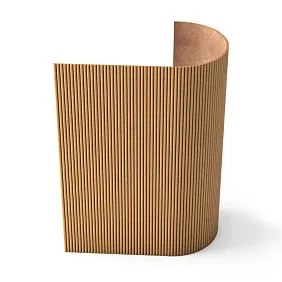
Architecture is far from always rectilinear. Columns, arches, rounded corners, radius walls, complex architectural transitions — all these create zones where a rigid panel physically cannot be mounted.Flexible slatted panelson a fabric base — a solution precisely for such surfaces.
Slats are fixed on a fabric backing with gaps sufficient to bend the entire structure along an arc. The panel smoothly wraps around a column or arch, the slat pattern is uninterrupted — the result looks like expensive custom fabrication, although essentially it is a standard product applied skillfully. Flexible slat panels for interior finishing open up possibilities for working with complex geometry that previously required manual custom fabrication.
Panels made of half-round molding strips
The third constructive type, which often remains out of sight when choosing — and completely in vain. Slats with a semicircular cross-section instead of the standard rectangular one create a fundamentally different light pattern. No sharp edges, no sharp shadows. Light flows smoothly along the rounded surface, forming soft, almost painterly transitions.
Such panels are appropriate in spaces where delicacy is needed: bedroom, children's room, study, relaxation area. Where a rectangular profile creates strict architectural graphics, a semicircular bead gives a warm, cozy plasticity to the surface. This is not worse or better — it is a different mood.
Where do slatted panels work best indoors?
The real application scenarios for slatted panels in interior finishing are much broader than just an 'accent wall in the living room'. Let's break it down by zones — honestly and specifically.
In the living room, a slatted panel on an accent wall behind the sofa or in the TV area creates a visual focal point for the room. Without such an accent, the living room often feels like a collection of furniture within four walls. With a slatted surface, you get focus, rhythm, and architectural logic. This is where full-height vertical slats made of oak or MDF, running from the baseboard to the ceiling, look most organic.
In the bedroom, slatted interior wall finishing behind the bed headboard functions as an atmosphere-forming element, not just decor. Panels made of half-round molding or thin oak slats with an oil finish in a neutral tone create an environment you want to be in — calm, warm, and homely. When integrated with hidden LED lighting along the top perimeter of the panels, the effect becomes truly restaurant-like — in a good way.
In the hallway, slatted panels for interior finishing solve two problems at once: aesthetic and practical. A narrow corridor with vertical slats visually stretches in height, drastically changing the first impression of the apartment. And a wall in the lower section up to 120 cm high, finished with slats, is protected from mechanical damage — from bags, backpacks, children's toys — significantly better than any paint or plaster.
In a corridor, a slatted surface on one wall creates an accent that makes the narrow space more dynamic. A good technique is combining a slatted wall with a mirrored surface opposite: the depth doubles, and the corridor feels twice as spacious.
In a study, slatted panels work on two levels: aesthetic and acoustic. A textured wall behind the desk creates a visual 'context' for work — structured and focused. Simultaneously, it diffuses sound, reducing echo in the room, which is critically important for video calls and voice recording.
In offices, meeting rooms, restaurants, hotels, and showrooms, slatted wall finishing is a long-established professional standard. Here, slats work comprehensively: they create atmosphere, manage acoustics in open spaces, zone areas without permanent partitions, and form a 'luxurious' visual layer that cannot be achieved with smooth painting. Slatted panels for restaurants, showrooms, and hotels are not a passing trend but a conscious professional decision with a measurable result in the form of the impression the space makes on visitors.
What do slatted panels for interior finishing offer besides decoration?
The decorative function is just one layer. The practical benefits of slatted panels indoors are much more concrete.
Space zoning is one of the key practical tasks. A slatted partition or an accent slatted wall in an open layout visually demarcates zones without losing light and air. Kitchen-living room, work area in the bedroom, children's corner in a room — in all these cases, slatted panels for interior zoning mark boundaries without construction intervention and without a feeling of 'enclosure'.
Acoustic comfort is a parameter often ignored in residential spaces, leading to suffering from an uncomfortable sound environment. Flat walls, especially in rooms with hard floors and high ceilings, actively reflect sound, creating unpleasant echo. A slatted surface breaks sound waves into many small reflections — a diffusion effect. When an acoustic mat is installed behind the panels, an absorption effect is added — and the room becomes significantly more comfortable in terms of sound. Acoustic slatted panels for interior finishing are especially relevant in meeting rooms, home theaters, studios, open living rooms, and restaurant halls.
Lighting integration — a unique opportunity that a flat wall lacks. The gaps between slats perfectly accommodate LED strips. Light emerges from the depth of the structure — soft, even, without direct sources. This is one of the most beautiful lighting effects in modern interiors, and it is achieved without complex engineering solutions — simply due to the design of the slatted panel.
Concealing utilities and leveling walls — a purely pragmatic function. When installing slatted panels on a frame, a gap forms between the wall and the panel, where pipes, cables, wires, internet wiring — everything that would otherwise have to be chased into the wall — can be hidden. The wall after installation is perfectly level, regardless of the actual condition of the substrate. This is especially valuable in old buildings where walls are far from geometrically ideal.
Volumetric interior wall finishing with slats also creates visual spatial correction: vertical rhythm raises a low ceiling, horizontal rhythm expands a narrow room. This works in any residential or commercial space — and it's a real, measurable effect.
How to choose slatted panels for interior finishing for a specific task
A practical algorithm — not a checklist, but an honest sequence of questions you need to ask yourself before ordering.
Is painting to an exact color needed? If yes — MDF. Only this material ensures perfect color matching without the base texture affecting the final coating color.
Is natural texture and tactility important? If yes — solid oak. Oil, varnish, stain — choose a finish to match the interior mood, but the living wood grain pattern will do its job with any treatment.
What is the surface geometry? Straight flat wall — rigid panel on a backing. Column, arch, radius corner — only flexible construction on a fabric base. This is not a recommendation, it's a technical imperative.
Is strict graphics or soft plasticity needed? Rectangular profile — clear shadow, architectural rigor. Half-round bead — smooth chiaroscuro, cozy delicacy.
Is there an acoustic issue? If yes — plan for frame installation with sound-absorbing material. Simply mounting a panel on the wall will not fundamentally solve the acoustic problem.
What type of room: residential or commercial? Both materials are suitable for both types of spaces. However, for commercial spaces with high traffic, solid oak is preferable due to its resistance to mechanical loads.
What is the scale of the surface? Small rooms — thin profile, small spacing, light tone. Large areas — you can work with larger profiles and pronounced rhythm. The spacing of slats in a small room should be proportionate to the space — too large a pattern will weigh down the space.
Installation of slatted panels on interior walls
Installation is the stage where you can either enhance the result or ruin even the highest quality panels. Let's break down the key steps.
Surface preparation — the first and most important step. For adhesive installation, the surface must be level (deviation no more than 3–5 mm over the panel length), dry, free of grease stains and flaking coating. If the wall does not meet these requirements — install on a frame.
Layout — the foundation of the entire plane's geometry. The first panel or first guide is set strictly level. If the first element is installed with an error — the mistake accumulates across the entire plane and becomes noticeable from a distance. A laser level here is not a luxury, but an essential tool.
Cutting: panels are cut with a jigsaw or miter saw. The cut must be clean, without chips — this is especially important for MDF to be painted, where the cut will be visible. For oak, a clean cut is also critical, but at joints, the wood grain partially 'forgives' minor imperfections.
Fastening — three main methods for interior finishing. Mounting adhesive: fast, clean, suitable for level walls and lightweight panels. Finish nails: point fastening, almost invisible, often used in combination with adhesive. Screws into guides: the most reliable option for frame installation, especially for large areas or heavy panels.
Joining: depending on the panel design, joints are resolved with a minimal seam butt joint or via a decorative separator. At junctions with the floor and ceiling, skirting boards and cornices are used — they conceal the technical gap and complete the finish. Here it is appropriate to useMoldings and cornices made of MDF or solid woodIn the same style—this transforms a slatted panel from a separate element into part of a unified architectural system.
Finishing elements and lighting: If integrating an LED strip into the gaps between slats is intended, it is laid before the final fixation of the upper guide. The wire is routed discreetly—through the frame or via a wall chase. Lighting in slatted panels, when properly implemented, is one of the most impressive lighting solutions in interior finishing.
DIY or with a professional? Installation with adhesive on a flat wall is quite accessible for someone with basic repair skills and care. Installation on a frame, especially with integration of utilities and lighting, is a task for an experienced professional. Ceiling solutions—only professional installation without exceptions.
Typical mistakes when choosing panels for interior finishing
Experience working with slatted panels shows the same mistakes with remarkable regularity. Their list is short, but each one can ruin a result that seemed obvious at the selection stage.
Choosing based only on a photo—mistake number one. A photo does not convey either the tactile quality or the real light and shadow in your specific lighting. Panels that look perfect in a studio render can produce a completely different effect in a living space with a different light source. Always request samples and evaluate them at the installation site.
Ignoring the material in favor of 'similarity'—a typical story. MDF and oak are visually similar only in photos. In a live interior, the difference is fundamental: texture, tactile quality, reaction to light, sense of value. Replacing one with the other is not 'the same thing, just cheaper,' it's a different product with a different result.
Incorrect scale calculation. A large slat spacing in a small room overloads the wall and makes the room even smaller. For small rooms—thin profile and small spacing. For large areas—you can work with a more pronounced rhythm.
Installing rigid panels on problematic geometry. A rigid structure does not adapt to curved walls and radius surfaces. The result—gaps, misalignments, loss of geometry. For complex surfaces—only flexible slatted panels for interior finishing.
Ignoring lighting when choosing color. Dark panels in poorly lit rooms absorb space instead of creating depth. Slatted surfaces only reveal themselves with side or directional lighting. First consider the lighting — then choose the color.
Overloading a room with textures. A slatted wall plus brickwork plus wooden furniture plus fur textiles — this isn't richness of materials, it's visual chaos. Slatted panels work well with a neutral environment, not in competition with other active surfaces.
Attempting to mount a complex volume 'by eye'. Precise marking, a level, calculating material quantity with a margin — this isn't pedantry, it's the foundation of the result. Without marking the first element with a level, the entire plane will go 'out of plumb'.
Why MDF and solid oak for interior finishing are different products, not different prices for the same thing
This distinction is important because this is precisely where the mistake 'I'll take the cheaper one, I don't see the difference' most often occurs. The difference is visible. And the higher the quality of lighting in the room — the more noticeable it is.
| Parameter | MDF for painting | Solid oak |
|---|---|---|
| Visual depth | Color + form | Color + form + texture + pore |
| Working with color | Precise match to any RAL tone | Wood tone affects the finish |
| Tactile | Smooth, neutral | Warm, with slight roughness |
| Repairability | Harder to restore locally | Can be sanded and renewed |
| Durability | 15–20 years with normal use | Decades with care |
| Sense of value | Technological, modern | Natural solidity |
| Best style | Minimalism, neoclassical, contemporary | Scandinavian, Japandi, loft, eco |
You shouldn't choose the 'best' material, but the right one for the specific task. If the project requires a precise color scheme — MDF. If natural expressiveness and tactility are needed — oak. Both options, when applied correctly, yield excellent results, but in different interior contexts.
Additional elements for comprehensive interior finishing
Slatted panels work even more convincingly in a system with other finishing elements made from the same material. If you've chosen oak slats for an accent wall — it's logical to consider other solid wood products to create a unified environment.
solid wood millwork— moldings, cornices, baseboards made of oak or beech — frame the slatted wall and create a complete architectural solution. A baseboard and cornice made from the same oak as the slatted panel transform a separate finishing fragment into a well-thought-out unified system.
MDF Moldings— cornices, moldings, and baseboards — perfectly complement MDF panels in minimalist and neoclassical interiors. A unified material, a unified finish — and the interior begins to look designed, not assembled from random solutions.
Where to buy slatted panels for interior wall finishing
The final question — and the most practical one. The market for slatted panels is broad, but the quality level varies greatly. Geometric precision, stability of slat spacing, quality of the backing — all of this is critically important for the final result. A 2 mm error in slat spacing, unnoticeable on a sample, will create a 'shaky' pattern on a 5 sq.m surface.
slatted panels for wallsThe STAVROS catalog includes a full range of solutions for residential and commercial projects: MDF for painting with a perfectly smooth surface, solid oak with natural texture and the possibility of any finishing treatment, rigid structures for flat surfaces, flexible panels for radius forms and non-standard geometry, panels made of semi-round battens for soft, delicate relief. Before purchasing, request samples and evaluate them in the actual lighting of your space — a good supplier is always ready for this.
FAQ: answers to popular questions about slatted panels for interior finishing
Can slatted panels be glued directly onto old paint?
Not recommended. Old paint is an unstable base. Under load, it can peel off along with the panel. The base must be cleaned down to the load-bearing layer or frame mounting should be used.
Which slat profile is better for a small room?
A thin profile with a small pitch. A large pattern overloads the space in a small room. A light tone enhances the expansion effect.
Can MDF slatted panels be used in the kitchen?
In an area not subject to direct exposure to steam and grease — yes. For the backsplash area and direct proximity to the stove, untreated MDF is not suitable.
Are slatted panels on the ceiling a complex installation?
Ceiling installation requires professional execution: proper framing, precise marking, and skills in handling weight loads. Do it yourself only if you have real experience.
How long does it take to install on one wall?
Depends on the area and installation method. Installation with adhesive on a flat wall of 8–10 sq.m. — 3–5 hours for an experienced craftsman. Installation on a frame takes longer, considering the installation of lathing.
How to calculate the number of panels?
Measure the wall area (length × height, minus openings). Divide by the area of one panel. Add 10–15% reserve for cutting and joining.
Are slatted panels suitable for wall finishing in a children's room?
Yes. Panels made of semi-round molding without sharp corners are the optimal option. MDF for painting in a bright color is an excellent solution for an accent wall. Installation is performed at a height inaccessible to children.
How often should slatted panel finishing be updated?
Painted MDF under normal use does not require updating. If the paint coating is damaged — local touch-up. Oak under oil — renewal of the oil layer every 1–2 years. Varnished oak — standard care without special procedures.
About the company STAVROS
Concluding this material, it is worth saying a few words about the manufacturer, because choosing a supplier is no less important a decision than choosing the product itself.
STAVROS is a Russian manufacturer of solid wood and MDF products for residential and commercial interiors. The company specializes in slatted panels, moldings, and decorative elements, combining in its assortment solutions for a wide variety of interior tasks — from an accent wall in an apartment to finishing a hotel lobby.
STAVROS production is focused on precision: profile geometry, pitch stability, substrate quality, uniformity of finishing — all of this is controlled at every stage. This is what distinguishes STAVROS slatted panels from the mid-price market product, where inaccuracies are visible already at the unloading stage.
The assortment includes paintable MDF and solid oak, rigid and flexible structures, rectangular and semi-circular profiles. This allows covering almost any project without searching for additional suppliers. STAVROS is a manufacturer you can trust not because it's written in advertising, but because behind the product lies real production culture and an understanding of how the result looks in the final interior.


