












































































Article Contents:
- Why a slatted facade is not a trend, but architectural logic
- Materials for slatted facade panels: an honest breakdown without illusions
- Thermally treated wood (thermowood)
- Larch: natural facade classic
- Wood-polymer composite (WPC)
- Aluminum and aluminum alloys
- Fiber cement
- Ventilated slatted facade structure: the engineering of beauty
- Direction of battens and its influence on architectural image
- Vertical Planks
- Horizontal battens
- Diagonal battens
- Combined direction
- Batten facade panels and climate: what to know before purchase
- Batten facade and architectural styles: from minimalism to neo-eclecticism
- Scandinavian and Nordic style
- Japanese minimalism and wabi-sabi style
- Contemporary minimalism and high-tech
- Contextual approach in natural surroundings
- Installation of slatted facade: a technology that cannot be simplified
- Design and layout
- Installation of brackets and substructure
- Laying insulation and installing membrane
- Installation of slatted cladding
- Processing slat ends
- Joints and connection points
- Maintenance of slatted facade: how to extend cladding lifespan
- Comparative table of materials for slatted facade
- Slatted facade panels and regulatory framework
- Slatted facade and interior unity: from street to home
- Slatted facade trends 2025–2026: what's being built now
- FAQ: popular questions about slatted panels for facades
- About the Company STAVROS
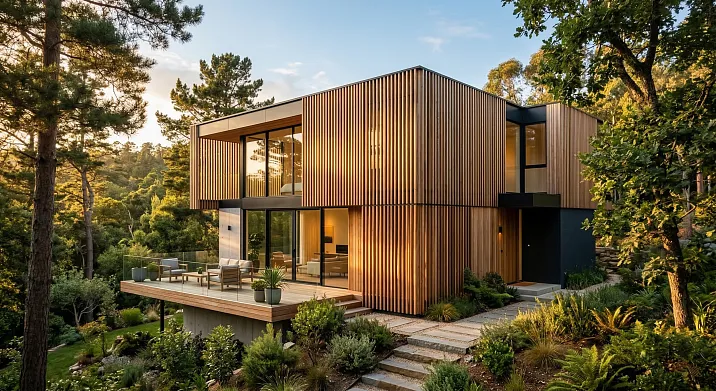
The first thing a person sees when approaching a house is the facade. Not the interior, not the layout, not the ceiling height. It is the facade that forms the first impression: of the architecture, of the owner, of the character of everything hidden inside. And that is why the choice of facade material is not a technical, but an architectural decision. Slatted panels for facades today occupy a special place in this choice: they are simultaneously functional, durable, and possess a rare quality—the ability to turn an ordinary building into an object that no one passes by indifferently.
Over the past ten years, slatted facades have evolved from a niche designer experiment to a mature, technologically refined solution for private construction, commercial real estate, and reconstruction. Vertical and horizontal slats on the facade, separated by uniform gaps, create a rhythmic pattern that changes depending on the viewing angle, time of day, and season. This facade lives—and that is its fundamental difference from faceless plasters and faceless siding.
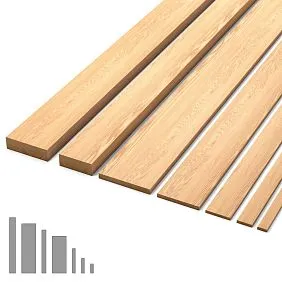

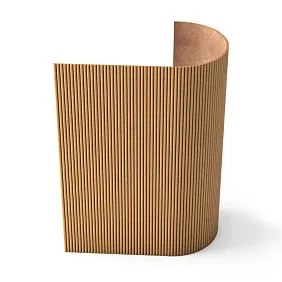
Why a slatted facade is not a trend, but architectural logic
Before discussing materials and constructions, it is necessary to answer the question every client asks themselves: why slats, exactly? What makes them fundamentally better than plaster, clinker tiles, or metal cassettes?
The answer unfolds on several levels.
First level—aesthetics. Slats create rhythm. Parallel slats with uniform spacing establish a regular surface structure that the eye perceives as orderly, logical, and complete. When the viewing angle changes, the width of the visible gaps changes—the facade optically transforms. With side lighting, each slat casts a shadow—creating expressive relief. At dusk, with artificial facade lighting, the slatted surface takes on a completely different, almost sculptural character.
Second level—functionality. A slatted facade is a ventilated construction. An air gap is created between the cladding layer and the load-bearing wall, through which air continuously moves. This airflow removes moisture from the wall structure, prevents condensation and biological damage (mold, fungus). Simultaneously, the ventilated facade acts as an additional thermal insulating shell: in winter—it reduces heat loss through the wall; in summer—it protects the wall from overheating.
Level three – durability. A properly designed slatted facade made from quality materials lasts 25–50 years without major repairs. Individual slats can be replaced if necessary without dismantling the entire structure.




Materials for slatted facade panels: an honest breakdown without illusions
The facade operates under extreme conditions. Solar ultraviolet radiation up to 1000 hours per year, temperature fluctuations from -40°C in winter to +60°C on the surface under direct summer sun, moisture in the form of rain, snow, condensation, wind loads, pollution. A material that withstands all this for decades deserves respect. Let's examine the main options.
Our factory also produces:


Thermally treated wood (thermowood)
Thermowood is ordinary wood that has undergone deep thermal treatment at temperatures of 180–230°C in an oxygen-free atmosphere. As a result, all organic substances that attract fungi, mold, and insects evaporate from the wood fibers. The fiber structure stabilizes: thermowood practically stops reacting to humidity changes, and its swelling coefficient decreases by 5–8 times compared to non-thermally treated wood.
For slatted facades, thermowood is the top choice among natural materials. The dark, noble tone it acquires during thermal treatment (from amber-brown to almost charcoal-black depending on the species and degree of processing) requires no additional pigmentation. Under ultraviolet exposure, thermowood uniformly acquires a silvery-gray patinated tone – just like aged teak or larch. Many architects deliberately choose this material precisely for this natural patina.
Wood species for thermowood: ash, pine, spruce, birch, alder, beech, oak. Each species provides its own tone and texture. Ash – lighter, with a fine grain. Pine – warmer, with soft swirls. Oak – deeper and darker, with a pronounced structure.
The main limitation of thermowood: it is more brittle than non-thermally treated solid wood. During installation, it requires pre-drilling of fastener holes – otherwise, edge cracking is possible. This is not a problem, but a requirement of the installation technology.
Get Consultation
Larch: the natural facade classic
Larch is one of the most durable coniferous materials for exterior cladding in the Russian climate. High density (500–700 kg/m³), natural resins in the fiber structure, pronounced resistance to moisture and biological damage. Larch boards that have lain in water petrify – this is not an exaggeration, but physics. The service life of a larch facade with proper treatment is 30–50 years.
The color of untreated larch is a warm golden russet. Under UV exposure without protective coating, it patinates to a silvery gray—exactly like thermowood. Under oil impregnation with ultraviolet filters, the original warm tone is preserved significantly longer. Tinting antiseptics allow you to achieve any desired shade.
Wood-polymer composite (WPC)
WPC is a material created specifically to solve the problem that ultimately is the Achilles' heel of any natural wood: instability under conditions of constant cyclical wetting and drying. Wood fiber (40–60% by volume) is mixed with polymer binders (polyethylene, polypropylene, PVC) and pressed into slats with a precise profile.
The result: a material that looks like wood (textured surface, warm tones), behaves like plastic (does not rot, does not deform, does not require periodic impregnation), and lasts as no type of natural untreated wood could ever dream of—25–35 years with minimal care.
The key parameter when choosing WPC for a slatted facade is the coefficient of thermal expansion. The polymer component expands significantly more when heated than wood. On a dark facade under direct sunlight, the surface of the slat can heat up to 60–70°C. Compensation gaps during WPC installation are not an option but a mandatory requirement. The gap spacing and its size are specified in the manufacturer's technical documentation.
Aluminum and aluminum alloys
Aluminum slatted facades are the standard for commercial architecture: office centers, shopping complexes, hotels, and public facilities. Absolute resistance to moisture, fire, biological damage, and mechanical wear. Precise factory geometry. Anodized or powder-coated finish retains color for 15–20 years without repainting.
For private residential construction, aluminum is also used, but less frequently: its cost is higher than that of WPC or thermowood, and its thermal expansion requires special fastening systems with compensation elements. In combination with glass and exposed concrete, an aluminum slatted facade provides a flawless high-tech look.
Fiber cement
Fiber cement slatted facade panels are a relatively new segment that has been actively growing in recent years. Base: cement reinforced with cellulose fibers. Result: a material completely insensitive to moisture and fire, with excellent resistance to ultraviolet light. The surface can replicate the texture of wood, stone, or concrete—in matte or satin finishes. The service life of high-quality fiber cement is 30–50 years.
Main drawback: significant weight compared to wood or WPC. Fiber cement requires a more robust load-bearing substructure. Installation is physically heavier and requires precise marking.
Ventilated slatted facade structure: the engineering of beauty
A beautiful facade is not just beautiful slats. It is a properly designed system where each layer performs its function.
Load-bearing wall — the foundation of the system. Its condition and geometry determine the installation technology of the substructure.
Vapor barrier or wind protection — a membrane that protects the insulation from external drafts and removes vapor from the inside. It is laid directly on the load-bearing wall over the insulation.
Insulation — mineral wool insulation boards (basalt fiber) with a density of 80–140 kg/m³ and a thickness of 100–200 mm depending on the climatic zone. They are fixed to the wall with disc dowels.
Substructure (load-bearing frame) — a system of brackets and vertical or horizontal guides made of galvanized steel or aluminum profile. It is the substructure that ensures the evenness and verticality of the cladding plane regardless of the condition of the load-bearing wall. The accuracy of setting up the substructure is a key factor in facade quality.
Air gap — the space between the windproof membrane and the face cladding. Minimum 40 mm, optimum 60–80 mm. It is this gap that ensures continuous ventilation of the facade.
Slatted cladding — the face layer. The slats are fixed to the substructure guides with hidden or exposed fasteners, with mandatory expansion gaps.
Open ends of the air gap (bottom and top) are protected with perforated strips or special mesh elements — they allow air to pass through but block insects, debris, and moisture in the form of splashes.
Direction of battens and its influence on architectural image
This is not a detail — it is a fundamental architectural decision. The direction of battens on a batten facade defines the plasticity of the entire building volume.
Vertical battens
Vertical orientation is the classic batten facade. Battens running from the plinth to the cornice visually elongate the building upward, emphasizing its height and slenderness. This technique is especially effective for buildings with a square or wide proportion — it corrects perception, making the volume more slender. With the same width of batten and gap, a vertical batten facade looks stricter and more monumental than a horizontal one.
Horizontal battens
Horizontal battens visually widen the building and emphasize its connection to the ground, horizon, and landscape. It is the horizontal batten facade that is more common in Scandinavian and Japanese architecture — it creates a sense of coziness, groundedness, and organic integration into the natural context. For low-rise one- and two-story houses, this is often the best choice.
Diagonal battens
A bold solution that creates dynamism and movement. Diagonal battens on the facade break the usual static nature of a rectangular volume, giving the building energy and unconventionality. As a rule, it is used in combination with straight battens on another part of the facade — the contrast enhances the expressiveness of both planes.
Combined direction
Different directions of battens on different parts of the facade. Vertical battens on the side faces, horizontal on the main facade. Or diagonal inserts in a vertical field. Such a combination requires precise architectural intent — but with a professional approach, it yields a result of the highest class.
Slatted Facade Panels and Climate: What You Need to Know Before Buying
The Russian climate is a serious testing ground for any facade material. And there is no universal answer here: the material is chosen taking into account the specific climatic conditions of the object.
Northwest and Central Russia — high humidity, frequent thaws, significant precipitation, moderate frost. Optimal choice: thermowood with oil and UV filters, larch, WPC with a coefficient of thermal expansion less than 0.003 mm/mm°C.
Ural and Siberia — harsh winters down to -40°C and below, sharp temperature fluctuations, summer heat up to +35°C. The frost resistance of the material is critically important. Thermowood with properly selected coating, larch, aluminum. WPC — only from proven manufacturers with confirmed frost resistance tests.
Southern Russia and Krasnodar Krai — high summer temperatures, significant UV radiation, humidity in coastal areas. Priority — resistance to ultraviolet light and moisture resistance. Thermowood, fiber cement, high-quality WPC with UV stabilizers.
Sea coast — aggressive saline environment, humid salty air, high biological activity. Anodized aluminum, fiber cement, thermowood from hardwoods. Natural teak — if the budget allows.
Slatted Facade and Architectural Styles: From Minimalism to Neo-Eclecticism
Scandinavian and Nordic style
Horizontal slats made of thermowood or larch, patinated to a silvery-gray tone, on a white or light gray foundation — this is an image familiar to anyone who has ever seen Finnish or Norwegian architecture. Simplicity, honesty of the material, organic connection with the natural surroundings. No decoration beyond what is necessary — only form, proportions, and the natural texture of wood.
Japanese minimalism and 'wabi-sabi' style
Vertical slats of thermally treated ash or cedar with a dark charcoal tone, wide gaps, simple rectangular volumes — this is an image inspired by Japanese architecture. Deliberate simplicity and the natural unpreciousness of the material. Aging, patina, visible traces of time are perceived as value, not as wear.
Contemporary minimalism and high-tech
Aluminum slat panels for the facade in dark gray or anthracite tones combined with exposed concrete, glass, and steel. Perfect geometry, precise gaps, a cold metallic character. This image works for commercial properties, urban residential complexes, and private homes with a pronounced minimalist concept.
Contextual approach in a natural setting
A country house in the forest or by the water requires a different logic: a slatted facade made of natural or thermally treated wood should dialogue with nature, not contrast with it. Tones close to tree bark, moss, stone; horizontal slats echoing the horizon line. This is a facade that becomes part of the landscape.
Installation of a slatted facade: a technology that cannot be simplified
A beautiful result is a consequence of correct technology. Every simplification at any stage of installation will ricochet back in 2–5 years.
Design and layout
Before installation begins, clear project documentation must be completed: a layout diagram for brackets, the spacing of guides, attachment points for window junctions, plinth and cornice strips. Marking the bracket axes on the load-bearing wall — strictly level, with checks every 3–4 m.
Installation of brackets and substructure
Brackets are attached to the load-bearing wall with dowels designed for the calculated wind load in the region. The vertical spacing between brackets is typically 600–900 mm. Guides (vertical or horizontal L-profiles) are fastened to the brackets with bolted connections. All guides are aligned to a single plane—this is not quick, but it is the foundation of everything.
Installation of insulation and membrane
Insulation boards are placed between the brackets in a tight fit, without gaps or cracks. The second layer (in two-layer insulation) is installed with staggered joints—'in a bond.' The windproof membrane is overlapped by 10–15 cm at horizontal joints, with the upper sheet overlapping the lower one. The membrane is secured to the insulation with mushroom-head dowels.
Installation of slatted cladding
Slats are attached to the guides with concealed or exposed fasteners. Concealed fasteners—clips or special brackets—are the professional standard for natural wood and WPC: no visible hardware on the front surface, keeping the surface clean.
Compensatory end gaps at corners, window openings, and plinths are mandatory. The gap size is determined by the coefficient of thermal expansion of the specific material and the calculated temperature range for the climatic zone. Ignoring compensatory gaps during thermal expansion creates mechanical stresses that break fasteners and deform the slats.
Treatment of slat ends
The ends of wooden slats are the most vulnerable areas in terms of moisture absorption. The ends must be treated with a protective coating on-site—this is a critically important step often overlooked during installation. An unprotected end absorbs moisture 5–8 times more intensely than the side surface. It is from the ends that the destruction of a wooden facade begins with improper installation.
Junctions and details
Window and door reveals, plinth strips, cornice overhangs, internal and external corners—all these junctions must be executed with geometric precision and full protection against water ingress. Errors in junction details are the most common cause of premature failure of facade structures.
Slatted facade care: how to extend the life of the cladding
Maintenance requirements differ drastically depending on the material.
Natural wood (larch, thermowood under oil) requires regular renewal of the protective coating — every 3–5 years, depending on the facade orientation (south side — more often, north side — less often). Renewal is performed without removing the slats: sanding with water-repellent pads, applying a new layer of oil with UV filters. This is a simple task that can be done independently.
WPC requires minimal maintenance: annual washing with warm water and a neutral detergent. No protective coating and no regular treatment. This is why WPC is especially popular in projects where the 'install once and forget' approach is a priority.
Aluminum — washing with water, if necessary — with a neutral detergent. The powder coating does not require renewal for 15–20 years.
Fiber cement — pressure washing with water every 1–2 years. The coating is renewed every 10–15 years.
Regardless of the material — regularly inspect the condition of the fasteners and the junctions at window and door openings. Spot-fixing problems at an early stage is incomparably cheaper than a major repair in 10 years.
Comparative table of materials for slatted facades
| Material | Service life | Care | Appearance | Frost resistance | Price (rel.) |
|---|---|---|---|---|---|
| Thermowood | 30–50 years | Oil every 3–5 years | Natural wood, patina | High | High |
| Larch | 25–40 years | Antiseptic every 3–5 years | Warm wood | High | Medium |
| WPC (Wood-Plastic Composite) | 25–35 years | Washing with water | Wood imitation | Medium–high | Medium |
| Aluminum | 30+ years | Washing with water | Metal, any color | Very High | High |
| Fiber cement | 30–50 years | Washing once a year | Wood/concrete/stone | Very High | Medium |
| Larch without treatment | 15–20 years | Regular treatment | Silver patina | Medium | Low |
Slatted facade panels and regulatory framework
Any facade project in Russia requires compliance with building codes. A ventilated curtain wall facade falls under the requirements of SP 23-101, SP 50.13330 (thermal protection of buildings) and fire safety regulations SP 2.13130. Key requirements from a fire safety perspective:
-
For buildings up to 28 m high (typically up to 9 floors), combustible facade materials are permitted with certain restrictions
-
For high-rise buildings and facilities with fire hazard class F1.1, F1.2 (children's institutions, hospitals) — only non-combustible materials in the facade system
-
The use of thermally modified wood or WPC in a ventilated facade system requires a technical certificate indicating the fire hazard class of the system
Private low-rise construction (up to 3 floors) is regulated less strictly, but insurance companies are increasingly interested in the combustibility class of the materials used. Properly executed system documentation is an investment in the legal protection of your facility.
Slatted facade and interior unity: from street to home
This is a topic that is almost never raised in articles about facades — and completely in vain. The architectural image of a house achieves completeness when the facade and interior speak the same language. Dark vertical slats outside and warm wooden planks in the hallway — this is a dialogue of materials across the threshold.
MDF Plank Panelsfor walls in the living room, executed in the same proportional system (slat width, gap spacing) as the exterior facade slats — create a sense of continuity of the architectural idea.Wooden planksin the framing of window openings,wooden baseboardat the floor in the tone of the facade — and you get a space where the boundary between 'outside' and 'inside' is erased.
Classic Furnituremade of natural wood in the interior of a house with a wooden slatted facade — this is a harmony that requires no explanation. It is simply felt.Balusters of the staircasefrom the same species as the facade slats,Furniture Handlesmade of natural wood — these are the details that turn a set of construction solutions into an architectural statement.
with a classic profile creates a sense of solidity, reliability.to finish the flooring andbuy MDF skirting boardfor interior wall panels — both solutions should relate to the overall logic of wood established by the facade.
Slatted Facade Trends 2025–2026: What's Being Built Now
Открытые фасады с широким зазором. Широкий зазор (30–60 мм) между рейками при тёмной несущей плоскости за ними создаёт эффект «парящих» планок. Фасад обретает глубину и объём, которых нет ни у какого другого материала.
Black and dark charcoal tones. Thermowood in an almost charcoal tone, black WPC, anthracite aluminum — dark facades are confidently conquering urban environments and suburban projects. Contrast with white or light gray joinery (windows, doors) is one of the most effective design techniques.
Combining slats with other materials. Slat panels combined with exposed concrete, clinker, corten steel. Each material highlights the advantages of the other.
Biophilic facade. Warm tones of thermowood, metal planters with plants on the facade, living walls with vertical greening. The house literally 'grows' into the surrounding landscape.
Dynamic facades. Slats of different widths in one plane, creating rhythmic acceleration or deceleration. Or planks offset from the supporting plane at different distances — a three-dimensional facade bas-relief.
FAQ: popular questions about slat panels for facades
Which material to choose for a slatted facade in the Moscow region?
Thermowood from ash or pine with oil and UV filters is the optimal choice in terms of aesthetics and durability. A low-maintenance alternative is high-quality frost-resistant WPC, confirmed by tests.
Is a project needed for installing a ventilated slatted facade?
For a private low-rise house (individual housing construction, garden non-profit partnership) a full project is not formally required, but nodal solutions (brackets, substructure, expansion gaps) must comply with regulatory requirements. For commercial objects — a project is mandatory.
How long does a larch slatted facade last without maintenance?
Without any protective coating, larch will patinate and gradually deteriorate. The first signs of surface cracking appear after 3–5 years, active degradation occurs after 10–15 years. With antiseptic oil applied every 4–5 years, service life is 25–40 years.
Can slatted facade be installed in winter?
Installation of substructure and insulation is possible at temperatures down to -10°C. Installation of wooden slats at sub-zero temperatures is not recommended: cold wood will expand significantly when heated, which will disrupt the expansion gaps. Final installation of the facing layer should be done at temperatures from 0°C and above.
WPC or thermally modified wood: which is better for a slatted facade?
Depends on priorities. Thermally modified wood is natural wood with a unique natural texture; requires oil renewal every 3–5 years; patinates to a beautiful silvery tone. WPC requires zero maintenance; imitates wood texture; has completely stable geometry under any conditions. If the aesthetics of natural material are important, choose thermally modified wood. If priority is minimal maintenance, choose WPC.
How to correctly choose the slat spacing for a facade?
Consider the scale of the building. For small houses (1–2 floors), the optimal slat width is 45–80 mm with a gap of 15–30 mm. For taller buildings, use slats 80–120 mm wide. Large slats on a small house look heavy and disproportionate; small slats on a large building get lost and are not visually distinct.
How to attach slatted facade panels at corners?
Standard solutions: butt joint with overlapping of one side (where one side's slats cover the ends of the other), corner metal profile made of painted aluminum or stainless steel, corner trim made of the same material as the slats. Each solution has its own architectural logic.
Does a wooden slatted facade burn?
Natural wood and WPC are combustible materials. However, in a ventilated facade system with proper fireproofing treatment and correct installation, the fire hazard class of the system can be reduced to K1 or K0. Use special fire-retardant impregnations (flame retardants) in combination with protective canopies over openings.
Can a slatted facade be installed independently?
Theoretically — yes. Practically — the substructure requires precise calculations and skills in working with metal profiles; installation of insulation and membrane requires an understanding of building physics. The most common mistake during independent installation is incorrect expansion gaps. I recommend involving specialists at least for the substructure installation.
How much does a turnkey slatted facade cost?
The range is wide — from 3,500 to 12,000 rubles/m² depending on the material, region, and complexity of the project. Reference: WPC + installation — from 4,000 rub/m²; thermally modified wood + installation — from 6,000 rub/m²; aluminum + installation — from 7,500 rub/m². The cost includes: substructure, insulation, membrane, cladding, fasteners, labor.
About the company STAVROS
STAVROS is a Russian manufacturer of wooden architectural elements for interior and exterior with a full production cycle. The STAVROS catalog includes —slatted panels made of MDF and solid oakfor walls and ceilings,Wooden planks for decorative and structural tasks,Wooden floor skirting boards made from solid wood and MDF,buy wooden skirting boardfrom oak and ash array,Furniture Handles— made of natural wood,Balusters and staircase elementshandcrafted, as well asClassic Furniture of high-quality execution. STAVROS works with private clients, designers, architects, and construction companies, providing full project support — from material selection to final installation. If you want your house to look exactly as you envisioned — start by choosing the right materials. STAVROS is a trusted manufacturer.


