












































































Article Contents:
- What lies behind the concept of 'slatted facade panel'
- Slatted facade panels for furniture: when the facade becomes an architectural accent
- Slatted facade panels for walls: accent, partition, architectural landmark
- Accent Wall
- Partition facade
- Niche facade
- Materials for slatted facade panels: selection by task
- MDF: geometric precision and color freedom
- Solid oak: natural expressiveness and tactile depth
- Slat profiles: how shape defines the character of the facade
- Rectangular profile
- Semicircular profile
- Trapezoidal profile
- Rigid and flexible slatted facade panels: construction by geometry
- Rigid panels on MDF backing
- Flexible panels on fabric base
- Spatial effects of slatted facades
- Slatted facade panels in different interior scenarios
- Living room: architectural centerpiece
- Bedroom: silence through material
- Hallway: the first word of the interior
- Study: status and acoustic comfort
- Office, meeting room, reception
- Restaurant, cafe, bar
- Showroom and boutique
- How slatted facades combine with other finishing elements
- Mistakes when selecting and applying slatted facade panels
- Installation of slatted facade panels: principles and nuances
- Where to view and select slatted facade panels
- About the Company STAVROS
- FAQ: frequently asked questions about slatted facade panels

There is a moment in working with space when you realize: finishing is not the final cosmetic touch, but the first thing the eye reads. Before furniture, before decor, before lighting. And it is the surface that sets the tone for everything else. Slatted facade panels are precisely that surface that speaks before words. Straight, confident, with character.
The word 'façade' in this context is broader than it seems. Yes, there is the literal meaning—the external cladding of buildings. But in interior architecture, a 'façade' is any open, visible plane: the front of a cabinet, the face of a partition, the front of a built-in niche, the frontal plane of a work zone. It is what looks at you. What you see first.
Slatted Façade PanelsIn interiors, it is a structure of parallel battens of the same profile, creating a rhythmic, textured surface on any façade: a wall, a furniture panel, a partition, a niche. Rhythm is the essence of a slatted façade. It is what makes the surface lively, architectural, expressive.
This article details how it works. Without clichés, with specifics and honesty.

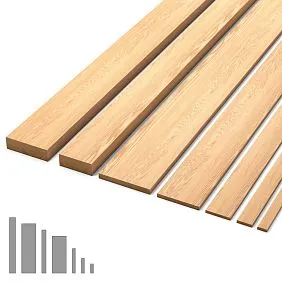
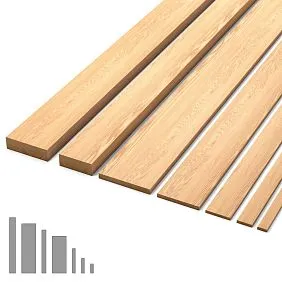

What lies behind the concept of a 'slatted façade panel'
Let's break down the term—calmly, without haste.
A batten is a longitudinal strip of constant cross-section. Rectangular, semicircular, trapezoidal—depending on the profile. Its length is fixed, corresponding to the height or width of the façade plane.
A panel is a structural module: several battens, fixed at equal intervals on a substrate (MDF base or fabric backing). The panel is mounted as a single unit—this is fast, precise, and yields a predictable result.
'Façade' means intended for an open, visible plane. In interiors, this includes:
-
wall façade planes (accent walls, TV zones, partitions);
-
furniture fronts (cabinets, wardrobes, chests, kitchen islands);
-
fronts of built-in structures (niches, mezzanines, podiums);
-
fronts of administrative counters, reception desks, bar counters.
Thus, a slatted façade panel is a universal finishing module for any open surface where a rhythmic texture with decorative and architectural effect is desired.
Why is this needed? Because a smooth surface is neutral. A slatted one is alive. It interacts with light, sets a rhythm, creates depth. It transforms a surface from a passive background into an architectural object.




Slatted Façade Panels for Furniture: When the Front Becomes an Architectural Accent
A furniture front is the first thing a person sees upon entering a room. Not the contents of the cabinet, not the structure of the carcass—but precisely the frontal plane. And it is here that the slatted panel works with particular persuasiveness.
Vertical battens on a furniture front visually lighten large volumes. A three-meter-wide sliding wardrobe with slatted fronts is perceived differently than one with smooth fronts: the rhythm of the verticals 'divides' the plane into several airy fragments, and the wardrobe doesn't weigh down the space—it becomes an architectural part of it.
A walk-in closet with solid oak slatted fronts is a different level of perception compared to standard smooth chipboard slabs. Not because it's expensive. But because it's lively, natural, architecturally precise.
A kitchen island with slatted side fronts is a technique from restaurant design that has firmly entered residential projects. The vertical rhythm on the island's side panels creates a sense of an architectural object integrated into the space, rather than 'a piece of furniture placed in a spot.'
Slatted furniture frontsare produced in the same materials and with the same profiles as wall panels—and this is precisely what allows for creating a unified material language in the interior: when the wall and the furniture front speak with one voice.
Our factory also produces:
Slatted Façade Panels for Walls: Accent, Partition, Architectural Landmark
Wall façades are the largest-scale application area for slatted panels. And here, clarity is needed regarding the tasks they solve.
Get Consultation
Accent Wall
One slatted plane in a room is an architectural landmark. The eye finds a focal point. The space ceases to be 'four walls' and gains direction. This is exactly how an accent wall with a slatted façade works—not as decoration, but as an organizing principle.
Behind the sofa in the living room, behind the headboard in the bedroom, on the end wall in the hallway—these are three classic positions where a slatted façade panel works flawlessly. One plane changes the entire interior.
Partition Façade
A partition is both a structural element and a façade on two sides. Slatted panels on a partition façade transform a utilitarian structure into an architectural object. If the partition is not full-height or has gaps—the slatted pattern enhances the feeling of lightness and airiness.
A slatted partition as a zoning element in an open-plan layout is one of the most in-demand scenarios. Kitchen and living room, work zone and relaxation zone, hallway and living space—all can be delineated by a slatted façade without losing visual and light connectivity.
Niche Façade
A wall niche with a slatted back panel is a technique that transforms a utilitarian recess into a decorative architectural element. Shelves within the niche against the slatted facade: the slats provide depth, volume, and a dynamic backdrop. With integrated lighting, the niche becomes a focal point in the interior.
Materials for slatted facade panels: selection based on the task
Material is not just a technical parameter. It is an architectural language that defines the character of the entire space.
MDF: geometric precision and color freedom
MDF with a density of 750–850 kg/m³ is a material with a perfectly uniform structure. No knots, no resin pockets, no natural variation—only pure, predictable geometry.
The key property of MDF for slatted facade panels is the ability to be precisely painted in any color from the RAL or NCS catalog or a custom sample. This is fundamentally important for project work: the color is consistent, reproducible from batch to batch, and does not change over time.
White MDF slatted facade panels are the most popular solution for light, modern interiors. Pure geometry, relief without color, space without visual load. Anthracite and graphite are for strict, composed spaces: offices, meeting rooms, modern living rooms with a dark accent. Monochrome (panel exactly matching the wall color) is a sophisticated minimalist technique where the relief is visible only through shadow.
MDF slatted facade panels for painting also offer maximum flexibility for the future. If the interior's color concept changes, the panels can be repainted without dismantling. This is practically important for commercial objects with evolving brand identity.
Solid oak: natural expressiveness and tactile depth
Oak is a wood species with a density of 700–750 kg/m³, a unique grain pattern, and natural wear resistance. Each slat carries its own pattern, which cannot be reproduced with veneer or film.
Under oil, oak reveals a warm golden-honey tone. Under tinting oil, it becomes a cool Scandinavian gray, deep tobacco, or rich graphite. Under clear varnish, it retains its natural color, protected from wear.
Wooden slatted facade panels made of oak create a surface that cannot be reproduced by any synthetic material. The tactility of open pores, the living grain pattern, natural warmth—all are properties perceived not only by sight but also by touch.
Oak for slatted facade panels is the right choice where natural material is the main theme: Scandinavian style, Japandi, organic minimalism, modern classic with an emphasis on natural materials.
| Parameter | MDF for painting | Solid oak |
|---|---|---|
| Color | Any RAL/NCS | Natural + tints |
| Texture | Uniform, without texture | Unique, natural |
| Tactile | Neutral | Living, open pore |
| Load resistance | Depends on the coating | High (wood density) |
| Repair | Local painting | Oil/varnish renewal |
| Application | Minimalism, office, monochrome | Japandi, Scandinavian, organic |
Slat profiles: how shape defines the character of the facade
Three profiles—three different interior images. This is not an aesthetic nuance but a fundamental parameter that defines the character of the entire surface.
Rectangular profile
Sharp edges. With any side lighting—clear linear shadows. A wall or furniture facade acquires a strict, disciplined graphic. This is architectural precision without compromise.
Rectangular profile—for minimalism, neoclassicism, offices, meeting rooms, loft, modern commercial spaces. It creates an image of order, professionalism, and deliberate restraint.
Dark oak with a rectangular profile under matte varnish is one of the most convincing and 'mature' interior solutions. It is a wall or facade that needs no adornment.
Semi-circular profile
Rounded edges diffuse light smoothly, without harsh shadows. The surface appears warm, pliable, organic. It's a softness without being saccharine.
Slatted facade panels made from semi-circular battens— the right choice for living spaces with a cozy atmosphere: bedrooms, children's rooms, living rooms with a warm character, home libraries. A semi-circular oak profile with oil finish is one of the most natural and tactilely rich looks for a residential interior.
Trapezoidal profile
A cross-section that widens towards the substrate. A more active relief, a complex multi-level shadow. The surface is dynamic — it attracts the eye more actively than a semi-circle, but without the rigidity of a rectangle.
Trapezoidal profile — for commercial spaces with a pronounced character: restaurants, showrooms, lobbies, boutiques. Where decorative intensity is needed without crossing into decorative aggression.
Rigid and flexible slatted facade panels: construction by geometry
The surface form dictates the construction. This is a rule that knows no exceptions.
Rigid panels on MDF backing
A classic solution for flat surfaces. The slats are fixed to a rigid MDF substrate with factory-precision spacing. The module is installed as a single unit — quickly, evenly, with a guaranteed result.
Rigid panels — the optimal choice for 90% of walls, furniture fronts, partitions, and niches in standard residential and commercial interiors. Geometric precision, stability, ease of installation.
Seamless joining of adjacent rigid modules is a fundamental quality parameter. If the factory spacing is precise, the slat pattern continues across the joint without visible offset. The wall reads as a monolithic surface.
Flexible panels on a fabric base
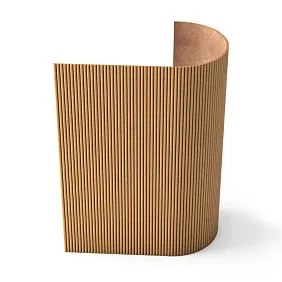
The only correct solution for curved surfaces. The slats are secured to a fabric mesh base — with a gap sufficient for bending without deforming the battens.
A flexible slatted facade panel wraps around:
-
cylindrical columns (diameter from 100–150 mm);
-
arched spans;
-
rounded internal and external corners;
-
wavy and S-shaped surfaces;
-
curved furniture fronts with a radius profile.
The slat pattern is not disrupted when bending — the panel continues a unified rhythm across all curvatures of the form. This is impossible to reproduce with a rigid construction without visible breaks.
Slatted facade panels for radius surfaces — a sought-after solution for hotel lobbies with columns, restaurant halls with arched vaults, residential interiors with non-standard layouts.
Spatial effects of a slatted facade
Let's examine specifically what happens to a room when a slatted facade plane appears in it.
Vertical slats increase visual height. This is a documented optical effect: the eye follows vertical lines upward. In a room with 2.7 m ceilings, a vertical slatted facade creates a sensation of 3 m and higher. For apartments with standard ceiling heights — an invaluable technique.
Horizontal slats expand the space. Horizontal lines guide the eye left and right. A narrow corridor with a horizontal slatted facade on the end wall appears wider.
A relief surface creates a sense of volume. With side or directed lighting, each slat casts a shadow into the gap — the surface is perceived as deeper than it actually is. This is the 'living wall' effect, which cannot be achieved with any smooth finish.
Rhythm calms or activates — depending on the spacing. Frequent spacing with narrow gaps — a dense, saturated rhythm that creates tension. Infrequent spacing with wide gaps — a calm, monumental surface. This is an architectural parameter that influences the psychological perception of space.
Acoustics. The relief surface scatters sound waves. A slatted facade reduces reverberation in rooms with hard reflective surfaces. In meeting rooms, restaurant halls, living rooms with open layouts — this is a practically significant effect.
Slatted facade panels in different interior scenarios
Living room: architectural centerpiece
A wall behind a sofa with a slatted facade — the conceptual center of the living room. Vertical oak slats in a natural tone with side lighting or concealed LED strip along the top perimeter — a classic that never goes out of style.
TV area with slatted anthracite facade: the screen becomes part of the architectural solution, not a 'device glued to the wall'. The slatted facade 'frames' the television, creating a professional accent.
Bedroom: silence through material
A slatted facade behind the bed headboard is the quietest and most convincing way to create an accent in the bedroom. Semi-circular profile, neutral warm tone, moderate spacing — no tension, only depth and naturalness.
Integrated LED strip along the lower perimeter of the facade panel: a soft halo illuminates the relief from bottom to top. In the evening, it's a different bedroom — with a soft, warm atmosphere and no visible light sources.
Hallway: the first word of the interior
The hallway is the entry point. Everything that stands, hangs, and reflects light here speaks to the character of the entire space. A slatted facade on the wall opposite the entrance: an instant architectural signal that everything here is well thought out.
For narrow hallways — a horizontal slatted facade on the end wall: visually widens the corridor, stops an overly deep perspective. Material: oak with a hard lacquer finish or MDF in durable enamel — mechanical loads in the hallway are higher than anywhere else.
Study: status and acoustic comfort
A wall behind the desk with a slatted facade is not just a visual background. It's a projected status, spatial coherence, and a partial solution to an acoustic task. Rectangular profile, dark MDF or dark oak — the image of a professional, serious place.
In home offices with frequent video calls, a slatted facade reduces reverberation: less echo in the frame, better sound quality. This is a small practical detail not described in catalogs but valued in work.
Office, meeting room, reception
A slatted facade in a meeting room is both a visual representation of the company and an acoustic solution. MDF in corporate RAL color — branding through architecture without banners and prints. The textured surface reduces echo in the room: meetings become more comfortable.
A reception desk with a slatted facade on the administrative counter — a professional image for the first point of contact. The slatted plane of the counter facade in oak or MDF in a corporate color creates an instant impression of level.
Restaurant, cafe, bar
Slatted facade panels for a restaurant — one of the most common scenarios for commercial application. Oak slats under warm directional lighting create an atmosphere that brings guests back. The textured surface reduces acoustic discomfort in a noisy hall. This is a dual functional effect in one solution.
A bar counter with a slatted facade is an interior object, not just a 'place where drinks are poured'. The vertical rhythm of the battens gives the counter architectural scale.
Showroom and boutique
A slatted facade in a showroom — a professional neutral background for the exposition. A living textured surface creates a 'luxury' context without competing with the product. This is a wall that is silent but speaks of the level.
MDF in an exact corporate RAL color — branded architecture. Oak in a natural tone — architecture with an organic character. The choice depends on the brand concept.
How a slatted facade combines with other finishing elements
A slatted facade is not an isolated object. It works within a system. And it is the system that determines the final quality of the interior.
Slatted facade and skirting board. Oak slatted facade +Wooden trimfrom the same wood species (skirting board, molding, wooden frame) — a unified material system. An oak skirting board completes the vertical axis of the slatted facade and transfers it to the horizontal plane of the floor. An uncoordinated skirting board (white plastic under an oak wall) is the most common mistake that destroys integrity.
Slatted facade and moldings. A molding above the upper end of the slatted panel — a horizontal 'cap' that completes the textured surface. Without it, the panel 'breaks off' into a smooth wall without transition. With a molding — a finished architectural system. In a neoclassical or modern-classical interior, a molding above a slatted facade is a mandatory element.
Slatted facade and concealed doors. A door leaf covered with slatted panels matching the main slatted facade and continuing the pattern of the slats completely 'disappears' into the wall. This is one of the strongest architectural techniques with slatted surfaces. Requires precise calculation of spacing when ordering panels for the wall and the door simultaneously.
Slatted facade and furniture with slatted cabinet fronts. Wall + furniture facade in a unified slatted rhythm — a material rhyme that unites architecture and furniture into a single whole. Condition: coordination of profile, spacing, and tone. Different profiles on the wall and adjacent furniture — an architectural conflict.
Slatted facade and lighting. An LED strip along the upper or lower perimeter of the slatted facade creates a soft diffused halo. Side directional spotlights — expressive sculptural shadows on the relief. Recessed lights in the gaps — architectural lighting from within. Lighting is planned simultaneously with the selection of the panel — it's part of a unified system, not an addition.
Slatted facade and stone surfaces. A slatted facade made of oak next to natural stone or large-format porcelain tile — a contrast of linearity and monolithic quality. This is one of the most convincing material combinations in a modern premium interior.
Mistakes when choosing and applying slatted facade panels
An honest block. Because a slatted facade applied incorrectly means money and time spent on redoing it.
Too many slatted surfaces. One slatted facade in a room is an accent. Four slatted walls in 14 sq.m. is overload and confinement. Rule: one accent slatted plane for every three to four neutral surfaces.
Large aggressive relief in a small room. Deep relief with a small pitch in a small space feels oppressive. For small rooms — thin profile, moderate pitch.
Flat frontal lighting. Slatted relief without side or directional lighting is invisible. This is the most common disappointment. The reason is always the same: lighting is planned after installation, not together with it.
Uncoordinated trim. Oak slatted facade + white plastic skirting board — destroys integrity.Wooden trim in the tone and species of the slatted facade is a mandatory condition for a systemic solution.
Oak and MDF side by side without justification. Two different materials on adjacent facades without clear architectural logic — visual chaos. Either a unified material or an intentional contrast with clear justification.
Joints between modules with offset pitch. This is a manufacturing defect that cannot be corrected during installation. Check manufacturing quality before purchase.
Too dark a tone in a small room. A dark slatted facade in a small room compresses the space. For small rooms — light neutral tones with a moderate profile.
Installation of slatted facade panels: principles and nuances
Installation is not the most difficult part of working with slatted panels. But there are nuances, and it's important to know them in advance.
The ceiling must be flat, strong, and dust-free. Height variations exceeding 5 mm over the socket area are not allowed — the element will not fit tightly and gaps will remain.
-
Surface: clean, dry, degreased, without crumbling fragments;
-
Deviation: up to 3–5 mm — adhesive installation without leveling; more than 5 mm — frame installation;
-
Wall moisture: no more than 8% for wooden panels.
Adhesive installation — directly on the wall: mounting adhesive is applied to the substrate, the panel is pressed against the surface. Fast, dust-free, noiseless. For flat substrates. Disadvantage: removal without damage is difficult.
Frame installation — metal profile or wooden lathing on the wall, panels attached to the frame with screws. Allows leveling the plane independently of the wall, creating a technical gap for wiring, laying sound-absorbing material. Professional result.
Joining modules: the main requirement is precise factory pitch, ensuring alignment of the slat pattern. Panels are joined flush. With proper manufacturing, the joint is invisible.
Orientation: vertical orientation of slats — standard position. Horizontal — panel is rotated 90°. Determine in advance.
For flexible panels: the base must be prepared according to the shape of the surface (column, arch). Adhesive is applied to the base; the panel is pressed gradually along the arc, without sharp bending.
Where to look and choose slatted facade panels
When the material, profile, and construction are determined — the next step is specific.Slatted Façade Panels in the STAVROS catalog are presented in full assortment:
-
Rigid panels on MDF substrate — for walls, furniture facades, and partitions;
-
flexible panels on fabric backing — for columns, arches, radius surfaces;
-
panels made of semi-circular battens — for soft, delicate chiaroscuro;
-
MDF for painting — for precise color according to RAL/NCS;
-
Solid oak — for natural texture and tactile depth.
The finishing system can be supplemented withwooden molding — skirting boards, moldings, and wooden baguettes from the same species for a unified material language from substrate to cornice. And for furniture projects —decorative inlays and profile elements that complete the slatted facade of a cabinet or island.
About the company STAVROS
Behind every quality slatted facade lies production discipline. Precision of slat pitch, profile geometry, quality of end processing, stability of the substrate — these are not just catalog words, these are the conditions for a result that will look correct in one, five, and ten years.
STAVROS is a Russian manufacturer of MDF and solid wood products for interior finishing, furniture production, and architectural solutions. The production program includes slatted panels, trim products, decorative overlays, furniture decor, and hardware: over 4000 models and 20,000 modifications.
The STAVROS production standard is drying wood to normative moisture in climate-controlled chambers, a two-level quality system (Standard and Prestige), manual processing of decorative elements, control of pitch accuracy in each production batch.
Shipping from one piece. Delivery across Russia. Consultation on selection — before placing an order, not after.
FAQ: frequently asked questions about slatted facade panels
How do slatted facade panels differ from regular wall panels?
The term 'facade' applies to any visible, front surface — not only to exterior walls but also to furniture fronts, partition fronts, niches, and columns. Wall panels are only for walls. Slatted facade panels are a universal solution for any open visible plane.
Can MDF slatted panels be used in a bathroom?
Standard MDF is not intended for areas with constant humidity and direct contact with water. For bathrooms, only moisture-resistant MDF (MDF-V) with protective coating is suitable. For saunas and steam rooms — only special types of natural wood.
How to achieve a 'seamless wall' effect when joining multiple modules?
Seamless connection is ensured by factory precision of slat spacing. If each module maintains spacing with a deviation of no more than 0.5 mm, the slat pattern continues across the joint without shifting. This is a property of the construction, not the installer's skill — therefore, it is important to choose a manufacturer with precision control.
Can slatted facade panels be ordered in non-standard sizes?
Check with the manufacturer. Non-standard formats are available for certain production runs. For project orders with non-standard openings — preliminary calculation based on actual dimensions is mandatory.
How to correctly choose slat spacing for a specific room?
Consider the scale of the room and viewing distance. For large spaces (from 25 sq.m.) — dense rhythm, narrower spacing. For small spaces — moderate spacing, sparser rhythm. For an accent wall with lighting — spacing that allows hiding LED strips in the gap.
How long does installation of slatted facade panels take?
Adhesive installation of one wall with an area of 6–8 sq.m. — from 2 to 4 hours for an experienced installer. Frame installation — longer, considering the installation of guides and leveling the plane. The main time is spent on base preparation, not on installing the modules themselves.
Do oak slatted facades require special care?
Regular care — dry or slightly damp soft cloth. Oil coating is renewed locally every 3–5 years without dismantling. Varnish coating — more durable; scratches can be locally restored. Complete coating replacement is not required for many years with proper care.


