Article Contents:
- Why wood, not paintable MDF: an honest conversation about the material
- Oak as a material for slat panels: why this particular species
- Structural types of wooden slat panels
- Wooden slats on an MDF backing (rigid module)
- Wooden slats on a flexible fabric base
- Solid oak — custom slat for special solutions
- Wooden slat profile: three characters, one material
- Rectangular profile of oak slat
- Semi-circular profile of oak batten
- Trapezoidal profile of oak batten
- Surface treatment of oak battens: oil, varnish, tinting
- Open-pore oil
- Matte lacquer
- Tinting: expanding oak's natural palette
- Wooden batten spacing: rhythm of natural material
- Seven styles where wooden slat panels are the main expressive means
- Scandinavian Style
- Japandi
- Organic Modern (organic minimalism)
- Modern classicism
- Loft with wooden accent
- Country house: Scandinavian chalet
- Restaurant with Soul
- Spatial Effects of Wooden Slat Panels
- Where to Install Wooden Slat Panels: Twelve Application Scenarios
- Living Room — Accent Wall as a Focal Point
- Bedroom — Natural Intimacy
- Hallway — First Natural Impression
- Staircase Landing — Natural Pathway
- Library and Reading Nook
- Bathroom (moisture-resistant design)
- Children's room
- Office and work area
- Attic and Country House
- Restaurant, cafe, bar
- Office and Reception Area
- Spa, wellness, sauna
- Wooden slat panel finishing system: how to create architectural unity
- Lighting wooden slat panels: how light reveals natural material
- Caring for wooden slat panels: how wood lasts for decades
- About the Company STAVROS
- FAQ: Answers to Popular Questions
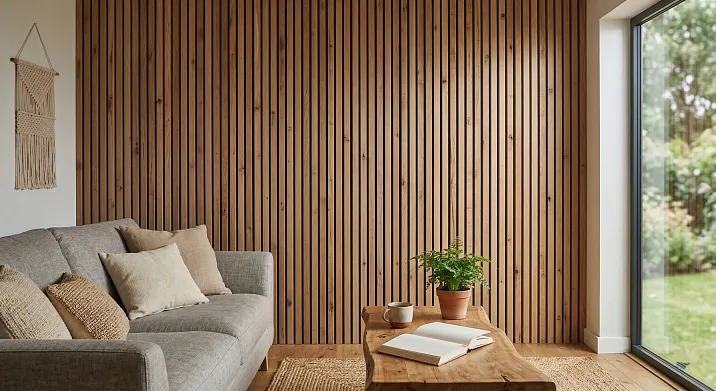
There are things that cannot be explained—they must be felt. Enter a room where the wall is clad in wood and feel how the air becomes different—warmer, denser, more real. This is not nostalgia for wooden huts or archaism. This is what neuroscientists call biophilia—the innate human need for closeness with natural materials. And it is precisely this need that wooden slat panels satisfy in modern interiors.
Over the past decade, this solution has evolved from a professional architectural tool to a mass design practice. Today, wooden slat panels are found in the most diverse spaces—from modest one-room apartments to country villas, from corporate meeting rooms to world-renowned restaurants. Their versatility is not a compromise: it is explained by the fact that wood as a material carries meanings that work in any context.
But 'wood on the wall' is not a single solution. It is a family of solutions with fundamentally different characteristics. Species, profile, spacing, orientation, finishing system, lighting—each parameter changes the result. And that is precisely why the choice of wooden slat panels must be approached consciously. This guide will help you do everything right.


Why wood, not painted MDF: an honest conversation about material
Before we begin, let's answer the question that everyone has: what is the fundamental difference between a wooden slat and a painted MDF slat? After all, both materials create a slatted surface. Both have rhythm, spacing, profile. Why is wood a separate conversation?
The difference lies in the nature of the material. MDF is an engineered product. Precise, predictable, uniform. It accepts any color, holds any geometry. But it has no character—only form.
Wooden slat panelsThey carry the history of the material within them. The grain pattern, the natural variation in shade, the tactility of an open pore—these are not flaws requiring correction. They are virtues that cannot be replicated. A hand gliding over an oiled oak slat feels something fundamentally different from touching any synthetic material. This is not a metaphor: the tactile response of natural wood is measurable physically and is psychologically significant.
The second fundamental argument is variability. Each oak slat is unique. Two adjacent battens never repeat each other's pattern. A surface made of wooden slat panels is alive, non-static, with an uncontrived natural beauty. This is precisely what distinguishes an 'expensive interior' from a 'well-made' one.




Oak as the material for slat panels: why this particular species
Wooden slat panels are made from various species, but oak holds a special place among them. Not due to tradition or inertia—but because of its objective properties.
Density 700–750 kg/m³. Oak is a hardwood. An oak slat does not dent from an accidental impact, does not deform under load, and does not get scratched by metal objects during everyday contact. This is a material for a long life—not just for a few years.
Open pore. Oiled oak is an unsealed surface with tactile depth. The oil penetrates the fibers, protects from within, but does not seal the natural texture. The slat remains 'breathable,' alive. Under varnish—it's a sealed surface with gloss or matte finish, more resistant to wet contact.
Grain pattern. Oak produces a rich, saturated pattern with radial rays—the characteristic 'fire' that appears with a tangential cut. It is this that gives oak surfaces their recognizable depth.
Durability with care. With regular renewal of oil or varnish—practically unlimited lifespan. Oak elements in old European interiors last for centuries. This is not an exaggeration—it's the physics of dense wood.
Restoration possibility. A scratch on varnished oak is not a catastrophe. Local sanding and applying a new coat of finish restores the surface to its original appearance. This is unattainable for any synthetic material.
Our factory also produces:


Structural types of wooden slat panels
Wooden slat panels are not just a single product. They are a family of constructions united by material but differing in application method.
Get Consultation
Wooden slats on MDF backing (rigid module)
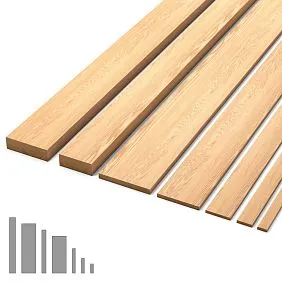
Oak battens are fixed to a rigid MDF base with factory precision. Standard module size: 0.6 × 2.4 m. The backing ensures precise spacing, flat geometry, and ease of installation. Mounted using adhesive or frame method.
This is the most common type — a standard format for straight walls, partitions, accent planes. The precision of slat spacing on the factory MDF backing is ≤ 0.5 mm: this ensures a monolithic surface when joining multiple modules.
Wooden slats on flexible fabric backing
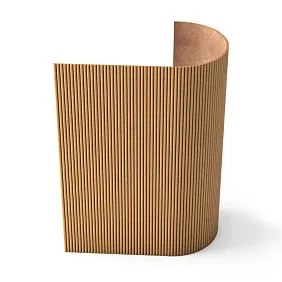
Oak battens on a fabric mesh backing. Bending radius from 100–150 mm. For curved surfaces: columns, arches, rounded corners, radius partitions. The only professional solution for non-standard architecture: a rigid panel would break on a radius.
Solid oak — individual slat for special solutions
Solid oak slats without backing — for furniture applications and specific architectural details where backing is structurally impossible. Mounted individually, requires precise layout and high installer skill.
Wooden slat profile: three characters, one material
The profile defines how the wooden batten interacts with light. On natural wood, this is especially significant: the natural material with its living texture, combined with different qualities of light and shadow, yields fundamentally different atmospheric results.
Rectangular profile of oak batten
Sharp edges. Clear, hard shadow under side lighting. The oak grain pattern acts as a horizontal or vertical background—the texture is read along the batten, the shadow draws the boundary. Architectural rigor combines with the natural warmth of the material: a conflict resolved in favor of both principles.
Application: Scandinavian style in a restrained interpretation, Japandi, modern study, minimalism with a natural accent.
Semi-circular profile of oak batten
Rounded edges. The shadow is soft, smooth, without sharp lines. Wood with a semi-circular profile is the most 'natural' of possible options: the surface resembles branches, log cabins, organic architecture. Light diffuses along the arc, emphasizing each grain pattern.
Application: living room with a warm atmosphere, bedroom, country house, Scandinavian style, organic modern.
Trapezoidal profile of oak batten
Widening towards the base creates a multi-level shadow. Wood with a trapezoidal profile is expressive, decoratively rich. For commercial spaces with a non-standard concept, where the natural material carries decorative weight.
Application: restaurant, lobby, boutique, commercial showroom.
Oak slat surface treatment: oil, varnish, tinting
The coating determines the long-term appearance and performance properties. For wooden slat panels, there are three fundamental options.
Open-pore oil
Oil penetrates the oak fibers, protects from within, and preserves the natural tactile feel. The surface under oil is matte, warm, with a lively dry sheen in diffused light. The grain pattern is read with maximum clarity—without the additional 'screen' of a varnish layer.
Maintenance: oil renewal every 3–5 years. Local damage is repaired without disassembly: sanding the damaged area, applying oil.
Matte lacquer
Varnish creates a protective layer on the surface. Matte—glare-free, soft, visually close to oil. More resistant to moisture contact and abrasion. The grain pattern is slightly 'closed' compared to oil. A choice for high-traffic areas: hallway, office, children's room.
Tinting: expanding oak's natural palette
Tinting compositions change the color of oak while preserving the grain pattern. This is a fundamental difference from painting: paint conceals the texture, tinting reveals it through color.
-
Gray tinting: cold Nordic look, Japandi;
-
Dark brown: classic, traditional warmth;
-
Fumed oak: airy, ashy tone, modern Scandinavian classic;
-
Light honey: natural warm shade that enhances the oak's natural color;
-
Graphite oak: industrial look, loft with a wooden accent.
Tinting opens up a color space for wooden slat panels that is inaccessible to natural wood—while preserving the natural texture. It's the best of both worlds: color freedom and natural honesty.
Wooden slat spacing: the rhythm of natural material
Spacing—the distance between the centers of adjacent battens—controls the visual 'density' of the surface. On wooden slats, this parameter gains an additional dimension: a wider spacing gives more room for the natural pattern of each slat to be legible.
Spacing 15–25 mm. Dense surface. The pattern of individual slats merges into a unified natural 'carpet.' A general textural effect, not the individual character of each batten. For large planes in spacious rooms.
Spacing 30–40 mm. Balanced rhythm. The pattern of each slat is read separately, while the surface is perceived as a single whole. The optimal choice for most applications.
Spacing 45–60 mm. Airy, monumental rhythm. Each slat is an independent architectural element. The gaps between battens are comparable to or greater than their width. For delicate accent solutions where depth is needed without decorative tension.
Rule of natural material: the more unique the grain pattern (pronounced 'flame' of radial cut, unusual pattern)—the wider the spacing, to allow this pattern to 'breathe'.
Seven styles where wooden slat panels are the main expressive element
Scandinavian style
Light oak with oil finish or whitewashed oak with tinting. Vertical slats with a semicircular profile. Warm lighting at 2700–3000 K. Natural linen textiles, concrete or ceramic surfaces nearby. Scandinavian interior with wooden slat panels is a dialogue of natural materials, where each speaks its own language without overpowering the others.
Japandi
Oak with gray tinting. Horizontal slats—a meditative horizon, a symbol of Japanese calm and Scandinavian restraint. Wide spacing. Rectangular profile. Natural adjacent materials: raw ceramics, bamboo, dark metal. Wooden slat panels in Japandi are not decoration, but a philosophy of surface.
Organic Modern (organic minimalism)
Natural oak with a semicircular profile. Monumental, uniform surfaces. Natural stone and textiles. Minimal decor—maximum material expressiveness.Wooden slat panelsIn organic minimalism, it is a natural wall that speaks more quietly than smooth concrete and louder than any wallpaper.
Modern classic
Oak with dark tinting.Wooden moldings and cornicesAround the perimeter of the slat field.solid wood baseboardAlong the lower boundary. A complete architectural panel system—a modern interpretation of classic wooden interiors without literal historicism.
Loft with a wooden accent
Dark oak under matte lacquer (graphite, wenge, dark walnut). Rectangular large profile. Metal details nearby. In the loft, a wooden slatted panel is a 'warm' accent in a cold industrial space. One natural element makes the space human without losing character.
Country house: Scandinavian chalet
Light or honey oak with a semi-circular profile. Horizontal or vertical slats — depending on the geometry of the room. Wood next to wood: slatted panel + wooden ceiling beams + solid wood furniture. The natural theme, fully revealed.
Restaurant with soul
Warm oak in a honey tone. Trapezoidal or rectangular profile. Directional lighting at a 30–45° angle. Acoustic diffusion reduces hall noise. Wooden slatted panels in a restaurant manage the guest experience through material: they come to eat — they stay for the atmosphere.
Spatial effects of wooden slatted panels
Wooden slats create effects that cannot be achieved with synthetic materials — simply because natural material interacts with light differently.
Living chiaroscuro. Natural lighting changes throughout the day. Morning side light, daytime diffused, evening warm. On wooden slats, each of these lighting states creates a unique shadow pattern. The surface literally 'lives' — it changes not like a screen, but like a natural object.
Thermal effect. Wood looks warm — this is not a subjective sensation. The thermal conductivity coefficient of oak is significantly lower than that of concrete and metal. A wooden wall feels warmer than a brick one — even at the same air temperature. This is psychophysiological comfort.
Acoustic softness. A wooden surface with a slatted relief scatters sound in several directions. Reverberation decreases. The voice in the room sounds softer — without the 'glassy' reflection from flat surfaces.
Scaling effect. Vertical wooden slats guide the eye from bottom to top, making the room appear taller. Horizontal slats make it appear wider. The natural material adds a 'natural volume' effect: wood is associated with the open space of a forest, which psychologically expands the perception of even a small room.
Where to install wooden slat panels: twelve application scenarios
Living room — an accent wall as the center of attraction
A single oak slat plane behind the sofa transforms the entire interior. The eye finds a natural focal point. In a light living room — light oak with oil finish and side lighting. In restrained modern classic — dark tinting for a deeper look.
Bedroom — natural intimacy
Wall behind the bed headboard. Semi-circular profile, honey-toned oak, wide spacing. LED strip along the bottom perimeter. The feeling of a natural refuge — a place where falling asleep is easy.
Entryway — the first natural impression
Wooden slat panels at the entrance provide an immediate statement about the character of the entire home. For a narrow hallway — horizontal slats on the end wall add width. For a spacious entryway — vertical slats emphasize height.
Staircase landing — a natural route
Vertical oak slats accompany the upward movement. Next tobalusters for staircasesFrom the same oak array, a unified wooden theme is created from the first floor to the last. This is an architectural narrative—the story of a natural material told across multiple levels.
Library and reading nook
Horizontal oak slats on the wall behind bookshelves. Books—like natural elements in a wooden frame. Acoustic diffusion reduces distracting noise. Tactile wood nearby—psychological comfort for focused reading.
Bathroom (moisture-resistant design)
Thermally treated wood (thermowood) or oak with a closed lacquer coating plus forced ventilation. Wooden slatted panels in the bathroom—a rare but powerful solution. Natural luxury in a space where a person begins and ends their day.
Children's room
Oiled oak with a non-toxic composition (natural linseed oil, wax compounds). Semi-circular profile without sharp edges. Natural material in a child's room—not just beauty, but a developmental environment: tactility, natural texture, the living pattern of the grain.
Office and work area
Dark oak with a rectangular profile. Directed side lighting. The natural surface reduces the acoustic tension of the workspace. A wooden background for video calls speaks of taste and seriousness.
Attic and country house
Wood in a country house—a natural choice. Wooden slatted panels in the attic following the angle of the pitched roof, with a flexible base for slopes—complete natural immersion.
Restaurant, cafe, bar
Warm oak, directed lighting, acoustics. Slatted wooden panels in a restaurant—this is mood management through material. The guest feels cozy—and wants to return.
Office and reception area
Oak with gray or honey-toned finish in the reception area. Natural materials in office spaces reduce anxiety and improve concentration. This is not just aesthetics — it's a work environment.
Spa, wellness, sauna
Thermowood or oak with wax finish in moderately humid areas. Natural materials in relaxation spaces are a necessity, not an option.
Wood slat panel finishing system: how to create architectural unity
Wood slat panels fully realize their potential within a system of coordinated elements made from the same material. This is not just a beautiful idea — it's an architectural principle.
The upper boundary of the slat field is finished with wooden molding made from the same wood species. A horizontal cornice line or simple molding creates a clear architectural 'cap' for the slat field. Without it, the top edge of the substrate appears unfinished. Oak molding with the same finish — visually seamless in terms of material difference, but architecturally essential.
The lower boundary of the system is finished with solid wood baseboard. An oak baseboard with the same finish alongside oak slat panels creates a unified natural look from floor to upper boundary. It appears as an architectural panel system, not as a collection of separate elements.
For non-standard areas — corner transitions, reveals, door/window framing — wooden plankfrom the same solid oak array. Same material, same tinting — an unnoticeable organic addition that completes the system without extraneous accents.
In classic and neoclassical interiorsDecorative Insertsmade from oak create horizontal and vertical framings for the slatted field — a full-fledged architectural 'frame'. This transforms a beautiful wooden wall into an architectural panel system with historical roots and contemporary embodiment.
Furniture Handlesin a coordinated material — the finishing touch of a furniture system with wooden slatted fronts. Not a single random detail.
Classic Furnituremade from solid wood next to wooden slatted panels — a dialogue of natural materials where both participants enhance each other. The wooden wall enriches the perception of the furniture, the furniture enriches the perception of the wall.
Wooden slatted panels in a stairwell together withbalusters for staircasesmade from the same solid oak array create a unified vertical natural theme. This is one of the strongest architectural solutions in a private home — when wood guides you through the space.
Lighting wooden slatted panels: how light reveals the natural material
On wooden surfaces, lighting works differently than on synthetic ones. The living pattern of the grain under different lighting conditions yields fundamentally different visual results — and this must be considered during design.
Warm light 2700–3000 K. Enhances the natural warmth of oak. Honey and reddish tones in the grain pattern become more saturated. The feeling of natural coziness is maximized. The choice for living spaces.
Neutral light 3500–4000 K. Accurate color rendering, without a 'warm' shift. For offices and work areas where visual neutrality is important.
Cool light 5000–6500 K. On an oak surface, it produces a cold, somewhat lifeless result. Natural warmth disappears. For wooden slatted panels — generally not a suitable choice.
Directional spotlights at a 30–45° angle to the surface. Sharp shadow, sculptural relief. The wood grain pattern on the illuminated edge is rich, on the shadowed edge — deep. Contrast enhances natural expressiveness.
LED strip behind the upper molding (downward light). Soft diffused glow across the wooden surface. Warm lighting 2700 K — an ideal combination.
LED in the gaps between slats. Wood glowing from within — a spectacular architectural technique. Requires a thin strip (up to 8 mm) and careful brightness adjustment: overheating of the strip near the wood is unacceptable.
Caring for wooden slatted panels: how wood lasts for decades
A natural material requires attention — but not complicated care. Proper maintenance takes minimal time and ensures decades of flawless appearance.
Panels with oil finish:
-
Weekly — dry microfiber cloth for dust;
-
For dirt — a slightly damp cloth with a neutral soap solution;
-
Every 3–5 years — oil renewal. Sanding with P180, applying a new coat;
-
For scratches — local sanding + oil.
Panels under varnish:
-
Dry or barely damp cloth;
-
Do not allow standing water on the surface;
-
For deep scratches — spot sanding and varnish restoration.
General rules:
-
Abrasive agents — absolutely not;
-
Alcohol-containing solvents — no;
-
Room humidity 40–60% — optimal for oak, prevents deformation.
About the company STAVROS
Wooden slat panels — products where material, precision, and manufacturing culture determine the final result. Wood species and moisture content, slat spacing accuracy, end treatment quality, stability of oil or varnish coating — all this is invisible in a catalog photo. All this becomes obvious after a year of use: either the slats warp due to unstable wood moisture, or they don't. Either the spacing is precise — or the joints are visible.
STAVROS is a Russian manufacturer of MDF and solid wood products for interior finishing and furniture production. Solid oak and MDF slatted panels of all structural types (rigid on MDF backing, flexible on fabric base), all profiles (rectangular, semicircular, trapezoidal), a complete coordinated line of moldings — solid wood and MDF moldings, cornices, baseboards, additional battens, decorative overlays. Staircase elements, furniture decor, hardware. Over 4000 models, 20,000 modifications, 39 product groups.
Wood drying climate chambers — solid wood moisture content of 8–10% guaranteed before shipment. Control of slat step accuracy ≤ 0.5 mm in each batch. Two-level quality control system (Standard and Prestige). Manual processing of decorative elements. MDF from European suppliers with a density of 750–850 kg/m³. Shipment from one piece. Delivery across all of Russia. Specialist consultation before ordering.
FAQ: Answers to popular questions
What is the difference between wooden slatted panels and MDF panels for painting?
Wooden slats carry the natural grain pattern, tactile feel, living shade variation — and a limited color palette (tints). MDF for painting — any RAL/NCS color, uniform surface, without natural grain. These are different materials for different tasks: wood — for a natural character, MDF — for precise color.
Can wooden slatted panels be installed in a bathroom?
Yes — when using thermally treated wood (thermowood) or oak with a closed lacquer coating, provided there is forced ventilation and no direct contact with water.
How long do wooden slatted panels last?
With proper installation, normal room humidity of 40–60%, and regular oil renewal — practically unlimited lifespan. Oak elements with proper care last for decades without loss of performance properties.
Is acclimatization of wooden panels needed before installation?
Mandatory — 48–72 hours in the installation room at working temperature and humidity. Without acclimatization — risk of slat deformation after installation.
What is the optimal indoor humidity for wooden slat panels?
40–60%. At humidity below 35%, oak dries out and may crack. At humidity above 70% — it swells. A normal residential climate with proper ventilation is ideal conditions.
Can wooden slat panels be combined with MDF elements in one system?
Yes — with coordinated tinting. Oak slats + MDF molding for painting in the same tone is a workable combination. The main thing: visual consistency of color and texture at the joints.
How to choose the tint for oak slat panels to match a specific interior?
Focus on the color temperature of lighting (warm light — warm oak tones; neutral — gray and cool tints) and on adjacent materials (stone, textiles, metal). Request samples from the manufacturer and view them under the actual lighting conditions of your room.