Article Contents:
- Psychology of children's space: why zoning is necessary
- Play area: territory of creativity
- Study area: concentration and order
- Sleeping area: tranquility and privacy
- Safety requirements for children's furniture and decor
- Absence of sharp corners and protruding parts
- Eco-friendliness of materials and finishes
- Structural stability
- Choosing material for a slatted partition in a child's room
- Walnut: warm luxury
- Beech: warm palette and silkiness
- Requirements for processing and drying
- Design of a slatted partition for a child's room
- Vertical or horizontal slats?
- Distance between slats: safety and light permeability
- Color solutions: stimulation or calm?
- Furniture handles for a child's room: ergonomics and safety
- Handle shape: what is comfortable for a child's hand?
- Absence of small removable parts
- Hygiene of the material
- Functional solutions for children's furniture
- Storage systems: accessibility and order
- Adjustable furniture: growing with the child
- Protection against finger pinching
- Decorative aspects: development through environment
- Slats as a play element
- Natural motifs and textures
- Color as a zoning tool
- Installation of a slatted partition in a child's room
- Mounting methods: maximum stability
- Edge and joint treatment
- Partition coating: protection and aesthetics
- Partition and furniture integration: creating a harmonious ensemble
- Unity of material and color
- Rhythm and proportions
- Practical care: durability and hygiene
- Cleaning wooden surfaces
- Checking fasteners
- Frequently Asked Questions
- At what age can a slatted partition be installed in a child's room?
- Which wood species is better for a child's room — oak or beech?
- Can a wooden partition be painted in bright colors?
- How difficult is it to install a slatted partition yourself?
- How to choose the size of a handle for children's furniture?
- Is special permission required to install a partition in a child's room?
- Can a slatted partition be used for two children in one room?
- How often should the oil coating on a partition be renewed?
- Is it worth making the partition sliding?
- What mistakes are most often made when decorating a child's room?
- Conclusion: creating a space for a happy childhood

A child's room is a special world where every detail should contribute to the development, safety, and comfort of a little person. There is no room for random decisions or compromises here. When it comes to organizing space for a child, questions that may seem secondary in other rooms come to the forefront. How to separate the play area from the study area without creating enclosed spaces? How to choose hardware that is not only aesthetically pleasing but also absolutely safe for children's hands?Slatted partitionand properly selectedFurniture Handlesbecome not just design elements, but tools for creating an ideal space for growth and development.
Why natural wood? Because in a child's room, materials that release toxic substances, accumulate static electricity, or create unpleasant tactile sensations are unacceptable. Wood breathes, regulates humidity, and creates a healthy microclimate. It is warm to the touch, pleasing to the eye, and safe upon contact. And when we talk about decorating a child's space, choosing natural materials is not a tribute to fashion but a conscious concern for the child's health.


Psychology of children's space: why zoning is needed
A child cannot organize their own space in a way that promotes concentration, peaceful sleep, and active play simultaneously. It is the task of adults to create an environment where each zone has its clear purpose while maintaining a sense of unity and openness.




Play area: territory of creativity
For a child, play is not entertainment but a way of exploring the world, developing imagination, social skills, and fine and gross motor skills. The play area should be spacious, bright, and safe. Bright colors, soft surfaces, and enough space for movement are appropriate here. However, it is important that the play area does not dominate the entire room, does not spill over into the sleep or study area, blurring boundaries and creating chaos.
Slatted Partitionsare perfect for visual zoning. They create a boundary but not a wall. Light penetrates freely through vertical or horizontal slats, the space remains airy, and parents can see what the child is doing even from another part of the room or an adjacent space. At the same time, psychologically for the child, the partition signifies: this is the play territory, here you can be active, noisy, creative.
Our factory also produces:



Study area: concentration and order
With the start of school age, a new function appears in the child's room — study. A desk, bookshelves, and organized storage of school supplies require a separate area where nothing distracts from studies. Psychologists assert: when a child sits at a table located in a clearly defined study area, their brain automatically switches to work mode. This is called spatial anchoring.
A slatted partition can separate a study nook from a play area or sleeping space, creating a visual and psychological barrier between different activities. It is important that the study area has sufficient natural light — ideally, the desk is placed by a window. A partition made of light wood does not block light but creates the necessary sense of separation.
Get Consultation
Sleep zone: tranquility and privacy
The sleeping area in a child's room should be as calm, protected, and comfortable as possible. Bright colors, active toys, and sources of distraction are inappropriate here. A slatted partition can separate the bed from the rest of the room, creating a cozy nook where the child feels protected, can fall asleep peacefully, and is not distracted by toys or the desk.
An important point: in a child's room, the partition must be absolutely stable, securely fastened, without sharp corners or protruding elements. Children are curious and active — they may lean on the partition, try to climb it, or use it in play. The structure must withstand such loads without risk of falling or damage.
Safety requirements for children's furniture and decor
Safety in a child's room is not just a desirable condition but an absolute requirement. Every element of the interior must be checked for potential risks.
Absence of sharp corners and protruding parts
A child, especially at a young age, does not control their movements like an adult. A sudden impulse, sharp turn, or fall — all these are common situations in a child's room. A sharp corner of a wardrobe, protruding hardware, or the edge of a partition can cause injury.
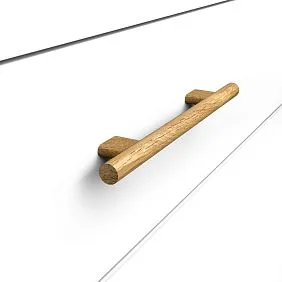
Wooden handlesfor children's furniture should have a rounded shape, without sharp edges. Buttons, staples with smooth lines, recessed or inset handles are ideal. Metal handles with sharp edges, protruding decorative elements that can snag clothing or injure skin are categorically unsuitable.
A slatted partition must be thoroughly sanded, all slats processed to smoothness, ends rounded or protected with special caps. No splinters, roughness, or chips.
Eco-friendliness of materials and finishes
Children spend most of their time in their room; here they sleep, breathe, play on the floor, and come into contact with furniture with their hands and body. Materials that release formaldehyde, phenols, or volatile organic compounds are unacceptable.
Wooden itemsmade of solid oak or beech is the optimal choice for a child's room. This is a completely natural material that, when properly processed, is not only safe but also beneficial: wood regulates air humidity, absorbs excess moisture and releases it when dry, creating a comfortable microclimate.
But it's not just the wood itself that matters, but also the finish. For children's furniture and partitions, eco-friendly oils and water-based varnishes that do not contain toxic solvents are used. Such finishes have safety certificates for use in children's institutions.
Stability of structures
Furniture tipping over is one of the common causes of childhood injuries at home. Wardrobes, shelves, and partitions must be securely fastened to the wall or floor. A slatted partition in a child's room must be fixed to the ceiling and floor, and if it is tall, also to the wall, to eliminate the possibility of swaying or falling.
Furniture handles must be securely fastened, screws tightened with sufficient force but without overtightening, which can damage the wood. It is necessary to periodically check the reliability of all fastenings — children put significant stress on hardware by opening and closing doors and drawers dozens of times a day.
Choosing material for a slatted partition in a child's room
Not all wood species are equally good for a child's space. Selection criteria: hardness, stability, absence of resinousness, hypoallergenicity, aesthetics.
Oak: strength and nobility
Oak is a classic choice for children's furniture and decor. Its density of about 700 kg/m³ ensures mechanical strength, resistance to scratches and dents, which are inevitable in an active child's environment. Oak contains tannins — natural antiseptics that prevent the development of bacteria and fungi on the wood surface.
The texture of oak is expressive, with a clear pattern of annual rings. This creates visual depth and interest, contributing to the development of a child's aesthetic perception. The color palette of oak ranges from light honey tones to rich browns, allowing you to choose a shade to match any color concept for the child's room.
Beech: warm palette and silkiness
Beech has a delicate pinkish or creamy hue that creates a soft, warm atmosphere. Its structure is fine-pored, homogeneous, and the surface becomes very smooth and pleasant to the touch. For a child's room, where tactile sensations are important, beech is an excellent choice.
The density of beech is slightly higher than that of oak, making it just as strong and durable. At the same time, beech is easier to process, allowing for more complex slat profiles, roundings, and decorative elements.
Requirements for processing and drying
Using wood with high moisture content is unacceptable for a child's room. The standard is 8-12%. Only at such moisture content is the wood stable, does not crack, and does not warp during use. Manufacturers working with children's themes pay special attention to the quality of drying and storing the material under controlled conditions.
Processing the slats includes thorough sanding, removal of all irregularities, knots, and resin pockets. The surface must be perfectly smooth, with no risk of splinters. The ends of the slats are rounded or covered with special caps.
Design of a slatted partition for a child's room
A partition in a child's room is not just a functional element but also part of the developmental environment. Its design influences the child's perception of space, mood, and activity.
Vertical or horizontal slats?
Vertical battens create a sense of height, visually raise the ceiling, and establish a dynamic, upward-striving rhythm. This is a good choice for small children's rooms with low ceilings. Vertical lines stimulate activity and alertness.
Horizontal battens, on the contrary, expand the space, making it calmer and more stable. They are suitable for elongated narrow rooms where visual width needs to be added. The horizontal rhythm calms, creating a sense of reliability and security.
Directions can be combined, creating geometric compositions that become an interesting visual object for the child, stimulating their spatial thinking.
Distance between battens: safety and light permeability
The distance between battens is determined by two factors: safety and functionality. For a child's room, gaps wider than 80-100 mm are not recommended — a child may try to put their head or limbs into wider gaps, creating a risk of getting stuck.
On the other hand, battens placed too close together create a feeling of a solid wall, block light and the visual connection between zones. The optimal spacing is 80-120 mm between the centers of battens with a batten thickness of 20-40 mm. This ensures sufficient light permeability, visual lightness, and safety.
Color solutions: stimulation or calming?
Color in a child's room is a powerful tool for influencing the psyche. Natural wood can be left in its natural shade, coated with transparent oil or varnish, or painted any color.
For active, energetic children prone to hyperactivity, calm, muted tones are recommended: light gray, beige, soft blue, mint. These colors calm and help with concentration.
For calm, phlegmatic children, on the contrary, brighter, stimulating shades can be used: sunny yellow, soft orange, grassy green. It's important not to overdo the saturation — a child's room should not have loud, aggressive colors.
An interesting solution is gradient coloring, where the slats smoothly change shade from warm to cool or from light to dark. This creates dynamism, interest, and stimulates the imagination.
Furniture handles for a child's room: ergonomics and safety
Furniture Handles— these are things a child touches daily, repeatedly. Their shape, size, and material affect not only the convenience of using the furniture but also safety and even the development of fine motor skills.
Handle shape: what is comfortable for a child's hand?
A child's hand is smaller and weaker than an adult's. A handle that is comfortable for an adult may be inconvenient for a child. Oversized pull bars that need to be fully grasped create difficulties for small fingers. Tiny knobs requiring precise grip are also inconvenient.
The optimal shape for a child's room is medium-sized knobs (diameter 30-50 mm) or small pull bars (center-to-center distance 64-96 mm) with a rounded profile, comfortable for gripping. The handle should protrude slightly above the surface of the front panel, but not so much that clothing can catch on it.
It is important that the handle surface is non-slip. Polished wood coated with varnish can be slippery. Matte oil finishes that create slight friction with the skin are preferable.
Absence of small removable parts
Young children put everything in their mouths, unscrew, and disassemble things. A handle with decorative overlays that can be pried off, with screws accessible from the front, poses a danger. Optimal are solid handles made from solid wood, where there are no small parts that can be torn off.
The fastening must be reliable, screws tightened and inaccessible to the child. Countersunk head screws tightened from the back of the front panel or hidden fastening systems are used.
Material hygiene
Children do not always wash their hands before opening a cabinet. Dirt and bacteria accumulate on handles. Wood coated with varnish or oil containing antibacterial additives is easily cleaned with a damp cloth, does not absorb dirt, and does not create a favorable environment for microorganisms.
Oak, as mentioned, contains tannins with natural antiseptic properties. This is an additional factor in the hygiene of wooden oak handles for children's furniture.
Functional solutions for children's furniture
Children's furniture should be not only beautiful and safe but also functional, adapted to the needs of a growing child.
Storage systems: accessibility and order
A child should be taught order from an early age. For this, storage systems must be clear, accessible, and convenient. Low drawers and cabinets that the child can reach on their own encourage independence.
Handles on children's furniture should be positioned at a level convenient for the child. For a preschooler, this is 60-80 cm from the floor; for a schoolchild, it's 80-120 cm. If the furniture grows with the child, adjustable or re-hangable front panels can be provided.
It is important to distinguish between handles for drawers and for doors. Drawers are more convenient to open with a pull bar or rail, doors — with a knob or a short pull bar. For heavy, deep drawers with toys, sturdy, reliably fastened handles that can withstand significant force are needed.
Adjustable furniture: growing with the child
Children grow quickly, and furniture that is perfect for a three-year-old becomes uncomfortable for a seven-year-old. Adjustable desks and chairs, extendable beds — these are investments in long-term comfort. The hardware for such furniture must maintain functionality through multiple adjustments, not become loose, and not wear out.
Wooden handlesSolid oak or beech furniture withstands intensive use, maintaining its appearance and functionality for decades. This is important for children's furniture that is passed down from an older child to a younger one, serving several generations.
Protection against pinched fingers
Doors and drawers of children's furniture should have soft-close mechanisms or dampers that prevent them from slamming shut. Pinched fingers are a common childhood injury that can be avoided by using the right hardware.
Concealed hinges, soft dampers, smooth closing — all of these are not luxuries but essential elements of safe children's furniture. Handles, in turn, should allow doors or drawers to be opened smoothly, without jerking.
Decorative aspects: development through the environment
A child's room is not just a place for sleep and play; it is a developmental environment. Every element of the interior can stimulate a child's imagination, creativity, and cognitive activity.
Slats as a play element
A slatted partition can become part of the play space. Threads can be stretched between the slats to create webs or geometric patterns. Drawings, crafts, and flags can be hung on the slats. The partition transforms into a dynamic, changeable element that the child can personalize, making the room truly their own.
It is important that the fastenings for decorations are safe — soft clips, magnets, Velcro, not pins or nails. The slats themselves must withstand the additional load from hung items without risk of deformation.
Natural motifs and textures
Wood provides a connection with nature, which modern urban children often lose. The natural texture of wood, visible growth rings, and natural color variations teach a child observation and develop aesthetic sense.
decor for furnitureFurniture made from natural wood can include carved elements with plant motifs, animal figures, and geometric patterns. This is not just decoration but also an educational element that stimulates interest in nature, shapes, and symmetry.
Color as a zoning tool
Different zones in a child's room can be distinguished not only by partitions but also by color. The play area — brighter; the study area — calmer; the sleep area — neutral and soothing. A slatted partition painted in the color of the corresponding zone enhances this effect, creating a clear visual structure for the space.
Handles on furniture can also support color zoning. A toy cabinet — bright colored handles; a cabinet with books and study materials — calm, neutral ones; a wardrobe — natural wood. This helps the child navigate and develops associative thinking.
Installation of a slatted partition in a child's room
Installing a partition in a child's room requires increased attention to the reliability and safety of the structure.
Mounting methods: maximum stability
A slatted partition in a child's room must be secured in at least two points — to the floor and to the ceiling. For tall partitions (from 2 meters), additional wall mounting or the installation of intermediate posts is recommended.
Floor mounting is done through a bottom rail — a horizontal beam to which the vertical slats are attached. The rail is fixed to the floor with anchors or powerful screws (if the floor is wooden). It is important that the fasteners are countersunk flush, do not protrude, and do not create a tripping hazard.
Ceiling mounting is similar — through a top rail. If the ceiling is stretch or suspended, it is necessary to provide for built-in elements in the ceiling structure before its installation.
Treatment of ends and joints
All ends of the slats must be thoroughly sanded and rounded. Sharp edges are unacceptable. The ends can be additionally protected with special plastic or wooden caps, which prevent chipping and make the structure more finished.
Joints between the slats and the rail must be tight, without gaps where a child could insert fingers. If an open mounting system is used, all screws and bolts must be countersunk and covered with decorative caps.
Partition coating: protection and aesthetics
After installation, the partition must be coated with a protective finish. For children's rooms, eco-friendly oils or water-based varnishes with safety certificates are preferred. The coating must be resistant to wet cleaning — floors need to be washed and dust wiped frequently in a child's room.
If the partition is painted, water-based paints that do not contain toxic solvents or heavy metals are used. After painting, the room must be thoroughly ventilated, and the coating must be allowed to dry completely and off-gas before the child occupies the room.
Integration of the partition and furniture: creating a harmonious ensemble
A slatted partition does not exist in isolation — it is part of an interior composition where the coordination of all elements is important.
Unity of material and color
If the partition is made of oak, it is logical for the furniture or its individual elements to also be made of oak. This could be an oak desk top, cabinet fronts,Wooden handleson all furniture.
Unity of material creates a visual connection between elements, making the interior cohesive and well-thought-out. A child subconsciously perceives such a space as harmonious, which positively affects their emotional state.
Color unity is also important. If the partition is painted in a certain shade, this shade can be repeated in other elements—textiles, individual furniture fronts, decorative accessories. But it's important not to overdo it—monotony is tiring. Color unity does not mean monochrome; it is rather a harmonious combination of shades from the same palette.
Rhythm and Proportions
The vertical rhythm of the partition slats can find an echo in vertical furniture elements—narrow tall cabinets, shelving units. The horizontal rhythm is supported by horizontal lines of shelves, countertops, beds.
Proportions also matter. Massive, heavy furniture conflicts with a light, airy slatted partition. It is important to maintain visual balance—if the furniture is large, the slats can be slightly thicker and more frequent, creating a more substantial impression.
Practical care: durability and hygiene
A child's room requires frequent cleaning. Materials and finishes must withstand regular wet cleaning, not lose their appearance, and not deteriorate.
Cleaning wooden surfaces
Wooden slats coated with varnish are easily cleaned with a damp cloth and mild detergent. It is important not to use abrasives that scratch the varnish and to avoid excessive moisture, which can penetrate into the joints.
Oil finishes require slightly more delicate care. For cleaning, special products for oiled wood or simply a slightly damp cloth without chemicals are used. Every 6-12 months, it is recommended to renew the oil finish by applying a fresh thin layer of oil.
Furniture handles are wiped daily—they accumulate the most dirt from children's hands. Oak handles coated with varnish practically do not absorb dirt, are easy to wash, and retain an attractive appearance for a long time.
Checking fasteners
Every few months, it is necessary to check the reliability of the partition and furniture handle fastenings. Children create significant loads—they pull, shake, hang. Gradually, fasteners can loosen. Timely tightening of screws and checking the stability of structures prevents possible incidents.
Frequently asked questions
At what age can a slatted partition be installed in a child's room?
A slatted partition is safe for any age, provided it is properly installed and safety requirements are met. For infants and children under three years old, it is important that the distance between the slats does not allow the head to be inserted (no more than 80 mm). For older children, the partition becomes a functional zoning element.
Which wood species is better for a child's room—oak or beech?
Both species are excellent for a child's room. Oak is slightly stronger, has a more pronounced texture, and natural antiseptic properties due to tannins. Beech has a more delicate shade, creating a softer atmosphere. The choice depends on the overall interior concept and personal preferences.
Can a wooden partition be painted in bright colors?
Yes, and it is even beneficial for creating visual zoning and stimulating children's perception. The main thing is to use high-quality, eco-friendly water-based paints designed for children's rooms. After painting, it is necessary to let the paint dry completely and air out.
How difficult is it to install a slatted partition yourself?
With basic woodworking skills and tools, installing a slatted partition is quite feasible for a DIY enthusiast. The main things are precise marking, reliable fastening of the frame, and careful finishing. For complex structures or lack of experience, it is better to involve professionals.
How to choose the size of handles for children's furniture?
For preschoolers, knobs with a diameter of 30-40 mm or pulls with a center-to-center distance of 64 mm are optimal. For schoolchildren, standard adult-sized handles can be used—96-128 mm for pulls. The main things are a rounded shape without sharp edges and ease of grip.
Is special permission required to install a partition in a child's room?
If it is a lightweight slatted partition that is not a permanent structure and does not affect load-bearing walls, no special permits are required. It is an element of interior decoration, similar to furniture.
Can a slatted partition be used for two children in one room?
This is one of the best options for zoning a shared children's room for two children. The partition gives each child a sense of personal space, without dividing the room into two isolated worlds. Children can see each other through the slats, can communicate, but still have their own zone.
How often should the oil finish on a partition be renewed?
In a children's room with active use, the oil finish is recommended to be renewed every 6-12 months. Signs that renewal is needed include a matte surface, slight roughness, and reduced water-repellent properties. Renewal takes minimal time and requires no special skills.
Is it worth making a partition sliding?
A sliding partition offers flexibility in space usage but requires more complex hardware and tracks. For a young child's room, a fixed partition is preferable—simpler, more reliable, safer. For teenagers, a sliding system can be an interesting solution.
What mistakes are most often made when decorating a child's room?
A common mistake is using materials not intended for children's rooms, with toxic emissions. The second mistake is insufficient attention to safety—sharp corners, unstable furniture. The third is creating a visually overloaded space with an excess of bright colors and decor. A child's room should be calm, bright, and safe.
Conclusion: creating a space for a happy childhood
Decorating a child's room is not just a design task; it's creating an environment for development, growth, and personality formation.Slatted partitionmade of natural wood becomes a tool for proper zoning, where each zone performs its function without conflicting with others.Furniture Handlesmade of solid oak or beech ensure safety, convenience, and durability, helping the child develop independence and tidiness.
Natural wood in a child's room is not a tribute to fashion but a conscious choice in favor of health, ecology, and connection with nature. It is a material that grows with the child, without losing its qualities, without emitting harmful substances, creating that very comfortable microclimate where one wants to play, learn, and dream.
Every element of a child's room should work towards creating a safe, harmonious, development-stimulating space. From the choice of wood species to the shape of a door handle, from the distance between partition slats to the color of the finish—everything matters. When these details are thought out, coordinated, and executed with quality, the child's room turns into a place where the child grows up happy, healthy, and harmonious.
The company STAVROS has been creatingWooden items, which serve as the foundation for beautiful and functional interiors. Slats for partitions, furniture handles, decorative elements—all are made from selected solid oak and beech, undergo the strictest quality control, and receive eco-friendly protective coatings. Choosing STAVROS means choosing reliability, safety, and the beauty of natural wood for the most important space in your home—the room where your child grows.