Article Contents:
- Buying a wall slat panel: where to start to avoid redoing
- What is a wall slat panel and why it works
- Type of construction: the first and most important decision
- Rigid slat panel on MDF backing
- Flexible slat panel on fabric base
- Panels made of half-round battens
- Material: oak or MDF for painting
- MDF for painting: color and geometry precision
- Solid oak: natural texture and tactility
- Batten Profile: How Shape Defines Character
- Rectangular profile
- Semicircular profile
- Trapezoidal profile
- Batten Spacing: Rhythm as an Architectural Tool
- Quantity Calculation: How to Avoid Buying Too Much or Running Out of Material
- Spatial Effects: How a Batten Panel Transforms a Room
- Where Batten Panels Are Used: Seven Purchase Scenarios
- 1. Accent Wall in the Living Room
- 2. Bedroom: Wall Behind the Headboard
- 3. Entryway
- 4. Study
- 5. Corridor and Transitional Zones
- 6. Restaurant, cafe, bar
- 7. Office, reception, meeting room
- What to check with the manufacturer before purchase
- Finishing system: slatted panel plus what completes it
- How to install slatted panels: a buyer's quick guide
- Foundation Preparation
- Two installation methods
- Module joining
- Orientation and trimming
- Finishing details
- Five mistakes when buying wall slatted panels
- Buy wall slatted panels in the STAVROS catalog
- About the Company STAVROS
- FAQ: Answers to Popular Questions

When someone types 'buy wall slat panel' into a search engine, they've typically already come halfway. They've looked at photos, fallen in love with the effect, imagined their living room or bedroom — and now face a very specific question: what exactly to buy, from whom, and how not to make a mistake.
This is an honest commercial query, and it deserves an honest, detailed answer. Not an advertising brochure, not abstract musings about interior beauty — but a concrete guide that will take you from 'I want' to 'installed and working'.
That's exactly the article you're reading now. Here is everything you need to know before buying: selection parameters, materials, profiles, types of structures, quantity calculation, installation nuances, typical mistakes, and clear guidelines on what the manufacturer should provide. And — specific links to real catalog pages where you can find all this.


Buying a wall slat panel: where to start so you don't have to redo it
The first mistake of everyone who wants tobuy a wall slat panel— is to start with the question 'how much does it cost'. It's not the wrong question. It's a premature question. Because price without understanding what exactly you're buying is meaningless. A cheap panel in the wrong finish for the wrong surface is money thrown away twice: on the purchase and on the rework.
Correct sequence:
-
Determine the surface type — flat or curved;
-
Choose the material — MDF for painting or solid oak;
-
Choose the slat profile — rectangular, semi-circular, trapezoidal;
-
Determine the orientation of the slats — vertical or horizontal;
-
Calculate the area and number of modules;
-
Choose a manufacturer with proven quality;
-
Order.
Only in this sequence. This is not a complication — it's saving time and money.




What is a slatted wall panel and why it works
Before moving on to purchase — a brief note about the product, because many confuse slatted panels with cladding, paneling, lamellas, and other related concepts.
A slatted wall panel is a modular structure made of parallel slats (battens, glazing beads) of identical cross-section, fixed at equal intervals on a substrate. The slats create a rhythmic linear relief. With side or directional lighting, each slat casts a shadow into the gap — and a flat wall transforms into a lively, three-dimensional, architectural surface.
This is a principle that works equally convincingly — in an oak bedroom and an anthracite meeting room, in a minimalist white living room and a perfectionist's dark study. Because behind the visible decorative effect lies a clear architectural mechanics: rhythm + relief + light = depth.
Now — to the purchase.
Our factory also produces:
Construction type: the first and most important decision
Get Consultation
Rigid slatted panel on MDF backing
This is a market classic and the most common solution. Slats made of MDF or solid oak are fixed to a rigid MDF base with factory-precision spacing. The module is completely flat, stable, and geometrically precise.
When to buy a rigid panel: for straight walls, straight furniture fronts, straight partitions. This covers 90% of all residential and commercial projects. Rigidity is an advantage: the backing maintains flatness regardless of the wall, modules join without gaps, and the slat pattern continues seamlessly across joints.
Key parameter: spacing precision. A good rigid MDF panel has a spacing deviation of no more than 0.5 mm. This is the condition for seamless connection: slats from one module continue those from the adjacent module without visible misalignment. If the manufacturer does not control this parameter, joints will be visible, and no installer can fix it.
Flexible slatted panel on fabric backing
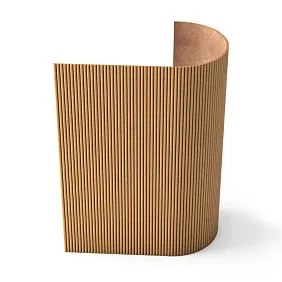
This is a solution for curved surfaces. Slats are attached to a fabric mesh backing, which allows the panel to bend without deforming the battens. Bending radius: from 100–150 mm. A flexible panel wraps around columns, arches, rounded corners, and wave-shaped partitions.
When to buy a flexible panel: if your project has at least one curved section that needs to be clad with a slatted pattern. A rigid panel will crack on a radius—this is not a matter of installer skill, it's physics. Only a flexible construction delivers a professional result.
Important when purchasing: a flexible panel must be ordered considering the slat orientation (vertical or horizontal)—this affects the direction of bending of the fabric backing.
Panels made of half-round molding strips
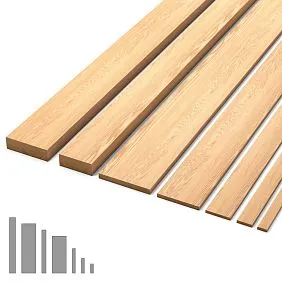
A separate category based on slat profile. A semicircular cross-section creates soft, diffused light and shadow—without the sharp shadows of a rectangular profile. Available in both rigid (for straight walls) and flexible (for curved) versions.
When to buy: for living spaces with a warm, organic, cozy character — bedroom, living room, nursery, home library. Where depth without harshness is needed.
Material: oak or MDF for painting
This choice defines the character of the space for years to come. Let's break it down honestly.
MDF for painting: color and geometry precision
MDF with a density of 750–850 kg/m³ is an engineered material with a uniform structure. No natural defects, no variability. A perfect surface for professional painting in any RAL or NCS color.
Buy MDF slatted wall panels— means getting absolute color freedom. White, anthracite, sage, terracotta, smoky blue, corporate RAL office color — any option is reproduced accurately and predictably. This is a key advantage of MDF over natural wood.
Who MDF for painting is suitable for:
-
Monochromatic solutions 'panel matching the wall color';
-
Precise brand color for commercial projects;
-
Interiors with frequent concept changes (repainting without dismantling);
-
Minimalism, office, Japandi with neutral tones.
Solid oak: natural texture and tactility
Oak is a species with a density of 700–750 kg/m³, a unique grain pattern, and natural wear resistance. Each plank carries its own pattern. Under oil, the open pore of oak is tactilely rich — this is something that cannot be reproduced synthetically.
Who solid oak is suitable for:
-
Scandinavian style, Japandi, organic minimalism;
-
Interiors where natural material is the main theme;
-
Spaces with a warm, lively atmosphere;
-
Combination with other natural materials: stone, linen, neutral metal.
| Selection criterion | MDF for painting | Solid oak |
|---|---|---|
| Color accuracy | Any RAL/NCS | Natural tints |
| Natural texture | No | Yes, unique |
| Tactile | Homogeneous | Living, open pore |
| Future color change | Repainting | New tint/varnish |
| Perfect style | Minimalism, office | Scandinavian, japandi, organic |
Rail profile: how shape defines character
Three profiles — three fundamentally different spatial images. This is not an aesthetic nuance — it's a defining choice.
Rectangular profile
Sharp edges. With side lighting — clear, hard linear shadows. The surface is strict, architectural, disciplined. The right choice for minimalism, offices, meeting rooms, loft, neoclassicism.
A white rectangular profile on a white wall — monochrome at its finest: relief created solely through shadow. This is seen in all 'luxury' shots in architectural publications — precisely because it looks expensive, even though it costs as much as a standard panel.
Semi-circular profile
Rounded edges. Light diffuses softly, shadows are smooth, transitions are organic. The surface is warm, natural, alive. The right choice for living spaces: bedroom, living room, children's room.
Trapezoidal profile
A section that widens toward the base. A more voluminous relief, complex multi-level shadowing. The surface is dynamic, eye-catching. The right choice for commercial spaces: restaurant, showroom, lobby.
Slat spacing: rhythm as an architectural tool
Spacing is the distance between the centers of adjacent slats (or, simply put, the width of the gap between them). Three ranges:
-
Narrow gap (15–20 mm): dense, rich rhythm. The surface is active, attention-grabbing. For large accent planes and spacious rooms.
-
Medium gap (25–35 mm): universal, balanced rhythm. Works in most residential spaces.
-
Wide gap (40 mm and more): airy, monumental surface. Less tension, more tranquility. For small rooms and delicate accents.
Scale rule: the smaller the room, the more delicate the spacing. An aggressive, dense rhythm in a small room creates a feeling of being caged.
Quantity calculation: how to avoid buying too much and not run out of material
Before placing an order — the right calculation. It takes five minutes and saves money.
Step 1. Measure the width and height of the wall (or walls) you plan to cover. Subtract the area of door and window openings.
Step 2. Find out the area of one module from the manufacturer (length × width in meters).
Step 3. Divide the total wall area by the area of one module.
Step 4. Round the result up to the nearest whole number.
Step 5. Add a 10–15% margin for cutting at edges, corners, and openings.
Example: wall 4 × 2.7 m = 10.8 sq.m. Panel 0.6 × 2.4 m = 1.44 sq.m. Needed: 10.8 / 1.44 = 7.5 → 8 panels. Plus 10% margin: 9 panels.
If covering multiple walls — calculate each separately, then sum them up. Use a 15% margin if there are complex corners and window reveals.
Spatial effects: how slatted panels transform a room
When the decision is made and the panels are purchased — the space begins to change. Predictably and precisely.
Vertical slats raise the ceiling. The eye follows the lines upward. A room with a 2.7 m ceiling and a vertical slatted wall appears taller. This is the most valuable visual technique for standard city apartments.
Horizontal slats expand the space. The eye glides horizontally. Horizontal slats on the end wall of a narrow hallway are a proven way to make it visually wider without physical changes.
Texture creates perceived volume. Each slat casts a shadow into the gap under side lighting. The surface appears deeper. The wall 'recedes' into space, creating a feeling of a larger room.
Rhythm structures the gaze. In a room without focal points, the eye doesn't know where to settle. A slatted wall is a point to which the eye returns. The space organizes itself around it.
Acoustics. The textured surface scatters sound waves. In rooms with hard, reflective surfaces, a slatted panel reduces echo and reverberation. This is relevant for open-plan living rooms, meeting rooms, and restaurant halls.
Where slatted panels are used: seven purchase scenarios
1. Accent wall in the living room
The most common scenario—and the most rewarding. Behind the sofa or behind the TV. One slatted plane changes the entire interior: the eye gets an anchor point, the space gains a center. Oiled oak with side lighting is a timeless classic. Anthracite MDF behind the TV is a strict, contemporary look.
2. Bedroom: wall behind the headboard
A delicate, intimate scenario. Semi-circular profile, neutral tone, moderate spacing. Oak or tinted MDF. LED strip along the lower perimeter of the panel—soft upward glow. It's not expensive or complicated—and the visual result is comparable to a high-class hotel room.
3. Hallway
The first architectural signal of the interior. Vertical slats on the main wall, horizontal on the end wall of a narrow corridor — depending on the geometry. Material with high resistance to mechanical loads: oak under hard lacquer or MDF in durable enamel.
4. Study
Wall behind the desk. Status, concentration, acoustic comfort. Dark tone, rectangular profile, strictness. Background for video calls with a professional image.
5. Corridor and transitional zones
Boring 'passage' spaces come alive with one architectural technique. A slatted plane at the end of the corridor — a 'stop' for the gaze. On the side wall — the dynamics of movement.
6. Restaurant, cafe, bar
Atmosphere as the main product. Warm oak under directional lighting, vertical rhythm, acoustic diffusion. This is what distinguishes a 'place with character' from 'just a cafe'.
7. Office, reception, meeting room
Corporate RAL on the reception desk. Business image of the meeting room. Slatted wall panels as branding through architecture.
What to check with the manufacturer before purchase
Before buying a slatted wall panel — ask the manufacturer or seller these questions. The answers will show the level.
1. MDF density?
An answer of "around 700 kg/m³" is a reason to be cautious. Correct: 750–850 kg/m³.
2. Accuracy of slat spacing?
Correct answer: "deviation no more than 0.5 mm". A vague answer is a sign of unstable production.
3. How are the edges processed?
MDF edges must be sealed (primed or covered with film). Open edges absorb moisture.
4. Are the panels supplied with a primer layer (for MDF to be painted)?
"Yes, with primer" — saves your time and material. "No, raw MDF" — you'll have to do the priming work yourself.
5. Does the catalog include coordinated trim—baseboards, moldings from the same wood species?
This shows that the manufacturer thinks systematically, rather than selling isolated parts.
Finishing system: slatted panel plus what completes it
Buying a slatted wall panel is not the final purchase. It's the first one. The system works when all elements are coordinated.
Molding along the top edge—completes the panel from above. Without molding, the textured plane 'breaks off' into a smooth wall.wooden moldingIn the same tone as the panel or in contrast—a mandatory architectural element, especially in neoclassical and modern classic styles.
Floor baseboard—completes the system from below.wooden skirting board purchaseMade from the same solid oak as the slats—a unified material language from floor to the upper boundary of the panel. For MDF systems—buy MDF skirting boardFor painting in the same color: white slatted panel + white baseboard = a monolithic, clean architectural system.
Wooden slat for additional elements—available for separate purchaseRK-001 can be ordered directly on the websitefrom the same solid wood is needed for non-standard sections: corner transitions, window reveal slopes, decorative trims. A slat from the same species with the same tone is an inconspicuous, organic addition.
Decorative overlays — in neoclassical and modern classic stylesDecorative Insertsmade of wood create an architectural 'frame' around the slatted plane: horizontal and vertical trims, corner elements. This transforms a simply beautiful wall into a full-fledged architectural panel system.
Furniture handles — if slatted panels are used on furniture fronts,Furniture Handlesin a coordinated material (metal matching the lighting tone, wood matching the slats) create a complete furniture image without random details.
Balusters for stairs — if slatted panels are installed in a stairwell,balusters for staircasesmade from the same solid wood create a vertical material rhyme: slatted wall + wooden stair railing — a unified natural theme that guides the eye from the first floor upward.
How to install a slatted panel: a brief buyer's guide
Installation is not the most difficult part. But several rules need to be known before starting work.
Foundation Preparation
Wall: clean, dry, without crumbling sections. Degreased surface — mandatory. Plane deviation:
-
Up to 3–5 mm — direct adhesive mounting;
-
Over 5 mm — frame mounting on metal profile.
Drywall must be primed before applying adhesive. Concrete and plaster — priming is recommended to improve adhesion.
Two mounting methods
Adhesive method — apply mounting adhesive or liquid nails to the substrate, press panel to wall. Fast, clean, no noise. For even substrates. Downside: removal without damage is difficult.
Frame method — metal CD-profile spaced 400–600 mm is fixed to wall, panels attached with screws through substrate into profile. Plane is leveled independently of wall. Can create technical gap for hidden wiring or sound-absorbing fill. Professional method with maximum control over result.
Module Joining
Modules butt-join — tightly, no gap and no decorative strip at joint. With factory precision of 0.5 mm, slats pass through joint without offset. Wall is perceived as monolithic surface.
Orientation and trimming
Vertical orientation — standard. Horizontal — panel rotated 90°. Trimming edge modules in width done with jigsaw or miter saw along substrate line — not along slat.
Finishing details
After installing all modules: install molding along the top edge, mount the baseboard at the bottom. Corner joints — miter cut at 45° for wooden trim. Gaps at joints with smooth walls — acrylic sealant matching the finish color.
Five mistakes when buying slatted wall panels
Mistake 1: choosing based only on price. Cheap panels made of low-density MDF (density 650–700 kg/m³) are unstable, hold fasteners poorly, and edges swell. Saving money leads to rework. Pay for proper MDF with a density of 750+ — it's an investment in the result.
Mistake 2: buying a rigid panel for a curved surface. Rigid MDF does not bend without cracking. For columns, arches, radius corners — only flexible panels on a fabric base. No compromises.
Mistake 3: not checking the accuracy of the spacing. Panels with unstable spacing create visible seams at module connections. This cannot be fixed during installation. Ask the manufacturer: 'What is the allowable deviation in slat spacing?' The correct answer: 0.5 mm.
Mistake 4: buying without considering the trim. A slatted panel without matching baseboard and molding is an unfinished project. A 'panel + trim from the same wood species' system is what looks professional. Mismatched elements ruin the integrity.
Mistake 5: planning lighting after installation. Slatted relief is invisible under frontal light without side or directional lighting. Lighting is planned before installation — not after. This is a rule, and breaking it is costly.
Buy slatted wall panels in the STAVROS catalog
All types of structures, materials, and profiles described in this article are available in the STAVROS catalog.Slatted wall panelsavailable in the following versions:
-
Rigid panels on MDF backing — rectangular and semicircular profile;
-
Flexible panels on fabric backing — for curved surfaces;
-
MDF panels for painting — for any RAL/NCS color;
-
Solid oak panels — in natural tone and tints.
For creating a finishing system:
-
wooden baseboardsolid wood;
-
buy wooden skirting board— solid oak skirting board;
-
Moldings and corniceswooden for top finishing of panels;
-
Wooden planksfor additional elements;
-
Furniture Handlesfor slatted furniture fronts.
About the company STAVROS
Behind every correctly purchased and properly installed slatted panel lies not only the buyer's choice—it reflects the manufacturer's production culture. Step precision, MDF uniformity, edge processing, coating stability—these are parameters not visible in a photo but felt during installation and years of use.
STAVROS is a Russian manufacturer of MDF and solid wood products for interior finishing and furniture production. Slatted panels, moldings, decorative overlays, stair elements, furniture decor and fittings—over 4000 models in 39 product groups, 20,000 modifications.
STAVROS production standard: MDF from European suppliers 750–850 kg/m³, wood drying climate chambers, two-level quality control system (Standard and Prestige), step precision control in each batch, manual processing of decorative elements.
Shipment from one piece. Delivery across all of Russia. Specialist consultations—before placing an order, not after.
FAQ: Answers to popular questions
Where to buy a slatted wall panel with a quality guarantee?
From a manufacturer with confirmed production parameters: MDF density 750+ kg/m³, step precision up to 0.5 mm, processed edges, quality control system. STAVROS meets these requirements and ships products from one piece.
How many slatted panels are needed for one wall?
Wall area ÷ area of one module + 10–15% margin for trimming. Detailed calculation—in the 'Quantity Calculation' section above.
Can I buy slatted wall panels and install them myself?
Yes, with adhesive installation on a flat surface, this is a task accessible to a person with basic repair skills. Frame installation and curved surfaces are preferably handled by a professional installer.
What makes slatted panels better than wallpaper?
Wallpaper is a flat surface with a printed pattern. A slatted panel is a living, three-dimensional relief. The relief interacts with light, changes depending on the lighting angle, creates an acoustic effect, and adds architectural depth. These are fundamentally different decorative levels.
Are slatted panels suitable for bathrooms?
Standard MDF — no. For bathrooms, moisture-resistant MDF (MDFV) with appropriate coating is needed. For saunas — only special types of wood. Please specify when ordering.
Should MDF slatted panels be painted before or after installation?
Before installation — this is the only way to achieve a professional, uniform result. Painting after installation with a roller gives uneven coverage in the gaps between the slats. The correct technology is spray painting before installation in the workshop.