Article Contents:
- What is a slatted modular wall panel: definition through essence
- Anatomy of a module: what's inside
- Why the modular principle: comparison with alternatives
- Slat material: MDF or solid oak
- MDF with a density of 750–850 kg/m³: engineering excellence for painting
- Solid oak: the natural honesty of the material
- Slat profile: three geometries, three spatial characters
- Rectangular profile
- Semicircular profile
- Trapezoidal profile
- Structural types of slatted modular panels: four scenarios
- Rigid Panel on MDF Backing
- Flexible Panel on Fabric Base
- Module with semicircular beading (rigid and flexible)
- Acoustic module with filling
- Slat spacing: how rhythm governs spatial perception
- Slat orientation: a spatial tool without additional costs
- Color strategies: how MDF modules create color architecture
- Monochrome: surface without color, only shadow
- Tonal Accent
- Saturated accent
- Two-Color System
- Ten spaces where slatted modular wall panels work flawlessly
- Living room: accent wall as architectural centerpiece
- Bedroom: headboard as intimate architectural accent
- Entryway: the first architectural signal
- Cabinet: status and acoustics
- Staircase flight
- Children's room
- Restaurant and cafe
- Office, reception, meeting room
- Kitchen island and kitchen area
- Bathroom (moisture-resistant design)
- Finishing system: how a slatted module becomes part of the architectural whole
- Lighting: without it, a slatted panel is half the result
- Installation of modular slatted wall panels: a sequence with no room for error
- Eight mistakes when choosing and installing modular slatted panels
- Calculation of the number of modules
- About the Company STAVROS
- FAQ: Answers to Popular Questions

Have you ever wondered why some interiors are remembered forever, while others—despite all the quality finishes and solid furniture—dissolve in memory without leaving a trace? The answer, as a rule, is not in the budget or the brand of the sofa. It lies in whether there is architectural will in the space. Intentionality. That decision which says: here they thought about form, not just function.
Modular slatted wall panels are precisely such a solution. Not just cladding. Not just decor. It is a modular system with a clear structural logic that changes how space is perceived, how light is distributed within it, how a voice sounds, how scale is felt. And at the same time—it is a solution that is installed without major renovation, without demolishing walls, and without months of waiting.
Today we will analyze this system completely. Not superficially, not 'a few words about the material'—but with the depth that allows making the right decision the first time.


What is a slatted modular wall panel: definition through essence
Let's start with precision. The word 'modular' is key, and it is often underestimated.
A module is a repeatable unit from which the whole is assembled. In architecture, the modular principle means: all elements of the system are geometrically coordinated with each other. They join without gaps, without on-site trimming, without individual adjustments. From identical modules, a surface of any area is assembled—and it is perceived as monolithic.
slatted modular wall panel—is a module (typically a rectangular sheet of specific dimensions) with parallel slats of fixed pitch, fixed to a substrate with factory precision. Several modules installed side by side form a single slatted surface: the slats of one module visually continue the slats of the adjacent one without interrupting the rhythm.
This is the main structural advantage of the modular principle over traditional piece-by-piece slat installation: you get a ready-made, factory-verified product—not a building material from which you still need to assemble the result. The pitch accuracy is guaranteed by production, not by the installer's skill.




Anatomy of a module: what's inside
Substrate. The base of the module. Comes in two types:
-
MDF with a density of 750–850 kg/m³—rigid, flat, for straight surfaces;
-
Fabric mesh base—flexible, for curved surfaces (columns, arches, radius corners).
Reiki (штапики). Decorative elements that create relief. Made from MDF (for painting) or solid oak (natural texture). Profile — rectangular, semicircular, or trapezoidal. Attached to the substrate with factory spacing.
Reiki spacing. The distance between the centers of adjacent штапики. Standard ranges: 20–25 mm (dense rhythm), 30–35 mm (balanced), 40 mm and more (airy). It is the spacing that determines the visual 'density' and atmospheric character of the surface.
Module size. Standard width — 0.6 m, length — 2.4 m. This is due to the standard sizes of MDF sheets and installation ergonomics: one person can lift a module, which speeds up work and reduces costs for the installation team.
Our factory also produces:
Why exactly the modular principle: comparison with alternatives
A logical question: why buy ready-made modules if you can buy reiki and substrate separately and then assemble them yourself? The answer is in three words: precision, speed, predictability.
| Parameter | Modular panel | Self-assembly from reiki |
|---|---|---|
| Spacing precision | Factory, ≤ 0.5 mm | Depends on the craftsman |
| Installation speed | High | Low |
| Seam integrity | Guaranteed | Depends on rail accuracy |
| Result control | Predictable | Unpredictable |
| Master requirements | Basic | High |
| Cost of work | Smaller | Larger |
Factory precision of the slat spacing is not a technical detail. It is the condition for a monolithic surface. When two adjacent modules join with a spacing deviation of 0.5 mm, the joint is invisible: the rhythm of the slats passes through it without interruption. When the spacing is unstable, the joint is noticeable under any lighting, and this is irreparable. This is precisely why purchasing ready-made modules from a manufacturer with precision control is not an overpayment, but insurance of the result.
Get Consultation
Slat material: MDF or solid oak
Choosing the material is choosing the style, the philosophy of the space, and the long-term concept. Let's examine both options honestly and without marketing simplifications.
MDF with a density of 750–850 kg/m³: engineering perfection for painting
MDF in the context of slatted modules is not a 'cheap substitute for wood.' It is a fundamentally different material with fundamentally different advantages. Its homogeneous, defect-free structure is ideal precisely where precise geometry and predictable color are needed.
A slat made from MDF with a density of 750–850 kg/m³ accepts paint evenly across the entire surface. No areas with different absorption, no 'showing through' of the structure beneath the finish layer. This means: any color from the RAL catalog (over 200 shades) or NCS is reproduced accurately and consistently—from the first batch to subsequent reorders.
For whom MDF is the right choice: monochrome 'panel-to-wall' systems, corporate facilities with a brand palette, interiors with a strictly defined color program, spaces with a planned color change after several years (repainting without dismantling).
Solid oak: the natural honesty of the material
Oak with a density of 700–750 kg/m³ is a material with the living tectonics of its grain. Two adjacent slats never repeat each other. A surface made of oak slats is not an 'imitation of nature', it is nature itself in architectural form. Under open-pore oil, oak is tactilely rich: the hand feels the grain, and this tactile interaction is something that cannot be reproduced by any synthetic material.
For whom oak is the right choice: Scandinavian style, Japandi, organic minimalism, any spaces where natural material is a philosophical position, not a compromise.
Slat profile: three geometries, three spatial characters
The profile — the cross-section of the slat — defines the character of light and shadow on the surface. This is not a visual nuance. This is a defining decision that creates completely different spatial images with the same spacing and the same color.
Rectangular profile
Sharp straight edges give a clear, rigid, 'drafting' shadow with side lighting. The surface is strict, architecturally precise, without halftones. The right choice for: minimalism, loft, study, meeting room, office, modern classic in a restrained interpretation.
A monochrome white modular slatted wall panel with a rectangular profile on a white wall is the highest level of architectural minimalism: color disappears, only shadow remains. This is exactly what 'expensive simplicity' looks like, which is difficult to describe in words but impossible not to notice.
Semi-circular profile
Rounded edges diffuse light in an arc. Shadows are smooth, soft, with organic transitions. The surface is natural, warm, cozy. The right choice for: bedroom, living room with a soft character, children's room, home library, any living spaces with an organic atmosphere.
A semi-circular MDF profile for painting is a visual paradox: an engineered material imitating natural plasticity. In neutral tones (linen, off-white, sage) — it creates an atmosphere that one wants to describe as 'alive'.
Trapezoidal profile
An extension to the base creates a multi-level, volumetric shadow. The surface is dynamic, with decorative weight. The right choice for: restaurants, showrooms, lobbies, boutiques, commercial spaces with high decorative intensity.
Structural types of modular slatted panels: four scenarios
Rigid panel on MDF backing
Standard type. Slats on a rigid MDF base. A flat, stable, geometrically precise module. For straight walls, partitions, furniture fronts — 90% of all applications. Mounted by adhesive method (wall deviation up to 5 mm) or frame method (deviation more than 5 mm).
Flexible panel on fabric base
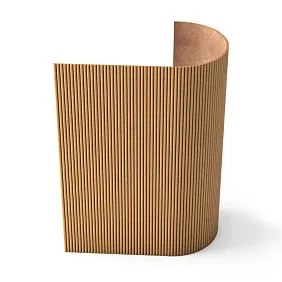
Reiki on fabric mesh base. Bending radius from 100–150 mm. For columns, arches, rounded corners, wavy partitions. The only professional solution for curved surfaces: rigid MDF panel breaks on radius, flexible one wraps without pattern deformation.
Module with semicircular bead (rigid and flexible)
Separate category by reiki profile. Available in both design versions. Semicircular bead on MDF backing — for straight walls with soft character. Semicircular bead on fabric base — for curved surfaces with organic atmosphere.
Acoustic module with filling
Construction with technical gap filled with sound-absorbing material. For meeting rooms, conference halls, restaurant spaces with high acoustic load.
Reiki spacing: how rhythm controls the feeling of space
This is one of the most important parameters — and one of the least understood when first introduced to the topic.
Spacing is not just a technical characteristic. It's the rhythm of the surface. And rhythm is what the human brain perceives emotionally long before analyzing it rationally.
Narrow spacing (15–20 mm). Dense, rich, active rhythm. Surface 'attracts' the eye. Creates decorative tension — surface 'vibrates'. For spacious rooms with large accent planes. In small rooms — visual noise.
Medium spacing (25–35 mm). Balanced, universal rhythm. Moderate decorative activity. Works in most residential and commercial applications. Foolproof default choice.
Wide spacing (40 mm and more). Airy, calm, monumental rhythm. The surface 'breathes'. For small rooms and delicate accent solutions where depth is needed without tension.
Practical rule: the smaller the room — the wider the spacing. And vice versa: the larger and taller the room — the tighter the spacing, so the surface doesn't appear empty.
Slat orientation: a spatial tool without additional costs
Slat direction — vertical, horizontal, or diagonal — changes the perception of space dramatically. And it doesn't require a single ruble of additional investment: just rotating the module 90° during installation.
Vertical slats guide the eye from bottom to top. The ceiling visually 'rises'. For apartments with standard 2.7 m height — the most valuable technique. Verticalslatted modular wall panel— standard solution for most residential and commercial applications.
Horizontal slats guide the eye left-right. The room visually expands. For end walls of narrow corridors, small rooms — a proven way to add width without physical changes. In Japandi — a meditative horizon, a symbol of natural calm.
Diagonal slats create dynamics and kinetics. A sense of movement. For commercial spaces with non-standard concepts.
Color strategies: how MDF modules create color architecture
Color work with MDF modular slat panels is a separate art. Let's consider the main strategies.
Monochrome: a surface without color, only shadow
The panel is painted exactly to match the wall tone. The color unifies the smooth and textured into a single whole. The texture is only perceived through shadow. Under frontal, uniform lighting, the surface is almost homogeneous. With side or directional lighting, it comes alive with a sculptural play of light and shadow. This solution requires side lighting—without it, the monochrome installation loses its meaning.
Tonal accent
A wall in a light neutral tone. The panel is 2–3 tones deeper. The texture is perceived through both shadow and color contrast simultaneously. A restrained, professional, flawless solution.
Saturated accent
Neutral walls. The slatted panel is in a deep, decisive color: Anthracite, Bottle Green, Navy Blue, Burgundy, Burnt Orange. The panel becomes the conceptual center of the room. One color choice changes the entire atmosphere.
Two-color system
Slats—one color, the backing (visible in the gaps)—another. White slats on a black backing: maximum graphic expressiveness. Gray-beige slats on a dark green backing: complex, multi-layered depth. This is an advanced level of working with slatted modules—with a very strong result.
Ten spaces where the modular slatted wall panel works flawlessly
Living room: an accent wall as an architectural center
One slatted plane behind the sofa or behind the TV transforms the entire interior. The gaze gains a focal point, the space acquires a conceptual center. Oiled oak with side lighting—warm classic. Anthracite MDF behind the TV in a white interior—a strict, contemporary look.
Bedroom: the headboard as an intimate architectural accent
Semi-circular profile, neutral warm tone, moderate pitch. LED strip along the lower perimeter — upward soft glow. An intimate atmosphere comparable to a designer hotel.
Entrance hall: the first architectural signal
Slatted modular wall panel on the main wall of the hallway — an immediate statement about the character of the entire interior. For a narrow corridor: horizontal slats on the end wall visually expand the space.
Study: status and acoustics
Dark tone, rectangular profile, directional light. Wall behind the desk. Background for professional video calls. Acoustic diffusion reduces reverberation.
Staircase flight
Vertical rhythm of slats accompanies upward movement. Next to thebalusters for staircasessolid oak — a unified wooden architectural theme connecting the levels. This solution transforms the staircase from a 'technical passage' into an architectural route.
Children's room
MDF for painting with non-toxic water-based enamels. Semi-circular profile without sharp edges. Pastels for toddlers, active tones for teenagers. Grown up — repainted without dismantling.
Restaurant and cafe
Atmosphere as a product. Warm oak, directional light, acoustic diffusion.slatted modular wall panelin the restaurant manages the guest's experience — what they feel, whether they want to return.
Office, reception, meeting room
Corporate RAL. Business image. Acoustics. Branding through surface architecture.
Kitchen island and kitchen area
Horizontal slatted island fronts matching the kitchen furniture color. Exact RAL color. Visual horizontal 'stretching' of the island.
Bathroom (moisture-resistant design)
Only moisture-resistant MDF (MDFV) with moisture-resistant coating and forced ventilation. Properly executed design — durable, stylish, moisture-protected surface.
Finishing system: how a slatted module becomes part of the architectural whole
A slatted modular wall panel achieves maximum effect not in isolation, but as an element of a coordinated system. Each additional element enhances the whole.
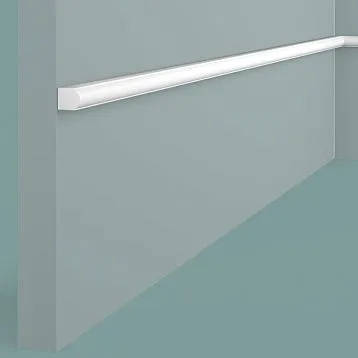
Molding along the top perimeter completes the slatted plane with an architectural horizontal line.Wooden molding and cornicefrom the same wood species creates a unified material language. MDF molding for painting in the same tone — an invisible but architecturally precise boundary.
Floor skirting completes the system from below.solid wood baseboardnext to oak slats — a natural material image from floor to the upper boundary of the panel.Baseboard MDFfor the MDF system for painting in an agreed color: a white system from bottom to top — monolithic, clean, flawless.
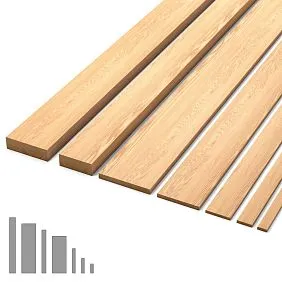
wooden plankfrom the same species is needed for non-standard areas: corner transitions, window slopes, door frame trims. An extension from the same material — inconspicuous, organic, professional.
Decorative Insertsin neoclassical and modern classic create an architectural 'frame' around the slatted field: horizontal and vertical framings turn a simply beautiful surface into a full-fledged architectural panel wall system.
Furniture Handlesin an agreed material — the finishing touch of a furniture system with slatted fronts. Metal matching the lighting, wood matching the slats: not a single random detail.
Classic Furniturewith wooden elements next to an oak slatted wall — a dialogue of materials, enhancing the value of both. The slatted panel gives wooden furniture a natural background — and the furniture 'comes to life' in this context differently than against a smooth painted wall.
Lighting: without it, a slatted panel is half the result
This needs to be said directly: the slatted relief exists only in angled light. With uniform frontal lighting, the slats lose their shadow — the surface is perceived as almost flat. You paid for the relief — but got an imitation of relief.
Directional spotlights at a 30–45° angle to the surface — the most effective tool. Clear, sculptural shadow. Adjustable spotlights allow changing the intensity.
LED strip behind the molding — descending soft light. Diffused halo. For bedrooms and living spaces with an intimate atmosphere.
LED in the gaps between the slats — backlighting from inside the panel. Glowing surface effect. An architectural stage technique for commercial objects and accent walls in residential interiors.
Color temperature: for oak — warm light 2700–3000 K, enhances natural warmth. For paintable MDF — neutral 3500 K for accurate color rendering. Cold light on oak kills the natural warmth of the material — a typical mistake resulting in a 'lifeless' look.
Installation of slatted modular wall panels: a sequence with no room for error
Base preparation. Wall: dry, clean, degreased. Plane deviation: up to 3–5 mm — adhesive installation, over 5 mm — frame installation on metal CD-profile.
Adhesive installation. Mounting adhesive applied in a zigzag pattern on the backing. Panel is pressed and held for 5–10 minutes. Finish nails around the perimeter in areas hidden by molding and baseboard — for reliability.
Frame installation. CD-profile 60×27 mm with 400–600 mm spacing is mounted on the wall. Panels are secured with 3.5×35 mm self-tapping screws through the backing into the profile. Plane is controlled with a laser level — permissible deviation 2 mm over 2 m. Technical gap for wiring and acoustic filling is possible.
Module joining. Butt joint without gap. With factory precision, the slat pitch of one module continues the rhythm of the adjacent one without visible offset. Monolithic surface from any number of modules.
MDF painting — before installation, by spraying. After installation, even coverage in gaps with a roller is impossible. Professional result — only spraying before installation.
Finish elements. Molding along the top edge, baseboard at the bottom, corner joints — 45° on a miter box, acrylic sealant on joints with smooth walls in the coating color.
Eight mistakes when choosing and installing slatted modular panels
Mistake 1: low MDF density. Density below 700 kg/m³ — unstable material: swelling edges, poor fastening, deformation. Demand density 750+ kg/m³.
Error 2: rigid panel on a curved surface. Rigid MDF does not bend. Only flexible fabric-backed panels for columns, arches, radius corners.
Error 3: unstable pitch from the manufacturer. Ask directly: 'What is the guaranteed accuracy of the slat pitch?' The correct answer is no more than 0.5 mm.
Mistake 4: lighting is not planned in advance. Slatted relief without side or directional lighting is invisible. Lighting is planned and installed before or simultaneously with the panels.
Error 5: heterogeneous trim from different production lines. Skirting and molding from another series next to a slatted panel destroy the material consistency of the system.
Error 6: painting MDF after installation with a roller. Gaps between slats are then covered unevenly. Only spraying before installation.
Error 7: unsealed MDF edges. Edges must be primed or covered with film at the factory. Open edges absorb moisture and swell.
Error 8: no surplus when ordering. Minimum surplus is 10%, optimal is 15%. The batch runs out, the next one has a different MDF shade or oak texture. Buying exactly to match later is almost impossible.
Calculating the number of modules
Surface area (minus openings) ÷ area of one module = number of modules. Result rounded up, plus 10–15% surplus added.
Example: accent wall 3.6 × 2.7 m = 9.72 sq.m. One module 0.6 × 2.4 m = 1.44 sq.m. Needed: 9.72 / 1.44 = 6.75 → 7 modules. 15% surplus: total 9 modules.
When cladding multiple walls, count each one separately — the cutting allowance is different for each. Trimmed pieces from one wall are generally not used on another (different sizes of edge fragments).
About the company STAVROS
A slatted modular wall panel is an architectural product where manufacturing precision determines the final result. MDF density, accuracy of slat spacing, quality of end processing, coating stability — all this is invisible in a catalog photo. It only becomes obvious after installation: either the joints are monolithic, or they are not. Either the ends are stable, or they swell after six months. Either the spacing is maintained with 0.5 mm accuracy, or the surface 'ripples'.
STAVROS is a Russian manufacturer of MDF and solid wood products for interior finishing and furniture production. Slatted panels of all types and constructions (rigid on MDF backing, flexible on fabric base, rectangular, semicircular and trapezoidal profiles), a complete line of coordinated moldings, decorative overlays, elements for stairs, furniture decor and fittings. Over 4000 models, 20,000 modifications, 39 product groups.
MDF from European suppliers with a density of 750–850 kg/m³, climatic wood drying chambers, a two-level quality control system (Standard and Prestige), manual processing of decorative elements, control of spacing accuracy in each production batch. Shipping from one piece. Delivery across all of Russia. Specialist consultation at any stage of selection — before placing an order.
FAQ: Answers to popular questions
How does a slatted modular wall panel differ from individual slats?
A modular panel is a factory-assembled module with guaranteed spacing accuracy. Individual slats are assembled on-site manually: spacing accuracy depends on the craftsman, installation speed is lower, labor costs are higher, and result predictability is lower. The modular principle provides a controlled, reproducible result.
What is the standard module size?
Standard: width 0.6 m, length 2.4 m (area 1.44 sq.m.). Some manufacturers offer non-standard formats to order. Please specify when ordering.
Can slatted modular panels be used in the kitchen?
Yes — in areas without direct contact with moisture and without steam (not above the cooking surface). MDF with a high-quality paint coating is resistant to household moisture with normal ventilation.
How to ensure monolithic joints between modules?
Only step accuracy ≤ 0.5 mm at the production level. Plus — installation on a flat, laser-leveled base. Monolithic joints are a property of the product, not an installation trick.
Is it necessary to coordinate the slat spacing when purchasing ceiling and wall modules?
Yes — mandatory, if the panels join at a corner wall-ceiling transition. Buy from one manufacturer with one spacing. Mismatched spacing at a corner transition is a visible defect, irreparable after installation.
Which slat to choose for a children's room?
MDF for painting with non-toxic water-based enamels + semi-circular profile (without sharp edges). Safe material, safe geometry, possibility of repainting when the child's age changes.
Can slatted modular panels be installed in rooms with underfloor heating?
Yes — provided that the wall surface temperature does not exceed +40°C. Standard underfloor heating systems do not reach this threshold. For non-standard systems — check with the manufacturer.