












































































Article Contents:
- Standard Baluster Height: Where 900 Millimeters Came From
- Diameter and Cross-Section: The Balance Between Strength and Elegance
- Proportions: The Ratio of Height to Diameter
- Baluster Drawing: How to Read and Understand
- Standard Dimensions by Baluster Type
- Supporting Posts: Dimensions of Load-Bearing Elements
- Handrails: Dimensions for a Comfortable Grip
- Under-Rail Strip: Dimensions of the Auxiliary Element
- Calculating the Number of Balusters: From Theory to Practice
- Tolerances and Deviations: What is Acceptable
- How to Take Measurements Correctly for an Order
- Dimension Specifics for Different Wood Species
- Baluster Dimensions for Various Interior Styles
- Common Mistakes When Choosing Dimensions
- Popular Questions and Answers
- Conclusion: Precision in Details

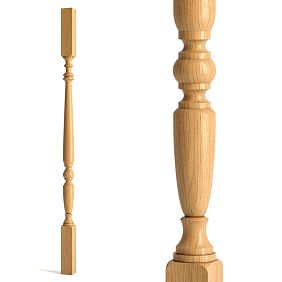
Size matters. Especially when it comes to architectural elements that simultaneously ensure safety and create the visual identity of an entire space.wooden baluster sizesThese are not arbitrary numbers invented by manufacturers, but the result of centuries of evolution in architectural thought, engineering calculations, and an understanding of human ergonomics. Millimeter by millimeter, the calibrated proportions of height, diameter, and cross-section determine whether a staircase will be comfortable and safe, whether a railing will be strong and durable, and whether the structure will look harmonious or dissonant. Why is the standard baluster height exactly 900 millimeters? What cross-section provides the optimal balance between strength and elegance? How to read drawings and translate them into reality? We examine in detail — with numbers, logic, and practical recommendations.


Standard Baluster Height: Where 900 Millimeters Came From
Nine hundred millimeters — a magic number in the world of stair railings. This is not a random value, but the result of research into human body ergonomics. The average adult height in Europe and Russia is 170-175 centimeters. At this height, the natural position of an arm bent at a 90-degree elbow angle gives a height from the floor of approximately 95-105 centimeters. A handrail positioned at this height provides maximum comfort when ascending and descending stairs — there's no need to reach up or unnaturally bend the arm down.
The baluster height is calculated as the total railing height minus the thickness of the handrail. If the handrail has a diameter or cross-section height of 50-60 millimeters, then the net baluster height is 840-850 millimeters. However, manufacturers have standardized baluster height at 900 millimeters — this is a universal value suitable for most structures, accounting for various handrail mounting methods.
Building codes regulate the minimum railing height for interior stairs — 900 millimeters from the step surface to the top point of the handrail. For exterior stairs and railings at heights over 6 meters, the minimum increases to 1100 millimeters. The maximum height is not regulated, but in practice, railings above 1200 millimeters create a feeling of confinement and visually weigh down the space.
Individual baluster dimensions may deviate from the standard. For families with small children, increasing the height to 950-1000 millimeters is recommended — an additional safety guarantee. For elderly people who find it difficult to raise their arm high, an optimal height is 850-880 millimeters. In luxury interiors with high ceilings, balusters can reach 1100-1200 millimeters to maintain proportions — in a room with a height of 4-5 meters, a standard 900-millimeter railing looks squat.




Diameter and Cross-Section: The Balance Between Strength and Elegance
baluster wooden dimensionsThe diameter or cross-section of a baluster determines its visual massiveness and actual strength. Round turned balusters are made with a variable diameter — in the widest part (usually in the center or lower third) the diameter ranges from 45 to 80 millimeters, in the narrowest part (the necks) — from 25 to 35 millimeters. These diameter variations create the characteristic silhouette of a turned baluster — smooth transitions from thin sections to voluminous balls, disks, cones.
The minimum diameter of a baluster at its thinnest part should not be less than 25 millimeters — this is the strength limit for oak or ash. For softer species (pine, spruce), the minimum is 30 millimeters. Balusters with thinner necks look elegant but risk breaking under lateral load or impact. The maximum diameter in the wide part rarely exceeds 80 millimeters — more massive balusters are visually heavy, overload the space, and consume more wood without a substantial increase in strength.
Square balusters have a constant cross-section along their entire length. Standard sizes: 40x40, 45x45, 50x50, 60x60, 70x70, 80x80 millimeters. The most popular cross-section is 50x50 millimeters, the golden mean between strength and economy. Balusters 40x40 millimeters are suitable only for light interior stairs with minimal load. Cross-sections of 60x60 and larger are for exterior stairs, terraces, porches, where increased resistance to wind loads and atmospheric exposure is required.
Rectangular balusters (flat) have a cross-section where one side is significantly larger than the other, for example 30x100, 40x120, 50x150 millimeters. The thickness (the smaller side) determines bending strength, the width (the larger side) — visual massiveness and area for decorative processing. Flat balusters are often adorned with openwork or three-dimensional carving, which requires sufficient blank width to accommodate the ornament.
Our factory also produces:


Proportions: The Ratio of Height to Diameter
The beauty of a baluster is determined not only by its absolute dimensions but also by their ratio. The classic proportion of height to maximum diameter is from 15:1 to 20:1. A baluster 900 millimeters high with a maximum diameter of 45-60 millimeters falls within this range and is perceived as elegant, elongated, and graceful. If the diameter is increased to 80-90 millimeters, the ratio becomes 10-11:1 — the baluster will appear squat, massive, and solid.
For square balusters, the ratio of height to cross-sectional side is typically 15:1 — 18:1. A baluster 900 millimeters high with a 50x50 millimeter cross-section gives a ratio of 18:1 — visually harmonious. With a 70x70 millimeter cross-section, the ratio is 12.8:1 — the baluster seems stocky, which is suitable for country or rustic styles but inappropriate for classic or modern styles.
The proportions within the profile of a turned baluster also matter. The classic scheme: the lower part (base) constitutes 20-25 percent of the height, the central part (body) — 50-55 percent, the upper part (capital) — 20-25 percent. Within each part, elements of different diameters alternate — thin necks occupy 10-15 percent of the section length, voluminous balls or disks — 30-40 percent, transition zones — the remainder. These proportions have been refined over centuries; any significant deviation disrupts the harmony.
Get Consultation
Baluster drawing: how to read and understand
Wooden Baluster Drawing— is technical documentation that contains all the necessary data for manufacturing the product. A professional drawing includes several projections: side view (profile), top view (end section), sometimes a perspective view or 3D model. The drawing indicates the dimensions of all significant elements with millimeter precision.
The main element of a turned baluster drawing is the profile. This is the contour of the baluster in cross-section, showing the variable diameter along its entire height. Control points are marked on the profile, indicating their position by height (distance from the lower end) and diameter at that point. For example: at a height of 150 millimeters, diameter 60 millimeters; at a height of 450 millimeters, diameter 50 millimeters; at a height of 600 millimeters, diameter 35 millimeters.
Smooth lines are drawn between the control points, showing the nature of the transition — straight (cone), convex (ball), concave (hollow), stepped (disk). These lines define the shape of each profile element. On a lathe, the craftsman or CNC program reproduces these transitions with high precision. The tolerance for diameter is typically ±0.5 millimeters, for the height of control points ±1 millimeter.
For carved balusters, the drawing includes additional projections showing the carving pattern. These can be developments (a flat image of the ornament to be applied to the cylindrical surface), sections at characteristic points (showing the depth and shape of the carving), detailing of individual elements (leaves, flowers, scrolls). Modern drawings of carved balusters are often made in 3D model format, which is loaded into a CNC machine for automatic processing.
Standard dimensions by baluster type
Turned balusters of classic style typically have a height of 900 millimeters, a maximum diameter of 50-60 millimeters, and a minimum diameter (neck) of 28-32 millimeters. The profile consists of 5-7 characteristic elements: a base disk with a diameter of 55-60 millimeters and a height of 40-50 millimeters, a transition neck with a diameter of 30 millimeters and a height of 80-100 millimeters, a central ball with a diameter of 55-60 millimeters, an upper neck, and a capital disk.
Carved balusters in the Baroque style are more massive: height 900-1000 millimeters, maximum diameter 70-80 millimeters, minimum 35-40 millimeters. Carving with a depth of 5-15 millimeters covers 50-70 percent of the surface. Carved elements require a thickness allowance — if a 10-millimeter deep ornament is cut from a 70-millimeter diameter, the residual diameter at that point is 50 millimeters, which must ensure sufficient strength.
Flat balusters for modern interiors: height 900 millimeters, thickness 30-50 millimeters, width 80-150 millimeters. The upper and lower ends are cut at an angle corresponding to the staircase slope (usually 28-35 degrees). If the baluster is decorated with openwork carving, the width must be sufficient to accommodate the pattern — a minimum of 100 millimeters for simple geometric ornaments, 120-150 millimeters for complex floral motifs.
Square balusters with chamfers: height 900 millimeters, cross-section 50x50 or 60x60 millimeters, chamfers 5-10 millimeters along the entire length of the edges. Chamfers are cut at a 45-degree angle, turning the square cross-section into an octagonal one. This adds decorativeness, reduces the risk of chipping on sharp edges, and simplifies painting (paint adheres more evenly on rounded edges).
Support posts: dimensions of load-bearing elements
Support posts are enlarged balusters installed at key points of the railing and bearing the main load. The standard height of a support post for a staircase is 1000-1200 millimeters, which is 100-300 millimeters higher than intermediate balusters. This difference allows for secure handrail attachment and creates a visual hierarchy — the posts dominate as support points, while the balusters are secondary as infill.
The cross-section of support posts ranges from 80x80 to 150x150 millimeters. The ratio of the post's cross-section to the baluster's diameter is typically 1.6:1 — 2:1. If a baluster has a maximum diameter of 50 millimeters, the post is 80-100 millimeters. This creates a harmonious visual ratio. Excessively massive posts (150x150 millimeters) with thin balusters (40-45 millimeters) look disproportionate and create imbalance.
Support posts can have a complex profile: a lower part (base) with an expansion up to 120-180 millimeters and a height of 150-250 millimeters, a central part with a constant cross-section of 100x100 millimeters and a height of 600-700 millimeters, an upper part (capital) with decorative elements 150-250 millimeters high. The total height of such a post can reach 1200-1400 millimeters, creating monumentality and impressiveness.
Handrails: dimensions for a comfortable grip
round handrails 50 mm— is the standard diameter, optimal for an adult hand to grasp. A diameter of 45 millimeters is suitable for people with smaller palms (women, teenagers), 55-60 millimeters — for larger male hands. A diameter less than 40 millimeters is uncomfortable — the fingers close too tightly, and the hand tires quickly. A diameter greater than 70 millimeters is difficult to grasp, compromising grip reliability.
Round balustrade 50 mm— is made with a smooth surface without protrusions or indentations — the hand should slide along the handrail without catching. Decorative grooves with a depth of no more than 2-3 millimeters are allowed, which do not hinder sliding but add visual detail. The length of standard handrail sections is 2000-3000 millimeters; for long flights, sections are joined with special couplings or mitered joints.
Rectangular handrails typically have a cross-section of 50x70, 60x80, or 70x90 millimeters. The smaller side (50-70 millimeters) is oriented vertically, the larger side (70-90 millimeters) horizontally. The top plane is rounded with a radius of 20-30 millimeters for comfortable gripping. The side edges may have chamfers or be profiled with decorative cutters. The bottom plane is flat or has a groove for mounting on a handrail bracket.
Handrail bracket: dimensions of the auxiliary element
A handrail bracket is a horizontal board attached to the upper ends of balusters and serves as a base for installing the handrail. The standard thickness of the bracket is 18-25 millimeters, width — 80-120 millimeters. The thickness is determined by the size of the groove in the handrail: if a groove is milled 20 millimeters wide, the bracket should be 18-19 millimeters for a loose fit with a glue gap.
The width of the bracket is chosen based on the placement of the balusters. If the balusters are installed strictly along the central axis of the railing, an 80-100 millimeter wide bracket completely covers their ends with a margin of 15-20 millimeters on each side. If the balusters are offset towards the inner or outer edge, the bracket width is adjusted accordingly. A bracket that is too narrow (less than 70 millimeters) does not provide sufficient contact area with the balusters; one that is too wide (more than 130 millimeters) looks bulky.
The length of the bracket equals the length of the flight from support post to support post. For a straight flight, this distance is measured with a tape measure under tension along the line of the balusters' upper ends. For turning flights, the bracket can be curved — made from bent-glued laminates or steamed and bent to a radius. The bending radius is typically at least 500 millimeters — a smaller radius requires special technologies and increases the risk of cracking.
Calculating the number of balusters: from theory to practice
How many balusters are needed for a staircase? The calculation begins with determining the clear distance between balusters. Building codes require that the gap not exceed 150 millimeters — this ensures safety for children. In practice, 2 balusters are usually installed per step, which, with a step width of 250-300 millimeters and a baluster diameter of 50 millimeters, gives a gap of 100-125 millimeters.
Formula: number of balusters = (number of steps × 2) + number of support posts. For a staircase with 15 steps and two support posts (at the beginning and end of the flight), 15 × 2 + 2 = 32 elements will be required (30 intermediate balusters and 2 posts). If the staircase has an intermediate landing with an additional support post, one more post is added.
Alternative calculation — by flight length. The flight length is divided by the desired distance between baluster axes (usually 120-150 millimeters), and the result is rounded to a whole number. For example: horizontal flight length 3500 millimeters, baluster spacing 125 millimeters, number of gaps 3500 / 125 = 28, number of balusters 28 + 1 = 29 pieces (one more than the number of gaps).
Tolerances and deviations: what is acceptable
Wooden balusters are living products; absolutely identical dimensions are unattainable. There are manufacturing tolerances—acceptable deviations from nominal dimensions. For baluster height, a tolerance of ±2 millimeters is considered standard. If balusters are ordered with a height of 900 millimeters, the actual height may range from 898 to 902 millimeters. This is not a defect—such variation is compensated for during installation by adjusting the fastening.
For the diameter of turned balusters, the tolerance is ±1 millimeter. A baluster with a nominal maximum diameter of 50 millimeters may have an actual diameter of 49-51 millimeters. For square balusters, the tolerance on cross-section is ±0.5 millimeters. A 50x50 millimeter baluster may be 49.5x50.5 millimeters—visually indistinguishable and functionally acceptable.
Baluster curvature is an important parameter. Deviation from straightness should not exceed 2 millimeters over a length of 900 millimeters. It is checked with a straightedge or a taut string—the baluster is placed on a flat surface, and the maximum gap between the surface and the baluster should be no more than 2 millimeters. Excessive curvature makes quality installation impossible—the baluster cannot stand vertically, and the handrail does not fit tightly.
How to correctly take measurements for an order
If standard balusters do not fit and custom manufacturing is required, precise measurements must be taken. The main parameter is the height from the step surface to the lower plane of the handrail. Measurement is performed on-site, considering all structural features. If the steps have uneven heights (which sometimes occurs in older houses), measure the height for each position separately.
Consider the method of baluster fastening. If fastening with dowels, subtract the depth of the dowel hole in the step (usually 40-45 millimeters) from the measured height. If fastening with threaded studs, subtract the length of the protruding part of the stud (30-40 millimeters). If fastening to a baluster rail, subtract the thickness of the rail (25-30 millimeters). The result is the net height of the baluster to be ordered.
For diameter or cross-section, be guided by aesthetic preferences and strength requirements. If the house is in a massive style with thick walls and large architectural elements, choose balusters with a larger cross-section—60-70 millimeters. For light modern interiors with an abundance of glass and metal, balusters of 40-50 millimeters are suitable. Bring sketches and interior photographs to the manufacturer—this will help select the correct proportions.
Size features for different wood species
Different wood species have varying strengths, which affects the minimum permissible baluster dimensions. Oak and ash are hardwoods with high bending and compression strength. Oak balusters can have a minimum cross-section of 40x40 millimeters or a minimum neck diameter of 28 millimeters without loss of strength. Such balusters withstand significant loads, do not sag, and do not break under lateral impacts.
Beech is a medium-hardness wood. For beech, the minimum cross-section is 45x45 millimeters, and the minimum neck diameter is 30 millimeters. Thinner beech balusters risk deforming under load, especially with humidity fluctuations—beech reacts strongly to changes in humidity, swelling and shrinking more than oak.
Pine and spruce are softwoods with low density and strength. The minimum cross-section for pine balusters is 50x50 millimeters, and the minimum neck diameter is 32-35 millimeters. Thinner pine elements are not strong enough and may break under heavy leaning or accidental impact. Pine balusters are typically made 10-15 percent more massive than similar oak ones to compensate for the material's lower strength.
Baluster dimensions for various interior styles
Classical style requires adherence to historically established proportions. Baluster height is 900-1000 millimeters, diameter of round elements is 60-80 millimeters, square ones are 70x70 or 80x80 millimeters. The profile of turned balusters is symmetrical, with smooth transitions and no sharp corners. The height-to-diameter ratio is 12:1 to 15:1, giving a sense of solidity and status.
Art Nouveau style prefers more elongated proportions. Baluster height is 900-950 millimeters, diameter is 45-55 millimeters, ratio is 17:1 to 20:1. The profile is asymmetrical, with plant motifs, smooth curves resembling stems and vines. Art Nouveau balusters are visually light, elegant, creating a sense of dynamism and growth.
Minimalism requires simple forms and clear lines. Balusters typically have a rectangular cross-section of 40x60 or 50x70 millimeters with a height of 900 millimeters. No decoration, minimal or no chamfers. The height-to-larger-side ratio is 13:1 to 15:1. Color is monochromatic, often contrasting—white, black, graphite. Visual effect: strictness, order, geometric purity.
Country and rustic styles allow for roughness and deliberate simplicity. Balusters have a square cross-section of 60x60 or 70x70 millimeters, height of 900 millimeters, ratio of 13:1 to 12:1. The surface may be intentionally rough, with tool marks and knots preserved (if they do not reduce strength). Corners are rounded with a radius of 5-10 millimeters for safety but without excessive neatness. Visual image: homeliness, warmth, closeness to nature.
Common mistakes when choosing dimensions
First mistake—ordering balusters of standard 900-millimeter height without considering the actual staircase structure. If the steps are already installed and the handrail is planned with a specific configuration, baluster height should be calculated individually. The 900-millimeter standard is a starting point, not a dogma. The result of this mistake: the handrail ends up too high or too low, requiring balusters to be cut or extended with spacers.
Second mistake—choosing overly thin balusters to save material or for visual lightness. Balusters with a diameter of 35-40 millimeters made of pine look elegant but do not provide the necessary strength. Under load, they sag and may break upon impact. Saving on cross-section leads to safety issues and the need to replace elements.
Third mistake—ignoring proportions. Massive balusters with an 80-millimeter diameter in rooms with low ceilings (2.5 meters) and narrow staircases (80-90 centimeters) visually overload the space, creating a sense of tightness. Thin 40-millimeter balusters in a spacious hall with 4-meter ceilings get lost, looking skimpy and unimpressive. Size must correspond to the scale of the space.
Popular questions and answers
Can balusters with a height of 800 millimeters be used instead of the standard 900? Yes, if it fits the project and ensures a railing height of at least 900 millimeters, including the handrail thickness. For families without children and elderly people, this height may even be more convenient.
What is the minimum safe diameter for an oak baluster? For oak, the minimum diameter at the thinnest part is 28 millimeters. Less than that risks breakage under lateral load.
Should wood shrinkage be considered when ordering dimensions? If balusters are made from dry wood (moisture content 8-10 percent), shrinkage is minimal—no more than 1-2 millimeters over 900 millimeters of height. This is within tolerance. Balusters made from green wood should not be ordered—they will deform after installation.
What is the maximum allowable distance between balusters? Building codes require no more than 150 millimeters clear. In practice, 100-120 millimeters is recommended for full safety.
Is it necessary to cut balusters to match the staircase slope? The upper ends of balusters, where the handrail attaches, must be cut at an angle so the handrail fits tightly. The lower ends on steps are usually only cut on winder steps.
Can balusters with a height of 1200 millimeters be ordered? Yes, manufacturers produce custom-height balusters to order. Lead time and cost may be higher than for standard models.
How to determine which baluster cross-section suits my staircase? Consider the scale of the staircase and interior style. For a standard staircase 90-100 centimeters wide, a cross-section of 50x50 millimeters or a diameter of 50-60 millimeters is optimal.
Do baluster dimensions differ for interior and exterior staircases? For exterior staircases, it is recommended to increase the cross-section by 10-20 percent for a safety margin against weather exposure. Height may be greater—950-1000 millimeters.
What is the standard handrail length? Handrails are manufactured in sections of 2000-3000 millimeters. For long flights, sections are joined with couplings or miter joints.
Should balusters be ordered with a quantity reserve? It is recommended to order 2-3 pieces more than the calculated quantity — in case of damage during transportation, installation errors, or future repairs.
Conclusion: Precision in Details
wooden baluster sizes— these are not abstract numbers, but the result of the interaction of ergonomics, strength calculations, aesthetic canons, and production capabilities. Every millimeter of height, diameter, and cross-section matters and affects the final outcome — the safety of the structure, ease of use, and the visual harmony of the space.
Do not rely on chance and approximation. Measure precisely, calculate thoroughly, check proportions. Consult with professionals, request drawings, demand samples. Correctly chosen baluster dimensions are the foundation of a quality stair railing that will last for decades without losing functionality and beauty.
The STAVROS company has been manufacturing wooden balusters for over twenty years and knows everything about dimensions. The STAVROS range includes balusters in standard sizes — height 900 millimeters, diameter from 45 to 80 millimeters, square cross-sections from 40x40 to 80x80 millimeters. However, the company accepts orders for any custom sizes from 700 to 2000 millimeters in height, from 35 to 120 millimeters in diameter or cross-section.
STAVROS production is equipped with high-precision CNC lathes and milling machines that ensure dimensional accuracy to within 0.5 millimeters. Each baluster undergoes quality control — height, diameter at control points, curvature, and absence of defects are checked. Balusters that do not meet standards are rejected and do not reach the customer.
STAVROS provides detailed drawings of all baluster models, indicating all dimensions, control points, and profile shape. Clients can request drawings before placing an order to ensure the products meet their requirements. For individual projects, STAVROS designers develop unique drawings based on customer sketches or wishes.
By choosing STAVROS, you get precision in every millimeter, quality in every detail, and confidence in the reliability of the structure. STAVROS balusters are a standard tested by thousands of completed projects, confirmed by an impeccable reputation, and guaranteed by the professionalism of craftsmen with many years of experience. Trust STAVROS — and your staircase will gain perfect proportions.


