Article Contents:
- Wooden molding: from utility to decor
- The historical role of molding in architecture
- Functions of modern molding
- Molding profiles: from flat to shaped
- Buy wooden molding: selection criteria
- Wood Species
- Dimensions and Cross-Section
- Finish
- Round wooden staircase handrail: ergonomics in every millimeter
- Why round, not square or oval?
- 50 millimeter diameter: an anthropometric standard
- Round wooden handrail for railings: construction and materials
- Wall-mounted round handrail: installation specifics
- Wooden handrails and balusters: linking staircase elements
- Balusters: the vertical rhythm of the staircase
- Wooden railing balusters: unity of style
- Molding and handrails: how to link into a unified system
- Strategy one: unity of wood species and color
- Strategy two: profile rhyme
- Strategy three: carved theme
- Strategy four: contrasting accents
- Molding installation: subtleties and nuances
- Surface Preparation
- Mounting methods
- Corner joints
- Application in Different Interior Styles
- Classic style
- Scandinavian Style
- Loft
- Maintenance and Durability
- Regular Cleaning
- Recoating
- Protection against damage
- Frequently Asked Questions
- Conclusion: entrust the details to STAVROS professionals
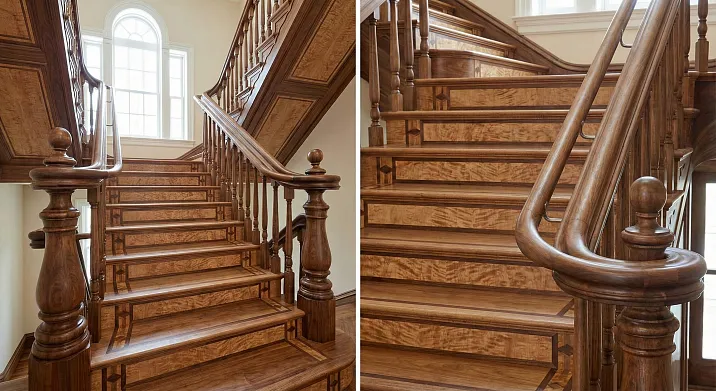
Details decide everything. When building a staircase or designing an interior, it's the little things—those very 'invisible' elements—that create a sense of completeness, thoughtfulness, and professionalism.wooden veneer with a decorative profileon walls,the staircase handrail is round woodenMolding and handrails in hand are not just functional components. They are the language of space, its character, its style. Why does one staircase look like a technical structure for moving between floors, while another looks like an architectural masterpiece? The difference is in the details. In how the molding profiles are selected, what kind of handrail crowns the railing, how wood textures are combined.
Let's examine in depth: what wooden shaped molding is, why it's needed, what profiles exist, how a round handrail becomes an ergonomic standard, and most importantly—how to link these elements into a unified system worthy of not only admiring glances but also decades of flawless service.


Wooden molding: from utility to decor
Many have heard the term 'molding,' but not everyone understands what it specifically means in the context of wooden products.Wooden moldingMolding is a thin profiled strip used for framing, dividing planes, creating decorative panels, and concealing joints. Essentially, molding is a universal tool for designers and builders, allowing a smooth wall to be transformed into an expressive surface with depth and rhythm.




In classical European architecture, molding played a key role in creating panel systems—boiserie. Wooden panels on walls were framed with thin profiled moldings, forming geometric patterns: rectangles, squares, sometimes complex polygons. Inside each 'frame' was a panel—smooth or with slight relief. Such a system served several functions: insulation (wood is warmer than stone and plaster), acoustics (wood absorbs sound), and aesthetics (rich textures and play of light on the profiles).
In classical European architecture, molding played a key role in creating panel systems—boiserie. Wooden panels on walls were framed with thin profiled moldings, forming geometric patterns: rectangles, squares, sometimes complex polygons. Inside each 'frame' was a panel—smooth or with slight relief. Such a system served several functions: insulation (wood is warmer than stone and plaster), acoustics (wood absorbs sound), and aesthetics (rich textures and play of light on the profiles).
Russian architecture was also familiar with panel molding — think of carved window surrounds, icon frames, and decorative panels in boyar chambers. Here, the molding was often adorned with carving, becoming an independent decorative element. In the Soviet era, molding was simplified to utilitarian battens, but today there is a renaissance: interest is returning to classical profiles, complex compositions, and natural materials.
Our factory also produces:


Functions of Modern Panel Molding
In modern interiorsdecorative wooden panel moldingperforms many tasks:
Zoning space. Molding can divide a wall into functional zones: highlight a dining area in the kitchen, create an accent wall in the living room, mark the boundary between an entryway and a hallway. Vertical or horizontal molding lines guide the eye and structure the space.
Concealing joints and defects. The joint between two materials (wallpaper and paint, wood and plaster) looks untidy. Molding covers the seam, giving it a finished look. A crack in the wall, uneven plaster, marks from old fasteners — all of this can be hidden under molding, avoiding labor-intensive repairs.
Creating panel systems. Classic boiserie, modern wall panels, decorative frames — all of these are built on molding. You buy MDF or plywood sheets, cut them into panels of the required size, frame them with molding — and you get a stylish panel system for a reasonable price.
Framing mirrors, paintings, doors. Molding can serve as a frame: wide figured molding around a mirror turns it into a decorative object, narrow molding around a doorway emphasizes its geometry.
Decorative compositions. You can 'draw' on the wall with molding: create geometric patterns, imitate stucco, form complex ornaments. This is especially effective in classical interiors, where walls are not just a background but part of the artistic concept.
Get Consultation
Molding Profiles: From Flat to Figured
The simplest molding is a flat batten of rectangular cross-section, for example 10x40 millimeters. Installed vertically or horizontally, it creates clear lines and divides planes. Minimalist, functional, inexpensive. Suitable for modern interiors where conciseness is valued.
Figured molding is a batten with a complex profile: rounded edges, chamfers, beads, coves. The profile can be symmetrical (identical on both sides when viewed end-on) or asymmetrical (one side flat, the other figured). Figured molding creates a play of light and shadow, adds volume, and gives the wall expressiveness.
Examples of popular profiles:
Semi-circular molding. One edge is rounded into a semi-circle with a radius of 5-10 millimeters. A soft, streamlined profile, good for classical and neoclassical interiors. Visually 'softens' corners and creates smooth transitions.
Molding with a chamfer. The edge is cut at a 45-degree angle to a depth of 3-8 millimeters. The chamfer can be single (only on one side) or double (on both sides). Creates a rhythmic play of light, suitable for modern classic, contemporary styles.
Molding with a bead. A convex bead with a diameter of 8-15 millimeters runs along the center of the batten, with coves (concave sections) at the edges. The profile is complex, voluminous, characteristic of rich interiors. The bead casts a sharp shadow, enhancing three-dimensionality.
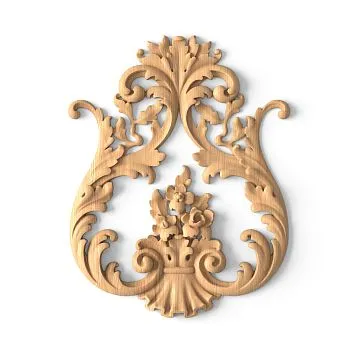
Carved molding. A relief ornament is applied to the surface: plant scrolls, geometric meanders, stylized flowers. The carving is done on a CNC milling machine or by hand. Carved molding is the pinnacle of decorativeness, used in palace interiors, classical mansions, exclusive projects.
Buying Wooden Molding: Selection Criteria
When decidingbuy wooden molding, it is important to consider several factors.
Wood Species
Oak. Density 700-800 kg/m³, high hardness, expressive texture with clear annual rings. Oak molding lasts 50-70 years, is not afraid of humidity, and is easily restored. Color ranges from light golden to dark brown, takes stain excellently. Disadvantage — price (30-50% more expensive than beech).
Beech. Density 620-680 kg/m³, wood is homogeneous, fine-pored, with a pinkish hue. Beech is cheaper than oak and takes paint well (the texture does not show through under paint). Ideal for figured profiles due to its plasticity. Disadvantage — sensitivity to humidity (can deform in unstable climates).
Ash. Similar in properties to oak: dense, strong, with an expressive texture. Color is lighter than oak, texture is more contrasting (bright annual rings on a light background). Ash is elastic, good for bent elements. Price is comparable to oak.
Pine. Soft, lightweight (450-500 kg/m³), inexpensive. Suitable for budget projects, country house interiors, country style. Disadvantages: softness (scratches easily), resinousness (resin can seep out for years), lack of durability (20-30 years compared to 50-70 for oak).
Dimensions and cross-section
The width of the molding is determined by the scale of the room and the style. For small apartments, narrow molding of 15-30 millimeters is suitable — it does not overload the wall and creates delicate lines. For spacious rooms with high ceilings, wide molding of 40-60 millimeters is appropriate — it is noticeable from a distance and forms a clear structure.
The thickness of the molding (profile depth) is usually 8-20 millimeters. Thin molding (8-12 millimeters) barely protrudes from the wall, suitable for minimalism. Thick molding (15-20 millimeters) creates a pronounced relief, casts deep shadows, characteristic of classical styles.
Finish
Molding can be sold unfinished (raw, only sanded), with a varnish finish, with an oil finish, or painted with enamel.
Unfinished. 20-30% cheaper, but requires final finishing on-site. You can choose any finish to your taste, match the color to the interior. Disadvantage — additional work and time.
Varnished molding. Ready for installation, coated with 2-3 layers of varnish (usually polyurethane). The surface is smooth, protected, color is stable. The degree of gloss varies: glossy, semi-matte, matte. For classical styles, semi-matte varnish (a slight sheen without excessive gloss) is often chosen.
Oil-finished layout. Coated with oil or oil-wax, the surface is natural and pleasant to the touch. The oil highlights the wood grain without creating a film. Requires periodic renewal (every 3-5 years), but is easily restored.
Painted layout. Coated with enamel (most often white, gray, or pastel tones), the wood grain is hidden. Suitable for Scandinavian style, Provence, shabby chic. The enamel can be glossy, semi-matte, or matte. Matte enamel creates a noble velvety feel, glossy gives a more elegant look.
Round wooden stair handrail: ergonomics in every millimeter
If the layout is an element of visual perception, then the the staircase handrail is round wooden is an object of constant physical contact. We grasp it with our palm, lean on it, feel the smoothness of the sanding, the temperature of the wood. The round cross-section of the handrail is not accidental, but the result of centuries of evolution in stair construction.
Why round, and not square or oval?
A round cross-section with a diameter of 50 millimeters ensures uniform contact between the hand and the handrail at any grasping angle. When you ascend the stairs, your hand slides along the handrail, changing position: overhand grip, side grip, underhand grip. On a round handrail, all these positions are comfortable — the diameter is the same in all directions.
A square or rectangular cross-section creates discomfort: corners dig into the palm, the grip is uneven. With prolonged contact (an elderly person slowly ascending, leaning their full weight), the corners can even chafe the skin. A round handrail is free of these drawbacks.
An oval cross-section is a compromise between round and rectangular. An oval has two different diameters (major and minor), which creates anisotropy: the grip in one direction differs from the grip in another. For stairs with a clearly defined direction of movement (only ascent), an oval handrail can be convenient, but for universal stairs (ascent and descent, right- and left-handed grip), round is unequivocally better.
Diameter of 50 millimeters: an anthropometric standard
The average adult palm circumference is 180-220 millimeters. With a handrail diameter of 50 millimeters, the circumference is approximately 157 millimeters. This means that when grasping, the fingers close with an overlap of 20-60 millimeters depending on hand size. The grip is secure, and the hand does not tire.
A diameter of 40 millimeters requires greater finger compression, the hand muscles work harder. For children and people with small hands, this is acceptable, but for adults, it quickly becomes tiring. A diameter of 60 millimeters is difficult to grasp fully, especially for people with small palms. The fingers do not close, the grip is weaker, and the hand may slip during a sudden jerk.
Standards (SP 54.13330.2016 "Residential Apartment Buildings") recommend a handrail diameter of 40-60 millimeters. Practice has shown: the optimum is 50 millimeters. This suits 95% of the adult population.
Round wooden handrail for railings: construction and materials
Wooden round handrail for balustrades is manufactured as solid wood or finger-jointed. Solid wood is turned from a single piece of wood on a lathe. Advantages: continuous grain, maximum strength. Disadvantages: length limitation (up to 2.5-3.0 meters), risk of cracking with humidity fluctuations, high cost.
Finger-jointed handrail is assembled from short lamellas (30-60 centimeters), glued end-to-end with a micro-tenon. Advantages: unlimited length, geometric stability, uniform color. Disadvantages: visible joints (though barely noticeable after tinting).
Hardwoods are preferred for handrails: oak, ash, beech. Pine is too soft — dents, scratches, and wear marks will quickly appear on the handrail. Oak is optimal: hard, wear-resistant, durable. Beech is also good, especially for curved sections due to its plasticity.
Wall-mounted round handrail: installation specifics
wall-mounted round handrail is attached to the wall with brackets. This is a solution for stairs where the railing adjoins the wall on one side (the flight is located along the wall). Brackets are installed with a spacing of 600-800 millimeters, each can withstand a load of up to 50-70 kilograms.
Brackets can be metal (chrome-plated, matte, bronze) or wooden. Metal brackets are stronger, thinner, less noticeable. Wooden brackets are matched to the handrail color, creating material unity. The choice depends on style: in classic settings, wooden or bronze brackets are appropriate; in minimalism, thin chrome-plated ones.
The distance from the wall to the center of the handrail is 50-70 millimeters. This ensures a comfortable grip: the hand grasps the handrail without the knuckles touching the wall. A smaller distance (30-40 millimeters) creates discomfort, a larger one (80+ millimeters) weakens the grip.
The height of a wall-mounted handrail according to standards is 900 millimeters from the level of the steps (measured vertically from the front edge of the step to the top of the handrail). For children, an additional lower handrail is sometimes installed at a height of 600-700 millimeters.
Wooden handrails and balusters: linking stair elements
A staircase is a system of interconnected elements: treads, risers, stringers (or carriages), balusters, handrails. handrails balusters wooden create the railing, ensure safety, and define the style.
Balusters: the vertical rhythm of the staircase
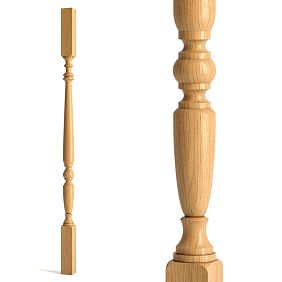
Balusters are vertical posts that support the handrail. They fill the space between the steps and the handrail, preventing falls. But besides their safety function, balusters carry a powerful aesthetic load. Turned balusters with alternating spheres, discs, and cylinders create rhythmic vertical graphics. Carved balusters with floral or geometric ornaments turn the staircase into a work of art.
The standard height of balusters is 900 millimeters (provides a railing height of 900-950 millimeters including the handrail). The diameter or cross-section is selected depending on the scale of the staircase: for narrow stairs (flight width 80-90 centimeters), balusters with a diameter of 40-50 millimeters are sufficient; for wide grand staircases (120-150 centimeters), 60-70 millimeters are appropriate.
The installation spacing of balusters is determined by safety requirements and aesthetics. According to standards, the distance between balusters (in clear space, i.e., between the surfaces of adjacent balusters) must not exceed 150 millimeters for residential buildings and 100 millimeters for children's institutions. This prevents a child's head from passing between the balusters.
From an aesthetic point of view, the spacing is chosen so that the balusters create a uniform rhythm. The classic option is one baluster per tread (baluster positioned at the center of the tread). A more frequent rhythm is two balusters per tread (at the edges of the tread). A sparse rhythm is one baluster per two treads (used if the balusters are thick and massive).
Wooden railing balusters: unity of style
wooden handrail balustersshould be executed in a unified style. If the handrail is a simple round shape, it's better to choose laconic balusters as well — square with chamfers or round with minimal decor. If the handrail has a complex figured profile (e.g., oval with beads), the balusters can be turned with rich relief.
The wood species for the handrail and balusters should match. An oak handrail on beech balusters will look alien — the texture and color differ. Ideally, the entire staircase (treads, risers, balusters, handrails) is made from the same wood species, from the same batch of lumber. This guarantees color and texture identity.
The finish should also be uniform. If the handrail is coated with matte varnish, the balusters should also have matte varnish. If the handrail is stained with 'dark walnut' stain, the balusters should be too. Even a slight difference in shade (one element half a tone darker) creates visual dissonance.
Wall paneling and handrails: how to link into a unified system
It might seem that wall paneling and staircase handrails are elements of different zones that don't intersect. But a competent designer will find a connection. Here are several strategies.
Strategy one: unity of wood species and color
The simplest approach is to use the same wood species for the paneling and handrail, treating them with the same finish. For example, everything from oak, stained with 'medium walnut' stain, coated with matte oil. Paneling on corridor walls, handrail on the staircase — all in the same shade, with identical texture. The eye moves from the wall to the staircase and everywhere finds a familiar texture. This creates a sense of integrity.
Strategy two: profile rhyme
If the paneling has a figured profile (e.g., semicircular with a bead), you can select balusters with a similar profile — with the same beads and coves. Or make the handrail not just round, but with a decorative element at the base (where it rests on the balusters) — a bead repeating the bead on the paneling. This profile rhyme creates a visual connection.
Strategy three: carved theme
If carved paneling is used on the walls (e.g., with a floral ornament), you can order carved balusters with the same ornament. Repeating motifs (acanthus leaves, grape vines, geometric meanders) link the space, creating a sense of thoughtful design.
Strategy four: contrasting accents
A bolder option is to highlight one element with color. For example, the paneling is white (painted enamel), while the handrail and balusters are natural oak under oil. The white paneling creates a neutral background, visually expands the space, and the natural oak staircase elements become a warm accent.
Paneling installation: subtleties and nuances
The beauty of paneling depends not only on the quality of the product but also on the skill of installation.
Surface preparation
Paneling is installed on a flat, clean, dry surface. If the wall is wallpapered, the paneling is glued over the wallpaper (first ensure the wallpaper is firmly adhered). If the wall is painted, the surface must be degreased (wipe with alcohol or mineral spirits). If the wall is plastered, the plaster must be strong, without delamination.
Methods of mounting
Adhesive method. The paneling is glued to the wall with polyurethane adhesive, liquid nails, or adhesive foam. Advantages: no visible fasteners, speed. Disadvantages: difficulty of removal, requires a flat surface. Technique: apply adhesive in a thin snake pattern on the back of the paneling, press to the wall, secure with painter's tape for 24 hours.
Mechanical fastening. The paneling is screwed to the wall with screws or nailed with finish nails. Advantages: reliability, possibility of removal. Disadvantages: visible fastener heads (need to be filled and painted). Technique: mark fastener locations with 300-400 mm spacing, drill holes in the wall (drill bit diameter for the dowel), install dowels, screw the paneling with screws, countersink heads 1-2 mm, fill holes with filler, sand, paint or varnish.
Combined method. The paneling is coated with adhesive and additionally secured with screws. After the adhesive sets (after 24 hours), the screws can even be removed and the holes filled. The adhesive will hold the paneling, and the fasteners served as temporary fixation.
Corner Joints
Paneling corners are cut at 45 degrees on a miter saw. Cutting accuracy is critical: a 0.5 mm gap on an external corner will be noticeable. Internal corners are less critical — a small gap can be filled with sealant or filler.
After cutting, the paneling ends are lightly sanded with fine abrasive (P240-320), removing burrs. The ends can be primed or coated with the same finish as the face surface (varnish, oil) to prevent moisture absorption.
When gluing a corner, use PVA wood glue or polyurethane glue. Apply a thin layer of glue to the ends, align the parts, secure with painter's tape. Remove excess glue with a damp sponge before it dries.
Application in different interior styles
Classic style
Classic style loves symmetry, proportions, richness of detail. Paneling — figured, with beads and coves, width 40-60 mm. Handrail — round, 50 mm diameter, made of oak. Balusters — turned with alternating balls, disks, vases.
Color — natural oak (medium and dark tones) or white (painted enamel). Finish — semi-matte varnish (for natural wood) or semi-matte enamel (for painted elements).
On walls, paneling forms panel systems: vertical and horizontal strips create rectangular or square frames, inside which wallpaper, fabric, or smooth paint is placed. The staircase with an oak handrail and carved balusters becomes the compositional center of the hall.
Scandinavian style
Scandinavian style values simplicity, light tones, functionality. Paneling — flat, rectangular section 15-25 mm, painted white matte enamel. Handrail — round, 50 mm diameter, made of light beech or whitewashed oak. Balusters — square section 40x40 mm, white or light.
On walls, paneling is used minimally: framing a mirror in the hallway, a horizontal line on the wall for hanging shelves. The staircase is laconic, light, with clear geometry. No excesses, only the necessary.
Loft
Loft style combines rough industrial materials (concrete, brick, metal) with wood. Paneling — thick, roughly processed (brushing emphasizes the texture), made of dark oak, coated with oil. Handrail — round, made of oak, preserving natural irregularities, oil finish. Balusters — square section 50x50 mm, massive, made of dark oak.
On walls, paneling is used for zoning: highlight a bar area with vertical strips, frame a brick wall. The staircase is brutal, with an open metal frame and wooden treads and handrail.
Care and longevity
Regular cleaning
Molding and handrails collect dust. Wipe weekly with a dry soft cloth or vacuum with a soft brush. Dust in the recesses of the shaped profile can be removed with a fine brush. Wet wiping — once a month, with a well-wrung cloth, without excessive wetting.
Recoating
Varnished surfaces — renew every 5-7 years. Lightly sand with P320-400 abrasive, apply a new coat of varnish. Oil finishes — apply a fresh coat of oil every 2-3 years (molding less often, handrails more often due to intensive contact).
Protection against damage
Molding near doors is prone to impacts (door handle, bags, vacuum cleaner). Install protective corner pieces in areas of intensive contact. The handrail on the staircase wears in the grip areas. Use hardwoods (oak, ash) and durable finishes (polyurethane varnish).
Frequently asked questions
What distinguishes flooring from molding?
Molding is usually thinner, simpler in profile, used for division and framing. Moulding — wider, with a complex profile, often used as a ceiling cornice or wall decoration.
Can wooden molding be used in damp rooms?
Yes, if you choose a moisture-resistant species (oak, larch), treat it with high-quality varnish in 3-4 coats, and ensure ventilation. In a bathroom with good exhaust, oak molding lasts for decades.
What diameter handrail to choose for a child’s staircase?
For children aged 3-7, a diameter of 40-45 millimeters is optimal. For children over 7, the standard 50 millimeters is suitable. You can install two handrails: a lower one 40-45 millimeters at a height of 600-700 millimeters for toddlers, and an upper one 50 millimeters at a height of 900 millimeters for adults.
How to care for carved molding?
Carving accumulates dust in recesses. Use a soft brush or a vacuum with an attachment. Wipe once a month with a slightly damp cloth. Do not use abrasive cleaners — they will damage the fine carving details.
Can oak and beech be combined in a staircase?
Yes, but carefully. Oak and beech differ in texture and color. If you plan to combine them, use tinting to even out the shade. Or use contrast deliberately: light beech balusters and a dark oak handrail.
How much does shaped oak molding cost?
The price depends on width, profile complexity, and finish. Simple semicircular 20mm oak molding costs 400-600 rubles per linear meter. Shaped 40mm molding with a complex profile — 800-1200 rubles. Carved molding — 1500-3000 rubles per meter.
Is it necessary to renew the finish on molding if no one touches it?
Even without contact, the finish ages: it fades from ultraviolet light, dulls from dust. It is recommended to renew it every 7-10 years to maintain aesthetics.
Which manufacturer offers a complete set of molding, handrails, and balusters from a single batch?
The company STAVROS offers a full range of decorative elements and staircase components made from solid wood. By ordering everything from STAVROS, you guarantee uniformity of species, color, and processing quality.
Conclusion: entrust the details to the professionals at STAVROS
Molding and handrails are not just millwork products. They are tools for creating a space that pleases the eye and is comfortable for living.wooden veneer with a decorative profileon walls forms rhythm and structure,the staircase handrail is round woodenprovides safety and tactile comfort,wooden handrail balustersties everything together.
The company STAVROS, with years of experience in producing millwork and staircase elements from solid wood, offers a full spectrum of solutions. Modern equipment, strict quality control, selected raw materials from European forests — all this guarantees that every detail will last for decades, preserving its original appearance and functionality.
By choosing STAVROS, you are choosing not just materials, but a partner in creating the interior of your dreams. Individual solutions, precise adherence to technical specifications, specialist consultations at every stage — from wood species selection to final finish. Entrust the details to those who know everything about wood.