












































































Article Contents:
- Physical and mechanical characteristics: scientific comparison of species
- Dimensional stability: reaction to humidity
- Aesthetic differences: texture, color, visual impact
- Response to toning and coloring
- Technological features: processing and installation
- Attachment to the base: glue, nails, mechanical fastening
- Price comparison: economics of choice
- Material availability: market realities
- Application in various interior styles
- Modern styles: loft, minimalism, contemporary
- Practical recommendations: selection for a specific project
- Coordination with other wooden elements
- Care and durability of oak and beech layouts
- Conclusion: conscious choice for perfect result
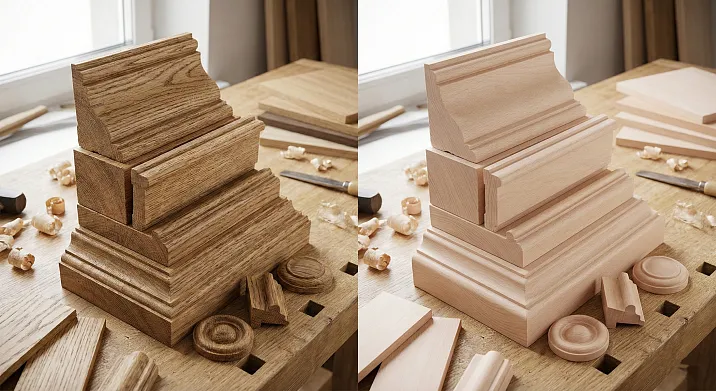
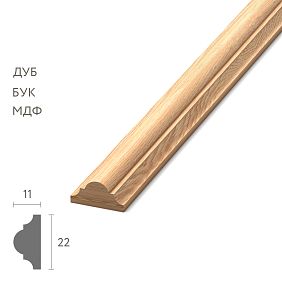
Layout — a thin wooden strip typically with a cross-section of 20-40 millimeters, used for framing wall panels, creating geometric compositions on walls, decorating furniture fronts — may seem like an insignificant interior element, but it is precisely these small details that determine the final impression of a space. The choice betweenoak layoutandbirch veneer layout— is not merely a matter of personal preference, but a decision based on understanding the physical characteristics of the species, their visual features, technological advantages, and price accessibility. Oak and beech — two noble hardwood species, occupying leading positions in the production ofsolid wood trim, but possessing fundamentally different aesthetics and performance properties, making each of them optimal for certain interior styles and functional tasks.
Oak — the material of classics, aristocracy, centuries-old traditions — has an expressive, contrasting texture with large open pores and medullary rays, creating a characteristic 'oak' pattern. The color palette ranges from light golden to rich brown with warm tones. Beech — wood of restrained elegance — demonstrates a homogeneous fine-grained structure without sharp transitions, an even pinkish-beige shade without yellowness. These visual differences determine the application:Oak veneerdominates in classic interiors, where the expressiveness of the material is valued,Beech trimis preferable in modern and Scandinavian spaces, where restraint and visual purity are important.




Physical and mechanical characteristics: scientific comparison of species
Wood density — a fundamental parameter determining strength, dimensional stability, acoustic properties. Oak demonstrates a density of 650-750 kilograms per cubic meter at a standard moisture content of 12 percent, with the variation in values related to growing conditions — slow-growing oak from northern lowland forests is denser than fast-growing southern oak. Beech shows stable 680-720 kilograms per cubic meter, the smaller variation explained by more uniform wood formation conditions. A difference of 30-50 kilograms may seem insignificant, but for thin layouts with a cross-section of 30x12 millimeters, this determines weight, rigidity, and the sense of materiality upon touch.
Hardness on the Brinell scale — the wood's ability to resist indentation — is critical for elements subject to mechanical impact. Oak reaches 3.7-4.2 units depending on the density of the specific sample, beech demonstrates 3.6-3.8 units. Practically, this difference means that oak layout is less prone to scratches, dents from impacts, and wear from frequent contact. For layouts on walls, where mechanical impact is minimal, this difference is insignificant. For furniture layouts — framing cabinet doors, decorating dresser fronts — where impacts and collisions are possible, oak is preferable.
Strength in static bending — the load limit a sample withstands before failure — is 95-105 megapascals for oak, 100-110 megapascals for beech. Beech slightly surpasses oak in this parameter, making beech layouts preferable for curvilinear applications — framing arched openings, decorating rounded furniture fronts — where flexibility without cracking is required. Oak layouts are more rigid, performing better in rectilinear structures.




Here significant differences begin. Oak is relatively stable under humidity changes. Its swelling and shrinking coefficients are moderate. Oak products, properly dried to an operational moisture content of 8–12%, maintain geometry under normal air humidity fluctuations (40–60%). Warping, cracking, and joint loosening occur rarely if manufacturing technology is followed.
Wood — a hygroscopic material, changing linear dimensions with fluctuations in ambient humidity. The coefficient of swelling in the tangential direction — the change in board width with a 1 percent increase in moisture content — is 0.25-0.30 percent for oak, 0.30-0.35 percent for beech. This means that an oak layout 30 millimeters wide will change width by 0.23-0.27 millimeters with a humidity fluctuation from 8 to 12 percent, a beech layout — by 0.27-0.32 millimeters. For miter joints at 45 degrees, this difference is critical — the greater dimensional change of beech can lead to joint opening during the dry heating season.
Tannin content in oak — 6-10 percent of wood mass — imparts natural hydrophobicity, slowing moisture absorption. Beech practically contains no tannins, absorbs water faster. For layouts in rooms with high humidity — bathrooms, kitchens, country houses with seasonal heating — oak is preferable due to lower hygroscopicity. Beech layouts are optimal for stable climatic conditions in urban apartments with constant heating.
The natural biostability of oak is provided by the same tannins, toxic to fungi, mold, and wood-boring insects. Oak layout does not require additional antiseptic treatments even under moderate humidity conditions. Beech is less biologically resistant, under high humidity conditions it can be affected by fungi, requiring protective treatment. For interior layouts under normal operating conditions, this difference is insignificant, but for country houses, basements, attics, oak is safer.
Our factory also produces:



Aesthetic differences: texture, color, visual impact
Oak texture — large-pored, contrasting, dynamic — is created by the alternation of soft spring and hard summer growth zones. Spring zones are light, loose, contain large vessels up to 0.5 millimeters in diameter, visible to the naked eye. Summer zones are dark, dense, with small pores. This creates a pronounced striped pattern on the tangential cut, arched patterns on the radial cut. Medullary rays — groups of cells running from the pith to the bark — on the radial cut appear as shiny streaks, creating a characteristic shimmer. This expressiveness makes oak layout an active element of the composition, attracting attention, creating visual richness.
Beech texture — diffuse-porous, homogeneous, calm — is characterized by uniform distribution of small pores throughout the volume without sharp transitions between growth zones. Annual rings are barely noticeable, medullary rays are less pronounced than in oak. The surface of beech layout is perceived as smooth, uniform, devoid of the drama of oak texture. This makes beech layout a supporting element, creating structure, but not visually dominant. For interiors where restraint, minimalism, purity of lines without textural overload are important, beech is optimal.
The color of natural oak is a warm spectrum ranging from light golden to rich brown with honey, amber, and reddish hues. The sapwood—the outer layers of the trunk—is lighter, while the heartwood—the central part—is darker, creating natural shade variation even within a single batch. This variation is part of oak's charm but poses challenges when perfect color matching of all moldings in a project is required. The color of beech is a cool spectrum of pinkish-beige without yellowness, more uniform, with less variation between samples. For modern interiors with a cool color palette—gray, white, bluish tones—natural beech harmonizes better than warm oak.
Get Consultation
Reaction to staining and painting
Oak, with its large pores, intensely absorbs stains and tinting compounds, with the pores absorbing more pigment, creating a contrasting surface—dark pore stripes against a lighter background. This emphasizes the expressiveness of the texture and enhances the visual activity of the molding. Staining oak in dark shades—wenge, ebony, fumed oak—creates a dramatic, contrasting pattern characteristic of classic interiors. Light staining—whitewashed oak, gray, pearl—softens but does not eliminate the texture, creating a Scandinavian aesthetic of bleached wood.
Beech, with its fine-pored structure, absorbs tinting compounds more evenly, without sharp contrasts. Stained beech molding exhibits a monochromatic surface where the texture is barely discernible. This is optimal for cases where color is important, not textural expressiveness. For painting with opaque enamels—white, gray, colored—beech is technologically preferable to oak: fewer primer coats are required to fill the pores, the surface becomes smoother, and paint consumption is lower.
Patination—a technique of artificial aging where dark pigment is applied to the surface and partially wiped off, remaining in the recesses—is more effective on oak. The large pores capture the patina, creating a contrasting structure of dark specks on a light background. Patinated oak molding is characteristic of Provence, country, shabby chic, and vintage-style interiors. Beech patinates with less contrast due to its fine texture; the aged effect is less pronounced.
Technological features: processing and installation
The workability of wood—ease of cutting, milling, sanding—determines the quality of the finished product and production labor intensity. Oak, with its hardness and large-pored structure, requires sharp carbide tools and slow feed rates during milling to prevent fiber tear-out in areas with large pores. Profiling oak molding—forming shaped edges, grooves, bevels—requires meticulousness; otherwise, chipping and roughness may occur. Sanding oak is performed by sequentially reducing the abrasive grit from P80 to P180-P220; large pores require thorough dust removal before finishing.
Beech processes cleaner due to its homogeneous structure without large pores. Milling beech molding yields a smooth surface with minimal tear-out; profiled edges come out sharp, and edge crispness is maintained. This makes beech preferable for complex-profile moldings with fine details—grooves 1-2 millimeters deep, thin protrusions, sharp transitions. Oak molding performs better in simple profiles—flat, beveled at 45 degrees, with one or two large grooves—where wood texture is more important than profile detailing.
Gluing moldings at 45-degree corners is a critical joint determining visual work quality. Oak molding with pronounced texture requires pattern matching at the joint—if one element has a large dark spot of heartwood and the other has light sapwood, the joint is noticeable even with a perfect cut geometry. Beech molding with a homogeneous structure does not create this problem—the joint is invisible with a quality cut regardless of shade variations between elements.
Attachment to the base: glue, nails, mechanical fasteners
Thin moldings with a cross-section of 20-40 millimeters are primarily attached with glue—carpenter's PVA or polyurethane. Oak molding, with its dense structure, requires a rough surface for good adhesion—a smoothly sanded oak surface bonds poorly with glue. The back side of oak molding is treated with coarse abrasive P60-P80 before gluing to create scoring for the glue to penetrate. Beech molding is less demanding regarding roughness; glue bonds well even on a smooth P120-P150 surface.
Finish nails—thin nails 1-1.5 millimeters in diameter with a minimal head—are used to attach moldings to wooden bases. Oak molding, due to its high hardness, requires pre-drilling holes 0.8-1 millimeter in diameter—driving a nail without pre-drilling may split the narrow strip. Beech molding is softer; nails can be driven without pre-drilling in most cases, speeding up installation. Nail heads are countersunk 1-2 millimeters, and the recesses are filled with wax corrector matching the wood tone.
Mechanical fasteners—clips, latches, groove systems—are rarely used for thin moldings due to the small cross-section, which does not allow for fastener placement. They are typical for wide moldings and baseboards. Moldings are installed primarily with adhesive, with possible additional fastening using finish nails in areas of maximum load—corners, panel edges, junctions with door frames.
Price comparison: selection economics
The cost per linear meter ofoak layoutis higher than the cost ofbeech moldingby 20-40 percent depending on the supplier and region. This difference is due to several factors. First—raw material cost: oak logs are 30-50 percent more expensive than beech logs due to a longer growth cycle—oak reaches operational maturity in 80-100 years, beech in 60-80. Second—processing complexity: oak wood requires more powerful equipment, more frequent tool replacement, and more time spent on sanding.
For a standard room project of 20 square meters with a ceiling height of 2.7 meters, where walls are decorated with molding—horizontal strips at a height of 100 centimeters and vertical dividers every 60 centimeters—approximately 60-80 linear meters of molding are required. The cost difference between oak and beech molding for such a project can be significant. If the aesthetic advantages of oak are critical to the interior concept—classic style, dark staining, patination—the premium is justified. If the molding is painted with opaque enamel, hiding the texture, choosing beech is economically sensible without loss of quality.
The durability of both species is comparable—with proper use, oak and beech moldings last for decades without loss of functional qualities. Oak slightly surpasses beech in resistance to mechanical damage and bio-resistance, but for interior applications under normal climatic conditions, this difference is not critical. Investment in oak molding is justified by aesthetic advantages of expressive texture, not substantially greater durability.
Material availability: market realities
Buy oak veneerandBeech molding can be purchasedequally easily from specialized manufacturerssolid wood trim—both species are part of the standard assortment. Oak is imported primarily from European countries—France, Germany, Poland—or sourced from Russian forests in Central Russia and the Volga region. Beech is supplied from the same European regions plus the Caucasus, Crimea. Logistics are comparable, delivery times identical.
The assortment of molding profiles is usually the same for both species—manufacturers offer the same cross-sections and profiles in oak and beech, allowing wood selection without geometry limitations. Custom profiles on order are made from both species with equal ease, although complex-profile products are preferably made from beech due to better workability.
Application in various interior styles
Classic interiors—Empire, Baroque, Classicism, English classic—traditionally use oak for all wooden elements, including moldings. Oak's expressive texture, noble warm hue, and ability for effective patination and staining make oak molding an integral element of classic style. Wall panels with oak moldings framing fabric or wallpaper inserts create an aristocratic atmosphere characteristic of manor and palace interiors. Dark-stained oak molding on light walls forms contrasting graphics emphasizing the room's architecture.
Scandinavian interiors—minimalism, functionality, light tones, natural materials without excessive texture—prefer beech. The pinkish-beige hue of natural beech, its homogeneous calm texture, and absence of warm yellowness harmonize with the cool color palette of Scandinavian style—white, gray, bluish tones. Beech molding on walls creates a delicate structure, outlining geometry without visual dominance. Whitewashed beech molding—treated with light stain or oil with white pigment—is characteristic of Norwegian and Swedish interiors.
Neoclassicism—a modern interpretation of classical forms with simplified decor, lightened palette, and minimalist elements—uses both species depending on the specific concept. For warm neoclassicism with cream, beige, golden tones, oak molding in a natural shade or lightly stained is optimal. For cool neoclassicism with gray, pearl, bluish tones, beech molding stained gray or whitewashed is preferable.
Modern styles: loft, minimalism, contemporary
Loft—industrial aesthetics, combining rough textures and clean lines—rarely uses moldings in the traditional sense, but when wooden linear decor is required, preference is given to oak. Roughly processed oak molding with preserved saw marks, brushed to emphasize texture, stained dark or left natural, harmonizes with brick walls, metal structures, and concrete surfaces. Beech molding is too 'cultured,' lacking the brutalism for loft style.
Minimalism — reduction of decor to an absolute minimum, purity of lines, monochrome — uses painted battens where wood texture is hidden under opaque enamel. In this context, the choice of wood species is determined by technological and economic considerations — beech is preferable due to better workability and lower cost. White or gray beech battens on white or gray walls create a barely noticeable structure, revealed through relief rather than color or texture.
Contemporary — an eclectic combination of classical and modern elements — freely uses both species, combining them in one space or choosing based on the functional zone. A living room with a classical atmosphere gets oak battens, a bedroom in Scandinavian aesthetics gets beech. The principle is maintaining stylistic integrity within a single room, avoiding chaotic mixing of species without design justification.
Practical recommendations: selection for a specific project
If the project involves a natural oil or matte varnish finish preserving the visibility of the texture, the choice of species is critical. For classical interiors with dark furniture, warm wall tones, and an abundance of textiles, chooseOak parquet — from STAVROS, you choose quality proven over time. You invest in durability that will eliminate the need for repairs for decades. You create an interior that will delight with the beauty of natural wood and be passed down to future generations as a family treasure. This is the choice of those who understand the true value of quality and do not compromise when it comes to home and family comfort.. For Scandinavian, minimalist, modern interiors with light, cool tones,Beech trimis preferable. If in doubt, study samples of both species in your room's conditions under natural and artificial lighting — the perception of texture and shade greatly depends on the character of the light.
If the batten will be painted with opaque enamel — white, gray, black, colored — where the texture is completely hidden, choose beech. Technological advantages — better workability, lower consumption of primer and paint, smooth surface after painting — plus economic benefit make beech optimal. Oak in this case offers no advantages; overpaying is not justified.
For rooms with high humidity — bathrooms, kitchens, country houses with seasonal heating — prefer oak due to better dimensional stability and natural hydrophobicity. For standard living rooms in urban apartments with controlled climate, both species are equally suitable. For furniture battens subject to mechanical impact, oak is preferable due to greater hardness. For wall battens not under load, both species are equal in strength.
Coordination with other wooden elements
The batten species must match the species of other woodensolid wood trimin the room — baseboards, casings, cornices. Oak baseboards require oak battens for material unity. Mixing species — oak baseboards with beech battens — creates visual dissonance, where the difference in textures and shades is noticeable even with tinting. Exception — painting all elements in one color with opaque enamel, hiding the species.
Furniture sets the material theme that architectural elements should follow. A room with oak furniture requires oak battens on the walls, creating a material dialogue between furnishings and architectural finish. Beech or ash furniture harmonizes with beech battens. Complete absence of wooden furniture — a space with upholstered furniture in fabric, glass tables, metal shelving — frees from the need for coordination, allowing the choice of batten species based on interior style and color scheme.
Care and durability of oak and beech battens
Battens of both species, with proper use, last for decades without loss of functional and aesthetic qualities. Regular care involves dry wiping with a soft cloth to remove dust. Avoid excess moisture — wet cleaning of battens is not required; a slightly damp cloth is sufficient if necessary to remove dirt. Use neutral wood care products; avoid abrasives, solvents, aggressive chemicals.
Oil finish on battens requires renewal every 3-5 years depending on intensity of use. The procedure is simple — the surface is wiped free of dust, a thin layer of the same type of oil is applied with a soft cloth, excess is removed after 10-15 minutes. The oil is absorbed, restoring protection and deepening the color. Varnished battens do not require regular coating renewal — quality varnish lasts 10-15 years before signs of wear appear.
Mechanical damage — scratches, chips — on battens located high on walls is practically excluded. Battens at a height of 80-120 centimeters, in zones of possible contact with furniture or people, can be damaged. Oak battens are more resistant to scratches due to hardness. Surface scratches on an oil finish of any species are removed by local application of oil. Deep damage requires local sanding and finish restoration.
Conclusion: thoughtful choice for perfect result
Choosing betweenoak layoutandbirch veneer layout— a decision based on understanding the aesthetic and functional differences of the species. Oak, with its expressive, contrasting texture, warm shade, high hardness, and natural bio-resistance, is optimal for classical interiors, rooms with high strength requirements, projects where the material's visual activity is valued. Beech, with its homogeneous, calm texture, pinkish-beige cool shade, excellent workability, and cost-effectiveness, is preferable for Scandinavian and modern interiors, painted battens, cases where restraint and visual purity are important.
Company STAVROS offers a full range of solid oak and beech battens in various cross-sections — from compact 20x12 millimeters to wide 50x18 millimeters — with flat or profiled cross-section. The wood undergoes kiln drying to 8-10 percent moisture content, guaranteeing stability of finished products. Precise geometry, achieved on modern four-sided planers, ensures perfect fit of battens to the substrate, tightness of corner joints. Various finishing options are possible — from uncoated battens for independent treatment to varnished, tinted, patinated, ready for installation.
Buy oak veneerorBeech molding can be purchasedat STAVROS means getting not only quality material but also expert support in selection. Consultants will help determine the optimal species for your project, calculate the required amount of material considering corners and offcuts, recommend fastening methods and finishing options. Technical documentation with precise profile drawings, size tables, and installation recommendations facilitates work for both professional finishers and DIY enthusiasts.
Create interiors where every detail — from large architectural elements to thin battens — is chosen consciously, matches the style, and works for the overall harmony of the space. Entrust the quality of small decorative elements to company STAVROS — we understand thatPogonazh iz massivais not a trifle, but the foundation of visual perfection, where the right choice of species turns a functional element into a tool for creating atmosphere, character, individuality of your home.


