












































































Article Contents:
- What is a profile: geometry and terminology
- Basic geometric elements of profiles
- Profile terminology: the language of woodworking art
- Types of profiles by complexity
- Simple profiles: minimalism and functionality
- Medium profiles: classic harmony
- Complex profiles: baroque opulence
- How wall profiles connect with furniture decor
- Repetition of basic profile elements
- Scaling profiles: from architecture to furniture
- Furniture overlays: three-dimensional decor from profiles
- Practical examples of profile coordination
- Classic interior: profile with ovolo and torus
- Modern interior: simple rectilinear profiles
- Neoclassical interior: mixed profiles
- How to choose profiles for your interior
- Define the Interior Style
- Coordinate profiles with furniture
- Consider the room size
- Profile production: from drawing to finished product
- Profile design: geometry on paper
- Milling: CNC machines and manual finishing
- Finish: protection and aesthetics
- Frequently Asked Questions
- Can different profiles be combined in one interior?
- How much does custom wooden profile cost?
- How to care for profiled products?
- Where to order coordinated profiles for walls and furniture?
- Conclusion: geometry as the foundation of harmony

Why does one interior look coordinated while another appears as a random collection of elements? The answer lies in the details, in the geometry of profiles. A profile is the cross-sectional shape of an element: baseboard, cornice, molding, furniture overlay. When profiles on different elements echo each other, when the ovolo on the baseboard repeats in the ovolo on the cabinet cornice, when the torus on the door casing resonates in the torus on the dresser molding — the interior gains internal logic, a language of forms, a system.
Wooden profile— is not just a technical term of woodworking production. It is the foundation of the visual grammar of classic interior, where every curve has a name (cavetto, torus, ogee), every element follows geometric laws, where randomness is excluded. Understanding profile geometry provides a tool for conscious choice: not "buy a baseboard because it's beautiful," but "choose a baseboard with a profile coordinated with cornices and furniture to create visual unity."
Profile made of woodfor walls andFurniture decor— parts of a single system. When they are designed from the same set of basic geometric elements (concave and convex arcs, straight and inclined planes), the interior becomes an architectural whole, where every detail continues another.



What is a profile: geometry and terminology
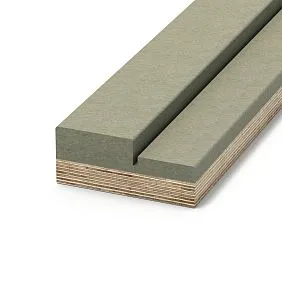
A profile is the shape of the cross-section of a linear product (baseboard, cornice, molding, casing, batten). If you cut a baseboard perpendicular to its length, we see the profile: the line describing the relief of the element. This line can be simple (straight, arc) or complex (combination of straight lines, arcs, transitions).




Basic geometric elements of profiles
Classical profiles are built from a limited set of geometric elements, known since ancient architecture:
Straight plane (fillet, shelf) — a horizontal or vertical flat strip, creating a visual pause, separating profile elements. The shelf width is 5-20 mm, it gives the eye a place to rest between curves.
Quarter-round torus — a convex arc with a radius of 5-15 mm, protruding outward, creating soft volume. The torus reflects light, creates a light stripe on the profile, visually expands the element.
Concave cavetto (scotia) — a concave arc with a radius of 5-15 mm, receding inward, creating shadow. The cavetto absorbs light, creates a dark stripe, visually deepens the profile.
Cyma recta (ogee) — an S-shaped curve, a combination of convex and concave arcs, smoothly transitioning into each other. The cyma recta is the most recognizable element of classical profiles, creating dynamism, plasticity.
Cyma reversa (reverse ogee) — an S-shaped curve where the concave part is at the top, convex at the bottom (opposite to cyma recta). The cyma reversa is used in cornices, creates a smooth transition from the vertical plane of the wall to the horizontal plane of the ceiling.
Astragal (bead with fillets) — a convex arc, framed by flat fillets above and below, creating a clear, graphic element. The astragal is often used in columns, pilasters, furniture cornices.
Chamfer — a beveled plane, connecting two perpendicular planes at a 45° angle. The chamfer softens a right angle, creates a transition, without adding curvature.
Our factory also produces:




Profile terminology: the language of joinery art
Knowing the terms allows for accurately describing profiles, ordering the right elements, understanding manufacturers' catalogs.
Cavetto (from Italian cavetto — recess) — a concave quarter-round molding. Used in column bases, furniture plinths, lower parts of cornices.
Torus (from Latin torus — convexity) — a convex quarter-round bead. Used in cornices, baseboards, moldings to create volume.
Scotia (from Greek σκοτία — darkness) — a concave molding with a steep curve, creating deep shadow. Used in column bases, less often in furniture.
Cyma (ogee, from Greek κῦμα — wave) — an S-shaped wave-like curve, a classical element of Ionic and Corinthian orders. Two types: cyma recta (convex part on top), cyma reversa (convex part at the bottom, this is the reverse ogee).
Ovolo (quarter-round bead) — a smooth convex arc, transitioning into a plane. Used in column capitals, cornices, moldings.
Dentils (denticules) — a row of small rectangular projections, separated by equal intervals, like teeth. Used in cornices of classical interiors to create rhythm.
Bead-and-reel (beads) — a row of small hemispheres, creating a decorative border. Used in moldings, frames, furniture appliqués.
Get Consultation
Types of profiles by complexity
Profiles are classified from simple (one geometric form) to complex (combination of several elements).
Simple profiles: minimalism and functionality
A simple profile consists of one or two geometric elements: straight plane, quarter-round bead, chamfer.
Rectangular profile — a batten without relief, with straight edges. This is minimal decor, used in modern interiors (minimalism, Scandinavian style). Rectangular baseboard (height 60-80 mm, thickness 10-12 mm) covers the gap at the floor, without drawing attention. Rectangular casing frames the door with a thin frame, not competing with furniture.
Profile with chamfer — a rectangular batten, where the top edge is beveled at 45°. The chamfer softens the profile, adds slight decorativeness without opulence. Baseboard with chamfer suits neoclassicism, modern classic, where structure is needed, but not ornament.
Quarter-round profile — a batten with a convex bead on the face side. The bead with a radius of 8-12 mm creates soft volume, classicism. Baseboard with quarter-round bead (height 80-100 mm) suits restrained classic, where form is needed, but not complexity.
Simple profiles are easy to produce (less milling, less sanding), cheaper than complex ones. But their expressiveness is limited: they create structure, but not opulence; order, but not drama. Simple profiles are the foundation on which more complex ones are built.
Medium profiles: classical harmony
A medium profile combines 3-4 geometric elements: a fillet, a torus, a cavetto, forming a recognizable classical shape.
A profile with a cyma reversa and a torus — a combination of an S-shaped cyma reversa (at the top) and a convex torus (at the bottom), separated by a flat fillet. This is the canon of classical baseboards, cornices, and moldings. The cyma reversa creates dynamism, the torus — volume, the fillet — a pause. The profile reads as classical, recognizable, traditional.
wooden wall profile with such a cross-section is suitable for neoclassical and classical interiors. A baseboard 100-120 mm high with a cyma reversa and a torus creates solidity, a cornice 100-130 mm high with the same profile frames the ceiling, a molding 50-70 mm wide with a reduced copy of the profile forms panels on the walls.
A profile with a cavetto and an astragal — a combination of a concave cavetto and a convex torus with fillets (astragal), creating graphic quality and clarity of elements. This profile is suitable for strict classicism (Palladian, Georgian), where clarity of forms and absence of excess are valued.
Medium profiles are the golden mean: decorative enough for classicism, but not overloaded for neoclassicism. They create visual richness without opulence, structure without heaviness. Medium profiles are universal: suitable for most interiors where a classical form is needed.
Complex profiles: baroque opulence
A complex profile combines 5-8 geometric elements: cyma reversas, tori, cavettos, fillets, dentils, forming a multi-tiered relief.
A profile with a cyma recta, tori, and dentils — a large cornice for baroque, palatial interiors. The cyma recta at the top creates a transition from wall to ceiling, several tori (large, medium, small) create volume, a row of dentils at the bottom creates rhythm, fillets between elements divide the form into readable parts.
The height of such a cornice is 150-200 mm (for ceilings from 3.5 meters), projection from the wall 100-150 mm (the cornice is massive, three-dimensional, creates an overhang over the space). Production of a complex profile requires multi-pass milling (each element is milled separately), manual finishing (sharp edges are accentuated with a chisel), multi-layer sanding (each step of the profile is sanded with an abrasive of the required grit).
A complex profile is not used on all elements, but selectively: a complex ceiling cornice (height 150-200 mm), a simplified copy for furniture cornices (height 100-120 mm, fewer elements), a medium baseboard (height 120-140 mm, basic profile elements preserved, detailing reduced). This creates a hierarchy: the ceiling cornice is primary (most opulent), the furniture cornice is secondary (recognizable, but more modest), the baseboard is background (connecting, non-dominant).
Complex profiles are for spacious rooms (from 30 square meters, ceilings from 3.2 meters), for baroque, rococo, palatial interior styles. In small rooms (15-20 square meters, ceiling 2.7 meters) a complex profile will overwhelm, create heaviness, visual overload.
How wall profiles are linked with furniture decor
The connection between profiles of architectural elements (baseboards, cornices, moldings on walls) and furniture elements (cornices, plinths, appliqués on facades) creates visual unity of the interior.
Repetition of basic profile elements
When a baseboard has a profile with a cyma reversa and a torus, the cornice of a cabinet should have the same cyma reversa and torus (possibly on a different scale, with the addition of extra elements, but the basic form is recognizable). The eye, glancing over the baseboard (having registered the cyma reversa+torus), moves to the cabinet, sees the familiar form on its cornice — and reads the kinship.
Pogonazh iz massiva for walls and furniture millwork (cornices, plinths, appliqués) are designed from one set of geometric elements. If a profile with a cavetto (concave curve) is used in the interior, the cavetto appears on the baseboard (lower part), on the ceiling cornice (upper part), on the cabinet cornice (crowning), on the chest of drawers plinth (base). The cavetto is a leitmotif, a repeating element linking different objects into a system.
Repetition does not mean identical dimensions. A cavetto on a baseboard with a radius of 8 mm, on a ceiling cornice with a radius of 12 mm, on a furniture cornice with a radius of 10 mm — the dimensions are different, but the form is the same. Proportions are preserved: the ratio of the cavetto's depth to its width is the same on all elements. The eye reads the proportion, not the absolute size.
Scaling profiles: from architecture to furniture
Architectural profiles (baseboards, cornices) are larger than furniture ones. A baseboard 120 mm high, a cabinet cornice 80 mm high — the furniture cornice is scaled by a factor of 0.66 (two-thirds of the architectural one). But the profile is not simply reduced — it is simplified: if an architectural cornice has 5 elements (cyma recta, fillet, large torus, small torus, fillet), a furniture one has 3 elements (cyma recta, fillet, torus). The basic form is preserved (the cyma recta is recognizable), detailing is reduced.
Scaling creates a hierarchy: architectural elements are primary (larger, more complex), furniture elements are secondary (smaller, simpler), but visually related. This is a law of classical composition: the primary is distinguished by size and complexity, the secondary supports it through simplified repetition of forms.
Correct scaling requires an understanding of geometry: you cannot simply reduce a profile proportionally (it will become too small, unreadable). You need to remove small details, leave large elements, preserve the proportions of the basic forms. This is a task for a designer proficient in profile geometry.
Appliqués on furniture: three-dimensional decor from profiles
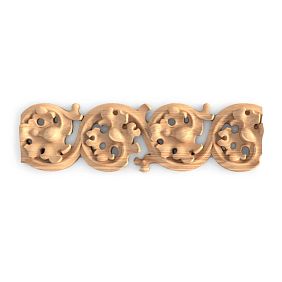
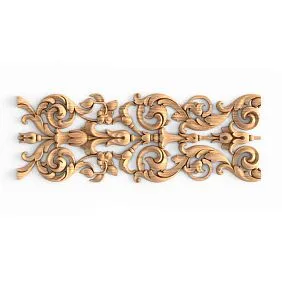
Furniture decor includes appliqués — carved or milled elements glued onto furniture facades, cornices, plinths. Appliqués have a profile (cross-section), which should be coordinated with the profiles of baseboards, cornices, moldings.
An appliqué with a cyma reversa on a chest of drawers facade echoes the cyma reversa on the baseboard. A carved appliqué with acanthus leaves (volumetric, three-dimensional) has a basic profile — a cyma reversa, on which carving is built up. Without carving, it would be a simple cyma reversa, like on the baseboard. With carving, it is an opulent appliqué, but the basic form is recognizable.
When appliqués on furniture and profiles on walls are coordinated, the furniture integrates into the architecture. A chest of drawers with appliqués containing a cyma reversa, standing in a room with baseboards containing a cyma reversa, is perceived as part of the space, not a foreign body.
Production of appliqués is more complex than production of simple profiles: carving is needed (CNC or manual), finishing (a master accentuates details with a chisel), multi-layer sanding (carving is sanded by hand, with abrasives of different grits). But when appliqués are designed from the same geometric elements as baseboards and cornices, the result is visual unity.
Practical examples of profile coordination
Theory requires specifics. Let's consider schemes for coordinating profiles in different interiors.
Classical interior: profile with a cyma reversa and a torus
Interior in classicism style: oak parquet, walls painted with light beige matte paint, white ceiling. Furniture made of solid oak, stained with walnut stain.
Baseboard: height 120 mm, profile — ogee (top, S-shaped curve) + fillet (middle part, flat, 10 mm) + torus (bottom, convex arc with a radius of 8 mm). Solid oak, walnut stain, matte varnish finish.
Ceiling cornice: height 130 mm, profile — ovolo (top, transition to ceiling) + fillet + ogee + fillet + torus. Profile is more complex than the baseboard (5 elements vs 3), but the ogee and torus are the same — recognizable shape. Painted with white enamel (ceiling color).
Wall panel molding: width 60 mm, profile — torus + bead (simplified baseboard copy, without middle shelf). Painted in wall color (light beige), reads through relief, not through color.
Furniture cornice (on cabinets, dresser): height 100 mm, profile — ogee + fillet + torus + a row of small dentils. Profile is recognizable (ogee+torus from the baseboard), but enriched with dentils (rhythm, decorativeness). Solid oak, walnut stain (like baseboard).
Furniture plinth: height 120 mm (like baseboard), profile — ogee + torus (exact copy of the baseboard). When a cabinet stands against a wall, its plinth visually continues the baseboard — one line, one shape.
Visual connection: ogee and torus appear on all elements (baseboard, cornice, molding, furniture). Scale varies (baseboard 120 mm, molding 60 mm), complexity varies (cornice 5 elements, baseboard 3 elements), but the basic geometry is the same. The interior is coordinated through a language of forms.
Modern interior: simple rectilinear profiles
Interior in minimalism style: engineered oak flooring natural, white matte walls, white ceiling without cornices. Furniture made of natural solid oak with oil finish, straight forms, no carving.
Baseboard: height 70 mm, profile rectangular with a chamfer (top edge beveled at 45°, softens the form). Solid oak with oil finish (natural color, like the floor).
Ceiling cornice is absent (minimalism does not like cornices). The transition from wall to ceiling is straight, without decoration.
Door architraves: width 70 mm, profile rectangular with a chamfer (same chamfer as the baseboard). Solid oak with oil finish.
Furniture: cabinet, smooth fronts without overlays. Cornice is absent (top of the cabinet is flat). Plinth height 70 mm (like baseboard), profile rectangular with a chamfer (same chamfer). When the cabinet is against a wall, its plinth continues the baseboard — one geometry (rectangle with chamfer), one height.
Visual connection: chamfer — the only geometric element repeating on all objects. Minimalist connection, but sufficient: the eye reads the chamfer as a repeating form creating unity. The interior is laconic, but not random — there is a system based on the simplest geometry.
Neoclassical interior: mixed profiles
Interior in neoclassical style: oak parquet stained gray (fashionable shade), light gray walls, white ceiling with a cornice. Furniture painted with white enamel, fronts with moldings.
Baseboard: height 100 mm, profile — cavetto (concave cove at top) + fillet + quarter-round torus. Painted with white enamel (contrasts with gray walls, graphic).
Ceiling cornice: height 110 mm, profile — ovolo + cavetto + fillet + torus. Cavetto and torus from the baseboard are repeated, ovolo (transition to ceiling) is added. White enamel.
Wall moldings: width 50 mm, profile — cavetto + torus (simplified copy of the baseboard). Painted in wall color (light gray), read due to shadows in the cavetto.
Furniture moldings (on cabinet, dresser fronts): width 40 mm, profile — cavetto + torus. White enamel. Moldings are glued onto fronts, forming frames, creating paneling.
Furniture cornice: height 80 mm, profile — cavetto + fillet + torus + small dentils. White enamel. Profile is recognizable (cavetto+torus), enriched with dentils.
Visual connection: cavetto (concave cove) — the leitmotif of the interior, appears everywhere (baseboard, cornice, moldings, furniture). Torus accompanies cavetto, creates balance (concave + convex). All elements are white (baseboard, cornice, furniture) — color unites additionally. The interior is coordinated through repetition of geometry (cavetto+torus) and color (white).
How to choose profiles for your interior
The choice of profiles depends on interior style, room size, furniture, personal preferences.
Determine the interior style
Minimalism, Scandinavian style, loft — simple rectilinear profiles (rectangle, rectangle with chamfer, quarter-round torus). Minimum decor, maximum function. Baseboard 60-80 mm, cornice absent or minimalist (rectangular strip without relief).
Neoclassicism, modern classic — medium profiles (ogee+torus, cavetto+torus, astragal). Classical form, but restrained, without opulence. Baseboard 80-100 mm, cornice 100-120 mm, wall moldings (panels), furniture with moldings on fronts.
Classic, classicism — medium and complex profiles (ogee+torus+fillet, ovolo+cavetto+torus, dentils). Traditional form, recognizable, time-tested. Baseboard 100-120 mm, cornice 120-150 mm, furniture with profiled cornices, plinths, overlays.
Baroque, Rococo, palace styles — complex profiles (multi-stepped, with dentils, carving, gilding). Opulence, decorativeness, theatricality. Baseboard 120-150 mm, cornice 150-200 mm, furniture carved with overlays, gilding.
Style determines profile complexity. An incorrect profile will ruin the style: a minimalist interior with opulent carved cornices — dissonance; a Baroque interior with rectangular baseboards — deficiency.
Coordinate profiles with furniture
If furniture already exists (purchased earlier, inherited), study its profiles: what elements are on cornices, plinths, overlays. If there is a cavetto—choose baseboards and cornices with a cavetto. If there is a bead—the bead should be on architectural elements. Furniture with simple rectilinear forms—architectural profiles are also simple.
If furniture is ordered together with architectural elements (as in a comprehensive order from STAVROS), the designer will systematically design the profiles: select basic geometric elements (cavetto, bead, ovolo), design baseboards, cornices, moldings, and furniture elements from this set. Profiles will be coordinated automatically.
Consider the room size
Small rooms (15-20 square meters, ceiling 2.7 m)—simple or medium profiles, small size. Baseboard 60-80 mm, cornice 80-100 mm (if present). Complex profiles will overwhelm and create a cramped feeling.
Medium rooms (20-30 square meters, ceiling 2.8-3.2 m) — medium profiles. Baseboard 80-100 mm, cornice 100-120 mm. This is the golden mean, suitable for most apartments.
Large rooms (30+ square meters, ceiling 3.2+ m)—medium or complex profiles. Baseboard 100-120 mm, cornice 120-150 mm (can be multi-stepped with dentils). Simple profiles will get lost and not create sufficient architectural presence.
The profile size should be proportional to the room. A large profile in a small room will visually consume space, a small one in a large room will disappear.
Profile production: from drawing to finished product
Understanding production helps assess profile quality, understand pricing, and choose a reliable manufacturer.
Profile design: geometry on paper
A profile begins with a drawing: a technologist draws a cross-section (a line describing the relief) to scale, indicates the dimensions of each element (bead radius 8 mm, ovolo depth 6 mm, shelf width 10 mm), calculates the total height/width of the profile.
The profile drawing contains: a baseline (from which dimensions are measured), a profile contour (line describing the relief), dimensions of each element, tolerances (±0.1 mm for precise profiles, ±0.3 mm for simple ones).
Based on the drawing, the designer models the profile in CAD software (AutoCAD, SolidWorks), creates a 3D model, checks for errors (line intersections, impossible curves, overly sharp angles that the cutter will break). After verification, the model is transferred to CAM software (which creates the control program for the CNC machine).
Milling: CNC machines and manual finishing
Milling is the process of cutting a profile from solid wood using a rotating cutter. A cutter is a cutting tool with edges of a specific shape that replicate the profile shape (a cutter for a cavetto has an S-shaped edge, a cutter for a bead has a semicircular edge).
A CNC machine (computer numerical control) moves the cutter along a specified trajectory, cutting the profile on a solid wood plank (length 2.2-3.0 meters, width and thickness depend on the profile). Milling speed is 5-12 meters per minute (depends on wood hardness: oak slower, pine faster), accuracy ±0.1 mm (modern machines).
Complex profiles require multi-pass milling: first, a roughing cutter removes the main volume (fast but imprecise), then a finishing cutter (with fine edges) follows the contour, creating an accurate shape (slow but high quality). For a profile with 5-7 elements, 3-4 passes with different cutters may be required.
After milling, the profile is sanded: with abrasive belts (grit 80, 120, 180, 240 sequentially), cutter marks are removed, and the profile becomes smooth. Complex profiles (with ovolo, dentils, sharp edges) are partially sanded manually (a craftsman treats hard-to-reach areas with sandpaper where the belt cannot reach).
Finishing: protection and aesthetics
After sanding, the profile goes to the painting shop: it is stained (with stain, if color is needed), coated with oil/wax (for natural wood) or primed and painted with enamel (for colored finishes).
Staining with stain: stain (a penetrating dye on a water or alcohol base) is applied with a spray gun or brush, absorbed into the wood (changes color but grain remains visible), excess is wiped off with a cloth, dried for 12-24 hours. Stain emphasizes the grain (darker areas of annual rings darken more, lighter areas less—contrast is enhanced).
Oil/wax: natural oil (linseed, tung, mixture) or wax is applied with a brush or roller, rubbed into the wood (fills pores, creates a protective film), polished with a dry cloth, dried for 24-48 hours. Oil does not create a surface film (like varnish) but impregnates the wood—the texture and tactile feel of the wood are preserved.
Enamel: the profile is primed (primer seals wood pores, evens the surface), dried for 6-8 hours, sanded (abrasive 240-320), coated with finish enamel (alkyd, acrylic, polyurethane) in 2-3 layers, each layer dried for 6-12 hours. Enamel is opaque (wood grain not visible), creates a smooth colored surface (white, gray, colored).
Frequently asked questions
Can different profiles be combined in one interior?
Yes, but carefully. Rule: basic geometric elements should be repeated, even if profiles are of different complexity. Baseboard with cavetto+bead (3 elements), cornice with cavetto+bead+dentils (5 elements)—the combination works, basic elements (cavetto, bead) are shared.
Baseboard with cavetto, cornice with ovolo (instead of cavetto)—the combination is weaker, basic elements differ. But if the furniture has both cavetto (on overlays) and ovolo (on plinth), a connection is created: the baseboard supports the overlays, the cornice supports the plinth.
Avoid: chaotic mixing (rectangular baseboard, carved cornice, figured molding, furniture with a third profile—no connection, no system).
How much does a custom wooden profile cost?
Depends on wood species, profile complexity, order volume. Approximate (STAVROS prices 2026):
Simple profile (rectangle, bevel) from oak: 800-1200 rub/linear meter.
Medium profile (ogee + torus) in oak: 1400-1800 RUB/linear meter.
Complex profile (multi-step, dentils) in oak: 2500-3500 RUB/linear meter.
Prices are indicated without finishing (for painting). With finishing: +200-400 RUB/linear meter (oil), +400-600 RUB/linear meter (stain+oil), +500-800 RUB/linear meter (enamel paint).
Custom profile (not from catalog, designed for a specific project): +30-50% to the cost (development, cutter manufacturing, machine setup).
Minimum order: 50-100 linear meters (smaller volumes are unprofitable for custom profile production). For standard profiles (from the STAVROS catalog) there is no minimum order.
How to care for profiled products?
The profile requires the same care as any solid wood product, but the relief complicates cleaning.
Oiled: wipe with a dry cloth (dust), dust collects in the recesses of the profile (cavetto, between dentils) — use a soft brush (sweep dust before wiping). Renew the oil every 3-5 years: apply a thin layer, rub in (into recesses with a brush), polish.
Painted with enamel: wipe with a slightly damp cloth, clean recesses with a cotton swab or thin brush (damp, with detergent). Do not use abrasives (scratch), stiff brushes (can strip enamel from sharp edges of the profile).
Avoid: accumulation of dust in profile recesses (dust becomes ingrained, darkens, spoils appearance — clean regularly), impacts on protruding parts of the profile (tori, corners can chip).
Where to order coordinated profiles for walls and furniture?
From a manufacturer that produces both architectural millwork and furniture — like STAVROS. A designer will design profiles systematically: select basic elements (ogee, torus, cavetto), create baseboards, cornices, moldings, and furniture elements (cornices, plinths, overlays) from this set. Profiles are milled with the same cutters (or cutters of the same geometry), finished identically.
Advantage of a comprehensive order: profiles are coordinated at the design stage, identity of forms is guaranteed, color is identical (from the same batch of wood, same stain/enamel), one delivery, one installation, one warranty.
Alternative: order architectural millwork from manufacturer A, furniture from manufacturer B, try to match similar profiles. Coincidence is not guaranteed (profiles are 'similar' but not identical), coordination is more complex (different timelines, different deliveries).
Conclusion: geometry as the foundation of harmony
A harmonious interior is not an accident, not luck, not the result of 'good taste'. Harmony is the result of understanding the geometry of forms, knowledge of the laws of composition, and mastery of the language of profiles. When an ogee on a baseboard echoes an ogee on a cabinet cornice, when a torus on a door casing repeats in a torus on a dresser molding, when basic geometric elements (cavetto, torus, ovolo) form a family of forms that permeates the interior — this is not an accident, but a system.
Wooden profile— is a tool for creating this system. Understanding the geometry of profiles gives power over the interior: not 'buy a beautiful baseboard', but 'choose a baseboard with a profile coordinated with cornices and furniture, creating visual unity'. Not 'order furniture with decoration', but 'design furniture with overlays whose profiles repeat the profiles of architectural elements'.
The company STAVROS has been creating interiors based on the geometry of profiles for over 20 years. STAVROS designers master the language of forms: they know how an ogee transitions into a torus, how a cavetto creates shadow, how an ovolo forms the transition from wall to ceiling. STAVROS production is equipped with CNC machines (German, Italian, Swiss — accuracy ±0.1 mm), a cutter library (hundreds of profiles, from simple to most complex), craftsmen (joiners, carvers, finishers with 10-30 years of experience).
Contact STAVROS for a consultation: a designer will show the profile catalog (drawings, samples, application photos), explain the geometry (what an ogee is, how a cavetto differs from a scotia, how profiles scale from architecture to furniture), suggest options for your interior. Consultation is free, designer visit is free (Moscow, St. Petersburg).
In 8-10 weeks after ordering, you will receive an interior whereProfile made of woodon walls andFurniture decorspeak the same language of geometry. Where baseboards, cornices, moldings, and furniture are designed from one set of basic elements, where forms echo, creating visual rhymes, where details are thought out, and randomness is excluded.
The geometry of forms is not abstract mathematics, but a practical tool for creating beauty. Master it — and the interior will submit, become manageable, created consciously, not by chance. STAVROS helps master this tool by providing knowledge, experience, production capabilities. Start with understanding profiles — and see how your perception of the interior changes, how the ability to see connections, understand harmony, and create beauty consciously appears.


