












































































Article Contents:
- The function of cornices: from utility to aesthetics
- The psychology of frame perception
- Cornice profiles: geometry and style
- Furniture cornices: adaptation of architectural profiles
- Selecting a unified profile: coordination technique
- Color and tonal coordination
- Creating a vertical frame: practical examples
- Minimalist interiors: simplified frame
- Coordination with other architectural elements
- Lighting integration: cornices as luminous elements
- Production aspects: manufacturing coordinated cornices
- Custom design: creating unique profiles
- Installation: creating a seamless visual line
- Maintenance and longevity
- Conclusion: architecture and furniture as a unified whole
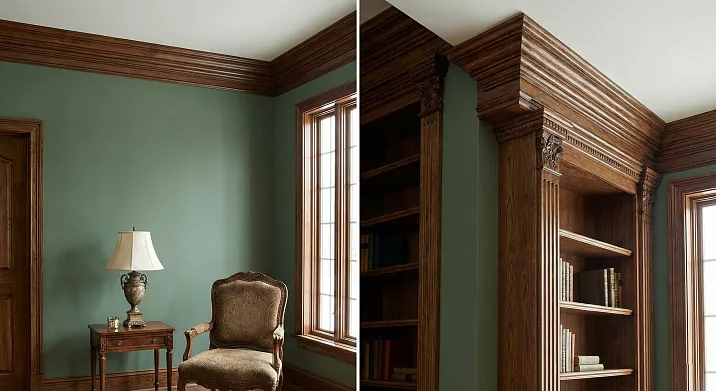
An interior is a three-dimensional composition where walls, floor, ceiling, and furniture form a unified space, perceived as either holistic or fragmented depending on the coordination of elements.Wooden ceiling baseboard, framing the upper boundary of the room, andFurniture made of oak complements the interior picture, especially if the furniture is also made of solid oak. Unity of material and finish creates a sense of completeness and stylistic coherence. on cabinets, dressers, and sideboards create a visual frame—an upper horizontal line running along the perimeter of the room at two levels: architectural—the junction of wall and ceiling—and furniture—the completion of case pieces. This two-level horizontal graphic forms a vertical structure of space, similar to how horizontal lines on a musical staff organize a musical composition. When the profile of theceiling skirting wood is coordinated with the profile of furniture cornices—identical or rhythmically linked through proportions—the eye perceives unity of design, and the interior is seen as an authored work, not a random collection of objects.
In classical interiors—Baroque, Empire, English classicism, Neoclassicism—the coordination of ceiling and furniture cornices was an architectural norm. Furniture was designed simultaneously with the room's architecture, cornice profiles were selected from a single catalog of decorative elements, and the wood species, tinting, and finishing method remained identical. This created the impression that the furniture grew from the architecture, being an organic part of it, rather than an externally introduced object. Modern practice, where furniture is purchased ready-made, often disrupts this unity—the ceiling cornice is one style, the furniture cornice another, materials do not match, scales conflict. Restoring classical harmony requires conscious selection of profiles, materials, colors—creating a visual coordinate system in which the interior exists.


The function of cornices: from utility to aesthetics
Wooden ceiling baseboard performs several functions simultaneously. The first is masking the joint between wall and ceiling, where micro-irregularities, cracks, signs of building settlement, and plaster imperfections are inevitable. Without a cornice, these defects are exposed, attract attention, and create a sense of incompleteness. A cornice covering the joint solves this problem, shifting focus from defects to a decorative element. The second function is visual completion of the space. A sharp transition from a vertical wall to a horizontal ceiling is psychologically uncomfortable—it is a geometric rigidity requiring softening. A profiled cornice creates a smooth transition where curves, beads, and coves form a gradient from vertical to horizontal.
The third function is scaling the space. A wide, massive cornice in a room with high ceilings of 3.5-4 meters creates a sense of monumentality, proportionality of elements to the room's scale. A narrow, elegant cornice in a room with ceilings of 2.5-2.7 meters preserves lightness, not weighing down the upper part. An incorrectly chosen cornice scale disrupts proportions—a massive cornice in a low room feels oppressive, visually lowering the ceiling further, while a narrow cornice in a high room gets lost, failing to provide visual completion.
Furniture made of oak complements the interior picture, especially if the furniture is also made of solid oak. Unity of material and finish creates a sense of completeness and stylistic coherence. on the upper part of cabinets, dressers, and sideboards perform similar functions on a smaller scale. They complete the verticality of the case, create a transition from the main volume to the space above the furniture, and mask the joint between the top panel and the fronts. Without a cornice, a furniture case is perceived as truncated, incomplete—like a column without a capital. A cornice crowns the case, giving it architectural completeness, transforming a utilitarian object into an architectural element. In the context ofclassic furniture a cornice is not an option but a mandatory element identifying stylistic affiliation.




The psychology of frame perception
The human brain perceives space through structures—boundaries, frames, axes. A room without defined boundaries—walls merging with the ceiling, unarticulated furniture—creates visual uncertainty, tiring the eye searching for reference points. A ceiling cornice creates a clear upper boundary—here the walls end, the ceiling begins. This psychologically calms and organizes perception. Furniture cornices at a height of 1.8-2.2 meters—typical cabinet height—create an intermediate horizontal line, dividing the vertical wall into two zones: the lower, filled with furniture, and the upper, free.
This two-level horizontal graphic forms a visual frame, analogous to a picture frame. The floor is the lower boundary, the ceiling cornice is the upper, the vertical corners of the room are the sides. Furniture cornices add an intermediate horizontal line within this large frame, creating nesting and compositional complexity. When the profiles of ceiling and furniture cornices are coordinated, both horizontals are perceived as parts of a unified system—the large frame contains smaller ones, all executed in a unified style, material, and scale. This is a visual logic, subconsciously read, creating a sense of order, harmony, and thoughtfulness.
Our factory also produces:


Cornice Profiles: Geometry and Stylistics
Simple cornice — a rectangular cross-section with a lower edge beveled at a 45-degree angle — is a minimalist form characteristic of modern interiors where clean lines without ornamentation are important. Ceiling projection width is 40-60 millimeters, thickness is 12-18 millimeters. The beveled edge creates a shadow, delineating the boundary between wall and ceiling without profiled complexity. This cornice pairs with modern minimalist furniture, where cornices are either absent or are a thin strip without profiling.
Classical cornice of medium complexity — a multi-element profile, including two or three elements: a shelf — a horizontal projection, a torus — a convex semicircular cross-section, a scotia — a concave cross-section. Typical composition from bottom to top: a scotia with a radius of 20 millimeters connecting the wall to the torus, a torus with a diameter of 15-20 millimeters, a shelf 10-15 millimeters wide, another scotia of smaller radius transitioning to the ceiling. Total projection width is 60-90 millimeters, thickness is 15-25 millimeters. This profile is characteristic of Classicism, Neoclassicism, English Classicism — styles that value a balance of decorativeness and restraint.
Complex cornice — a multi-tiered composition of four to five elements, where tori of various diameters, scotias, reverse scotias (with convexity outward), and shelves of varying widths alternate. Projection width is 100-150 millimeters, thickness is 25-40 millimeters. This profile creates an expressive play of light and shadow — each projection casts a shadow, each recess creates an illuminated plane, the profile changes depending on the lighting angle. Complex cornices are characteristic of Baroque, Empire styles, where architectural decor is maximally saturated, each element demonstrates craftsmanship and luxury.
Get Consultation
Furniture Cornices: Adaptation of Architectural Profiles
Furniture made of oak complements the interior picture, especially if the furniture is also made of solid oak. Unity of material and finish creates a sense of completeness and stylistic coherence.Furniture cornices use the same geometric elements as ceiling cornices, but on a smaller scale and often simplified. A furniture cornice for a classic 2-meter tall wardrobe has a projection width of 50-80 millimeters compared to 60-90 millimeters for a ceiling cornice — furniture requires a smaller scale of elements. The profile of a furniture cornice can replicate the ceiling one by reducing all dimensions by 20-30 percent, maintaining element proportions. Or it can be simplified — if the ceiling cornice has five elements, the furniture cornice contains three, retaining the key ones — a large torus, the main scotia, a shelf — but omitting small details.
Visual coordination is achieved by preserving the rhythm of the elements. If in a ceiling cornice a large torus with a diameter of 25 millimeters follows a scotia with a radius of 20 millimeters, the furniture cornice contains an 18-millimeter torus after a 15-millimeter scotia — the scale is smaller, but the size ratio is preserved. The eye, gliding from the ceiling cornice to the furniture cornice, reads the kinship of forms, similarity of proportions, unity of language. This creates visual coherence — all elements are from the same stylistic family.
For low case furniture elements — chests of drawers 80-100 centimeters high, consoles, cabinets — the furniture cornice is even smaller: projection 30-50 millimeters, profile maximally simplified — one torus and one scotia. Excessive detailing on a small scale looks fragmented, illegible. The principle is — the smaller the furniture, the simpler the cornice, but the character of the profile, the rhythm of the elements remain recognizably related to the ceiling cornice.
Selecting a Unified Profile: Coordination Technique
Coordination should begin with selecting the ceiling cornice — it sets the scale, profile complexity, and stylistic affiliation for the entire room. Ceiling height determines the scale: for ceilings 2.5-2.7 meters — a cornice 60-80 millimeters wide; for 3-3.5 meters — 80-110 millimeters; for above 3.5 meters — 110-150 millimeters. Interior style determines profile complexity: minimalism and contemporary — simple cornice; neoclassicism and English classic — medium complexity; Baroque and Empire — complex multi-tiered.
After selecting the ceiling cornice, the furniture cornice is determined. If the ceiling cornice has a simple profile — a beveled strip — the furniture cornice is either identical or absent altogether, replaced by a thin overlay without profiling. If the ceiling cornice is of medium complexity — two to three elements — the furniture cornice contains a simplified version retaining the key elements. A practical method — take the drawing of the ceiling cornice, reduce all dimensions by 25-30 percent, remove the smallest details, leaving the large tori and scotias. The resulting profile will become the basis for the furniture cornice.
It is critical to coordinate not only the profile geometry but also the wood species, color, and finishing method.Wooden ceiling baseboardA ceiling cornice made of oak requires furniture cornices made of oak. Mixing species — an oak ceiling cornice and beech furniture cornices — creates visual dissonance, where differences in texture and shades destroy unity. An exception is painting with opaque enamels that hide the wood species, where color becomes the unifying factor.
Color and Tonal Coordination
Natural finishing with oil or matte varnish, which keeps the wood texture visible, requires identical shades for ceiling and furniture cornices. Oak has a warm golden-brown hue, beech — pinkish-beige, ash — grayish-beige. Cornices made from the same species, treated with the same oil or varnish, have a coordinated shade. If a color change is required, staining with wood stains is applied — both cornices are stained with the same composition, ensuring color identity.
Patination — applying dark pigment into the profile recesses with partial wiping from the projections — creates an aging effect, emphasizing the relief. Patinated ceiling cornices require patinated furniture cornices with the same intensity of effect. Light patina — barely noticeable darkening in deep recesses — creates a delicate vintage effect. Intense patina — strong contrast between dark recesses and light projections — is characteristic of Provence, Country, Shabby Chic styles.
Painting with opaque enamels — white, gray, cream — allows mixing wood species without visual conflict, as the texture is hidden, the color is uniform. A white ceiling cornice made of beech and white furniture cornices made of oak are perceived as a single whole. The quality of painting is critical — ceiling and furniture cornices must have an identical shade of white, gloss level of the coating, application method. Inconsistency in white shades — one cold bluish, the other warm creamy — is noticeable and destroys unity.Wooden ceiling baseboardBeech and white oak furniture cornices are perceived as a unified whole. The quality of painting is critical—the ceiling and furniture cornices must have identical shades of white, coating gloss, and application method. A mismatch in white shades—one cool bluish, the other warm creamy—is noticeable and disrupts the unity.
Creating a Vertical Frame: Practical Examples
A classic living room with a ceiling height of 3.2 meters receives a ceiling cornice 100 millimeters wide with a complex profile — a large torus, two scotias, a shelf, a transitional bead. The profile is made of solid oak, stained a dark brown shade, matte varnish. A bookcase 2.4 meters high, occupying an entire wall, is crowned with a furniture cornice with a 70-millimeter projection, containing a simplified version of the ceiling profile — the same large torus of smaller diameter, one scotia, a shelf. Wood, stain, and finish are identical. A chest of drawers 90 centimeters high against the opposite wall has a cornice with a 50-millimeter projection with an even more simplified profile — a torus and a scotia, but the character of the elements is recognizably related to the ceiling and cabinet cornices.
The eye, entering this living room, reads three horizontal lines: the ceiling cornice at 3.2 meters, the cabinet cornice at 2.4 meters, the chest of drawers cornice at 0.9 meters. All three are made of oak, stained the same, have related profiles with decreasing complexity as the element height decreases. This creates a visual hierarchy — the most complex profile at the top, the simplest at the bottom — logical, organic, harmonious. The space is perceived as a single work, where architecture and furniture were designed simultaneously.
A neoclassical dining room with 2.7-meter ceilings uses a ceiling cornice 70 millimeters wide with a medium profile — a torus, a scotia, a shelf — made of beech, painted pearl gray. A sideboard 2 meters high has a cornice with a 60-millimeter projection with the same profile, but reduced by 20 percent, painted the same gray. A server 1.2 meters high receives a 40-millimeter cornice with a simplified profile — a torus and a shelf without a scotia — of the same gray color. Unity of color compensates for the simplification of the profile, creating a visual connection between all cornices.
Minimalist Interiors: Simplified Frame
Contemporary minimalism rarely uses profiled cornices, preferring clean lines without decorative elements. But when a visual finish is required, simple cornices are used — rectangular strips with a beveled edge.Ceiling skirting board made of wood, height 100-150 mm, enhances the perception of ceiling height.A ceiling cornice in a minimalist bedroom — a strip with a 60x15 millimeter cross-section with an edge beveled at 45 degrees, made of ash, coated with matte oil of a natural shade. A built-in sliding wardrobe 2.5 meters high is finished with an identical strip, creating a minimalist upper boundary without profiling.
In this context, unity is achieved through identity of cross-section, wood species, and finish in the absence of profile complexity. Simplicity of form is compensated by the expressiveness of the ash texture — light annual rings, cool grayish-beige hue — creating visual interest without ornamentation. The eye reads the material unity of the ceiling cornice and furniture strip, sufficient to create a visual connection in minimalist aesthetics, where less is more.
Scandinavian interiors use light wood species — pine, birch, ash — in natural or bleached state. A ceiling cornice made of pine, 50 millimeters wide, with a simple profile — one scotia — treated with white oil that keeps the texture visible but lightens the shade. A low chest of drawers under a window, 70 centimeters high, is finished with a cornice made of the same pine with the same scotia, treated with the same white oil. The visual lightness of light wood, restraint of the profile, unity of material create the characteristic Scandinavian atmosphere — naturalness without excess, functionality without asceticism.
Coordination with Other Architectural Elements
Baseboard — the lower horizontal line, closing the vertical frame of the room — must be coordinated with the ceiling cornice in terms of wood species, color, and finishing method. The profile of a baseboard usually differs from the ceiling cornice — it is taller (80-150 millimeters compared to 60-100 millimeters projection width of the ceiling cornice), has a different geometry adapted for floor use. But material unity is critical — an oak ceiling cornice requires an oak baseboard. Color coordination is achieved by staining both elements with the same composition.
Door and window casings — vertical elements framing openings — are also coordinated with ceiling and furniture cornices. Wide profiled casings in classic interiors can contain profile elements related to cornices — tori, scotias, shelves. When a door casing has a torus of the same diameter as the torus of the ceiling cornice, the eye reads a rhythmic connection between vertical and horizontal elements. This creates a visual grid that organizes the perception of space.
Wall moldings — horizontal strips that divide the wall height into panels — add intermediate horizontals between the baseboard and ceiling cornice. Typical placement is at a height of 80-100 centimeters, dividing the wall into a lower panel zone and an upper wallpaper or painted zone. The profile of wall moldings is simpler than that of a ceiling cornice — usually a single ogee or torus — but is made from the same wood species and finished identically. The system of horizontal lines — baseboard, wall molding, furniture cornices, ceiling cornice — creates a multi-level visual structure that organizes space like a musical composition.
Lighting Integration: Cornices as Light-Bearing Elements
Modern techniques for integrating LED strips into cornices transform them from purely decorative into functional lighting elements. A ceiling cornice with a shelf projecting 80-100 millimeters from the wall creates a niche between the shelf and the ceiling where an LED strip is placed. The light is directed upwards, reflects off the ceiling, and creates diffuse lighting without visible fixtures. The ceiling visually separates from the walls, appearing to float — an effect valued in contemporary architecture.
Furniture cornices with a similar construction — a shelf creating a niche — can also contain upward-directed LED lighting. A 2.2-meter tall cabinet with a glowing cornice creates localized lighting in the upper zone, emphasizing the furniture's height and creating a visual lightness for the massive carcass. When both the ceiling and furniture cornices glow, it creates a distributed lighting system where light emanates not from point sources but from the horizontal lines that articulate the space.
The color temperature of the LEDs must be coordinated — typically warm white 2700-3000 Kelvin for classic interiors, neutral white 4000 Kelvin for contemporary ones. Brightness is regulated by dimmers, allowing the glow intensity to be changed from delicate accent lighting to full illumination. Glowing cornices turn architectural elements into light fixtures, blurring the line between decor and functional systems.
Production Aspects: Manufacturing Coordinated Cornices
Producing ceiling and furniture cornices with coordinated profiles requires using unified templates and tools. The profile is formed by milling on four-sided planers or CNC milling machines, where the cutter shape determines the geometry of the elements. To create a family of coordinated cornices, a set of cutters is manufactured — for the full-profile ceiling cornice, a simplified one for the furniture cornice, and an even simpler one for small cornices — where the key elements are identical in shape, differing only in scale.
Wood for all cornices in a single project is taken from the same batch, ensuring identical color and grain. Kiln drying to a moisture content of 8-10 percent guarantees dimensional stability of the finished products — critical for cornices installed with minimal gaps. Milling is performed on the same equipment, ensuring consistent surface quality. Sanding with progressively finer grit from P80 to P180-P220 creates a smoothness ready for final finishing.
Finishing — staining, patinating, painting, varnishing — is performed simultaneously for all cornices in the project, ensuring identical color and gloss. The stain is applied by spraying or brushing, with equal dwell time before removing excess, ensuring uniform shade. Varnish is applied in a chamber with controlled temperature and humidity, guaranteeing consistent coating thickness and gloss. Finished cornices are packaged in protective film to prevent damage during transportation.
Custom Design: Creating Unique Profiles
For projects requiring a unique profile not available in the standard catalog, custom design is performed. The designer or architect provides a sketch of the desired profile — a drawing or technical draft with dimensions of all elements. Technologists adapt the sketch to production capabilities, adjusting radii of curves, transition angles, ensuring manufacturability. Special cutters are manufactured, the CNC machine is programmed, and a trial batch is produced to check geometry.
After approval of the trial sample, production of the required linear meters of ceiling cornice and corresponding furniture cornice is launched. The minimum order quantity for a custom profile is typically 50-100 linear meters — smaller quantities are economically unviable due to cutter manufacturing and equipment setup costs. The cost of a custom profile is 30-50 percent higher than standard, but it is the only way to realize a unique design where off-the-shelf profiles do not match the architectural concept.
Documentation for the custom profile — drawings, photographs, samples — is retained by the manufacturer, allowing the profile to be reproduced for repairs or project expansion in the future. This is critical for restoration projects requiring cornices identical to historical ones, or for phased construction where furniture is ordered later than architectural finishes but must contain coordinated cornices.
Installation: Creating a Seamless Visual Line
Ceiling cornices are installed on the wall surface, fastened with screws or adhesive. For heavy, massive cornices, mechanical fastening is preferred — screws are driven through the cornice into the wall at 400-600 millimeter intervals. Pilot holes for screws are drilled from the front side, screw heads are countersunk 2-3 millimeters, the recesses are filled with wood filler to match the tone, and sanded. With quality execution, the fastening points are invisible. An alternative is adhesive mounting with polyurethane glue or liquid nails, leaving no visible marks but less reliable for heavy cornices.
Corner joints of cornices are a critical node determining the visual quality of installation. A 45-degree miter cut using a miter saw with precise angle adjustment ensures tight fit of elements. Profiled cornices require particular precision — all profile elements must align at the joint; any misalignment creates a step, breaking the line's continuity. The joint is glued, clamped until the adhesive sets. If necessary, it is filled with a thin layer of filler, sanded, and the finish is restored.
Furniture cornices are mounted on the top carcass panel, fastened with screws from below (through the panel into the cornice) or with adhesive. Screws provide reliability, adhesive provides a clean look without visible fasteners. For classic furniture, adhesive mounting with additional fixation using small finish nails driven at an angle through the cornice into the panel is preferable. Corners of furniture cornices are mitered at 45 degrees, glued, and if necessary reinforced with wooden dowels to prevent the joint from opening due to humidity fluctuations.
Maintenance and longevity
With proper care, wooden cornices last for decades without losing functional and aesthetic qualities. Regular maintenance involves dry wiping with a soft cloth to remove dust settling on the horizontal surfaces of the cornices. Avoid excess moisture — a wet cloth can leave stains on oil finishes or cause swelling of untreated wood. Use specialized wood care products — polishes, waxes — that restore protection and deepen the color.
The oil finish on cornices does not require regular renewal — unlike baseboards subject to wear, ceiling and furniture cornices experience no mechanical loads. The finish lasts 10-15 years, after which renewal is possible — the surface is cleaned of dust, a thin layer of the same oil is applied, and excess is removed. Varnished cornices do not require coating renewal throughout their service life — quality varnish retains gloss and protection for decades.
Mechanical damage — chips, scratches — on cornices located near the ceiling is practically excluded. Furniture cornices can be damaged by careless handling of tall objects. Localized damage is restored with wood filler, sanding, and finish restoration. For painted cornices, local touch-up is possible; for natural finishes, treatment with wax or oil can mask the defect.
Conclusion: Architecture and Furniture as a Unified Whole
Wooden ceiling baseboardandFurniture made of oak complements the interior picture, especially if the furniture is also made of solid oak. Unity of material and finish creates a sense of completeness and stylistic coherence.— are not autonomous elements existing independently, but parts of a unified visual system creating the vertical framework of an interior. When profiles are coordinated — identical or rhythmically linked through proportions — when the material is unified — one wood species, one treatment, one color — when the scales are proportionate to the element heights, the space is perceived as an integral work.Classic Furniturewith cornices coordinated with theceiling cornice wood, does not merely stand in a room but is integrated into the architecture, becoming its organic part.
Company STAVROS offers a complete system of wooden cornices for ceilings and furniture made from solid oak, beech, ash. The catalog includes dozens of profiles — from simple minimalist to complex classical — with the possibility of manufacturing coordinated variants for ceiling and furniture applications. Production on modern European equipment ensures perfect profile geometry; kiln drying guarantees stability. Finishing options — natural oil, staining, patinating, painting, varnishing — are performed in-house with quality control for each batch.
with cornices coordinated with ceiling ones provides a comprehensive solution — architectural finish and furniture from a single source, guaranteeing material and stylistic unity.classic furnitureCreate interiors where every element — from the
to the furniture cornice — is coordinated, where the vertical framework of the space is created by a system of horizontal lines, crafted from noble solid wood. Entrust the quality of architectural decor and furniture to company STAVROS — we understand that harmony is born from the coordination of details, that the beauty of an interior is not the sum of separate items but a unified composition where architecture and furniture speak the same language of forms, materials, proportions.ceiling skirting boardUp to the furniture cornice—coordinated, where the vertical frame of the space is created by a system of horizontal lines made from noble solid wood. Entrust the quality of architectural decor and furniture to STAVROS—we understand that harmony arises from the coordination of details, that the beauty of an interior is not the sum of separate items but a unified composition where architecture and furniture speak the same language of forms, materials, and proportions.


