Article Contents:
- Why 50 mm: the history of the standard
- Grip ergonomics: anatomy of the 50 mm contact
- Geometry of optimal grip
- Grip strength and safety
- Wood species: what works at 50 mm diameter
- Oak: the king of handrails
- Ash: light strength
- Beech: uniform silkiness
- Larch: coniferous durability
- Solid or glued: construction options
- Solid (solid)
- Glued (glued, laminated)
- Standard lengths and sizes
- Solid
- Glued
- Surface treatment: from sanding to finishing
- Sanding: creating the ideal cylinder
- Finishes: protection and aesthetics
- Application: where the 50 mm standard works
- Internal staircases in residential buildings
- Staircases in public buildings
- Wall-mounted handrails for accessible environments
- Balustrade railings for balconies and terraces
- Installation: mounting to balusters and walls
- Mounting on balusters
- Wall-mounted mounting
- Where to buy round 50 mm handrail: quality guarantee
- Company STAVROS: quality benchmark
- How to order
- Inspection Upon Receipt
- FAQ: Round handrail 50 mm
- Why exactly 50 mm, not 45 or 55?
- Solid or glued — which is more reliable?
- Which finish to choose for maximum durability?
- Can I install the handrail myself?
- Is it necessary to treat the handrail with antiseptic?
- After how many years will the handrail need replacement?
- Is a 50 mm handrail suitable for children?
- Where to buy a round 50 mm handrail in Moscow/St. Petersburg?
- Conclusion: a standard proven by millions of hands
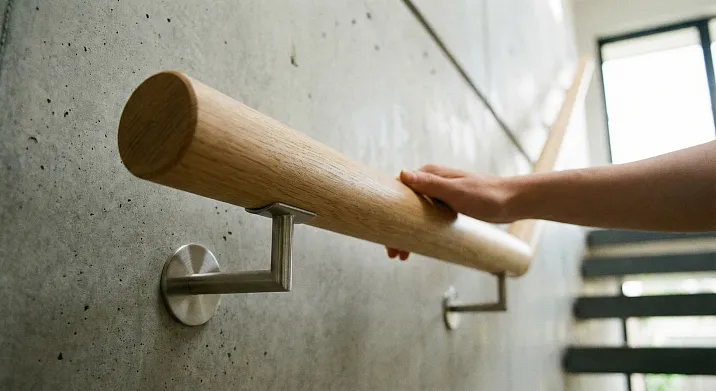
In the world of architectural standards, there are sizes that seem arbitrary, but in reality, they have been refined over decades of biomechanics research, thousands of projects, and millions of human hand touches. Fifty millimeters — this is exactly the diameter of a round handrail that became the gold standard for stair railings, wall-mounted handrails, balustrades in residential and public buildings. This is not a random number, but the result of an ergonomic calculation, taking into account the average adult hand size, grip strength, comfort of prolonged contact, and safety during sudden movements.
Round handrail 50millimeters — this is the diameter that an adult with an average hand (palm circumference of 220–240 mm) can comfortably grip so that the thumb and index finger almost touch, creating a secure grip ring. Fingers are not overstrained, joints do not experience excessive load, the palm contacts the surface over the maximum area. This is a balance between sufficient thickness for structural strength and optimal thinness for ergonomic grip.
In 2026, when interior design increasingly integrates principles of universal access (design for all — design for all user categories), anthropometrics and biophilia,round handrails 50 mmremain the dominant choice for staircases in residential buildings, offices, hotels, shopping centers, and medical facilities. This standard combines safety (a secure grip prevents falls), comfort (the hand does not tire during prolonged contact), aesthetics (a 50 mm diameter visually harmonious, neither overly bulky nor too fragile), and manufacturing rationality (most machines are set to this size, materials are readily available).
This article is a complete guide toround handrail 50 mm: why exactly this diameter became a standard, how the biomechanics of grip works, which wood species are optimal, whether to choose solid or glued, what lengths are produced, how to install correctly, where to buy a quality handrail. From ergonomic research to practical tips — everything for creating a staircase that is safe and comfortable to use daily.


Why 50 mm: history of the standard
Standardization of handrail diameter began forming in the mid-20th century, when architects and medical professionals united to create building codes ensuring safety. Prior to this, handrails were made in arbitrary sizes — from 30 to 80 mm — based on visual harmony with baluster thickness or simply material availability.
The first serious ergonomic studies of handrails were conducted in Scandinavia and Germany in the 1950s–60s. Thousands of hands (male, female, child, elderly) were measured, grip strength was recorded at different diameters, and analysis was performed to determine at which size people felt maximum confidence on stairs. Results showed: the optimal range is 45–55 mm, with peak comfort at 50 mm.
This size was adopted in building codes of many countries (DIN in Germany, SNiP in the USSR/Russia, U.S. building codes) as recommended. Over time, the recommendation became de facto standard — manufacturers began mass-producing 50 mm handrails, hardware (brackets, connectors, end caps) was standardized for this diameter. Today, a round wooden handrail 50 mm — is the lingua franca of staircase design, a universal language understood by builders, designers, and manufacturers worldwide.




Ergonomics of grip: anatomy of the 50 mm contact
The human hand is a complex biomechanical tool with twenty-seven bones, numerous joints, muscles, ligaments. When gripping a cylindrical object (handrail), a so-called "power grip" is engaged: four fingers (index, middle, ring, little) wrap around one side, while the thumb opposes the other, creating a ring.
Our factory also produces:




Geometry of optimal grip
At a diameter ofround wooden handrail 50 mm:
Adult male (average palm circumference 220–240 mm): Fingers grip the handrail, thumb almost touches the index finger. Grip is full and secure. All joints are slightly bent at natural angles (without overstraining). Palm contact area with the handrail is maximal — from base of fingers to wrist.
Adult woman (average palm circumference 180–200 mm): Fingers wrap around, index and thumb meet with slight overlap. Grip is secure. A medium-sized woman’s hand fits perfectly on a 50 mm diameter — not too thick (a woman with a smaller hand may have difficulty gripping a 60 mm handrail).
Teenager (12–16 years old, palm circumference 160–190 mm): Fingers close more tightly, grip remains comfortable. For a teenager’s hand, 50 mm is the upper limit of comfort, but still acceptable.
Elderly person (possibly weakened hand muscles, arthritis): A 50 mm diameter allows grip with less effort than a thicker one. Contact area is sufficient to distribute load and reduce pressure on joints.
Get Consultation
Grip Strength and Safety
When losing balance on a staircase, a person instinctively grips the handrail with maximum force. Studies show: at a 50 mm diameter, an average adult develops a grip strength of 300–500 Newtons (30–50 kg force). This is sufficient to hold their own weight during a fall.
At a 30 mm diameter (too thin), grip strength decreases — fingers clamp too tightly, pressure concentrates on a small area, causing pain, and the hand reflexively releases. At a 70 mm diameter (too thick), fingers cannot close properly, grip weakens, and with a sudden jerk, the hand slips.
Round wooden handrail 50 mm buy— it’s an investment in family safety. The correct diameter can prevent tragedy, especially for the elderly, children, and people with coordination impairments.
Wood species: what works at 50 mm diameter
Not all wood species are equally suitable for making a 50 mm diameter round handrail. Critical are hardness (resistance to wear from daily hand contact), stability (minimal deformation with humidity changes), aesthetic texture, and tactile comfort.
Oak: the king of handrails
Oak — the standard forround wooden handrail 50 mmHardness by Brinell 3.7–3.9 makes an oak handrail practically eternal — even under intensive use (shopping center, office building with hundreds of employees) it does not wear out over decades.
Oak’s texture is expressive — large pores, contrasting growth rings create visual depth. On a 50 mm round cross-section, the texture is clearly visible and does not fade (as it would on a very thin 25 mm handrail). Color ranges from light honey to dark brown.
Tactilely, an oak handrail is warm (low wood thermal conductivity), with a slight roughness (if coated with oil preserving texture), pleasant for daily contact. Oak darkens over time, acquiring a noble patina — after ten to twenty years, the handrail looks even more beautiful than new.
Ash: light strength
Ash is not inferior to oak in hardness (4.0–4.1), but has a lighter tone — cream, light gray. For interiors requiring a light palette (Scandinavian style, minimalism), an ash handrail is ideal.
Ash’s texture is expressive but more delicate than oak. On a 50 mm diameter, growth rings create a beautiful pattern, especially if the handrail is coated with oil or wax, highlighting the contrast between hard and soft fibers.
Ash can be bleached (treated with whitening agents), yielding almost white handrails with preserved texture — a unique aesthetic for light interiors with white walls and light parquet.
Beech: uniform silkiness
Beech has a uniform fine-grained structure without the large pores of oak. This makes beechround wooden handrail 50 mmperfectly smooth after sanding — silky surface, maximally comfortable to the touch.
Beech’s color is warm beige-pink. It creates a cozy atmosphere. Beech stains beautifully, accepting any shade — you can mimic walnut, redwood, or wenge, while preserving beech’s natural smoothness.
Beech’s hardness is high (3.8), durability is good. For indoor staircases, beech is an excellent choice, especially if maximum surface smoothness is important (for sensitive skin, children).
Larch: coniferous durability
Larch — a coniferous species with hardness comparable to oak, due to high resin content. Color is amber-honey, texture expressive. A larch handrail smells of resin — a pleasant pine aroma, a biophilic stimulus.
Larch is uniquely resistant to moisture (resin protects against rot), making it suitable for staircases on open verandas, terraces, saunas, pools — anywhere other species quickly deteriorate from moisture. Larch is also good for indoor staircases, especially if you want an amber color and pine scent.
Solid or glued: construction options
Round wooden handrail 50 mm buycan be of two types of construction:
Solid (solid)
Turned from a single solid piece of wood with a cross-section of at least sixty by sixty millimeters. On a lathe, the block is processed, corners are removed, and an ideal cylinder of fifty millimeters in diameter is formed. The cross-section at any point shows natural annual rings running along the handrail.
Advantages:
-
Maximum strength (no joints that could split over time)
-
Aesthetics (texture is continuous, no visible joints)
-
Durability (a solid handrail will last a century without problems)
-
Prestige (solid wood is valued higher than glued)
Disadvantages:
-
More expensive (requires high-quality timber without knots along the entire length)
-
Length limitation (maximum three to four meters — longer pieces are hard to find without defects)
-
Risk of cracking (if the wood is poorly dried, a solid block may crack due to humidity changes)
Glued (laminated)
Composed of short wood segments (lamellas 30–60 cm long), glued end-to-end with a toothed joint and along the length. From the glued block, a cylinder of fifty millimeters in diameter is turned.
Advantages:
-
Cheaper (uses short segments, knots and defects can be trimmed out, and quality sections can be glued together)
-
Up to six meters in length (gluing allows creating long rods)
-
Stability (glued wood is less prone to movement, lower risk of cracking — stresses are compensated across different lamellas)
-
Ecological production (uses a higher percentage of wood, less waste)
Disadvantages:
-
Visible joints (on the ends of the handrail, glue lines are visible — zigzag toothed joints)
-
Dependence on glue quality (poor glue may delaminate over years, although modern woodworking glues are stronger than the wood itself)
-
Less prestigious (in the elite segment, solid blocks are preferred)
What to choose? For grand staircases in halls, living rooms — solid block (aesthetics matter more than price). For utilitarian staircases (basement, attic, dacha, technical room) — glued (cost-saving with good quality). For long runs (over three meters without joints) — glued, as solid blocks of such length are hard to find and expensive.
Standard lengths and sizes
round handrails 50 mmproduced in standard lengths:
Solid
-
Two meters — the most popular size for short runs (ten to twelve steps of a straight staircase)
-
Two and a half meters — for medium runs
-
Three meters — standard maximum for solid blocks
-
Four meters — rare, expensive, requires high-quality long timber
Glued
-
Three meters — standard
-
Four meters — popular length
-
Five to six meters — custom order for long runs
Diameter: Nominal fifty millimeters, actually forty-nine to fifty millimeters after grinding. Allowable deviation ± one millimeter.
Wood moisture: Critical parameter. Should be eight to twelve percent (kiln-dried). This is the equilibrium moisture for heated indoor spaces. If the handrail is wet (fifteen to twenty percent and above), it will dry out, deform, and may develop cracks after installation. If overly dry (below eight percent), it will absorb moisture from the air and swell.
When purchasing, request a moisture certificate from the seller or check with a moisture meter.
Surface treatment: from grinding to finishing
Qualityhandrail round 50 mmDetermined not only by wood species, but also by surface treatment.
Grinding: creating an ideal cylinder
After turning, the surface has tool marks. Requires multi-stage grinding:
-
Coarse (grit 80-100) — removes tool marks
-
Medium (150-180) — levels the surface
-
Fine (220-240) — creates smoothness
-
Final (300-320) — silky finish
A well-ground handrail is absolutely smooth, without roughness, scratches, or dents. The hand glides freely without catching. Critically: do not over-grind to mirror finish (400-600) — such a surface is slippery, and the hand does not feel grip.
Finishes: protection and aesthetics
Oil (linseed, tung, specialized): Penetrates into the structure, does not form a film. Wood breathes, texture is visible and tactile. Surface is matte, velvety. Requires renewal once a year or two. Optimal for biophilic interiors.
Wax (beeswax, carnauba): Creates a thin film, silky to the touch, with a slight sheen. Protects against moisture and dirt. Requires renewal every six months to a year (rubbing and polishing).
Lacquer (polyurethane, alkyd): Hard protective film. Maximum wear resistance. But tactilely colder and more slippery. If lacquer is needed, choose matte or semi-matte (not glossy), in thin layers (two to three coats), so the texture remains visible.
Staining + finishing: If you want to change the color (light beech stained to dark walnut, oak darkened to wenge), first apply a stain, then a protective finish (oil, lacquer).
Application: where standard 50 mm works
Residential staircases
round wooden handrail 50mm— classic for staircases in private homes, townhouses, two-story apartments. Mounted on balusters (attached from above via dowels or bolts) or as wall-mounted handrails (on brackets along the wall).
For family homes, oak or ash are preferred — strong, durable, and beautiful. Oil or wax finish for tactile comfort.
Staircases in public buildings
Offices, hotels, restaurants, shopping centers require especially strong handrails — heavy use (hundreds of touches per day). Here, oak handrails with lacquer finish (maximum wear resistance) work best. Fifty-millimeter diameter ensures comfort for all visitors — from children to seniors.
Wall-mounted handrails for accessible environments
In medical facilities, senior care homes, and rehabilitation centers, wall-mounted handrails with fifty-millimeter diameter are installed along corridors and staircases. This is an accessible environment element for people with limited mobility. Correct diameter is critical — a too-thick handrail is impossible for an elderly person with a weakened grip to grasp.
Balcony and terrace railings
On open balconies, terraces, and verandas, handrails are exposed to moisture, temperature fluctuations, and UV radiation. Here, larch (moisture-resistant) with fifty-millimeter diameter is optimal, coated with specialized exterior oil with UV filters.
Installation: mounting on balusters and walls
Mounting on balusters
Stages:
-
Balusters are installed vertically on the steps (one to two per step), secured from below
-
Holes with a diameter of ten millimeters and depth of thirty millimeters are drilled on the upper ends of the balusters (strictly centered, perpendicular to the end face)
-
Wooden dowels of fifty millimeters length are inserted into the holes (protruding twenty millimeters)
-
Holes for dowels are marked and drilled on the underside of the handrail (diameter ten millimeters, depth twenty-five millimeters)
-
The handrail is placed over the dowels, glued with carpenter's glue, and pressed into place
-
Additionally, screws are screwed through the balusters into the handrail (for rigidity)
-
After the glue dries (twenty-four hours), joints are sanded and finished with a coating
Important: All holes must be strictly vertical/perpendicular. Any deviation will cause the handrail to sit crooked.
Wall-mounted mounting
Stages:
-
The handrail installation line is marked on the wall (height nine hundred millimeters from the steps, or as per the project)
-
Brackets (metal or wooden) are installed at intervals of eight hundred to one thousand millimeters
-
Brackets are mounted to the wall using anchors (concrete, brick) or strong screws (wood, framed walls with built-in supports)
-
The handrail is placed into the brackets' grooves and secured from below or the side (hidden mounting)
-
Gap between handrail and wall: forty to fifty millimeters (hand can wrap freely, fingers do not press against the wall)
Handrail ends are covered with decorative caps (wooden or plastic) or the handrail is bent into the wall, entering horizontally into a recess.
Where to buy round handrail 50 mm: quality guarantee
The market offers many options, but quality varies greatly. What to pay attention to:
Company STAVROS: quality standard
STAVROS is one of the leading Russian manufacturers of wooden components for staircases. Over twenty years of experience, own production with modern equipment, strict quality control.
Catalog of round handrails:
-
Diameter: fifty millimeters (standard)
-
Species: oak, beech, ash, larch
-
Construction: solid block or jointed (choice available)
-
Length: from two to six meters (solid up to four meters, jointed up to six)
-
Moisture content: eight to twelve percent (kiln-dried, certified)
-
Finishing: sanded to 320 grit (ideal smoothness)
-
Coating: oil, wax, varnish, or staining (optional) or without coating (for your final finish)
Advantages of STAVROS:
-
Wood selection: solid timber without knots, cracks, rot, or insect damage
-
Precise geometry: diameter maintained with ±0.5 mm accuracy along the entire length
-
Radius bends: if the staircase has turns, STAVROS will manufacture a curved section of the handrail according to your drawings
-
Custom orders: non-standard lengths, stains, finishing
-
Kit includes: brackets, connecting couplings, end caps — all in one place
-
Delivery across Russia: Moscow, St. Petersburg, regions
How to order
-
Visit the website:Round wooden handrail 50 mm buy
-
Select the type of wood (oak for durability, ash for light interiors, beech for smoothness, larch for humid areas)
-
Choose the construction (solid for prestige, glued for cost-efficiency and long spans)
-
Specify length and quantity (measure the staircase diagonally from the first to the last baluster, add a reserve)
-
Choose finish (oil for biophilia, varnish for durability)
-
Order online or call our managers for consultation
Consultation is free: STAVROS specialists will calculate the required amount of materials, advise on suitable wood species and finish for your project, and answer questions about installation.
Inspection Upon Receipt
-
Geometry: Roll the handrail along a flat surface — it should roll smoothly (ideal cylinder)
-
Diameter: Measure with a caliper at five points along the length — should be fifty±one millimeters
-
Surface: Run your hand over it — absolute smoothness, no roughness or burrs
-
Moisture: If you have a moisture meter — eight to twelve percent
-
Defects: Inspect through the wood — no knots (especially dead ones), cracks, resin pockets, blue stain, rot
-
Ends: Flat and perpendicular to the handrail’s axis (for precise joints)
Any defects — immediately notify the supplier and request replacement.
FAQ: Round handrail 50 mm
Why exactly 50 mm, not 45 or 55?
Fifty millimeters is the result of ergonomic research: it’s optimal for an average adult hand (grip circumference of 200–220 mm). At 45 mm, men with large hands grip too tightly (discomfort). At 55 mm, women with smaller hands cannot fully encircle it (weak grip). Fifty mm is the golden middle, suitable for 90% of adults.
Solid or glued — which is more reliable?
Both are reliable when properly manufactured. Solid has an aesthetic advantage (no visible joints) and traditional prestige. Glued is more stable (less prone to movement, lower risk of cracking), can be longer, and is cheaper. For residential staircases, differences in reliability are imperceptible — both will last decades. Choice depends on budget and aesthetic preferences.
Which finish to choose for maximum durability?
Varnish (matte or semi-matte polyurethane) provides maximum protection against abrasion, moisture, and dirt. But it feels colder to the touch. Oil feels more pleasant to the touch but requires renewal every one to two years. Compromise — oil with wax (oilwax): better protection than pure oil, more tactile than varnish.
Can I install the handrail myself?
Yes, if you have basic woodworking skills and tools (drill, handsaw or circular saw, sander). Installation is straightforward for straight staircases without turns. For staircases with curved sections or complex geometry, it’s better to hire professionals — improper installation compromises safety.
Do I need to treat the handrail with antiseptic?
For indoor staircases in heated rooms — not necessary. The finish (oil, varnish) provides sufficient protection. For outdoor staircases, saunas, and humid areas — antiseptic treatment before finishing is recommended (especially for ends, where wood absorbs moisture more intensely).
How often will the handrail need replacement?
A quality oak or ash handrail, properly installed and maintained, will last fifty to one hundred years or more. The only requirement — periodic refreshment of the finish (oil every one to two years, varnish every five to ten years). The wood itself does not wear out — instead, it develops a patina over time and becomes more beautiful.
Is a 50 mm handrail suitable for children?
For children over eight to ten years old — absolutely. For younger children (four to eight years) — fifty millimeters is at the upper limit of comfort, but acceptable. For families with young children, we recommend installing two rows of handrails: the upper row at 50 mm, 900 mm high (for adults), and the lower row at 38–40 mm, 750 mm high (for children).
Where in Moscow/St. Petersburg can I buy a 50 mm round handrail?
STAVROS has branches in Moscow and St. Petersburg. Main production in St. Petersburg. Order online on the website with delivery to Moscow, St. Petersburg, and all of Russia. Self-pickup from warehouse is possible (pre-arranged call to coordinate time).
Conclusion: a standard, proven by millions of hands
round wooden handrail 50 mmThis is not an arbitrary size, but the result of deep biomechanical research, decades of architectural practice, and millions of human hand touches. Fifty millimeters — the golden middle, where ergonomics (comfortable grip for most adults), safety (secure hold when losing balance), aesthetics (visually harmonious diameter, neither bulky nor fragile), and manufacturing rationality (standardized hardware, accessible materials) converge.
Investing in quality
Investing in qualityRound wooden handrail 50 mm buyBy choosing a handrail made of oak, ash, or beech from a reliable manufacturer such as STAVROS, you are investing in family safety (preventing falls), durability (the handrail will last for generations), comfort (ergonomically correct diameter does not strain the hand), and beauty (natural wood grain delights the eye). In a world where much is done hastily, choosing a proven standard is wisdom, respect for ergonomic traditions, and care for those who will use this staircase for years and decades.