Article Contents:
- Dimensional parameters and their functional significance
- Diameter: why exactly 50 mm
- Length: standards and possibilities
- Tolerances and manufacturing accuracy
- Materials science: properties of wood species and their impact on operation
- Oak: the highest category of strength
- Beech: uniformity and workability
- Ash: strength with flexibility
- Larch: coniferous alternative with unique properties
- Production technology: from log to finished product
- Log Preparation and Primary Processing
- Drying: a critically important stage
- Lamella gluing: finger-jointed timber technology
- Turning and profile forming
- Sanding: achieving a perfect surface
- Protective coatings: chemistry and application technology
- Oil impregnation: penetrating protection
- Varnish coating: film protection
- Wax coating: traditional technology
- Installation: engineering solutions and technological nuances
- Baluster mounting system
- Wall mounting: brackets and consoles
- Joining long spans: miter joint
- Operation and Maintenance: Extending Service Life
- Regular Cleaning
- Recoating
- Protection against damage
- Normative requirements and safety standards
- Installation height and dimensions
- Strength requirements
- Surface requirements
- Economic aspects: pricing and profitability
- Cost structure
- Price Categories
- Calculation of economic efficiency
- Frequently Asked Questions
- What is the optimal wood moisture content for a handrail?
- Can a handrail be used without a coating?
- What is the difference between a finger-jointed handrail and a solid one?
- How to calculate the required handrail length?
- Why do cracks appear on the handrail?
- Which finish to choose: oil or varnish?
- How to remove scratches from a varnished handrail?
- Is a handrail mounting plate needed or can the handrail be attached directly to the balusters?
- How often should the oil coating be renewed?
- Can a handrail be installed independently?
- Conclusion: Technological Excellence from STAVROS

What determines the quality of a stair railing? Structural strength? Visual appeal? Or perhaps ergonomics of use? The answer is all of the above simultaneously, and the central element of this triad is the handrail.Round wooden handrail 50is not just a support rail, but a technically precise element with exact dimensional characteristics, specific material requirements, and a multi-stage manufacturing process.
A diameter of 50 millimeters became an industrial standard for a reason. This value is derived from anthropometric data, biomechanical research, and years of operational practice. A circular cross-section provides maximum contact area with the palm, even load distribution, and the absence of stress concentration at grip points. Wood as a material adds tactile comfort, natural warmth, and durability when technological requirements are met.





Dimensional Parameters and Their Functional Significance
The technical characteristics of a handrail determine not only its performance properties but also its compatibility with the railing system, ease of installation, and the durability of the structure.




Diameter: Why Exactly 50 mm
A diameter of 50 mm meets ergonomic requirements for 95% of the adult population. The average adult palm circumference is 180-220 mm, which allows for fully encircling a cylinder with a diameter of 45-55 mm. With a 50 mm diameter, the fingers close with slight overlap, ensuring a secure grip without excessive strain on the hand muscles.
From an engineering standpoint,Round 50 mm handrailhas an optimal mass-to-strength ratio. The section modulus of a circular cross-section is calculated by the formula W=πd³/32, where d is the diameter. As the diameter increases, strength grows proportionally to the cube of the size, but simultaneously the mass increases, complicating the installation of long spans.
Technologically, 50 mm is a size that allows for efficient processing of the workpiece on lathes and milling machines. A smaller diameter requires increased caution due to the risk of deformation during clamping. A larger one requires more powerful equipment and increases material consumption.
Technologically, 50 mm is a size that allows for efficient processing of workpieces on lathes and milling machines. A smaller diameter requires increased caution due to the risk of deformation during clamping. A larger one requires more powerful equipment and increases material consumption.
Our factory also produces:


Length: Standards and Possibilities
Standard lengths of wooden handrails are determined by production capabilities and logistical considerations. The main dimensional ranges are:
-
1500 mm — for short flights, additional wall-mounted handrails
-
2000 mm — a universal size for small and medium stairs
-
2500 mm — for medium flights
-
3000 mm — maximum length of a solid-lamella blank without splicing
-
4000-6000 mm — spliced constructions for long spans
The choice of length is determined by the geometry of the staircase. The length of the handrail along the inclined part is calculated by the formula L=√(H²+P²), where H is the rise height, P is the horizontal projection of the flight. To the obtained value, the length of the horizontal sections on the landings and a 50-100 mm allowance for trimming are added.
+P2
Professional production of wooden
Get Consultation
Tolerances and manufacturing accuracy
elements for stairsrequires adherence to strict tolerances. The diameter deviation should not exceed ±0.5 mm along the entire length of the product. Ovality of the cross-section — no more than 0.3 mm. Straightness of the axis — no more than 1 mm per meter of length.These parameters are critical for quality installation. If the diameter is uneven, the handrail will sit in the mounts with gaps, creating play and squeaking. If the axis is curved, internal stresses will arise during installation, which over time will lead to deformation.
These parameters are critical for quality installation. If the diameter is uneven, the handrail will sit in the mounts with gaps, creating play and squeaking. If the axis is curved, internal stresses will arise during installation, which over time will lead to deformation.
Accuracy control is performed using micrometers, calipers, and profile gauges. Modern production utilizes laser measuring systems that provide accuracy up to 0.01 mm.
Materials Science: properties of wood species and their impact on performance
The choice of wood species is not a matter of aesthetic preference. It is an engineering decision that determines mechanical characteristics, geometric stability, and product durability.
Oak: highest strength category
Oak (Quercus robur) has a density of 690-720 kg/m³ at a standard moisture content of 12%. Brinell hardness is 3.7-4.0 units. Modulus of elasticity — 13000 MPa, bending strength limit — 105-110 MPa. These indicators provide exceptional load-bearing capacity.
Oak wood contains tannins — natural polyphenols with antiseptic properties. Tannin concentration reaches 6-8% of dry matter mass. This makes oak resistant to biological damage: fungi, mold, wood-boring insects.
Oak structure is characterized by ring-porous construction. Large vessels form a clear pattern of annual rings. Medullary rays — up to 300 µm wide — create a characteristic texture on radial cuts. This structure ensures stability: oak shrinkage coefficient in tangential direction is 8.6%, in radial direction — 4.5%.
Beech: uniformity and workability
Beech (Fagus sylvatica) has a density of 650-680 kg/m³, hardness of 3.8 Brinell units, modulus of elasticity of 14000 MPa. In strength characteristics, beech is not inferior to oak, surpassing it in structural uniformity.
Beech wood is diffuse-porous. Vessels are distributed evenly throughout the volume, ensuring isotropic properties.round wooden handrail 50 mmBeech possesses a smooth, silky surface after turning and sanding.
The color of beech wood — from pale pink to reddish-brown — is determined by the content of extractive substances. A characteristic feature of beech is numerous medullary rays, forming decorative flecks on radial cuts.
Beech hygroscopicity is higher than that of oak. Shrinkage coefficient in tangential direction is 11.8%, in radial direction — 5.8%. This requires special attention to wood moisture content and operating conditions. In rooms with unstable climate, beech handrails must have enhanced protective coating.
Ash: strength with flexibility
Ash (Fraxinus excelsior) combines high hardness of 4.0-4.1 Brinell with increased impact toughness. Modulus of elasticity reaches 13500 MPa with bending strength limit of 110-115 MPa. These characteristics make ash an ideal material for elements experiencing dynamic loads.
Ash structure is ring-porous, similar to oak, but vessels are larger, creating a more pronounced texture. Color varies from light yellow to olive with gray shades. Sapwood is wide, light; heartwood is darker, with a brownish tone.
An important technological property of ash is its ability to bend after steaming. At a temperature of 95-100°C and workpiece moisture content of 25-30%, ash wood plasticizes, allowing creation of curved elements with a radius up to 300 mm without risk of cracking. This is critical for spiral staircases and structures with complex geometry.
Larch: coniferous alternative with unique properties
Larch (Larix sibirica) — the only coniferous species competing in density with deciduous woods. Density is 650-700 kg/m³, hardness 3.0-3.2 Brinell. Modulus of elasticity — 12000 MPa.
Key advantage of larch — high gum content (up to 12-14% of mass). Gum — a complex of resinous substances and polysaccharides — creates natural waterproofing. Water absorption of larch is 2-2.5 times lower than that of pine or spruce. This makes larch the optimal choice for exterior stairs, verandas, terraces, saunas.
Color of larch wood — from golden-yellow to reddish-brown. Annual rings are clear, contrasting. Over time, the wood darkens, acquiring a noble patina.
Production technology: from log to finished product
Productionof a wooden round handrail 50mmis a multi-stage process, each stage of which affects the final quality.
Log preparation and primary processing
The process begins with raw material selection. For handrails, first-second grade wood is used: without knots larger than 10 mm in diameter, without cracks, rot, wormholes, blue stain. Logs are sawn into lumber — square or rectangular section beams.
Sawing direction matters. Radial sawing — when the saw plane passes through the pith — yields boards with minimal shrinkage and warping. Tangential sawing — when the saw plane is tangent to annual rings — yields more expressive texture but less stable geometry. For handrails, semi-radial sawing is preferable — a compromise between stability and aesthetics.
Drying: critically important stage
Freshly cut wood has moisture content of 60-120%, depending on species and season. For use in interior structures, moisture content of 8-12% is required. Moisture reduction occurs in drying chambers according to strictly controlled schedules.
Drying schedule for oak: initial temperature 45-50°C at relative air humidity 85-90%. Gradually temperature increases to 70-75°C, humidity decreases to 40-50%. Total drying duration for 50×50 mm beam — 7-10 days.
Too rapid drying causes cracking: surface layers dry faster than internal ones, internal stresses arise, wood cracks. Too slow — is uneconomical and can lead to development of fungal damage.
After drying, wood is conditioned in a room with temperature 20±2°C and humidity 50-60% for at least 72 hours. This allows the material to reach equilibrium moisture content corresponding to operating conditions.
Laminate Bonding: Finger-Jointed Timber Technology
For handrails longer than 3000 mm, a finger-jointing technology is used. Dried timber is sawn into lamellas 15-25 mm thick. The lamellas are sorted by color, grain pattern, and absence of defects.
Micro-tenons are milled onto the ends of the lamellas—a toothed joint with a pitch of 3-5 mm and a depth of 10-15 mm. The micro-tenon joint provides a gluing area 5-7 times larger than a simple butt joint, resulting in tensile strength exceeding that of the wood itself.
Bonding is performed using polyurethane or resorcinol adhesives, providing water resistance class D3-D4 according to the European standard EN 204. Pressing pressure is 8-12 kg/cm². Curing time at 20°C is at least 6 hours.
After bonding, the timber is planed to precise cross-sectional dimensions. Thickness tolerance is ±0.2 mm.
Turning and Profile Forming
Square or rectangular timber is mounted in a lathe and turned to a round cross-section with a diameter of 52-53 mm (including allowance for sanding). Spindle rotation speed is 1200-1500 rpm. Tool feed rate is 0.3-0.5 mm/rev.
The quality of turning is determined by surface roughness parameters. The height of micro-irregularities after turning should not exceed Ra 12.5 µm (according to ISO 4287 standard). This is ensured by subsequent sanding.
Modern production uses CNC machines, which ensure identical geometry for all items in a batch. Diameter deviation along the length is no more than 0.1 mm.
Sanding: Achieving a Perfect Surface
Sanding is performed in three to four stages with a sequential reduction in abrasive grit:
-
Primary sanding — P80-P100 grit, removal of lathe tool marks
-
Intermediate sanding — P120-P150 grit, surface leveling
-
Finish sanding — P180-P220 grit, creating a smooth surface
-
Polishing — P320-P400 grit, mirror-like smoothness (optional)
After each stage, the surface is blown with compressed air or treated with brushes to remove abrasive dust. Final roughness is Ra 1.6-3.2 µm, which corresponds to the tactile sensation of absolute smoothness.
Protective Coatings: Chemistry and Application Technology
Unprotected wood quickly loses its properties during use.Wood OilOil, varnish, wax — these are not decorative but functional materials that determine the service life of the product.
Oil Impregnation: Penetrating Protection
Wood oils are compositions based on vegetable (linseed, tung) or mineral (paraffin) oils with the addition of driers (drying accelerators) and wax. The principle of action is penetration into the wood structure to a depth of 2-5 mm, filling pores and capillaries.
Application is performed with a brush, cloth, or by spraying. Consumption is 80-120 g/m² per coat. After application, the oil is left for 15-20 minutes for absorption, then excess is removed with a dry cloth. After 6-8 hours, a second coat is applied. Total number of coats is 2-3.
Oil polymerization takes 24-72 hours at a temperature of 20°C and humidity of 50-60%. During this period, oxidation of unsaturated fatty acids occurs, forming a hard polymer film inside the wood.
Advantages of oil coating: preservation of wood vapor permeability, tactile comfort, ease of renewal. Disadvantages: need for regular renewal (every 1-3 years), lower wear resistance compared to varnish.
Varnish Coating: Film Protection
Varnishes form a hard, transparent film on the surface, 80-150 µm thick. Modern water-based varnishes (polyurethane-acrylic) provide wear resistance class 23-33 according to EN 13696.
Coating is applied in several thin layers with intermediate sanding using fine-grit sandpaper. Each layer must be fully dry before applying the next. The number of layers depends on the type of coating and surface quality requirements.
-
Priming — a special primer-varnish fills pores, creating a base for subsequent coats. Consumption is 100-120 g/m².
-
Inter-coat sanding — P220-P280 abrasive, removal of raised wood fibers.
-
Intermediate coating — 2-3 coats of varnish with inter-coat drying of 2-4 hours. Consumption per coat is 80-100 g/m².
-
Finish coating — the final coat to create the required sheen (gloss, semi-matte, matte).
Full polymerization of water-based varnishes takes 7-10 days. During this period, intensive use and contact with water must be avoided.
Advantages of varnishes: high wear resistance, durability (10-15 years without renewal), moisture resistance. Disadvantages: altered tactile feel, highlighting of surface defects, difficulty of repair.
Wax coating: traditional technology
Wax (beeswax, carnauba) is applied to a pre-oiled surface. Solid wax is heated to 60-70°C, applied in a thin layer, and after cooling, polished with soft fabric wheels or brushes.
Wax coating creates a silky surface with a soft satin sheen. It repels water well but is less wear-resistant than oil or varnish. It is used primarily in interiors with low traffic or as a top coat over oil.
Installation: engineering solutions and technical nuances
Installationstair handrailsrequires strict adherence to technology. Installation errors lead to reduced strength, squeaking, and deformation.
Baluster mounting system
Classic scheme: the handrail rests onbalustersconnected to each other by ahandrail subrail. The handrail subrail — a block with a cross-section of 40×20 mm or 50×25 mm — is attached to the top ends of the balusters with screws 3.5-4 mm in diameter and 35-40 mm long.
Screw spacing is 150-200 mm. Screws are driven at a 15-20° angle to the vertical to ensure a tight connection. Screw heads are countersunk 2-3 mm below the surface of the subrail.
The handrail is placed on the subrail and secured from below with screws. Screws (diameter 4-5 mm, length 50-60 mm) are driven through the subrail into the handrail at a 30-45° angle with a spacing of 250-300 mm. It is important not to overtighten to avoid deforming the handrail.
Additional fixation is done with glue (PVA, polyurethane). A thin layer of glue is applied to the top surface of the subrail before placing the handrail.
Wall-mounted attachment: brackets and consoles
For wall-mounted handrails, brackets are used — metal or wooden elements fixed to the wall. A bracket consists of a support plate attached to the wall and a holder into which the handrail is inserted.
Bracket spacing is 600-800 mm. With greater distance, the handrail will sag under load. Wall attachment is done with anchor bolts (for concrete, brick) or bolts with wall plugs (for hollow materials). Anchor diameter is 8-10 mm, embedment depth is at least 50 mm.
Distance from the wall to the handrail axis is 40-50 mm. This ensures free hand passage when gripping the handrail. Installation height is 900-1000 mm from the step surface.
The handrail is secured in the bracket holders with countersunk head screws driven from below. Holes for screws are drilled with a countersink so the screw head is flush with the inner surface of the holder.
Joining long spans: miter joint
When the length of a flight exceeds the standard handrail length, joining is performed. The most aesthetic and strong connection is a miter joint at a 45° angle.
Handrail ends are cut on a miter saw with an angle setting accuracy of ±0.5°. Holes 6-8 mm in diameter and 40-50 mm deep are drilled into the ends for the joint axis. A wooden dowel (cylindrical insert) or a metal threaded stud is used.
Glue is applied to the ends. The dowel or stud is glued into one end, and the second end is fitted onto the protruding part. The joint is tightly clamped and fixed until the glue fully cures (24 hours).
The joint area is sanded with P220-P320 grit abrasive for leveling. If necessary, gaps are filled with wood filler matched to the color. After sanding, the joint area is coated with the same finish as the entire handrail.
Operation and maintenance: extending service life
Proper handrail maintenance ensures durability and preservation of consumer properties.
Regular cleaning
Cleaning frequency depends on usage intensity. For a residential home, weekly damp wiping is sufficient. Use a soft microfiber or cotton cloth slightly moistened with water. Excessive moisture is unacceptable — it can penetrate the finish and cause wood swelling.
To remove grease stains, a mild soap solution is used (5-10 g of natural soap per liter of water). After treatment with the soap solution, the surface is wiped with a clean damp cloth to remove soap residue, then dried thoroughly.
The use of solvents, alkaline detergents, or abrasive pastes is prohibited — they damage the protective finish and the wood.
Recoating
Oil finish requires renewal when signs of wear appear: surface dullness, roughness, darkening. Renewal frequency is every 1-3 years.
Update technology:
-
Light sanding with P220-P280 abrasive to remove contaminants and the top oxidized layer
-
Dust removal with a vacuum or damp cloth followed by drying
-
Applying a fresh coat of oil with a brush or cloth
-
Curing for 15-20 minutes, removal of excess
-
Drying 24 hours
Lacquer coating lasts longer. Renewal is required when multiple scratches or wear appear. Complete renewal involves removing the old lacquer by sanding, applying a new lacquer coating using the full technology. This is a labor-intensive process requiring railing removal or on-site work with protection of surrounding surfaces.
Protection against damage
The main source of damage is impacts from hard objects when moving furniture, equipment, or cargo on the stairs. Prevention: wrapping furniture corners with soft materials, using protective pads.
If damage does occur, minor scratches are eliminated by local sanding and coating application. Deep dents can be raised using the steaming method: place a damp cloth on the damaged area, then a hot iron on top. Steam penetrates the wood, fibers swell, partially restoring the shape.
Normative Requirements and Safety Standards
Stair railings are regulated by building codes, which define requirements for strength, dimensions, and safety.
Installation height and dimensions
SP 54.13330.2016 "Residential multi-apartment buildings" sets the minimum railing height for stairs at 900 mm from the step surface. For buildings with children's institutions — 1200 mm. Height is measured vertically from the front edge of the step to the top point of the handrail.
Gaps between balusters — no more than 100 mm (for children's institutions — no more than 80 mm). This prevents children from falling between the posts.
Strength requirements
The railing must withstand a horizontal load of at least 300 N (30 kgf), applied at handrail height. For public buildings — at least 400 N (40 kgf). Testing is performed by applying the load over a 1-meter section at the most unfavorable location.
Handrail deflection under load must not exceed 1/100 of the span length between supports. Residual deformation after load removal — no more than 0.1 mm.
Surface requirements
The handrail surface must be smooth, without burrs, chips, or cracks. Roughness — no more than Ra 6.3 µm (tactilely perceived as absolutely smooth). Protruding fastening elements are not allowed.
The handrail must have rounded ends (rounding radius of at least 5 mm) to prevent injury from accidental impact.
Economic aspects: pricing and profitability
Priceof handrails and balusters for stairsis composed of many factors.
Cost structure
Main cost items:
-
Raw materials (30-40% of cost) — price depends on wood species, grade, purchase volume
-
Energy resources (15-20%) — drying, processing, workshop heating
-
Consumables (10-15%) — glue, abrasives, coatings
-
Labor costs (20-25%) — worker salaries, contributions
-
Equipment depreciation (5-10%)
-
Overhead expenses (10-15%) — rent, management, marketing
Price categories
Economy segment (1500-2500 rub/linear meter): pine, laminated construction, without coating or simple oil, standard dimensions.
Mid-range segment (2500-4000 rub/linear meter): larch, beech; laminated construction; quality oil or lacquer; extended dimensional range.
Premium segment (4000-7000 rub/linear meter): oak, ash; solid wood or high-quality finger-jointed; multi-layer lacquer coating or expensive oil; custom sizes; warranty.
Calculation of economic efficiency
The service life of a quality oak handrail is 50+ years. Cost — approximately 5000 rub/linear meter. For a length of 10 meters — 50000 rubles. Annual cost of ownership — 1000 rubles.
A cheap pine handrail costs 2000 rub/linear meter (20000 for 10 meters), but lasts 10-15 years. Requires replacement 3-4 times over the same period. Total costs — 60000-80000 rubles plus costs for dismantling and reinstallation.
Conclusion: investing in a quality handrail is more economically advantageous in the long term.
Frequently asked questions
What is the optimal wood moisture content for a handrail?
Moisture content should be 8-12% for interior structures. This corresponds to the equilibrium moisture content of wood in heated rooms with a relative air humidity of 50-60%. Higher moisture content can lead to shrinkage with deformation and cracking. Lower moisture content can lead to swelling during use.
Can a handrail be used without a finish?
Technically possible, but not recommended. Unprotected wood quickly gets dirty, absorbs oils from hands, darkens, and becomes rough. The period for maintaining aesthetic properties without a finish is 6-12 months. With a finish — 5-15 years depending on the type.
What is the difference between a finger-jointed handrail and a solid one?
A finger-jointed handrail is made from separate lamellas glued together lengthwise with a finger joint. Advantages: geometric stability, ability to manufacture any length, fewer defects (knots, cracks). A solid handrail is turned from a single piece of wood. Advantages: maximum strength, exclusivity, continuous grain. Disadvantages: length limitation (up to 3-4 m), higher price, possible raw material defects.
How to calculate the required handrail length?
For a straight flight: measure the length along the incline from the bottom to the top step plus horizontal sections on landings. Add a 5-10% margin. For complex configurations: the length of the inclined part is calculated by the formula L=√(H²+P²)
+P2
, where H is the rise height, P is the horizontal projection. It is better to invite a specialist for precise measurement.
Why do cracks appear on a handrail?
Main reasons: 1) High initial wood moisture content — internal stresses arise during drying. 2) Sharp fluctuations in temperature and humidity in the room. 3) Water getting onto unprotected end grain. 4) Natural wood defects (knots, grain irregularities). Prevention: purchase from trusted manufacturers, control of raw material moisture content, quality protective finish, stable microclimate.
Which finish to choose: oil or lacquer?
Depends on priorities. Oil: preserves natural feel, pleasant to the touch, easy to refresh, but requires regular maintenance. Lacquer: maximum protection, durability, does not require frequent refreshing, but alters tactile feel, highlights defects. For residential homes with moderate use, oil is optimal. For public buildings, exterior stairs — lacquer.
How to remove scratches from a lacquered handrail?
Minor scratches: polishing with P2000-P3000 abrasive paste followed by polishing with polishing paste. Medium scratches: local sanding with P400-P600, applying lacquer with a fine brush, polishing after drying. Deep scratches (down to the wood): sanding, priming, 2-3 coats of lacquer, sanding, polishing. For multiple damages, it is easier to completely refinish.
Is a handrail sub-rail necessary or can the handrail be attached directly to the balusters?
A handrail sub-rail is technically necessary. It: 1) Creates a level base for the handrail. 2) Connects the balusters together, increasing structural rigidity. 3) Simplifies handrail installation. 4) Allows for concealed fastening (screws are driven from below through the sub-rail). Direct attachment to balusters is only possible when using special fastening systems, but is less reliable.
How often should the oil finish be renewed?
Depends on intensity of use and type of oil. On average: 1-2 years for heavily used stairs, 2-3 years for stairs with moderate use. Signs that refreshing is needed: surface dullness, roughness, darkening, appearance of stains. Refreshing is simple: light sanding, applying a fresh coat of oil.
Can a handrail be installed independently?
Yes, with basic carpentry skills and tools. For a straight flight, installation is not difficult. Requires: miter saw, screwdriver, drill, level, tape measure. Difficulties arise with joining, installation on spiral stairs, creating bends. In such cases, it is better to invite a specialist. Installation errors can reduce the strength and safety of the structure.
Conclusion: Technological excellence from STAVROS
The production of a quality wooden handrail is a synthesis of traditional carpentry craftsmanship and modern technology. Every stage — from raw material selection to final sanding — requires knowledge, experience, and precise adherence to parameters. The result is a product that serves for decades, providing safety, comfort, and aesthetic pleasure.
STAVROS specializes in the industrial production of woodenstaircase components from select oak and beech solid wood. The production complex is equipped with high-tech equipment from leading European manufacturers, ensuring micron-level processing accuracy and stability of product characteristics.
All materials undergo multi-stage kiln drying with computer-controlled temperature and humidity regimes. Final wood moisture content is 8±2%, guaranteeing geometric stability during use. The quality of each batch is confirmed by laboratory tests and certificates of conformity.
STAVROS production implements a full technological cycle: from log sawing to finished product packaging. This ensures quality control at every stage and guarantees that the products meet the declared characteristics. Our own design bureau develops products taking into account modern requirements for ergonomics, safety, and aesthetics.
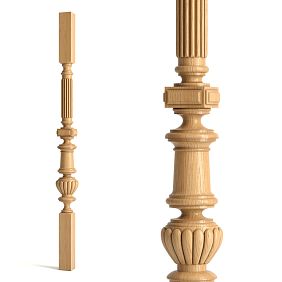
The assortment includeshandrails of various profiles, balusters of classic and modern design, Support Columns, sub-handrail strips, fastening systems. All elements are maintained in a unified style and fully compatible, simplifying the design and installation of stair structures.
STAVROS offers not only standard products but also custom manufacturing according to individual drawings. Company engineers will develop a structure considering the specifics of the object, calculate the required amount of materials, and select optimal solutions. This is especially in demand for stairs of non-standard configuration, restoration of historical objects, and exclusive design projects.
STAVROS clients receive a comprehensive solution: quality products, technical support, delivery with professional packaging, warranty service. Years of experience, thousands of completed projects across Russia, positive customer reviews — confirmation of the company's reliability and professionalism.
By choosing STAVROS, you invest in quality, safety, and durability. Your staircase will not just be a functional structure, but a piece of joinery art that will serve for many decades, preserving strength, beauty, and comfort of use!