












































































Article Contents:
- Comprehensive approach: unity of solid wood
- Door system: casing and trim
- Wooden skirting: lower line of interior
- Decorative rails: vertical and horizontal
- Flooring and crown molding: frames and panels
- Oak stop: small details matter
- Unified style: role of oak texture
- Full set assembly "turnkey"
- Conclusion: complete set from STAVROS
- Frequently Asked Questions
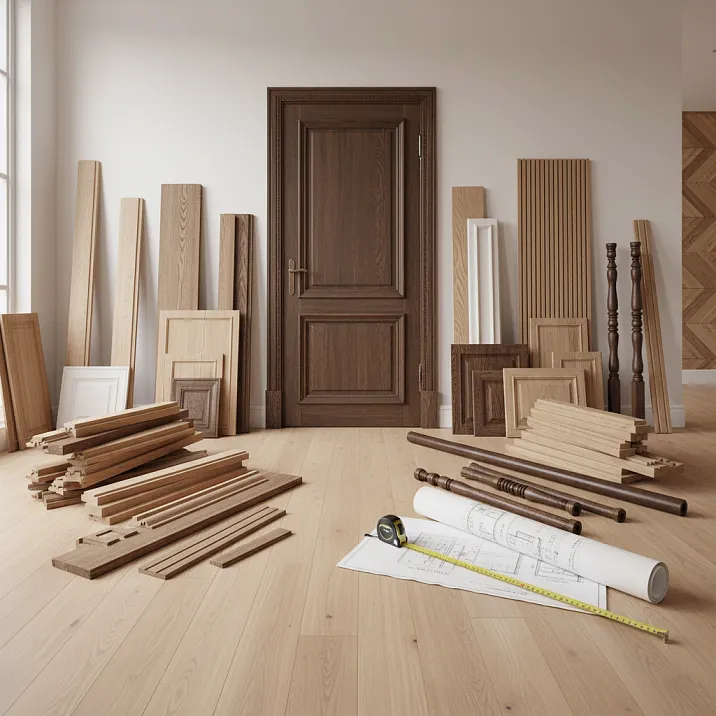
Repair is not just wallpapering and laying tiles. It is creating a cohesive architectural environment where each element is coordinated with others in material, color, and style.Oak casingframes the door opening.Wooden baseboardfinishes the wall at the bottom.Wooden planks for decorationcreate a rhythmic structure on accent walls.Oak veneerdivide wall panels into sections.Oak trimsecure glass in doors.wooden molding by the meterframe mirrors and panels. Each element performs its function, but together they form a system where material unity is critically important. Let's understand why a comprehensive approach — when the entireWooden trimis made from a single solid piece — defines the quality and perception of the interior.


Comprehensive approach: unity of solid wood
Imagine an interior where door casings are made of oak, skirting boards of beech, and decorative rails of ash. Each element is individually high-quality, but together they create a visual dissonance. The oak texture, with its pronounced growth rings, conflicts with the uniform structure of beech. Light ash does not harmonize with dark oak. Even if all elements are painted the same color, the difference in texture is subconsciously perceived, creating a sense of inconsistency, random selection, and lack of a thought-out concept.
A comprehensive approach means that all wooden elements in the room are made from one type of wood — oak, beech, or ash.Door Trim— casings, frames, and trim — are made of oak.wooden skirting board purchaseis also oak.Wooden planks for decoration— are oak.Wooden molding, crown molding, and stops — all made of oak. This creates material unity, visual coherence, a sense of thoughtfulness and quality.
Textural unity is critical for perception. Oak texture is recognizable: pronounced growth rings, radial medullary rays, natural variations in tone from light gold to dark brown. When all wooden elements display this unified texture, the space achieves harmony. The eye moves from casing to skirting, from skirting to rails — and everywhere sees the same noble wood structure, creating a calming, balanced effect.
Color unity is easier to achieve when all trim is made from one species. Oak from one production batch has minimal color variation. All elements are stained or painted simultaneously with the same compounds, guaranteeing absolute color match. Attempting to match the color of elements from different species and manufacturers almost always results in tonal mismatch, which is especially noticeable under daylight and spoils the impression of the repair.
Strength characteristics of one species ensure uniform aging of all elements. Oak, with its high density and hardness, wears down slowly and evenly. After 10-15 years of use, all oak elements retain their original appearance, acquiring a noble patina. If casings are oak and skirting boards are pine, then within a few years, the skirting boards will show scratches and dents that will not be present on the casings — visual inconsistency will become apparent over time.
The economic logic of a comprehensive approach is not always obvious, but it is real. Ordering a complete set of trim from one manufacturer using one type of wood often costs less than purchasing individual elements from different suppliers. The manufacturer offers volume discounts, optimizes material usage, and reduces transportation costs. Additional savings come from avoiding defects due to incompatible elements, incorrect selection, or tonal mismatch.
Interior finish is determined by details. When all wooden elements are made from one noble solid wood — oak or beech — it immediately conveys the impression of a high-quality, thoughtfully designed, expensive renovation. Mixing different materials, even if each is good individually, reduces status and creates the impression of a budget solution, where one chose the affordable rather than the best.




Door system: casing and trim
The door frame is not just a panel on hinges. It is a complex system of elements, where the frame sets the geometry, casings conceal mounting gaps, dados extend the frame to the thickness of the wall, and door stop strips seal the door stop.Oak casingA width of 70-90 mm frames the opening on both sides, creating a decorative frame and concealing the gap between the frame and the wall, which is 10-30 mm wide.
The casing profile determines the style of door trim. A flat rectangular casing with sharp edges or minimal bevel of 1-2 mm — for minimalism and modern interiors. A casing with one radius of 5-8 mm — a universal solution for most styles. A multi-level casing with complex profile — with grooves, rounded corners, protrusions — for neoclassicism and classicism. The profile must be uniform for all openings in the room or apartment.
Door moldingThe door frame — the structural base that is mounted in the opening and supports the door panel. A solid oak frame has an L-shaped or U-shaped cross-section with grooves for hinges, lock, and seals. The frame width of 80-120 mm is selected based on wall thickness. Thickness of 30-40 mm ensures strength and durability. An oak frame withstands the weight of heavy doors 40-50 kg without hinge sagging or deformation.
Dados extend the door frame to the full thickness of the wall. If the wall thickness is 200 mm and the frame width is 100 mm, a dado 100 mm wide is required. Dados are made from the same solid oak as the frame, with the same finish. They are joined to the frame with a groove or overlapping, forming a single plane. A quality oak dado is invisible after installation — it is perceived as an extension of the frame, not as an added element.
Door stop strips are mounted to the frame at the point of contact with the door panel. They seal the door stop, reduce noise, and conceal the gap between the panel and the frame. Oak door stop strips have a shaped cross-section with a protrusion that fits into the frame groove. Installing door stop strips increases door functionality and improves its appearance, creating a finished, professionally executed structure.
Thresholds are used rarely — mainly where it is necessary to conceal floor height differences or provide additional sound insulation. An oak threshold with thickness 20-25 mm and height 10-15 mm withstands intensive loads — thousands of daily passes without visible wear. Oak does not wear down, does not deform, and retains its original geometry for decades.
Color coordination of door trim is critical. The frame, casings, and dados must be the same tone, with a permissible deviation of no more than 1 ΔE (unit of color difference, imperceptible to the eye). The best way to ensure such coordination is to order all elements of one opening from one production batch with a single staining and finishing process. Even a slight tonal mismatch between the frame and casing is noticeable and creates an impression of carelessness.
Installation of a solid oak door frame requires professionalism. Frame installation is performed with precise vertical and horizontal alignment — tolerance no more than 1 mm per 2 meters. Mounting on anchor plates or construction foam with controlled expansion. Casings are mounted on finish nails 40-50 mm long, with nail heads recessed and gaps filled with wood-colored putty. Corner casing joints are mitered at 45 degrees on a miter saw with precision to 0.5 degrees. Only flawless execution reveals the potential of oak trim.
Our factory also produces:


Wooden baseboard: the lower line of the interior
Wooden baseboard— a mandatory element of any interior, completing the wall at the bottom and creating a transition from the vertical plane to the floor. The functions of the baseboard are numerous: protection of the lower part of the wall from mechanical damage, concealment of the gap between the wall and floor covering, masking of electrical cables (if the baseboard has a cable channel), and creating a decorative border for the floor.
The height of the baseboard determines the visual perception of room proportions. Low baseboards 40-60 mm are characteristic of minimalist interiors with low ceilings, where it is important not to overload the space. Medium baseboards 70-90 mm — a universal solution for most residential rooms with ceiling heights of 2.5-2.7 meters. High baseboards 100-150 mm create a prestigious, classic look, emphasize ceiling heights of 3 meters or more, and form a visual base on which the entire wall architecture "stands."
The baseboard profile matches the door casing profile. If the casing has a radius of 8 mm, the baseboard should have a similar or proportional radius of 5-6 mm. If the casing has sharp edges, the baseboard should also be sharp-edged. Uniform profiles create visual continuity between different interior elements, a sense of thoughtful design and stylistic coherence.
Oak baseboard has unique operational characteristics. Oak density of 700-800 kg/m³ and hardness of 3.7-4.2 on the Brinell scale ensure resistance to vacuum cleaner, mop, and furniture leg impacts. Oak baseboard does not deform, does not form dents, does not crack under humidity fluctuations. The service life of oak baseboard is 30-50 years — it will outlast several generations of floor coverings and wall finishes.
Baseboard mounting is performed with adhesive (liquid nails, polyurethane glue) with additional mechanical fixation. Finish nails 40-50 mm long are driven in at 400-500 mm intervals, nail heads are recessed by 1-2 mm, and gaps are filled with wood-colored putty. An alternative method — mounting on a hidden mounting strip, which is fixed to the wall, and the baseboard clicks onto the strip. This method ensures a clean front surface and allows for easy removal.
Corner baseboard joints are mitered at 45 degrees for inside corners and 135 degrees for outside corners. The cut is made on a miter saw with precise angle setting. Profiled baseboards require special care — the relief must match at the joint, forming a continuous line. After installation, joints are sealed to prevent opening due to wood shrinkage.
Baseboard color coordination has several approaches. Classic — baseboards in the color of door casings, creating a unified system of vertical and horizontal trim. Baseboards under the floor — in the color of the floor covering, visually expanding the floor. Contrasting baseboards — dark on light walls or light on dark — emphasizing the boundary between wall and floor. Any solution must be implemented precisely, without tonal mismatch between baseboards of different walls.
Color coordination of skirting boards has several approaches. Classic — skirting boards in the color of door casings, creating a unified system of vertical and horizontal frames. Skirting boards under the floor — in the color of the floor covering, visually expanding the floor. Contrasting skirting boards — dark on light walls or light on dark — emphasizing the boundary between wall and floor. Any solution must be implemented precisely, without tonal mismatch between skirting boards of different walls.
Get Consultation
Decorative rails: vertical and horizontal
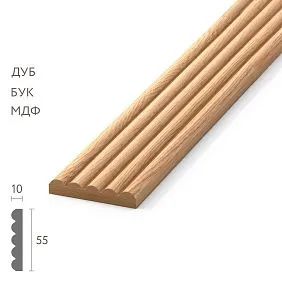
Wooden planks for decoration— transformed from utilitarian construction material into the main trend of modern interior design.Decorative oak plankWidth 20-40 mm and thickness 10-20 mm creates a rhythmic structure on walls and ceilings, organizing space without overloading it.
Vertical scheme — the most popular. Rails are mounted vertically with even spacing of 50-120 mm, creating a fence of parallel lines that visually increases room height. This technique is especially effective in standard apartments with 2.5-2.7 meter ceilings, where every visual centimeter of height is valuable. Oak rails under transparent lacquer showcase noble texture, creating a connection with nature, a sense of naturalness and eco-friendliness.
Horizontal scheme creates the opposite effect — visually expands space, making it feel more spacious. Horizontal rails with spacing of 80-150 mm slow down vertical gaze movement, making it glide along the wall, exploring width. This technique works in narrow hallways and entryways, where it is necessary to visually push back the walls. Horizontal rhythm calms, creates a sense of stability and security.
Diagonal scheme introduces dynamism, energy, and disrupts the static of a rectangular room. Rails are installed at an angle of 30-60 degrees, creating directional movement. A diagonal from lower left to upper right is perceived as ascending — optimistic, upward-looking. A diagonal from upper left to lower right — as descending, more calm. Diagonal mounting is technically more complex, requiring precise marking and angled cuts, but the result creates uniqueness and an authorial character of the interior.
Combined scheme combines different rail directions on one wall or in one room. The central part of the wall with vertical rails is framed by horizontal rails around the perimeter. Diagonal rails intersect vertical rails, forming a grid. Chaotic placement of rails of different widths and spacing creates an abstract composition. Combined schemes require design and visualization before installation.
Rails are mounted on a subframe of smaller cross-section beams 20x40 or 30x40 mm. The subframe is mounted perpendicular to the direction of finish rails with spacing of 400-600 mm. Rails are mounted to the subframe with finish nails, screws, or hidden clips. An air gap of 20-40 mm forms between the rails and the wall, which improves room acoustics — sound waves disperse in the gaps, reducing reverberation.
Lighting between rails — an effective technique that turns the wall into a source of soft, diffused light. LED strips are mounted in the gaps between rails, light reflects off the base wall and passes through the gaps, creating even illumination. Adjustable brightness and color temperature allow changing the room’s atmosphere from cool, invigorating light in the morning to warm, cozy light in the evening. Oak rails with backlighting create a play of light and shadow on the wood texture, highlighting its natural beauty.
Layout and crown molding: frames and panels
Oak veneer— a thin strip 20-40 mm wide and 8-15 mm thick, creating divisions within larger forms. If the molding divides a wall into large panels of 100x150 cm, the grid divides these panels into smaller sections of 40x50 cm, creating a complex hierarchical structure. This approach is characteristic of neoclassical and classical interiors, where detail, layering, and architectural logic are valued.
Wooden moldingIn wall panels, the grid divides panels, creating fine geometry. A rectangular panel can be divided by the grid into 4, 6, or 9 small rectangles. Each fragment is filled with its own material: fabric, leather, embossed wallpaper, or stained MDF. The variety of fillings creates visual interest, richness of textures, and complexity of perception. Oak grid with its pronounced texture creates clear boundaries between sections, emphasizing the composition’s geometry.
wooden molding by the meter— a universal profiled element 40-120 mm wide and 20-60 mm high. Molding creates decorative frames on walls, frames mirrors and paintings, forms the perimeter of ceiling outlets. The molding profile can be simple (one rounded edge), medium-complexity (multiple tiers), or richly decorated (carvings, grooves, dentils).
Molding on the wall forms geometric divisions, creating a classic three-part structure. The lower tier (panel) 80-120 cm high is framed by molding and painted in a darker tone. The middle tier (main field) occupies most of the height. The upper tier (frieze) 40-60 cm high completes the composition. Horizontal oak molding strips separate one tier from another, creating architectural logic tracing back to classical canons.
Molding around mirrors and panels creates a visual frame, separating them from the wall plane and drawing attention. The molding width is chosen proportionally to the framed object’s size: for a 60x80 cm mirror, 50-60 mm wide molding is sufficient, while for a large panel 150x200 cm, 90-120 mm molding is required. Oak molding with transparent lacquer creates a warm, natural frame that harmonizes with any images or mirrors.
Molding joints in corners are mitered at 45 degrees to create a neat joint with matching profiles. Mitering is done on a circular saw with precise angle setting and profile positioning control. After mitering, elements are dry-fitted to check quality. Then they are glued with carpentry glue and additionally secured with finish nails. Screw holes are filled with wood putty, and after drying, they are sanded.
Molding and grid color coordination aligns with the overall color concept. Monochromatic solution — all elements in one color, creating a relief structure where effect is built on light and shadow play. Contrast solution — molding and grid differ in color from panel fillings, emphasizing geometry. Popular options: white molding and grid on gray background, dark oak molding on beige walls, gold or patinated molding on white background in classical interiors.
Oak stop: small details matter
Oak trim— a thin strip 10-20 mm wide, which seems like a minor detail but performs an important function. Stop secures glass in doors, windows, and furniture facades, pressing glass against the frame and ensuring secure fixation without rattling. Oak stop withstands mechanical loads, does not crack when nailed, and does not deform over time.
Stop profile can be flat rectangular or shaped with rounding. Flat stop with 10x10 or 12x15 mm cross-section is used in minimalist interiors where simplicity of form is important. Shaped stop with 3-5 mm rounding creates a softer, traditional look, typical for classical and neoclassical doors. Stop profile must match door frame and casing profiles.
Stop is fastened with finish nails 20-25 mm long with 150-200 mm spacing. Nails are driven at a slight angle to press the stop against the frame and simultaneously secure the glass. It is important not to over-tighten — excessive force may cause glass cracking. Oak stop holds nails securely without cracking due to high wood density and strength.
Stop color always matches frame color — door frame, window casing, furniture facade. This creates visual unity, when stop is perceived as part of the frame, not as a separate added element. Even a slight color mismatch between frame and stop is noticeable, especially against transparent glass, creating an impression of carelessness.
Stop replacement during glass repair is a simple operation but requires care. Old stop is carefully pried off with a chisel, nails are removed, glass is taken out. Groove is cleaned of old sealant and dirt. New glass is installed on silicone sealant, pressed with new stop, which is secured with nails. Oak stop lasts decades but can be easily replaced without damaging the frame if needed.
Stop in furniture performs not only utilitarian but also decorative function. In classical cabinets with glass facades, stop creates a framing structure, dividing glass into sections. Stop width 15-20 mm is sufficient to be noticeable and create geometry. Shaped oak stop with carving or decorative profile transforms a simple glass facade into a piece of furniture art.
Coordination of stop with other trim elements is critical for interior integrity. If door casings are oak, stops in glass doors should also be oak. If baseboards and casings are painted in a certain shade, stops should be painted the same. Any mismatch — different wood species, color mismatch, profile mismatch — disrupts harmony, creates an impression of random selection.
Unified style: role of oak texture
Oak texture — not just a pattern on the wood surface. It is a calling card instantly recognized and associated with quality, durability, status. Prominent annual rings create linear structure guiding the gaze. Radial heartwood rays form characteristic "mirrors" — light spots that gleam at certain lighting angles. Natural color variations from light golden to dark brown create a lively, dynamic surface.
When all wooden interior elements —Oak casing, Wooden baseboard, — decorative oak strips, Oak veneer, Oak trim, Wooden Picture Frame— demonstrate this unified oak texture, the interior achieves stylistic unity. The eye glides from one element to another and everywhere sees a familiar, noble wood structure. This creates a calming, harmonious effect, a sense of thoughtful, cohesive space.
Oak texture works in different styles. In classical interiors, oak trim under transparent lacquer emphasizes connection to tradition, referencing palace halls and old libraries. In neoclassicism, oak lightly toned in gray or beige shades creates a modern interpretation of classicism. In Scandinavian interiors, light oak or whitewashed oak forms a sense of purity, naturalness, closeness to nature. In loft spaces, dark oak with rough finish emphasizes the industrial character of the space.
Oak toning expands the palette while preserving texture visibility. Gray oak — modern, urban shade, popular in minimalist and Scandinavian interiors. Whitewashed oak — light, almost white color with barely noticeable texture, creating a sense of lightness and spaciousness. Walnut oak — dark, rich brown with black veins, forming a luxurious, status-oriented look. Oak veneer — warm brown shade, universal for most styles.
Oak staining in dense opaque colors hides texture, turning wooden elements into purely geometric forms. White, black, gray, colored strips and molding work as graphic lines. But even under paint, oak retains its strength advantages — hardness, stability, durability. Stained oak trim lasts 2-3 times longer than stained pine under identical usage conditions.
Combining natural and stained oak in one interior — an interesting design approach. For example, natural lacquered oak door casings and baseboards, while decorative strips on accent walls are stained white. Material unity (all elements are oak) is preserved, but color contrast creates dynamics, avoiding monotony. It is critically important that both types of finish are high quality — then the contrast appears as a deliberate technique, not a compromise.
Care for oak elements is simple: regular dry cleaning with soft brush or vacuum cleaner, periodic wet wiping with well-wrung cloth, reapplying protective coating every 7-10 years. Oak is moisture-resistant with coating, does not fear temperature fluctuations, does not attract insects due to tannins in composition. Properly treated oak trim requires no special care and retains original appearance for decades.
Full set assembly "turnkey"
Full set of wooden items for repair begins with detailed design. A room plan is created indicating all door and window openings, wall areas for decorative strips, locations for panel and molding installation. Quantity for each element is calculated: casings — 5 strips per single-panel opening, baseboards — perimeter minus opening width, strips — based on wall area and chosen interval.
Wood species selection — key decision. Oak for maximum strength, durability, expressive texture, and high status. Beech for quality-price balance, ideal for painting due to uniform texture. Ash for light Scandinavian interiors. Decision is made once and applies to all wooden elements of the project.
Finish selection. Natural color under transparent lacquer or oil showcases oak texture beauty. Staining with stains creates desired shade — gray, whitewashed, walnut, veneer — while preserving wood structure visibility. Staining in dense colors turns trim into graphic elements. Possible combinations: main elements (casings, baseboards) natural, accent elements (strips, molding) stained.
Profile coordination of all elements. Casings, baseboards, strips, grid, molding must have coordinated motifs — rounding radii, bevel characteristics, proportions. Samples of all profiles are ordered, assembled into a mockup, visually evaluated for compatibility. Profiles for production are approved based on results or adjustments are made.
Budget calculation. The cost of trim is indicated per linear meter or per set. Oak casing costs 800-1500 rubles/meter, depending on width and profile complexity. Oak skirting board 900-1800 rubles/meter. Decorative rails 400-900 rubles/meter. Molding 300-600 rubles/meter. Picture frame 600-1500 rubles/meter. Installation is added to material cost — 40-60% of trim cost for complex geometric layouts.
Ordering from one manufacturer guarantees compatibility of all elements. The company STAVROS offers a complete setwooden trimfrom solid oak:Casings, Baseboards, rails, layouts, trim, moldingAll items from the same batch of wood, with a uniform processing and finishing, guaranteed compatibility.
Delivery and acceptance. Trim is delivered in protective packaging to prevent damage during transport. Upon receipt, completeness, absence of defects, and conformity to dimensions are checked. Any issues are recorded in an act and resolved before installation begins.
Acclimatization. Before installation, trim must remain in the installation room for a minimum of 48-72 hours at a temperature of 18-22°C and humidity of 50-60%. This allows the wood to reach equilibrium moisture, relieve internal stresses, and prevent future warping.
Professional installation. Installing a full trim set requires qualification, experience, and specialized tools. The team must have a portfolio of similar projects, positive references, and understanding of the designer’s concept. Adherence to technology, use of quality fasteners, finishing, and cleanup after completion — standards of professional work.
Result — an interior where all wooden elements from one solid oak block create a unified, harmonious system. Door openings are framed with noble casings. Walls are finished at the base with elegant skirting boards. Accent walls are structured with rhythmic rails. Panels are separated by moldings. Mirrors are framed with picture frames. Glass is secured with neat trim strips. Everywhere — one oak texture, one color, coordinated profiles. The space acquires character, status, longevity.
Conclusion: complete set from STAVROS
The company STAVROS specializes in producing a complete set of wooden items for renovation from solid oak and beech.Door molding, Wooden skirting boards, rails for decoration, layouts, molding— all elements are manufactured on modern equipment with quality control at every stage.
Premium-grade wood, kiln-dried to 8±2% moisture, high-precision processing, professional finishes — STAVROS standards guarantee premium-grade products. Ordering a complete set from STAVROS ensures compatibility of all elements by species, color, profile, and dimensions.
Oak skirting boards are an indispensable element of classic interior styles. In the English style, oak skirting boards with rich carving emphasize the aristocracy and solidity of the space. Dark wood tones harmonize beautifully with traditional materials — natural stone, leather, bronze., wooden baseboards for sale, — decorative oak stripsAvailable from stock in Saint Petersburg and Moscow with delivery throughout Russia. Custom manufacturing is possible with non-standard sizes and profiles.
Frequently asked questions
Why is it important to buy all trim from the same wood species? Uniform species ensures identical texture, color, strength characteristics, and even aging of all elements. Mixing species creates visual inconsistency.
How much does a complete oak trim set for a 60 m² apartment cost? It depends on the number of openings, area of decorative rails, and profile complexity. On average, 180,000–350,000 rubles including materials and installation.
Can oak casings be combined with pine skirting boards? Technically yes, but visually there will be a noticeable difference in texture even under the same paint. It is better to use one species.
How to care for oak trim? Regular dry cleaning, weekly wet wiping with a well-wrung cloth. Reapply finish every 7–10 years.
How long does it take to manufacture a complete custom set? Standard profiles from the stock program — 5–7 days. Custom profiles with tool development — 3–4 weeks.
Do oak items require additional treatment? If trim is delivered with factory finish — no additional treatment is required. Untreated solid wood requires priming and finishing.
How long does oak trim last? With proper use and periodic finish renewal — 30–50 years. Oak practically does not wear out, retaining its original geometry.


