












































































Article Contents:
- Polyurethane: the material of the future with historical roots
- Game-changing advantages
- Assortment: from cornice to console
- Cornices: the upper boundary of space
- Baseboards: foundation of composition
- Moldings: Universal Dividers
- Rosettes: central accents
- Overlays: local decor
- Corbels and Brackets: Visual Support
- Application: from ceiling to furniture
- Ceiling decor: the fifth wall of the interior
- Wall decor: structuring the plane
- Furniture decor: updating without replacement
- Facade decor: architectural expressiveness
- Production technology: from idea to product
- Design and modeling
- Casting and curing process
- Final Finishing and Quality Control
- Installation: Easier Than It Seems
- Preparation: Foundation of Success
- Trimming and joining: precision is everything
- Gluing: chemistry in the service of decor
- Finishing: from white to perfect
- Durability and practicality: an investment in the future
- Service life: decades without compromises
- Care: minimum effort, maximum result
- Eco-friendliness: safety for the whole family
- Economic efficiency: calculating real benefits
- Material cost: affordable luxury
- Installation: saving time and money
- Operating costs: forget about repairs
- Design possibilities: from classic to avant-garde
- Style Universality
- Color solutions
- Combining with other materials
- Frequently asked questions: answering doubts
- Innovations and Trends: Looking to the Future
- Technological novelties
- Design trends
- Ecological aspect
- Conclusion

Have you ever wondered why classical interiors continue to inspire even in the era of high-tech and minimalism? It's not just about forms—it's about materials that make luxury accessible.Polyurethane moldingsrevolutionized decorative art, opening doors to elegance for those for whom plaster moldings remained an unattainable dream. Todaypolyurethane moldingsis not a compromise, but a conscious choice of professionals who understand the advantages of modern technologies.
Why has this material gained recognition from architects, designers, and simply people striving for beauty? It's simple:Polyurethane Itemscombine the aesthetics of centuries-old traditions with the practicality of the 21st century. They are not afraid of moisture, do not crack over time, and do not require special installation skills. At the same time, the detailing of relief, clarity of lines, and depth of ornaments are not inferior to classical plaster.
Polyurethane: the material of the future with historical roots
When it comes to decorative finishes, many still envision heavy plaster cornices that craftsmen install over weeks, or carved wood accessible only to a select few. But times have changed. Polyurethane is a high-tech polymer composite specifically created for architectural decor. It's not just plastic, but a material with precisely calculated characteristics: density of 350-420 kg/m³, closed-cell structure, and chemical inertness.
The development of polyurethane for construction purposes began in the mid-20th century, but a real breakthrough occurred in recent decades. Modernpolyurethane productsare produced by reaction injection molding. A two-component composition—polyol and isocyanate—is mixed in precise proportions, fed into a heated mold, where a polymerization chemical reaction occurs. Within minutes, the liquid mixture transforms into a solid element with perfect geometry and the finest relief detail.
Why has polyurethane become the material of choice forpolyurethane interior products? The answer lies in a unique combination of properties. The material is resilient—withstanding mechanical impacts without chips or cracks. It is thermally stable—maintaining shape and strength at temperatures from -60 to +80°C. It is waterproof—the closed cell structure prevents water absorption. It is chemically neutral—compatible with any paints, primers, and adhesives.
The production of polyurethane molding is a high-precision technological process. First, a master model is created—the original of the future product, which is hand-carved or CNC-milled from a digital model. A silicone mold is taken from the master model, capable of reproducing the finest nuances of the relief. Then a metal press mold is manufactured—an expensive but necessary step for serial production. It is the quality of the press mold that determines the clarity of details in the finished product.




Advantages that change the game
Weight is the first thing that impresses when working with polyurethane. A one-meter cornice 15 cm wide weighs only 400-600 grams. A similar plaster one—3-4 kilograms. A difference of 5-7 times! This is not just about transportation convenience. Lightness opens up possibilities unavailable to traditional materials: installation on drywall ceilings without structural reinforcement, mounting on thin partitions, creating large-scale compositions without the risk of collapse.
polyurethane interior itemsare mounted with special polymer adhesive without additional mechanical fasteners. No dowels, screws, or anchors are needed. The adhesive creates a strong bond with any substrate—concrete, plaster, drywall, wood, even painted surfaces. Setting time—a few minutes; full polymerization—one day. Installing a ceiling cornice around the perimeter of a 20 m² room takes 3-4 hours instead of two to three days for plaster.
The moisture resistance of polyurethane makes it the only sensible choice for high-humidity areas. Bathrooms, toilets, kitchens, swimming pools, saunas—everywhere where plaster is unsuitable, polyurethane performs for decades. The material does not absorb water, does not swell, does not deform, and does not develop mold or fungus. After contact with water, it dries without consequences, retaining its shape and strength.
Strength and impact resistance—what distinguishes qualitypolyurethane moldingfrom cheap imitations. Dense polyurethane withstands accidental impacts, pressure, without leaving dents. This is critically important during transportation, installation, and operation. A dropped tool won't shatter the cornice. A careless movement of a stepladder won't leave a chip on a pilaster. In homes with children or pets, this durability becomes a decisive factor.
Durabilitypolyurethane molding decorationis measured in decades. The polymer structure is not subject to biological degradation. The material does not age, yellow, or crack over time. UV stabilizers in the composition protect against fading even under direct sunlight. Elements installed 20-30 years ago look like new—requiring only periodic repainting.
Environmental safety is confirmed by certifications. Fully polymerized polyurethane is chemically inert, does not emit volatile substances, and is odorless. The material is hypoallergenic and does not attract dust due to antistatic properties. This is important for children's rooms, bedrooms, medical facilities, where material requirements are especially strict.
Our factory also produces:


Assortment: from cornice to console
Get Consultation
Cornices: the upper boundary of space
Ceiling cornice—a basic element of classical interiors. It runs along the perimeter of the room at the junction of the wall and ceiling, concealing the technical seam, creating architectural completeness.Polyurethane cornicesare presented in hundreds of variants—from laconic smooth profiles 5-7 cm wide to luxurious multi-tiered compositions 30-40 cm wide with modillions, dentils, and floral ornaments.
A classical cornice consists of architectural moldings—fillet, scotia, ovolo, torus. Each element creates a specific play of light and shadow. A wide projection visually expands the space, creating a sense of grandeur. A narrow profile suits compact spaces where restraint is important. Smooth cornices without ornamentation fit perfectly into modern interiors where classicism combines with minimalism.
Light cornices—a modern interpretation of a classical element. A special design with a setback from the ceiling allows placement of an LED strip behind the cornice. Soft diffused light flowing from under the cornice creates a floating ceiling effect, visually increases room height, and forms a special atmosphere.
Flexible cornices—a special development for curved surfaces. Adding rubber components to the polyurethane composition allows bending the profile along a radius from 50 cm. Such cornices go around columns, follow the curve of bay windows, and wrap around arches. Where an ordinary rigid cornice would have to be assembled from many small segments, a flexible profile is installed as a single piece.
Baseboards: foundation of composition
Floor skirting boards cover the joint between the wall and floor, protecting the lower part of the wall from mechanical damage and dirt.polyurethane baseboardsare presented in a wide range of heights—from compact 6-8 cm to impressive 15-20 cm for high rooms. Profiles vary from simple rectangular to complex multi-stepped with decorative elements.
Moisture resistance makes polyurethane skirting boards an ideal choice for wet areas. In bathrooms, toilets, kitchens, laundry rooms, it does not deform from contact with water and does not develop mold. After wet cleaning, it dries without consequences. This is critically important in areas where wooden skirting boards quickly deteriorate.
Flexible skirting boards are used for decorating curved walls, columns, and bay windows. They follow the curves of the substrate without the need to assemble from many short segments. Installation is simplified, there are fewer joints, and visual integrity increases.
High skirting boards—a characteristic feature of classical interiors. A profile 15-20 cm high with a multi-tiered structure creates a sense of solidity, visually elevates the room. Combined with a massive ceiling cornice, such a skirting board forms an architectural frame within which the wall composition unfolds.
Moldings: Universal Dividers
Molding—an overlay strip with a profiled surface, one of the most versatile elements. Horizontal moldings divide the wall into tiers—panel, main field, frieze. Vertical ones create frames for wallpaper, mirrors, paintings.decorative moldingsare used for zoning, framing, and imitating panels and raised panels.
Wall moldings create decorative frames—rectangular, square, oval. Inside the frames, wallpaper of contrasting color or texture is placed, creating a panel effect. This technique allows visually structuring large wall planes, giving them rhythm and graphic quality. In high rooms, moldings divide the wall into tiers, making proportions more harmonious.
Ceiling moldings create coffers — recesses of regular shape that imitate wooden beam ceilings. A system of intersecting moldings forms a grid of squares or rectangles. A coffered ceiling lends solemnity to a room, visually increases its height, and creates an expressive play of light and shadow.
Flexible moldings are used to finish curved surfaces — arches, vaults, bay windows. Made from elastic polyurethane with added rubber, they easily take the desired shape without cracking. This opens up wide possibilities for creating complex architectural compositions in rooms with non-standard layouts.
Recesses: central accents
Ceiling rosette — a round or polygonal decorative element traditionally placed in the center of the ceiling at the point of chandelier attachment. Originally, the rosette concealed the electrical wiring outlet, but over time it evolved into an independent decorative accent capable of becoming the compositional center of the entire interior.
Diameterceiling fixtures made of polyurethane varies from compact 30 cm to impressive 120 cm and more. The choice of size depends on the area of the room and the scale of the chandelier. A general rule: the diameter of the rosette should be 1.5-2 times larger than the diameter of the light fixture's bowl. In small rooms, rosettes of 40-60 cm are used; in spacious halls — 80-120 cm.
The ornamentation of rosettes is astonishing in its diversity. Classic models reproduce motifs of plant decoration — open flowers, acanthus leaves, grapevines. Baroque rosettes are distinguished by their opulence — scrolls, cherubs, garlands create a rich composition. Modern interpretations lean towards geometry — concentric circles, radial rays, strict rosettes without excessive decoration.
Oval and square rosettes are used in rooms with elongated proportions or for non-standard compositions. Several rosettes arranged in a row create a rhythmic sequence that organizes movement through the space. This solution is effective in enfilades, galleries, and long corridors.
Appliques: Local Decoration
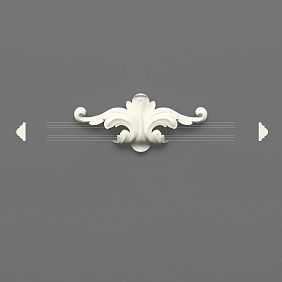
Polyurethane decorative appliques — small elements for enriching basic forms. They are placed on door panels, furniture fronts, wall panels, in piers between windows — anywhere a local accent is needed. Sizes vary from miniature 10×10 cm to large 50×70 cm.
Plant ornaments include leaves, flowers, fruits, garlands. Acanthus leaves — a classic motif used for millennia. Rosettes in the form of open flowers — another common motif. Grape clusters, oak leaves, laurel wreaths add symbolism.Appliques with ornamentation create accents on furniture, doors, walls.
Geometric ornaments are based on the repetition of simple shapes — circles, squares, rhombuses, stars. Meander — a continuous band of rectangular scrolls. Egg-and-dart — a row of egg-shaped elements. Pearl molding — a chain of small spheres. These classic motifs also work in modern interiors where graphic quality is important.
Cartouches — decorative shields or plaques with scrolls along the edges and a free field in the center. Traditionally, a coat of arms, monogram, or inscription was placed in the cartouche. In modern interiors, a cartouche may remain empty or contain a relief ornament. Such appliques add Baroque opulence to the interior.
Corbels and brackets: visual support
Corbel — a projecting element that serves as a support for a shelf, cornice, balcony. In classical architecture, corbels performed a real load-bearing function. In modern interiors, they are more often decorative, but visually create a sense of support, which is important for compositional logic.
Wall corbels are placed under shelves, mantelpieces, windowsills. Even if there is no real load, a corbel creates architectural completeness. A pair of corbels at the edges of a shelf forms a classic support scheme. Sizes range from compact 8×10 cm to massive 25×35 cm.
Ceiling corbels (modillions) are placed under the projection of a cornice, imitating supporting elements. A row of corbels at a certain interval creates a rhythmic structure, enriches the cornice profile, and enhances the play of light and shadow. The shape varies from simple volutes to complex sculptural compositions.
Corner corbels solve the problem of finishing corners at the junction of cornices. A specially designed corbel closes the intersection point of two profiles, creating a decorative accent. This is especially important when working with complex multi-profile cornices, where simple mitering gives an unsatisfactory result.
Application: From Ceiling to Furniture
Ceiling Decoration: The Fifth Wall of the Interior
The ceiling — often a forgotten plane that remains simply white. But preciselyPolyurethane Ceiling Moldings can turn it into a work of art. A cornice around the perimeter creates an architectural frame. A central rosette frames the chandelier. Coffers made from moldings form a volumetric structure.
Light ceiling with cornices for hidden lighting — a technology that visually increases the height of a room. Behind a cornice, set 10-15 cm away from the ceiling, an LED strip is placed. The light reflects off the ceiling, creating soft, diffused illumination. The ceiling appears floating, weightless.
Coffered ceiling — a system of intersecting moldings forming a square or rectangular grid. Each coffer is a recess of regular shape, which can be additionally decorated with a rosette, painted in a contrasting color, or illuminated with spotlights. Such a ceiling lends solemnity to a room, characteristic of classical interiors.
Multi-level compositions combine cornices of different widths and profiles. The lower tier — a wide, ornamented cornice. Above, with a 30-50 cm offset — a narrower, smooth profile. A frieze zone is placed between the tiers, which can be painted in a contrasting color. Such a structure visually increases height and creates rhythmic complexity.
Wall Decoration: Structuring the Plane
Walls — the main surface of the interior, requiring thoughtful organization. Moldings divide the height into levels: lower panel up to 90-120 cm, main field up to 180-200 cm, frieze under the ceiling. Each level can have its own finish — different wallpapers, paint, decorative plaster.
Decorative frames made from moldings create architectural accents. Rectangular panels on the wall with contrasting infill — a classic technique that makes the space more structured. Inside the frames, patterned wallpaper, fabric, mirrors, or paintings are placed. Moldings are painted to match the wall color or in a contrasting color.
Framing openings — door, window, arched — gives them architectural significance. Architraves with decorative appliques, pediments above openings, pilasters on the sides create a classical portal. In modern interiors, laconic rectangular framings without ornament are used.
Vertical elements—pilasters, half-columns—introduce a sense of monumentality to the interior. A pair of pilasters frames the fireplace, mirror, and media center, creating a classic portal. A row of pilasters along a long wall forms a rhythmic colonnade. Polyurethane pilasters are lightweight, mounted with adhesive, and can be painted any color.
Furniture Decor: Renewal Without Replacement
Polyurethane overlays can transform furniture without fully replacing the carcasses. Cabinet, dresser, and nightstand fronts are decorated with ornamental overlays that are glued on and painted to match the base tone or in a contrasting color. Old furniture gains new life and fits into a refreshed interior.
Kitchen sets often look too plain, especially those made of particleboard. Overlays on the fronts add texture, create an imitation of carving, and turn a budget set into a classic one. Polyurethane is moisture-resistant, easy to clean, and not afraid of steam or grease—an ideal solution for the kitchen.
Doors—entry doors, interior doors—are decorated with overlays, moldings, and rosettes. A smooth door panel is transformed into a paneled construction. Moldings create frames within which the door is painted a contrasting color. Ornamental overlays add accents. All of this is glued on and painted along with the door.
Mirrors are framed with moldings, creating a frame effect. A rectangular, oval, or arched polyurethane frame is attached to the wall, and a mirror is placed inside. This solution is cheaper than a ready-made framed mirror, and the result looks more integrated into the interior. The frame is painted, patinated, or gilded as desired.
Façade Decor: Architectural Expressiveness
Polyurethane molding allows creating a stylish and presentable exterior of a house, while the material retains its qualities in any weather conditions.—a separate category of products with increased durability requirements. The material must withstand temperature fluctuations from -60 to +80°C, humidity up to 100%, ultraviolet radiation, and wind loads. Polyurethane with UV stabilizers and increased density meets these challenges.
Cornices, pediments, and keystones frame windows and doors, creating architectural accents. Corbels support balconies, bay windows, and canopies. Pilasters and half-columns divide the façade vertically. Balustrades enclose balconies, terraces, and porches. The entire arsenal of classical architecture is accessible thanks topolyurethane façade decor..
Installation of façade elements is performed using special polyurethane adhesive with additional mechanical fasteners. Anchors through the element into the wall ensure secure fixation even under wind loads. After installation, joints are sealed to prevent water ingress. The surface is primed and painted with façade paints containing UV protection.
Polyurethane columns are hollow inside, making their transportation and installation straightforward. Diameter ranges from 20 to 40 cm, height up to 3-4 meters. A column consists of three parts: base, shaft (which may be composite from several sections), and capital. It is mounted on a metal frame or attached to the wall.
Production Technology: From Idea to Product
Designing and modeling
Creating a new molding element begins with design. An artist develops a sketch—a drawing of the future product indicating dimensions, proportions, and the nature of the ornament. The sketch is coordinated with technologists who assess feasibility: whether such a shape can be extracted from the mold, if there will be overly thin elements that might break.
Digital modeling is the modern stage that accelerates development. The sketch is converted into a three-dimensional computer model using specialized software. The model is detailed, checked for technological defects, and optimized. The finished digital model is sent to a CNC milling machine.
The master model is milled from polystyrene foam, polyurethane, or wood on a milling machine. This is the physical original of the future product at full scale. The master model is manually refined—milling marks are smoothed, and fine details that the machine cannot reproduce are added. The quality of the master model determines the quality of all subsequent copies.
A silicone mold is taken from the master model. Liquid silicone is poured over the model, hardens, and forms an elastic mold that accurately reproduces all details. Several trial specimens are cast from the silicone mold to test the technology and make adjustments if necessary.
A metal mold is manufactured for serial production. This is an expensive stage—the mold is milled from aluminum or steel, polished, and chrome-plated. But it is the metal mold that ensures tens of thousands of cycles without wear, consistent product quality, and quick extraction without damage.
Casting and Curing Process
Component preparation is a critical stage. Polyol and isocyanate are stored separately and dosed by automatic systems in precise proportions. Even a slight deviation in the component ratio will lead to defects—the product will be too soft or brittle, with surface imperfections.
Mixing is performed in a special chamber where components are fed under pressure, collide, and mix in a turbulent flow. Mixing time is fractions of a second. The chemical polymerization reaction begins with heat release. The mixture remains liquid for only 15-30 seconds—during this time, the mold must be filled.
Pouring into the mold occurs under pressure or by gravity depending on the design. Liquid polyurethane fills all cavities of the mold, reproducing the finest relief details. The mold may be heated to 40-60°C to accelerate the reaction. Polymerization takes 3-5 minutes, after which the product hardens.
Extraction from the mold requires care. The mold opens, and the element is extracted. If the design is complex, multi-part molds with locks are used. The hot product is still flexible and easily deformed—it is allowed to cool on a flat surface or in special tooling that preserves its geometry.
Finishing includes removing sprues—material feed points, trimming flash—thin polyurethane films at mold joints, and checking geometry. Products are inspected for cavities, voids, and surface defects. Defective items are sent for recycling—polyurethane can be crushed and added to the composition as filler.
Final Processing and Quality Control
Priming is a mandatory stage for most products. White acrylic primer is applied by spraying or dipping, creating a matte surface ready for painting. The primer seals micropores, evens out absorbency, and ensures paint adhesion. Products are supplied primed, ready for installation and on-site painting.
Painting is performed according to the customer's wishes. Water-based, acrylic, and alkyd paints adhere perfectly to polyurethane. Painting in any color according to RAL or NCS catalogs is possible. Special effects—patination, gilding, silvering, creating wood or stone textures—are performed manually by decorator craftsmen.
Quality control includes checking geometric dimensions, visual inspection of the surface, and testing sample strength. Density is measured—it should be in the range of 350-420 kg/m³. Shore hardness is checked—an indicator of polymerization completeness. Samples undergo accelerated aging in climate chambers.
Packaging protects products during transportation. Cornices and moldings are packaged in shrink film and placed in cardboard boxes with cushioning inserts. Rosettes and large elements are wrapped in bubble wrap and placed in individual boxes. Proper packaging prevents damage even during long-distance shipping.
Installation: easier than it seems
Preparation: the foundation of success
The surface must be level, clean, and dry. Irregularities exceeding 3 mm are detected with a straightedge or level and corrected with plaster or filler. Polyurethane is flexible and partially compensates for minor defects, but significant pits and bumps will manifest as gaps between the element and the base.
Cleaning from dust, grease stains, and old peeling paint is critically important. The adhesive bonds not with the paint but with the substrate. If the paint adheres poorly, the element will fall off along with it. Old coatings are checked by tapping—a dull sound indicates delamination. Questionable areas are cleaned down to a sound substrate.
Priming improves adhesive adhesion. Deep-penetration acrylic primer is applied with a roller or brush to the surface where the molding will be installed. The primer strengthens the base, binds dust, and evens out absorbency. Drying time is 2-4 hours depending on temperature and humidity.
Marking is performed with maximum precision. For cornices, a horizontal line is snapped around the perimeter of the room at the desired height. A laser level provides a perfectly straight line in minutes. For rosettes, the center of the ceiling is determined by intersecting diagonals. For moldings, frames are marked while maintaining symmetry.
Cutting and joining: precision is everything
Mitering is performed with a sharp backsaw with fine teeth or a miter saw. The cut must be strictly perpendicular for straight joints or at 45° for corners. A miter box ensures angle accuracy. A miter saw provides a perfect cut without chipping. The cut area is lightly sanded with fine sandpaper to remove burrs.
Fitting in corners is the most critical moment. Two profiles, cut at 45°, must meet without a gap. In reality, room corners are rarely exactly 90° — deviations of 1-2° are common. Profiles are cut with slight adjustments, ends are fitted on-site. Minor gaps (up to 1 mm) will be concealed by joint adhesive.
Curvilinear joints require making a template. For complex multi-profile cornices, a template is cut from cardboard or thin plastic, replicating the profile. The mating part is marked and cut according to the template. This is meticulous work, but the result is perfectly fitted elements without gaps.
Dry fitting before applying adhesive is mandatory. The element is placed against the installation location, alignment with markings, tightness of fit, and quality of joint fitting are checked. If something is wrong — it can be corrected now. After applying adhesive, there is almost no time for adjustments.
Gluing: chemistry in the service of decor
Mounting adhesive for polyurethane— is a specialized polymer-based compound. Available in cartridges for a caulking gun or cans for application with a spatula. Adhesive is applied to the back of the element in a continuous serpentine pattern with intervals of 5-7 cm for light moldings, 3-4 cm for heavy cornices.
Pressure against the surface must be uniform along the entire length. The element is placed against the markings, firmly pressed by hand from the center to the edges. Excess adhesive is immediately removed with a damp sponge — after curing, cleaning will require mechanical action. Pressure is maintained for 20-30 seconds for initial fixation.
Temporary fixation is necessary for heavy elements. A cornice can be propped with a batten braced against the floor. A rosette is supported by a T-shaped brace. For light moldings, brief hand pressure is sufficient — the adhesive sets in 1-2 minutes. Full polymerization occurs after 24 hours, after which finishing work can continue.
Joint adhesive for ends — a special compound that not only bonds but chemically fuses polyurethane. Ends are coated with a thin layer, elements are joined, excess is removed. After curing, the joint becomes monolithic, practically invisible. Some craftsmen additionally reinforce cornice joints with painter's tape for reliability.
Final finishing: from white to perfect
Sealing joints and gaps is done with acrylic sealant. White sealant is matched to the color of the primed polyurethane. Sealant is applied from a cartridge in a narrow strip, smoothed with a wet finger or spatula. Excess is immediately removed with a damp sponge. After drying (4-6 hours), joints are ready for painting.
Puttying is rarely required — only for sealing accidental dents, chips. Acrylic putty is applied with a narrow spatula, sanded with fine sandpaper after drying. The putty must be elastic to avoid cracking from minor thermal deformations of the polyurethane.
Priming before painting improves adhesion, evens out absorbency. Elements are often supplied pre-primed, but after installation and joint sealing, re-priming is required. Acrylic primer is applied with a roller or spray gun, dries in 2-4 hours.
Painting — the final touch. Water-based paint is applied in two to three coats with intermediate drying. A roller provides even coverage on smooth surfaces. A brush works into the relief, recesses of the ornament. A spray gun speeds up work, creates a perfectly smooth finish, but requires protecting surrounding surfaces from splatter.
Durability and practicality: an investment in the future
Service life: decades without compromise
The polymer structure of polyurethane is chemically stable. Unlike gypsum, which carbonizes, cracks, and crumbles over time, polyurethane is not subject to aging. The molecular bonds of the polymer do not degrade over time.polyurethane moldings, installed 20-30 years ago, retains its shape, strength, and relief detail.
UV stabilizers in the composition protect against sunlight. Ultraviolet light degrades most polymers — they yellow, become brittle, and crack. High-quality polyurethane contains additives that absorb UV radiation, converting it to heat. Even under constant direct sunlight, the material does not degrade.
Temperature stability from -60 to +80°C ensures applicability in any climate. The material does not become brittle in cold like ordinary plastic. Does not soften in heat like some polymers. Maintains elasticity and strength in extreme conditions — from unheated dachas to hot regions.
Biological resistance prevents degradation by microorganisms. Polyurethane does not serve as a nutrient medium for mold, fungi, or bacteria. Does not attract insects and rodents, unlike wood. In damp rooms where organic materials quickly become moldy, polyurethane remains perfectly clean.
Care: minimal effort, maximum result
Regular dry cleaning — all that's needed to maintain appearance. Dust is removed with a soft brush, dusting brush, or vacuum with a soft attachment. Frequency — once every 1-2 weeks depending on dust levels. Antistatic properties of polyurethane prevent dust accumulation.
Wet cleaning is permissible and even recommended for damp rooms. Smooth surfaces are wiped with a slightly damp cloth. For relief surfaces, a wrung-out sponge is used. Cleaning agents — mild, pH-neutral, without abrasives or solvents. After wet cleaning, elements dry quickly without consequences.
Painted surface protects polyurethane and is easily renewed. Paint forms a protective layer that takes on mechanical impacts, dirt, and UV radiation. If necessary, the surface can be repainted without prior cleaning — just dust off and prime. A new color completely transforms the interior.
Repairing damage is simple thanks to the material's properties. Small chips are filled with acrylic putty, sanded, and touched up after drying. Cracks in joints are sealed with sealant. Serious damage is fixed by replacing the element — it is unglued, and a new one is installed in its place. Due to low weight, replacement does not require structural reinforcement.
Eco-friendliness: Safety for the whole family
Fully polymerized polyurethane is chemically inert. It does not emit volatile organic compounds (VOCs), has no odor, and does not cause allergic reactions. Certificates of compliance with sanitary and hygienic standards confirm its safety for residential premises, children's rooms, and medical facilities.
The absence of toxic components is critically important for living spaces. The composition contains no formaldehyde, phenols, heavy metals, or asbestos. The material is approved for use in children's and medical institutions. Even when heated (e.g., from built-in lighting), polyurethane does not emit harmful substances.
Antistatic properties prevent dust accumulation on the surface of the molding. This reduces the concentration of dust mites, allergens, and microorganisms in the room's air. For people with allergies or asthma, this is a significant factor when choosing finishing materials.
Hypoallergenicity is confirmed by clinical studies. Polyurethane does not contain proteins that could trigger an immune response. It does not emit allergenic volatile substances. It does not serve as a substrate for mold, the spores of which are a strong allergen. This makesPolyurethane items for interiorsa safe choice for the whole family.
Cost-effectiveness: Calculating real benefits
Material cost: Affordable luxury
Pricemoldings from polyurethaneis significantly lower than gypsum or wood of comparable quality. A linear meter of a medium-complexity cornice costs from 500 to 2000 rubles depending on width and ornamentation. A similar gypsum one costs from 1500 to 5000 rubles. A carved wooden one costs from 5000 to 20000 rubles.
A wide price range allows selecting elements for any budget. Simple smooth profiles are available at a minimum price. Richly ornamented elements with large relief cost more but are still cheaper than gypsum counterparts. Exclusive handcrafted models based on custom sketches can cost as much as gypsum ones but surpass them in durability.
Fitting out a room requires precise calculation. For a standard 20 m² room with an 18 m perimeter, you will need: 18 m of cornice, one rosette with a diameter of 40-60 cm, optionally wall moldings. The cost of materials is 15000-30000 rubles depending on the chosen models. This is comparable to good wallpaper, but the effect is incomparably more powerful.Transportation costs are minimal due to low weight. A set of molding for an apartment weighs 30-50 kg and fits in a passenger car. Delivery by a transport company costs 500-1500 rubles. Gypsum molding of the same volume weighs 200-300 kg, requires freight transport, careful loading/unloading. Delivery costs 5000-10000 rubles.
Installation: Saving time and money
The cost of installation work for polyurethane is 2-3 times lower than for gypsum. Installing a cornice costs 200-400 rubles per linear meter. Installing a rosette costs 1000-2000 rubles per piece. For gypsum, rates are higher: 500-800 rubles per meter of cornice, 3000-5000 per rosette. The difference is explained by the complexity of the work—gypsum is heavy, fragile, and requires special fasteners.
Installation speed—time is also money. A room with polyurethane molding is finished in 1-2 working days. Gypsum requires 5-7 days, accounting for time for reinforcement, solution curing, and joint sealing. For projects with strict deadlines, polyurethane is the only realistic option.
Installing polyurethane molding yourselfis accessible to non-professionals. Simple elements—cornices, moldings, baseboards—can be installed independently, saving on craftsmen's labor. Minimal tools are needed: a saw, miter box, mounting gun, level. Savings will amount to 30-50% of the total project cost.
The absence of wet processes speeds up renovation. Gypsum molding is attached with gypsum solutions that dry for one to two days. You must wait before the next finishing stage. Polyurethane is glued with polymer adhesive that sets in minutes. After a day, you can fill joints and paint.
Operational costs: Forget about repairs
No need for repairs is the main long-term saving. Gypsum molding cracks at joints over time, especially in new buildings with structural settling. Every 3-5 years, crack sealing and repainting are required. Polyurethane is elastic, compensating for minor base deformations. Joints remain intact for decades.
Moisture resistance eliminates the need to replace elements in bathrooms and kitchens. Gypsum in damp areas lasts 5-10 years, then requires replacement due to moisture degradation. Polyurethane lasts indefinitely. Once installed, it remains in place for decades without needing intervention.
Repainting without replacing decor saves money when updating the interior. If you want to change the wall color, polyurethane molding can be repainted along with them. You can change the color scheme every few years without dismantling and reinstalling the decor. This allows freedom to experiment with the interior.
No special care reduces operational costs. No special treatment compounds are needed, as for wood. No periodic reinforcement is required, as for gypsum. Regular wet cleaning is all that's needed. This saves both money and time throughout the entire service life.
Design possibilities: from classic to avant-garde
Style versatility
Classical interiors are the natural environment forpolyurethane products. Cornices with modillions, rosettes with acanthus leaves, pilasters with capitals recreate the atmosphere of palaces and mansions. Rich ornamentation, clarity of details, and the possibility of gilding and patination make polyurethane a full-fledged replacement for historical gypsum.
Baroque and Rococo with their opulence require abundant decor. Polyurethane allows creating rich compositions without the risk of collapse from weight. Scrolls, volutes, garlands, cherubs—the entire arsenal of Baroque decorativeness is available in a lightweight and durable material. Multi-tiered cornices, large rosettes, and an abundance of overlays create an atmosphere of luxury.
Empire style with its imperial severity finds a reliable ally in polyurethane. Laurel wreaths, torches, military trophies, Egyptian motifs are reproduced with documentary accuracy. The combination of strict symmetry with decorative richness—the hallmark of Empire style—is easily achieved thanks to the wide range of elements.
Modern interiors use molding in measured doses, as a graphic accent. Laconic cornices without ornamentation, strict geometric rosettes, flat moldings create subtle play of light and shadow. Painting to match the wall color makes the decor part of the architecture, not a separate element. This is a modern interpretation of classicism.
Color Solutions
White is a universal choice that suits any style. White molding on light walls creates volume through light and shadow. This is a classic solution that visually expands the space, giving it airiness. Different shades of white—milky, ivory, bleached—add nuance.
Colored molding matching the walls is a modern approach. The decor is painted the same color as the walls, working on subtle textural play. Gray molding on gray walls, beige on beige creates monochromatic sophistication. The relief is discernible thanks to light and shadow, without distracting with color contrasts.
Contrasting molding is a bold solution for modern interiors. White on dark blue, emerald, or graphite walls creates a graphic effect. Black on light walls is a dramatic technique that requires a precise sense of measure. Contrast emphasizes the architecture of the decor, making it the main accent.
Gilding and patination are traditional techniques for classical interiors. Full gilding creates a luxurious effect, suitable for formal halls. Partial gilding of protruding relief parts is a more delicate technique. Patina in recesses on a light base enhances volume and creates an antique effect.
Combining with other materials
Polyurethane and wood— a classic combination where each material plays its role. Wooden panels in the lower part of the wall are complemented by polyurethane decor in the upper zone and on the ceiling. The warm texture of wood contrasts with the smoothness of polyurethane, creating material richness in the interior.
Polyurethane and stone — a combination of lightweight polymer decor with massive stone finishing. Polyurethane cornices and moldings frame areas with marble cladding on fireplaces, countertops, and windowsills. The contrast of textures — smooth polished stone and matte relief polyurethane — creates visual interest.
Polyurethane and metal — an unexpected but effective combination. Chrome or brass elements — lighting fixtures, hardware, decorative inserts — coexist with classical molding. The shine of metal sets off the matte finish of polyurethane, creating a play of textures. This is characteristic of eclectic interiors.
Polyurethane and glass work in modern interiors where lightness and transparency are important. Glass partitions, doors, and shelves do not compete with the molding but allow it to be seen from different angles. The transparency of glass enhances the perception of the decor's volume.
Frequently Asked Questions: Answering Doubts
What is the main difference between polyurethane molding and plaster molding?
The main differences are weight, moisture resistance, and installation. Polyurethane is 5-7 times lighter than plaster, simplifying transportation and installation. It is completely moisture-resistant, applicable in bathrooms and kitchens where plaster quickly deteriorates. Installation with adhesive without mechanical fasteners takes hours instead of days. At the same time, detailing and appearance are identical to high-quality plaster.
Is polyurethane molding safe for health?
Fully polymerized polyurethane from verified manufacturers is absolutely safe. The material does not emit volatile substances, has no odor, and is hypoallergenic. Certificates of compliance with sanitary standards confirm its applicability in residential premises, children's rooms, and medical facilities. It is important to purchase products with documentation, not cheap items of unknown origin.
Can polyurethane molding be painted, and how often?
Not only can it be painted, but it should be. Polyurethane paints excellently with water-based, acrylic, and alkyd paints. The number of repaints is practically unlimited — you can update the color every few years when changing the interior. It is important to use primer before the first painting and between layers for better adhesion.
How long does polyurethane molding last?
The service life is measured in decades. The polymer structure is not subject to aging; the material does not yellow, crack, or deform. Elements installed 20-30 years ago retain their original appearance. The only thing that may be required is periodic repainting. The polyurethane itself remains unchanged.
Will a drywall ceiling support the weight of a polyurethane cornice?
Yes, this is one of the main advantages of the material. The weight per linear meter of cornice is 300-600 grams depending on size. A drywall ceiling can handle such a load without reinforcing the structure. A plaster cornice of the same size weighs 2-4 kg and requires reinforcement with profiles or installation on a load-bearing wall.
How does cheap polyurethane differ from high-quality polyurethane?
Density, detailing, durability. Cheap products have a density of 250-300 kg/m³, high-quality ones — 350-420 kg/m³. Low density means less strength, coarser relief, and a tendency to deform. Saving on UV stabilizers leads to yellowing over time. High-quality polyurethane is 20-40% more expensive, but the difference pays off in durability.
Can polyurethane molding be installed independently?
Simple elements — cornices, baseboards, moldings — are quite feasible to install independently. Basic tools and care are needed. Complex compositions with multiple elements, pilasters, and large rosettes are better entrusted to professionals. Installation errors are difficult to correct; it's easier to do it right from the start.
How to care for polyurethane molding?
Maintenance is minimal. Dry cleaning with a soft brush once every 1-2 weeks removes dust. Periodic wiping with a slightly damp cloth refreshes the appearance. Mild cleaning agents without abrasives can be used. A painted surface additionally protects the material. No special treatment compounds are required.
Is polyurethane molding suitable for facades?
Yes, provided that special facade polyurethane with increased density and UV protection is used.Facade polyurethane moldingwithstands temperature fluctuations, precipitation, and solar radiation. It is installed with adhesive and additional mechanical fasteners. Painted with facade paints. Serves 20-30 years without degradation.
What is cheaper — polyurethane or polystyrene?
Polystyrene is 2-3 times cheaper, but it is a completely different level of quality. Polystyrene is soft, easily damaged, has noticeable surface graininess, and limited relief detailing. Suitable for temporary or budget projects. Polyurethane is dense, durable, with a perfect surface — a material for long-lasting interiors.
Innovations and trends: looking to the future
Technological Innovations
Reinforced polyurethane with added fiberglass — a development of recent years. Short glass fibers in the polymer composition increase strength by 30-40%, allowing the creation of large-format elements with thin walls. Such products are lighter than traditional ones but stronger, able to withstand greater mechanical loads.
Self-extinguishing polyurethane with flame retardants enhances fire safety. Special additives cause the material not to support combustion — when the fire source is removed, it extinguishes within seconds. This is important for public buildings with strict fire safety requirements — hotels, shopping centers, offices.
Biodegradable polyurethane based on plant-based polyols — an ecological trend. Traditional polyurethane is produced from petroleum products. New formulations use soybean or castor oil as raw materials for polyols. The material retains all technical characteristics but is produced from renewable resources, reducing the carbon footprint.
Smart molding with built-in functions — a futuristic direction. Cornices with integrated LED strips and wireless control. Rosettes with speakers for distributed audio systems. Moldings with channels for hidden wiring. Decor ceases to be purely aesthetic, acquiring technological functions.
Design Trends
Minimalist molding with maximally laconic forms is conquering modern interiors. Flat profiles, geometrically strict lines, absence of ornamentation. The decor works to create architectural structure without drawing attention to itself. Painting to match the wall color enhances the effect of integration.
Large-format elements instead of many small ones—a trend toward simplifying composition. One wide cornice instead of a multi-tiered structure. A large rosette instead of several small ones. Massive moldings instead of a fractional grid. Enlarging the scale creates a modern interpretation of classical forms.
Asymmetric compositions break classical canons. A rosette is offset from the center of the ceiling. The cornice runs not along the entire perimeter, but only along one or two walls. Moldings form irregular shapes instead of strict rectangles. Asymmetry introduces dynamism, making the interior less predictable.
Colored molding instead of traditional white—a bold trend. Dark cornices on light walls, bright rosettes, metallized moldings. Color turns decoration into an accent, not a background. This requires a precise sense of proportion—an excess of colored molding creates clutter.
Ecological aspect
Recycling polyurethane is becoming a reality. Chemical recycling technologies allow the polymer to be broken down back into its original components, which are used to produce new products. This solves the disposal problem, makes production more environmentally friendly, and reduces dependence on petroleum feedstock.
Production with a minimal carbon footprint—the goal of progressive manufacturers. Using renewable energy, optimizing logistics, and switching to plant-based raw materials reduce CO2 emissions. Certification to environmental standards is becoming a competitive advantage.
Durability as an environmental value. A material that lasts 30-40 years without replacement is more eco-friendly than one requiring renewal every 5-10 years. Polyurethane molding does not generate construction waste from regular renovations. Once produced and installed, it remains in place for decades.
Conclusion
Polyurethane has revolutionized decorative art, making classical aesthetics accessible to millions. What was once the privilege of palaces—molded decor with exquisite ornaments—now adorns ordinary apartments and houses.polyurethane interior itemshave proven that modern technology does not contradict beauty but expands its possibilities.
Lightweight, durable, moisture-resistant, long-lasting—these practical advantages makepolyurethane molding decorationa sensible choice for any project. From a modest city apartment to a luxurious country mansion, from a classic interior to modern minimalism—polyurethane molding finds its place. Easy installation opens the door to creativity even for those who have never held construction tools.
Economic efficiencypolyurethane productsis evident when calculated over the long term. The affordable material price, low installation costs, no operational expenses, and durability measured in decades—all this makes investing in polyurethane molding profitable. Beauty that requires no sacrifice.
The environmental safety of the material is confirmed by certificates and years of practical application. No harmful emissions, allergens, or toxic components. Only pure polymer that serves people without harming their health. This is especially important in living spaces where we spend most of our lives.
The design freedom that polyurethane provides is limitless. Hundreds of ready-made elements in manufacturers' catalogs, the possibility of custom manufacturing from sketches, compatibility with any finishing materials.Polyurethane moldings and rosettesallow the realization of any idea—from strict adherence to historical canons to bold experiments.
STAVROS offers a full range ofpolyurethane moldingand polyurethane products for creating unique interiors. Own production, high quality standards, a wide selection of models—from classic to contemporary. Professional consultations will help select elements, calculate quantities, and provide installation recommendations.
Polyurethane cornices, baseboards,ceiling rosettesCreate interiors that are not just functional, but beautiful. Where furniture legs are not just a technical necessity, but an element of visual composition. Where a wooden cornice is not just a strip under the ceiling, but an architectural finish, a frame that brings the space together as a whole. Where height is not a given, but a tool you can manage. With STAVROS, this is not just possible — it is natural, logical, beautiful.applique—the full spectrum of elements for comprehensive design. Catalog items are available in stock and ship the same day. Custom manufacturing from customer sketches—for those seeking exclusivity. Delivery across all of Russia—from Kaliningrad to Vladivostok.
STAVROS is a combination of European material quality, advanced production technologies, and years of experience in creating molded decor. Every product undergoes strict quality control, every client receives professional support. We don't just sell molding—we help create beauty that will delight for decades. Choosing STAVROS means choosing reliability, quality, and impeccable taste.


