












































































Article Contents:
- Why paint wooden skirting boards — protection and aesthetics
- Two layers of meaning in one operation
- When to coat — before or after installation
- Preparing the surface of a wooden skirting board for painting
- Preparation stages: from blank to perfect surface
- What to paint wooden skirting boards with: alkyd, acrylic, enamel
- Three main types of paint compositions
- Acrylic paint (water-dispersion enamel)
- Alkyd enamel
- Nitro enamel (NC-132, NC-25)
- Oil and wax — an alternative to paint
- Comparison table: what to choose
- White wooden skirting board — the most popular color
- Why white is unbeatable
- Technology of painting white: nuances
- Gray and black skirting boards — modern trends
- Gray wooden skirting board: Scandinavian spirit
- Black wooden skirting board: a bold choice
- Painting skirting boards: brush, roller, or spray gun
- Brush — a classic that requires skill
- Roller — speed for simple profiles
- Spray gun — professional coating without tool marks
- Table: tool for the task
- Typical mistakes when painting wooden skirting boards
- Mistake 1: Painting without primer
- Mistake 2: Thick first coat
- Mistake 3: Painting at high air humidity
- Mistake 4: Applying alkyd over still-wet primer
- Error 5: Neglecting intermediate sanding
- FAQ: Answers to Popular Questions
- About the Company STAVROS

Color decides everything. This simple truth explains why the same wooden skirting board profile looks classic in white, Scandinavian minimalist in gray, and like a designer statement in black. One shape, but three different interior images.
Painting wooden skirting boards— is not a 'technical repair detail'. It's the final author's touch that either completes the interior or ruins everything done before. A skirting board in the wrong color or with poor coating is a daily irritation: it's always in sight, it's the first thing that 'falls into the frame' when looking at a room.
This article is a comprehensive guide to painting wooden skirting boards. From surface preparation to paint composition selection. From white technique to black nuances. From brush to paint sprayer. Read slowly — each section answers a specific question that will inevitably arise during the process.


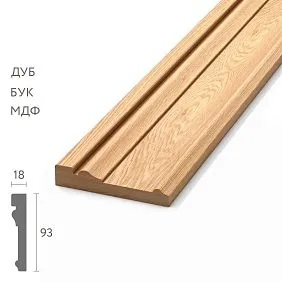

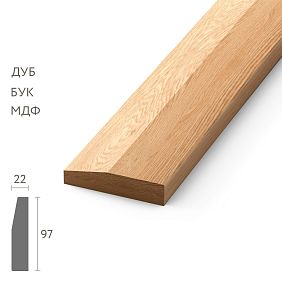


Why paint wooden skirting boards — protection and aesthetics




Two layers of meaning in one operation
Painting wooden skirting boards solves two tasks simultaneously, and neither can be considered secondary.
The first is protective. Uncoated wood is wood under threat. Moisture, dust, ultraviolet light, mechanical impacts — all gradually destroy the unprotected surface. Skirting boards at floor level are particularly vulnerable: wet cleaning, splashes from vacuum cleaners, contact with shoes and furniture legs. A layer of paint or enamel creates a barrier between the wood and the aggressive lower zone of the room.
An unpainted wooden skirting board made of kiln-dried beech or oak is a blank, not a finished product. It absorbs moisture unevenly, changes dimensions and color, and becomes a breeding ground for mold in high humidity. Coating seals the wood pores and normalizes its behavior during use.
The second is aesthetic. A painted wooden skirting board 'blends into' the interior or 'makes a statement' in it — depending on the chosen color. A white skirting board next to a white wall creates a 'dissolving' boundary effect: the wall appears extended, the room — taller. A black skirting board on light parquet is a sharp graphic outline that 'draws' the room's perimeter. A gray skirting board in a Scandinavian interior is a delicate boundary without emphasis.
Color choice is a design decision. And that's precisely why painting wooden skirting boards isn't the last item on the work list, but a conscious choice made already at the interior concept stage.
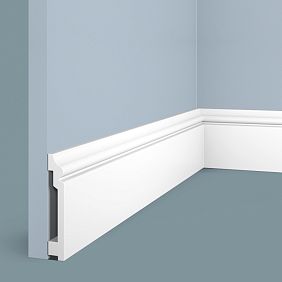
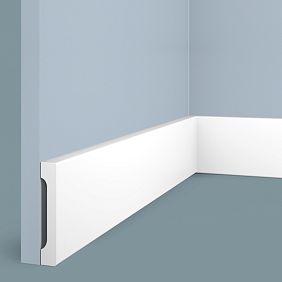
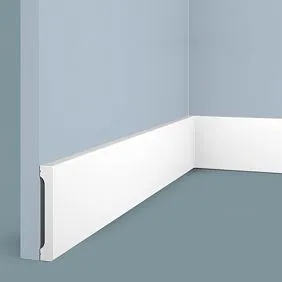
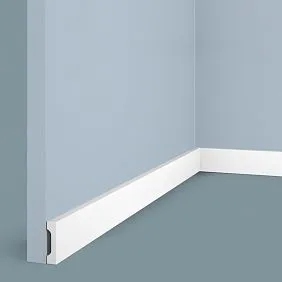
Our factory also produces:

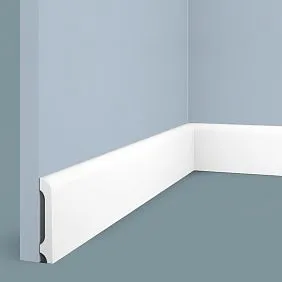
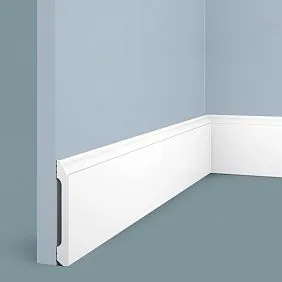
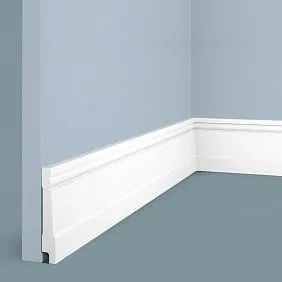
When to coat — before or after installation
The professional standard is clear: coat before installation. There are several reasons:
-
A horizontally positioned skirting board is coated evenly, without drips
-
The back side and ends are easily treated — which is critical for protection against moisture from the wall side
-
The brush doesn't touch the floor and wall, no masking needed
-
After installation — only final touch-up of joint and sealant areas (5–10 minutes per room)
Exception: painting in place, if the skirting board is already installed and cannot or shouldn't be removed. In this case — thorough masking of floor and wall with painter's tape.
Get Consultation
Preparing wooden skirting board surface for painting
Preparation stages: from blank to perfect surface
Surface preparation is what separates professional coating from amateur work. Two people can use the same paint, but the result will be different — precisely because of preparation.
Stage 1. Primary sanding
STAVROS K-series skirting boards come factory-sanded to P180. Nevertheless, light sanding with P180–P220 is recommended before painting — to remove raised grain that occurs during acclimatization (wood 'absorbed' air moisture and slightly swelled).
Sanding technique: move along the grain, not across. Crosswise scratches will be visible under paint. A sanding block with sandpaper provides more even pressure than fingers.
After sanding — remove dust with a soft brush or tack cloth. Dust on surface under primer = grainy coating.
Stage 2. Defect repair — knots, cracks, chips
Before applying primer — repair all visible defects:
-
Open knots: wood filler, matching color or white (under white paint). Apply with a spatula under pressure, slightly 'mounded' — filler shrinks 10–15% after drying. After drying — sand with P180.
-
Cracks along the grain: if deeper than 2 mm — fill with acrylic wood filler. Thin cracks up to 1 mm — will be covered by primer.
-
Chips on the ends: putty, sanding. Especially important when reusing old baseboards.
Step 3. Priming
Primer is mandatory. It performs three functions:
-
Strengthens the nap and raised fibers - after drying they are easy to sand
-
Levels water absorption across the baseboard area - especially important on ends and near knots where wood absorbs paint faster
-
Improves paint adhesion
Primer selection:
-
For acrylic paint - water-based acrylic wood primer (primer-antiseptic or simply wood primer)
-
For alkyd enamel - alkyd or universal primer (Primer GF-021, GF-021, or specialized alkyd primer)
-
For nitro enamel - nitro primer (rarely used in residential areas due to odor)
Application: thin even layer with brush or sponge. Do not leave puddles or drips. Drying time: 1-2 hours for water-based, 4-6 hours for alkyd.
Step 4. Intermediate sanding after primer
After the primer dries, the surface becomes slightly rough - the primer raised the nap. Light sanding with P220-P320 removes this nap and creates a perfect "platform" for paint. Result - even, smooth finish without "bristles".
After intermediate sanding - remove dust again.
Step 5. Re-puttying (if necessary)
If after priming unevenness becomes visible that wasn't noticeable before - re-putty with a "thin layer". Primer "reveals" defects, making them more noticeable under side lighting. This is normal and correct information - it's better to fix the defect now than under the finish paint.
What to paint wooden baseboards with: alkyd, acrylic, enamel
Three main types of paint compositions
The market of paint materials for wood is huge. But regarding wooden baseboards in residential interiors, all compositions boil down to three groups. Let's examine each honestly - with advantages and limitations.
Acrylic paint (water-dispersion enamel)
What it is: water suspension of acrylic polymers with pigment. Solvent - water.
Advantages:
-
Fast drying: 1-2 hours between coats, 24 hours to full cure
-
No odor during application - can work in living spaces
-
Wide color selection (tinting by RAL or NCS at any base)
-
Easy tool maintenance: brushes and rollers wash with water
-
Color retention: doesn't yellow over time (unlike alkyd)
-
Elasticity: follows wood "breathing" without cracking
Limitations:
-
Film hardness lower than alkyd and nitro enamel - less resistant to mechanical impact when applied in 1-2 coats
-
Requires 3-4 coats for full opaque coverage on baseboards
-
On cheap compositions - less resistant to wet cleaning
Recommended for: bedrooms, living rooms, children's rooms — spaces with normal humidity and moderate load on the skirting board. Ideal for white, gray, pastel, and saturated colors.
Best composition classes: acrylic enamel with 'hammer' hardness level (acrylic-polyurethane compositions), water-thinnable alkyd-acrylic hybrids.
Alkyd enamel
What it is: a pigment suspension in alkyd resin on an organic solvent (white spirit). The traditional 'Soviet' standard in PF-115 and PF-266.
Advantages:
-
High hardness and mechanical resistance of the film after full curing
-
Resistance to wet cleaning with detergents
-
Good adhesion to wood even without specialized primer
-
Levels minor surface irregularities — more 'gentle' towards preparation
Limitations:
-
Slow drying: 6–12 hours between coats, 48–72 hours until full curing
-
Strong odor of organic solvent — requires ventilation
-
Yellowing of white color: the alkyd film acquires a yellowish tint after 2–4 years under exposure to light and air. For white wooden skirting boards — a serious drawback
-
The tool is cleaned with solvent
Recommended for: hallways, corridors, kitchens — spaces with increased mechanical load. For colored skirting boards (gray, green, black) — yellowing is not critical. For white — only modern 'non-yellowing' alkyds or acrylic.
Nitro enamel (NC-132, NC-25)
What it is: nitrocellulose enamel on acetone or ethyl acetate solvent. Fast-drying.
Advantages:
-
Ultra-fast drying: 30–60 minutes between coats
-
High film hardness
-
Levels irregularities worse than others, but reproduces profile relief more accurately
Limitations:
-
Sharp toxic odor — unacceptable for residential spaces when applied with a brush. Only in a workshop or when working with a spray gun and exhaust.
-
Requires nitro primer — regular acrylic primer is incompatible
-
Film brittleness — may crack with wood movement
Recommended for: professional painting in a workshop with a spray gun. For home painting — not recommended.
Oil and wax — an alternative to paint
Wood oil is not paint: it penetrates the fiber structure, does not create a film on the surface. Oil coating for wooden skirting boards — for interiors with natural wood under transparent finish.
Oil does not hide the texture — it emphasizes it. Oak K-066 under 'natural oak' oil looks more vibrant, warmer, and richer than the same skirting board under white paint. This is a completely different aesthetic language.
Oil — only for spaces with normal humidity. For bathrooms and kitchens — polyurethane varnish over oil orKPU-seriesas an alternative.
Comparison table: what to choose
| Parameter | Acrylic | Alkyd | Nitro enamel | Oil |
|---|---|---|---|---|
| Odor during application | Weak | Strong | Sharp | Weak |
| Drying | 1–2 hours | 6–12 hours | 30–60 minutes | 12–24 hours |
| Hardness | Medium | High | High | Low |
| Yellowing of white | No | Yes, after 2–4 years | Slightly | N/A |
| Wet cleaning | Good | Excellent | Excellent | Satisfactory |
| Clear version | No | No | No | Yes |
| For living rooms | Yes | Yes | No (odor) | Yes |
| For bathroom/kitchen | Specialized | Yes | Yes | No |
White wooden skirting board — the most popular color
Why white is unrivaled
White wooden skirting board is the choice of the majority, and this majority has solid reasons. White works in any interior: Scandinavian, classic, modern, Provençal. It doesn't 'argue' with the color of walls and floors — it simply covers the seam and fades into the background. At the same time — if the walls are also white — the skirting board creates a unified space that visually 'raises' the ceiling.
For K-series STAVROS skirting boards with rich profiles (K-070, K-009, K-066), white color is especially organic: a white surface with rich relief creates a play of light and shadow that makes the profile 'readable'. On natural wood under oil, the same relief is more 'quiet'.
White color painting technology: nuances
White is the most 'demanding' color. It doesn't forgive unevenness, poor preparation, and thin layers: all flaws are more visible on white than on any other color.
Choosing a base for white skirting board:
Acrylic enamel with high hiding power index is the best choice. The 'whiteness' of paint is determined not only by pigment (titanium dioxide) but also by the base: high-quality acrylic base with high TiO₂ content covers in 2 coats. Cheap ones require 4–5 coats.
Application scheme for white:
-
Acrylic primer (white or gray — for white, white primer is better)
-
Intermediate sanding P240
-
The first thin coat of white enamel is a 'bonding' coat, not a covering one.
-
Drying time 2–3 hours, light sanding with P320.
-
Second covering coat.
-
Drying time 3–4 hours, sand with P400 if necessary.
-
Third finishing coat — for perfect 'whiteness' and uniformity.
Total: primer + 3 coats of paint. This is the standard for a white wooden skirting board when applied with a brush.
Gloss level for white:
-
Matte (5–15% gloss): hides surface imperfections, 'soft' appearance. For walls and ceiling skirting boards.
-
Semi-matte / Satin (20–40%): optimal balance. Easy to clean, doesn't 'glare', hides minor imperfections. Best choice for floor skirting boards.
-
Semi-gloss (50–70%): brighter appearance, cleans well. For classic interiors with rich profiles.
-
Gloss (80–90%): 'lacquered' appearance. High resistance to mechanical impact. Requires perfect surface preparation — all imperfections are visible in the reflection.
Forwhite wooden skirting boardin most cases — satin or semi-matte. This is the 'classic' look for a white skirting board.
Yellowing of white alkyd — how to avoid:
If using alkyd enamel — choose formulations marked 'non-yellowing', 'yellowing-resistant', or based on modified alkyd (urethane-alkyd). Standard PF-115 in white will yellow after 2–3 years — especially in areas without UV exposure (behind furniture). The best choice for durable white — acrylic or acrylic-urethane enamel.
Grey and black skirting boards — modern trends
Grey wooden skirting board: Scandinavian spirit
Gray Wooden Baseboard— this is a modern trend, originating from Scandinavian design tradition. There, they long ago understood: neutral grey is not an 'absence of color', it is a self-sufficient tone that works as a connecting link between the floor, walls, and furniture.
Grey tones for skirting boards:
-
RAL 7044 (Silk grey) — very light, almost white with a grey tint. For interiors with white walls and light floors.
-
RAL 7035 (Light grey) — standard 'office' grey. For modern neutral interiors.
-
RAL 7036 (Platinum grey) — warm grey with a beige undertone. For Scandinavian interiors with wooden furniture.
-
RAL 7016 (Anthracite) — dark grey, almost graphite. For modern interiors with dark accents, for rooms with light walls.
-
RAL 7021 (Black grey) — transitional zone between grey and black.
The subtlety of grey: grey is an 'optically heavy' color if chosen incorrectly. Cool grey next to a warm wooden floor — conflict. Warm grey next to warm parquet — harmony. Always compare a sample of grey paint with a sample of the flooring under the same lighting.
Application scheme for grey:
Grey covers better than white — the pigment is more 'dense'. Standard scheme: primer + 2 coats of enamel. Finish: satin or matte — gloss on grey 'looks cold'.
Black wooden skirting board: a bold choice
Wooden skirting board in black color— this is the boldest decision of all. Not everyone is ready for it. And that is precisely why those who dare to do it get an interior with a memorable character.
A black baseboard 'draws' the perimeter of a room with a clear graphic line. It works like a frame: just as a picture frame makes the image more concentrated, a black baseboard 'gathers' the space of the room.
When a black baseboard works:
-
Light walls (white, cream, milk) — maximum contrast, clear perimeter
-
Light wooden or marble floor — a black line between the light floor and light wall creates an expressive rhythm
-
Modern, loft, industrial, minimalist style
-
Rooms with high ceilings — a black baseboard does not 'weigh down' at heights from 2.8 m
When a black baseboard does not work:
-
Dark walls + dark floor — the baseboard 'sinks', gets lost
-
Warm classic interiors — black conflicts with gold and warm wood
-
Small rooms with low ceilings — a black line 'lowers' the ceiling even further
Black painting technique:
Black is the most 'forgiving' color in terms of coverage: it covers in 1–2 coats. But it has its own complexity: any speck of dust, brush fiber, brush stroke mark — all of this is visible on a black surface in side lighting.
Scheme for a black baseboard:
-
Gray or dark gray primer (not white — white primer reduces the density of black)
-
First coat of black enamel: thin, diluted 5%
-
Drying 2–3 hours, sanding P400 with a tack cloth roller (remove fibers)
-
Second coat: dense, covering. Brush strokes — strictly in one direction
-
If necessary — a third coat for maximum depth of tone
Gloss level: for black — matte (RAL 9005, matte 'velvet black') creates depth without reflections. Semi-gloss — more 'designer', emphasizes the profile relief.
Colors for a black baseboard:
-
RAL 9005 (black) — neutral cool black
-
RAL 9004 (signal black) — warm black with an anthracite undertone
-
RAL 9017 (traffic black) — warm, slightly brownish. For interiors with warm wooden floors.
Painting a baseboard: brush, roller, or spray gun
Brush — the classic, which requires skill
Brush — the most common tool for painting a baseboard. But 'just a brush' is the wrong way to frame the question. The brush must be the right one.
Brush selection:
-
Type: flat, bristle or artificial bristle (for acrylic — synthetic, for alkyd — natural bristle or synthetic)
-
Width: for profiled baseboard — 40–50 mm. For wide (K-066, K-104) — 50–75 mm
-
Quality: 'live' tip of the bristles without protruding individual hairs. A cheap brush will leave fibers in the paint.
Brush application technique:
-
Load paint onto 1/3 of the bristle length — no more. Excess paint on the brush = drips.
-
First 'filling': move the brush across the profile, working paint into the recesses of the relief.
-
'Feathering': long strokes along the baseboard — parallel to the long axis.
-
Final pass: use light strokes with a 'dry' brush (almost no paint) to smooth the surface. This pass removes traces of previous strokes.
Golden rule: do not 'go back' over an already painted area after 3–5 minutes. Drying acrylic paint will pull and leave visible marks if touched again with a brush.
Brush pros: application control, precision in corners and on ends, accessibility, minimal workspace preparation.
Cons: brush marks on the finished surface (especially on gloss), slower than roller or spray gun.
Roller — speed for simple profiles
The roller is used forpainting wooden baseboards only with flat or minimally profiled sections — K-034, K-125. For complex profiles (K-070, K-009, K-066), the roller cannot reach into the recesses of the relief, leaving unpainted areas.
Roller selection:
-
Length: 100–150 mm (special 'corner' mini roller)
-
Nap: 4–6 mm for matte/semi-matte, 2–4 mm for gloss
-
Nap material: foam — not recommended for baseboards (leaves bubbles); velour or nylon nap — optimal
Technique:
Roll with moderate pressure along the baseboard, then a final pass with an 'almost dry' roller for smoothing. Ends and corners are always finished with a narrow brush.
Spray gun — professional finish without tool marks
The spray gun is the ideal tool for painting wooden baseboards with any profile. It applies paint evenly, without brush marks, and covers the most complex reliefs inaccessible to brushes or rollers.
Types of spray guns for baseboards:
HVLP (High Volume Low Pressure) — high volume, low pressure. Optimal type for wood: minimal overspray, good application, suitable for acrylic and alkyd. Cost from 5,000 rubles.
Aerosol can — the most accessible 'spray gun'. Specialized aerosol enamels (white, gray, black) are convenient for small volumes and touch-up painting. Cost: 300–500 rubles/can.
Preparation for spray gun work:
Masking the floor and wall is mandatory — spray gun overspray settles on any surfaces within a 1–2 m radius. Workspace: baseboard lies horizontally on a rack, floor covered with newspapers.
Spray gun application scheme:
Pressure: 2.5–3.5 bar for HVLP. Paint viscosity: thin acrylic with water to 20–25 seconds on a DIN4 viscometer (approximately 10–15% water by volume). Distance from nozzle to surface: 200–250 mm. Movement uniform, at a speed of 30–40 cm/s, 30% overlap.
Scheme: 2–3 thin coats with intermediate drying of 30–45 minutes (for acrylic). Result: perfectly smooth surface without tool marks.
Spray gun pros: best finish quality, coverage of complex relief, speed.
Cons: masking preparation, higher paint consumption (some goes to overspray), nozzle cleaning required after work.
Table: tool for the task
| Baseboard profile | Volume | Recommended tool |
|---|---|---|
| K-034, K-125 (simple, flat) | Small (1–2 rooms) | 40 mm brush |
| K-034, K-125 (simple, flat) | Large (3+ rooms) | 100 mm roller + brush |
| K-006, K-070 (medium profile) | Any | 50 mm brush |
| K-009, K-018, K-066 (rich profile) | Small | 50–75 mm brush |
| K-009, K-018, K-066 (rich profile) | Large | HVLP spray gun |
| K-104 (maximum profile) | Any | HVLP spray gun |
Common mistakes when painting wooden baseboards
Mistake 1: Painting without primer
Without primer, paint is absorbed unevenly by the wood — especially on end grain and near knots. Result: a "patchy" finish that cannot be fixed with additional coats. Only sanding down and reapplying with primer will work.
Mistake 2: Thick first coat
A thick first coat of paint on wood causes drips, especially on the vertical surfaces of the profile. Rule: first coat — a thin "bonding" layer, each subsequent coat — slightly thicker.
Mistake 3: Painting at high air humidity
At humidity above 70%, acrylic paint dries slower and can cause "blushing" — matte spots on the surface. Optimal conditions: 40–65% humidity, 15–25°C.
Mistake 4: Applying alkyd over still-wet primer
Alkyd enamel will not adhere properly to a wet water-based primer — peeling occurs. The water-based primer must be completely dry (2–4 hours) and sanded in between before applying alkyd.
Mistake 5: Neglecting intermediate sanding
After the first coat of paint, the surface becomes slightly rough — the grain has risen again. Without intermediate sanding with P320, the second coat will lock in this grain, and the final surface will be "bristly." Intermediate sanding takes 5 minutes — don't neglect it.
FAQ: Answers to popular questions
What is better for painting wooden baseboards — acrylic or alkyd?
For white baseboards in living rooms — acrylic enamel (doesn't yellow, dries quickly, odorless). For hallways, corridors, and kitchens with high wear — alkyd or acrylic-urethane enamel (higher film hardness). For colored baseboards (gray, black) — both options are equally suitable.
How many coats of paint are needed for a wooden baseboard?
Standard: primer + 2–3 coats of paint. White color requires 3 coats. Black and dark tones — 2 coats are sufficient. Each coat should be thin. Three thin coats are better than one thick one.
Is sanding necessary between coats of paint?
Yes — light sanding with P320–P400 after the first and second coats. Removes raised grain and brush marks. Without sanding — the finish will be uneven.
How to paint a wooden baseboard white without yellowing?
Acrylic enamel — by definition, does not yellow. Alkyd — choose formulations marked 'non-yellowing' (urethane-alkyd). Regular PF-115 in white will yellow after 2–3 years.
Can a wooden baseboard be painted after installation?
Yes. Mask the floor and wall with painter's tape and paper tape. Apply paint in small sections. Remove the tape immediately after applying the final coat, without waiting for it to dry — this will ensure a crisp edge.
How to achieve a matte black baseboard without glare?
Acrylic or alkyd enamel RAL 9005, gloss level 5–10% (matte). A 'velvety' matte black is achieved by applying with an HVLP spray gun: an even, thin layer without brush marks gives perfect matteness.
About the company STAVROS
Color is the final decision. But material is the first. The right profile, properly dried solid wood, correct cross-section geometry — this is the foundation without which no painting will yield a professional result.
wooden K-series millworkSTAVROS is made from kiln-dried beech and oak with a moisture content of 8–10%. The surface is factory-sanded to P180: no need to level, no need to remove coarse grain. Primer goes on smoothly right away.
Over 30 K-series profiles — from the minimalist K-034 (from 230 rub./lm) for a white Scandinavian baseboard to the monumental K-104 (from 6,060 rub./lm) for a white classical 'crown'. Each profile comes in two wood species: beech and oak. Both are equally good for painting.
Additionally —wooden cornices KZ-seriesfor curtains,door trims and cornicesfrom the unified K-series for doors and ceilings,Furniture legsandMirror Frames— all for unified painting.
If the preference is for polyurethane—KPU-serieswith perfect factory geometry, specially designed for painting.
Stock program. Shipment on the day of order. Delivery throughout Russia and CIS countries.
STAVROS — when the baseboard is ready for painting from day one. All you have to do is choose the color.


