












































































Article Contents:
- History of the standard: how 50 mm became the benchmark
- Ergonomics of 50 mm diameter: science of comfortable grip
- Hand size anthropometry
- Grip strength and safety
- Tactile comfort
- Application of 50 mm baluster: universality of the standard
- Staircase handrails
- Wall-mounted support handrails
- Curtain Cornices
- Round-section balusters
- Support posts and pillars
- Decorative rails and accent elements
- Furniture handles
- Craft projects
- Wood species: from budget to premium
- Spruce: affordability
- Birch: strength and lightness
- Oak: king of durability
- Ash: strength and light color
- Beech: Smoothness and Warmth
- Larch: Moisture Resistance
- Technical specifications and quality requirements
- Diameter accuracy
- Straightness
- Wood moisture
- Surface Quality
- Absence of defects
- Installation of round 50 mm baluster
- Handrail mounting on balusters
- Wall-mounted mounting
- Finishing and coating
- Final Sanding
- Finishes
- Where to buy quality round 50 mm baluster
- Company STAVROS: Quality Standard
- FAQ: Round 50 mm baluster
- What distinguishes solid baluster from glued one?
- Which wood species to choose for stair handrail under heavy load?
- Can 50 mm baluster be used for outdoor elements?
- How to check baluster quality upon receipt?
- How many brackets are needed for a wall-mounted handrail 3 meters long?
- Can 50 mm baluster be bent for stair turns?
- What price is considered reasonable for 50 mm baluster?
- Conclusion: fifty millimeters as a universal standard
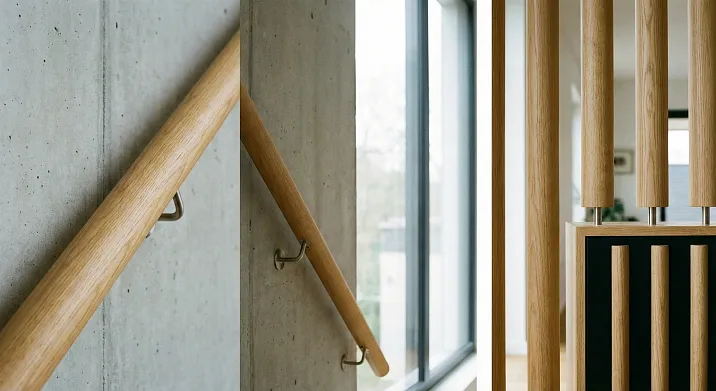
In the world of construction standards, there are sizes that do not appear by chance — they crystallize over decades of practice, thousands of projects, millions of human touches, hundreds of ergonomic and safety studies. Fifty millimeters — this is exactly the diameter of round wooden balusters that became a universal standard for stair handrails, wall-mounted support elements, curtain valances, balusters, decorative posts.Round baluster 50millimeters — this is not just one of many sizes in the manufacturer's catalog, it is a benchmark, the golden mean, the optimum, to which the industry has converged after a careful analysis of human hand biomechanics, safety requirements, visual harmony of proportions, and manufacturing rationality.
In 2026, when building codes become increasingly strict regarding accessible environments, when interior design returns to proven classic solutions, when biophilic architecture demands maximum material naturalness,Round balustrade 50 mmexperiences a new wave of popularity. Architects, designers, builders, carpenters know: if you are unsure about choosing the diameter for a handrail, baluster, or decorative post — take fifty millimeters. This is a size that works in ninety percent of cases, that never errs, that is equally comfortable for an adult man with a large hand and a woman with a tiny hand, that visually harmonizes and does not appear either too bulky or too thin.
When you make the decisionRound wooden baluster 50 mmto use in your project — whether a private home staircase, a wall-mounted handrail system in a medical facility, decorative posts for zoning open-space offices, balusters for a terrace of a country residence — you are relying on decades of research, safety standards, aesthetic classics. This is a choice in favor of universality, reliability, durability.
This article is a comprehensive guide to round balusters with a 50 mm diameter: why this size became a standard, what ergonomic studies underlie this number, where and how it is applied, what wood species it is made from, which technical characteristics are critical, how to choose and install correctly, where to buy quality material. From biomechanics science to practical tips — everything to help you use this universal standard as effectively as possible.


History of the standard: how 50 mm became the benchmark
Standardization of round baluster diameters began not in government offices, but in carpenters' workshops and on construction sites. Until the mid-20th century, handrails and other round elements were made in arbitrary sizes — from thirty to eighty millimeters, depending on material availability, the master's preferences, and the visual proportions of a specific building. This created chaos: hardware (brackets, connectors, end caps) was not universal, each project required custom-made fasteners, interchangeability was absent.
The first serious ergonomic studies of handrails were conducted in Scandinavia in the 1950s. Swedish and Norwegian scientists, working on creating universal standards for accessible environments for people with disabilities, measured thousands of hands — male, female, child, elderly. They recorded grip strength at different diameters, analyzed at which size people felt maximum confidence and secure contact.
Results showed: the optimal range for adults is forty-five to fifty-five millimeters, with peak comfort at fifty millimeters. This size allows an adult with an average hand to wrap around the handrail so that the thumb and index finger almost meet, creating a secure grip without straining the joints.
In the 1960s-70s, these data were incorporated into building codes in Germany (DIN), the United Kingdom (British Standards), and the USSR (SNiP). Manufacturers of wooden balusters began mass-producing exactly fifty-millimeter products. Hardware manufacturers standardized brackets for this diameter. By the end of the 20th century, fifty millimeters became the de facto global standard for round balusters used in support and decorative functions.




Ergonomics of the fifty-millimeter diameter: science of comfortable grip
Why exactly fifty millimeters, not forty-five or fifty-five? Behind this number lie deep biomechanical calculations.
Our factory also produces:


Hand anthropometry
Average palm circumference of an adult (measured at the widest part of the palm through the bases of the fingers):
-
Men: 200–230 millimeters
-
Women: 170–200 millimeters
-
Adolescents (12–16 years): 150–190 millimeters
When fingers wrap around a cylinder with a 50 mm diameter, the circumference of this cylinder is approximately 157 millimeters (πD = 3.14 × 50). This means that to fully wrap around, the hand must 'stretch' 157 millimeters along the cylinder's circumference.
For a male hand (palm circumference 200 mm), this means that when gripping a 50-mm cylinder, the fingers overlap by approximately 40 mm — the thumb and index finger meet with a comfortable overlap, creating a secure grip.
For a female hand (palm circumference 180 mm), the overlap is about 20 mm — the fingers barely meet, but the grip is still full and secure.
This is the golden mean: a diameter that allows both large male hands and small female hands to create a full, secure grip.
Get Consultation
Grip Strength and Safety
Biomechanical studies show: maximum grip strength is achieved when fingers meet with a slight overlap (20–40 mm). At this point, all the muscles in the hand and forearm work synchronously and optimally.
At a 30 mm diameter (too thin), fingers grip too tightly, pressure concentrates on a small area, causing discomfort, and the hand tires quickly. In a sudden jerk (e.g., someone trips and grabs the handrail), a thin handrail may 'sink' between the fingers — the grip is unreliable.
At a 70 mm diameter (too thick), fingers do not meet. For a woman with a small hand or an elderly person with a weakened hand, gripping a 70-mm handrail is difficult — fingers are spread wide, grip strength is insufficient, and during sudden movements, the hand slips.
Round balustrade 50 mmensures optimal grip strength for the widest range of users — from adolescents to the elderly, from petite women to large men. This is critical for safety: the correct handrail diameter can prevent falls and injuries.
Tactile Comfort
A diameter of fifty millimeters creates a comfortable palm contact area. When grasped, the palm touches approximately one hundred twenty to one hundred forty millimeters of the handrail's circumference. This is sufficient for even pressure distribution but not excessive (as would be the case with a very thick handrail).
If the wooden handrail is coated with oil or wax (not a thick glossy lacquer layer), the natural texture is preserved, making tactile contact at a fifty-millimeter diameter most pleasant — the hand feels the warmth of the wood, a slight roughness of the fibers, and natural grip.
50 mm handrail application: universality of the standard
Versatilityround wooden handrail 50 mmmakes it a material for many tasks.
Staircase handrails
Main and widespread application. A 50 mm diameter handrail is the standard for interior staircases in residential buildings, offices, and public buildings. It can be mounted:
-
On balusters: The handrail is installed on top of vertical balusters, forming a stairwell railing.
-
Wall-mounted: The handrail is attached to the wall via brackets, running parallel to the staircase incline.
-
Combined: On one side of the staircase — a handrail on balusters (at the staircase edge), on the other side — a wall-mounted handrail (on the wall).
For children's staircases and playgrounds, it is recommended to install an additional child handrail with a diameter of thirty-eight to forty millimeters at a height of seven hundred fifty millimeters above the steps (below the main adult handrail at nine hundred millimeters).
Wall-mounted support handrails
In medical facilities, nursing homes, sanatoriums, and rehabilitation centers, wall-mounted handrails with a 50 mm diameter are installed along corridors at a height of nine hundred millimeters from the floor. People with weakened health, on crutches, or during rehabilitation rely on these handrails for mobility.
Wall-mounted handrails are also installed in bathrooms (near the toilet, bathtub, shower, sink) to ensure safety for elderly individuals and those with limited mobility.
Curtain valances
A round wooden cornice with a 50 mm diameter is a solution for heavy, bulky drapes, wide windows (three to five meters), where a standard 28 mm diameter cornice may sag under the weight of the fabric.
A 50 mm cornice can support significant weight (up to fifteen to twenty kilograms of distributed load over a three-meter length) without deformation. It is mounted on strong brackets spaced eight hundred to one thousand millimeters apart.
Visually heavier cornices are suitable for high ceilings (three to four meters), large windows, and classic interiors with heavy drapery.
Round balusters
In modern minimalism, Scandinavian style, and Japanese aesthetics, simple cylindrical balusters without turned profiles — segments of round 50 mm diameter handrail installed vertically on steps with a spacing of one hundred to one hundred fifty millimeters — are used.
This creates visual purity, a rhythm of verticals of the same diameter, and focus on wood texture. A handrail of the same diameter (50 mm) is installed on top of the balusters — resulting in a monolithic unity of form.
Support posts and pillars
Round handrail with a 50 mm diameter is used as vertical support posts for:
-
Wall-mounted shelves: Shelves are suspended on round posts passing through holes in the ends of the shelf.
-
Partition walls: Vertical posts forming the frame of lightweight decorative partitions (filled with glass, fabric, or battens).
-
Garden furniture: Supports for benches, tables, swings.
-
Small-scale pergolas: Vertical supports and horizontal beams of the garden canopy.
Decorative battens and accent elements
In 2026 interior design, accent walls with vertical or horizontal wooden battens are popular. A round handrail with a 50 mm diameter, installed on a wall with a spacing of one hundred to two hundred millimeters, creates a textured, light-and-shadow play, and visual rhythm.
Especially effective with hidden backlighting: LED strips behind the battens create light bands that pierce through gaps between the round elements.
Furniture handles
Round trim pieces with a diameter of fifty millimeters and a length of one hundred to three hundred millimeters are used as minimalist handles for cabinet, chest, and kitchen set facades. The cylindrical handle is easy to grip and visually minimalist, emphasizing the wood texture.
Craft Projects
DIY enthusiasts use fifty-millimeter trim for hundreds of projects:
-
Wall and floor-mounted hooks
-
Paper towel holders
-
Plant stands
-
Frames for mirrors and paintings
-
Lamp bases
-
Legs for tables and chairs
A diameter of fifty millimeters is sufficiently substantial for structural use (withstands loads), but not visually excessive.
Wood species: from budget to premium
Round baluster 50millimeters is produced from various species, each with its own application niche.
Spruce: accessibility
Density 500-550 kg/m³, Brinell hardness 1.6-2.0. The cheapest species. Light yellow color, pine scent.
Application: Curtains for light drapes, decorative rails without load, temporary structures, DIY projects with limited budgets, garden elements (with protective treatment).
Price: 150-250 rubles per linear meter.
Birch: strength and lightness
Density 650-700 kg/m³, hardness 2.6-3.0. White color with a slight yellow-pink tint.
Application: Handrails for internal staircases, balusters, cornices, furniture parts. Suitable for Scandinavian and minimalist interiors where a light color is needed.
Price: 300-450 rubles per meter.
Oak: the king of durability
Density 700-800 kg/m³, hardness 3.7-3.9. Color ranges from light honey to dark brown, expressive grain.
Application: Handrails for heavily used staircases (public buildings, hotels), balusters, exterior elements (with treatment), prestigious interiors. Oak is practically immortal — it lasts for centuries.
Price: 600-1000 rubles per meter (solid grade A stock).
Ash: strength and light color
Density 700-750 kg/m³, hardness 4.0 (higher than oak). Light cream-gray color.
Application: Handrails and balusters in light modern interiors where oak’s strength is needed but a lighter palette is desired. Ash can be bleached to nearly white.
Price: 500-800 rubles per meter.
Beech: smoothness and warmth
Density 650-750 kg/m³, hardness 3.8. Warm rose-beige color, uniform fine-grained structure.
Application: Handrails, balusters, cornices in residential homes. Smooth after sanding — silky surface. 20-30% cheaper than oak for comparable strength.
Price: 450-700 rubles per meter.
Larch: Resistance to Moisture
Density 650-700 kg/m³, hardness 3.5-3.7. Amber-honey color, pine scent.
Application: Outdoor handrails (verandas, terraces), elements in saunas, pools, wet areas. Larch, due to its resin, is resistant to rot.
Price: 400-600 rubles per meter.
Technical specifications and quality requirements
Consider ceiling height, room size, interior style, and functionality.Round baluster 50 mmThe following parameters are critical:
Diameter accuracy
Nominal fifty millimeters, but after sanding the actual diameter is forty-nine to fifty millimeters. Allowable deviation ± one millimeter along the entire length.
Check: measure the diameter at five points along the length of the rod (start, two intermediate points, end, plus a control point in the middle) using a caliper. All measurements must be within the range of forty-nine to fifty-one millimeters. If the deviation exceeds this, the baluster is of poor quality and will cause problems with installing hardware (brackets are designed for exact diameter).
Straightness
The rod must be perfectly straight. Check: place it on a flat surface and roll it — it should roll without wobbling. Or, place a long straightedge (two to three meters) along the rod — there should be no gaps or bends.
Crooked balusters (warping, bowing after drying) are unsuitable for handrails or balusters — they will look crooked and cause installation problems.
Wood Moisture
Critical parameter. Must be eight to twelve percent (kiln-dried). This is the equilibrium moisture content for indoor spaces with heating.
If the baluster is raw (moisture content fifteen to twenty percent or higher), it will dry out and deform after installation. The handrail may crack or warp. If over-dried (below eight percent), it will absorb moisture from the air and swell.
Check: request a moisture certificate from the seller or check with a moisture meter (a pin-type moisture meter is inserted into the wood, showing the percentage of moisture). Without checking, purchasing balusters is risky.
Surface Quality
Sanded balusters must be absolutely smooth — the final sanding grit should be 300-320. A hand gliding over the surface should not feel roughness, splinters, or scratches.
Unsanded balusters (sold cheaper for DIY sanding) will have saw marks and micro-grooves — this is normal, but requires careful sanding before use.
No defects
Not allowed:
-
Dead knots (black, falling out) — weaken the structure and spoil the appearance
-
Cracks (especially through or deep) — will expand over time
-
Resin pockets (large resin accumulations, especially on conifers) — resin protrudes and stains
-
Blue stain, rot, insect galleries — signs of biological damage; such wood is not durable
-
Bark (area with bark) — not allowed on finished products
Light, healthy knots up to ten millimeters in diameter are allowed for category AV (standard), but not allowed for category A (extra).
Installation of round balusters 50 mm
Handrail mounting on balusters
Stage 1: Prepare balusters. Balusters are installed vertically on steps, with their upper ends aligned on the same line (for straight staircases — a sloped line matching the staircase angle). A ten-millimeter diameter hole, thirty millimeters deep, is drilled precisely in the center of each upper end. Wooden dowels, fifty millimeters long (twenty millimeters protruding above the end), are inserted into the holes.
Stage 2: Marking the handrail. On the undersideround wooden handrail 50 mmMark drilling points for dowel holes. The distance between holes must exactly match the distance between balusters (measure from center to center of balusters with a tape measure).
Stage 3: Drilling. Drill holes with a diameter of ten millimeters and a depth of twenty-five millimeters. Critical: holes must be strictly perpendicular to the lower generatrix of the handrail (use a drill guide or a vertical-feed drill press).
Stage 4: Assembly. Apply PVA wood glue into the handrail’s holes. Slide the handrail onto the dowels and press firmly. Tap with a rubber mallet for a tight fit. Check for levelness (relative to the stair slope) using a long spirit level.
Stage 5: Fixation. Additionally, from below through the balusters, drive screws into the handrail (diameter four millimeters, length sixty millimeters). The screw enters vertically upward through the baluster and is driven in forty millimeters into the handrail. Cover the screw heads with putty or decorative caps.
Wall-mounted mounting
Stage 1: Marking. On the wall, mark the handrail installation line (nine hundred millimeters above the stairs for staircases, from floor level for corridors). The line must be parallel to the staircase slope (for staircases) or strictly horizontal (for corridors).
Stage 2: Installing brackets. Brackets are installed at intervals of eight hundred to one thousand millimeters. For a wooden handrail with a fifty-millimeter diameter, an interval of eight hundred millimeters is recommended (wood is more flexible than metal; a smaller interval prevents sagging under load).
Brackets are mounted to the wall using anchors (concrete, brick) or strong screws (wood). Critical: the gap between the handrail and the wall must be forty-five to sixty millimeters (to allow the hand to wrap freely, fingers not touching the wall).
Stage 3: Installing the handrail. The handrail is placed into the grooves or rings of the brackets and secured from below or the side (hidden mounting). The ends of the handrail are covered with decorative caps or inserted horizontally into the wall (requires a recess).
Treatment and coating
Final sanding
If purchasing unfinished handrail, multi-stage sanding is required:
-
Grain 120 — remove large irregularities
-
Grain 180 — leveling
-
Grain 240 — smoothness
-
Grain 320 — silky finish
For oak with large pores, brushing can be applied — brushing out soft fibers with a metal brush to accentuate the texture.
Finishes
Oil: Optimal for handrails and balusters in residential interiors. Linseed, tung, or specialized wood oil is applied in two to three thin coats with intermediate sanding using 400-grit sandpaper. Wood breathes and retains tactile warmth. Requires reapplication once a year or every two years.
Wax: After oiling, the surface is rubbed with wax to provide additional protection and a silky finish.
Varnish: For cornices and elements in public buildings. Apply two to three thin coats of matte or semi-matte polyurethane varnish. Maximum durability, but tactilely cooler than oil.
Staining: If color change is needed (e.g., light pine stained to walnut), apply stain followed by a protective finish.
Where to buy high-quality round handrail 50 mm
Company STAVROS: quality standard
STAVROS — manufacturer with full production cycle of wooden products, over twenty years on the market.
Catalog of round handrail with 50 mm diameter:
-
Species: pine, birch, oak, beech, maple, larch
-
Construction: solid stock (up to 4 meters) or laminated (up to 6 meters)
-
Category: A (no knots), AV (small light knots allowed)
-
Finish: sanded (ready for coating) or unfinished
-
Coating: oil, wax, varnish, staining (optional) or uncoated
Quality guarantees:
-
Wood moisture content 8–12% (certificate provided)
-
Diameter accuracy ±0.5 mm
-
Straightness (deviation no more than 2 mm per 3 meters of length)
-
Defective sections rejected
-
Ideal geometry after CNC turning
Additional Items:
-
Mounting brackets for wall mounting (metal, wood)
-
Connecting couplings for joining long sections
-
Decorative end caps
-
Balusters and support posts included with handrails
-
Custom fabrication of curved (radius) sections
How to order:
-
STAVROS website: sectionRound baluster
-
Select species, category, construction
-
Specify the number of linear meters
-
Select finish and coating
-
Place order online or call for consultation
Delivery across Russia. Pickup from warehouses in Saint Petersburg and Moscow.
FAQ: Round baluster 50 mm
How does solid baluster differ from glued?
Solid is turned from one piece of wood (maximum 3-4 meters for quality timber without defects). Glued is assembled from short laminates using a toothed joint (minispline), can be up to 6 meters. Solid is more aesthetic (no visible joints on ends), glued is more stable (less prone to warping, fewer cracks) and cheaper. Strength is identical when properly manufactured.
Which species to choose for a stair handrail under heavy load?
Oak or beech. Hardness of 3.7-4.0 on Brinell ensures resistance to wear even with hundreds of daily contacts. For a family home with four people, larch (cheaper, sufficiently strong) is suitable. Pine and birch are not recommended for heavily used handrails — they are soft and wear quickly.
Can 50 mm baluster be used for outdoor elements?
Yes, but with proper species and finish selection. Larch or oak are optimal (resistant to moisture). Mandatory treatment: antiseptic + oil or exterior lacquer with UV filters. Reapply coating every one to two years. Pine, birch, larch are not recommended for outdoor elements — they deteriorate quickly.
How to check baluster quality upon receipt?
Roll it over a flat surface — it should roll smoothly without wobbling. Measure diameter with calipers at five points — should be 49-51 mm. Run your hand over it — smooth without roughness. Inspect through light — no cracks, dead knots, blue stains. If you have a moisture meter — check moisture content (8-12%). Any defects — request replacement.
How many brackets are needed for a 3-meter wall-mounted handrail?
At the recommended 80 cm spacing: 3000 mm / 800 mm = 3.75, round up to 4 brackets. Plus two end brackets. Minimum 4 brackets (at ends and two intermediate). For wooden handrails, 5 brackets (60-75 cm spacing) are better — more secure, less sagging.
Can 50 mm baluster be bent for stair turn sections?
Theoretically yes, but difficult. Requires steaming (wood softens with steam, bends on a template of the desired radius, and is fixed until fully dry). High risk of cracking, especially for hardwoods. Simpler and more reliable: order curved baluster from the manufacturer — they will fabricate it from glued laminated timber with the required bend radius.
What price is considered reasonable for 50 mm baluster?
Depends on the species. Pine: 150-250 rubles/meter. Birch: 300-450. Beech: 450-700. Oak/maple: 600-1000 rubles/meter (solid grade A stock). Laminated is 20-30% cheaper than solid. If the price is significantly lower, quality may be questionable (poor drying, defects). If the price is too high, it’s an overpayment for the brand.
Conclusion: fifty millimeters as a universal code
Standards exist not to restrict creativity, but to ensure safety, compatibility, and reliability.Round balustrade 50 mm— this is a standard, tested over decades of research, millions of installations, thousands of projects worldwide. Fifty millimeters is not a random number, but the result of deep understanding of human hand biomechanics, safety requirements, and visual proportion harmony.
ChoosingRound wooden baluster 50 mmFor your project, you choose a proven solution that works in ninety percent of cases, that doesn’t fail, that is equally comfortable for a wide range of users. This is an investment in safety (the correct handrail diameter can save a life in case of a fall), durability (quality oak or maple balusters will last a century), aesthetics (a 50mm diameter visually harmonious, neither bulky nor fragile), and universality (suitable for dozens of different applications — from handrails to decorative planks).
Every day, thousands of people grasp 50mm diameter handrails, ascending staircases in homes, offices, hospitals, shopping centers. They don’t think about why this diameter is so convenient — the hand fits naturally, the grip is secure and comfortable. Behind this comfort lie decades of work by ergonomists, engineers, carpenters, and architects who found the golden mean and codified it in the standard. Fifty millimeters — this is a universal code of safety and comfort, written into wood, serving humanity daily, unnoticed, reliably.


