Article Contents:
- Why St. Petersburg Chooses Wooden Molding
- Climate Demands Quality
- Architectural Tradition of the City
- Ecological Awareness
- Types of Wooden Molding: Variety of Forms and Functions
- Floor Skirting Boards: The Foundation
- Wall Moldings: Play of Light and Shadow
- Door and Window Casings: Framing Openings
- Round Molding: Handrails and Decorative Elements
- Balusters: Verticals of Stair Railings
- Wood Species: Which Wood to Choose for St. Petersburg
- Oak: The King Among Species
- Beech: Warmth and Strength
- Ash: Elasticity and Beauty
- Larch: resistance to moisture
- Pine: budget option
- Molding Production: Quality Technology
- Wood Selection and Drying
- Planing and profiling
- Sanding and final finishing
- Where to Buy Molding in St. Petersburg: Supplier Selection Criteria
- Manufacturer or reseller
- Availability of Production and Warehouse
- Assortment and possibility of custom order
- Warranty and Service
- Wooden Molding Installation: Process Nuances
- Room preparation
- Installation Tools
- Skirting board fastening
- Corner joints
- Cost of Molding and Installation: Project Economics
- Molding Prices in St. Petersburg
- Installation Costs
- Saving or Investment
- Frequently Asked Questions
- Which Molding is Better: Solid Wood or MDF
- Should Molding be Coated with Varnish or Oil
- How Long Does Delivery Take in St. Petersburg
- Can Wooden Molding be Used in Wet Rooms
- How to Care for Wooden Molding
- Where to Buy Quality Molding in St. Petersburg
- Which Skirting Board Profile to Choose
- Can Wooden Molding be Painted
- What to Do if Walls are Uneven
- Should you restore old millwork or buy new
- Conclusion: the choice of St. Petersburg professionals
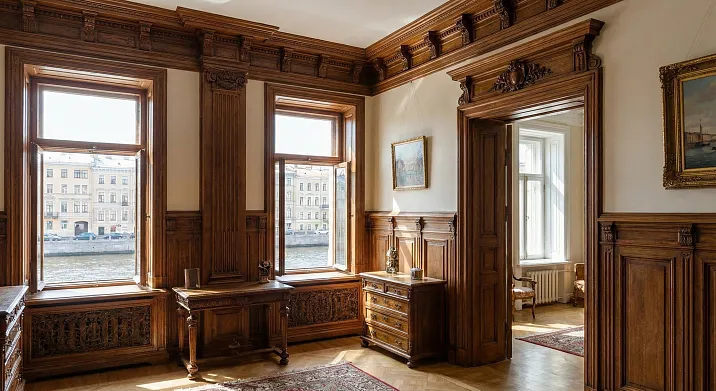
St. Petersburg is a city where architecture breathes history, where every building tells its story through details. Moldings, carved window trims, elegant cornices — all this creates the unique atmosphere of the northern capital. And if previously such elements were only available to palaces and mansions, todaybuy wood millwork St. Petersburganyone can, who wants to bring the nobility of solid wood and the filigree of joinery craftsmanship into their interior.
What is wood millwork and why has it become an essential element of quality finishing? It's a whole universe of products: from classic baseboards that cover the joint between floor and wall, to exquisite moldings that form panel systems on walls, from functional trims that frame doors, to elegantround handrails for stairs. Each element is made from solid wood — oak, beech, ash, larch — and serves for decades, becoming a silent witness to your life.




Why St. Petersburg chooses wood millwork




Climate demands quality
St. Petersburg is a city with a complex climate. The humidity of the Baltic, sharp temperature fluctuations, damp winters and rare but hot summers — all this is a test for finishing materials. Plastic baseboards crack in the cold, MDF swells from moisture, polyurethane moldings yellow under the rare rays of the northern sun.Wooden trim SPBProperly dried solid oak or beech is not afraid of these fluctuations — it 'breathes' along with the microclimate, expanding and contracting within acceptable limits, preserving its shape and beauty.
Wood dried in kilns to a moisture content of eight to ten percent and treated with modern protective compounds becomes stable. It does not absorb excess moisture from the air, does not deform when radiators are turned on in winter, does not warp in summer. Quality kiln drying is the foundation of durability, and it is at this stage that many manufacturers cut corners, offering 'cheap' millwork that within a year or two turns into a wavy, cracked plank.
Our factory also produces:


Architectural tradition of the city
St. Petersburg is an open-air museum. Palace interiors, Stalinist skyscrapers, early twentieth-century apartment buildings — wood is present everywhere. Parquet, solid wood doors, carved trims, ceiling cornices with moldings — these elements have created and continue to create an atmosphere of nobility. When restoring a historic apartment in the center or furnishing a modern home in a new building, St. Petersburg residents intuitively gravitate towards natural materials, towards what has stood the test of time.
wood moldings St. Petersburg— is not just decor, it's a way to create a connection between modernity and history. When you install an oak baseboard in an apartment on the Petrograd Side, you continue a tradition laid down back in the time of Peter the Great. Wood is a material that unites eras, styles, generations.
Get Consultation
Environmental Awareness
St. Petersburg residents are increasingly thinking about health, ecology, and quality of life. Plastic emits volatile compounds, MDF contains formaldehyde, synthetic materials do not decompose for centuries. Wood is a renewable resource that, with proper forest management, does not harm nature. One cubic meter of wood binds almost a ton of carbon dioxide, improving the environmental situation. After the end of its service life (and for oak millwork this is fifty to seventy years) the product can be composted or used as fuel — a full cycle without an environmental footprint.
Types of wood millwork: variety of forms and functions
Floor baseboards: the foundation
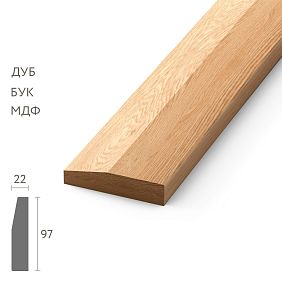
buy wood baseboard St. Petersburg— is the first thing a person thinks about when finishing a renovation. The baseboard covers the technological gap between the floor covering and the wall, protects the wall from dirt during cleaning, hides wiring (if a baseboard with a cable channel is used), and completes the floor composition. The height of the baseboard varies from fifty to one hundred fifty millimeters depending on the interior style and ceiling height.
For small apartments with ceilings of two meters forty to two meters seventy, baseboards with a height of fifty to seventy millimeters are recommended. They do not overload the space, visually do not 'eat up' the height. For standard apartments with ceilings of two meters eighty to three meters, baseboards of eighty to one hundred millimeters are suitable. For spacious apartments and private houses with high ceilings, baseboards of one hundred twenty to one hundred fifty millimeters are appropriate — they emphasize the scale and create a sense of solidity.
The baseboard profile is also important. A simple Euro baseboard with a rectangular cross-section and a slight rounding of the top edge suits Scandinavian and minimalist styles. A shaped baseboard with curves, beads, and chamfers creates a classic look. A carved baseboard with plant ornaments is the pinnacle of decorativeness, appropriate in luxurious interiors.
Wall moldings: play of light and shadow
Moldings are decorative strips that are installed on walls to create panels, frame mirrors and paintings, and separate different types of finishes. In St. Petersburg apartments with their high ceilings, moldings are especially appropriate — they break up the wall plane, create rhythm, depth, and architectural complexity.
Classic panel system: the lower third of the wall (from the floor to a height of ninety to one hundred twenty centimeters) is framed with moldings, forming rectangular or square sections. Inside the sections, the wall is painted the same or a contrasting color, wallpapered, or clad with paneling. The upper two-thirds of the wall remain smooth. The horizontal molding at the boundary of the panel and the upper part of the wall is called a 'dado' — a classic element of English and French interiors.
Moldings on the ceiling create a cornice effect, visually increase the height of the room, and hide the joint between the wall and ceiling. A wide ceiling molding (eighty to one hundred twenty millimeters) suits classic interiors, a narrow one (thirty to fifty millimeters) — for modern ones.
Door and window trims: framing openings
A trim is a strip that frames a door or window opening, covering the gap between the frame and the wall. Without a trim, the opening looks unfinished, technical, like on a construction site. A quality wood trim turns an ordinary door into a decorative element.
The width of the casing is selected proportionally to the size of the opening. For a standard interior door two meters high, a casing seventy to ninety millimeters wide is recommended. For an entrance door or a wide opening — one hundred to one hundred twenty millimeters. Casing can be flat (rectangular cross-section), rounded (soft lines, pleasing to the eye), shaped (with a decorative profile), or carved (with an ornament).
In St. Petersburg apartments with thick walls (especially in Stalin-era and pre-revolutionary buildings), telescopic casings are often used — sliding systems that are adjusted to the wall thickness without cutting.
Round millwork: handrails and decorative elements
Round handrail SPB— these are cylindrical wooden blanks, the main application of which is stair handrails. In two-level apartments, townhouses, and country houses near St. Petersburg, the staircase is a central element of the interior, and the handrail is not only a functional safety detail but also an aesthetic accent.
The standard handrail diameter is forty-five to fifty-five millimeters, optimal for an adult hand to grip. A handrail can be solid (turned from a single solid wood beam) or laminated (glued from several lamellas). A laminated handrail is more stable — it does not crack, does not warp, and can be of any length. A solid one is more prestigious but limited by the beam length (three to four meters) and may crack from internal wood stresses.
In addition to handrails,Round trim buy St. Petersburgcan be used to create decorative columns, curtain cornices, furniture legs, door and drawer handles.
Balusters: verticals of stair railings
Wooden balusters SPB— vertical posts that fill the space between the steps and the handrail, ensuring the safety and decorativeness of the staircase. The distance between balusters should not exceed twelve centimeters (the norm for homes with children) so that a child cannot slip between them.
Balusters come in three types. Turned — cylindrical or with a shaped profile, turned on a lathe. The shape can be simple (smooth cylinder) or complex (alternation of beads, coves, vases). Milled — flat or three-dimensional, with geometric or floral ornamentation, manufactured on a CNC milling machine. Carved — exclusive handcrafted balusters, each unique, expensive, and a work of art.
In St. Petersburg, with its classical architectural tradition, turned balusters with complex profiles, recreating the forms of palace interiors, are especially valued.
Wood species: which wood to choose for St. Petersburg
Oak: The King Among Species
Oak — a classic, proven over centuries. Density six hundred fifty to seven hundred fifty kilograms per cubic meter, Brinell hardness three point eight, high tannin content make oak incredibly durable. Oak millwork lasts fifty to seventy years without loss of characteristics. Oak texture is expressive — clear annual rings, medullary rays on a radial cut create a noble pattern.
Oak color varies from light yellow (young oak) to dark brown (mature oak). Tinting with oils and stains allows obtaining any shade — from Scandinavian bleached to wenge-black. Oak is resistant to moisture (tannins protect against rot), mechanical damage, and temperature fluctuations.
The downside of oak is its high price. A linear meter of oak baseboard costs from one thousand five hundred to three thousand rubles depending on the profile and grade. But if you calculate the cost of ownership over fifty years, oak turns out to be cheaper than repeatedly replacing short-lived analogues.
Beech: warmth and strength
Beech — the second most popular species for millwork. Density six hundred twenty to six hundred eighty kilograms per cubic meter, bending strength is even higher than that of oak. Texture is uniform, fine-pored, color light — from pinkish-cream to reddish-brown (after steaming). Beech takes tinting excellently, is easy to work with, and after steaming becomes plastic, allowing the creation of bent elements.
Beech millwork is twenty to thirty percent cheaper than oak, while in strength it is almost not inferior. Service life thirty to fifty years. Beech is more hygroscopic than oak — it actively absorbs and releases moisture, therefore requiring a stable microclimate (temperature eighteen to twenty-four degrees, humidity forty-five to sixty-five percent). In St. Petersburg apartments with central heating and normal humidity, beech feels excellent.
Ash: elasticity and beauty
Ash is similar to oak in texture and color, but slightly lighter and with a more contrasting pattern. Density six hundred fifty to seven hundred kilograms per cubic meter, hardness high, elasticity outstanding. Ash does not crack under impact loads, bends without breaking fibers — this makes it ideal for stair elements experiencing constant dynamic loads.
The price of ash is comparable to oak or slightly lower. In St. Petersburg, ash is less popular than oak and beech, but is gaining popularity due to its beautiful texture and excellent performance properties.
Larch: resistance to moisture
Larch — a coniferous species with unique properties. Density six hundred fifty to seven hundred fifty kilograms per cubic meter (like oak), high gum content (a natural antiseptic) make larch incredibly resistant to moisture, rot, and insects. Larch millwork can be used even in baths, saunas, and wet rooms without special treatment.
Larch color is reddish-brown, texture expressive. Over time, larch darkens, acquiring a noble shade of aged wood. Minuses: high price (comparable to oak), resinousness (during processing, resin may be released, requiring additional cleaning), tendency to crack during rapid drying (requires a slow kiln-drying regime).
Pine: budget option
Pine — the most affordable species. Density five hundred to five hundred fifty kilograms per cubic meter, soft, easy to work with. Color light yellow with a pinkish tint, texture with clear annual rings. Pine is resinous (resin protects against rot), has a characteristic coniferous aroma.
Pine millwork is two to three times cheaper than oak, but also lasts less — twenty to thirty years. Pine is soft — easily scratched, dents from impacts. For living areas with low traffic (bedrooms, studies) pine is suitable; for high-traffic areas (hallways, stairs) it is better to choose hardwoods.
Millwork production: quality technology
Selection and drying of wood
Quality begins with proper raw material selection. For millwork, first and second-grade wood is used — without rot, large knots, cracks, or fungal damage. Boards are sorted visually and with a moisture meter, rejecting those that do not meet standards.
Freshly sawn wood has a moisture content of sixty to eighty percent. It cannot be processed immediately — after manufacturing, the product will dry out, deform, and crack. Drying reduces moisture to eight to twelve percent — the optimal level for products used in heated premises.
Kiln drying takes place in special chambers at a temperature of forty to sixty degrees and controlled air humidity. The process lasts from two to four weeks depending on the species and material thickness. Slow drying is critical — with rapid drying, wood cracks from internal stresses. After kiln drying, the wood is stabilized (rests at room temperature for several days), then goes into production.
Planing and profiling
Dry boards are sawn into beams of the required cross-section (with a two to three millimeter allowance for planing). The beams pass through a four-sided planer, where all faces are processed simultaneously, obtaining precise dimensions and smooth surfaces.
Profiling — creating a decorative profile — is performed on milling machines. For simple profiles (euro skirting board, rectangular molding), standard cutters are used. For complex shaped profiles, custom cutters are made or CNC machines are used, which can create any shape from a digital model.
Buy round wooden trim in St. Petersburgcan only be done after turning — a square-section beam is mounted in a lathe, and the cutters turn a cylinder of perfectly round cross-section. The rotation speed is one and a half to two thousand revolutions per minute, the process is fast and precise.
Grinding and finishing
After machining, the products are sanded with abrasives of progressively increasing grit: P80 (coarse sanding, removing marks) → P120 (intermediate) → P180 (fine) → P240 (finish). After P240, the surface becomes silky, without scratches or tears, ready for coating.
The coating is chosen depending on the purpose and customer preferences. Oil-wax compositions penetrate the wood, highlight the texture, and create a matte, velvety surface. They require renewal every one to two years but are easily restored. Water-based varnishes are eco-friendly, dry quickly, and create a semi-matte or matte film of medium strength. Polyurethane varnishes form a hard, durable film that protects against moisture and abrasion, lasting five to seven years without renewal.
Where to buy millwork in St. Petersburg: criteria for choosing a supplier
Manufacturer or reseller
Buy round wood trim in St. Petersburgcan be purchased from the manufacturer or from a reseller store. The manufacturer controls the entire cycle: from raw material procurement to final packaging. Prices are lower (no intermediary markups), the assortment is wider (custom sizes and profiles can be ordered), and the warranty is real (the manufacturer is responsible for quality).
A reseller purchases finished products from various manufacturers, forms an assortment, and sells with a markup. The advantage is that you can see samples from different manufacturers in one place. The disadvantage is higher prices, no flexibility in ordering custom items, and a formal warranty (the store does not control production).
Presence of production and warehouse
A serious manufacturer has its own production (drying chambers, machine park, finishing workshop) and a warehouse of finished products. This allows shipping standard items within three to five days, and manufacturing custom orders in ten to fourteen days.
If a company operates 'on order' without a warehouse, deadlines stretch to weeks and months. If a company does not have production, only an office and a website, it is an intermediary purchasing from third parties — quality control is impossible.
Product range and option for custom orders
A good manufacturer offers a wide range of standard profiles (dozens of options for skirting boards, moldings, architraves) and the possibility of manufacturing custom items according to the client's drawings. If you are restoring a historical apartment and need a skirting board with exactly the same profile as the original, the manufacturer will make the cutter and turn the required number of meters.
Warranty and Service
A quality manufacturer provides a warranty on the products — usually five years for the absence of manufacturing defects (cracking, warping, coating delamination due to production fault). The warranty does not cover damages arising from improper installation, operation in extreme conditions, or mechanical impacts.
Good service includes: consultations on material selection, calculation of the required quantity, installation recommendations, assistance in selecting a team of installers (if the client is not ready to install themselves), consultations on care and restoration.
Installation of wooden millwork: process nuances
Room preparation
Millwork installation is the final stage of finishing. Walls must be leveled, painted, or wallpapered. The floor is fully laid, including the final covering. A five to ten-millimeter expansion gap is left between the floor and the wall for thermal expansion of the flooring.
The humidity in the room should be normal (forty-five to sixty-five percent), temperature eighteen to twenty-four degrees. If millwork is installed in a damp, cold room, the wood will absorb moisture, and after turning on the heating, it will begin to dry out, and gaps will appear.
Tools for installation
For professional installation, you will need: a miter saw with a swivel table (for precise cutting of corners at forty-five degrees), a screwdriver or drill (for drilling holes and driving screws), a compressor with a pneumatic gun (for driving finish nails or applying adhesive), a tape measure, square, pencil, level.
A miter saw is the key tool. A hand saw will not provide the necessary precision — the slightest unevenness of the end when cutting at forty-five degrees will lead to a gap in the corner that cannot be hidden. A quality miter saw with a laser guide provides accuracy to zero point one degree.
Skirting board fastening
There are three main methods of attaching skirting boards. With adhesive — fast, invisible fastening, but requires a perfectly flat wall and makes removal impossible without destroying the skirting board. With screws — reliable, removable, compensates for wall unevenness, but the fastening points are visible (filled holes). With hidden clips — invisible fastening, removable, but more expensive and complex.
For St. Petersburg apartments with old uneven walls, fastening with screws and filling the holes with a wax pencil matching the wood color is recommended. Fastening spacing is fifty to seventy centimeters. Screws are driven into dowels (if the wall is concrete or brick) or directly into a wooden base (if the wall is wooden or drywall with frequent studs).
Corner Joints
Corners are the most challenging part of installation. Internal corners (the angle between walls inside a room) are joined by cutting both skirting boards at forty-five degrees. If the angle is not exactly ninety degrees (walls are slanted, which is common in old St. Petersburg houses), each skirting board is cut individually — the sum of the angles must equal the actual angle between the walls.
External corners (protruding corners, e.g., columns, wall projections) are also cut at forty-five degrees but require perfect precision — the joint is visible from all sides. An alternative is using ready-made corner elements that are installed on the corner, and the skirting boards meet them with straight ends.
Cost of millwork and installation: project economics
Prices for millwork in St. Petersburg
Prices forWooden balusters in St. Petersburgand other millwork vary depending on wood species, profile, and coating. Approximate prices per linear meter:
-
Simple pine skirting board: three hundred to five hundred rubles
-
Figural pine skirting board: five hundred to seven hundred rubles
-
Simple oak skirting board: one thousand two hundred to one thousand eight hundred rubles
-
Figural oak skirting board: two thousand to three thousand rubles
-
Simple oak molding: eight hundred to one thousand two hundred rubles
-
Complex oak molding: one thousand five hundred — two thousand five hundred rubles
-
Oak architrave: one thousand — one and a half thousand rubles per set for one door
-
Round oak handrail: one thousand eight hundred — two thousand five hundred rubles per meter
-
Turned oak baluster: from five hundred to two thousand rubles per piece
For a standard two-room apartment with an area of sixty square meters, about seventy — eighty meters of baseboard will be required. At an average price of one thousand five hundred rubles per meter (medium-complexity oak baseboard), the material cost will be one hundred five — one hundred twenty thousand rubles.
Installation cost
Baseboard installation costs from two hundred to five hundred rubles per linear meter depending on complexity (simple straight sections are cheaper, complex corners and bends are more expensive). For the same apartment, installation will cost fourteen — forty thousand rubles.
Molding installation is more complex — it requires marking, creating panel systems, precise cutting. Cost from four hundred to eight hundred rubles per meter. Stair railing installation (balusters, handrails, posts) — from ten to thirty thousand rubles per staircase depending on the number of elements and structural complexity.
Saving or investment
Is it possible to save? You can buy pine baseboard instead of oak — saving two — three times. But pine's service life is twenty years versus fifty years for oak. In twenty years, you'll have to replace the baseboard again — removing the old one, buying new, installing. If you calculate the total cost of ownership over fifty years, oak turns out to be cheaper.
You can save on installation by doing everything yourself. If you have experience, tools, time — why not. But unprofessional installation often leads to gaps in corners, uneven joints, visible screws. Redoing it will cost more than paying professionals right away.
Frequently asked questions
Which millwork is better: solid wood or MDF
Solid wood is more durable (fifty years versus ten for MDF), more eco-friendly (contains no formaldehyde), more prestigious, restorable (can be sanded, coating renewed). MDF is cheaper, more dimensionally stable (doesn't crack, doesn't warp), easier to process. For budget projects with short planning horizons — MDF. For quality long-term interiors — solid wood.
Is it necessary to coat millwork with varnish or oil
Absolutely. Without coating, wood absorbs dirt, moisture, darkens, and can develop mold in humid conditions. Coating protects, emphasizes texture, facilitates maintenance. Coating choice depends on usage: for dry living rooms oil-wax is suitable, for high-traffic areas — polyurethane varnish.
How long does delivery take in St. Petersburg
For manufacturers with a warehouse in St. Petersburg, standard items ship within three — five business days. Custom orders are manufactured in ten — fourteen days. City delivery is usually on the day of shipment or the next day. Delivery to suburbs (Pushkin, Pavlovsk, Gatchina, Peterhof) — one — two days.
Can wooden millwork be used in wet areas
Yes, if the wood is treated with moisture-protective compounds and good ventilation is ensured. Oak and larch are more moisture-resistant due to tannins and gum. Beech and pine require mandatory impregnation with water repellents. In bathrooms and toilets, it's recommended to use oak or larch millwork with yacht varnish coating.
How to care for wooden millwork
Weekly dry cleaning with a soft cloth or vacuum with a soft brush. Wet cleaning once a month with a well-wrung cloth without aggressive detergents. Renew oil-wax coating every one-two years (lightly sand with P320, apply fresh oil layer, rub in, let dry). Varnish coatings last five — seven years without renewal, then full restoration is required.
Where to buy quality millwork in St. Petersburg
Balusters from wood for sale in SPB and other millwork is better purchased from manufacturers with their own production and warehouse. Advantages: quality control at all stages, reasonable prices without intermediary markups, wide assortment, possibility of custom orders, real warranty, specialist consultations.
Which baseboard profile to choose
For minimalism and Scandinavian style — simple Euro baseboard with rectangular cross-section. For modern interiors — baseboard with light curves and chamfers. For neoclassicism — medium-complexity shaped baseboard. For classical and palace interiors — wide baseboard with complex profile, beads, carving.
Can wooden millwork be painted
Yes. Wood takes enamel excellently, especially fine-pored species (beech, birch). Before painting, the surface is primed, sanded, enamel applied in two — three coats with intermediate sanding. Painted millwork lasts as long as tinted or varnished, but the natural wood texture is lost — under paint all species look the same.
What to do if walls are uneven
If walls have waves, bumps, depressions over five millimeters, baseboard won't adhere with glue — gaps will form. Solution: fastening with screws every thirty — fifty centimeters (more frequently than usual), which allows pressing the baseboard even to an uneven wall. Gaps between baseboard and wall (if any) are filled with acrylic sealant, which becomes invisible after painting.
Is it worth restoring old millwork or buying new
If old millwork is made of solid oak or beech, not rotten, not cracked through, restoration is advisable. Old coating is removed by sanding, minor damage is repaired, new coating is applied — millwork looks like new for thirty — forty percent of new cost. If millwork is made of pine or MDF, severely damaged, it's simpler and cheaper to buy new.
Conclusion: The Choice of St. Petersburg Professionals
St. Petersburg is a city where every detail matters. Here, history, quality, and durability are valued. It is not customary here to skimp on things that last for decades.buy wood millwork St. Petersburg— means investing in the comfort, beauty, and value of your home.
STAVROS has been manufacturing solid wood products for over fifteen years, serving St. Petersburg clients who value quality. In-house production with a full cycle (from wood drying to final packaging), European equipment (Nardi drying chambers, Weinig planers, CNC milling machines), and qualified specialists ensure consistent quality for every batch.
STAVROS's assortment includes dozens of profiles for baseboards, moldings, door frames, handrails, and balusters. Standard sizes are always in stock — shipping within three days. Need a custom profile for restoring a historic apartment? Our technologists will create a custom cutter and produce the required number of meters within ten to fourteen days.
The eco-friendliness of STAVROS products is confirmed by certificates: wood from responsibly managed forests (FSC), E1 class adhesives and coatings (minimal formaldehyde), safe for children's rooms and bedrooms. A five-year warranty on manufacturing defects is not a formality but a real commitment to quality.
STAVROS consultants will help you select optimal profiles for your style, calculate the required material quantity, and recommend trusted installers. Logistics will organize delivery throughout St. Petersburg and the region with unloading at the site. The service department will advise on care, restoration, and any issues.
Choosing STAVROS means choosing reliability, proven by thousands of St. Petersburg apartments and country houses. You choose wood that will outlast several generations, preserving warmth and beauty. You choose quality worthy of the Northern Capital.
Visit the STAVROS website, explore the catalog, order samples. The first step toward your dream interior begins with the right choice. Make it today — enjoy the result for a lifetime.