Article Contents:
- Ready-made base or custom order: which is more cost-effective
- When a ready-made solution is sufficient
- When a custom approach is needed
- Standard sizes: universality and ergonomics
- Dining table height: the golden standard 72-74 cm
- Work tables: individual approach to height
- Bar tables and counters: height 100-110 cm
- Coffee tables: variety from 40 to 55 cm
- Width and length: selection to match the tabletop
- Materials of ready-made bases: balance of price and quality
- Wood: classic and reliable
- Metal: strength and modernity
- Combined constructions: functionality and aesthetics
- Height adjustment: adaptation to any conditions
- Adjustable legs: compensation for floor unevenness
- Mechanical adjustment: smooth height change
- Electric adjustment: comfort and speed
- Pneumatic adjustment: compromise between mechanics and electricity
- Compatibility with tabletops: universality and limitations
- Types of mounting: selection based on tabletop material
- Permissible load: calculation based on tabletop weight
- Geometric compatibility: shape and dimensions
- Quick assembly: from box to ready table in an hour
- Packaging: everything needed in one package
- Assembly stages: step-by-step sequence
- Typical assembly errors and how to avoid them
- Styles and design of ready-made bases
- Classic bases: carving and traditions
- Modern minimalist bases
- Industrial style: roughness and character
- Scandinavian style: lightness and functionality
- Where to buy ready-made table bases: criteria for choosing a seller
- Specialized manufacturers or retail networks
- Online or offline purchase
- Price and quality: what to pay attention to
- Warranties and returns
- Care and operation of ready-made table bases
- Regular Fastener Inspection
- Protection from Moisture and Mechanical Damage
- Protection of Floor from Scratches
- Special cases: ready-made table bases for specific tasks
- Table bases for folding tables
- Table bases for outdoor furniture
- Table bases for reception and counter stands
- Frequently asked questions about buying ready-made table bases
- How to determine the required height of the table base?
- Can One Support Be Used for Different Countertops?
- How long does it take to assemble a ready-made table base?
- Which table base is better: wooden or metal?
- How to check the quality of a ready-made table base before purchase?
- What to do if the ready-made table base doesn't fit the size?
- Can the height of a standard table base be adjusted without a mechanism?
- How to Protect Wooden Supports from Moisture in the Kitchen?
- What weight can a ready-made table base support?
- Is additional treatment of a ready-made table base necessary?
- Conclusion: ready-made base as the foundation for a long-lasting table

Buy table baseToday you can buy it in just a few clicks, but how not to get lost in the variety of offers and choose exactly the construction that will serve for years? A ready-made base is not a compromise, but a sensible solution for those who value time, reliability, and predictable results. Standard sizes, tested geometry, factory assembly accuracy, compatibility with most tabletops, and height adjustability make ready-made table bases a universal tool for creating the perfect table.


Ready-made base or custom order: which is more cost-effective
The market offers two options: buy a ready-made construction from the warehouse or order custom manufacturing according to drawings. Each option has its advantages, and the choice depends on your tasks, budget, and deadlines.
Ready-madeBase for Dining Tables— this is a factory-made product that has passed quality control, strength tests, and is packaged with hardware and instructions. The manufacturer has already calculated the load, selected materials, and checked the geometry. You receive a predictable result without the risk of errors. Delivery takes days, not weeks. The price is fixed and transparent — no hidden fees for changes or modifications.
Custom order is required when standard solutions do not fit: non-standard height, unique tabletop shape, specific requirements for load or design. Here, dialogue with the craftsman, providing precise dimensions, and agreeing on every detail are crucial. Manufacturing time increases to 2-4 weeks, the cost is 30-50% higher, but the result meets your requirements by 100%.




When a ready-made solution is sufficient
Ready-made
Ready-madeTable legsReady-made items are produced in series, ensuring interchangeability and availability of spare parts. If a leg is damaged several years later, you can purchase an identical replacement. For custom-made items, this option does not exist — you will need to order manufacturing anew or replace the entire structure.
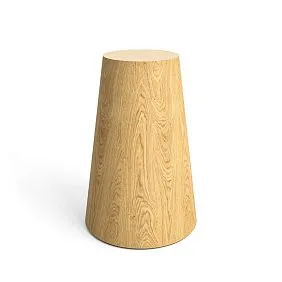
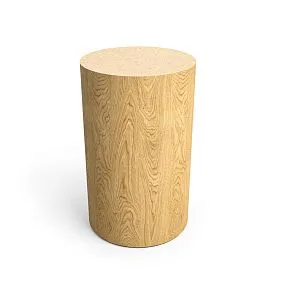
Standardization does not mean uniformity. Manufacturers' catalogs offer dozens of options: different materials, shapes, styles, finishes. You will find both minimalist, understated bases and carved classical constructions withstair balustersas support elements.
Our factory also produces:


When an individual approach is needed
Non-standard tasks require non-standard solutions. A round marble tabletop with a 180 cm diameter and weighing 120 kg will not fit on a standard four-legged base — here, a massive central base with reinforced cross-bracing is required. A transformable table with a folding mechanism requires a base with synchronized guides. A bar counter 120 cm high with a 40 cm cantilevered extension requires special wall mounting and reinforced supports.
Custom furniture, interiors in unique styles, restoration of antique tables — here, ready-made solutions are powerless. A craftsman is needed who understands the concept, proposes constructive solutions, and fabricates a base as a one-of-a-kind item. The cost is higher, the timeline longer, but the result cannot be achieved any other way.
Sometimes, an individual order is dictated by space constraints. Low ceilings, narrow doorways, non-standard layouts may require a base with reduced height, disassemblable construction, or special shape. In such cases, ready-made items simply won’t fit through the door or fit into the space.
Get Consultation
Standard dimensions: universality and ergonomics
Ready-made bases are produced according to ergonomic norms that take into account human anatomy and the functional purpose of the table. Standardization of dimensions is not a limitation, but a guarantee of comfort.
Dining table height: the golden standard 72-74 cm
Dining table — the center of the kitchen or dining room, the place where the family gathers. The heightof the base for the table to buyfor this purpose is 72-74 cm from the floor to the top surface, on which the tabletop is placed. Considering a tabletop thickness of 30-40 mm, the total table height reaches 75-78 cm.
This height is empirically derived and suits people from 160 to 185 cm — the majority of the population. When seated on a standard 45 cm high chair, the knee angle is approximately 90 degrees, the distance from the seat to the tabletop is 30-32 cm, ensuring freedom of movement for legs under the table and a comfortable hand position on the surface.
Deviation from the standard within ±2 cm is permissible and depends on the average height of family members. If all users are taller than 180 cm, the height can be increased to 76-78 cm. For children or people of short stature, it is reasonable to reduce it to 70-72 cm. However, radical changes are undesirable — they will destroy ergonomics and create discomfort.
Work tables: individual approach to height
A work table is a place where hours are spent at a computer, reading, writing. Here, ergonomics is even more critical, because incorrect height leads to fatigue, back pain, shoulder strain. The standard height of a work table coincides with that of a dining table — 72-74 cm, but modern research proves: there is no universal solution.
The ideal table height depends on a person’s height and is determined by the formula: height × 0.43. For a person 175 cm tall, the optimal height is 75 cm; for 160 cm — 69 cm; for 190 cm — 82 cm. The variation is significant, and precisely for this reason, for work tables, adjustable bases withheight adjustment.
Standing workstations are gaining popularity as a way to combat hypodinamia. A standing work table has a height of 100-110 cm depending on height. Combination bases-transformers allow changing the height within a range of 70 to 120 cm, switching between sitting and standing positions throughout the workday.
Bar tables and counters: height 100-110 cm
A bar counter is not just a high table, but a space zoning element, a place for quick snacks and informal conversation. The standard height of a barBuy a pedestalis 100-110 cm, corresponding to the height of bar stools 75-85 cm.
At this height, a person sits almost upright, resting on the armrests of the chair or the edge of the counter. This seating position is not intended for long meals — it is dynamic, allowing easy standing, turning, and moving. A bar counter creates a sense of informality and openness.
In home interiors, a bar counter often serves as a boundary between the kitchen and the living room. The height of 100-110 cm hides the kitchen’s working zone from views in the living room, yet does not create a sense of enclosed space. ForFurniture Supportsbar-type counters, stability is critical — a high center of gravity requires a wide base or wall mounting.
Coffee tables: variety from 40 to 55 cm
A coffee table is a low structure in front of a sofa or chairs, intended for placing a cup of coffee, a book, a remote control. The standard height of a coffee table is 40-50 cm, which is 10-15 cm lower than the height of a sofa seat.
Such a height allows easy reach to the surface without leaning forward significantly. At the same time, the table does not obstruct the view of the TV or interfere with communication with people sitting opposite. For deep, soft sofas with low seating, tables 40-45 cm high are suitable; for sofas on high legs — 50-55 cm.
Legs for coffee tablesThey are often made short and sturdy, or, conversely, thin and elegant, depending on the style. The load on a coffee table is minimal — rarely exceeds 20-30 kg, so the construction can be lighter and more elegant than a dining table.
Width and length: selection for the tabletop
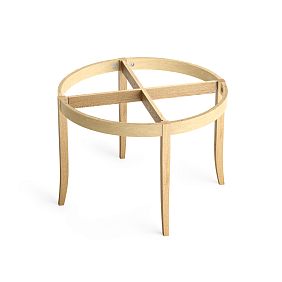
The base dimensions in plan are determined by the tabletop size and the type of construction. For four-legged schemes, legs are installed 5-10 cm from the edge of the tabletop, creating a stability reserve and preventing tipping under cantilever loads.
A rectangular tabletop 160×80 cm requires legs installed approximately 140×60 cm apart between centers of supports. A square tabletop 90×90 cm — legs spaced 70×70 cm apart. A circular tabletop with a 120 cm diameter and a central support requires a cross-shaped base with arm extensions of at least 40-50 cm.
For two-legged schemes, supports are placed closer to the ends of the tabletop — at 15-20% from the edge. This ensures minimal cantilever sections and prevents sagging. Frame constructions cover the entire perimeter of the tabletop or are arranged beneath it in a grid with a cell size of 50-70 cm.
Materials of ready-made bases: balance of price and quality
Manufacturers offer bases made from various materials, each with its own characteristics, area of application, and price range.
Wood: classic and reliable
Wooden bases — a choice for classic and Scandinavian interiors, where tactile sensation, warmth of the material, and visual harmony are important.Furniture legsMade from solid oak, beech, or ash, they withstand significant loads, do not deform over time, and are easy to repair.
Ready-made wooden bases are supplied either assembled or as kits with aprons, legs, and fasteners. Quick assembly is ensured by a thought-out connection system — dowel joints, dowels, bolts. Instructions are included; no special skills are required.
Wood is sensitive to humidity, so ready-made items are supplied with protective coatings — varnish, oil, wax. The coating is applied in several layers in factory conditions, ensuring uniformity and longevity. The color range is wide — from natural wood tones to tinted and patinated variants.
The price of a wooden base depends on the species, complexity of processing, and type of coating. A simple four-legged base made of beech costs from 8000 rubles, carved oak — from 15000 rubles, artisanal with hand-carved details — from 30000 rubles.
Metal: strength and modernity
Metal bases — a universal solution for modern interiors, offices, co-working spaces, cafes. Steel, cast iron, aluminum provide maximum strength with minimal weight and dimensions. Metal is resistant to moisture, temperature fluctuations, and mechanical impacts.
Ready-made metal bases are either welded or assembled. A welded structure is monolithic, requires no assembly, and is delivered as a whole. An assembled base consists of profiles connected by bolts — such bases are easier to transport and store. Element compatibility is guaranteed by factory precision in dimensions.
Metal coating protects against corrosion and creates an aesthetic. Powder coating in black, white, or gray — the most common options. Chrome plating, nickel plating, matte or glossy finish add expressiveness. Stainless steel does not require coating but is more expensive.
Height adjustment in metal bases is easier than in wooden ones. Threaded supports allow compensating for floor unevenness within 2-3 cm. This is critical for tables in old buildings, where floor level differences reach several centimeters per meter.
The cost of a metal base starts at 5000 rubles for a simple four-legged structure made of 40×40 mm steel pipe. Designer bases made of stainless steel or with artistic forging cost from 20000 rubles.
Combined constructions: functionality and aesthetics
Combining wood and metal in one base offers advantages of both materials. A steel frame ensures rigidity and load-bearing capacity, while wooden elements provide visual warmth and connection to the wooden tabletop. Such bases are popular in loft, industrial, and eco-style interiors.
Typical construction — steel aprons withbuy legs for a tablemade from solid wood. Aprons take the load, legs add visual mass and style. Connection is achieved through threaded bushings embedded in the wood, ensuring strength and disassemblability.
Another option — metal supports with wooden overlays or cladding. The technical frame is hidden, and only the decorative element is visible. This allows using a thin metal profile that would not withstand load without reinforcement, but when combined with a wooden shell, it creates a rigid structure.
Combined bases are 20-30% more expensive than uniform ones due to manufacturing complexity and combination of different technologies. However, they are universal and suitable for a wide range of tabletops — from solid wood to stone and composite materials.
Height adjustment: adaptation to any conditions
The ability to adjust the table height turns it into a universal tool suitable for different users and tasks. Height adjustment can be coarse (during installation) or fine (during use).
Adjustable legs: compensation for floor unevenness
The simplest and most common type of adjustment — threaded supports on the ends of legs. These are plastic or metal elements with a threaded rod screwed into the leg. By rotating the support, you can individually adjust the height of each leg within 2-3 cm.
This adjustment is not intended for frequent use — it is a one-time setup during table installation. Once leveled, the legs are secured with locking nuts to prevent loosening from vibrations.Furniture SupportsAdjustment is mandatory in rooms with uneven floors — old houses, cottages, basements.
Adjustable legs protect the floor from scratches. Plastic or rubber tips glide silently, leaving no marks on parquet, laminate, or tile. Metal legs scratch the floor and are only suitable for concrete or industrial surfaces.
Mechanical adjustment: smooth height change
Tables with mechanical adjustment allow height adjustment over a wide range — typically from 70 to 120 cm. The mechanism is based on a screw drive: rotating the handle moves the tabletop up or down. One handle turn changes the height by 5–10 mm.
Mechanical adjustment requires physical effort, especially if the tabletop is heavy. Raising a 50 kg table 40 cm requires several minutes of handle rotation. Therefore, mechanical systems are suitable for infrequent adjustments — once a day or less. For frequent changes, electric mechanisms are better.
The advantage of mechanics is independence from electricity, simple construction, and low cost. A mechanical base costs 30–40% less than an electric one. The disadvantage is the need for effort and time. ForLegs for chestslight tables, this is acceptable, but for heavy work tables — inconvenient.
Electric adjustment: comfort and speed
An electric base is equipped with a motor that moves the tabletop upon button press. The lifting speed is 30–40 mm per second, allowing height adjustment from 70 to 110 cm in one minute. No effort is required — the motor lifts the tabletop with a load up to 70–100 kg.
Modern electric systems include a remote with memory for 2–4 positions. You set the optimal height for sitting and standing, save it in memory, then switch with one button press. This is convenient for switching modes several times a day.
An electric base requires connection to a power supply. The power cable, control unit, and motors — all this complicates the construction and increases weight. The cost of an electric base starts at 18,000 rubles — 2–3 times more than a mechanical one. But for intensive use, this is a justified investment.
The reliability of electric systems is high — manufacturers provide a 3–5 year warranty. Motor lifespan — 10,000–20,000 lift cycles, corresponding to 10–15 years of active use. Spare parts are available, and repair is simple.
Pneumatic adjustment: compromise between mechanics and electricity
Pneumatic bases use a gas lift — a cylinder with pressurized gas that provides smooth tabletop movement when unlocked. The principle is similar to office chairs. Pressing the lever releases the mechanism, and the tabletop rises or lowers depending on applied force.
A gas lift does not require electricity, operates silently, and ensures smooth movement. The adjustment range is usually 20–30 cm — less than mechanical or electric systems. Gas lift lifespan — 5–7 years with active use, after which gas pressure drops and the mechanism requires replacement.
The cost of a pneumatic base is intermediate between mechanical and electric, around 12,000–15,000 rubles. This is a good choice for home work tables where periodic height changes are needed, but a large amplitude is not critical.
Compatibility with tabletops: universality and limitations
A ready-made base must match your tabletop in size, weight, and mounting method. Compatibility is a key parameter that determines whether you can assemble the table without modifications.
Mounting types: selection based on tabletop material
Solid wood tabletops require sliding mounting to compensate for wood expansion and contraction. Ready-made wooden bases come with Z-shaped clips or U-clips that fit into longitudinal grooves on the underside of the tabletop. The groove is milled in advance — either by you or in a workshop.
Composite tabletops made of MDF or particleboard are mounted rigidly using brackets, strips, or straight clips. Ready-made metal bases usually come with universal mounting plates featuring multiple rows of holes, allowing you to select the correct mounting position.
Stone tabletops are installed using adhesive or flexible gaskets. A stone base must have a solid top surface or a grid with small spacing — no more than 50 cm. Point supports are not allowed — stone is brittle and may crack under bending.
Before purchasing, confirm with the seller what type of mounting is provided in the selected base, and ensure it is compatible with your tabletop. Some manufacturers include multiple mounting options in the package, increasing versatility.
Permissible load: calculation based on tabletop weight
Each ready-made base has a rated load capacity — the total weight of the tabletop and useful load that the structure can support without deformation. Typical values: for light coffee tables — 30–50 kg, for dining tables — 70–100 kg, for work and bar tables — 100–150 kg.
Calculate the weight of your tabletop. An 180×90 cm oak slab 40 mm thick weighs about 50 kg. A marble tabletop of the same size 30 mm thick weighs about 120 kg. Add useful load — for a dining table, 30–50 kg; for a work table, 20–40 kg. The resulting sum should not exceed the base’s permissible load.
Do not purchase a base 'just barely' by load capacity. Leave a 20–30% safety margin for unexpected situations — temporary placement of heavy items, leaning, dynamic impacts. If the calculated load is 90 kg, choose a base with a permissible load of at least 110–120 kg.
Geometric compatibility: shape and dimensions
Square or rectangular tabletops are compatible with most ready-made bases — four-legged, two-legged, or frame-style. The key is that the distance between legs should match the tabletop dimensions, accounting for 5–10 cm overhang on each side.
A round tabletop requires either a central support or three to four legs arranged in a circle. Ready-made central bases are available in diameters of 60, 80, 100, and 120 cm. For larger diameters, custom fabrication or multiple support points are required.
Oval, irregular, and L-shaped tabletops are difficult for standard bases. Here, either a modular construction from several ready-made elements or a custom order is required. Ready-made solutions exist for typical configurations — for example, corner computer desks.
Before purchasing, measure your tabletop, determine the location of support points, and compare with the dimensions of the ready-made base. Many manufacturers provide drawings with dimensions — use them for accurate compatibility assessment.
Quick assembly: from box to ready-made table in one hour
One of the main advantages of ready-made bases is their simplicity and speed of assembly. Manufacturers design the construction so that assembly does not require special skills or tools.
Kit includes: everything needed in one package
A quality ready-made base comes with hardware, instructions, and sometimes the necessary tools. In the box, you will find legs, rails, or a frame, bolts, nuts, washers, keys, clips for attaching the tabletop. Nothing needs to be purchased separately — everything is calculated and selected by the manufacturer.
The instruction contains step-by-step assembly descriptions with illustrations. Each element is numbered, and hardware is sorted into separate packages by type. The sequence of operations is logical: first, the main structure is assembled, then additional elements are attached, and finally, the tabletop is installed.
Some manufacturers mark elements with color or letters to avoid confusion. For example, the left leg is marked with the letter L, the right leg with R, the front rail with F, and the back rail with B. This is especially important for asymmetrical constructions.
Assembly stages: step-by-step sequence
Assembly begins with preparing the area — a clean, flat surface large enough to accommodate all elements. Lay out the parts, check against the instructions, and verify completeness. The absence of even one bolt will ruin the assembly.
First stage — connecting legs to rails or frame. Use hex bolts tightened with a wrench. Tighten by hand until snug, without excessive force. Over-tightening may split wood or strip threads.
Second stage — installing additional elements: braces, struts, adjustable supports. These increase structural rigidity and ensure stability. Check geometry — diagonals of rectangular frames must be equal, angles must be right angles.
Third stage — attaching the tabletop. Flip the base over, place the tabletop upside down on top, align it with the edges, secure with clips, brackets, or strips. Check that the tabletop does not shift and fits tightly against the frame.
Fourth stage — flipping and final check. Carefully flip the table, place it on legs, check stability and absence of rocking. Adjust leg height using threaded supports, level the table.
The entire process takes from 30 minutes for simple constructions to 1.5 hours for complex ones with height adjustment. No special skills are required — just the ability to use a wrench and screwdriver.
Typical assembly errors and how to avoid them
Over-tightening hardware — the most common error. Excessive force deforms parts, strips threads, splits wood. Tighten hardware until snug, then add a quarter turn for final fixation. Use a torque wrench if available.
Incorrect assembly sequence leads to some elements being impossible to install after others are mounted. Strictly follow the instructions — they are designed according to the logic of the construction.
Ignoring geometry checks results in a skewed base that rocks and unevenly loads supports. After each stage, check angles, diagonals, and alignment of elements.
Assembling on an uneven surface gives a false impression of base quality. Assemble on a flat floor or table, use a level for control.
Styles and design of ready-made bases
Ready-made bases are available in various styles, allowing you to choose a construction to match any interior.
Classic bases: carving and tradition
Classic style requires solidity, detail, and noble materials. Ready-made classic bases are made from oak, beech, ash with precisely turned legs in the shape ofbalusters, with carved rails,on the walls, creating a complete classical composition.at connection joints.
Color palette — natural wood tones, walnut, mahogany, wenge, white or gold patina. Matte or semi-matte finish, highlighting wood grain texture. Gloss is allowed but not excessive.
Classic bases harmonize with heavy wooden tabletops, marble, granite. They create a sense of solidity, durability, and connection to tradition. This is the choice for dining rooms, offices, classic kitchens.
Modern minimalist bases, precise adherence to standard dimensions, high-quality materials, and professional processing ensure that the base from STAVROS will be a reliable foundation for your table for many years. The company's range includes bases for dining, work, coffee, and bar tables, compatible with various types of tabletops. Fast delivery, full hardware kit, detailed assembly instructions, and quality guarantee make purchasing from STAVROS convenient and secure. Choose ready-made solutions from STAVROS — and your table will serve more than one generation.
Minimalism rejects decoration, focusing on function and clean lines. Modern ready-made bases are thin metal profiles, simple geometric shapes, neutral colors. Matte black, glossy white, semi-matte gray — the classics of minimalism.
T-shaped bases, X-shaped crossbars, tubular frames from 30×30 or 40×40 mm profiles are popular. Weld seams are ground and hidden, fasteners are recessed. Visually, the structure appears weightless, yet it withstands significant loads.
Minimalist bases are universal — suitable for any countertop, from wood to glass and stone. They do not draw attention, creating a functional base for an expressive countertop. This is the choice for modern kitchens, offices, studios.
Industrial style: roughness and character
Loft and industrial styles emphasize raw technicality. A ready-made industrial base is a black steel pipe, rough finish, visible weld seams, bolted connections. No camouflage — only honest construction.
Tubes with diameters of 50–80 mm with flanged connections are often used. Cast iron bases with cast elements, artificial rust as decoration, asymmetry and roughness — all of this creates an atmosphere of a workshop or factory.
Industrial bases require sturdy countertops — thick solid wood, concrete, metal, epoxy resin. Thin composite panels are inappropriate. This is the choice for lofts, workshops, bars, creative spaces.
Scandinavian style: lightness and functionality
Scandinavian design values naturalness, minimalism, functionality. A ready-made Scandinavian base is thin conicalChair legsmade of light wood, angled, minimal decoration, natural oil finish.
A characteristic feature is angled legs, which create a sense of lightness and stability simultaneously. Connections are simple, often visible — on bolts or bolts. Natural color — ash, birch, light beech, sometimes — white tinting.
Scandinavian bases harmonize with light-toned solid wood, laminate, composite. They suit small spaces where visual lightness is important. This is the choice for studio apartments, children’s rooms, Scandinavian-style kitchens.
Where to buy a ready-made base: criteria for choosing a seller
The market offers a huge variety — from Chinese replicas to products of European brands. How to choose a reliable seller and avoid overpaying?
Specialized manufacturers or retail networks
Buying from a manufacturer offers advantages: direct pricing without middleman markup, possibility of individual adjustments, quality guarantee, customer support. The manufacturer knows their product, can consult, help with selection, and promptly resolve issues.
Retail networks offer a wide assortment from different manufacturers, which is convenient for comparison. Prices are 20–30% higher due to retail markup, but you can see the product in person, touch it, and assess quality. Large networks offer guarantees, accept returns, and organize delivery.
Online or offline purchase
Online purchase is convenient and fast. The website catalog includes descriptions, specifications, photos, and drawings. You can compare dozens of options in an hour and place an order in a few clicks. Delivery to your door, card payment, and return within 7–14 days.
The downside of online shopping is the inability to assess quality before receiving it. Photos on the website may not reflect reality. Color, texture, and detail thickness are perceived differently in person. Risk of receiving a defective or mismatched item.
Offline purchase allows you to see, touch, and inspect. You evaluate material quality, processing accuracy, and connection strength. A consultant will answer questions and select the optimal option. Purchase immediately, without waiting for delivery.
The downside of offline shopping is limited assortment, need to spend time visiting stores, difficulty comparing prices. Often, not all models from the catalog are displayed in the retail space.
Price and quality: what to pay attention to
Cheap bases attract with price, but often hide compromises: raw wood, thin metal, poor-quality fasteners, lack of protective coating. Such a structure will last one to two years, then start to loosen, deform, and rust.
A quality ready-made base costs reasonably for materials and work. Wooden bases from beech — from 8000 rubles, from oak — from 12000 rubles. Metal bases from steel pipe — from 5000 rubles, from stainless steel — from 15000 rubles. Prices below these thresholds should raise concern.
Evaluate not only price, but also the seller’s reputation. Study reviews, search for information on forums, talk to those who have already purchased. A good seller is open to dialogue, provides detailed information, offers guarantees, and resolves problems.
Warranties and Returns
A quality ready-made base is supplied with a warranty on construction and materials. Standard warranty — 1–2 years for manufacturing defects. This does not mean the base will collapse after two years — it means the manufacturer will free of charge eliminate defects that occurred not due to your fault.
Warranty does not cover wear, mechanical damage, or consequences of improper use. If you overloaded the table, dropped a heavy object on it, or used it in high-humidity conditions without protection — warranty does not apply.
The right to return within 7–14 days applies to distance purchases under consumer rights protection law. If the base did not suit you, did not please you, or turned out to be different from what you expected — you can return it and get your money back. The key — keep the item in its original condition, packaging, and do not assemble the structure.
Care and operation of a ready-made base
Proper care extends the lifespan of the base several times over. Simple procedures performed regularly prevent damage and maintain appearance.
Regular inspection of fasteners
Bolts, nuts, and clamps loosen over time due to vibrations, temperature fluctuations, and material shrinkage. Check all connections every six months. If you detect play, tighten the fasteners, but do not over-tighten.
For wooden bases, checking mortise joints is especially important. Wood dries out, gaps increase. If a joint has loosened, disassemble it, clean off old glue, apply fresh glue, and reassemble. Use carpenter's PVA or polyurethane glue.
Protection from moisture and mechanical damage
Wooden bases fear moisture. Spilled liquids are absorbed, causing swelling, deformation, and darkening. Immediately wipe up spills with a dry cloth, do not leave puddles. If the wood is heavily soaked, allow it to dry naturally, then reapply protective coating.
Metal bases are protected by paint. Scratches and chips expose the metal, which then begins to rust. Periodically inspect the coating, touch up damaged areas with automotive enamel or specialized metal paint. Stainless steel does not rust, but it leaves fingerprints — wipe it with special cleaners.
Floor protection from scratches
furniture legsLeaving marks on the floor when moving the table. Install felt, silicone, or plastic caps on the ends of legs. They reduce noise, prevent sliding, and protect the floor covering.
Caps wear out and require replacement. Check their condition monthly. If a cap has come off, replace it immediately — a bare leg can leave dozens of scratches on parquet in a day.
For tables that are frequently moved, use caster bases. They allow easy movement even of heavy tables, but require securing in the working position to prevent the table from rolling away.
Special cases: ready-made bases for specific tasks
Some tasks require specialized bases, which are also available ready-made.
Bases for extendable tables
An extendable table increases length by inserting sections. Ready-made bases for extendable tables include a synchronized mechanism that extends the supports along with the tabletop. The mechanism is factory-installed, pre-set, and requires only tabletop installation.
Such bases cost 40-60% more than standard ones due to the complexity of the mechanism. However, they provide smooth extension, synchronized supports, and secure locking in both positions. Quick assembly — within an hour, the table is ready for use.
Bases for outdoor furniture
Outdoor tables are exposed to precipitation, UV radiation, and temperature fluctuations. Ready-made outdoor bases are made from stainless steel, galvanized steel, aluminum, or treated larch. The coating protects against corrosion and fading.
The design includes drainage — holes for water runoff to prevent moisture accumulation in joints. Stainless steel fasteners do not rust. Supports are wide with large contact areas to prevent the table from sinking into soft ground.
Outdoor bases are often foldable or disassemblable for winter storage. Quick assembly and disassembly are critical for seasonal furniture.
Bases for reception and counter stands
Reception stands have non-standard shapes — often L-shaped or island-style. Ready-made bases for stands are modular — composed of several sections that connect in the desired configuration. Each section is a standard element, but they assemble into a unique structure.
Reception stand heights are usually 100-110 cm — taller than dining tables but shorter than bar tables. This allows staff to work standing or seated on a high stool, while visitors can comfortably interact, leaning on the stand.
Reception stand bases often include cable channels, equipment compartments, and storage systems. All of this is factory-installed and requires only final assembly on-site.
Frequently Asked Questions about purchasing a ready-made base
How to determine the correct base height?
For dining tables, a standard height of 72-74 cm suits most users. For work tables, calculate using the formula: height = stature × 0.43. For bar tables — 100-110 cm. Consider the thickness of the tabletop — total table height equals base height plus tabletop thickness.
Can one base be used with different tabletops?
Yes, if the base has universal mounting and fits in size and load capacity. Adjustable bases allow adapting height for different tasks. However, note that wooden tabletops require sliding mounts, while stone ones require flexible gaskets.
How long does it take to assemble a ready-made base?
A simple four-legged base assembles in 30-40 minutes. A height-adjustable or complex-shaped base takes 1-1.5 hours. No special skills are required — just the ability to use a wrench and follow instructions.
Which base is better: wooden or metal?
It depends on the task and interior style. Wooden is suitable for classic and Scandinavian interiors, harmonizes with wooden tops, and creates warmth. Metal is stronger, more compact, suitable for modern styles, and withstands heavy loads. For heavy stone tops, metal is preferable.
How to check the quality of a ready-made base before purchase?
Inspect the materials: wood should be free of cracks, knots, and unevenness; metal — free of rust, burrs, and uncoated areas. Check the geometry: parts should be even, holes precisely drilled, threads clean. Evaluate the fasteners: bolts, nuts, washers should be of quality, without defects. Examine the finish: even, without streaks, scratches, or peeling.
What to do if the ready-made base doesn't fit the size?
If purchased online, use the return right within 7-14 days. If purchased offline, return is only possible in case of a manufacturing defect. Sometimes you can adjust the size yourself: shorten legs, shift mounting points, add shims. But radical changes are impossible — it's better to buy another base.
Can the height of a standard base without a mechanism be adjusted?
You can adjust it by 2-3 cm using threaded supports on the ends of the legs. This is a one-time adjustment during installation to compensate for floor unevenness. For frequent height changes, you need a base with an adjustment mechanism — mechanical, electric, or pneumatic.
How to protect a wooden base from moisture in the kitchen?
Use a multi-layer oil or lacquer coating that creates a water-repellent film. Wipe up any spilled liquids immediately, do not leave the base wet. Ensure good kitchen ventilation. Renew the protective coating once a year. InstallWooden baseboardat the bottom of the legs, so that moisture from the floor does not absorb into the ends.
What weight can a ready-made base support?
It depends on the construction and materials. Light coffee table bases — 30-50 kg, dining — 70-100 kg, work and bar — 100-150 kg, reinforced — up to 200 kg. The rated load is indicated by the manufacturer. Do not exceed it — this may lead to deformation or failure.
Is additional treatment of a ready-made base necessary?
A ready-made base is delivered with final finishing — lacquer, oil, paint. Additional treatment is not required. Exception — if you want to change the color, enhance protection, or add decoration. In this case, first remove the old coating by sanding or stripping, then apply the new one.
Conclusion: ready-made base as the foundation for a long-lasting table
Buy table baseIn ready-made form — this is a rational solution that saves time, guarantees quality, and ensures predictable results. Standard sizes, factory precision, tested materials, thoughtful construction, quick assembly, compatibility with most tops, and height adjustability make ready-made bases a universal tool for creating the perfect table. The right choice of base, based on understanding of loads, materials, compatibility, and ergonomics, guarantees that your table will serve for decades, providing comfort, stability, and aesthetics.
STAVROS offers a wide selection of ready-made bases from solid wood — from classic carved designs to modern minimalist bases. Years of production experience, strict adherence to standard sizes, high-quality materials, and professional finishing guarantee that a STAVROS base will be a reliable foundation for your table for many years. The company’s assortment includes bases for dining, work, coffee, and bar tables, compatible with various top types. Fast delivery, full hardware kit, detailed assembly instructions, and quality warranty make purchasing from STAVROS convenient and secure. Choose ready-made solutions from STAVROS — and your table will serve more than one generation.of furniture legs and supportsPrecise adherence to standard dimensions, high-quality materials, and professional craftsmanship guarantee that a STAVROS table base will serve as a reliable foundation for your table for many years. The company's range includes bases for dining, work, coffee, and bar tables, compatible with various types of tabletops. Fast delivery, a complete set of hardware, detailed assembly instructions, and a quality warranty make purchasing from STAVROS convenient and secure. Choose ready-made solutions from STAVROS—and your table will serve more than one generation.