












































































Article Contents:
- What is a base and why it is more important than it seems
- Stability and reliability
- Ergonomics and Comfort
- Aesthetics and style
- Types of base constructions: from simple to complex
- Four legs at the corners: classic scheme
- Six or eight legs: for large tables
- Central support: one massive pedestal or column
- Two pedestal supports: for rectangular tables
- Braces: tradition of Russian tables
- Frame construction: metal plus wood
- Base materials: from solid wood to particleboard
- Solid Wood: Classic and Reliable
- Glued beam: stability without deformation
- MDF and particleboard: budget alternatives
- Base styles: from classic to loft
- Classic: balusters and carving
- Baroque and Rococo: curved cabrioles
- Provence and country: simplicity and coziness
- Scandinavian style: minimalism and functionality
- Loft and industrial: metal and rough wood
- Modern and Art Deco: smooth lines and geometry
- How to choose a base: step-by-step guide
- Step 1: Determine the table's purpose
- Step 2: Measure the space
- Step 3: Choose a style
- Step 4: Assess quality
- Step 5: Calculate budget
- Where to buy a base: online stores and workshops
- Ready-made bases in online stores
- Custom bases in furniture workshops
- DIY: making a base yourself
- Installing the base to the tabletop: mounting methods
- Mounting on slat rails
- Mounting on metal angles
- Mounting on threaded bushings (fittings)
- Adhesive Joining
- Caring for wooden aprons: preserving beauty for decades
- Regular Cleaning
- Protection against damage
- Recoating
- Repair of damage
- Frequently Asked Questions about aprons
- Conclusion: apron as the foundation of the table and interior
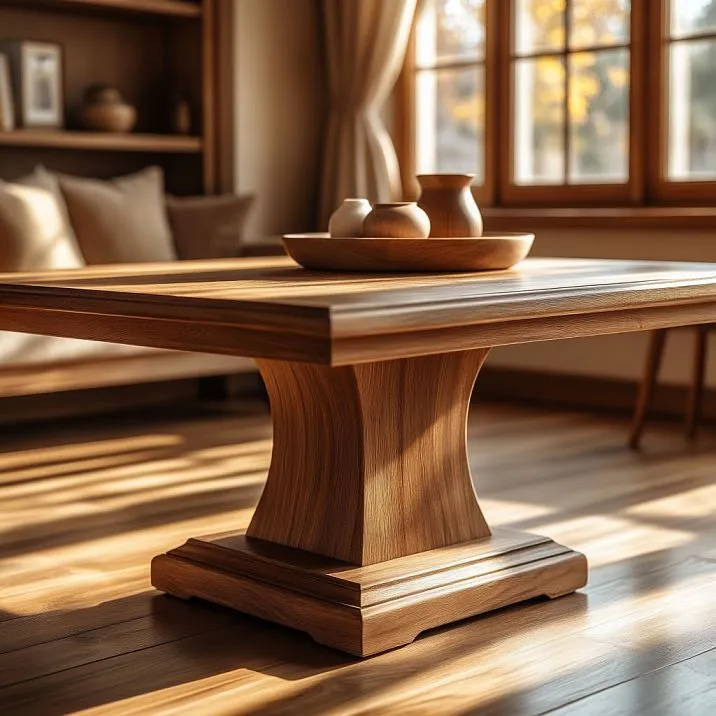
A table is not just a tabletop. Beneath it lies what defines its character, reliability, and aesthetics. The apron. That very structure of legs, slats, and stretchers, which many overlook but which determines everything. Step into an interior with a table on massive carved legs with elegant slats — and you feel solidity, classicism, tradition. Where the table stands on slender metal legs — lightness, modernity, airiness. Where the table rests on a central support column — elegance, comfort, freedom of movement.
wooden base for tableThis is the furniture’s architecture. The skeleton on which the entire composition rests. Its construction determines stability, its style — aesthetics, its quality — longevity. Choosing an apron means choosing the soul of the table.
This article is a guide from a professional with fifty years of experience working with wood, furniture, and interiors. We will examine apron constructions from the simplest to the most complex, discuss styles from classicism to loft, explain how to choose an apron for a dining table for eight people or a compact kitchen table for two, show what to look for when purchasing to avoid mistakes.
Ready to understand what lies beneath the tabletop? Let’s dive into the world of aprons.


What is an apron and why it is more important than it seems
The apron is the load-bearing structure of the table located beneath the tabletop. It consists of legs (supports), slats (horizontal boards connecting the legs), stretchers (lower horizontal boards for additional rigidity), sometimes — a central support (column or pedestal).
Many consider the apron a secondary element. After all, the main thing is the tabletop, beautiful wood, pleasant to the touch surface. But this is a misconception. The apron determines three critically important things.




Stability and reliability
The tabletop may be made of luxurious Karelian oak 50 millimeters thick, but if the apron is flimsy — the table will wobble, creak, and over time become so loose that it will collapse. A quality apron ensures structural rigidity, evenly distributes load, and prevents deformation.
Dining tables experience serious loads. Heavy dishes are placed on them, people lean on them, sometimes children sit on them. The apron must withstand not only static weight (50–100 kilograms of tabletop plus dishes), but also dynamic loads (impacts, shocks, uneven pressure).
Our factory also produces:


Ergonomics and comfort
The apron’s construction determines how comfortable it is to sit at the table. Legs at the corners — classic, but they prevent chairs from being pushed close, limiting seating capacity. A central support frees up space under the table, allows more people to sit comfortably without pressing knees against legs.
The height of the slats is also important. If the slat is low (60–65 centimeters from the floor), sitting at the table is comfortable — knees do not press against it. If high (70 centimeters and above) — knees feel cramped, especially for tall people.
Get Consultation
Aesthetics and style
The apron is the table’s calling card, its stylistic marker. Carved balusters with finely detailed elements — classicism, tradition. Straight, rigid legs with square cross-section — minimalism, Scandinavian style. Curved cabriole legs with scrolls — baroque, rococo, luxury. Metal legs with wooden slats — loft, industrial chic.
The same table with different aprons looks completely different. A classic oak tabletop on carved legs — a respectable dining room. The same tabletop on simple straight legs — a Scandinavian kitchen. On metal spike legs — a loft space.
Types of apron constructions: from simple to complex
Four legs at the corners: classic scheme
The most common construction. Four legs are installed at the corners of the tabletop (5–10 centimeters from the edge), connected by slats around the perimeter.
Advantages: maximum stability (four points of support), simplicity of construction (easy to manufacture, repair), traditionalism (familiar classic appearance).
Disadvantages: legs prevent chairs from being pushed close (especially corner areas), limit seating capacity (for a 180×90 cm rectangular table, 6 people sit comfortably, 8 with difficulty), press against knees of those sitting at the corners.
Variants of execution: legs can be straight (simple square or rectangular sectioned beam), turned (turning creates complex profiles — balusters, vases, spheres), carved (hand-carved with plant motifs, scrolls), curved (cabriole legs — legs curved outward at the top and inward at the bottom, characteristic of baroque and rococo).
For which tables: universal construction, suitable for dining tables of any size (from compact 120×80 to large 240×100 cm), work tables, writing tables, console tables.
Six or eight legs: for large tables
For large dining tables 200 cm and longer, four legs may be insufficient — the tabletop sags in the center under weight. Additional legs are added: six (two on long sides, one on ends) or eight (three on long sides, one on ends).
Advantages: increased load-bearing capacity (can support heavy solid wood tops up to 60–80 millimeters thick), no sagging (additional supports in the center prevent drooping).
Disadvantages: more legs under the table (hinder seated users, limit seating space), visually bulkier (many vertical elements create a heavy appearance).
For which tables: large dining tables 200–300 centimeters long for dining rooms, banquet halls, conference rooms.
Central support: one massive pedestal or column
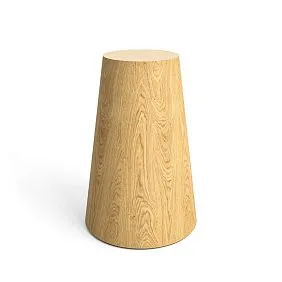
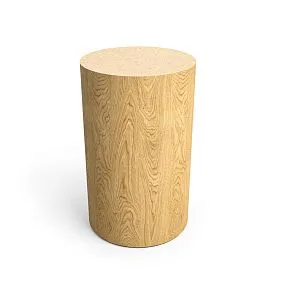
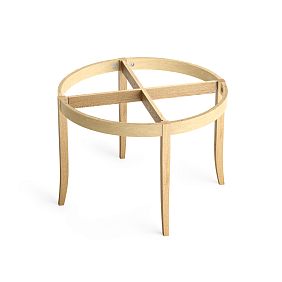
Instead of four legs at the corners — one central support in the form of a massive pedestal, column, or thick baluster. The support is installed strictly at the center of the tabletop. Below the support — a crossbase (four arms radiating from the center) or a round base for stability.
Advantages: free space under the table (no legs at the corners, chairs can be pushed close from any side), more seating capacity (for a round table 120 centimeters in diameter, 6 people can comfortably sit on a central support, vs. 4–5 on four legs), elegant and minimalist appearance (one support instead of four — visually lighter).
Disadvantages: lower resistance to tipping (one point of support — if pressure is applied to the edge of the tabletop, the table may tilt), size limitation for tabletops (central support suits round, square, and small rectangular tables up to 140 centimeters in diameter or side length; for large rectangular tables, a very massive and heavy support is required), crossbase at the bottom may obstruct feet (especially if the crossbase is large).
Execution variants: support can be in the form of a turned baluster (classic style), carved column (baroque), straight rectangular pedestal (minimalism, modernity), or composite construction from several elements (several turned balusters connected together to create a more massive support).
For which tables: round and square dining tables 90–140 centimeters in diameter/side for kitchens, small dining rooms, cafes, restaurants; coffee tables; bar tables.
Two pedestal supports: for rectangular tables
Two massive pedestal supports are installed not at the center, but closer to the ends of the rectangular tabletop (approximately 1/4 of the length from each end). Supports are connected by a crossbar for rigidity.
Advantages: free space along the long sides of the table (chairs can be comfortably placed, knees do not hit the supports), high stability (two supports spaced apart create a stable platform), suitable for large rectangular tables (180–240 centimeters long).
Disadvantages: supports may hinder seated users at the ends (especially if the supports are massive), require more material (two pedestals instead of four legs — more wood, higher weight, more expensive).
Execution variants: supports can be in the form of rectangular pedestals (classic, traditional), carved columns (luxury, monumentality), trapezoidal supports (modernity, minimalism).
For which tables: large rectangular dining tables 180–300 centimeters long for dining rooms, meeting rooms, libraries; writing desks; monastery tables.
Legs: Russian table tradition
Two triangular or trapezoidal elements (legs) are installed perpendicular to the table's length, connected by a crossbar. Each leg consists of two inclined legs connected at the top by a rail.
Advantages: very high stability (inclined legs create a wide base), simple construction (easy to manufacture, disassemble, transport — old peasant tables on legs were disassemblable), traditional Russian style (characteristic of izba, monastery, and trapezoidal tables).
Disadvantages: legs occupy space under the table (hinder pushing chairs close, limit seating space along long sides), visually bulky (two large triangular elements create a heavy appearance).
For which tables: large dining tables in Russian, country, rustic style for dining rooms, country houses, restaurants serving folk cuisine; outdoor tables for verandas, gazebos.
Frame construction: metal plus wood
Table base made of metal frame (steel or cast iron legs, frame) combined with wooden elements (top, sometimes rails).
Advantages: high strength (metal withstands heavy loads with smaller cross-section), modern industrial appearance (characteristic of loft, industrial style), possibility of creating thin, elegant legs (metal is stronger than wood, legs can be made 20–30 millimeters in diameter instead of wooden 60–80 millimeters).
Disadvantages: cold to the touch (metal conducts heat, unpleasant to touch with feet in winter), requires corrosion protection (paint, powder coating), harder to repair (requires welding, metalworking).
Execution variants: leg spindles (thin straight metal rods 10–15 millimeters in diameter with threading for attachment to the tabletop — a trick of Scandinavian style and minimalism), П-shaped or Х-shaped frames (metal frame in the shape of the letters П or Х, onto which the tabletop is laid), spider legs (thin metal tubes radiating from the center at an angle — minimalism, high-tech).
For which tables: modern dining tables in loft, industrial, minimalism, Scandinavian styles; coffee tables; work desks for offices, co-working spaces.
Table base materials: solid wood to particleboard
Solid wood: classic and reliable
Table base made of solid wood — whole wooden blocks without gluing or joining. The most traditional, reliable, and durable material.
Wood species:
Oak — king of wood species. Density 700 kg/m³, high hardness, exceptional strength. Oak base withstands enormous loads, lasts for centuries, is not afraid of moisture (tannins in oak make it resistant to rot). Color ranges from light straw to dark brown, expressive texture with clear annual rings. Price is high (80×80 mm beam — 1500–3000 rubles per linear meter), but justified by longevity.
Beech — slightly softer than oak (density 650 kg/m³), but strong enough for furniture. Fine, uniform texture, pink or yellowish-white color. Easy to work with, sand, and bend after steaming (ideal for curved elements — cabriole legs, Viennese chairs). Price is moderate (80×80 mm beam — 1000–2000 rubles/m). Shortcoming — hygroscopic (absorbs moisture, may warp in humid environments), requires protective coating.
Ash — very strong (density 700 kg/m³), elastic, impact-resistant. Texture is expressive, similar to oak but lighter. Easily bends, ideal for curved elements. Price is close to oak (80×80 mm beam — 1200–2500 rub/m).
Birch — affordable species (density 650 kg/m³), strong enough for light and medium tables. Fine, uniform texture, light yellowish-white color. Easy to process, paint, and stain. Low price (80×80 mm beam — 500–1000 rub/m). Drawback — unexpressive texture (often stained to resemble more expensive species), hygroscopic.
Spruce — soft species (density 520 kg/m³), suitable for light tables without heavy loads. Texture with expressive resin streaks, yellowish-white color. Easy to process, inexpensive (80×80 mm beam — 300–700 rub/m). Drawback — soft (easily dents from impacts), resinous (resin may appear on surface).
Advantages of solid wood: maximum strength and durability (lasts decades, withstands heavy loads), naturalness (eco-friendly, pleasant to touch, warm), repairability (can be sanded, re-coated, restored), noble appearance (natural wood texture, color variations).
Disadvantages: high price (especially valuable species — oak, ash), weight (oak apron weighs 15–25 kilograms), reaction to humidity (solid wood absorbs and releases moisture, may deform or crack with humidity changes — requires protective coating, stable indoor humidity).
Glued beam: stability without deformation
Beam made by gluing several laminates (thin boards) 20–40 mm thick. Laminates are glued so that annual rings point in different directions. This compensates internal stresses and prevents deformation.
Advantages: geometric stability (does not warp, twist, or crack with humidity changes), absence of large defects (knots and cracks are removed during laminate manufacturing), possibility of creating large-section elements (glue several laminates to achieve any thickness), lower price than solid wood for comparable quality.
Disadvantages: glue joints visible on ends (less aesthetically appealing than solid wood), lower eco-friendliness (contains glue, though modern glues are safe), harder to repair (deep sanding may expose glue joints).
For which table aprons: suitable for any construction, especially for elements requiring stability — straight legs, aprons, large-sized stretchers.
MDF and plywood: budget alternatives
MDF (medium-density fiberboard) and plywood (glued veneer sheets) are used for budget table aprons.
Advantages: low price (3–5 times cheaper than solid wood), stability (no reaction to humidity, no deformation), easy processing (easily sawn, routed, drilled), possibility of creating complex shapes (plywood bends, MDF allows carved elements).
Disadvantages: low bending and impact strength (MDF or plywood legs under 30 mm thick are brittle and may break), unattractive ends (require veneer or edge banding), lower eco-friendliness (contains binding resins, though quality MDF and plywood have E1 emission class — safe), low repairability (broken elements are easier to replace than repair).
For which table aprons: budget dining and kitchen tables, office tables, temporary furniture, DIY projects (self-made furniture).
Table apron styles: from classic to loft
Classic: balusters and carving
Classic table aprons are recognized by precisely turned baluster legs with expressive profiles, aprons with relief friezes, sometimes — carved elements (acanthus leaves, rosettes, scrolls).
Characteristic elements: precisely turned legs with alternating convex (ovals, spheres, vases) and concave (necks, joints) elements, aprons with decorative friezes (carved or routed ornaments along lower edge), stretchers at 15–20 cm from floor (for stiffness and decoration), patina (artificial aging, gold or silver patina on protruding elements).
Wood species: oak (traditionally), beech, ash, sometimes walnut, redwood (mahogany, meranti) for luxury furniture.
Finishing: staining in dark tones (walnut, wenge, stained oak), transparent varnishes or oils (highlight wood texture), patina (artificial aging).
For which interiors: classic dining rooms, living rooms, offices, libraries; English, French, Italian classic styles.
Baroque and Rococo: curved cabriole legs
Baroque table aprons — luxury, opulence, theatricality. Characterized by curved cabriole legs (S-shaped curve: upper part curves outward, lower part inward), carved elements (scrolls, shells, acanthus leaves), gilding.
Characteristic elements: cabriole legs (curved legs), carved aprons with ornate patterns, carved inlays at leg-apron junctions, gilding or silvering (entirely or patina on protruding elements).
Wood species: beech (easily bent, ideal for cabriole legs), walnut, oak, sometimes more exotic species.
Finishing: staining in light tones (white, cream, ivory) with gold or silver patina, or in dark tones (walnut, mahogany) with gilding.
For which interiors: palace, theater interiors; Baroque, Rococo, Empire; luxurious dining rooms, living rooms.
Provence and country: simplicity and coziness
Table aprons in Provence and country styles — simplicity, naturalness, coziness. Characterized by straight or slightly turned legs without complex profiles, aprons without carving or with simple routed patterns, light tones, aging effects.
Characteristic elements: straight legs with square or round cross-sections, slightly tapering toward the bottom, sometimes simple turned elements (one or two crossbars), straight or simply profiled aprons, aprons at a height of 20–30 centimeters, painted in light tones with a worn effect.
Wood species: pine, spruce (budget options), oak, beech (more expensive).
Finishing: painted in light tones (white, cream, light gray, lavender, mint, blue) with aging effects (worn areas, scratches, patina), or transparent oils and waxes (highlighting wood texture, creating a natural look).
For which interiors: Provence, country, shabby chic, Scandinavian style; kitchens, dining rooms, cottages, country houses.
Scandinavian style: minimalism and functionality
Scandinavian bases — minimalism, functionality, light tones. Characterized by straight legs with conical shape (tapering toward the bottom), minimal decoration, light wood species, transparent finishes.
Characteristic elements: straight round-section legs with tapering (diameter 60–80 mm at top, 40–60 mm at bottom), minimalist rectangular or hidden aprons (attached from inside, not visible from outside), absence of aprons (visual lightness), natural wood color.
Wood species: birch, beech, pine, oak — light species with fine grain.
Finishing: transparent oils, waxes, varnishes (highlighting natural wood color and texture), white or light-gray paint (rarely).
For which interiors: Scandinavian, minimalism, japandi (Japanese minimalism + Scandinavian functionality); kitchens, dining rooms, living rooms.
Loft and industrial: metal and rough wood
Loft-style bases — combination of metal and wood, industrial aesthetics, rough texture. Characterized by metal legs (steel pipes, I-beams, angles), wooden thick aprons from rough wood, dark tones.
Characteristic elements: metal legs from steel pipes with diameter 40–60 mm or square-profiled pipes 40×40, 50×50 mm, П-shaped or Х-shaped metal frames, wooden aprons from boards 40–50 mm thick with rough texture (saw marks, knots, cracks), dark tones (black metal, dark wood).
Wood species: oak, beech (roughly processed, brushed), pine (with prominent knots).
Finishing: metal — matte black paint, powder coating, anodizing; wood — staining in dark tones (wenge, stained oak), transparent oils (highlighting rough texture), brushing (brushing soft fibers to create relief texture).
For which interiors: loft, industrial, modern; kitchen-living rooms, dining rooms, co-working spaces, cafes.
Modern and art deco: smooth lines and geometry
Modern bases are characterized by smooth curved lines, asymmetry, floral motifs. Art deco — strict geometry, symmetry, luxury.
Modern: curved legs with smooth transitions (not sharp angles, but soft curves), asymmetrical elements, carved floral motifs (lilies, irises, vines), staining in natural tones.
Art deco: geometric legs (trapezoids, stepped profiles, zigzags), symmetry, luxurious materials (dark wood, inlays, chrome metal), contrasting combinations (dark wood + chrome, dark walnut + gold).
For which interiors: modern, art deco, eclectic; living rooms, dining rooms, restaurants.
How to choose a base: step-by-step guide
Step 1: Determine the table's purpose
Dining table for daily use requires maximum strength and stability. The base must withstand daily loads, impacts, uneven pressure. Optimal — solid oak, beech, beech, construction on four legs or central support.
Dining table for holidays and guests (used rarely) can have a less massive base. Suitable glued beam, birch, construction on four legs.
Kitchen table for two or three people can be compact, on central support or four legs. Any species will do, even pine (light loads).
Work or writing desk requires stability, but loads are static (computer, papers, books). Suitable glued beam, birch, construction on four legs or two pedestals.
Coffee table experiences minimal loads. Suitable lightweight constructions — thin legs, metal, pine.
Step 2: Measure the space
Tabletop size determines the base construction. For small tabletops (diameter up to 120 cm, rectangle up to 140×80 cm) — central support. For medium (diameter 120–140 cm, rectangle 140–200×80–100 cm) — four legs. For large (rectangle 200–300×100–120 cm) — six to eight legs or two pedestal supports.
Table height is standard — 75 centimeters from floor to tabletop. Base height depends on tabletop thickness: if tabletop is 40 mm, base should be 710 mm; if tabletop is 25 mm, base should be 725 mm.
Floor clearance: the distance from the floor to the bottom edge of the apron should be at least 60 centimeters, ideally 65–67 centimeters. If less, knees will be cramped.
Step 3: Choose the style
The apron should match the interior style. A classic dining room requires classic balusters. A Scandinavian kitchen — simple conical legs. A loft space — metal legs. Mismatching is visually jarring.
If the interior is eclectic (a mix of styles), the apron can be neutral (simple straight legs, natural wood) or accent (expressive baroque apron in a modern interior as an art object).
Step 4: Evaluate quality
When purchasing a ready-made apron or ordering custom fabrication, pay attention to:
Material: A quality apron made of solid oak, ash, or beech is fairly heavy (15–25 kg for a dining table). Too light indicates softwood (pine) or hollow construction. Tap the leg — solid wood sounds dull, hollow construction sounds hollow.
Surface finish: The surface should be smooth, free of burrs, chips, or cracks. Run your hand along the leg — no roughness. Precision-cut elements should be symmetrical with clear profiles. Carved elements — sharp lines, no blurring.
Joints: Check how the elements are joined. Quality joints — dowel, tenon, or hidden fasteners (conformers). Cheap joints — visible screws. Try wiggling the apron — no play or creaking.
Finish: Lacquer or oil should be applied evenly, without drips, bubbles, or uncoated areas. Run your hand over it — smooth, silky surface. If painted — no pooling, uniform tone.
Geometry: Place the apron on a flat floor — it should not rock (sign of uneven leg lengths). Measure diagonals (for rectangular constructions) — they should be equal (deviation up to 2–3 mm max, otherwise the structure is skewed).
Step 5: Calculate your budget
Budget apron (3000–10000 rubles): pine, birch, glued-lumber, simple construction (four straight legs), transparent finish or light paint.
Mid-range apron (10000–25000 rubles): oak, beech, ash, precision-cut legs, aprons with routered edges, quality staining or lacquering.
Premium apron (25000–60000+ rubles): solid oak, ash, walnut, complex construction (central carved support, baroque cabrioles, two heavy pedestals), hand-carving, patina, gilding.
Remember: an apron is an investment for decades. A quality oak apron will last 50–100 years, outlasting several generations of tabletops (the tabletop can be replaced, but the apron remains). Saving on quality will result in repairs, replacements, and disappointment.
Where to buy an apron: online stores and workshops
Ready-made aprons in online stores
buy wooden table basecan be found in online stores for furniture hardware and components.
Advantages: wide selection of ready-made models (dozens of variations in styles, constructions, sizes), photos from multiple angles and in interiors, detailed descriptions (material, dimensions, weight, construction), transparent pricing, delivery across Russia, return option (14 days if item retains its condition).
What to look for: material (solid wood species, glued-lumber, MDF), dimensions (apron height without tabletop, width and length — must match your tabletop), construction (four legs, central support, two pedestals), attachment method to tabletop (planks with holes, metal plates, threaded bushings), finish (lacquer, oil, wax, paint — affects maintenance and longevity), weight (the heavier, the denser the material, the stronger the construction).
Prices: budget aprons from pine or birch — 3000–8000 rubles; mid-range from oak or beech with precision-cut legs — 10000–20000 rubles; premium from solid oak with carving — 25000–50000 rubles.
Custom aprons in furniture workshops
If you didn't find a suitable ready-made apron or need a non-standard construction (unusual size, unique design, specific wood species),Buy a pedestalcan be ordered custom in a furniture workshop.
Advantages: custom design (any construction, style, decor based on your sketch or the workshop designer’s idea), non-standard sizes (apron tailored to your specific tabletop, considering room characteristics), wood species selection (oak, ash, walnut, exotic species), finish options (staining in any color, patina, carving, inlay), handcrafted quality (the master oversees every stage, perfect fit).
Ordering process: consultation with a master or designer (discuss your idea, style, construction, materials), sketch or 3D model creation (visualization of the future apron), approval and adjustments, cost and timeline calculation, manufacturing (typically 2–6 weeks depending on complexity), delivery and installation.
Prices: custom-made aprons cost 30–50% more than ready-made ones. Simple apron from oak on four legs — 15000–25000 rubles. Complex with carving and patina — 40000–80000 rubles.
DIY: making an apron yourself
If you are skilled in woodworking,Buy table baseYou can partially (buy ready-made legs, make rails yourself) or make everything completely.
What you can buy ready-made: turned legs (sold separately, dozens of models of different heights, diameters, profiles — price 500–3000 rubles per leg), metal legs (price 200–800 rubles per leg), metal frames (ready-made L-shaped or X-shaped frames — price 5000–15000 rubles).
What to make yourself: rails (rectangular boards, easy to cut from a board to the required width), aprons, connecting elements.
Tools: circular saw (for precise cutting at an angle), drill (for drilling holes for dowels, self-tapping screws), sander (for surface finishing), clamps (for holding during gluing), brushes or spray gun (for applying finish).
Materials: timber of the required cross-section (for rails, aprons), ready-made legs (if you don't turn them yourself), carpentry glue (PVA or polyurethane), dowels or self-tapping screws (for joints), finish (oil, varnish, wax).
Advantages of DIY: saving money (making it yourself is 2–3 times cheaper than buying ready-made), enjoyment of creativity (you make it yourself, you control the quality), possibility to realize a unique idea.
Disadvantages: requires time (making a simple base takes 2–3 days of work), requires tools and skills (without experience in carpentry, the result may be sloppy), risk of mistakes (incorrect marking, crooked cuts — you’ll have to redo or accept imperfections).
Mounting the base to the tabletop: methods of attachment
Attachment to rail boards
The most common method. Rails are attached to the upper ends of legs. Mounting boards (30×30 or 40×40 mm strips) with pre-drilled holes are attached to the rails from the inside. The tabletop is placed on the base, and self-tapping screws are screwed into the tabletop from below through the holes in the boards.
Advantages: secure attachment (the tabletop holds firmly), possibility of disassembly (you can unscrew the screws and remove the tabletop for transport), compensation for thermal expansion (wood expands and contracts with humidity changes — screws in elongated holes allow the tabletop to move, preventing cracking).
Technology: boards are attached to rails from the inside with screws or glue. Holes in the boards must be elongated (along the grain of the tabletop — for expansion compensation) or round (across the grain). Screws are screwed in not to the bottom, leaving a 1–2 mm gap for tabletop movement.
Attachment to metal brackets
Metal furniture brackets (L-shaped plates with holes) are attached to the rails from the inside. The tabletop is placed on the base, and self-tapping screws are screwed into the tabletop through the holes in the brackets.
Advantages: simple installation (brackets are attached with two screws to the rail and two to the tabletop), low cost (brackets cost 20–50 rubles each), possibility of disassembly.
Disadvantages: less rigidity than boards (brackets are thinner and may bend), does not compensate for tabletop expansion (round holes do not allow movement).
Application: budget tables, temporary furniture, lightweight tabletops (up to 30 mm thick, without heavy loads).
Attachment to threaded inserts (fittings)
Threaded inserts (fittings — metal cylinders with internal threads M6, M8, M10) are screwed into the legs of the base. In the tabletop, holes are drilled from below (not through) slightly larger than the fittings and 30–50 mm deep. Bolts (studs) are screwed into the fittings, which enter the holes in the tabletop.
Advantages: hidden attachment (fasteners are not visible from the outside), high strength (bolted connection is more reliable than screws), possibility of multiple disassembly and reassembly (thread does not wear out).
Disadvantages: complex installation (requires precise marking of holes in the tabletop — even slight misalignment, and the bolt won’t fit into the fitting), does not compensate for tabletop expansion.
Application: quality tables, custom furniture, structures requiring multiple disassembly (exhibition furniture).
Adhesive bonding
The base is glued to the tabletop with carpentry glue (PVA, polyurethane). The upper ends of legs and rails are coated with glue, the tabletop is pressed and clamped until the glue dries (4–12 hours).
Advantages: absolute rigidity (the tabletop and base become a single structure), absence of fasteners (aesthetically pleasing, nothing is visible from the outside).
Disadvantages: inability to disassemble (a glued tabletop cannot be removed without damage), risk of tabletop cracking (if the wood expands while the base is rigidly glued, the tabletop may crack), difficulty in repair (if the base breaks, it cannot be replaced).
Application: solid-glued tables, where the tabletop and base are made of the same wood species (expand equally), small tables made of stable materials (glued timber, narrow tabletops up to 60 cm wide).
Care for wooden base: preserving beauty for decades
Regular cleaning
Dry cleaning: once a week, wipe the base with a dry soft cloth or slightly damp (well wrung out) cloth, removing dust. Dust accumulates in grooves of turned and carved elements. Use a soft brush or vacuum cleaner with a soft attachment for hard-to-reach areas.
Wet cleaning: once a month, wipe with a damp cloth and mild cleaning agent (liquid soap, wood cleaner). Wring out the cloth well — water should not drip or seep into joints. Immediately dry the surface after wet cleaning.
Avoid: abrasive agents (powders, stiff sponges — scratch the finish), aggressive chemicals (solvents, acids, alkalis — damage wood and finish), excess water (wood absorbs moisture, swells, may deform).
Protection against damage
Scratches and impacts: use protective pads on chair legs (felt, silicone — prevent scratches when moving chairs), a mat or rug under the table (protects against heavy objects falling — if you drop a knife or fork, they won’t hit the table leg).
Moisture: wipe up spilled liquids immediately (water, tea, soup, on the table apron, may leave stains or cause swelling), do not place wet items on aprons and leg pads.
Sunlight: direct sunlight bleaches wood and makes the finish brittle. If the table stands near a window, use curtains or blinds that protect from sunlight.
Recoating
After 5–10 years (depending on usage intensity and conditions), the finish (varnish, oil) wears out, dulls, and develops scratches and scuffs. You can refresh it yourself or by a professional.
For varnished aprons: lightly sand the surface with fine-grit sandpaper (220–320 grit), removing the top worn layer of varnish, wipe with a damp cloth (to remove dust), let dry, apply fresh varnish with a brush or spray gun, let dry (24 hours), apply a second coat if necessary.
For oil-finished aprons: clean the surface of dirt, wipe with white spirit (to degrease), apply fresh oil with a cloth or brush, let it soak in (15–30 minutes), wipe off excess with a dry cloth, let dry (12–24 hours).
For painted aprons: if the paint is scratched, sand the damaged areas, prime, repaint in matching tone, repaint the entire apron if necessary (if local touch-up differs in tone).
Repair of damage
Scratches: for minor scratches (not deeper than finish), sand lightly with fine-grit sandpaper, apply a drop of varnish or oil, blend in; for deep scratches (down to wood), fill with wood putty in matching tone, sand smooth, finish with varnish or oil.
Dents: steam the wood (place a damp cloth over the dent, iron with a hot iron — wood will swell and the dent will reduce or disappear), let dry, sand, and finish.
Cracks: for small cracks, fill with liquid wax or wood putty, sand smooth; for large cracks, fill with epoxy resin or a mixture of PVA glue and sawdust, clamp until dry.
Loose joints: if a leg has become loose (tenon has come out of mortise), disassemble the joint, clean off old glue, apply fresh glue, reassemble, clamp for 12 hours.
Frequently Asked Questions About Table Aprons
What is the most stable table apron construction?
Four legs at corners with aprons and leg pads — maximum stability. Central support with cross-brace — good stability for round and small rectangular tables. Two pedestal supports — high stability for large rectangular tables.
What wood is best for a table apron?
Oak — optimal combination of strength, durability, and beauty. Ash — slightly cheaper than oak, very strong and elastic. Beech — sufficiently strong, cheaper than oak, easily turned. Birch — budget option for light tables. Pine — for tables under heavy loads (coffee, children’s tables).
Can I use an old table apron with a new tabletop?
Yes, if the apron is in good condition (not loose, not cracked, not rotten). Often, old oak aprons last 50–100 years, outlasting several tabletops. Check the joints, tighten if needed. Refresh the finish. Ensure the apron size matches the new tabletop.
How to determine the quality of a table apron when purchasing?
Weight (quality solid oak weighs 15–25 kg for dining tables — light or made of softwood or hollow), absence of play (shake — should not creak or wobble), finish quality (smooth surface, crisp lines of turned and carved elements), joint quality (tenon-mortise, dowels, hidden fasteners — better than visible screws).
How much does a good table apron cost?
Budget option from pine or birch — 3000–8000 rubles. Mid-range from oak or beech with turned legs — 10000–20000 rubles. Premium solid oak with carving — 25000–60000 rubles. Price depends on wood species, construction complexity, decor, and finish.
How often should I refresh the finish?
Depends on usage intensity and finish type. Varnish — every 7–10 years. Oil — every 3–5 years (oil absorbs into wood, protection gradually diminishes). Wax — every 2–3 years.
Conclusion: Table Apron as the Foundation of the Table and Interior
Table apron is not just legs under the tabletop. It is the architecture of the table, its character, soul. The stability, comfort, aesthetics, and longevity of the table depend on the apron. A well-chosen apron transforms an ordinary table into a piece of furniture art. A poorly chosen one — into a wobbly structure that irritates and disappoints.
Solid oak or ash, turned balusters or simple conical legs, classic aprons or modern metal frames — choice depends on interior style, table purpose, your taste, budget. But quality must be unconditional. Table apron is an investment for decades. A quality oak apron will last half a century and more, outliving several tabletops, remaining strong, reliable, and beautiful.
Company STAVROS offers professional solutions for creating the ideal table:Base for Dining TablesMore than 50 ready-made models of different constructions (four legs at corners, central support, two pedestals), styles (classic with turned balusters, Scandinavian with conical legs, Provence with simple legs, loft with metal elements), sizes (for tables from 80 to 300 cm long, height from 70 to 77 cm), from solid premium wood (oak, ash, beech, birch, walnut), individual furniture legs over 80 models (straight, square or round section, turned with classic baluster profiles, vases, spheres, crossbars, carved with plant motifs, acanthus leaves, scrolls, curved cabrioles for baroque style, Scandinavian conical), height from 40 to 110 cm, diameter from 40 to 100 mm, all major styles (classic, baroque, rococo, Provence, country, Scandinavian, minimalism, modern), from solid oak, beech, ash, birch, walnut, with various finishes (natural transparent finish, oil, wax, varnish, tinting in any RAL catalog color, white, black, gray, colored tones, patina, gold, silver, bronze, aging effects, brushing), aprons over 40 models, rectangular section from 60×40 to 120×80 mm, length from 60 to 250 cm (straight, smooth, classic with profiled edges, carved with ornaments, shaped, curved for tables with non-standard shapes), from solid oak, beech, ash, leg pads, connecting elements, fastening plates, metal brackets, fittings — everything needed for self-assembly of table aprons,Countertop substructureAny configuration (rectangular, oval, round, square, non-standard shapes), material (solid wood, MDF, plywood, particleboard, stone — natural or artificial, glass, ceramic tile, composite materials), size (from compact coffee tables 60×60 cm to large dining tables 300×120 cm), weight (from light tabletops 10–20 kg to heavy stone tabletops 100–200 kg), custom-made table aprons based on customer sketches, drawings, or photos, taking into account all preferences (unique design, non-standard sizes, special construction, rare wood species, complex carving, inlay, combination of materials — wood + metal, wood + stone), production time 2–6 weeks depending on project complexity.
Each STAVROS pedestal is crafted from premium solid wood of the highest grade, free of knots, cracks, and decay, with proper sawing (radial and semi-radial cuts ensure minimal deformation and maximum geometric stability) at 8–12 percent moisture content (kiln-dried in specialized drying chambers with precise temperature, humidity, and time control to guarantee no cracking or warping during use). Production is carried out on modern, high-precision European equipment (Germany, Italy, Austria), ensuring ideal geometry, precise joints, and clean surface finishing. Precision elements are machined on CNC lathes based on digital models, guaranteeing absolute symmetry and profile repeatability (each leg is identical to another down to the millimeter). Carved elements are handcrafted by experienced master carvers with over 20 years of experience, using traditional tools (chisels, gouges, milling cutters) and modern technologies (CNC milling of complex base forms, final manual refinement and detailing), creating a unique blend of machine precision and the warmth of handcrafted work. Joints are made using classic joinery techniques (mortise-and-tenon) with additional reinforcement using professional wood glue (PVA D3-D4, water-resistant polyurethane) and wooden dowels, ensuring maximum strength, rigidity, and longevity of the structure (such joints last for decades, do not loosen, do not creak, and withstand any load).
All pedestals undergo strict multi-stage quality control at every production stage: inspection of wood quality before processing (removal of knots, cracks, and other defects), geometric control after mechanical processing (dimensional accuracy, angle precision, compliance with drawings with tolerance not exceeding 0.5 millimeters), inspection of joint quality after assembly (absence of play, gaps, or misalignment), stability control of the finished structure (the pedestal must be placed on a flat surface and must not wobble or shift), and finish quality control (evenness of coating, absence of drips, uncoated areas, or roughness). Only items passing all control stages receive the STAVROS mark and are shipped to the customer.
STAVROS provides comprehensive services for creating the ideal table: professional consultation with experienced specialists who help select the optimal pedestal construction for your tabletop, interior style, usage conditions, and budget (free consultation by phone, email, in-office, or on-site), individual design project development with 3D visualization (you will see the exact result before production begins and can make changes or adjust the design), precise calculation of pedestal dimensions and characteristics ensuring optimal stability and load-bearing capacity for your specific tabletop (taking into account tabletop material, weight, dimensions, thickness, mounting method, and usage conditions), selection of accompanying elements (brackets, angles, fittings, screws, glue, protective coatings for wood), installation instructions (detailed step-by-step guides with photos and drawings for each assembly and mounting stage), professional on-site installation at the customer’s location (master’s visit, assembly, pedestal installation, tabletop mounting, stability check, final finishing; service cost is calculated individually), post-purchase service (consultations on care, usage, repair, and restoration if needed).
The STAVROS online store operates without weekends: a convenient catalog with detailed photographs of each pedestal from multiple angles (overall view, detail, mounting examples in interiors with different tabletops), detailed technical descriptions (exact dimensions, height, width, depth, distance between legs, material, wood species, construction, joint types, weight, load-bearing capacity, mounting methods to tabletop, usage recommendations), drawings with dimensions for self-selection and installation (downloadable in PDF and DWG formats), online pedestal selection calculator based on your tabletop dimensions (enter length, width, thickness, tabletop material; the calculator recommends optimal pedestal models), shopping cart and order placement in just a few clicks, online payment via bank card, e-wallet, or cash on delivery (for legal entities), delivery within Moscow (courier within MKAD) the next day after order placement (cost: 500–2000 rubles depending on weight, dimensions, and distance), delivery to the Moscow region by courier or transport company (2–3 days, cost: 1500–5000 rubles), delivery across Russia via reliable transport companies (Delovye Liniy, PEC, Baikal, SDEK) (3–7 days, cost calculated individually, usually 1000–4000 rubles depending on region, weight, and dimensions), free self-pickup from the Moscow warehouse (operating daily from 9 to 19 hours; address listed on the website; please call in advance to coordinate time).
Packaging ensures absolute protection during transportation, even over long distances: each pedestal element is wrapped in protective air-bubble film to prevent scratches and impacts, then packed in dense corrugated cardboard creating a rigid protective box; sharp corners are additionally protected with polystyrene corner guards; large, heavy pedestals are packed in wooden frames and pallets for maximum protection; packaging includes markings such as "Fragile" and "Do Not Drop" with diagrams and arrows for proper handling. Over 25 years of operation, no STAVROS pedestal has been damaged during delivery due to professional packaging.


