












































































Article Contents:
- Cutouts: architecture of light in wooden plane
- Patterns: from traditional ornaments to modern patterns
- Carving: when plane acquires volume
- Minimalism: how traditional form becomes contemporary
- Ethnic motifs: from literal copying to stylization
- Assembly of flat balusters: features and nuances
- Conclusion

There is a type of balusters that appears as an architectural anomaly in the world of volumetric turned forms. Not round in cross-section, not massive, not requiring a lathe for manufacturing. Flat — cut from boards, adorned with cutouts and carving, arranged in rhythmic compositions. This is an inherently Slavic tradition, which existed parallel to the European school of turned balusters, developed according to its own logic, reflecting other aesthetic values.
Flat balustersThis is not a simplified version of turned balusters, not a compromise due to the absence of lathes, but an independent direction with its own philosophy of form. Where beauty is created not by volume, but by silhouette. Where decoration is not relief, but the play of light passing through cutouts. Where the rhythm of railing is created not by repeating identical elements, but by alternating different patterns, forming a continuous narrative.
This article is a study of flat balusters as a phenomenon, where construction and decoration are inseparable, where form is determined not by turning technology, but by the logic of carving, where each element carries not only functional, but also symbolic load. How cutouts transform a baluster into a light filter. Which patterns refer to craft traditions, and which are created by modern design. Why carving on a flat baluster works differently than on a volumetric one. How minimalism reinterprets traditional forms. Which ethnic motifs are relevant today. How the assembly of flat balusters differs from that of turned ones.
This article is an exploration of flat balusters as a phenomenon where construction and decoration are inseparable, where form is determined not by turning technology but by the logic of carving, where each element carries both functional and symbolic load. How grooves transform a baluster into a light filter. Which patterns refer to craft traditions, and which are created by modern design. Why carving on a flat baluster works differently than on a volumetric one. How minimalism reinterprets traditional forms. Which ethnic motifs are relevant today. How the installation of flat balusters differs from that of turned ones.
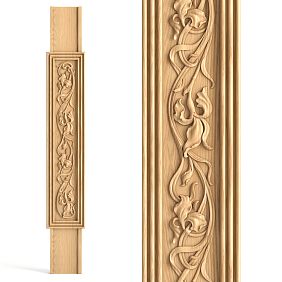


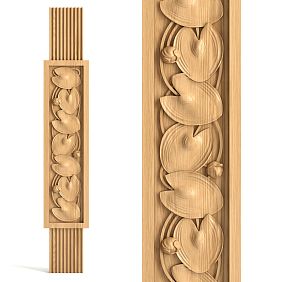

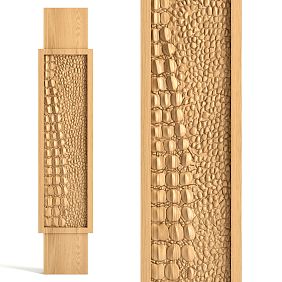

Cutouts: architecture of light in wooden plane
A cutout — a through hole in the wooden plane of a baluster — is not merely a decorative technique, but a key constructive and aesthetic element defining the character of flat balusters. In turned balusters, beauty is created by volume, convexities and concavities, the play of light and shadow on relief. In flat balusters, beauty is created by void, absence of material, light passing through cutouts.
Functional logic of cutouts: originally, cutouts in flat balusters served a practical function — reducing the weight of the structure without losing strength, ensuring ventilation (important for wooden railings prone to moisture accumulation), reducing sail area (critical for veranda and balcony railings exposed to wind loads). Removing part of the material in the central zone of the baluster, where stresses are minimal, did not reduce load-bearing capacity, but made the element lighter and more economical.
Over time, the functional cutout became a decorative motif. Masters began to vary the shape of cutouts, creating patterns, ornaments, entire compositions. Circular, oval, rhombic, shaped cutouts formed rhythmic sequences, where the alternation of material and void created a visual code, readable as text.
Types of cutouts by shape:
Geometric cutouts — circles, ovals, rhombuses, triangles, squares — create a strict, ordered pattern characteristic of northern traditions of Russian wooden architecture. The geometry of cutouts refers to cosmogonic concepts: circle — sun, rhombus — earth, triangle — elements. On modern flat balusters, geometric cutouts function as elements of minimalist design — pure form, devoid of superfluous meaning, creating a graphic pattern.
Plant cutouts — stylized leaves, flowers, branches — reflect the connection with nature, characteristic of Slavic culture as a whole. A cut-out leaf does not merely depict a natural object, but becomes a symbol of life, growth, renewal. On modern balusters, plant cutouts can be either naturalistic (accurate reproduction of leaf shape) or stylized (simplified silhouette, retaining recognizability but lacking detail).
Zoomorphic cutouts — silhouettes of birds, beasts, mythical creatures — add narrative, transforming the railing into a visual story. Traditional images — firebird, horse, swan — carry symbolic load, referring to fairy tales, myths, folk beliefs. Modern interpretations simplify forms, retaining recognizable silhouette but removing detail, creating a graphic, almost iconic image.
Abstract cutouts — a modern direction, where the shape of the cutout does not depict a specific object, but creates visual rhythm, dynamics, mood. Asymmetric, organic forms reminiscent of natural processes — flow of water, movement of wind, growth of plants. Abstract cutouts transform a flat baluster into a sculptural object, where each element is unique but functions as part of a whole composition.
Technology of creating cutouts:
Hand carving — traditional method, where the master cuts out cutouts with a coping saw or a dovetail saw, then manually processes the edges with chisels and gouges, removing bevels, rounding corners, creating smooth transitions. Handwork provides uniqueness — each cutout slightly differs from others, preserving tool marks, the character of the master’s hand movement. This is valued in author projects, where individuality of each element is important.
Laser cutting — modern technology, where a laser beam with micron precision cuts out cutouts of any complexity. Cutout edges are perfectly smooth, without chips or burrs, requiring no additional processing. Laser allows creating cutouts with extremely thin webs (1-2 mm), unattainable by hand. All cutouts are absolutely identical, which is important for mass production and modern interiors, where precision and repeatability are valued.
CNC milling — compromise between handwork and laser cutting. The milling cutter selects the material, creating cutouts with a light texture preserving the feeling of handwork. CNC ensures precision and repeatability while maintaining the "warm" character of handwork. The method is optimal for producing flat balusters in traditional style, where precision of form is important while preserving craft aesthetics.
Cutouts and light-shadow: key feature of cutout balusters — their dependence on lighting. Under frontal light (light source in front of balusters), cutouts appear as dark spots on a light surface — silhouette is clearly readable, form is graphic. Under backlight (light source behind balusters), cutouts become glowing elements — the baluster becomes a light filter, transmitting light through the pattern. Under side light, the thickness of the baluster creates additional light-shadow — cutouts have lit and shadowed sides, adding volume to the flat form.
On curved staircases or railings with turns, flat balusters with cutouts create dynamic play of light — as one moves along the railing, the viewing angle changes, cutouts open and close, creating a stroboscopic effect, visual flickering. This transforms a static railing into a dynamic, living interior element.




Patterns: from traditional ornaments to modern patterns
Pattern on a flat baluster — this is not merely decoration, but text written in the language of forms. Traditional patterns carry symbolic load, referring to mythology, cosmogony, folk beliefs. Modern patterns reinterpret tradition, preserving rhythm and structure, but freeing from literal symbolism, transforming it into abstract graphics.
Traditional Slavic carving patterns:
Solar symbols — circles, rosettes, eight-pointed stars — represent the sun, the source of life and warmth. On flat balusters, solar symbols are usually placed in the central part, serving as a visual accent. A circle may be filled with concentric rings, radial rays, geometric ornamentation, creating a complex, multi-layered composition within a single element.
Rhombic meander ornament — rhombuses with protrusions, zigzags, meanders (continuous broken lines) — symbolize the earth, field, fertility. This pattern type is characteristic of central and southern regions of Russia. On balusters, rhombuses often form a vertical chain, creating an upward rhythmic movement symbolizing growth, development, and the connection between earth and sky.
Tree of Life — stylized tree with branches, leaves, sometimes with birds — a universal symbol found in all cultures. On Slavic balusters, the Tree of Life usually occupies the entire height of the element: roots at the bottom, trunk in the center, crown at the top. This creates a vertical composition, natural for a vertical structural element.
Wavy lines and spirals — symbols of water, movement, time. Horizontal waves symbolize the water element, vertical lines — rain, spirals — whirlwind, cycle, infinity. On balusters, wavy lines often form a background on which other elements — geometric shapes, plant motifs — are placed, creating a multi-layered composition.
Plant motifs — grapevine, hops, oak leaves, berries — symbols of fertility, abundance, vital energy. After Christianization, the grapevine acquired an additional meaning — symbol of Eucharist, spiritual nourishment. On balusters, plant motifs usually create a continuous composition — the vine winds from one baluster to another, uniting separate elements into a single whole.
Zoomorphic images — birds (firebird, peacock, rooster), horses, lions, griffins — associated with mythology, fairy tales, heraldry. Birds symbolize soul, freedom, connection with the sky. Horses — strength, nobility, movement. Lions — power, protection. On balusters, zoomorphic images are usually depicted in profile, in heraldic pose (walking, rearing), creating a recognizable, iconic silhouette.
Modern reinterpretations of traditional patterns:
Geometric abstraction — traditional rhombuses, circles, zigzags are simplified to minimal forms, losing symbolic load, becoming pure geometry. A circle is simply a circle, a shape in itself, beautiful for its regularity, not as the sun. A rhombus is a geometric figure creating rhythm, not as a symbol of earth. This allows using traditional motifs in minimalist interiors where literal symbolism would be inappropriate.
Deconstruction of plant forms — traditional leaf, flower, branch are broken down into components, reinterpreted as sets of lines, spots, shapes. Recognizability is preserved at the silhouette level, but detail is removed. A leaf becomes a teardrop-shaped spot with one central vein. A flower — a circle with radial rays. A branch — a broken line. This creates stylization, where natural form becomes a graphic sign.
Asymmetrical composition — departure from strict symmetry, characteristic of traditional ornaments. Elements are arranged freely, creating a sense of naturalness, organic quality, living growth, rather than geometric regularity. Asymmetry makes each baluster unique, transforming the railing from a rhythmic pattern into a dynamic composition.
Combined patterns — combination of elements from different traditions. Slavic rhombuses + Scandinavian runes + Celtic knots. This creates an eclectic but cohesive image, where each element functions as part of a common decorative language. Combined patterns are popular in author projects where uniqueness, individuality, and originality are required.
Patterns and rhythm of the railing: if precisely turned balusters are usually identical and create rhythm through repetition, flat balusters often differ and create rhythm through alternation. Simple example: baluster A with a rhombus alternates with baluster B with a circle. More complex: a sequence of three to five different balusters repeats along the railing, creating a higher-order metronome.
Even more complex: each baluster is unique, but all are united by a common theme — all with plant motifs or all with geometric ones. This creates unity in diversity — the railing is perceived as a whole, but each element is interesting upon detailed examination.
Our factory also produces:


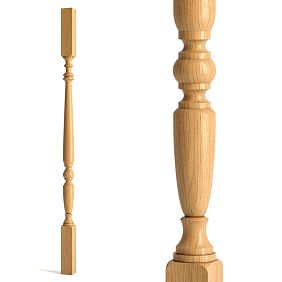

Carving: when the plane acquires volume
Carving on a flat baluster works differently than on a turned, three-dimensional one. On a turned baluster, carving is additional decoration layered on top of the already formed turned volume. On a flat baluster, carving is the primary method of creating form, transforming a flat board into a decorative element. Carving on flat balusters comes in three types: through (openwork), relief (flush), and combined.
Through carving — piercing the wooden plane through and through, creating openings discussed above. This is the main type of carving for flat balusters, defining their character. Through carving can be geometric (clear, regular shapes — circles, rhombuses, triangles) or plant-based (organic shapes — leaves, flowers, branches, requiring more complex cutting and edge finishing).
Openwork through carving — the highest level of skill, where wood is pierced with numerous small openings, creating a lace effect. Material and void are in equal proportions, the baluster appears almost weightless. Openwork carving requires fine, strong wood (beech, ash, oak) and high craftsmanship — the slightest error leads to breaking thin struts.
Relief carving — creating volume on the baluster's surface without piercing through. Relief can be low (2–5 mm depth — bas-relief) or high (5–15 mm — high relief). Relief carving on flat balusters usually complements through carving, creating a multi-layered composition: the main form is created by openings, detail — by relief.
Counter-relief — carving inward, where the background remains at the original surface level, and the image is recessed. This type of carving creates an interesting effect under side lighting — recessed elements are shadowed, the background is illuminated, the image reads as a dark silhouette on a light background.
Three-dimensional carving on flat balusters is rare, as it contradicts the idea of flatness. However, in some cases, three-dimensional applied elements — carved rosettes, scrolls, figurines — are attached to the main flat surface. This creates a complex, multi-layered composition, where the flat base serves as a background for the three-dimensional details.
Combined carving — combination of through and relief on one baluster. Typical example: through openings create the main pattern (rhombuses, circles), relief carving adds detail (plant motifs, geometric ornamentation within openings or on uncut areas). Combined carving creates visual richness, where each element contributes to the overall composition.
Carving techniques:
Geometric carving — the oldest type, using only geometric forms. Executed with a chisel, creating three-sided recesses. Combinations of recesses at different angles form rhombuses, rosettes, stars, knots. Geometric carving is readable under any lighting — even under diffused light, the edges of recesses create light and shadow.
Contour carving — cutting the image's outline to a depth of 2–5 mm. Creates a linear drawing, like an engraving. Used for plant motifs, zoomorphic images, complex compositions. Contour carving requires precise, confident hand — the line must be continuous, of equal depth and width.
Flat relief carving — creation of low relief (5–10 mm) while preserving a flat background. The image slightly protrudes or is recessed relative to the background, creating light volume. This type of carving is popular on flat balusters, as it does not violate the idea of flatness, but adds volume.
Through (openwork) carving — cutting through the background, leaving only the image. Creates a lace effect. Requires fine wood and precise tools. Traditionally executed with a fret saw, modern masters use CNC laser or router machines.
Carving and wood species: for carving on flat balusters, not only wood hardness (determining durability) but also its structure matters. Fine-grained woods (beech, maple, linden, pear) allow creating fine details, clear lines, smooth transitions. Coarse-grained woods (oak, ash) produce a rougher, textured carving, where wood grain becomes part of the decoration.
Soft woods (linden, aspen, pine) are easy to carve, suitable for beginners, but less durable, especially for delicate openwork elements. Hard woods (oak, beech, ash) are more difficult to work with, require sharp tools and experience, but produce durable, long-lasting items.
Get Consultation
Minimalism: how traditional form becomes modern
Minimalism and flat balusters seem incompatible — traditional craft form with carving and ornamentation versus modern philosophy 'less is more'. But flat balusters turned out to be the ideal material for minimalist reinterpretation of tradition. Removing excessive decoration, preserving the purity of silhouette, minimalism revealed the beauty of the flat plane, geometry of openings, rhythm of voids, and material itself.
Minimalist flat balusters: characteristics:
No ornamentation — no plant motifs, zoomorphic images, symbolic patterns. Form is created not by decoration, but by geometry. If there are cutouts, they have the simplest shapes — circle, square, rectangle, vertical slit. Their placement follows mathematical logic — even spacing, symmetry, proportions.
Line purity — all contours are clear, straight or perfect curves (circles, ellipses). No arbitrary bends or organic forms. Top and bottom edges of the baluster are parallel or have simple geometric shapes (angled bevel, rounded edge). Side edges are strictly vertical or slightly taper upward, creating a trapezoidal silhouette.
Monochromaticity — color is uniform, without transitions, patinas, or artificial aging. Either natural wood color with a transparent matte finish (emphasizing texture but not adding gloss), or monochromatic staining (white, gray, black) with complete concealment of texture.
Thin profile — minimalist flat balusters are typically thinner than traditional ones — 15–20 mm versus 25–30 mm. This creates a sense of lightness, graphic quality, almost weightlessness. A thin baluster functions as a line in space, not as a volume.
Verticality — absence of horizontal divisions, decorative bands, or changes in width along height. The baluster is a continuous vertical element from base to handrail. Verticality enhances the sense of height and upward aspiration, characteristic of minimalist architecture.
Examples of minimalist solutions:
Solid balusters — without cutouts, a solid plane. Form is created solely by silhouette. The baluster may be rectangular with constant width (the most strict solution), trapezoidal (widening toward the bottom for visual stability), or with rounded top edges (softening rigidity).
Balusters with one vertical slit — a narrow (5–10 mm) slit running the full height of the baluster. The slit may be centered (dividing the baluster into two equal parts) or offset (creating asymmetry). The vertical slit enhances verticality and creates subtle play of light.
Balusters with rhythmic circular cutouts — several (3–5) circular holes of equal diameter, arranged along the vertical axis with even spacing. This is minimal decoration, creating rhythm without ornamentation. Circles may be uniform in size (even rhythm) or decrease upward (creating visual movement).
Balusters with horizontal slits — several (2–4) horizontal cutouts, creating rhythmic division. Slits may span the full width of the baluster or not reach the edges. Horizontal slits create visual contrast with the baluster’s verticality, adding dynamism.
Combination of different baluster widths — alternating narrow (80–100 mm) and wide (150–200 mm) balusters without cutouts. Rhythm is created not by decoration, but by variation in element proportions. Wide balusters act as visual accents, narrow ones as fillers.
Minimalism and material: for minimalist flat balusters, wood species selection is important. Wood with pronounced texture (oak, ash) creates visual noise, distracting from form purity. Preferred species have uniform, fine texture (beech, maple, birch) or complete texture concealment via staining.
Staining white — the most popular solution for minimalist balusters. White color nullifies texture, transforming the baluster into a geometric object, emphasizing line purity. Staining gray creates a more restrained, neutral look. Black — dramatic, contrasting, but risky choice, requiring interior support.
Minimalism and installation: minimalist balusters require flawless installation. Any irregularities, misalignments, or uneven spacing are immediately noticeable due to the absence of distracting decoration. All balusters must be strictly vertical, installed with perfectly even spacing, and all cutouts at the same level (if any). This requires precise marking, use of templates, level and plumb check.
Ethnic motifs: from literal copying to stylization
Ethnic motifs in flat baluster design — a broad spectrum from literal reproduction of historical samples to subtle stylization, where ethnicity is implied rather than quoted. Modern approach to ethnic motifs — not museum reconstruction, but creative reinterpretation, where traditional elements are adapted to contemporary aesthetics and functionality.
Slavic ethnic motifs:
Historical samples — flat balusters from terem, izba, and estate buildings of the 17th–19th centuries — preserved in museums of wooden architecture (Kizhi, Malye Korely, Vitoslavlitsy). These are carved compositions with solar symbols, plant ornaments, zoomorphic forms. Literal copying of such balusters creates a museum-style, historically styled interior — suitable for Russian restaurants, ethnic hotels, private homes in traditional style.
Stylization — simplification of forms, enlargement of elements, abandonment of fine detailing. Traditional rhombic-meander ornament transforms into a sequence of large rhombs without small fillings. Plant motifs — stylized leaves with simplified contours. This creates recognizable ethnicity without literal copying, suitable for modern interiors with ethnic accents.
Abstraction — complete departure from recognizable forms, retaining only principles: composition verticality, rhythm, symmetry or asymmetry, characteristic of tradition. The baluster appears modern, but detailed analysis reveals the logic of traditional ornament.
Scandinavian motifs:
Scandinavian tradition of wooden carving is close to Slavic, but more restrained and geometric. Characterized by runes (not as functional writing, but as decorative signs), interwoven bands, stylized dragon ships (dракkar), plant motifs of northern flora (fir, fern, moss).
Modern Scandinavian aesthetics value minimalism, naturalness, functionality. Flat balusters in Scandinavian style usually have the simplest form, minimal decoration (one or two geometric cutouts), natural color of light wood (pine, fir, birch) with matte oil. This creates a sense of northern restraint, purity, and connection to nature.
Japanese motifs:
Japanese tradition of wooden architecture — another philosophy of form. Not carving and ornament, but line purity, tectonics (visibility of structure), asymmetry, emptiness as compositional element. Flat balusters in Japanese style — more like geometric-patterned lattices (squares, rectangles forming regular grids), rather than carved elements.
Characteristic techniques: alternating vertical and horizontal elements creating a grid structure (sёdзи-скрин), asymmetrical placement of cutouts creating dynamic balance, contrast between dark wood (veneered, stained oak) and light walls.
Middle Eastern and Indian motifs:
Arabesques — infinite interweavings of stylized plant forms — technically complex for flat balusters (require delicate openwork carving), but simplified versions create recognizable Middle Eastern character. Characterized by pierced carved lattices (mashrabiya), geometric star patterns, calligraphic elements.
Indian tradition — abundance of detail, complexity of ornamentation, multi-layered composition. Flat balusters with Indian motifs are usually covered in carving almost entirely, with plant motifs (lotus, mango, bananas), zoomorphic forms (elephants, peacocks, monkeys), geometric borders.
Ethnic motifs and modern interior:
Full immersion — an interior where all elements (balusters, furniture, decor, textiles) are unified under one ethnic tradition. Creates the feeling of a journey, transporting you to another culture. Requires a professional approach to avoid turning into a museum exhibit or kitsch.
Ethnic accents — a modern neutral interior (minimalism, Scandinavian style) with several bright ethnic elements. Balusters with Slavic, Japanese, or Indian motifs become art objects, drawing attention and creating individuality.
Eclecticism — mixing elements from different ethnic traditions. Slavic balusters + Japanese minimalism in overall layout + Moroccan textiles. Eclecticism is the riskiest but also the most creative approach, requiring a sense of proportion and compositional skill.
Installation of flat balusters: features and nuances
Installation of flat balusters differs from that of turned balusters not only in mounting technique but also in placement logic. Turned balusters are installed independently of each other — each vertically, with even spacing. Flat balusters often form a composition — the pattern of one baluster continues onto the next, with all elements working as a single whole. Errors in marking, incorrect installation order, or deviation from verticality disrupt the entire composition.
Preparation for installation:
Laying out and numbering — before installation, lay out all balusters on the floor in the order they will be installed. If balusters form a continuous composition (pattern transitions from one to another), mark them with a pencil on the bottom end. This eliminates confusion during installation.
Checking dimensions — measure the height of all balusters. Deviation exceeding ±2 mm requires sorting: balusters of the same height are installed on one section, different heights — on another. Mixing balusters of different heights will create an uneven handrail.
Checking end perpendicularity — ends must be strictly perpendicular to the baluster’s plane. A non-perpendicular end will prevent vertical installation. Check with a square, and if necessary, trim the ends.
Marking installation locations:
For staircases — balusters are usually installed on treads. The classic option is one baluster centered on each tread. For narrow treads (step 250–280 mm), one baluster is sufficient. For wide treads (step 300–350 mm), two balusters per tread are required to meet safety norms (gap between balusters no more than 150 mm).
Marking: mark the center of each tread (or two points at 1/3 width from edges), draw a vertical line through all treads. Balusters will be installed along this line. Use a level or plumb bob to check verticality of the line.
For straight railings (terraces, balconies, platforms) — marking with even spacing. Measure the length of the railing between support posts, calculate the spacing: Spacing = Length / (Number of balusters - 1). Mark installation points with calculated spacing, check for evenness.
Use a template — a rail with holes spaced at the desired interval. Place the template against the base, mark installation points through the holes. This is faster and more accurate than manual marking.
Ways to mount flat balusters:
Dowel joint — traditional, most reliable method. A dowel (projection) of section 8×40 or 10×50 mm is cut into the bottom end of the baluster, and a corresponding groove is milled into the base (tread, floor, handrail support). The dowel is inserted into the groove with wood glue. The joint is invisible, strong, and works under shear and bending.
Technology: mark the position of grooves on the base, mill grooves to a depth of 20–25 mm. Apply glue to the groove and dowel, insert the baluster, align vertically (check with level), temporarily fix with clamps until glue dries (12–24 hours).
Mounting on dowels — simplified version of dowel joint. Drill holes of 8–10 mm diameter in the baluster’s end and in the base, insert wooden dowels (cylindrical rods) with glue. The baluster is mounted on the dowel protruding from the base.
Technology: mark the centers of holes on the baluster’s end and on the base (exact alignment is critical), drill holes 20 mm deep in the baluster and 25 mm deep in the base. Insert the dowel into the base hole with glue (15 mm protruding above surface), apply glue to the protruding part of the dowel, mount the baluster, align, and fix.
Mounting from below with screws — for bases accessible from below (wooden floor on joists, treads with access from below). A 5–6 mm diameter screw, 70–80 mm long, is screwed from below through the base into the baluster’s end. The mounting is invisible from above but less secure than dowel joint.
Technology: place the baluster in position without mounting, align vertically, drill a pilot hole 3–4 mm diameter from the base side through the base into the baluster’s end to a depth of 40–50 mm. Screw in the screw, ensuring the baluster does not shift. Optionally, apply glue to the end before installation.
Mounting on metal brackets — for cases where dowel joint is impossible (concrete or stone base). A metal bracket is screwed to the base with anchors or wall plugs, and the vertical flange is screwed to the side of the baluster with screws. Mounting is visible and requires decorative covers for concealment.
Mounting top ends to handrail:
Into handrail groove — a longitudinal groove is milled into the underside of the handrail, width equal to baluster thickness + 1–2 mm (for 20 mm balusters, groove 21–22 mm), depth 15–20 mm. Top ends of balusters are inserted into the groove with glue. The joint is invisible from below and strong.
For staircases with incline, ends of balusters must be beveled at the angle equal to the incline of the stair run, so balusters stand vertically and ends fit tightly into the handrail groove. Beveling is done with a miter saw or by hand sawing according to a template.
On dowels to underside of handrail — if groove is impossible or undesirable. Drill holes in the top end of balusters and underside of handrail, insert dowels. Technology is similar to mounting bottom ends.
Screwing from above through handrail — simplest but least aesthetic method. Screws are screwed from above through the handrail into baluster ends. Screw heads are countersunk, holes are filled with putty and sanded. After painting, fasteners are almost invisible, but visible under transparent coating.
Features of installing flat balusters with slots:
Slots must be at the same level on all balusters. When marking, note not only horizontal position of balusters but also their vertical orientation. Use a horizontal line (tensioned string) to align slots relative to it.
If balusters form a continuous composition with a transitioning pattern, even the slightest height misalignment will break continuity. Use a temporary horizontal board with slots to fix all balusters at the same level during installation.
Mounting Quality Check:
Verticality — each baluster must be strictly vertical in both planes (perpendicular to both the base and the handrail). Check with a level applied to the baluster’s plane. Deviation exceeding 1–2 mm at a height of 900 mm is visually noticeable.
Spacing uniformity — the distance between adjacent balusters should be identical along the entire length of the railing. Deviation of ±5 mm is acceptable; more than that is visually noticeable. Measure the gaps between all balusters and compare.
Height alignment — if balusters have slots, the slots must be at the same level. Visually inspect along the railing — the slots should form horizontal lines.
Sturdiness — an installed baluster must not wobble. Grip the top edge and attempt to rock it. Play exceeding 1–2 mm indicates weak fastening and requires reinforcement (additional dowel, glue, screw).
Conclusion
Flat balustersThis is a parallel universe within the world of stair railings. Here, the logic of form is determined not by turning, but by carving. Here, beauty is created not by volume, but by silhouette. Here, decoration is not relief on the surface, but the play of light passing through slots. Here, each element carries the memory of artisanal tradition, rooted in Slavic wooden architecture.
Slots transform a baluster into a light filter — during the day, light passing through the pattern casts projections on walls and floors; in the evening, with backlighting, the railing becomes a glowing lace. This is architecture of light in a wooden plane, where void is as important as material.
Patterns on flat balusters — this is text written in the language of form. Traditional ornaments carry symbolic weight — solar symbols, fertility rhombuses, Tree of Life, zoomorphic forms. Modern patterns reinterpret tradition — geometric abstraction, deconstruction of botanical forms, asymmetrical compositions. From literal copying of historical motifs to subtle stylization, where ethnicity is read as a hint.
Carving on a flat baluster — the primary method of creating form. Through-carving pierces the plane with slots, creating an openwork, lace-like effect. Relief carving adds volume, detail, and multiplanarity. Combined carving combines both types, creating visual richness. Techniques range from ancient geometric carving with a chisel to modern laser cutting with micron precision.
Minimalism revealed a new beauty in flat balusters — by removing excessive decoration, it exposed the purity of lines, geometry of slots, rhythm of void and material. Solid balusters without slots, balusters with a single vertical slot, with rhythmic round holes — minimal decoration, maximum expressiveness. Monochromatic staining transforms the baluster into a geometric object, where only form matters.
Ethnic motifs — from Slavic solar symbols to Japanese lattice structures, from Near Eastern arabesques to Scandinavian restraint. Modern approach — not museum reconstruction, but creative reinterpretation, where traditional elements are adapted to contemporary aesthetics. Stylization, simplification, abstraction — methods to preserve the spirit of tradition without literal copying.
Installation of flat balusters requires special attention — they often form a composition where the pattern transitions from one baluster to another. An error in installation order, deviation from verticality, uneven spacing disrupts the entire composition. Dowel joints, dowels, screws from below — each fastening method has its advantages. Fastening into the handrail groove creates an invisible, strong connection.
The company STAVROS offersFlat balustersVarious types: traditional with carved ornaments (solar symbols, botanical motifs, geometric patterns), minimalist with simple geometry (solid, with vertical slots, with round holes), modern with abstract compositions (asymmetrical forms, deconstructed botanical motifs).
Manufacturing on CNC routers and laser machines ensures precision of form (±0.2 mm), identity of all elements in a batch, possibility of creating complex patterns. Manual finishing adds individuality — chamfering, light sanding, emphasizing relief. Species: pine, larch (for stained balusters and outdoor use), beech, oak, ash (for balusters with transparent finish, highlighting texture).
Final finishing: transparent finishes (oil, matte or semi-matte lacquer), staining (white, gray, black, colors from RAL/NCS catalog), patination (artificial aging with dark patina in carved recesses), brushing with tinting (to emphasize wood texture).
Custom manufacturing from sketches — possibility to create unique balusters reflecting the interior’s individuality. Provide a sketch, reference photo, or description of the idea. Technicians will develop the construction, create a 3D model for approval, and produce a sample. After approval — mass production of the entire batch.
Technical consultation: calculation of required baluster quantity, selection of optimal installation spacing, recommendations on fastening method for specific base type (wooden, concrete, metal frame), selection of compatible posts and handrails, color solutions considering interior design.
Fastening kits: beech fluted dowels with 8 or 10 mm diameter, polyurethane wood glue (Titebond, Kleiberit), wood screws (for bottom fastening), metal angles with anchors (for concrete bases). Full calculation of required fasteners for your project.
Flat balusters — a choice for those who value restrained geometry over excessive decoration, who see beauty in silhouette rather than volume, who understand the language of slots and patterns, who feel a connection to artisanal tradition. This is for interiors where the staircase does not shout, but delicately complements the space. Where the railing is not a massive structure, but a light, almost graphic form. Where each element carries meaning, history, memory of ancestral craftsmanship.
Flat balusters: restrained geometry and reference to artisanal tradition | Company STAVROS


