












































































Article Contents:
- Skirting Board Typology: Ceiling vs. Floor
- Ceiling Skirting Boards: Covings, Cornices, Moldings
- Floor Skirting Boards: Protection and Framing
- Flexible Skirting Boards: A Solution for Curved Surfaces
- Flexible Polyurethane Technology
- Application of Flexible Skirting Boards
- Installation of Flexible Skirting Boards
- Skirting Boards with Cable Channels: Beauty and Functionality
- Baseboard construction with cable channel
- Installation of Skirting Boards with Cable Channels
- Size Range: From Miniature to Monumental
- Miniature Skirting Boards: 30-60 mm
- Standard Skirting Boards: 60-100 mm
- Tall Skirting Boards: 100-160 mm
- Euro Skirting Boards: 150-300 mm
- Skirting Board Installation: Two Strategies
- Adhesive Installation: Cleanliness and Simplicity
- Screw Installation: Reliability and Versatility
- Corner Joining: The Art of Invisible Seams
- Tools for Cutting Corners
- Technology for Joining Internal Corners
- Technology for Joining External Corners
- Sealing Joints: Putty and Sealant
- Painting Skirting Boards: Color as a Strategy
- Strategy 1: Skirting Board in Wall Color
- Strategy 2: Contrasting Skirting Board
- Strategy 3: Skirting Board in Floor Color
- Frequently Asked Questions about Polyurethane Skirting Boards
- Can polyurethane skirting boards be installed in bathrooms and kitchens?
- Does polyurethane yellow over time?
- How to cut a polyurethane baseboard if you don't have a miter saw?
- Can you bend a regular (non-flexible) polyurethane baseboard?
- How long after installation can you paint a baseboard?
- Which baseboard to choose if the walls are very uneven?
- Conclusion: Baseboard — the frame of the interior

The renovation is finished. The floor is laid — parquet, laminate, tile laid perfectly. The walls are leveled — a perfect plane, fresh paint or wallpaper. The ceiling is done — smooth, snow-white, without a single defect. And everything seems right, everything is according to technology. But you stand in this room — and something is missing. A sense of incompleteness hangs in the air. The eye catches the joint between the floor and the wall — a three-millimeter gap, an uneven edge of the flooring sticking out. You look at the ceiling — the border with the wall is sharp, the geometry is precise, but cold, soulless. There is no transition, no softness, none of that architectural delicacy that turns a box into a living space.
What's missing? Baseboards. Those strips of material, 5-20 centimeters high, that run along the perimeter of the room at the bottom (floor) and at the top (ceiling), connecting the vertical and horizontal planes.Polyurethane baseboard moldingsolves four problems at once: functional (masks gaps between the wall and floor/ceiling, protects the wall from mechanical damage at the bottom, hides wiring in cable channels), aesthetic (creates a visual frame for the room, sets proportions, adds an architectural detail), technical (compensates for uneven joints, covers thermal expansion joints of floor coverings), stylistic (classical profile for classic, minimalist for modern, high European baseboard for neoclassical).
Why polyurethane? Because it's a chameleon material: three times lighter than wood (a 100 mm high baseboard weighs 0.5-0.8 kg/meter compared to 1.5-2.5 kg for wooden), 2-4 times cheaper than wood (average price of polyurethane baseboard 350-850 rub./meter, wooden 800-2500 rub./meter), moisture-resistant unlike wood and MDF (does not swell in bathrooms and kitchens, does not rot, does not mold), flexible (there are special flexible models for curved walls, columns, bay windows — wood cannot bend like that without steaming), can be painted any color (white, black, wood-like, marble-like, gold — acrylic paints last on polyurethane for decades), lasts 30-50 years without deformation (wood dries out after 10-15 years, MDF swells from moisture, plastic yellows from ultraviolet light, polyurethane is stable).
This article is a complete encyclopedia of polyurethane baseboards. We will analyze the types (ceiling and floor — what are the differences, how each works), the size range (height from 30 to 300 mm, how to choose for a specific room), specialized types (flexible for curved surfaces, with cable channels for hidden wiring, with lighting for modern interiors), installation technology (glue or screws — when to use what, how to join internal and external corners without gaps, how to cut at 45 degrees without a miter box), finishing (painting to match the color of walls, ceiling, floor or contrasting — which option works in which style). The goal is to provide a tool for completing the interior, where every boundary of the room is framed, every joint is closed, every line is precise.


Typology of baseboards: ceiling vs. floor
Baseboard is a general name for linear profiles installed at the boundaries of a room. But ceiling and floor baseboards are two different universes in terms of functions, construction, and installation.




Ceiling baseboards: coving, cornices, moldings
Ceiling baseboard (also called coving, cornice, molding) — a profile installed at the junction of the wall and ceiling. The standard plank length is 200 or 240 cm (polyurethane ones are usually 240 cm — more convenient for large rooms, fewer joints).
Functions of a ceiling baseboard:
Visual separation of the ceiling from the walls — creates a boundary, fixes the transition from the vertical plane (wall) to the horizontal (ceiling). Without a baseboard, the ceiling and wall merge — the boundary exists geometrically but is not perceived architecturally.
Masking joint defects — builders rarely make the angle between the wall and ceiling perfect (gaps of 2-5 mm, plane differences, unevenness). The baseboard covers a width of 40-150 mm from the joint — everything is hidden.
Placement of hidden lighting — LED strip is placed behind the baseboard (the baseboard is installed with a 50-100 mm gap from the ceiling, the strip is in the gap, light is directed upward onto the ceiling). The ceiling is illuminated from within, visually rises, floats.
Architectural proportion — a wide ceiling baseboard (100-200 mm) visually lowers the height of the room (the ceiling boundary drops by the width of the baseboard), makes the space more intimate, cozier. A narrow baseboard (40-70 mm) preserves height, works delicately.
Types of ceiling baseboard profiles:
Smooth — without ornament, simple geometric lines (beads, rolls, straight edges). Width 40-100 mm, price 280-580 rub./meter. For minimalist and modern interiors.
Ornamental — with relief decoration (dentils, egg-and-dart, meander, acanthus leaves, palmettes). Width 80-220 mm, relief depth 10-30 mm, price 480-1650 rub./meter. For classical interiors (classicism, neoclassicism, baroque).
With a cavity for lighting — the profile contains a channel or is mounted so that a gap remains between the baseboard and the ceiling. Width 60-140 mm, price 620-1380 rub./meter.
Ceiling baseboard height depending on ceiling height:
| Ceiling Height | Optimal baseboard width | Interior style |
|---|---|---|
| 2.4-2.5 m | 40-70 mm | Modern, minimalism |
| 2.5-2.7 m | 60-100 mm | Modern, neoclassical, Scandinavian |
| 2.7-3.0 m | 80-130 mm | Classic, neoclassic |
| 3.0-3.5 m | 110-180 mm | Classic, baroque, country houses |
| More than 3.5 m | 140-250 mm | Palace interiors, mansions, lofts |
Rule: ceiling skirting board width is 3-6% of room height. Ceiling 2.7 m (270 cm): 3% = 8 cm, 6% = 16 cm → skirting board 80-160 mm. Selection within this range depends on style (minimalism closer to 3%, classic to 6%).
Our factory also produces:


Floor skirting boards: protection and framing
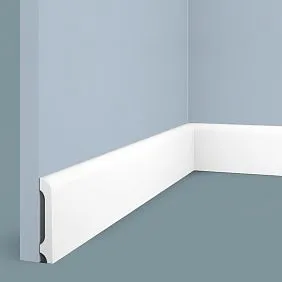
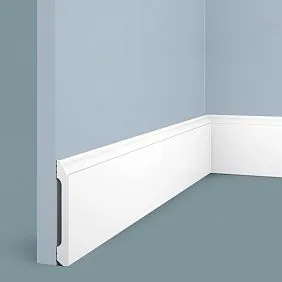
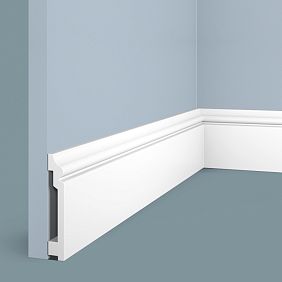
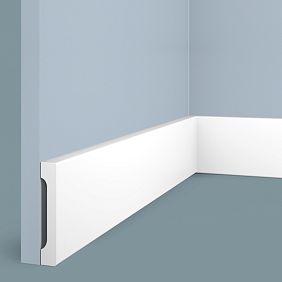
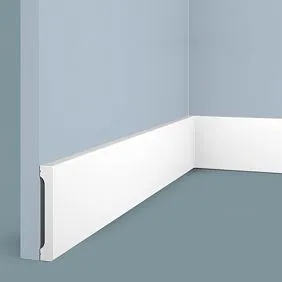
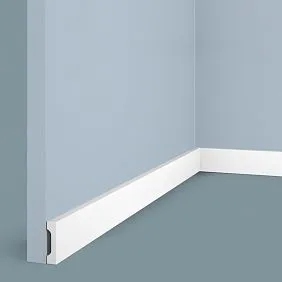
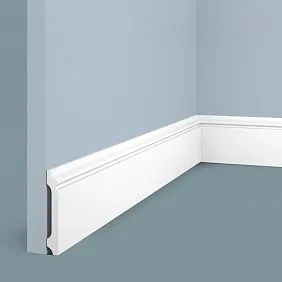
Floor skirting board — a profile installed at the junction of wall and floor. Height from 30 to 300 mm (standard 60-140 mm, tall European skirting boards 150-300 mm). Plank length 200-240 cm.
Functions of floor skirting board:
Concealing the gap between floor and wall — when laying flooring (laminate, parquet, linoleum, tile) a 5-15 mm expansion joint is left around the perimeter (material expands/contracts with temperature and humidity changes, the joint compensates for movement). The skirting board covers this joint.
Protection of the lower part of the wall — the wall in the 10-20 cm zone from the floor is subject to impacts (feet when walking, mop and vacuum cleaner during cleaning, furniture when rearranging). The skirting board absorbs the impacts, the wall (wallpaper, paint, plaster) remains intact.
Hiding wiring — skirting boards with cable channels contain a cavity for laying wires (electrical, TV, internet cables). Wires are hidden, not lying on the floor, not spoiling the appearance.
Visual boundary — the skirting board creates a clear line between floor and wall, completes the flooring (floor without skirting looks unfinished, hanging in the air).
Types of floor skirting board profiles:
Simple (rectangular or rounded) — minimal relief, one or two grooves or a bead. Height 50-100 mm, price 250-520 rubles/meter. For modern interiors.
Figural (profiled) — complex profile with curves, beads, steps (imitation of classic wooden skirting boards). Height 70-140 mm, price 380-780 rubles/meter. For neoclassical and classic styles.
Ornamental — with plant decoration (stylized leaves, meander). Height 80-160 mm, price 520-1200 rubles/meter. For classic and baroque interiors.
Tall European skirting boards — skirting boards 150-300 mm high, creating a powerful vertical boundary. Visually raise the ceiling (the floor boundary rises by 20-30 cm, room proportions change — height is perceived as greater). Popular in neoclassical interiors, lofts, minimalism with high ceilings. Price 680-1850 rubles/meter.
Height of floor skirting board depending on ceiling height:
| Ceiling Height | Optimal baseboard height | Room purpose |
|---|---|---|
| 2.4-2.5 m | 50-80 mm | Apartments, small rooms |
| 2.5-2.7 m | 70-100 mm | Standard apartments, living rooms, bedrooms |
| 2.7-3.0 m | 90-140 mm | Improved apartments, country houses |
| 3.0-3.5 m | 120-200 mm | High ceilings, country houses, studios |
| More than 3.5 m | 180-300 mm | Lofts, mansions, double-height spaces |
Rule: floor skirting height is 3-5% of wall height. Ceiling 2.7 m: 3% = 8.1 cm, 5% = 13.5 cm → skirting 80-135 mm.
Get Consultation
Flexible skirting: solution for curved surfaces
Standard polyurethane skirting is rigid (does not bend without heating or risk of breaking). But interiors feature curved elements: round or semicircular columns, bay windows (wall projections with a radius of 1-3 meters), radius partitions, arched openings. How to skirt around them? Use flexible polyurethane.
Flexible polyurethane technology
Flexible polyurethane skirting is made from the same polymer composition, but with increased content of elasticizing additives (plasticizers) and reduced foam density. Result: density 180-240 kg/m³ (vs. 300-380 kg/m³ for rigid), high elasticity (skirting bends by hand to a radius from 400 mm to infinity).
Flexible skirting characteristics:
Minimum bending radius: 400-600 mm (depends on profile height — the taller the skirting, the larger the minimum radius; 50 mm skirting bends to a 400 mm radius, 120 mm skirting — to an 800 mm radius).
Strip length: 200-240 cm (standard).
Weight: 20-30% lighter than rigid (flexible skirting 80 mm high weighs 0.35-0.50 kg/meter, rigid 0.50-0.70 kg/meter).
Price: 30-50% more expensive than rigid (flexible skirting 80 mm costs 520-850 rub./meter, rigid 350-580 rub./meter) — more complex production technology, special additives.
Application of flexible skirting
Going around columns: column diameter 400 mm (radius 200 mm), need to install floor skirting around the base. Rigid skirting is not suitable (does not bend to a 200 mm radius). Options: cut rigid skirting into short 5-10 cm segments, install them in a broken line around the column (forms a polygon approximating a circle — visually imperfect, joints visible) or use flexible skirting (one 130 cm piece wraps around a 40 cm diameter column, perimeter π×40 = 125.6 cm, plus allowance). Flexible skirting bends along the circumference, is glued — results in a smooth line without joints.
Bay windows: bay window with a 2-meter radius, arc length 3-4 meters. Flexible skirting is laid along the arc (pressed against the wall, fixed with glue or temporary fasteners until the glue dries).
Arches: if an arched opening needs to be framed with skirting (floor skirting transitions to vertical, wraps around the arch, descends on the other side — an unusual but effective solution for classic interiors), flexible skirting bends along the arch's arc.
Radius walls: in modern layouts, walls are sometimes not straight but smoothly curved (design technique to create spatial fluidity). Flexible skirting follows the wall's curve.
Installation of flexible skirting
Technology is identical to rigid, but with nuances:
Glue: use polyurethane glue (Cosmofen, European Plus) or high-strength liquid nails (Moment Montazh Supersilny). Acrylic mounting adhesives hold worse on flexible surfaces (flexible skirting tends to straighten after installation — the glue must withstand this force).
Fixation during drying: flexible skirting is forcibly bent (you bent it by hand to the wall or column radius), after gluing it tries to straighten (material elasticity). For 24 hours (full glue drying time) fix the skirting: with painter's tape (strips of tape from skirting to wall every 20-30 cm, taut, pressing the skirting), weights (if floor skirting, place heavy objects along it — books, bricks, dumbbells — pressing the skirting against the wall from below), temporary small nails (20 mm finishing nails driven into the wall through the skirting every 30 cm, removed after glue dries, holes filled).
Skirting with cable channel: beauty and functionality
Wiring in modern interiors is a problem. Wall-mounted TV, internet router in the corner, table lamp on a nightstand, phone charger by the bed — wires run to each device. Running wiring in walls (chasing, embedding) is expensive (5000-15000 rub. per room, walls are damaged, dust, dirt) and inflexible (if you want to move the TV, you have to chase again). Wires along skirting — traditional solution, but aesthetically debatable (if wires are visible).
Polyurethane molding skirtingwith cable channel — elegant compromise: wires hidden inside the skirting (completely invisible), accessible (open the cable channel lid — take out a wire, add a new one, close), flexible (you can lay an additional cable at any time without renovation).
Skirting board construction with cable channel
Base: lower part of the skirting (height 40-70% of total height), attached to the wall with screws or glue. Contains a cavity (cable channel) with cross-section from 15×15 mm to 40×40 mm (depends on skirting height).
Cover: upper decorative part (height 30-60% of total height), snaps onto the base after laying cables. Hides the cavity, creates an aesthetic look. Removable without tools (pressed from above, snaps onto locks on the base sides; to remove, pry with a flat screwdriver, unclips).
Cable channel: cavity between base and cover. Cross-section determines how many cables fit:
15×15 mm — 2-3 thin cables (internet, TV, one power cable 2×0.75 mm²).
20×20 mm — 3-5 cables (two power cables 3×1.5 mm², two internet, one TV).
25×25 mm — 5-7 cables (three power cables 3×1.5 mm², three internet/telephone cables).
30×30 mm and larger — 7-10 cables (universal option, reserve for future additions).
Skirting board height with cable channel:
| Baseboard Height | Channel cross-section | Number of cables | Price, rub./meter |
|---|---|---|---|
| 60 мм | 15×15 mm | 2-3 | 420-680 |
| 80 мм | 18×18 mm | 3-4 | 480-750 |
| 100 мм | 22×22 mm | 4-6 | 550-820 |
| 120 мм | 25×30 mm | 6-8 | 620-950 |
| 140 мм | 30×35 mm | 8-10 | 720-1100 |
Installation of skirting board with cable channel
Step 1: Marking and base installation. Mark a horizontal line on the wall at the height of the lower edge of the base (if the skirting board is 100 mm, base is 70 mm, line at 70 mm from the floor). Place the base against the wall with the lower edge on the floor, upper edge to the line. Drill holes through the base into the wall (diameter 6 mm, depth 40 mm, spacing 40-60 cm). Insert 6×40 mm dowels, screw the base with 4×40 mm screws.
Step 2: Cable laying. Place cables in the base channel (run along the entire perimeter of the room or only to the required point — outlet, TV). In corners, bend the cable smoothly (bend radius at least 25-30 mm for standard cables). If there are many cables, separate them into layers (bottom layer — power cables, top — low-voltage; this reduces electromagnetic interference).
Step 3: Cover installation. Snap the cover onto the base (place the cover on top, press down — the latches will click, the cover is fixed). Check along the entire length (the cover should fit tightly, without gaps).
Step 4: Corner joining. In room corners, the base and cover are joined at a 45° angle (cut with a miter saw or miter box). The base joint and cover joint must align (otherwise the cover won't snap on). Fill joints with white acrylic sealant, smooth out.
Size range: from miniature to monumental
Skirting board height is not a manufacturer's whim, but an architect's tool for managing room proportions.
Miniature skirting boards: 30-60 mm
Application: small rooms (area up to 12 m², ceiling height 2.4-2.5 m), minimalist interiors (Scandinavian, Japanese minimalism, contemporary), rooms with low ceilings (a high skirting board will visually lower the ceiling even further).
Profile style: simple rectangular or with one rounded radius (without complex moldings).
Price: 180-380 rub./meter.
Standard skirting boards: 60-100 mm
Application: standard apartments (ceiling height 2.5-2.7 m), universal interiors (suitable for most styles — from modern to neoclassical), living rooms, bedrooms, kitchens, hallways.
Profile style: simple and shaped, with grooves, beads, minimal ornamentation.
Price: 280-620 rub./meter.
Most popular size: 80 mm (floor skirting board). The golden mean between visual prominence (the skirting board is visible, performs a decorative function) and restraint (does not overload, does not dominate). Suitable for 70% of interiors.
High skirting boards: 100-160 mm
Application: rooms with ceilings 2.7-3.2 m, classical and neoclassical interiors (where solidity, architectural expressiveness are valued), living rooms, dining rooms, studies in apartments and country houses.
Profile style: shaped with multi-level moldings, ornamental with plant decor (acanthus, meander, stylized leaves).
Effect: A high skirting board creates a powerful horizontal line at the floor (visually grounds the room, makes it stable, steady), highlights the boundary (the border between floor and wall is clearly accentuated), and is appropriate with classic furniture (tall furniture + high skirting board = proportional harmony).
Price: 420-980 RUB/meter.
Euro skirting boards: 150-300 mm
Application: Rooms with ceilings 3.0+ meters, neoclassical interiors (modern interpretation of classicism — minimalist forms but monumental scales), lofts (high ceilings, industrial elements + classic skirting boards = style contrast), mansions, double-height spaces.
Profile style: Smooth (Euro skirting boards are often minimalist — rectangular profile without ornament, painted in a bright or contrasting color) or with geometric grooves (1-3 vertical or horizontal grooves creating rhythm).
Effect: A 200 mm high Euro skirting board occupies a significant part of the wall (20 cm out of 270 cm height = 7.4% of the wall), becomes an architectural element (not just a technical detail, but part of the composition), visually raises the ceiling (the floor boundary rises, proportions change — height is perceived as greater).
Price: 680-1850 RUB/meter (high skirting boards are more expensive proportionally to material consumption — more polyurethane per meter).
Euro skirting board in a modern interior: Often painted in contrast to the wall. Gray wall, white Euro skirting board (or vice versa). White wall, black Euro skirting board (maximum graphic effect). Beige wall, dark brown Euro skirting board (wood imitation — walnut, wenge). Contrast enhances the expressiveness of the skirting board, turning it into an active decorative element.
Skirting board installation: Two strategies
Polyurethane skirting boards are installed in two ways: with adhesive (contactless fastening, adhesive holds the skirting board, wall is not damaged) or with screws (mechanical fastening, screws pass through the skirting board into the wall, holding it rigidly). The choice depends on the skirting board weight, wall evenness, and wall type.
Adhesive installation: Cleanliness and simplicity
When to Use:
Skirting boards are lightweight (height up to 120 mm, weight up to 0.8 kg/meter).
Walls are even (plane deviation no more than 3-5 mm over a skirting board plank length of 240 cm).
Walls made of materials that hold adhesive well (concrete, brick, drywall, plaster, walls painted with acrylic paint).
You don't want visible fasteners (screws leave heads that need to be filled and painted over; adhesive is invisible).
Adhesive selection:
Polyurethane adhesive (Cosmofen Plus, European Plus) — fast setting (2-5 minutes), high strength (comes off only with a piece of the wall), price 350-550 RUB per 310 ml cartridge (enough for 8-12 meters of skirting board).
Acrylic mounting adhesive (Moment Montazh Express, Tytan 60 Seconds) — setting time 10-15 minutes, sufficient strength for skirting boards up to 100 mm, price 200-350 RUB per 400 ml cartridge (enough for 10-15 meters).
Liquid nails (Makroflex, Kraftool) — universal adhesive, setting time 20-30 minutes, medium strength, price 180-280 RUB per 400 ml cartridge.
Adhesive installation technology:
Wall preparation: Clean the installation area from dust, dirt, peeling paint (wipe with a damp cloth, let dry). Prime with acrylic primer (if the wall is loose — plaster, filler without paint). Primer drying time 4-6 hours.
Skirting board cutting: Cut the skirting board to the required length (measure the wall with a tape measure, mark on the skirting board, cut with a fine-toothed saw or miter saw). Corners are cut at 45° (for joining internal and external corners) — use a miter box or miter saw.
Adhesive application: Apply adhesive to the back side of the skirting board (the surface facing the wall) in a zigzag pattern or dots (zigzag — a continuous adhesive line 5-8 mm wide; dots — adhesive drops 10-15 mm in diameter every 10-15 cm). Do not apply adhesive to the edges of the skirting board (when pressed, adhesive will squeeze out and stain the wall).
Installation: Place the skirting board against the wall, press evenly along the entire length (press with palms, moving from one end to the other, 10-20 seconds per meter). Hold pressed for 2-3 minutes (for polyurethane adhesive) or 5-10 minutes (for acrylic). Adhesive has set — skirting board holds.
Temporary fixation during drying (optional): If the skirting board is high (over 120 mm) or the wall is uneven (skirting board pulls away from the wall in some places), secure the skirting board with painter's tape (strips of tape from skirting board to wall every 50 cm, remove tape 24 hours after adhesive dries).
Removing excess adhesive: Adhesive squeezed out along the edges of the skirting board, remove immediately with a damp cloth (before it sets) or cut off with a knife after it hardens.
Screw installation: Reliability and versatility
When to Use:
Skirting boards are heavy (height over 120 mm, weight over 0.8 kg/meter, especially Euro skirting boards 150-300 mm).
Walls are uneven (deviations over 5 mm — adhesive won't compensate, skirting board will detach in gap areas; screws press the skirting board against the wall rigidly, compensating for unevenness).
Walls made of materials that poorly hold adhesive (wooden walls, paneled with clapboard, plywood; walls painted with oil paint or enamel — adhesive doesn't stick to them reliably).
Floor skirting boards with cable channels (the base is attached with screws, after laying cables the cover snaps on — convenient, removable).
Screw selection:
Length: 40-60 mm (depends on skirting board thickness and wall type; for a 15 mm thick skirting board on a concrete wall — use a 50 mm screw, for a 20 mm skirting board on a drywall wall — use a 40 mm screw).
Diameter: 3.5-4.5 mm (thinner screws — cause less splitting of the skirting board when driving).
Head type: countersunk (the screw head sinks into the skirting board, becoming invisible after puttying and painting).
Color: yellow (galvanized, universal) or white (for white skirting boards — less noticeable before puttying).
Wall plugs: for concrete and brick walls — use 6×40 mm plastic wall plugs (pre-drill a 6 mm diameter hole in the wall, insert the plug, drive the screw into the plug). For drywall — use self-tapping metal screws (drive directly into the drywall frame profile without a plug).
Mounting technology using screws:
Marking attachment points: the first screw at a distance of 5-10 cm from the corner (or from the skirting board end), subsequent ones every 40-60 cm (the heavier and wider the skirting board, the closer the screws; for an 80 mm skirting board a 60 cm spacing is sufficient, for a 200 mm European-style skirting board a 40 cm spacing is more reliable).
Drilling holes in the skirting board: with a drill and a 3-4 mm drill bit (diameter slightly smaller than the screw diameter) drill completely through the skirting board at the marked points. Drill from the front side (so the hole edges are neat on the front surface, chips on the back side are invisible).
Countersinking (widening the hole mouth for the screw head): with an 8-10 mm drill bit, widen the hole to a depth of 3-5 mm from the front side (the screw head will sink into this widening and won't protrude above the skirting board surface).
Positioning the skirting board against the wall: hold the skirting board in place, mark points on the wall through the holes in the skirting board with a pencil or drill bit (brief contact with a rotating drill bit leaves a mark on the wall).
Drilling holes in the wall: with a hammer drill (for concrete/brick) drill holes 6 mm in diameter, 40-50 mm deep (depth 5-10 mm greater than the plug length so the plug enters without resistance and dust has somewhere to fall).
Installing wall plugs: insert plugs into the wall holes (tap with a hammer until fully seated, the plug should be flush with the wall or slightly deeper).
Attaching the skirting board: position the skirting board against the wall, align the holes in the skirting board with the plugs, drive the screws with a screwdriver (drive until the screw head sinks 1-2 mm below the skirting board surface into the countersink).
Puttying screw heads: fill the depressions over the screws with acrylic putty (white if the skirting board will be white; tinted if the skirting board is colored). Apply with a rubber spatula (press putty into the depression, smooth flush with the skirting board surface). Drying time 2-4 hours, sand with P180-P240 sandpaper (if unevenness remains).
Painting (or the putty is painted the same color as the skirting board before installation — screw heads become invisible).
Corner joining: the art of invisible seams
Room corners — internal (90° concave, most corners in rooms) and external (90° convex, corners of columns, protrusions, bay windows). Joining skirting boards at 45° angles — standard (two skirting boards are cut at a 45° angle, joined — forming a 90° angle, the joint is barely noticeable). Cutting at 90° (one skirting board end is straight, the other end is cut to match the profile of the first — curved cut) is rarely used (more complex, requires precise profile copying).
Tools for cutting corners
Miter box: a hand saw guide with slots for 45° and 90° angles. The skirting board is placed in the miter box, the saw is inserted into the slot, you saw — the cut is at the required angle. Price 300-800 rubles (plastic 300-500 rubles, metal 600-800 rubles — more accurate). Downside: requires skill (hand must be steady so the saw doesn't deviate from the angle), limited by miter box size (skirting boards taller than 120 mm may not fit).
Miter saw (chop saw): power tool with a circular saw, rotates to the required angle (from 0° to 45° left and right), lowers onto the skirting board — perfect cut. Price 4500-25000 rubles (budget 4500-8000 rubles — accuracy ±0.5°, professional 15000-25000 rubles — accuracy ±0.1°, laser marking). Advantage: accuracy (corner joints are gap-free), speed (cut takes 5 seconds per skirting board), versatility (cuts skirting boards of any height up to 200-300 mm).
Angle finder: measuring tool that determines the actual wall angle (not all room corners are exactly 90° — builders may make 88° or 92°). The angle finder is placed against the corner, shows the value, you divide by two, cut the skirting boards at these angles (e.g., wall angle 88°, cut skirting boards at 44°, they join precisely). Price 500-2500 rubles (mechanical 500-1000 rubles, digital 1500-2500 rubles — more accurate).
Internal corner joining technology
Internal corner (concave, 90°) — two skirting boards meet in the room corner.
Cutting: the right skirting board is cut at 45° to the left (viewing the end, the left side of the end is longer than the right), the left skirting board at 45° to the right (the right side of the end is longer than the left). When joined, the ends form a 90° angle (check on a table — place two cut skirting boards end-to-end, should form a right angle without gaps).
Installation: install the right skirting board (glue or screw), then the left (the end of the left presses against the end of the right in the corner — the joint should be tight). If a gap remains (wall corners aren't exactly 90°, or cutting is inaccurate), fill with white acrylic sealant (apply a thin bead from a caulking gun into the gap, smooth with a wet finger).
External corner joining technology
External corner (convex, 90°) — two skirting boards meet on a protrusion (column corner, wall protrusion, bay window).
Cutting: the right skirting board is cut at 45° to the right (the right side of the end is longer than the left — opposite to internal corner), the left skirting board at 45° to the left (the left side of the end is longer than the right).
Nuance: when cutting an external corner, the front side of the skirting board ends up shorter than the back (the front face of the end is short, the back is long — the triangular end has its acute angle facing the front side). This is correct — when joined at an external corner, the front faces of the skirting boards form a neat joint.
Installation: install both skirting boards, join them end-to-end at the external corner (the joint is visible from both sides — cutting accuracy is critical). Fill any gaps with sealant, but try to cut precisely (the external corner is visible, a poor joint stands out).
Joint sealing: putty and sealant
Even perfectly trimmed corners have micro-gaps (0.2-0.5 mm — invisible from 1+ meter distance, but visible up close). After installation, seal all joints:
Acrylic putty (for wide gaps over 0.5 mm) — press the putty into the gap with a rubber spatula, smooth it out, let it dry (2-4 hours), sand with P180-P240 sandpaper. The putty is rigid and not elastic after drying (if the skirting board moves slightly — due to thermal expansion, building shrinkage — the putty may crack).
Acrylic sealant (for narrow gaps up to 0.5 mm and for elastic joints) — squeeze the sealant from the tube into the gap (a thin strip), smooth with a wet finger or rubber spatula (the sealant spreads, fills the gap, excess is removed). The sealant remains elastic after drying (compensates for micro-movements of the skirting board, does not crack). Drying time 4-8 hours, no sanding required.
Color: white (for white skirting boards), transparent (for colored skirting boards — does not contrast), tinted (if the skirting board is painted a color — tint the sealant or putty to the same color).
Painting skirting boards: color as a strategy
Polyurethane molding skirting boardsare supplied white primed (factory primer — white acrylic paint in 2-3 layers, thickness 0.12-0.18 mm). Can be left white (classic option, suitable for 60% of interiors) or painted another color. Painting is a tool for managing perception: a skirting board matching the wall color visually extends the walls (the wall seems to descend to the floor or rise to the ceiling — the boundary is blurred), a contrasting skirting board highlights the boundary (the floor/ceiling boundary is emphasized, room proportions are clearly defined), a skirting board matching the floor color visually expands the floor (the floor seems to rise up the wall to the height of the skirting board).
Strategy 1: Skirting board matching the wall color
Floor skirting board is painted to match the wall color (wall is gray — skirting board is gray, wall is beige — skirting board is beige). Ceiling skirting board is painted to match the wall color or the ceiling color (but more often the wall color — visually the ceiling starts from the lower edge of the skirting board, room height is maximized).
Effect: the boundary between wall and floor/ceiling is blurred (skirting board blends with the wall, does not create a contrasting line), the wall appears taller (if the floor skirting board matches the wall color, the wall visually starts from the floor — height increases by the skirting board height; if the skirting board is 100 mm, the wall appears 10 cm taller).
Application: small rooms (blurring boundaries visually increases space), rooms with low ceilings (every visual millimeter of height is valuable), monochrome interiors (where all surfaces are one color or close shades — minimalism, Scandinavian style).
Technique: tint acrylic paint to match the wall color (take a can of the paint used on the wall, or a wall color sample, bring to a store, tint a new can identically). Paint the skirting board with a roller or brush (two coats, 3-4 hour interval). If the skirting board is already installed, protect the wall and floor with painter's tape (tape the edges — paint won't get behind the skirting board).
Strategy 2: Contrasting skirting board
Floor skirting board is painted to contrast with the wall and floor (wall white, floor gray, skirting board black — maximum contrast; or wall gray, floor white, skirting board white — contrast with the wall). Ceiling skirting board contrasts with the ceiling (ceiling white, skirting board gray) or the wall (wall white, skirting board black, ceiling white — skirting board highlighted on both sides).
Effect: the boundary is clearly emphasized (skirting board — a visible line separating wall from floor/ceiling), graphic quality (especially black-white contrast — creates architectural rigidity, geometric clarity), accent (skirting board becomes a decorative element, not a technical detail).
Application: large spaces (contrasting boundaries structure the space, create scale), modern interiors (minimalism, contemporary, Scandinavian with accents, loft), black-and-white interiors (monochrome, graphic).
Popular contrasting combinations:
Wall white, skirting board black (classic contrast, graphic).
Wall gray, skirting board white (soft contrast, modern elegance).
Wall dark (graphite, anthracite, black), skirting board white (inverted contrast, drama).
Wall colored (blue, green, terracotta), skirting board white (color is accentuated, white skirting board neutralizes, creates a boundary).
Strategy 3: Skirting board matching the floor color
Floor skirting board is painted to match the floor color (floor oak — skirting board oak-like, floor gray porcelain tile — skirting board gray).
Effect: the floor visually expands (skirting board is perceived as an extension of the floor, rising up the wall by 8-15 cm — the floor seems larger), the boundary between floor and wall shifts upward (the wall starts from the top edge of the skirting board — wall height decreases by the skirting board height; compensated by the room appearing wider — floor is larger).
Application: narrow spaces (hallways, corridors — skirting board matching floor color expands the floor, compensates for narrowness), interiors with accent floors (expensive parquet, marble tile — want to visually continue the material onto the skirting board), classic interiors (where skirting boards are traditionally wooden, matching the floor color).
Technique: if the floor is wooden, order a skirting board with decorative wood-grain film (imitation oak, walnut, wenge — factory-applied to polyurethane, looks like wood from a distance) or paint with acrylic wood-effect paint (base layer light brown, then draw veins with dark brown using a brush — imitation texture). If the floor is porcelain tile/ceramic tile, paint the skirting board with acrylic paint matching the tile color (tint precisely).
Frequently asked questions about polyurethane skirting boards
Can polyurethane skirting boards be installed in bathrooms and kitchens?
Yes, polyurethane is completely moisture-resistant (does not absorb water, does not swell, does not rot, does not mold). This is the main advantage over MDF (swells at humidity above 70%, service life in a bathroom is 3-5 years) and wood (shrinks/swells cyclically, cracks after 5-10 years in damp rooms). A polyurethane skirting board in a bathroom lasts 20-30 years unchanged. Install with adhesive or screws (as described above), paint with acrylic paint (water-resistant) or leave white.
Does polyurethane yellow over time?
High-quality polyurethane with a density of 300+ kg/m³ does not yellow (stable for 30-50 years). Cheap low-density polyurethane (less than 250 kg/m³, foam-like) may yellow after 5-10 years due to ultraviolet light (especially if the skirting board is on a south-facing wall, under direct sunlight). Solution: buy skirting boards from reputable manufacturers (density is specified in the characteristics, request a certificate), paint skirting boards with acrylic paint (the paint protects polyurethane from ultraviolet light).
How to cut a polyurethane skirting board if you don't have a miter saw?
Use a miter box + a fine-toothed saw (tooth pitch 1-2 mm, blade for metal or laminate). Place the skirting board in the miter box (face up, press against the side wall of the miter box), insert the saw into the 45° slot, cut smoothly without pressure (polyurethane is softer than wood, cuts easily but requires care — strong pressure crushes the cut edges). The cut is clean if the saw teeth are sharp. If the cut edges are rough, sand with P120-P180 sandpaper.
Can you bend a regular (non-flexible) polyurethane skirting board?
A regular rigid skirting board can be bent with heat (using a construction heat gun at 300-400°C, heat a section of the skirting board for 30-60 seconds, bend by hand to the desired radius, hold until cool for 2-3 minutes — the skirting board will retain the bend). The minimum bending radius for a rigid skirting board with heat is 600-1000 mm (less — it will crack). But this technique is risky (overheat — the skirting board will melt, underheat — it won't bend, will crack when attempting). For radii less than 1000 mm, use flexible skirting boards (they are initially elastic, bend without heat, safer and simpler).
How long after installation can you paint the skirting board?
If the skirting board is installed with adhesive, wait 24 hours (full adhesive drying), then paint. If installed with screws, you can paint immediately after installation and filling the screw heads with putty (putty dries in 2-4 hours, after which you can paint). But it's more convenient to paint the skirting board before installation (lying on a table, all sides accessible, paint applies evenly), then install the painted skirting board (carefully to avoid scratching the paint), only touch up the joints and fastener points (with a brush, 10-15 minutes per room).
Which skirting board to choose if the walls are very uneven?
If the walls have variations of more than 5 mm along the length of the skirting board strip (old building, careless plastering), installation with adhesive is not suitable (the skirting board will detach in areas with gaps). Install with screws (screws press the skirting board firmly against the wall at the attachment points, compensating for unevenness; between attachment points the skirting board flexes, following the wall's unevenness). Reduce the screw spacing to 30-40 cm (the more frequent the screws, the more precisely the skirting board is pressed against the wall). Fill gaps between the skirting board and the wall (if unevenness is large — more than 10 mm) with acrylic sealant or putty (apply the compound into the gap, smooth it, let it dry, paint to match the skirting board color).
Conclusion: Skirting board — the frame of the interior
Polyurethane skirting board molding— an element without which the interior is incomplete. It is a frame, bordering the room along the perimeter (at the bottom, the floor skirting board separates the floor from the walls; at the top, the ceiling skirting board separates the ceiling from the walls — the space is enclosed, boundaries are defined), protection (the lower part of the wall is protected from impacts, scratches, dirt; the upper part from cracks and unevenness at the ceiling joint), function (cable channels hide wiring, lighting behind the ceiling skirting board creates light, expansion joints of floor coverings are covered), proportion (the height of the skirting board sets the scale of the room — low skirting board for small rooms with low ceilings, high for large rooms with high ceilings).
Polyurethane is ideal for skirting boards: lightweight (weight 0.3-1.2 kg/meter depending on height, installation without an assistant, adhesive holds reliably), moisture-resistant (installed in bathrooms, kitchens, pools without restrictions, does not rot, does not mold, lasts 30-50 years), flexible (special flexible models go around columns, bay windows, curved walls with a radius from 400 mm), functional (models with cable channels hide up to 10 cables, models with a cavity for lighting create a floating ceiling effect), paintable to any color (acrylic paints last on polyurethane for decades, you can repaint the skirting board when changing the interior design — no need to remove and replace), inexpensive (price 180-1850 rub./meter depending on height and profile complexity, this is 2-5 times cheaper than wooden skirting boards of comparable quality).
Size rangeof polyurethane ceiling skirting boardscovers all architectural tasks: miniature 30-60 mm (for small rooms, minimalist interiors, price 180-380 rub./meter), standard 60-100 mm (universal, suitable for 70% of interiors, price 280-620 rub./meter), high 100-160 mm (for classic interiors with ceilings 2.7-3.2 m, expressive profiles with ornaments, price 420-980 rub./meter), Euro skirting boards 150-300 mm (for modern neoclassical interiors and lofts with high ceilings 3.0+ meters, monumental, often painted in contrasting colors, price 680-1850 rub./meter).
Company STAVROS has been manufacturing polyurethane skirting boards since 2002 at its own factory with European equipment (injection molding machines from the German company Hennecke ensure uniform polyurethane density of 320-380 kg/m³, absence of cavities and voids, profile clarity up to 0.5 mm — every groove, every bead is reproduced accurately, symmetrically). The STAVROS assortment includes 380+ skirting board models: ceiling skirting boards (180 models with heights from 40 to 220 mm, smooth and ornamental, with and without a cavity for lighting, prices 280-1650 rub./meter), floor skirting boards (160 models with heights from 50 to 200 mm, simple, figured, ornamental, prices 250-1200 rub./meter), Euro skirting boards (25 models with heights from 150 to 300 mm, smooth with geometric grooves, prices 680-1850 rub./meter), flexible skirting boards (15 models with heights from 50 to 120 mm, bending radius from 400 mm, prices 520-950 rub./meter), skirting boards with cable channels (40 models with heights from 60 to 140 mm, channel cross-section from 15×15 to 30×35 mm, prices 420-1100 rub./meter).
Quality of STAVROS skirting boards: polyurethane from European manufacturers (BASF Germany, density stable batch to batch, no shrinkage or deformation), three-layer snow-white acrylic primer (thickness 0.12-0.18 mm, applied by robotic sprayers, uniformity is perfect, ready for painting without sanding), precise geometry (stated height 100 mm — you measure, get 99.5-100.5 mm, deviation ±0.5 mm, skirting board joints are perfect without gaps), strip length 240 cm (20% longer than the standard 200 cm — fewer joints per room perimeter, less work, less adhesive and sealant consumption).
STAVROS service: free designer consultations (help choose skirting board height according to ceiling height and interior style, calculate the required number of meters considering waste for corner cuts — usually +10% to the room perimeter), skirting board samples (sent for 200-400 rub. — a piece of skirting board 30-40 cm long, you physically see the profile, polyurethane density, whiteness of the primer, make a purchase decision), installation instructions (text manuals and videos on the website — installation techniques with adhesive and screws, joining corners at 45°, sealing seams, painting, all step-by-step with timing), delivery (own courier service in Moscow and Moscow region — delivery on the day of order or the next day, skirting boards packed in shrink film + cardboard corners on the ends, damage during transportation is excluded; to regions — transport companies, timeframe 3-7 days), 24-month warranty (if the skirting board deforms, yellows, primer peels due to manufacturing fault — replacement free, but in 24 years of operation STAVROS has had less than 0.1% claims of shipments).
Choose STAVROS — choose skirting boards that complete the interior, create an architectural frame for the room, hide technical defects of joints, protect walls, serve for decades unchanged, affordable in price (Russian production without import markups), high-quality (European polyurethane, profile detailing, geometric precision), diverse (380+ models — you'll find a skirting board for any ceiling height, any style, any budget). Your interior deserves completeness — STAVROS skirting boards create it, framing the space along the perimeter, making it holistic, harmonious, architecturally refined.


