Article Contents:
- Skirting, crown molding, cornice: understanding terminology
- What is a ceiling skirting
- Constructive differences
- Functional purpose
- Material: wood vs polyurethane
- Wood: nobility and eco-friendliness
- Polyurethane: technology and practicality
- Where each is appropriate
- Thin and wide profiles: impact on space
- Narrow crown moldings for low ceilings
- Medium cornices for standard rooms
- Wide cornices for high ceilings
- Complex angles and curved walls
- Straight angles: standard situation
- Irregular angles: adapting to reality
- Curved walls: polyurethane's flexibility
- Walls with irregularities: filling gaps
- Combined Solutions: The Best of Both Worlds
- Polyurethane on ceiling plus wood on floor
- Wood on ceiling in entrance areas
- Polyurethane with wood imitation
- Local application of wood
- Practical Recommendations for Selection
- Which rooms suit which options
- Budget constraints
- Conclusion: conscious choice

You stand in a hardware store in front of shelves with ceiling skirting. On the left — white lightweight PU strips, 200–500 rubles each. On the right — wooden, heavy, noble, 1500–3000 rubles per linear meter. The seller asks: 'What will you take?' But you don’t know. What exactly distinguishes skirting from cornice? Which is better — natural wood or modern polymer? Where one is appropriate, and where the other?
Choosing betweenwooden ceiling skirtingand PU cornice — is not just a question of price. It’s a choice between tradition and innovation, between the warmth of natural material and the practicality of polymer, between classic aesthetics and modern possibilities. Each material has its strengths, ideal application scenarios, and limitations.
In this article, we’ll examine all aspects of the choice. We’ll learn how technically crown molding differs from cornice, how wood and polyurethane behave under different conditions, which profiles suit low and high ceilings, how to install elements on curved walls and complex angles. Most importantly — we’ll understand that the best choice is not universal; it depends on the specific situation: room type, interior style, budget, and installation skills.


Baseboard, crown molding, cornice: understanding terminology




What is a ceiling baseboard
A ceiling baseboard is a decorative element installed at the junction of the wall and ceiling. Its main functions: to conceal irregularities at the joint, create a visual boundary between vertical and horizontal planes, add completeness and architectural expressiveness to the interior.
The term 'baseboard' originally referred to floor elements (from Greek 'plinthos' - brick, slab), but over time it became associated with ceiling elements as well. In professional contexts, a ceiling baseboard is often called a crown molding (from German 'Hohlkehle' - recess, groove) or cornice. Strictly speaking, these are synonyms, but there are nuances.
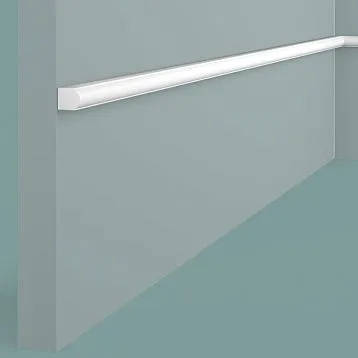
Crown molding is a ceiling baseboard with a simple profile, usually with a concave surface (a rounded groove), smoothly connecting the wall and ceiling. Crown moldings are narrow (3-8 cm), minimalist, without complex decoration. They serve more of a technical function - sealing the gap, rather than decorative.
Cornice is a wider and more decorative element (from 8 to 30 cm and more). It has a complex profile: protrusions, recesses, ornaments. It does not merely cover the joint, but becomes an architectural accent, giving the room a classical grandeur or modern graphic quality.
Our factory also produces:


Constructive differences
Ceiling baseboard woodenUsually has two mounting planes: one against the wall, the other against the ceiling. The angle between them is most often 90 degrees, but can be different (for rooms with non-standard angles). The cross-section of the baseboard is rectangular, trapezoidal, or with a complex profile (grooves, rounded edges).
A polyurethane cornice may have a similar construction, but due to molding technology, more complex shapes are possible. For example, the cornice may have a wide decorative part protruding from the wall by 5-10 cm, creating a volumetric overhang. Or a cornice for hidden lighting - with a niche where an LED strip is installed.
A wooden baseboard is always solid - milled from a single piece of wood. Polyurethane may be solid or have cavities inside (to reduce weight). This does not affect strength - polyurethane is sufficiently dense and rigid even with voids.
Get Consultation
Functional purpose
Both types of elements perform several functions simultaneously:
Decorative - interior decoration, style creation. A classic carved wooden cornice sets the tone for the entire room, transforming an ordinary room into a mansion hall. A minimalist white polyurethane crown molding emphasizes the modern space's minimalism.
Masking - hiding construction defects. Rarely is the junction between wall and ceiling perfectly flat. Usually, there are gaps, irregularities, level differences. A baseboard or cornice covers all this, creating the impression of flawless finishing.
Structural - in some cases, a ceiling cornice serves as a curtain holder (a cornice-baguet with hidden curtain mounting) or as a base for hidden lighting (the LED strip is laid behind the cornice, with light directed toward the ceiling).
Visual - altering the perception of room proportions. A wide cornice visually lowers the ceiling, which is good for overly high rooms. A narrow baseboard, painted to match the ceiling, visually raises it - suitable for low rooms.
Material: wood versus polyurethane
Wood: nobility and eco-friendliness
Wood is a living material with a unique texture, warm to the touch, breathable.Ceiling baseboard woodenIt is made from solid wood - a single piece of timber, sawn from a log and dried to 8-12 percent moisture.
Wood species for ceiling baseboards: pine (budget option, soft, easy to process, but less durable), oak (hard, strong, beautiful texture, expensive), beech (light, with expressive texture, medium price), ash (dense, uniform, pinkish tone), linden (soft, used for carved elements).
Advantages of wood:
Ecological - natural material, does not emit harmful substances, regulates air humidity (absorbs excess moisture and releases it when dry). For people with allergies or chemical sensitivity, wood is a safe choice.
Aesthetics - each wooden baseboard is unique in its grain pattern. Even two pieces cut from the same board differ. This creates liveliness and individuality in the interior. The texture of wood, especially of valuable species, is inherently decorative.
Tactility - wood is warm and pleasant to the touch. Although one usually does not touch ceiling baseboards, the psychological presence of natural material in the interior creates comfort.
Durability - a quality wooden baseboard made from hardwoods lasts 50-100 years. It will survive several renovations, wallpaper changes, and repaints. It is an investment in long-term perspective.
Restorability - if a wooden baseboard gets scratched or dull, it can be sanded (removing a thin top layer), then re-oiled or varnished. It will look as new again.
Disadvantages of wood:
Hygroscopicity - wood absorbs moisture from the air, expanding when humidity increases and shrinking when it decreases. This can lead to warping, cracking, or detachment from the base. In rooms with unstable humidity (unheated cottages, bathrooms without exhaust) wood requires special treatment.
Weight - a wooden baseboard is 5-7 times heavier than a polyurethane one. This complicates installation (requires strong fasteners) and requires assistance when working with long boards.
Processing difficulty - cutting wood at an angle is more difficult than polyurethane. Requires sharp tools and precision. Wood may split or chip at a knot. Not every DIY enthusiast can handle it.
Price - a wooden skirting board made of quality wood costs 3-10 times more than its polyurethane equivalent. A carved oak cornice may cost 5000-8000 rubles per linear meter compared to 500-1000 rubles for polyurethane.
Polyurethane: Technology and Practicality
polyurethane moldingsThese are items made of foamed polymer obtained by injection molding. The material has a rigid cellular structure with closed pores, density of 200-400 kilograms per cubic meter.
Advantages of polyurethane:
Water resistance - polyurethane does not absorb water, does not rot, does not develop mold. It can be used in bathrooms, kitchens, saunas, pools, on unheated verandas - anywhere where wood would require special protection.
Dimensional stability - polyurethane does not expand or shrink with changes in temperature and humidity. A mounted cornice after a year will have the same dimensions as on the day of installation. No warping, cracking, or delamination.
Lightweight - a polyurethane cornice 15 cm wide and 2 meters long weighs about 1.5-2 kilograms. A similar wooden one weighs 7-10 kilograms. This radically simplifies installation - one person can easily handle even 3-meter-long sections.
Ease of processing - polyurethane can be cut with a regular saw, even with a stationery knife. No special tools are required. The cut edge is smooth, without chips. Even a beginner can cut an angle to 45 degrees.
Complex profiles - injection molding technology allows creating incredibly complex relief patterns: deep ornaments, delicate scrolls, multi-tiered cornices. What would require a master’s hand carving (and cost tens of thousands) in wood is accessible in polyurethane at reasonable prices.
Price - a polyurethane cornice is 3-10 times cheaper than wooden one for comparable dimensions and profile complexity. This makes decoration accessible to mass consumers.
Disadvantages of polyurethane:
Artificiality - polyurethane looks and feels like synthetic material. Even if painted to resemble wood, the texture will be printed, not natural. For enthusiasts of natural materials, this is unacceptable.
Lower strength - polyurethane is softer than wood. A strong impact may leave a dent. Although ceiling elements rarely experience mechanical impacts, careless cleaning with a long mop may cause damage.
Flammability - polyurethane burns, releasing toxic gases. This is not critical for residential spaces (all furniture also burns), but may be a limitation in spaces with heightened fire safety requirements.
Static nature - polyurethane attracts dust. It will need to be wiped more frequently. Wood coated with oil or wax is more neutral to dust.
Where each is appropriate
Choose wood for:
-
Classic interiors (Empire, Baroque, English classic), where material authenticity is important
-
Rooms with wooden floors, wall panels - for material unity
-
Ecological style interiors (eco, Scandinavian, Japanese)
-
Luxury projects, where budget allows investing in quality
-
Restoration of historical buildings, where originality must be matched
Choose polyurethane for:
-
Rooms with high humidity (bathrooms, kitchens, pools)
-
Modern interiors (minimalism, high-tech, loft), where synthetic materials are natural
-
Budget projects, where cost-saving is important without sacrificing appearance
-
Situations where installation is done by oneself without experience in carpentry
-
Interiors requiring complex ornaments at affordable prices
Thin and wide profiles: impact on space
Narrow cornices for low ceilings
Rooms with ceilings 2.4-2.7 meters (Khrushchev-era, some panel buildings) require a delicate approach to decoration. A wide, heavy cornice in such a room will create a heavy feeling and visually further lower the ceiling.
Optimal solution: a narrow cove 4-7 centimeters wide, painted in the ceiling color (usually white). It serves as a technical transition between wall and ceiling, not drawing attention. The eye glides over it without stopping — the ceiling appears higher.
For low ceilings, polyurethane is better: it is lightweight, does not create a sense of heaviness, and even visually appears weightless. A wooden cove of the same width appears heavier due to material density.
Profile for low ceilings — simple, without deep ornamentation. A concave cove or a cove with one or two bulges (convex rings). Complex relief in a narrow format is unreadable and creates visual noise.
Medium cornices for standard rooms
Rooms with ceilings 2.7-3.0 meters (modern standard construction, improved layouts) allow using medium-width cornices: 8-15 centimeters. Both wood and polyurethane are suitable; the choice depends on interior style and budget.
Medium cornices are already noticeable, becoming a decorative element rather than just technical. The profile can be more complex: multiple steps, ornamentation, grooves. Suitable for classic interiorsCeiling baseboard woodenwith carving or milling. For modern interiors — minimalistpolyurethane moldingsgeometric shapes.
Color solutions for medium cornices are varied. You can paint them to match wall color (monochromatic solution, visually elongating walls), ceiling color (expanding ceiling downward), or contrasting color (white cornice on colored walls — classic).
Wide cornices for high ceilings
Rooms with ceilings from 3.0 to 4.5 meters (Stalin-era, suburban houses, lofts, commercial spaces) require large-scale framing. A narrow skirting in such a space will disappear and fail to perform the function of visual completion.
Wide cornices: 15-30 centimeters, with complex multi-step profiles. Here, polyurethane especially excels — creating a wooden cornice of such width and complexity is technically possible but very expensive (master hand carving). A polyurethane cornice with deep relief, moldings, and dentils costs reasonable money and installs without problems.
For high rooms in classic style, a combination is possible: the base of the cornice — a wide polyurethane strip (15-20 centimeters), and decorative inserts, rosettes — wooden carved. This creates material richness at a reasonable budget.
A wide cornice can perform an additional function — a base for hidden lighting. An LED strip is laid behind the cornice, light directed upward toward the ceiling. This creates an effect of a floating ceiling and soft diffused lighting. This works with both wood and polyurethane.
Complex angles and curved walls
Straight angles: standard situation
In most rooms, wall angles are close to 90 degrees. Installing a ceiling skirting in such angles is standard: each strip is cut at 45 degrees, two strips join to form a right angle.
For wood, use a miter box (tool for precise angled cuts) or a miter saw. Polyurethane is cut with the same tools but is easier — the material is softer. The key is precision of the cut. Even a 1-2 degree deviation will result in a gap at the joint.
Alternative to manual cutting of angles — ready-madePolyurethane corner moldingsThese are cast elements imitating the joint of two strips at 45 degrees. They accept straight-cut skirting strips. Corner elements simplify installation but are not suitable for all profiles — only those for which they are produced.
Irregular angles: adapting to reality
In practice, wall angles are rarely exactly 90 degrees. Especially in old houses, where walls may have settled or become misaligned. The angle may be 85, 95, or 88 degrees. If cutting skirting at standard 45 degrees, the joint will have a gap.
Solution: measure the actual wall angle with a protractor. Divide the value in half. Cut both skirting strips at this angle (accounting for symmetry). For example, wall angle 86 degrees. Divide in half — get 43 degrees. Cut both strips at 43 degrees. The joint will be tight.
Polyurethane is more forgiving of inaccuracies — it can be slightly compressed or stretched during installation, and small gaps are filled with sealant. Wood is stiffer and requires more precise fitting.
Curved walls: polyurethane flexibility
Rooms with complex geometry — bay windows, columns, arches, round walls — require a flexible cornice. A standard rigid skirting (wooden or standard polyurethane) cannot be installed on a curved surface — it won’t bend.
Special solution — flexible polyurethane cornice. Rubber (latex) is added to its composition, allowing the strip to bend along a radius of 50 centimeters and more. Such a cornice wraps around a column, follows the curve of a bay window, or arcs around an arch.
Installing a flexible cornice: the strip is placed on the curved surface, pressed, and fixed with adhesive. It takes the shape of the base, and after the adhesive dries, it holds this shape. For very sharp curves (radius less than 50 centimeters), use several short cornice segments, joined together.
Wood cannot be made flexible. You can construct assembled structures from short straight segments approximating the curve. But this is difficult, labor-intensive, and involves many joints. Bent wooden elements are made using special technology (steam bending, shaping), and cost very much.
Walls with irregularities: filling gaps
Even visually flat walls often have micro-irregularities—waves, bumps, depressions within 3-5 millimeters. When installing a rigid skirting board, these irregularities create a problem: the skirting board does not fit tightly, leaving gaps.
A polyurethane cornice, being more flexible, partially compensates for irregularities—it presses against the wall, slightly deforming. Small gaps (up to 2 millimeters) are filled with adhesive during installation. Larger gaps are filled with acrylic sealant after installation.
A wooden skirting board is rigid and does not bend. On an uneven wall, you will either need to level the wall with putty (labor-intensive), or carefully sand the back of the skirting board at protruding areas (requires skill), or accept gaps and fill them with putty or sealant.
Combined solutions: the best of both worlds
Polyurethane on the ceiling plus wood on the floor
The most common combined solution: a polyurethane cornice on the ceiling and a wooden skirting board on the floor. This combines the practicality and cost-effectiveness of polymer with the elegance and eco-friendliness of natural material.
The logic of this choice: the ceiling element is high up, out of reach, so visual quality and ease of installation are important—these are polyurethane’s strengths. The floor skirting board is in the contact zone, where tactile feel, strength, and natural warmth matter—wood’s strengths.
Aesthetically, this works: a white polyurethane cornice on the ceiling creates a clear boundary, visually lifting the space. A wooden skirting board on the floor (natural color or painted) adds solidity and connection to the floor. If the floor is wooden (parquet, planks), a skirting board made of the same material is a logical continuation.
It is important to coordinate profiles: the cornice and skirting board should not differ too much in style. If the cornice is classical with ornamentation, the skirting board should also be classical. If the cornice is minimalist (simple profile), the skirting board should be equally minimalist.
Wood on the ceiling in entrance areas
There are interiors whereCeiling baseboard woodenit is justified on the ceiling—these are formal rooms in classical style: living rooms, dining rooms, offices in country houses, premium apartments. Here, authenticity of materials and luxury of natural wood are important.
In such interiors, wooden ceiling cornices are often left unpainted and finished with oil or varnish, highlighting the texture. The color—natural oak, walnut, or stained oak—creates warmth and material richness.
But in other rooms of the same house (bedrooms, hallways, kitchen, bathrooms), you can use polyurethane cornices painted in the same color. This is cost-saving without compromising the overall concept—the decor is less noticeable in transitional spaces.
Polyurethane with wood imitation
Modern technologies allow creatingpolyurethane moldingwith wood texture imitation. A relief pattern mimicking wood grain is applied to the cornice surface during molding. After painting with special coatings, it creates an effect visually resembling wood.
Such a cornice is 3-5 times cheaper than natural wood, easier to install, and resistant to moisture. However, upon close inspection, the imitation is noticeable—the texture repeats and lacks the liveliness of real wood. This is a compromise solution for those who want the look of wood but with a limited budget.
Using wood imitation is justified in rooms where the cornice is far away (high ceilings), where it is viewed from an angle rather than up close. At a height of 3-4 meters, artificial texture is not discernible, and the cornice appears wooden.
Local use of wood
Another combined approach: a main polyurethane cornice around the entire perimeter (cost-saving), with wooden carved inserts at key points (accent pieces). For example, above a fireplace, above an entrance, in corners—wooden carved rosettes, corner elements. The main cornice matches and joins seamlessly with them.
This creates focal points that attract attention. Carved wood is used where it is visible and appreciated. Polyurethane is used where function matters more than material demonstration.
Installing such combined solutions requires precision—the joints between different materials must be perfect. But the result is impressive: the richness of a classical interior at reasonable cost.
Practical Recommendations for Selection
What suits which rooms
Living room: If the style is classical—Ceiling baseboard wooden—natural color or lightly tinted. If modern—polyurethane moldings—white or painted to match the wall color.
Bedroom: A medium-width polyurethane cornice (10-12 cm), painted in soft tones (cream, beige, light gray). Wood is appropriate in bedrooms with a classical style.
Kitchen: Definitely polyurethane—it does not fear moisture, temperature fluctuations, and is easy to clean. A wooden cornice in the kitchen would require a moisture-resistant coating and would still remain vulnerable.
Bathroom: Polyurethane, no alternatives. High humidity and direct contact with water—wood here quickly deteriorates.
Office: A prestigious room where a wooden cornice of oak or walnut is appropriate, highlighting status. An alternative is polyurethane with wood imitation.
Corridor: Polyurethane - practical, inexpensive, easy to install. Passage areas do not require expensive materials.
Budget frames
Polyurethane cornice: from 200 to 2000 rubles per linear meter depending on width and profile complexity. Simple rounded molding 5 cm - 200-400 rubles. Wide carved cornice 20 cm - 1200-2000 rubles.
Wooden baseboard: from 800 rubles (spruce, simple profile) to 5000-8000 rubles (oak, carved) per linear meter. For a 4x5 meter room (perimeter 18 meters), the material difference will be from 14,000 to 140,000 rubles.
If budget is limited - the choice is clear: polyurethane. If budget allows and authenticity matters - wood in formal zones, polyurethane elsewhere.
Conclusion: Conscious choice
Choosing betweenwooden ceiling skirtingandpolyurethane moldingThis is not a question of 'what is better'. It's a question of 'what is better for my specific situation'. There is no universal answer. There is an understanding of the strengths and weaknesses of each material, consideration of usage conditions, interior style, budget, and installation skills.
Wood is excellent in classic interiors where naturalness matters, where budget allows, and where climate is stable. Polyurethane is indispensable in high-humidity spaces, modern styles, limited budgets, and DIY installations. Combined solutions offer the best of both worlds - the practicality of polymer and the elegance of wood where it matters most.
STAVROS company offers wooden ceiling baseboards made of solid oak, ash, beech, and an extensive range of polyurethane cornices - from simple moldings to luxurious multi-tiered cornices with ornamentation. Also in the catalog,Polyurethane corner moldingssimplifying installation. STAVROS consultants will help you select the optimal solution for your interior, taking into account all room specifics and your preferences. Because the right choice of ceiling decor is not a compromise, it’s an exact hit.