Article Contents:
- What is MDF Skirting Board — Material Composition and Differences from Solid Wood
- MDF Structure: What's Inside
- How MDF Skirting Board Differs from Solid Wood
- MDF Emission Class: An Important Parameter for Living Spaces
- Types of MDF Skirting Boards: Laminated, Veneered, Paint-Ready
- Laminated MDF Skirting Board: Convenience Without Compromises
- Wood-Veneered MDF Skirting Board
- Paint-Ready MDF Skirting Board
- MDF Skirting Board Sizes: 70, 100, 120 mm — How to Choose the Height
- Logic for Choosing Skirting Board Height
- Standard Heights of MDF Skirting Boards
- MDF Skirting Board Thickness: What It Depends On
- MDF Skirting Board with Cable Channel — Convenience for Wiring
- Cable Channel Structure in Skirting Board
- Important Notes on Cable Channels
- Installing Cables in Skirting Board Channels
- Installing MDF Skirting Board: Clips, Adhesive, Dowels — Three Methods
- First Method: Clips (Mounting Brackets)
- Second Method: Mounting Adhesive
- Third Method: Through-Mounted Dowels with Screws
- Joining Corners of MDF Skirting Board
- MDF vs Plastic vs Solid Wood — Honest Comparison Table
- Full Comparison by Key Criteria
- Why Plastic Loses to MDF
- When MDF is the Optimal Choice
- Moisture-Resistant MDF Skirting Board — Where to Use
- Composition of Moisture-Resistant MDF
- Where to Use Moisture-Resistant MDF Skirting Board
- MDF Skirting Board for Laminate and Parquet Flooring
- Rule for Choosing Skirting Board for Laminate
- Laminate Expansion Gap and Skirting Board
- MDF Skirting Board Care — How to Clean and What is Prohibited
- Regular Care: Wiping and Dust Removal
- What is Strictly Prohibited for MDF Skirting Board
- Repairing Minor Damage to MDF Skirting Board
- Periodic Coating Renewal
- MDF Skirting Board Profiles: Straight, Chamfered, Shaped
- Straight Profile
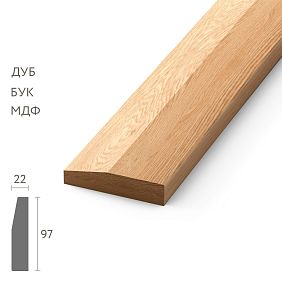
- Chamfered Profile
- Shaped Profile
- MDF Skirting Board in Interior Design: Three Designer Techniques
- First Technique: The 'Disappearing' Skirting Board
- Second Technique: Contrast Accent
- Third Technique: Floor Continuation
- FAQ - answers to popular questions
- About the Company STAVROS

Skirting board is the detail people think about last. First they choose the floor, then the walls, then the furniture, then the lighting — and only when everything else is decided do they remember the narrow strip at the base of the wall. But it is precisely this that 'closes' the interior, just as a final stroke completes a painting. Chosen carelessly — it ruins. Chosen consciously — it brings the space together as a unified whole.
MDF Skirting BoardToday occupies a special place in the finishing hierarchy. It is not 'second-rate' compared to solid wood and not 'better than plastic' — it is an independent material with its own advantages, its own limitations, and its own huge audience of buyers who have made a conscious choice.
What is MDF skirting board really? How does it differ from wooden? Which one to choose from dozens of profiles and heights? How to install it so there are no gaps at the corners? How to care for it so it lasts not three years, but twenty? These are the questions this article provides comprehensive, practical, honest answers to.




What is MDF Skirting Board — Material Composition and Difference from Solid Wood
Behind the abbreviation MDF (Medium Density Fiberboard) lies a specific technology: wood fiber, ground to a homogeneous mass, is mixed with a binder based on urea-formaldehyde or MDI resins, pressed under pressure at high temperature — resulting in a board with a homogeneous dense structure.




MDF Structure: What's Inside
MDF is not 'wood', but not 'plastic' either. It is an engineered wood material: its composition is 85–92% natural wood fiber and 8–15% binder. The density of standard MDF is 700–800 kg/m³ — comparable to the density of oak (680–750 kg/m³).
The homogeneous structure of MDF without annual rings, knots, or grain is the main technological advantage. MDF skirting board precisely holds its profile along its entire length, has no 'weak spots' in knot areas, and does not split when drilled. A router works with it perfectly — the most complex profile comes out clean, without tear-out.
Our factory also produces:


How MDF Skirting Board Differs from Solid Wood
These are not competitors — they are different materials for different tasks. An honest comparison:
| Parameter | MDF | Solid wood |
|---|---|---|
| Geometry stability | Excellent — does not react to humidity | Depends on wood species and humidity |
| Surface for painting | Perfect (no pores, resins) | Requires priming, resins possible |
| Profile complexity | Any milled shape | Limited by fiber strength |
| Durability | 20–35 years with proper care | 50–100+ years |
| Moisture resistance | Standard — low; moisture-resistant — medium | Depends on wood species (oak > pine) |
| Ecological | Depends on emission class (E1, E0) | Natural material |
| Price | 30–60% lower | Higher |
| Repairability | Limited | Sanding, oil, varnish |
Solid wood floor skirting board— a choice for decades, with restoration capability. MDF skirting board — the optimal balance of price, quality, and appearance with a more limited lifespan. Both options are justified — each in its own context.
Get Consultation
MDF emission class: an important parameter for living spaces
The binder in MDF is the source of formaldehyde emissions. Emission classes:
-
E2 — permissible only for construction purposes (not in living spaces)
-
E1 — standard for living spaces (< 0.1 mg/m³ of air)
-
E0 — minimal emissions, equivalent to natural wood (< 0.05 mg/m³)
For skirting boards in living rooms — only E1 and E0. Request documentation from the seller or check the labeling. MDF skirting boards from reputable manufacturers always comply with E1.
Types of MDF skirting board: laminated, veneered, paintable
The MDF skirting board market offers several fundamentally different types. Understanding their differences means making the right decision at the selection stage.
Laminated MDF skirting board: convenience without compromise
Laminated MDF skirting board is the most common type. The surface of the MDF profile is coated with PVC film or melamine film using thermopressing. The film precisely replicates the profile relief, including milled grooves and bevels.
Melamine film — thinner, matte, closer to a 'paper-like' texture. Less resistant to mechanical damage but provides a more natural wood imitation appearance. An economical option.
PVC film — more durable and moisture-resistant. The 'wrapping' technology is often used — the film covers the ends and backside of the skirting board, insulating the MDF around the entire perimeter. This is crucial: an exposed MDF end is a weak point that 'draws' moisture.
Laminated skirting board decors: imitations of oak, walnut, wenge, pine, birch — dozens of textures. Solid colors: white, gray, anthracite, ivory.In the STAVROS catalogover 200 decors are available — from budget melamine to premium PVC with embossing.
Advantages: does not require painting, ready for installation 'out of the box', stable color throughout its service life, easy maintenance.
Limitations: if the film peels off — it cannot be restored at home. Scratches on the film are visible and cannot be removed by sanding. Large formats (100–120 mm) in laminated versions are less common.
Veneered MDF skirting board under wood
Veneered skirting board is an MDF base faced with thin natural veneer (0.3–0.6 mm) from valuable wood species: oak, ash, walnut, cherry. This is an intermediate option between MDF and solid wood: natural wood texture on a stable engineered base.
Veneer is applied to the profile surface by hot pressing with adhesive. After application, the veneer is sanded and coated with varnish or oil — exactly like solid wood.
Advantages of veneered skirting board:
-
Natural wood texture and structure — not an imitation
-
Stability of MDF base geometry (does not deform with humidity fluctuations)
-
Can be restored — careful sanding with P220 + re-varnishing
-
Combines withsolid wood STAVROS skirting boardsof the same wood species without visual difference
Limitations: more expensive than laminated; not suitable for wet rooms without special varnish coating.
MDF skirting board for painting
— is a horizontal element that frames the room at the bottom of the walls where the wall meets the floor. Skirting boards perform several functions: they hide the technological gap between the wall and floor covering (necessary for thermal expansion), protect the lower part of the wall from mechanical damage, create visual completion, and may conceal wiring.— pure white (or natural beige MDF) profile without finish coating. The surface is already factory-primed — ready for paint application.
This is the most versatile type for a designer: you choose the finish color yourself. White gloss under RAL 9003 — classic Scandinavian style. Anthracite matte under RAL 7024 — loft. Soft "gray mist" — modern minimalism. Any color from the RAL or NCS database.
MDF skirting board 100 mm for painting— the most popular format: sufficient height for modern interiors, wide plane for brush or spray gun.
MDF skirting board painting technology:
-
Acrylic primer-isolator — 1 coat (if not applied at the factory)
-
Acrylic paint first coat — apply, let dry for 4 hours
-
Light sanding with P400 (remove raised fibers)
-
Acrylic paint second coat — finish
Paint before or after installation? Professionals paint before installation: skirting board horizontal, full access to all edges, no risk of staining the floor. After installation — only touch-up of joint and cut areas.
MDF skirting board dimensions: 70, 100, 120 mm — how to choose the height
Skirting board height is a parameter that affects not only aesthetics but also the visual perception of room proportions.
Logic for choosing skirting board height
Proportion rule: skirting board height should be 2.5–4% of room height. With a ceiling of 2,500 mm — optimal skirting board height is 63–100 mm. With a ceiling of 3,000 mm — 75–120 mm. With a ceiling of 3,500 mm — 88–140 mm.
But rules are just a starting point. Design logic adds nuances:
Low skirting board (60–70 mm): recedes into the background, "dissolves" at the floor. The eye doesn't linger. A good solution for small rooms — doesn't "eat up" height visually. Also used in bathrooms and corridors where skirting board height is dictated by practical rather than design considerations.
Medium skirting board (80–100 mm): the gold standard of modern residential interiors. Noticeable enough to "hold" the floor line, restrained enough not to "shout." 80–100 mm — optimum for apartments with standard ceiling height of 2,500–2,700 mm.
High skirting board (120–150 mm): an architectural statement. Creates a "podium" feel, adds monumentality to the room. Appropriate in living rooms with ceilings from 2,800 mm, in studies, in formal halls. In small rooms — overloads.
Standard MDF skirting board heights
| Height | Visual effect | Room |
|---|---|---|
| 60 мм | Inconspicuous, background | Bathroom, small corridor |
| 70 мм | Neat, minimalist | Small rooms, bedrooms |
| 80 мм | Standard, neutral | All rooms |
| 100 мм | Expressive, modern | Living room, study, bedroom |
| 120 мм | Architectural, significant | Living room with high ceiling |
| 150 мм | Monumental, classic | Grand Entrances |
MDF skirting thickness: what it depends on
Standard MDF skirting body thickness is 14–16 mm. This is the thickness of the MDF base in the lower part of the profile that rests against the wall. Thickness is important for:
-
Choosing an external corner: the thicker the skirting, the more noticeable the joint when mitering
-
Cable routing: cable channel is only possible with thickness ≥ 14 mm
MDF skirting with cable channel – convenient wire routing
One of the main practical arguments in favor of MDF floor skirting is the possibility of an integrated cable channel. This is a groove or cavity in the back of the profile designed for concealed routing of electrical and low-current cables.
Cable channel design in skirting
MDF skirting with cable channel has a molded groove in the profile with a depth of 8–12 mm and width of 12–16 mm. Channel capacity:
-
One VVG 2×2.5 mm² cable – no problem
-
Two VVG 2×1.5 mm² cables – fit
-
Internet cable (8-core, cat. 5e) – easily
-
Combination of power cable + telephone + antenna – with each diameter up to 6 mm
Cables in skirting channel – not a violation of PUE provided: cables are laid in factory insulation, without twists or connections inside the channel, with access to connections.
Important notes on cable channel
What can be routed in skirting cable channel:
-
Low-current cables (internet, TV, audio, sensors)
-
Power cables with double insulation class VVGng
What cannot:
-
Underfloor heating heating cable – generates heat, may damage MDF
-
Exposed wiring without protective sleeve
Installing cables in skirting channel
Cables are laid into the groove before securing the baseboard to the wall. Sequence:
-
Lay out cables on the floor along the intended baseboard line
-
Place cables in the groove — they should lie loosely, without tension
-
Secure the baseboard — cables are fixed by the groove
-
At corners and near outlets: cables exit the groove through special caps or holes
Baseboard with cable channel — an elegant solution for hidden wiring without wall chasing. Especially relevant during renovations in already occupied apartments.
MDF baseboard installation: clips, adhesive, anchors — three methods
Installation of MDF Skirting Board— the stage where many make mistakes that turn quality material into a 'done haphazardly' result. Let's examine three main methods.
First method: clips (mounting brackets)
The clip system is the most popular and technologically advanced method. Clips are attached to the wall with anchors at 300–400 mm intervals, the baseboard snaps into the clips and is held by spring clamp pressure.
Process:
-
Mark the wall for clips: first clip — 50 mm from corner, last — 50 mm from other corner. Others — evenly spaced at 300–400 mm intervals.
-
Attach clips with 4×40 mm anchor screws for concrete/brick or 4×50 mm for hollow substrates.
-
Insert baseboard into clips: hook lower groove first, press and snap upper part.
Main advantage of clips: baseboard can be removed without tools. Access to cables, removal when replacing flooring — with one motion.
Limitation: clips are designed for specific manufacturer profiles. Universal clips — less reliable.
Second method: mounting adhesive
Adhesive mounting — silent, fast, and creates a monolithic result. Baseboard is glued to wall with acrylic or polyurethane mounting adhesive.
Process:
-
Apply adhesive to back surface of baseboard: continuous strip along top edge + droplet dots along bottom edge (not continuous strip — otherwise cannot be removed without damage).
-
Press baseboard to wall, align horizontally.
-
Secure with painter's tape or pressure wedges for 30–60 minutes.
-
Remove fixation after adhesive sets.
Advantages: no visible attachment points, maximally 'clean' result. Fast installation.
Limitations: removing baseboard without damaging wall and baseboard itself — difficult. On drywall — possible paper tearing during removal. Not suitable for frequent reinstallation.
Third method: anchors with through screws
Classic construction method. Anchor screw passes through baseboard body into wall. Head is countersunk below surface, covered with decorative cap matching baseboard color.
Fastening parameters:
-
Spacing: 400–500 mm along length
-
Anchor: 6×40 mm for concrete/brick; 6×50 mm for solid blocks
-
Screw: 3.5×40 mm (diameter for 6 mm cap)
Advantages: maximum reliability, works on any substrate. With properly selected caps — practically invisible.
Limitations: on uneven walls creates 'stress points' — baseboard may crack near attachment points after several years.
MDF Skirting Board Corner Joining
Three types of corner joints:
Internal corner (standard 90°): cut at 45° on a miter saw. Skirting boards are joined with a miter joint. A 1° error creates a visible gap — filled with paint-grade putty or colored decor sealant.
Internal corner (non-standard): measure angle with a protractor, divide by 2 — cutting angle for each piece. Most 'right' angles are actually 89° or 91°.
External corner: cut at 45° in opposite direction. Alternative — factory corner connectors (plastic or wood) that completely hide the joint.
Lengthwise joint (splicing): when wall length > single plank length (usually 2,400 mm). Cut both planks at 45° with overlapping joint — 'lock joint'. Joint must align with clip/dowel mounting point.
Proper installation of wood products and skirting boards— a separate topic covered in detail by STAVROS article. Recommended as supplement to this section.
MDF vs plastic vs solid wood — honest comparison table
Choosing floor skirting begins with material selection. Three main competitors — each with its own niche.
Complete comparison by key criteria
| Criterion | MDF | Plastic | Solid wood |
|---|---|---|---|
| Appearance | Good wood imitation | Artificial appearance | Natural, unique |
| Durability | 20–30 years | 10–20 years | 50–100 years |
| Moisture resistance | Standard — low | High | Depends on wood species |
| Profile | Complex milled profiles | Complex molded profiles | Complex milled profiles |
| Installation | Moderately simple | Simple | Moderately simple |
| Repairability | Weak | Zero | Good |
| Ecological | Class E1/E0 — acceptable | Depends on PVC | Natural material |
| Price | Medium | Low | High |
| Restoration | Impossible | Impossible | Sanding + repainting |
| Linear expansion | Low | Significant | Moderate |
Why plastic loses to MDF
Plastic skirting is the cheapest option. But its list of drawbacks is substantial:
-
Visible plastic sheen — cannot be masked, reveals the 'budget' nature of the renovation
-
Significant thermal expansion: with a 20°C difference, a 2,400 mm long strip 'moves' by 2–3 mm — gaps appear at the joints
-
Yellows over time — especially white under UV exposure
-
Cracks and crumbles upon mechanical impact
-
Glue does not hold plastic securely — only clips work
Comparison of wooden skirting board with MDF and plasticThoroughly covered in the STAVROS article — recommended for those facing a material choice.
When MDF is the optimal choice
MDF skirting board — the first choice when:
-
Budget is limited, but aesthetics above 'construction plastic' are desired
-
A perfectly smooth surface for painting is needed (MDF is better than solid wood)
-
Stable geometry is required without dependence on room humidity
-
The design calls for a complex profile at a moderate cost
Solid wood floor skirting board— the choice when priority is given to durability and the possibility of restoration. Oak and beech are materials worked with for decades.
Moisture-resistant MDF skirting board — where to use
Standard MDF is a hygroscopic material. With constant contact with water or condensation, it swells, breaks down, and the film peels off. For wet rooms, there is a special modification — moisture-resistant MDF (MMDF, HDF waterproof).
Composition of moisture-resistant MDF
Moisture-resistant MDF is produced with the addition of paraffins and special resins to the fibrous mass before pressing. This reduces water absorption several times. Visually, moisture-resistant MDF differs from standard by a greenish tint on the cut — standard color is light beige, moisture-resistant is greenish.
Where to use moisture-resistant MDF skirting board
| Room | Recommendation |
|---|---|
| Dry living room | Standard MDF |
| Bedroom | Standard MDF |
| Kitchen (by the sink) | Moisture-resistant MDF |
| Hallway (by the entrance door) | Moisture-resistant MDF |
| Bathroom | Moisture-resistant MDF or PVC |
| Toilet | Moisture-resistant MDF or PVC |
| Balcony (glazed) | Moisture-resistant MDF |
Even moisture-resistant MDF is not for constant contact with water. In the bathroom with direct water exposure (shower area) — only plastic or ceramic.
MDF Skirting Board for Laminate and Parquet Flooring
MDF floor skirting perfectly matches laminate — and this is no coincidence. Both materials are engineered wood products, both have melamine or PVC coating, and both offer a wide palette of decors. Choosing an MDF skirting board to 'match' the laminate is a task with dozens of ready-made solutions.
Rule for Choosing Skirting Board for Laminate
Three principles:
Tone-on-tone: skirting board in the exact color of the laminate — an 'invisible' transition. Works with high-quality decor matching. With a slight tone discrepancy — more noticeable than a contrasting option.
Contrast: dark skirting + light laminate (or vice versa). A clear line at the floor, an architectural accent. Popular in modern and Scandinavian interiors.
Neutral: white MDF skirting board for any floor decor. A universal solution — white 'recedes' into the wall, competing neither with the floor nor the walls.
Technical Gap for Laminate and Skirting Board
Laminate and parquet flooring are installed with a technological gap at the wall of 8–12 mm. The skirting board covers this gap — its lower edge must overlap the gap by at least 4–5 mm. A standard skirting board with a lower protrusion of 8–12 mm covers any technological gap. A tall skirting board (100–120 mm) — overlaps with a margin.
Important: the skirting board is attached to the wall, not to the floor. The laminate must freely 'float' under the skirting board.
Caring for MDF Skirting Board — How to Clean and What is Prohibited
The long service life of MDF skirting board is not only a matter of material quality but also proper care. Simple rules that extend the life of the skirting board for years.
Regular care: wiping and dust removal
Dust accumulates on the skirting board constantly — especially on shaped profiles with horizontal shelves. Regular care:
Once a week: go over the skirting board with a dry or slightly damp microfiber cloth. Microfiber 'captures' dust without leaving streaks.
Once a month: damp wiping. A microfiber cloth, slightly moistened with water and a small amount of neutral agent (pH 6–8). Wipe, then dry thoroughly.
Hard-to-reach places (milled grooves): a soft toothbrush or a small brush. Not a metal brush — it scratches the film.
What is strictly prohibited for MDF skirting board
-
Abrasive cleaning agents — powders, pastes — irreversibly scratch the film
-
Aggressive solvents — acetone, white spirit, chlorine-based agents — destroy the PVC/melamine coating
-
Washing with strong water pressure — water penetrates the ends and joints, causing swelling
-
Steam cleaner — the high temperature of the steam deforms the film, disrupts adhesion
-
Brushes with stiff bristles — leave micro-scratches that accumulate dirt
Eliminating Minor Damage to MDF Skirting Board
Scratch on the film: if minor — masked with a corrector or marker of a similar tone. If deep (film penetrated) — for paintable white skirting: fill with putty, let dry, touch up paint. For decorative skirting — a camouflage marker matching the decor.
Corner chip: a chip on the end in the corner is the most common damage. Restored with PVA wood glue (for small chips) or by replacing the plank in that specific section (the clip system allows removal of a single section).
Water damage (swelling): if the skirting board swelled from contact with water — force dry (use a fan heater, not a construction dryer — too high temperature). If swelling is minor — after drying, the skirting board restores its shape. With significant swelling — replacement.
Periodic coating renewal
Laminated MDF skirting board — cannot be repainted. If the coating has lost its appearance — replacement. This is a disadvantage compared to solid wood skirting, which can be sanded and repainted.
Paintable MDF skirting board — repaints easily. Light sanding with P400, dusting off, acrylic paint 2 coats. Skirting board 'like new'.
MDF Skirting Board Profiles: straight, beveled, shaped
MDF skirting boards in the STAVROS catalogare available in several profile groups. A profile is the cross-sectional shape visible in the interior.
Straight profile
A geometrically correct rectangle with a slight rounding or chamfer on the top edge. No additional decorations. The perfect profile for minimalism, Scandinavian style, loft.
Straight MDF skirting board 100 mm high + white paint + matchingwhite moldingsaround the ceiling perimeter — a "clean architecture" system that never ages or becomes outdated.
Chamfered profile
The top edge of the skirting board is cut at a 30–45° angle — a "chamfer". The chamfer creates a thin shadow line between the skirting board and the wall, visually "separating" the skirting. The effect — the skirting board slightly "floats" near the wall, despite direct contact.
The chamfered profile is a compromise between minimalism and decorativeness. Suitable for modern and modern-classical interiors.
Shaped profile
Complex milled form — coves, "steps", roundovers. MDF allows milling any profile without shape limitations — this is an advantage over solid wood, where too complex a profile can "expose" the grain in weak spots.
Classic MDF skirting boardswith a shaped profile — the ideal choice for neoclassical, art deco, and traditional interiors. Paired withdecorative moldings and cornices from STAVROS— a complete "framing" system for walls in a classic style.
MDF skirting board in the interior: three designer techniques
First technique: the "disappearing" skirting board
White MDF skirting board for painting to match a white wall. One color — the skirting board "dissolves" into the wall. The floor line becomes a clear geometric boundary. The accent shifts to the flooring. Works perfectly in Scandinavian and minimalist styles.
Second technique: contrasting accent
Dark skirting board (anthracite, wenge, black) on a white or light wall. The skirting board becomes an architectural detail, an "anchor" at the floor.Modern MDF skirting boards from STAVROSin dark decor are specifically designed for this technique.
Third technique: floor continuation
MDF skirting board with a "wood-like" finish that exactly matches the laminate decor. The floor "rises" up the wall — the boundary between floor and wall blurs. The room visually "expands" vertically. Especially effective with ceilings 2,400–2,500 mm — the technique "adds" visual height.
FAQ — answers to popular questions
Can you paint a laminated MDF skirting board?
Technically — yes, if you sand the surface with P180 grit and apply an adhesion primer. But practically — the result is unsatisfactory: paint adheres worse than on paintable MDF. If a different color is needed — it's easier to replace it with a paintable skirting board.
How to calculate the quantity of MDF skirting boards for a room?
Measure the room perimeter in meters (all walls, including door corners). Divide by the length of one plank (2,400 mm = 2.4 m). Add 10–12% reserve for corner joints and cutting. Subtract door openings from the perimeter (only the opening width, without additions).
MDF skirting board or plastic for the hallway?
For the hallway, moisture-resistant MDF is optimal: better appearance than plastic and sufficient resistance to variable humidity. Plastic — only if the budget is critically tight. An alternative is —floor skirting board made of larch— natural and moisture-resistant at the same time.
Is a gap needed between MDF skirting board and the floor?
When installing skirting board to the wall (not to the floor) — a small 1–2 mm gap is acceptable and compensates for floor unevenness. If the floor is level — the skirting board fits without a gap. If the floor is wavy — the gap is sealed with color-matched sealant.
Can MDF skirting board be installed on underfloor heating?
Standard MDF — not advisable: underfloor heating heats the air at the base of the wall to 30–35°C, which accelerates the degradation of the PVC film. Better —solid wood baseboardor high-quality MDF with heat-resistant PVC film. A 2 mm gap between skirting board and floor — for ventilation.
About the company STAVROS
Skirting board — a detail seen every day. That's why it's important to choose what's made honestly: from the right material, with the right profile, with a coating that won't peel off in two years.
STAVROS — a Russian manufacturer of decorative products from solid oak, beech, and high-quality MDF.STAVROS MDF Skirting Boardis made from E1 class board, coated with high-quality PVC film using the 'wrapping' method (edges protected), in over 200 decors — from white enamel to premium oak imitation.
STAVROSSkirting board made of MDFis presented alongsidesolid wood baseboard, moldings, decorative slatsanddoor casings— a complete system where every detail is coordinated with the others in profile, tone, and style.
STAVROS: from skirting board to cornice — one manufacturer, one standard, one interior without compromises.