Article Contents:
- Psychology of Perception: How Skirting Controls Your Gaze
- Skirting as a Frame for Space
- Vertical Proportions and the Golden Ratio
- Skirting Profile: Character in Details
- Straight Profile: A Manifesto of Minimalism
- Beveled Profile: Elegant Detailing
- Ornamental Profile: Classical Expressiveness
- Ceiling Height and Skirting Selection: The Mathematics of Harmony
- Low Ceilings 2.4-2.5 Meters: Visual Lightening
- Standard Ceilings 2.6-2.8 Meters: Universal Zone
- High Ceilings 3.0+ Meters: Monumentality of Proportions
- White Skirting: A Universal Key to Visual Unity
- White as a Unifying Force
- Shades of White: Warmth and Coolness
- White Skirting and Contrast Combinations
- Combining Skirting with Architectural Decor: A System of Connections
- Skirting and Door Casings: Vertical and Horizontal
- Skirting and Ceiling Cornice: Top and Bottom of the Room
- Wall Molding: The Middle Tier of Composition
- Door Format and Coordination with Skirting
- Standard Doors Height 2000-2100 mm
- Tall Doors 2400-2600 mm: A New Scale
- Hidden Doors and Minimalist Skirting
- Painting Technology: How to Achieve Perfect White
- Surface Preparation: The Foundation of Quality
- Paint Selection: Enamels and Their Properties
- Application Technology: Brush, Roller, Spray Gun
- Installation Practice: How Mounting Affects Visual Result
- Angle Cutting: Precision to the Degree
- Mounting: invisible fixation
- Joining straight sections: seamless
- Frequently Asked Questions about MDF Skirting Boards
- What skirting board height is optimal for an apartment with 2.7-meter ceilings?
- Is it mandatory to paint an MDF skirting board intended for painting?
- Can MDF skirting boards be used in damp rooms?
- How to match the skirting board color to the interior?
- How is MDF skirting board better than wooden?
- Can MDF skirting boards be installed independently?
- STAVROS: architecture of details creating perfection

Have you ever wondered why some interiors give an impression of completeness, integrity, while others — even with expensive furniture and finishes — seem disjointed, as if hastily assembled from mismatched pieces? The secret lies not in the price of materials or the fame of the designer, but in understanding how the visual composition of space works.MDF floor skirting board for painting— is not just a technical strip covering the gap between the wall and the floor. It is a powerful tool of visual architecture, capable of unifying disparate elements into a harmonious whole or, if chosen incorrectly, ruining even the most well-thought-out concept. The height of the skirting board, its profile, color, relationship with other architectural details — door architraves, ceiling cornices, moldings — all this creates an invisible framework on which the aesthetics of the room rests.




Psychology of perception: how skirting boards guide your gaze
Before discussing sizes and profiles, it's worth understanding the mechanism by which the human eye perceives space. We don't scan a room chaotically — the gaze moves along certain trajectories, stops at contrasts, follows lines, seeks rhythm and repetitions. The skirting board forms one of the main such trajectories — a horizontal line encircling the room along the perimeter at floor level. This is the baseline from which all vertical dimensions of the interior are measured.




Skirting board as a frame for space
Imagine a painting without a frame — even a masterpiece looks unfinished, gets lost on the wall, lacks boundaries. The skirting board serves as such a frame for the floor and the lower part of the walls. It creates a clear boundary that tells the eye: here one plane ends and another begins. Without this boundary or with its incorrect execution, the space loses structure, becomes amorphous.
MDF skirting board 100 mm for paintingin a light room with high ceilings creates a powerful horizontal line that visually grounds the space, makes it stable, substantial. A narrow 60-millimeter skirting board in the same room will look disproportionately thin, timid, unable to support the vertical scale. Conversely, a massive one-hundred-millimeter skirting board in a compact room with 2.5-meter ceilings will steal precious height, creating a feeling of being cramped.
The color of the skirting board determines whether it will be an active contrasting element or a neutral background one. A dark skirting board on a light wall creates a graphic frame, clearly separating the vertical plane from the horizontal one. This works for structuring but visually reduces the height of the room — the eye fixes on the dark strip, and everything above is perceived separately. A light skirting board, especially matching the wall color, dissolves, creating an effect of continuity, where the wall seems to smoothly flow into the floor. This visually increases the height, makes the room airier, but deprives it of structural clarity.
Our factory also produces:


Vertical proportions and the golden ratio
Classical architecture operates by the rule: the height of the skirting board should be approximately one-twentieth of the room's height. For standard 2.7-meter ceilings, this gives 135 millimeters — a format close to classic wide skirting boards. But in real life, this rule works with caveats. Modern interiors tend towards more restrained proportions, where the skirting board is more delicate, not dominant, but accompanying.
For typical apartments with ceilings of 2.5-2.7 meters, the optimal skirting board height is 70-80 millimeters.MDF skirting board 80 mm for painting— is a universal size that works in most scenarios: not too massive, not too modest, noticeable enough to structure the space, but not so large as to attract unnecessary attention. A 60-millimeter skirting board suits minimalist interiors, where airiness and absence of visual noise are valued. A 100-120 millimeter skirting board is a choice for rooms with ceilings from 3 meters, classic interiors, where monumentality and architectural dignity are valued.
Not only the absolute size of the skirting board is important, but also its relationship with other horizontal divisions. If a room uses a ceiling cornice 120 millimeters high, and the floor skirting board is only 60 millimeters, a visual asymmetry arises — the top of the room looks heavy, the bottom — lightened, the space loses balance. A harmonious solution: the height of the ceiling cornice and floor skirting board should be within a ratio of 1:1 or 1.5:1, creating a visual rhyme between the top and bottom of the room.
Get Consultation
Skirting board profile: character in details
If the height of the skirting board determines the scale, then the profile determines its character, stylistic affiliation, emotional coloring. The profile is the cross-sectional shape of the skirting board, the pattern it creates at the junction of the wall and floor. MDF as a material is ideal for creating complex profiles: it mills easily, holds sharp edges, has no knots or defects that interfere with the purity of lines.
Straight profile: a manifesto of minimalism
A skirting board with a straight profile is a rectangular cross-section without bevels, roundings, or protrusions. Pure geometry, maximum simplicity, absence of decorativeness. Such a skirting board is the choice of modern interiors, where conciseness, purity of lines, and absence of visual noise are valued. A straight profile does not draw attention to itself; it is a background against which other interior elements unfold.
The height of a straight skirting board is especially critical. A narrow straight skirting board of 60-70 millimeters looks like a thin shadow, a barely noticeable border. It works in interiors where walls and floor are close in tone, where spatial continuity is valued. A wide straight skirting board of 100-120 millimeters turns into a powerful graphic stripe, especially contrasting with a difference in wall and skirting board colors. This is a technique from the arsenal of modern classicism, where minimalist forms gain monumentality through scale.
MDF for a straight profile is ideal because it ensures perfect geometry. Any deviation from a right angle, the slightest waviness of the edge — and the purity of form is destroyed. Solid wood, even high-quality, can warp, bend over time under the influence of humidity. MDF is stable, does not warp, and maintains factory geometry for decades.
Beveled profile: elegant detailing
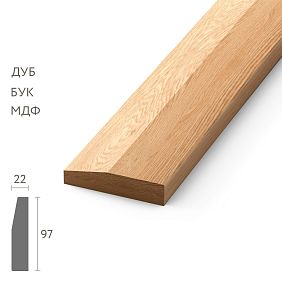
A bevel is a chamfered edge on the top of a baseboard, typically at a 45-degree angle, 5-15 millimeters wide. This simple detail dramatically changes perception: the baseboard ceases to be a flat plank, gains volume, and creates interplay of light and shadow. The bevel creates a fine line that separates the baseboard from the wall, emphasizing it as an independent element.
A baseboard with a single bevel is a universal solution for transitional interiors, between minimalism and classicism. It is simple enough not to clash with modern furniture, yet detailed enough to fit into a neoclassical context. The width of the bevel determines the degree of decorativeness: a narrow 5-7 mm bevel is a delicate detail noticeable only up close, while a wide 12-15 mm bevel is an expressive element creating a clear play of facets.
A double bevel — two chamfered edges separated by a narrow vertical strip — enhances decorativeness, bringing the baseboard closer to classical examples. Such a profile requires careful painting: each facet must be painted evenly, without drips or gaps. MDF, thanks to its smooth, homogeneous surface, accepts paint perfectly evenly, which is difficult to achieve with solid wood due to its porous texture and multidirectional grain.
Figural profile: classical expressiveness
Figural profiles are complex curvilinear forms with alternating convexities and concavities, beads and coves, fillets and ogees. Such profiles originated from classical architecture, where each element had a complex shape creating a rich interplay of light and shadow. In baseboards, this manifests as rounded top edges, concave central parts, and protruding lower bases.
A classic figural baseboard with a height of 100-120 millimeters is a full-fledged architectural element requiring appropriate surroundings. It is organic in interiors with high ceilings, stucco decoration, parquet floors, and massive doors. In compact modern spaces, such a baseboard will look excessive, like a quote without context.
Simplified figural profiles — with one or two curved elements instead of the five to seven classical ones — serve as a transitional link between simple and complex forms. A baseboard with a rounded top edge (radius 8-12 mm) and a straight central part looks softer than a strict rectangular one but is not overloaded with details. This is a compromise solution for interiors where one desires the warmth of classicism without its pomposity.
MDF allows reproducing any figural profile with precision unattainable through manual solid wood processing. CNC milling creates identical elements where radii of curves, depth of coves, and bevel angles match to within tenths of a millimeter. This is critical for long baseboard runs, where any profile mismatch at joints will be glaringly obvious.
Ceiling height and baseboard selection: the mathematics of harmony
The relationship between room height and baseboard size is not an abstract rule but a concrete dependency affecting visual comfort. An incorrect ratio creates a balance that is subconsciously perceived as an error, a disharmony.
Low ceilings 2.4-2.5 meters: visual lightening
Rooms with ceilings below 2.5 meters are a reality in many typical Soviet-era buildings and budget modern housing. The main task in such spaces is not to steal precious centimeters of height, but to visually raise the ceiling and create a sense of airiness. A massive baseboard is the enemy here: it visually weighs down, cuts off height, and makes the room squat.
The optimal baseboard height for low ceilings is 60-70 millimeters. A simple profile is preferable — straight or with a small bevel. Color is critical: a dark baseboard creates a heavy horizontal stripe that further reduces the visual height. A light baseboard, especially matching the wall color or slightly lighter than the floor, will blend in, creating an effect of a continuous vertical from floor to ceiling.
A white MDF baseboard for painting in a room with low ceilings and light walls is a classic solution in Scandinavian interiors, where the fight for visual height is critical in northern latitudes with insufficient light. White reflects light, makes the boundary between floor and wall unnoticeable, and the space is perceived as a single light field where the eye doesn't stumble over dark horizontals.
Standard ceilings 2.6-2.8 meters: the universal zone
This is the most common height range for modern housing — both typical and custom. Maximum freedom of choice applies here: the room is high enough not to fear overload, yet compact enough that a too-narrow baseboard won't get lost.
A baseboard height of 70-90 millimeters is the optimal zone for standard ceilings. An 80 mm baseboard is the mathematical center of this range, working in the vast majority of cases. The profile is chosen based on style: minimalism, loft, Scandinavian style — a straight profile or with a single bevel; neoclassicism, modern classic — a profile with a double bevel or a simplified figural one.
Color solutions in rooms of standard height are more flexible. A contrasting baseboard — dark on light walls or light on dark — creates structure, graphic quality, and a clear frame for the space. This works in interiors with pronounced geometry, where clarity of form is valued. A nuanced approach — a baseboard in a tone close to the wall — creates calmness, soft transitions, and suits relaxed interiors of bedrooms and living rooms with a cozy atmosphere.
High ceilings 3.0+ meters: monumentality of proportions
High ceilings are a luxury that needs to be properly emphasized. A narrow baseboard in a room with three-meter ceilings looks like a disproportionately thin pencil stroke on a large canvas — timid, out of place, unable to support the vertical scale. High rooms require architectural weightiness of all elements, including the baseboard.
A baseboard height from 100 millimeters and above is the starting point for high ceilings. A 120-150 mm baseboard gains monumentality, transforming from a technical element into an architectural detail. The profile at such scales must be detailed — a simple rectangular plank 15 centimeters high looks crude and primitive. A figural profile with alternating forms creates visual complexity that justifies the large size.
Wooden baseboards made of solid oak or beech in rooms with high ceilings gain special expressiveness — the wood texture, its tactility, and the nobility of its shades become noticeable at a large scale. But MDF for painting has an advantage here: the ability to create a perfectly white, gray, or black surface without a visible wood grain, which is critical for modern classicism with its tendency towards monochrome.
An important nuance: in rooms with high ceilings, the baseboard must correlate not only with the height but also with the door format. Doors 2.4-2.6 meters high with wide casings of 100-120 millimeters require a proportionate baseboard. If the doors are tall and expressive, but the baseboard is modest — an imbalance arises where the vertical openings dominate and the horizontal contour is lost.
White baseboard: the universal key to visual unity
Baseboard color is one of the most complex choices in interior design. A mistake here can ruin the entire composition. A white MDF baseboard for painting is not just a safe choice for the indecisive; it is a strategically sound solution that works as a universal visual connector.
White as a unifying force
White has a unique property: it combines absolutely with any colors and materials. Dark wenge flooring, light oak, gray laminate, multi-colored tile — a white baseboard is harmonious with all of them. This is because white is not a color in the usual sense, but a reflection of the entire visible spectrum. It does not compete with other colors but creates a neutral frame in which they are displayed.
A white MDF baseboard creates visual continuity with white door casings, white ceiling cornices, and white window frames. When all architectural details are executed in the same color, they form a unified system, a spatial framework that connects disparate elements — floor, walls, ceiling, furniture — into an integral composition. This technique is fundamental to Scandinavian design, where white architectural decor creates a light shell within which the most diverse colors and textures can coexist.It creates a visual continuity with white door casings, white ceiling cornices, and white window frames. When all architectural details are executed in the same color, they form a unified system, a spatial framework that binds disparate elements—floor, walls, ceiling, furniture—into a cohesive composition. This technique lies at the heart of Scandinavian design, where white architectural decor creates a light envelope within which a wide variety of colors and textures can coexist.
Practical advantage of white skirting boards: when changing flooring, repainting walls, or updating furniture, they remain relevant. Fashionable shades and stylistic preferences change, but white architectural decor continues to work without requiring replacement. This is a long-term investment in interior flexibility.
Shades of white: warmth and coolness
White is not monolithic—there are hundreds of shades of white, from cool arctic with a blue undertone to warm creamy with a yellowish note. Choosing the right shade of white is critical for harmony with other interior elements. A cool white skirting board in an interior with warm beige walls will look alien, bluish, and unwelcoming. Warm white in a cool gray-blue interior will appear yellowish and aged.
Universal rule: the shade of the white skirting board should correlate with the shade of white ceilings, white doors, and white textiles in the room. If the ceiling has a light cream tone—the skirting board should be in the same range. If the ceiling is pure white, close to cool—the skirting board should be too. This creates a visual rhyme where all white elements speak the same language.
For paintable MDF skirting boards, shade selection is resolved during the finishing stage. Primed white MDF has a neutral shade that can be shifted toward warm or cool with the final coat of paint. Using tinted enamel allows for an exact match with other white interior elements. Unlike pre-finished white MDF with a factory coating, where the shade is fixed, on-site painting provides full control over the final color.
White skirting boards and contrasting combinations
Classic combination: dark floor—white wall—white skirting board. This creates a clear, graphic composition where the dark horizontal of the floor contrasts with the light vertical of the wall, and the white skirting board acts as a dividing strip emphasizing the boundary. Effect: the space is structured, geometric, and cohesive.
Alternative approach: dark floor—dark skirting board matching the floor—light wall. Here, the skirting board does not separate but unites the floor into a single dark base, upon which light walls rise. This visually weighs down the lower part of the room, creating a sense of solidity and grounding. Works in spacious rooms with high ceilings where there is ample height.
Reverse combination: light floor—dark wall—white skirting board. A white skirting board on a dark wall creates a contrasting strip that visually lifts the dark wall above the light floor, lightening the darkness. This is a technique for creating dramatic interiors with dark walls, where gloominess and heaviness need to be avoided.
Nuanced composition: light floor—light wall of a similar tone—white skirting board. Here, the skirting board creates a delicate transition, barely noticeable yet structuring. The space is perceived as light, unified, continuous, but not amorphous—the white line of the skirting board creates a subtle boundary that organizes the composition.
Combining skirting boards with architectural decor: a system of connections
Skirting boards do not exist in a vacuum—they are part of the architectural system of a room, which includes door and window casings, ceiling cornices, and wall moldings. Harmony between these elements creates visual unity; their discord creates chaos.
Skirting boards and door casings: vertical and horizontal
Door casing—a vertical element framing the opening. Floor skirting board—a horizontal element encircling the room. At the point where the door meets the floor, these two elements meet, creating either a harmonious connection or a visual conflict.
Classic rule: the width of the casing and the height of the skirting board should be close or relate as 1:1 or 1.2:1. If the door casing is 90 millimeters wide, a skirting board 80-90 millimeters high will create a visual rhyme. If the casing is narrow, 60 millimeters, and the skirting board is wide, 120 millimeters—imbalance occurs, where the horizontal dominates the vertical, making doors appear fragile against a massive skirting board.
Color unity is critical. WhiteMDF trimand white paintable MDF skirting boards from the same collection, painted with the same paint—this is a visual system where verticals and horizontals are linked by a single color. The eye reads this as order, thoughtfulness, professionalism. When casings are dark wood and skirting boards are white, the question arises: is this a deliberate contrast or an accident? If the contrast is justified by style—for example, dark doors as an accent in a white interior—it works. If it's simply a mismatch of materials bought from different stores—it looks sloppy.
Profile should also correlate. A simple straight casing and a figured classic skirting board—a conflict of languages. Either both elements are simple, or both are detailed. A casing with a single bevel and a skirting board with a similar bevel—this is a kinship of forms creating unity. A casing with a double bevel and a skirting board with a double bevel—an even stronger connection, where the repetition of a specific detail creates a visual rhyme.
Skirting boards and ceiling cornices: top and bottom of the room
Ceiling cornice—a horizontal element at the junction of the wall and ceiling, symmetrical to the skirting board in function but located at the opposite boundary of the space.Wooden ceiling cornicesand floor skirting boards create a vertical frame for the room—a dark or light strip at the bottom and top, framing the central field of the walls.
Classic technique: the height of the cornice and skirting board is the same or similar, and the profile also matches. A 100-millimeter cornice with a figured profile and a 100-millimeter skirting board with the same profile—this is a strong unity creating a sense of a complete architectural system. The room is perceived as a cohesive volume where top and bottom are linked by a common form.
Modern technique: asymmetry with balance. A more massive cornice, 120-150 millimeters, and a more modest skirting board, 70-90 millimeters. This creates a visual weighting of the upper part of the room, which works in high spaces where excessive height needs to be visually reduced to make the room more proportionate to a person. The reverse—a massive skirting board and a modest cornice—is less common, as it creates a sense of a heavy bottom and a light top, contradicting the natural perception of gravity.
Color is another level of connection. White skirting boards and white cornices on colored or textured walls create a light frame within which walls can be any color—gray, blue, green, with wallpaper, with decorative plaster. The frame sets order, structures the space, and the content of the frame can change without disrupting the composition.
Wall moldings: the middle tier of the composition
Wall moldings—decorative strips that create panels, frames, zoning on walls.MDF moldingsfor walls function as an intermediate tier between floor skirting boards and ceiling cornices, creating additional horizontal divisions that structure the vertical of the wall.
Classic technique: the molding repeats the profile of the skirting board but on a smaller scale. If the skirting board is 100 millimeters high with a figured profile, the wall molding is 50-60 millimeters with a simplified version of the same profile. This creates a scale gradation where the largest element is the skirting board, the medium is the molding, and the small may be additional decorative strips.
The color of wall moldings is critical for the overall composition. If the moldings are white, like the skirting board and cornice, they become part of a unified white architectural system. If the moldings are the color of the wall or contrasting—they stand out as independent graphic elements, creating a more complex, multi-layered composition.
The use of wall moldings in combination with MDF skirting boards is particularly effective in classical and neoclassical interiors where walls are divided into panels. The lower panel, 80-120 centimeters high, is framed at the bottom by a skirting board, at the top by a horizontal molding, and on the sides by vertical moldings. This panel can be painted a different color than the main wall or covered with wallpaper of a different texture. Here, the skirting board forms the foundation of the panel's lower boundary, setting the scale for the entire system.
Door format and coordination with the skirting board
Doors are the dominant vertical elements in most rooms. Their format—height, width, the massiveness of the frame, the width of the architraves—sets the scale that the skirting board must coordinate with.
Standard doors 2000-2100 mm high
Typical interior doors 2 meters high with narrow architraves of 60-70 millimeters are the standard for mass housing. Skirting boards 60-80 millimeters high fit organically with such doors. A skirting board wider than the architrave will look disproportionately large, creating an effect where the horizontal dominates over the vertical of the openings.
The color of the skirting board relative to the doors is a separate topic. A skirting board matching the door color creates unity among the joinery elements—all wood or MDF in the room is of the same tone. This works for interiors where materiality is valued, when oak, walnut, or wenge are expressed in all wooden elements. A skirting board contrasting with the doors—for example, a white skirting board with dark doors—creates a graphic solution where the architectural framework (skirting board, cornice, moldings) is white, and the functional elements (doors, windows) are dark.
Tall doors 2400-2600 mm: a new scale
Tall doors visually enlarge a room, creating a sense of spaciousness and respectability. They require proportionate framing. Architraves for tall doors are usually wider—80-120 millimeters, creating a more massive vertical frame. The skirting board must correspond to this scale.
A skirting board 80-100 millimeters high is harmonious with tall doors. If the doors are tall but the skirting board is narrow, 60 millimeters, a visual imbalance arises: the verticals of the openings are powerful and expressive, while the horizontal outline is timid and insufficient. The room looks unfinished, as if the designer paid attention to the doors but forgot about the skirting boards.
The wide architraves of tall doors often have a complex profile—chamfers, fillets, decorative elements. The skirting board should match this detailing. A simple straight skirting board with detailed architraves is a mixing of languages, a stylistic incoherence. A skirting board with a shaped profile, where there is a dialogue of forms with the architraves, creates stylistic unity.
Concealed doors and minimalist skirting boards
Concealed doors are a trend in modern architecture, where the door leaf is integrated into the wall plane, without visible architraves, with invisible hinges, painted the color of the wall. Such a door disappears, becoming part of the wall. For such solutions, a massive decorative skirting board is inappropriate—it will conflict with the minimalist philosophy of concealed doors.
The skirting board for interiors with concealed doors is narrow, 50-70 millimeters, with a straight profile, painted the color of the wall or a neutral white/gray. Its function is technical—to cover the joint between the floor and wall without attracting attention. The ideal solution is a shadow gap instead of a skirting board, where a 10-15 millimeter gap is left between the wall and floor, painted black or dark gray. This creates an effect of floating walls, an ultra-modern solution for high-tech, minimalist interiors.
Painting technology: how to achieve perfect white
MDF skirting board for painting is supplied primed—with a white primer applied, which creates an even base for the finish coat. The quality of the final painting determines whether the skirting board will look professional or amateurish.
Surface preparation: the foundation of quality
Even primed MDF requires pre-finish preparation. The factory primer may have micro-irregularities, slight roughness, or marks from transportation. Sanding with fine-grit abrasive P220-P280 before painting creates a perfectly smooth surface onto which the paint will lay in an even layer without streaks or bumps.
Sanding is done by hand with a sanding sponge or sandpaper, using careful movements along the length of the skirting board. For shaped profiles, a special sponge that follows the form of the curves and beads is used. After sanding, the surface is dusted—with a soft cloth or a vacuum with a soft attachment. Any remaining dust under the paint will create roughness, ruining the finish.
To achieve museum-quality finish, professionals apply a second coat of primer—thin, filling the micro-pores left after sanding. After the second primer dries—another light sanding with P320 and dusting. This is labor-intensive, but the result is a mirror-smooth surface onto which the paint lays like on glass.
Paint choice: enamels and their properties
For painting MDF skirting boards, enamels are used—paints that create a smooth, hard, wear-resistant coating. Enamels are divided into alkyd, acrylic, and polyurethane. Alkyd enamels based on organic solvents create a durable glossy or semi-matte coating, resistant to abrasion. They dry in 12-24 hours, have a characteristic odor, and require good ventilation during application. They hold color for a long time and do not yellow.
Acrylic enamels on a water base are eco-friendly, almost odorless, and dry in 2-4 hours. They create a matte or semi-matte coating, less wear-resistant than alkyd, but sufficient for skirting boards not subjected to intensive load. Modern premium-class acrylic enamels provide a coating comparable in quality to alkyd, but more eco-friendly.
Polyurethane enamels are the professional choice for maximum wear resistance. Two-component compositions, where the base is mixed with a hardener before application. They create an exceptionally hard, chemically resistant coating. Used for furniture, stairs, elements subjected to high loads. They are excessive in strength for skirting boards but provide unparalleled finish quality.
Choice of gloss level: Glossy enamel creates a mirror-like surface where any irregularity, speck of dust, or unevenness in the layer is visible as plain as day. Gloss requires perfect preparation and professional application. Semi-matte enamel is a compromise between the elegance of gloss and forgiveness of flaws. Matte enamel hides minor defects, creating a calm surface without glare. For skirting boards, semi-matte is optimal—elegant enough, practical enough.
Application technology: brush, roller, spray gun
Brush—a traditional tool, offering maximum control but requiring skill. A quality brush with natural bristles for alkyd enamels, synthetic for acrylics. Brush width 40-60 millimeters for skirting boards 80-100 millimeters high. Application with long, smooth strokes along the skirting board, without excess paint that creates drips.
For shaped profiles, a brush is indispensable—it penetrates into the curves, paints the beads, leaving no gaps. But brush marks—micro-relief from the bristles—remain even with professional application. For a perfectly smooth finish, a second tool is required.
A roller with short pile (5-7 millimeters) creates a smoother surface than a brush. Suitable for skirting boards with a straight or simple profile, where there are no deep curves. The roller is used on the flat surface of the skirting board, and a brush is used to finish corners and joints. The combination of roller and brush is the workhorse of professional painting crews.
Spray gun—a professional tool that provides a perfect coating without brush or roller marks. The paint is sprayed in micro-droplets, creating an even layer. Requires experience, adjustment of pressure and spray pattern, and protection of surrounding surfaces from overspray. For skirting boards, a spray gun is optimal for large volumes—painting skirting boards for an entire apartment or house before installation. Painted skirting boards are installed as finished elements, eliminating the need for on-site painting.
Number of coats: minimum two, optimally three. The first coat—base, filling pores, creating color. The second coat—leveling, covering gaps in the first, enhancing color saturation. The third coat—finish, creating a perfectly even surface without variations in tone, gaps, or unevenness. Between coats—intermediate drying according to the paint manufacturer's recommendations, light sanding with P320 to remove raised fibers and dust particles, dusting.
Installation practice: how installation affects the visual result
A perfectly painted skirting board can be ruined by improper installation. Gaps in corners, uneven joints, visible fasteners, gaps from the wall — all of this destroys the impression of quality.
Cutting corners: precision to the degree
The internal corners of a room are rarely perfectly straight. Walls meet at angles of 88-92 degrees, deviations of up to 5 degrees are not uncommon. Cutting skirting boards at the standard 45 degrees under such conditions results in gaps at the joints. Professional approach: measuring the actual angle with a protractor, calculating the cutting angle (half of the measured angle), cutting with a miter saw with precision to tenths of a degree.
MDF cuts cleaner than solid wood — the absence of fibers prevents chipping and tear-out. For a perfect cut, a saw with a fine-toothed blade (60-80 teeth) is used, feed speed is slow, pressure is even. The cut is made with the face side up so that any possible chipping occurs on the back side.
After cutting, the ends are sanded with fine P220 abrasive, removing burrs and micro-chips. For painted skirting boards, the ends are touched up with the same paint using a fine brush — even a perfect cut exposes the unpainted MDF core, which is lighter than the surface layer. Touch-up makes the joint invisible.
Fastening: invisibility of fixation
Visible screw or nail heads ruin the aesthetics of the skirting board, especially if painted in light colors. Professional installation implies hidden fastening. First method: adhesive mounting on even walls. Mounting adhesive is applied in a zigzag pattern on the back of the skirting board, the skirting board is pressed against the wall, fixed with weights or props until the adhesive sets (15-30 minutes). The method works on perfectly flat plastered or drywall walls.
Second method: hidden fastening with screws followed by masking. Screws are driven into the upper part of the skirting board at a 45-degree angle to the wall, going into the wall 30-40 millimeters. The heads are countersunk 2-3 millimeters below the surface, the holes are filled with acrylic putty matching the paint color, sanded after drying, and touched up. With quality work, the fastening points are invisible.
Third method: mounting on clips — hidden brackets that are attached to the wall, the skirting board snaps onto them. The method requires special skirting boards with grooves for clips, not universal. Advantage — the ability to remove the skirting board without damage for access to utilities.
Joining straight sections: seamlessness
The length of skirting boards is standard — 2400-2600 millimeters for MDF. On long walls, joining several planks is required. Joints should be as inconspicuous as possible. The ends of the planks to be joined are cut at a 90-degree angle with high precision, sanded, dry-fitted until tight contact without a gap.
During installation, the joint is coated with a small amount of PVA glue, the planks are pressed against each other. Squeezed-out glue is immediately removed with a damp cloth. After drying, the joint is filled with acrylic putty, sanded, and touched up. On white skirting boards, a quality joint is completely invisible, the skirting board is perceived as a single continuous plank.
The placement of joints is planned so that they are not conspicuous. Optimal places are in the corners of the room, where joints are hidden by furniture, behind doors, in shaded areas. Joints on open, well-lit sections of walls are more noticeable, even with quality execution.
Frequently asked questions about MDF skirting boards
What skirting board height is optimal for an apartment with 2.7-meter ceilings?
For 2.7-meter ceilings, the optimal skirting board height is 70-90 millimeters. An 80-millimeter skirting board is a universal solution that works in most cases. If the interior is minimalist, 70 millimeters can be used. For neoclassical interiors with more pronounced decor, 90 millimeters is suitable.
Is it mandatory to paint an MDF skirting board intended for painting?
Yes, an MDF skirting board for painting is supplied primed but not finished. Without final painting, it has a grayish-white primer color, uneven shade, and insufficient surface protection. Final painting with two to three coats of enamel is mandatory to achieve a quality appearance and durability.
Can MDF skirting board be used in damp areas?
MDF is afraid of prolonged contact with water — it swells and deforms. In damp areas — bathrooms, toilets, kitchens — MDF skirting board can be used provided there is quality painting that creates a waterproof barrier and proper room ventilation. For areas of direct contact with water — near shower cabins, bathtubs — it is better to use ceramic or plastic skirting board.
How to match the color of the skirting board to the interior?
Universal rule: the skirting board is either the color of the floor (creates a unified base, visually expands the floor), or the color of the wall (dissolves, increases height), or contrasting white (creates a structural frame, universal). Avoid intermediate options — a skirting board slightly darker than the floor but lighter than the wall — they create visual uncertainty.
How is MDF skirting board better than wooden?
MDF is more stable — it doesn't warp, doesn't crack, maintains geometry. The MDF surface is homogeneous, without knots and defects, ideal for painting. MDF is cheaper than solid oak or beech, but the difference is not visible when painted. The disadvantage of MDF is the absence of natural wood grain, which is critical only if the skirting board is not painted but varnished or stained with the grain preserved.
Can MDF skirting board be installed independently?
Yes, with the right tools — a miter saw or miter box for cutting corners, a screwdriver for fastening, a level for control — installing skirting board is accessible to a home craftsman. The precision of corner cutting and the care of fastening are critical. Painting is more difficult than installation — it requires experience to achieve a perfectly smooth coating without drips and color variation.
STAVROS: architecture of details, creating perfection
When it comes to MDF skirting boards capable of becoming the basis for the visual unity of an interior, the name STAVROS sounds like a benchmark of quality and professionalism. Over 23 years of work, the company has accumulated unique experience in producing architectural decor, where every detail is thought out to the millimeter, every profile is verified from the standpoint of aesthetics and manufacturability.
STAVROS MDF skirting boards are made from high-density MDF of emission class E1 — an environmentally safe material approved for use in residential premises, including children's rooms. A density of 760-850 kilograms per cubic meter provides strength comparable to hardwoods, while maintaining ease of processing and dimensional stability. Each plank undergoes multi-stage sanding on automated lines, creating a perfectly smooth surface without scratches, waves, or variations.
The STAVROS profile collection covers the entire spectrum — from strict rectangular for minimalist interiors to complex shaped for classical spaces. Each profile is created on CNC milling machines, where rounding radii, recess depths, and bevel angles are maintained with precision to tenths of a millimeter. This guarantees that all skirting boards in a batch are identical, joints between them are seamless, and corners meet perfectly.
Priming of STAVROS skirting boards is performed under factory conditions using professional compounds that create a smooth white base for final painting. Primer is applied in two coats with intermediate drying and sanding, fills MDF pores, and creates an adhesion layer for paint. Priming quality is critical for the final result — on poorly primed surfaces, paint applies unevenly, absorbs in spots, and requires additional coats.
The size range of STAVROS skirting boards covers all needs: from compact 60 millimeters for modern interiors to monumental 120-150 millimeters for classic spaces with high ceilings. Plank length of 2400-2600 millimeters is optimal for transportation and installation, minimizing the number of joints on standard walls 4-6 meters long.
STAVROS service includes not only material sales but also professional support. Company specialists consult on selecting skirting board height and profile for specific interiors, calculate required quantities considering corners and joints, recommend optimal paints and painting technologies. For large projects, factory painting service is available — skirting boards are painted with professional spray guns in the chosen color and supplied ready for installation.
After installation, the room remains clean — construction debris is removed, surfaces are wiped, skirting boards are ready for use without additional finishing.
STAVROS delivery geography covers all of Russia. Central warehouses in Moscow and St. Petersburg ensure same-day order shipment upon request. Regional partners in major cities — from Yekaterinburg to Vladivostok — maintain stock of popular items. For remote regions, delivery is organized via transport companies with professional packaging that prevents damage to skirting boards during transportation.
The STAVROS integration system allows creating comprehensive interior solutions where MDF skirting boards are combined with other collection elements.MDF door architravesfor painting replicate the profile and width of skirting boards, creating unity between vertical and horizontal elements.Ceiling cornicesfrom the same collection frame the upper part of the room, forming a symmetrical frame.Wall moldingscreate intermediate divisions, panels, decorative compositions.
All elements are made from the same material — high-density E1 class MDF, primed with the same compound, and have compatible profiles. This ensures visual and technical compatibility when creating complex interior systems. When you order all architectural decor for a room from STAVROS, you receive a guarantee that all elements will be coordinated in dimensions, profiles, finishing quality, and primer shade.
STAVROS technical documentation includes detailed installation instructions, painting recommendations, corner jointing diagrams, material calculation tables. Video tutorials on the company website demonstrate the skirting board installation process from cutting to final fixing, making the technology accessible for DIY installation.
STAVROS warranty for MDF skirting boards is 24 months from the date of purchase. The warranty covers material defects — MDF delamination, primer peeling, deformations not related to storage and installation condition violations. If a defect is found, skirting boards are replaced free of charge, including delivery. This is quality confidence backed by real commitments.
STAVROS pricing policy is transparent and competitive. Direct manufacturing without intermediaries allows maintaining prices at a level accessible to a wide range of buyers while preserving premium quality. A discount system for large orders, turnkey projects, and regular clients makes cooperation with STAVROS economically beneficial.
Custom manufacturing is another direction of STAVROS work. If the standard collection does not contain the required profile or size, the company manufactures skirting boards according to customer sketches. From technical drawing to finished batch — 15-30 working days, depending on profile complexity and order volume. This is an opportunity to create a unique interior with custom architectural decor, not limited to standard solutions.
STAVROS environmental responsibility is manifested in material and technology choices. MDF is produced from wood processing waste — sawdust, chips, which are pressed without using formaldehyde resins. Emission class E1 means volatile organic compound emissions are at the level of natural wood. Primers and paints recommended by STAVROS are water-based, containing no heavy metals or toxic solvents.
STAVROS educational mission extends beyond commercial activity. The company conducts seminars for designers and architects, discussing possibilities of architectural decor in creating holistic interiors, demonstrating installation technologies, sharing experience in implementing complex projects. Publications in professional journals, exhibition participation, cooperation with design studios — all this cultivates a culture of quality interiors where skirting boards are not a secondary detail but an important tool of visual composition.
Choosing STAVROS MDF skirting boards means choosing not just a material, but a system for creating harmonious interiors. You receive professional manufacturing quality, wide selection of profiles and sizes, technical support, warranties, possibility of comprehensive room outfitting with coordinated elements. You gain confidence that your interior will look cohesive, thoughtful, professional — where every detail is in its place, where horizontals and verticals are connected by a unified language of forms, where skirting boards work as a tool of visual assembly, transforming a set of elements into an architectural whole.
Create interiors that inspire. Use materials that last decades. Trust professionals for whom quality is not a marketing promise but a production philosophy. STAVROS — your reliable partner in creating spaces where beauty and functionality exist in perfect balance, where every line, every curve, every junction is verified with master precision and conceived with architect wisdom.