Article Contents:
- Philosophy of Selective Luxury
- What Deserves Investment
- What Can Be Background
- MDF Skirting: When Imitation Is Not a Compromise
- Geometric Stability
- Veneer as an Aesthetic Solution
- When MDF Is Better Than Solid Wood
- Solid Wood Furniture Handles: When Saving Is Inappropriate
- Tactility as a Quality Criterion
- Visual Hierarchy in Furniture
- Durability and Repairability
- How to Combine Budget and Premium in One Space
- Rule of Visibility and Touch
- Style Unity with Material Differences
- Budget Allocation: Numbers and Priorities
- Technical Aspects of Choosing MDF Skirting
- Base Density
- Veneer Quality
- Finish Coating
- Choosing Furniture Handles: Shapes, Sizes, Styles
- Button Handles: Compactness and Minimalism
- Pull Handles: Versatility and Ergonomics
- Shell Handles: Integration into the Facade
- Stylistic Forms
- MDF Skirting Installation: Features and Mistakes
- Wall Preparation
- Cutting corners
- Fastening
- Joint concealment
- Furniture Handle Installation: Precision and Reliability
- Marking Hole Positions
- Drilling
- Mounting Screws
- Frequently Asked Questions
- Can You Visually Distinguish Veneered Skirting from Solid Wood?
- How Long Does MDF Skirting Last Compared to Solid Wood?
- Can You Repaint Wooden Handles If You Get Tired of the Color?
- Which Wood Species to Choose for Handles — Oak or Beech?
- How often should the oil coating on handles be renewed?
- Can you combine handles of different shapes in one interior?
- Conclusion: smart savings, calculated luxury
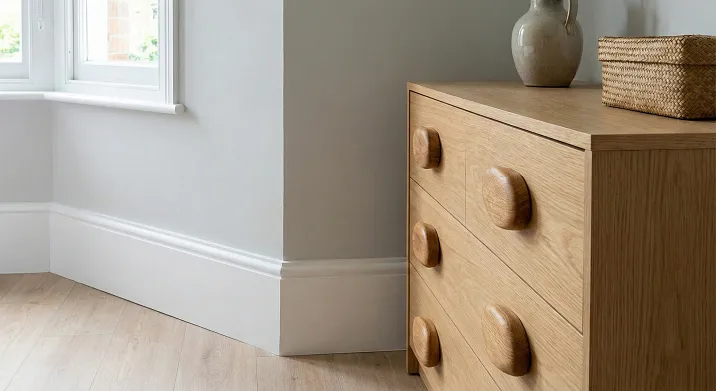
Elegance doesn't have to be expensive everywhere. The secret to a harmonious interior lies in the ability to allocate the budget: invest in what you touch with your hands, save on what remains in the background.Furniture handles made from solid oak or beech— is a tactile accent that is registered daily with every touch to a kitchen cabinet, dresser, wardrobe door.MDF skirting board with veneer— is the visual frame of a room, which should be of high quality but doesn't have to cost as much as solid wood. Let's figure out how to create a contrast between budget and luxury without sliding into cheapness or overspending on secondary details.


Philosophy of selective luxury
An interior is not a museum where every item is equally valuable. It is a space with a hierarchy of elements: some are in the focus of attention, others remain a supporting background. Skillful budget allocation creates a sense of luxury with reasonable expenses.




What deserves investment
Tactile elements — those you touch dozens of times a day.Wooden handle on a kitchen cabinet front, door handle in the hallway, stair railing — these are points of contact between a person and the interior. Their quality, texture, and material temperature shape the emotional response.
If a handle is plastic, cold, slippery — every touch creates subconscious irritation. If a handle is wooden, warm, of a pleasant shape — the touch becomes a micro-pleasure that repeats hundreds of times a week. This difference between cheap discomfort and quality pleasure is critical for the perception of a home.
Visual accents — elements that attract the eye. Carved fireplace decor, an impressive chandelier, an unusual wall texture. They create the character of the interior, its memorable features. Don't skimp on accents — they should be flawless.
Our factory also produces:


What can be background
Background elements — those that don't attract attention but create a frame for accents.Skirting board around the perimeter of a room— is a typical background element. It should be of high quality but doesn't have to be made of solid oak unless it's a palace interior.
Veneered MDF skirting board with oak veneer looks like solid wood but costs 2-3 times less. Even a specialist won't see the difference unless they come close and touch it. And a skirting board is an element that is almost never touched by hand.
Walls, ceilings, basic lighting — all of this is background. High-quality, even, neutral, but not requiring premium materials. The background should not compete with accents for attention.
Get Consultation
MDF skirting board: when imitation is not a compromise
MDF (medium-density fiberboard) is often perceived as a budget substitute for wood. This is a mistake. In the context of skirting boards, MDF is a technological material that surpasses solid wood in some parameters.
Geometric Stability
Wood is alive. It reacts to changes in humidity, expands and contracts. During the dry heating season, a solid oak skirting board can shrink by 2-3 mm in width, creating gaps in the corners. In spring, when humidity rises, it expands, sometimes bowing away from the wall.
MDF is stable. Its expansion coefficient is 5-7 times lower than that of solid wood. An MDF skirting board doesn't warp, doesn't twist, doesn't form gaps. After installation, it remains geometrically perfect for years.
For a skirting board that should create a clear line around the perimeter of a room, stability is more critical than naturalness. No one will come to stroke the skirting board, admiring the texture of oak. But everyone will notice if gaps appear in the corners.
Veneer as an aesthetic solution
Veneered skirting board — is an MDF base covered with a thin (0.6-2.0 mm) layer of natural oak veneer. Visually, it is indistinguishable from solid wood. The texture of annual rings, wood pores, natural shade variations — all of this is present because veneer is real oak.
Advantages of veneer:
You can select a uniform color and texture for the entire batch of skirting boards. Solid oak always has variations — one board is lighter, another darker, one has more knots, another fewer. Veneer is sorted, matched, creating visual uniformity.
Veneer is easier to tint. Its thin layer allows precise control of pigment penetration, creating even shades without stains and streaks that sometimes appear on solid wood due to uneven density.
Veneer is cheaper. From one cubic meter of oak, you can produce 20 meters of solid baseboard or 400 meters of veneered baseboard. Resources are used more efficiently, the price is lower, and the environmental footprint is smaller.
When MDF is better than solid wood
For rooms with variable humidity—kitchens, hallways, bathrooms—MDF is preferable to solid wood. It does not warp from water splashes, crack from the dry air of radiators, or swell from humidity.
For modern interiors with painted elements. If the baseboard is planned to be painted white, gray, or black, there is no point in overpaying for solid wood. MDF for painting is ideal—a uniform surface without wood grain, which will be hidden by paint anyway.
For long runs without joints. MDF baseboards are produced up to 5 meters long (solid wood is usually 2-2.5 meters), allowing a wall to be installed without joining seams. Fewer seams mean cleaner geometry.
Solid wood furniture handles: when saving is inappropriate
wooden furniture handles—this is the element where saving is felt instantly and ruins the impression of the entire interior. A cheap plastic handle on an expensive kitchen set is like a synthetic tie with a suit worth a hundred thousand rubles. Details give it away.
Tactility as a quality criterion
Humans are tactile beings. Texture, temperature, and the weight of an object in the hand are subconsciously perceived and form an emotional response. A wooden handle is warm (wood quickly adopts the hand's temperature), pleasantly rough (doesn't slip like plastic), and has weight that creates a sense of quality.
A plastic handle is cold to the first touch (especially in winter), smooth to the point of slipperiness, and light to the point of being imperceptible. A metal handle is even colder, requires getting used to, and creates an industrial feel, which doesn't suit all styles.
Wood is universal. It fits in a classic interior (carved handles with patina), Scandinavian minimalism (concise forms from light beech), eco-style (untreated texture with preserved knots), and modern interiors (geometric forms from stained oak).
Visual hierarchy in furniture
A kitchen set consists of fronts and handles. Fronts are the area, the background. Handles are points, accents. Fronts can be budget-friendly (laminated chipboard with high-quality film), but handles should be premium. They are what create the feeling of expensive furniture.
A chest of drawers with simple fronts made of painted MDF (inexpensive) and eleganthandmade wooden handles(expensive) looks prestigious. A chest of drawers with expensive fronts made of walnut veneer (expensive) and cheap plastic handles (cheap) looks shabby.
Handles are visible, they are at eye level, they attract attention. Fronts are the background, which shouldn't shout. Invest in what is seen and touched.
Durability and repairability
Wooden handles last for decades. Oak, beech—hardwoods resistant to wear. Even with intensive use (kitchen cabinets are opened 10-20 times a day), the handle doesn't lose shape, wear down, or deform.
If a handle is scratched—it can be sanded, re-oiled, or re-varnished. If it becomes boring—it can be repainted, changing the interior's color scheme without replacing all the furniture.Wooden itemsThey are repairable, adaptable to new trends, and don't require complete replacement.
A plastic or metal handle cannot be restored. A scratch, chip, or wear mark is permanent. After 5-7 years of intensive use, they look worn and require replacement.
How to combine budget and premium in one space
Creating a contrasting interior requires understanding where saving is acceptable and where it will ruin the entire concept.
The rule of visibility and touch
An element is at eye level and is touched by hands—a premium material is mandatory.Furniture handles on kitchen fronts, door handles, handrails, countertops—invest here.
An element is at eye level but is not touched—quality imitations are acceptable. Decorative wall panels, moldings, cornices can be made of MDF with a finish. Visually, they are identical to solid wood, cost less, and last longer (don't deform).
An element is below or above eye level (underfoot, near the ceiling)—saving is justified.Floor baseboard made of MDFCeiling cornices, hidden structural elements — there's no point in overpaying for solid wood here.
Unity of style with different materials
Key point: different materials should not look heterogeneous. Veneered skirting boards and wooden handles should be made from the same species (oak + oak or beech + beech), in the same tone, with the same finish.
If handles are coated with matte oil, the skirting board should also be matte. If handles are tinted dark brown, the skirting board should be the same shade. Consistency in color and texture creates a sense of a unified ensemble, concealing the fact of material differences.
Mistake: wooden handles made of natural light oak + MDF skirting board painted white. The contrast of materials and color destroys integrity; the interior looks assembled from random elements.
Correct: wooden handles made of oak with natural oil + MDF veneered skirting board with oak veneer, coated with the same oil. Visually, everything looks like a unified system of wooden elements.
Budget allocation: figures and priorities
Imagine a 12 m² kitchen requiring replacement of fronts, handles, and skirting board.
Option 1 (even distribution): solid oak fronts (200,000 rubles), plastic handles (5,000 rubles), solid oak skirting board (15,000 rubles). Total: 220,000 rubles. Result: expensive fronts are devalued by cheap handles.
Option 2 (accent distribution): wood-look laminate fronts (80,000 rubles),solid oak handles(25,000 rubles), MDF oak veneer skirting board (8,000 rubles). Total: 113,000 rubles. Result: the kitchen looks expensive due to quality handles, saving 107,000 rubles.
Conclusion: redistributing the budget from background to accents yields better visual results at lower costs.
Technical aspects of choosing MDF skirting boards
Not all MDF is equally good. The quality of the base, veneer, and finish determines durability and appearance.
Base density
MDF is produced in different densities: 650-850 kg/m³. For skirting boards, a density of 750-800 kg/m³ is optimal. MDF that is too light (650 kg/m³) is brittle and prone to chipping during installation. MDF that is too dense (850 kg/m³) is harder to process, more expensive, and excessive for skirting boards.
Density check: weigh a 1-meter section of skirting board. A skirting board with a cross-section of 80×16 mm should weigh about 1000-1100 grams. If lighter than 900 g — low-density MDF; if heavier than 1200 g — excessively dense.
Veneer quality
Veneer can be natural (sliced from an oak trunk) or fine-line (reconstructed from cheaper species). Natural veneer preserves natural texture with variations; fine-line is artificially uniform.
For skirting boards, fine-line is preferable. Its uniformity creates visual unity of all planks in a batch; there is no variation in tone or texture, which can sometimes be noticeable with natural veneer.
Veneer thickness: 0.6 mm — minimum, suitable for budget solutions, but cannot be sanded (you'll sand through it). 1.5-2.0 mm — optimum, allows for local restoration. 3.0 mm — excessive for skirting boards, used in furniture production.
Finishing coating
Wooden veneered skirting boardcan be sold for painting (unfinished) or with a ready-made finish (varnish, oil, paint).
For painting: cheaper, allows any color choice, requires additional work (priming, painting, drying). Suitable if you are doing the renovation yourself and want to control the color.
With ready-made varnish: more expensive, instantly ready for installation, color limited to standard options (natural oak, walnut tint, wenge, bleached oak). Suitable if speed is needed and a standard color is acceptable.
With oil: medium price, emphasizes texture, tactilely more pleasant than varnish (does not create a slippery film), requires periodic renewal (every 3-5 years). Optimal for living spaces.
Choosing furniture handles: shapes, sizes, styles
wooden furniture handlesvary by shape, size, mounting method, and style.
Knob handles: compactness and minimalism
Round or square knobs with a diameter of 30-50 mm. Mounted with one screw through a central hole. Suitable for small doors (bathroom cabinets, upper kitchen cabinets), light drawers.
Advantages: compact, do not protrude far from the facade (important in narrow kitchens where every centimeter counts), easy to install (one hole).
Disadvantages: inconvenient for heavy doors (uncomfortable finger grip), not suitable for wide drawers (require two buttons, which is more expensive and visually bulky).
Pull handles: versatility and ergonomics
U-shaped handles 100-300 mm long. Mounted with two screws at a fixed distance (128 mm, 160 mm, 192 mm — standard center-to-center distances). Suitable for any doors and drawers.
Advantages: convenient grip with the whole hand, suitable for heavy doors, visually structure the facade (the long horizontal line of the handle divides the facade into zones).
Disadvantages: protrude 30-50 mm from the facade, which is critical in narrow passages. Require precise drilling of two holes (if the distance is inaccurate, the handle mounts crookedly).
Recessed handles: integration into the facade
Recessed handles with a finger indentation. Do not protrude from the facade, create a minimalist look. Suitable for modern interiors where protruding elements are to be avoided.
Advantages: do not protrude, do not catch, visually inconspicuous (the facade looks clean).
Disadvantages: less convenient to grip (fingers enter the indentation at an angle), more difficult to install (require milling an indentation into the facade).
Styling of forms
Geometric simple shapes (circle, square, rectangle) — modern style, minimalism, Scandinavian interior.
Carved with decorative elements (scrolls, floral motifs, beveled edges) — classic style, Provence, country.
Asymmetric organic shapes (drop, wave, irregular oval) — eclecticism, modern classic, art deco.
The choice depends on the overall interior style. Mistake: classic carved furniture with minimalist square handles. Correct: consistency between the style of handles and furniture.
Installation of MDF skirting boards: features and mistakes
Veneered skirting boards are installed differently than solid wood ones. Mistakes lead to veneer chips, gaps, and crooked geometry.
Wall Preparation
The wall must be even. MDF skirting is not flexible (unlike plastic), does not press against unevenness. If the wall is wavy, gaps form between the skirting and the wall.
Checking evenness: place a 2-meter straightedge against the wall. The gap between the straightedge and the wall should not exceed 2-3 mm. If larger — level with filler.
Dust removal: MDF skirting is glued, and glue does not adhere to a dusty surface. Before installation, vacuum the wall, wipe with a damp cloth, let dry.
Cutting angles
Corners are cut at 45° with a miter saw. A hand saw does not provide the necessary accuracy — the cut will be rough, the veneer will chip. A miter saw with fine teeth (80-100 teeth) cuts cleanly, without chips.
Sequence: measure the wall length, cut the skirting with a 5 mm allowance, place against the wall, adjust precisely. It's better to cut twice (first with allowance, second precisely) than to cut too short immediately (cannot be corrected).
Sanding the end: after cutting, the end is rough. Sand with P180-P240 sandpaper to make the end smooth. This is important for tight fit in corners.
Fastening
Combination of adhesive and mechanical fasteners. Adhesive (liquid nails, mounting adhesive) holds the skirting to the wall along its entire length. Mechanical fasteners (finish nails, screws) secure until the adhesive sets.
Apply adhesive in a wavy line to the back of the skirting. Place against the wall, press. Secure with finish nails (20-30 mm long) every 40-50 cm. Drive nails into the upper part of the skirting, where they will later be hidden by sealant or where they will be inconspicuous.
Do not use regular nails — they are thick and will split MDF. Finish nails are thin (1.5-2.0 mm), with a small head, almost invisible after driving.
Masking joints
Joints in corners are filled with acrylic sealant matching the skirting color. Sealant fills micro-gaps, creates the illusion of a monolithic connection.
Application technique: squeeze a thin strip of sealant into the gap, smooth with a wet finger, remove excess with a damp sponge. Let dry for 24 hours. The sealant will become invisible, the joint will look like a single surface.
Do not use silicone sealant — it cannot be painted. Acrylic can be painted if the color is not a perfect match.
Installing furniture handles: precision and reliability
A wooden handle is heavier than a plastic one. Improper installation leads to loosening, falling out, and damage to the facade.
Drill hole marking
For a knob handle: one hole in the center of the facade (or at another point according to the design). For a pull handle: two holes at a fixed distance (128, 160, 192 mm).
Use a template — a plastic or cardboard blank with holes in the right places. Place the template on the facade, mark the points with an awl, remove the template, and drill.
Precision is critical for pull handles. If the holes are shifted by 1-2 mm, the handle will not sit flush and will be crooked. This is noticeable and unsightly.
Drilling
Drill from the front side of the facade with a drill bit 0.5 mm larger than the screw diameter (if the screw is M4, use a 4.5 mm bit). Drill perpendicular to the facade, without tilting.
Place a board or plywood under the facade. When the drill bit exits the back side, it can chip the facade material. The backing prevents chipping.
If the facade is thick (more than 20 mm), drill from both sides. From the front side — to a depth of 15 mm, from the back — until they meet. This gives clean hole edges on both sides.
Mounting screws
Furniture handles woodenare supplied with standard-length screws (25-35 mm). If the facade is thicker than 18 mm, standard screws are too short — the handle will not be tightened properly and will loosen over time.
Buy screws of the required length. Screw length = facade thickness + handle thickness (at the mounting point) + 5 mm margin. For example, facade 22 mm, handle leg 10 mm, screw needed is 37 mm.
Tighten the screws evenly (for pull handles, tighten both screws alternately, a little at a time). Overtightening can split a wooden handle leg. Moderate tightening ensures reliability without risk.
Frequently asked questions
Can you visually distinguish a veneered baseboard from solid wood?
From a distance of more than 50 cm — practically impossible. Up close, you can notice that the texture is too uniform (solid wood has more variation). But in real conditions, when the baseboard is on the floor, no one will squat down to examine it closely.
How long does an MDF baseboard last compared to solid wood?
With proper use, an MDF baseboard lasts 20-30 years, solid oak — 40-50 years. There is a difference, but for living spaces where renovations are done every 15-20 years, it's not critical. The baseboard is changed along with the renovation, not meant to last 50 years.
Can wooden handles be repainted if you get tired of the color?
Yes, this is one of the main advantages of wood. The handle can be sanded (remove the old finish), and recoated with oil, varnish, or paint in any color. Plastic or metal handles cannot be repainted.
Which wood species to choose for handles — oak or beech?
For the kitchen, where humidity varies, oak is better — it is more moisture-resistant. For the bedroom, living room, where the climate is stable, beech is suitable — it is lighter, cheaper, and no less durable. If you need a dark color, choose oak (it is easier to tint into dark shades without losing texture).
How often should the oil finish on handles be renewed?
Depends on the intensity of use. In the kitchen, where handles are touched 20-30 times a day, renewal is needed every 2-3 years. In the bedroom, where the cabinet is opened 2-3 times a day, the oil lasts 5-7 years. A sign that renewal is needed — the surface has become dry, rough, and lost its shine.
Can you combine handles of different shapes in one interior?
Yes, but wisely. In the kitchen, pull handles on lower cabinets (convenient to pull down) and knob handles on upper ones (compact, not in the way) are acceptable. But they should be made of the same wood species, in the same tone, preferably from the same collection (so they are stylistically consistent).
Conclusion: smart savings, calculated luxury
Creating a harmonious interior is not mindless spending nor total economizing. It is the ability to see the hierarchy of elements, to understand where details are critical and where compromises are acceptable.
MDF skirting board with veneer— smart savings that do not worsen the visual result. Stable geometry, natural veneer texture, durability — this makes it the choice of professionals who know the value of details.
solid wood furniture handles— a necessary investment that pays off with daily tactile comfort and visual integrity of the interior. They turn ordinary furniture into status pieces, create the character of a space, and last for decades.
The contrast between budget and accent works when you understand the logic: save on the background, invest in the details.Wooden products for interior— whether handles, baseboards, moldings — create a unified system where each element is in its place, performs its function, not competing for attention nor falling out of the overall ensemble.
STAVROS has specialized for over twenty years in manufacturing solid wood and high-quality MDF products for interiors. The range includes both premium elements made of oak and beech solid wood, as well as technological solutions based on MDF with natural wood veneer.
Furniture handles Stavrosare manufactured using 3D milling on CNC machines from selected wood that has undergone chamber drying to 8-12% moisture content. This eliminates deformation, cracking, and ensures dimensional stability for decades. The catalog features 32 models of various shapes and sizes — from compact buttons with a diameter of 35 mm to impressive brackets up to 400 mm long.
Each handle undergoes multi-stage sanding (coarse, medium, finish) to achieve a perfectly smooth surface. Several finishing options are offered: natural oil (enhances the grain, creates a warm tactile feel), matte varnish (durable protection while preserving the natural appearance), painting in four basic colors (white, black, brown, clear).
STAVROS baseboardsare presented in two categories: solid wood (oak, beech) for classic and premium interiors, and MDF with veneer for modern solutions where geometric stability and affordable pricing are important.
Veneered skirting boards are manufactured using high-density European MDF (density 780 kg/m³), faced with natural oak or beech veneer 1.5 mm thick. This provides visual identity to solid wood at a significantly lower cost and complete dimensional stability under any climatic conditions.
The skirting board size range includes heights from 60 to 160 mm, allowing for proportional solutions for spaces of any scale — from compact apartments to spacious country houses. Plank lengths up to 5 meters minimize the number of joints, creating clean, continuous geometry.
STAVROS provides comprehensive interior element selection services, taking into account the customer's budget and priorities. The company's designers will help determine where investments in premium materials are justified, and where technological alternatives are acceptable without compromising visual quality.
Create interiors where every ruble is invested wisely, where luxury coexists with practicality, where touching a wooden handle brings pleasure, and the perfect geometry of a skirting board delights the eye for years.