












































































Article Contents:
- Why White MDF Skirting Board is the Best-Selling Option in Russia
- The Material That Never Lets You Down
- White MDF Skirting Board Sizes: 60, 70, 100, 120 mm — What to Choose
- 60 mm Skirting Board: A Timeless Classic
- White Floor MDF Skirting Board 70mm: The Optimal Balance
- White MDF Skirting Board 100mm: Tall — For High Ceilings
- 120 mm and Taller Skirting Boards: An Architectural Statement
- How to Choose Skirting Board Height: A Simple Rule
- Laminated White vs. Paint-Ready — Surface Differences
- Laminated White MDF Skirting Board
- White MDF Skirting Board for Painting
- MDF Skirting Board Painting Technology
- Matte and Glossy White — When Each is Appropriate
- White Matte MDF Skirting Board
- White Glossy MDF Skirting Board
- Semi-Matte and Satin Finish
- White Skirting Board in Scandinavian Style, Classic, Minimalism
- White MDF Skirting Board in Scandinavian Style
- Classic Interior: White Skirting Board as an Architectural Element
- Minimalism: The Invisible Skirting Board
- Modern classic and neoclassic
- Set: White Skirting Board + White Doors + White Architrave
- Why a Unified Set is Important
- How to Properly Assemble a Set
- White Skirting Board and White Laminate: A Special Case
- Installing White MDF Skirting Board — How Not to Damage the Surface
- Tools and Materials for Installation
- Preparing the Room and Skirting Board
- Step-by-Step Installation
- Common Installation Mistakes
- Installation in the Bathroom and Kitchen
- Caring for White MDF Skirting Board
- Prices for white MDF skirting board
- White MDF skirting board: comparison with analogues
- MDF vs PVC
- MDF vs wood
- MDF vs aluminum
- FAQ: frequently asked questions about white MDF skirting board
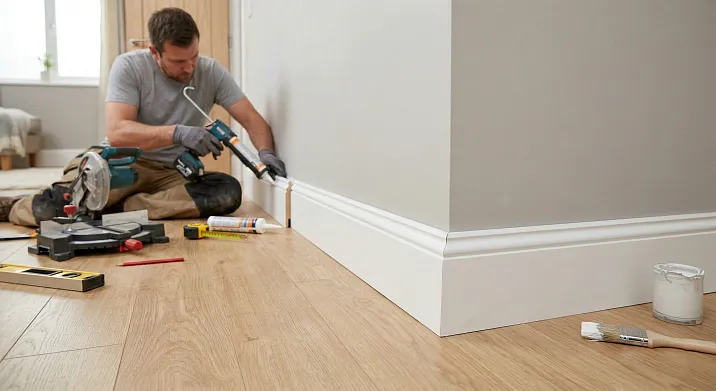
There are interior details that go unnoticed while in place, but immediately catch the eye as soon as they're missing. Skirting board is exactly such a detail. A thin strip between floor and wall that we take for granted. But choose the wrong material, wrong height, or wrong color — and the entire interior loses its completeness, like a painting without a frame. Among all the variety of floor skirting boardsWhite MDF Skirting Boardholds a special place: it sells better than all other options, it's chosen by designers and ordinary buyers, it's installed in studios and country houses, in Scandinavian apartments and classic living rooms. Why does this happen? Let's figure it out.


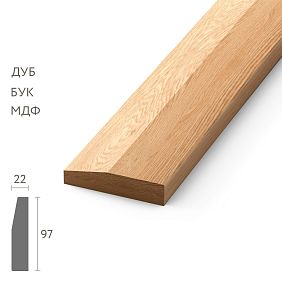


Why white MDF skirting board is the best-selling option in Russia
Before discussing technical characteristics and sizes, it's worth understanding why exactly white color and exactly MDF became the dominant combination in the Russian market of floor decorative elements.
The answer is obvious if you look at the construction market statistics of the last decade. Russia is experiencing a steady trend toward light interiors. White walls, light laminate, minimalist furniture — all this creates demand for white finishing elements. AndMDF floor skirting board, whitefits organically into this picture: it doesn't create visual contrast between floor and wall, but softly connects them, making the transition smooth and elegant.
MDF as a material surpasses wood in stability: it doesn't dry out, doesn't crack with humidity changes, doesn't deform from temperature fluctuations. At the same time, quality MDF is practically indistinguishable from natural wood in appearance — especially after painting or laminating. It's this combination of price, stability, and aesthetics that made MDF skirting board the sales leader.
Add to this the convenience of installation: MDF cuts easily, holds fasteners well, doesn't crumble when working with a jigsaw. For DIY installation, this is fundamentally important. No wonder the search query 'white MDF skirting board DIY installation' is among the top search queries on the topic.
Another factor is versatility. White skirting board looks equally good with parquet, laminate, tile, self-leveling floors, and carpet. It doesn't dictate style, but supports any. Scandinavian minimalism, classic, Provence, modern loft — white skirting board will be appropriate everywhere.




Material that doesn't let you down
MDF (Medium Density Fiberboard) is produced by hot pressing wood fibers with binding resins. The result is a homogeneous, dense, smooth board with high resistance to mechanical impacts. MDF skirting boards are produced by milling: the desired profile shape is cut from a blank — straight, rounded, with chamfer, with decorative relief.
Thanks to its homogeneous structure, MDF perfectly accepts paint: the surface becomes even, without pores and knots, without protruding wood texture. That's why white MDF skirting board for painting is one of the most in-demand formats: you get pure white color without yellowness, without uneven coloring, without the risk that after a year the wood texture will 'show through' the paint.
Our factory also produces:


White MDF skirting board sizes: 60, 70, 100, 120 mm — what to choose
Everyone asks about skirting board size — from experienced designers to people doing renovation for the first time. And they're right to do so: skirting board height changes the visual perception of a room dramatically.
Get Consultation
60 mm skirting board: timeless classic
60 mm height is the standard of Soviet and post-Soviet architecture. Most typical apartments with ceilings of 2.5–2.7 meters were built exactly for such skirting board. It doesn't attract attention, doesn't disrupt proportions, provides a neutral transition from floor to wall.
If you're doing renovation in a regular city apartment and want a simple neat result — 60 mm will be the right choice. It's practical, affordable, easy to install. White color in this format is especially advantageous: narrow white skirting board almost 'disappears' against light walls, creating a sense of cleanliness and neatness.
White floor MDF skirting board 70mm: optimal balance
70 mm height is a compromise between modest standard and pronounced decorative accent. White floor MDF skirting board 70mm is today the most popular format in business-class new buildings and during major renovations in apartments with ceilings of 2.7–3 meters.
Why exactly 70 mm? This size is noticeable enough to add completeness to the interior, but not so high as to 'weigh down' the space. It looks organic with both laminate and tile or parquet. Most manufacturers offer the widest range of profiles exactly in this size.
White MDF skirting board 100mm: tall — for high ceilings
If you have ceilings of 3 meters and above — a modest skirting board will look like a random strip at the base of the wall. White MDF skirting board tall 100mm creates a completely different impression: it becomes a full-fledged architectural element, visually 'continues' the wall downward, makes the interior more majestic and complete.
In classic interiors, in houses with high ceilings, in living rooms with columns and moldings — 100 mm skirting board looks organic and rich. Especially as part of a set with white doors and white architraves — we'll talk about this in more detail below.
120 mm skirting board and above: architectural statement
A height of 120 mm or more is no longer just a baseboard, but an architectural molding. Such an element is used in rooms with ceilings from 3.5 meters: in country houses, office and commercial spaces, and interiors in Art Deco or Neoclassical styles.
Installing such a baseboard requires greater care and, as a rule, a professional approach — if only because working with a wide profile on long walls is physically more difficult, and the cost of a mistake is higher.
How to choose baseboard height: a simple rule
Designers use a simple proportion: the height of the baseboard should be approximately 3–4% of the ceiling height. That is:
-
Ceiling 2.5 m → skirting board 60–80 mm
-
Ceiling 3.0 m → baseboard 80–100 mm
-
Ceiling 3.5 m → baseboard 100–140 mm
This rule also works in reverse: if you want to visually 'raise' the ceiling in a low room — choose a baseboard of minimal height in white. White does not weigh down the space but dissolves into it.
Laminated white vs. paintable — surface differences
Buyers are often confused: which is better — white laminated MDF baseboard or paintable MDF baseboard? Both options are white, both are made of MDF, but they differ fundamentally.
White laminated MDF baseboard
A laminated baseboard is an MDF profile covered with PVC film or paper-laminate coating. The film can imitate white paint (solid color), create a glossy or matte effect, or replicate the texture of fabric or stone.
The main advantage of the laminated option is its readiness for installation. You receive a baseboard with a finished coating: no need to paint, prime, or wait for drying. Unpack it — and install.
White laminated MDF baseboard is resistant to wet cleaning, not afraid of household chemicals (within reasonable limits), and does not lose color over time — provided the film is of high quality. This is the optimal choice for those who want quick results without additional work.
The disadvantage is that if the film is damaged, it is difficult to repair. A scratch or chip on a laminated baseboard looks unsightly, and 'touching up' the damaged area to make it unnoticeable is practically impossible.
White paintable MDF baseboard
A paintable MDF baseboard is a profile with a primed or unprimed surface that needs to be painted yourself. It sounds like extra work, but this option has serious advantages.
First, you choose the color and type of paint yourself. Want a perfect matte white — no problem. Want a light cream shade — easy. Want glossy varnish over a white base — that's possible too.
Second, a damaged area is easily touched up — with the same brand and color of paint you used initially.
Third, the surface quality with professional painting surpasses any film: you get a monolithic, uniform coating without seams or joints.
For those who approach renovation thoughtfully and want a perfect result — a paintable baseboard is preferable. Especially in classic interiors where white surfaces must be absolutely identical: baseboard, doors, trims — everything is painted with the same paint, in one layer, and the result looks monolithic.
MDF baseboard painting technology
If you have chosen a paintable baseboard, the process is not complicated but requires care:
-
Priming. Apply acrylic primer — it will seal the MDF pores and improve paint adhesion. Without primer, the paint will apply unevenly and may 'bubble'.
-
First coat of paint. Use water-based acrylic paint for wood and MDF. A brush or short-nap roller gives an even result. Let dry for 2–4 hours.
-
Light sanding. Go over it with fine sandpaper (grit 320–400) to remove any fibers.
-
Final coat. A second coat of paint — and the baseboard is ready for installation.
For work in the bathroom or kitchen, use paint with moisture-resistant additives or semi-matte enamel — it withstands wet cleaning better.
Matte and glossy white — when each is appropriate
The question of surface texture — matte or glossy — may seem secondary, but in fact, it largely determines the character of the interior.
White matte MDF baseboard
A matte surface absorbs light, prevents glare, and creates a sense of softness and restraint. White matte MDF skirting board is a choice for modern interiors: Scandinavian style, minimalism, Japanese design, Nordic conciseness.
A matte skirting board 'disappears' in the interior, not drawing attention—it serves its function without announcing itself. This is especially valuable in small apartments where it's important not to overload the space with details.
The practical advantage of a matte surface is that it shows minor scratches and cleaning marks less noticeably. Matte white forgives small installation and usage imperfections.
White glossy MDF skirting board
A glossy surface reflects light, adds shine, and makes interior details look 'expensive' and expressive. White glossy MDF skirting board is suitable for classic interiors, Art Deco style, formal living rooms, and rooms with plenty of light.
Glossy skirting board pairs well with glossy doors, polished furniture, and lacquered parquet. In such interiors, shine is part of the style, and glossy skirting fits in organically.
The downside: gloss mercilessly shows all scratches, stains, footprints, and furniture marks. Maintaining a glossy skirting board requires greater care.
Semi-matte and satin finish
A compromise option is a semi-matte or satin surface. It provides a slight silky sheen without mirror reflection, hides minor damage better than gloss, but looks richer than matte. Many professional painters recommend semi-matte enamel specifically for skirting boards and door frames—a universal choice for most interiors.
White skirting board in Scandinavian style, classic, minimalism
White skirting board is a surprisingly flexible element: it changes its role depending on the interior style. In one room, it's almost invisible; in another, it becomes a key accent. Let's look at how it works in different styles.
White MDF skirting board in Scandinavian style
Scandinavian design is about simplicity, functionality, natural materials, and light spaces. White skirting board is absolutely organic here: it continues white or light gray walls, creating a unified clean canvas.
White MDF skirting board in Scandinavian style typically involves a simple straight profile without decorative elements—no curls or relief patterns. Height 60–80 mm, matte surface. Pairs with wooden floors in natural shades, gray and white laminate, and natural fiber carpets.
In a Scandinavian interior, white skirting board literally 'stitches' the space together: walls, furniture, textiles—all exist in a unified light palette, and the skirting supports this harmony without disrupting it.
Classic interior: white skirting board as an architectural element
In classic style, skirting is not just a transition from floor to wall but a full-fledged architectural molding. High profiles from 100 mm are appropriate here, with bevels or relief patterns, glossy or semi-matte surface.
Classic white skirting board paired with white cornices, white doors, and white moldings creates a sense of noble completeness—like in old St. Petersburg apartments or French châteaux. This is an interior that reads as a cohesive architectural concept, not a collection of random elements.
For classic style, coordination is especially important: skirting, cornice, and architrave should be from the same line, with matching profile patterns. Study the catalog of cornices and moldings—there you'll find elements designed specifically to complement such skirting boards.
Minimalism: invisible skirting board
In a minimalist interior, skirting board strives for invisibility. The ideal option is a white skirting board with a straight profile, minimal height, matte surface, exactly matching the wall color.
Sometimes in radical minimalism, skirting is abandoned altogether, creating a hidden skirting—a groove in the wall. But this solution requires perfect room geometry and complex installation. In most cases, a thin white MDF skirting board 60 mm solves the task more simply and cheaply.
Modern Classicism and Neoclassicism
Neoclassicism is one of the most popular styles in Russia in recent years. It's a synthesis of classical forms and modern materials: white walls with light texture, parquet or engineered wood flooring, furniture with clean lines but soft details. White skirting board here takes the form of a medium profile: 80–100 mm, with slight relief, matte or semi-matte surface.
Set: white skirting board + white doors + white architrave
One of the most frequent questions from customers: 'How to make all white elements look the same?' This is indeed a challenging task—different manufacturers use different shades of white, different textures, different levels of sheen. As a result, white skirting board from one brand and white doors from another can look frankly disharmonious together.
Why a unified set is important
White color is tricky. It exists in hundreds of shades: warm white with a yellowish tint, cool white with a bluish tint, neutral pure white, milky, cream, pearly. When two 'whites' that differ in temperature meet in one interior, it catches the eye and creates discomfort.
The ideal solution is to buy skirting board, architrave, and other finishing elements from one manufacturer, from the same line. In this case, the shade, texture, and level of sheen will be identical.
White MDF skirting board and white doors set is not just about aesthetics. It's also practical: simultaneous installation of skirting and door architraves allows for a neat solution at the junction point. The architrave and skirting meet at the corner of the doorway, and if they're from the same line—this joint looks perfect.
How to properly assemble a set
Professional approach to interior finishing:
-
Baseboard — choose a profile that echoes the door casing profile. If the casing is straight — the baseboard should also be straight. If the casing has a bevel — the baseboard should have a similar bevel.
-
Door casing — the width of the casing should be proportionate to the height of the baseboard. For a 70 mm baseboard, the optimal casing is 60–80 mm wide.
-
Door panel — if the doors are glossy white, the baseboard is better glossy or semi-matte. A matte baseboard with glossy doors creates imbalance.
A properly selected set turns an ordinary renovation into a thoughtful interior project. That's why designers always insist on preliminary coordination of all white elements at the planning stage.
White baseboard and white laminate: a special case
If you have white or light gray laminate — a white MDF baseboard for laminate creates a unified monochrome base. This is a bold but stylish solution. It's important that the shade of the baseboard is cooler or warmer than the laminate just enough to create a slight contrast, but not dissonance.
Warm white laminate + neutral white baseboard — good.
Cool gray-white laminate + warm cream baseboard — bad.
If in doubt — choose a paintable baseboard and paint it with the same paint as the walls. This guarantees a perfect color match.
Installation of white MDF baseboard — how not to damage the surface
Self-installation of white baseboard is a quite feasible task, but requires care and the right tools. MDF is a durable material but does not tolerate rough handling: it can chip at the cut, deform from an improperly driven nail, and get scratched by careless tool use.
Tools and materials for installation
Before starting work, prepare:
-
Miter saw or miter box with a wood saw (fine teeth, 40–60 teeth per inch)
-
Tape measure and pencil
-
Level or laser level
-
Liquid nails or mounting adhesive for MDF
-
Finish nails 35–45 mm or a pneumatic nailer
-
White wood filler (for sealing joints)
-
White acrylic sealant (for wall abutment)
-
White paint (if the baseboard is paintable)
Extremely important point: use only special MDF adhesive or solvent-free liquid nails. Ordinary solvent-based mounting adhesives can dissolve the laminate film and permanently ruin the appearance of the baseboard.
Room and baseboard preparation
Before starting installation, let the baseboard 'acclimatize' in the room — keep it horizontally in the room for 24–48 hours. MDF reacts to humidity: if you bring a cold baseboard from outside and install it immediately — it may slightly deform after a few days.
Check the geometry of the corners in the room. In real apartments, corners are rarely exactly 90°: a deviation of 1–2 degrees is normal. Measure the actual angle and cut the baseboard ends with the corresponding offset. Use a digital angle finder or a smartphone app.
If the wall at the base is uneven — do not try to 'bend' the baseboard. It's better to use liquid nails adhesive as a filler: apply it in a wavy pattern on the back of the baseboard, press it against the wall, secure it with masking tape until dry.
Step-by-step installation
Step 1. Marking. Go around the perimeter of the room with a level, mark the baseboard mounting line. This is especially important if the floor is uneven: the baseboard should be horizontal, not follow the floor relief.
Step 2. Cutting corners. For internal corners (regular room corners) make a 45° cut on the miter saw. For external corners (protruding pilasters, niches) — also 45°, but in the other direction. If the angle is not 90° — adjust the cutting angle.
Step 3. Applying adhesive. Apply liquid nails in a 'zigzag' pattern on the back of the baseboard. Step back 3–5 cm from the edges so the adhesive does not squeeze out from under the baseboard when pressed.
Step 4. Installation. Place the baseboard against the wall, press firmly, hold for 30–60 seconds. Additionally secure with finish nails every 40–60 cm — this is insurance in case the adhesive does not provide perfect adhesion to the specific wall surface.
Step 5. Sealing joints. At the baseboard joints in corners, apply white wood filler, let dry, sand with fine sandpaper. Run white acrylic sealant along the line where the baseboard meets the wall — this will eliminate gaps and protect against moisture ingress.
Step 6. Painting (if the baseboard is paintable). It's better to apply the final coat of paint after installation: this way you'll cover the filler at the joints and nail marks.
Typical installation mistakes
Mistake 1: Cutting MDF with a coarse-toothed saw. Result: chips and burrs on the cut. Use only a fine-toothed saw or a miter saw.
Mistake 2: Driving nails too close to the edge. MDF may split. Keep at least 15–20 mm from the end.
Mistake 3: Using aggressive glue. Solvents in the glue can damage the laminate film. Use only solvent-free liquid nails.
Mistake 4: Installing skirting before laying the floor covering. First lay the laminate or parquet, then install the skirting. Otherwise, the joints will be exposed and untidy.
Mistake 5: Not leaving an expansion gap. There should be a 5–8 mm gap between the skirting and laminate for thermal expansion. The skirting covers this gap but should not press against the laminate.
Installation in bathroom and kitchen
In wet areas, white MDF skirting requires additional protection. Use moisture-resistant MDF (indicated by green color in cross-section — a sign of moisture-proof impregnation), paint with moisture-resistant enamel, and seal all joints with silicone sealant. The joint at the base of the wall in the bathroom is critical: if water regularly gets under the skirting, even moisture-resistant MDF will eventually swell.
For bathroom and kitchen backsplash, many designers recommend using PVC or aluminum skirting with white coating instead of MDF — they are completely moisture-proof. But if you value the aesthetics of MDF — the moisture-resistant version with proper sealing will handle wet conditions.
Caring for white MDF skirting
White skirting is beautiful but requires attention — it instantly shows dust, footprints, and accidental stains. However, caring for it is not difficult.
Regular wiping — with a damp cloth or microfiber with neutral detergent. Do not use abrasive sponges and powders: they scratch any surface, including laminated.
For stubborn stains (shoe marks, furniture stains) you can use a melamine sponge — a 'magic eraser'. It gently removes stains without scratching the surface.
If the skirting coating is paintable — every few years you can refresh it with a coat of white paint. This is easier and cheaper than replacing the skirting.
Prices for white MDF skirting
The cost of white MDF skirting depends on several factors: profile height, MDF quality, coating type, and manufacturer.
Approximate price range per linear meter:
-
White MDF skirting 60 mm, laminated — 80–150 rub./m.
-
White MDF skirting 70 mm, paintable — 100–180 rub./m.
-
White MDF skirting 100 mm, paintable — 150–280 rub./m.
-
White MDF skirting 120 mm, glossy laminated — 200–400 rub./m.
Standard length of one plank is 2.2 or 2.4 meters. To calculate the required quantity: measure the room perimeter, add 10–15% for cuts in corners and joints.
When purchasing on stavros.ru, you can select skirting, architraves, and moldings from the same collection — this guarantees matching shade and style. Managers will help calculate the required material quantity for specific room dimensions.
White MDF skirting: comparison with alternatives
To understand why MDF outperforms competitors, let's compare it with other materials.
MDF vs PVC
PVC skirting is cheaper, completely waterproof, and does not require painting. But it has a plastic, 'budget' look — it appears cheap even in white. Additionally, PVC becomes brittle at low temperatures and may crack, and can deform when heated. MDF looks significantly more natural and richer.
MDF vs wood
Natural wood is a classic, but it has serious drawbacks. It dries out, cracks, reacts to humidity, and requires thorough antiseptic treatment. White paint on wood may 'yellow' — wood releases resin and tannins over time that show through the paint. MDF is free from these problems.
MDF vs aluminum
Aluminum skirting is indispensable in modern and high-tech styles. But for classic, Scandinavian style, and most residential interiors, they are too 'industrial'. MDF is warmer and cozier.
FAQ: Frequently Asked Questions About White MDF Skirting Boards
Can you paint a laminated MDF skirting board?
Technically — yes, but the result won't be perfect. Paint doesn't adhere well to PVC film without special primer. If you need to repaint a laminated skirting board — first degrease the surface, apply plastic primer, then paint. But it's better to initially choose a skirting board designed for painting.
How to calculate the amount of skirting board needed for a room?
Measure the room's perimeter (sum of all walls), subtract the width of door openings, add 10–15% for offcuts. Divide by the length of one plank (usually 2.2 or 2.4 m) — you'll get the required number of planks.
What adhesive should I use for installing white MDF skirting boards?
Solvent-free liquid nails — 'Moment Montage', 'Titan', 'Technonicol'. Do not use solvent-based 'Moment' — it dissolves the laminating film.
Can MDF skirting boards be installed using only adhesive, without nails?
If the wall is even and the adhesive is high-quality — yes. But it's better to combine: adhesive + finishing nails. This is insurance in case the adhesive provides weak adhesion to a specific surface.
Which skirting board is better for laminate flooring — MDF or PVC?
MDF looks significantly better. PVC is suitable for rooms with high humidity (bathroom, toilet). For living rooms — definitely MDF.
How to remove the gap between the skirting board and the wall?
Apply white acrylic sealant into the gap, smooth it with your finger or a wet spatula, remove excess with a damp cloth. After drying, the sealant can be painted to match the wall or skirting board color.
Is MDF skirting board flammable?
MDF is a combustible material, like natural wood. Flammability class G2–G3. When installing near electrical outlets and heating appliances, observe fire safety regulations.
Can MDF skirting boards be installed in the bathroom?
Yes, if using moisture-resistant MDF (MDFV, green core in cross-section), coated with moisture-resistant paint and all joints are thoroughly sealed. Standard MDF is not suitable for bathrooms.
Why does white skirting board turn yellow over time?
This usually happens due to low-quality paint or laminating film. A quality white MDF skirting board with good coating doesn't yellow for 5–10 years. Yellowing can also be a result of sunlight exposure — use paint with UV protection.
Which skirting board profile to choose for Scandinavian style?
Straight profile without decorative elements, height 60–80 mm, matte surface. Simplicity is the main principle of Scandinavian design.
How much does skirting board installation by a professional cost?
On average in Russia — 100–300 rubles per linear meter, depending on the region and complexity of the work. Installation in complex rooms with many corners and niches costs more.
Where to buy white MDF skirting boards with quality guarantee?
In specialized stores of construction and finishing materials. The website stavros.ru offers a wide range ofwhite MDF skirting boardswith the option to select a set: skirting board + door casing + molding from one collection. Managers will assist with calculations and selection.
White MDF skirting board is not just a finishing element. It's the final touch that either makes the interior complete or leaves a feeling of incompleteness. Choose consciously: the right size, the right surface, the right set — and your renovation will look as if it was done by a professional designer.


