












































































Article Contents:
- Why skirting board height determines room perception
- Wide skirting board in classical and neoclassical interiors
- Materials for wide skirting boards: solid wood vs MDF
- Wide skirting board profiles: from simple to carved
- Color solutions: contrast or harmony
- Wide skirting board installation: technology for heavy elements
- Wooden skirting boards for different rooms
- Questions and answers: all about wide skirting boards
- STAVROS: where traditions of European carpentry become accessible

European interiors of the last decade demonstrate a return to classical proportions, where architectural details play no less a role than furniture and decor.Wide wooden floor skirting boardwith a height of 100 to 140 mm becomes not just a functional element covering the joint between floor and wall, but a full-fledged architectural accent that changes the visual perception of the room. A high skirting board creates a sense of solidity, grounds the space, makes it stable, respectable, expensive without ostentatious luxury. In a room with 3.0-meter ceilings, a 120 mm high skirting board occupies only 4% of the wall height, but visually changes the proportions so that the ceiling appears higher, the walls slimmer, the space more noble. A narrow 40-50 mm skirting board in the same room looks stunted, unfinished, as if they skimped on the interior.
Why does European style prefer wide skirting boards? Because in traditional European architecture - French hotels, Italian palazzos, English mansions - skirting boards were always high, 120-200 mm, often with a carved profile and gilding. This created a transition from the horizontal of the floor to the vertical of the wall, an architectural base on which the walls stood. Modern European designers are reviving this tradition, adapting it to modern materials and proportions.Wide Wooden Skirting Boardmade of light oak or bleached ash against light walls - is not a historical stylization, but a modern interpretation of classical proportions, where respect for details creates a quality interior.





Why skirting board height determines room perception
Room proportions are perceived through the ratio of horizontal and vertical elements. Floor, ceiling, furniture lines - horizontals. Corners, doorways, vertical decorative elements - verticals. Skirting board is a horizontal element that runs along the entire perimeter of the room at eye level of a standing person when looking down, or in the field of vision of a seated person. Its height determines how significant this element will be in the overall composition.
A narrow skirting board of 40-60 mm is practically unnoticeable, especially if its color is close to the color of the floor or wall. It performs a technical function - covers the joint, protects the lower part of the wall from vacuum cleaner impacts, hides cables in a special channel. But visually it does not participate in forming the room's image. The gaze slides over it without lingering. A room with a narrow skirting board looks ordinary, neutral, faceless.
A high skirting board of 100-140 mm declares itself as an independent architectural element. It creates a visual base on which the walls stand. This base stabilizes perception - the room seems stronger, more solid, more substantial. Psychologically, a wide horizontal strip at the bottom of the wall calms, creates a sense of reliability, groundedness. This is especially important in spacious rooms with high ceilings, where without such a base the space may seem empty and cold.
The proportion of skirting board to ceiling height is a mathematical ratio that determines the harmony of the interior. For ceilings of 2.4-2.6 meters, a skirting board of 60-70 mm is recommended - this is approximately 2.5-3% of the height. For ceilings of 2.7-3.0 meters, a skirting board of 80-100 mm is optimal - about 3-3.5%. For high ceilings of 3.2-3.5 meters, a skirting board of 120-140 mm is appropriate - approximately 3.5-4%. Exceeding these proportions makes the skirting board excessive, dominant. Underestimating makes it insignificant, lost.
The visual effect of increasing ceiling height seems paradoxical - it seems that a wide skirting board should reduce wall height, taking centimeters away from them. But perception works differently. When a skirting board creates a clear horizontal base, the wall above it is perceived as a vertical that starts from this base and strives upward. The more expressive the base, the stronger the sensation of vertical movement. A narrow skirting board does not create a base - the wall simply starts from the floor without an architectural transition, and vertical movement is not accentuated.
Color contrast of the skirting board enhances or weakens the effect. A skirting board contrasting to the wall - dark on a light background or white on a dark one - creates a clear horizontal that visually divides the space into two parts: base (floor + skirting board) and wall. The effect of increasing height is maximum. A skirting board in the color of the wall dissolves into the background, reducing visual impact. A skirting board in the color of the floor creates the impression that the floor continues up the wall to the height of the skirting board, which visually reduces the height of the room.




Wide skirting board in classical and neoclassical interiors
Classical style requires high skirting boards with a profiled surface - beads, chamfers, protrusions, creating play of light and shadow. The skirting board profile repeats the profile of the cornice under the ceiling, creating symmetry of the top and bottom of the room. In a classical interior, the skirting board is not just a floor trim, but an architectural molding that connects the horizontal of the floor with the vertical of the wall.
Skirting board height in classic starts from 100 mm and can reach 200-250 mm in rooms with ceilings above 3.5 meters. Such skirting boards are made from solid oak, ash, beech - species capable of holding a complex profile without chips and deformations. The profile is milled on CNC machines according to a given program, ensuring identity of all planks in a batch. After milling, the skirting board is sanded, coated with oil or varnish, tinted in noble shades - walnut, mahogany, dark oak - or patinated for an antique effect.
Classic FurnitureClassical furniture - massive tables on turned legs, chairs with high backs, chests of drawers with carved fronts - requires appropriate architectural surroundings. A narrow modern skirting board next to such furniture creates dissonance - the massiveness of the furniture is not supported by the architecture of the room. A wide profiled skirting board creates a visual connection between furniture and architecture, showing that both belong to the same aesthetic system, where solidity, materiality, tactility are important.
Neoclassicism simplifies the skirting board profile, preserving its height. Instead of complex multi-level beads, simple chamfers, one or two steps, laconic lines are used. The color is often light - bleached oak, painted white or light gray. Such a skirting board combines with a modern interpretation of classical furniture, where forms are traditional, but execution is minimalist, without excessive decor.
Combining a high skirting board with door architraves creates an integral architectural system. An architrave of the same width as the skirting board forms a continuous frame around the door, which visually unites floor, walls, doorway. This looks especially effective when the skirting board and architrave contrast with the walls and floor - for example, white against gray walls and dark floor. Such a frame structure is characteristic of European style, where architectural details are more important than decorative filling.
Skirting board with cable channel in classical style - a compromise between functionality and aesthetics. The cable channel allows hiding power wires, internet, TV cable inside the skirting board without violating wall cleanliness. For wide skirting boards of 100-120 mm, the cable channel is milled on the back side, closed with a removable strip. This makes the skirting board universal - it works as a decorative element and as a technical infrastructure of the room.
Our factory also produces:

Materials for wide skirting boards: solid wood vs MDF
Solid wood is a traditional material for tall skirting boards, providing strength, durability, and the natural beauty of wood grain. An oak skirting board 120 mm high and 20-25 mm thick withstands impacts, does not warp from moisture, and lasts for decades. The oak grain—open pores and medullary rays on a radial cut—creates visual depth, transforming the skirting board from a mere border into an independent decorative element.
Beech skirting board is an alternative to oak with a more uniform texture and a soft pinkish-beige color. Beech is denser than oak—720 vs. 700 kg/m³—making it stronger, but it is less resistant to moisture. Beech skirting board is suitable for dry rooms—living rooms, bedrooms, studies—where humidity fluctuations are minimal. The uniformity of the texture makes beech ideal for painting—enamels apply evenly without being absorbed into large pores.
Ash skirting board combines the strength of oak with a more contrasting texture—distinct annual rings create a wavy pattern that is more expressive than oak. Untreated light ash has a warm creamy-yellow hue that softens the coldness of white and gray interiors. Ash is easy to work with, holds complex profiles, and is suitable for carved skirting boards.
MDF with veneer is a solid wood imitation that is 2-3 times cheaper. The base is a high-density MDF board (850-950 kg/m³), onto which a 0.6-1.0 mm thick veneer of oak, ash, or walnut is glued. The profile is milled on the base, then the veneer is applied, sanded, and varnished. Externally, a high-quality veneered skirting board is indistinguishable from solid wood—same texture, same color, same tactile feel. However, its strength is lower—MDF is susceptible to impacts and moisture, and if the top layer is damaged, the base is exposed.
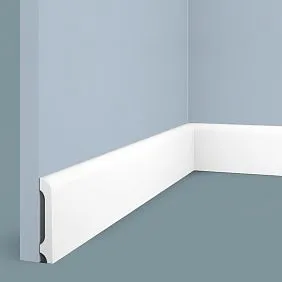
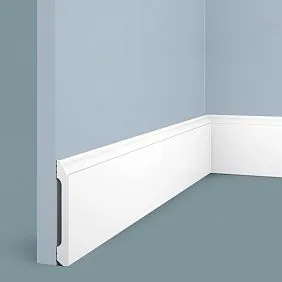
Painted MDF is a budget option for white and colored skirting boards. The MDF board is primed, sanded, and coated with several layers of white or colored enamel. The surface is perfectly smooth, without wood texture. This is the choice for interiors where the purity of lines and color is important, not the naturalness of the material. A painted MDF skirting board 100-120 mm high creates the graphic quality characteristic of Scandinavian and modern styles.
Polyurethane skirting boards imitate wood but are made from expanded polyurethane. They are lightweight, moisture-resistant, and inexpensive, but look and feel plastic. For classic interiors where materiality and tactile feel are important, polyurethane is unacceptable. It is suitable for wet rooms—bathrooms, kitchens—where wooden skirting boards risk warping from moisture.
Get Consultation
Profiles of wide skirting boards: from simple to carved
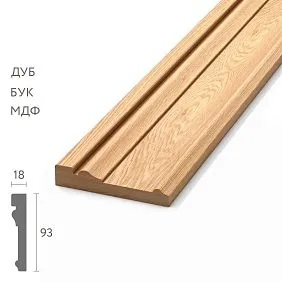
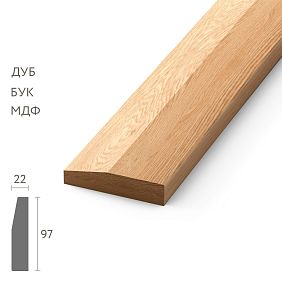
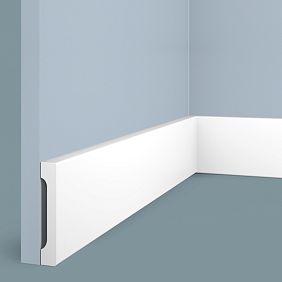
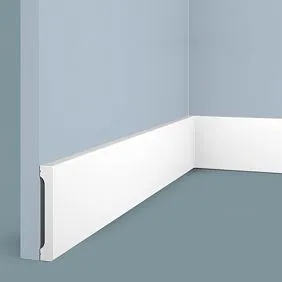
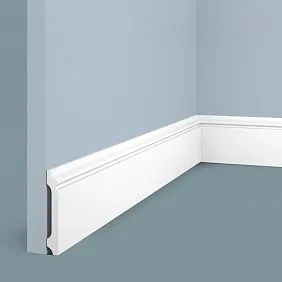
Straight profile—the most concise, with a flat front surface and a chamfer along the top edge. Height 100-120 mm, thickness 18-22 mm, chamfer at a 45° angle, 5-8 mm wide. This profile suits modern and neoclassical interiors where the purity of lines without decorative excess is important. A straight skirting board accentuates the horizontal, creating strictness, geometry, and order.
Profile with a cove—a classic option with a concave surface creating a soft transition from wall to skirting board. The cove is a smooth arc with a radius of 15-30 mm in the upper part of the skirting board, creating a play of light. Light falling from above creates a gradient from the light top edge to the darker bottom, adding volume to the flat element. A profile with a cove softens the interior, making it less strict and more cozy.
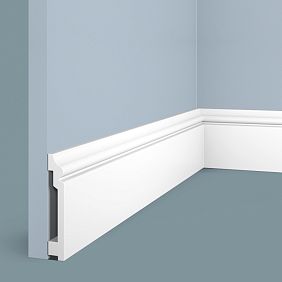
Stepped profile—several horizontal protrusions creating relief. The front surface is divided into 2-3 levels with a height difference of 3-5 mm between them. This creates visual complexity characteristic of classic interiors. Light and shadow accentuate each step, making the skirting board an architectural element, not just a border.
Carved profile—complex relief with ornaments, swirls, and plant motifs. Made by milling on CNC machines or by hand by wood carvers. Relief depth 5-12 mm, requiring a skirting board thickness of 25-30 mm and dense wood species—oak, ash. A carved skirting board is the pinnacle of decorativeness, suitable for palatial classic interiors, galleries, and representative rooms.
Skirting board with flutes—vertical grooves, like on columns. Flutes create a rhythmic texture that breaks the horizontality of the skirting board with vertical accents. This is a rare profile used in interiors with architectural references to antiquity—columns, pilasters, arches. Flutes are milled with a pitch of 15-20 mm, depth 3-5 mm, requiring perfect equipment precision.
Color solutions: contrast or harmony
White skirting board on light walls—Scandinavian classic, creating monochromatic purity. A white skirting board 100-120 mm high on white or light gray walls creates a delicate relief noticeable only due to the shadow from the profile. This solution is for interiors where airiness, lightness, and minimalism of details are important. A white skirting board expands space, reflects light, and makes the room more spacious.
Dark skirting board on light walls—a contrasting solution creating graphic quality. A skirting board in wenge, dark walnut, or black against white or beige walls creates a clear horizontal line that visually divides the space. The effect of increasing ceiling height is maximized. A dark skirting board also connects the dark floor with the rest of the interior, creating color continuity.
wooden baseboardMatching the floor color—a harmonious solution creating the impression that the floor continues up the wall. This is appropriate when the floor is the main decorative element of the room—parquet with a beautiful pattern, engineered board made of valuable wood. A skirting board of the same color emphasizes the value of the floor without distracting attention from it. But visually, this solution does not increase the height—on the contrary, it may reduce it.
Skirting board matching the color of doors and architraves—a systemic solution creating architectural unity. If the doors are white, the skirting boards are white. If the doors are dark, the skirting boards are dark. This creates a framing structure—the horizontal of the skirting board and the verticals of the architraves form a continuous line that organizes the space. Especially effective in open-plan layouts where several doors are visible simultaneously.
Toned skirting board with patina—a choice for interiors imitating antiquity. The skirting board is toned in noble dark shades—walnut, mahogany—then patinated with gold, silver, or white patina that fills the profile recesses. This creates the effect of aged wood that has been polished and coated with new layers of finish for decades. A patinated skirting board is an accent that attracts the eye and makes the interior luxurious.
Painted colored skirting board—a bold solution for modern interiors. A skirting board painted in deep blue, emerald, or burgundy becomes a color accent that sets the tone for the entire room. This solution is for interiors where color is used not sporadically but systematically—colored walls, colored skirting boards, colored doors create a rich color environment.
Installation of wide skirting board: technology for heavy elements
Wall preparation is critical for installing wide skirting boards. Wall irregularities exceeding 3-5 mm per meter of length create gaps between the skirting board and the wall, which are especially noticeable on a tall skirting board. A wide skirting board is rigid, does not bend, and does not follow irregularities—it either fits tightly or pulls away with a visible gap. Leveling walls with plaster or drywall before installing the skirting board is a mandatory condition for quality work.
Fastening with screws is the primary method for solid wood skirting boards. Screws 4.5×60 mm are driven through the skirting board into the wall at 40-50 cm intervals. Holes 3 mm in diameter are pre-drilled in the skirting board and 6 mm in the wall for dowels. Screw heads are countersunk 2-3 mm and covered with plastic plugs matching the skirting board color or filled with colored wax. For heavy solid wood skirting boards, this is the only reliable fastening method.
Fastening with adhesive is only possible on perfectly even walls. Adhesive "liquid nails" or mounting foam is applied in a zigzag pattern to the back surface of the skirting board, the skirting board is pressed against the wall, and fixed with temporary supports for 12-24 hours until the adhesive sets. This method provides a clean surface without visible fastening points but requires flawless wall geometry. Any irregularity will create a gap that the adhesive cannot compensate for.
Cutting corners at 45° is a complex operation for wide skirting boards. The wider the skirting board, the longer the cut and the more precise it must be. A deviation of 1-2° creates a visible gap in the joint. The cut is made with a miter saw with a rotating table, blade diameter at least 250 mm for a skirting board 120 mm high. After cutting, the ends are sanded with fine abrasive to remove burrs and ensure tight fit.
Joining in corners is reinforced with PVA glue class D3 or D4. Glue is applied to both ends, the skirting boards are connected, pressed tightly, and fixed with a clamp or painter's tape for 2-4 hours. Excess glue is immediately removed with a damp cloth. After drying, the joint is almost invisible if the cut is precise. For additional strength, finish nails can be driven at an angle through one skirting board into the other in long skirting boards.
Straight joints on long walls are made at a 45° angle with an offset. If the wall length exceeds the skirting board length, joining several planks is required. A joint at a right angle is noticeable even with perfect fitting. A joint at a 45° angle with an offset—where both skirting boards are cut at 45° but in opposite directions, creating a beveled joint—is less noticeable, especially when the wood grain hides the connection line.
Wooden skirting boardsFor different rooms
Living room with high ceilings—an ideal place for a wide skirting board 120-140 mm. A spacious room with ceilings 3.0-3.5 meters requires architectural elements of appropriate scale. A narrow skirting board in such a living room gets lost and does not create visual weight. A wide skirting board made of dark oak or walnut against light walls creates monumentality, representativeness, and status. A profiled skirting board with coves and steps enhances the classic character of the interior.
Bedroom requires a more delicate approach. A wide skirting board 100 mm is sufficient to create solidity without excessive monumentality. Light colors are preferable—whitewashed oak, white painted—to avoid overloading the space where peace and relaxation are important. A simple profile with a chamfer creates restraint characteristic of private rooms.
Study and library—rooms where a wide skirting board supports massive furniture. Solid oak bookcases, a desk with carved legs, leather armchairs—all this furniture is massive, weighty, and requires architectural surroundings of appropriate scale. A wide dark skirting board 120 mm with a carved profile creates a connection between the furniture and the architecture, showing that the interior is thoughtfully holistic.
A dining room with a classic table and chairs benefits from a wide baseboard that supports the solemnity of the space. A dining table for 8-12 people is the central element of the dining room, massive and imposing. A narrow baseboard next to such a table creates disproportion. A wide baseboard of 100-120 mm, especially in the color of the table, creates visual unity, where furniture and architecture belong to the same aesthetic system.
The hallway and corridor are rooms where a wide baseboard is practical, as it protects walls from impacts and dirt. The corridor is a high-traffic area where walls are subject to mechanical impacts—bumps from bags, umbrellas, shoes. A wide, sturdy solid oak baseboard withstands these impacts, does not deform, and retains its appearance for decades. A dark-colored baseboard hides dirt, which is important in an entryway.
The bathroom and kitchen require moisture-resistant materials. A solid wood baseboard in these rooms risks deforming from moisture. An alternative is a larch baseboard, resistant to moisture due to its high resin content, or painted MDF with a moisture-resistant coating. A wide baseboard in the bathroom creates a feeling of a spa space, a luxurious restroom, rather than a utilitarian bathroom.
Questions and Answers: All About Wide Baseboards
What height baseboard to choose for 2.7-meter ceilings?
For 2.7-meter ceilings, a baseboard height of 80-100 mm is optimal. An 80 mm baseboard will create a restrained accent, 100 mm—a more expressive one. A baseboard higher than 100 mm may be excessive for such a ceiling height, creating a visual overload of the lower part of the room.
Is a profiled baseboard mandatory or can it be flat?
It depends on the interior style. Classic style requires a profiled baseboard with beads and steps. Modern and neoclassical styles allow for a flat baseboard with a simple chamfer. A flat wide baseboard creates graphic quality, a profiled one—decorativeness.
Can a wide skirting board be installed by oneself?
Yes, but experience and tools are required. A miter saw for precise angle cuts, a hammer drill for drilling holes for dowels, a screwdriver for driving screws—the minimum set. The difficulty lies in precise angle cutting and leveling the baseboard horizontally. For a first attempt, it is recommended to hire a professional.
How to care for wooden baseboard?
Maintenance is minimal—dry or slightly damp cleaning with a soft cloth. Avoid aggressive cleaning agents and excessive moisture. A baseboard with an oil finish requires a thin layer of oil renewal every 2-3 years. A varnished baseboard does not need renewal, but if the varnish is damaged, local restoration is required.
How much does a wide wooden skirting board cost?
The price depends on the wood species, height, and profile. A pine baseboard 100 mm high—from 400 rubles per linear meter. Oak—from 1200 rubles. Oak with a carved profile—from 2000 rubles. MDF with veneer—from 600 rubles. Painted MDF—from 500 rubles.
Can a baseboard be painted any color?
Yes, a solid wood or MDF baseboard can be painted any color according to RAL or NCS. For painting, the baseboard is primed, sanded, and coated with enamel in 2-3 layers with interlayer sanding. Fine-pored species—beech—paint more evenly. Coarse-pored—oak—require a pore filler.
Is it necessary to match the baseboard with door architraves?
It is desirable, but not mandatory. Baseboards and architraves of the same height, color, and profile create architectural unity. But contrasts are also acceptable—dark baseboard and light architraves or vice versa. The main thing is to maintain style unity: classic baseboard with classic architraves, modern with modern.
How does a wide baseboard affect room cleaning?
A wide baseboard protects the wall from dirt, but itself requires regular cleaning. The horizontal top surface of the baseboard collects dust, which needs to be wiped. A profiled baseboard with beads and recesses requires more thorough cleaning than a flat one. A smooth varnished surface is easier to clean than an oiled one.
STAVROS: where traditions of European joinery become accessible
STAVROS is a manufacturing company with its own facilities in St. Petersburg, specializing in the production of premium-quality solid wood millwork.Wide wooden floor skirting board100, 120, 140 mm high from oak, beech, ash—profiles of varying complexity from simple with a chamfer to carved with beads. Modern European Weinig equipment ensures profile milling accuracy up to 0.1 mm—critical for tight corner joints and wall fit.
Wood moisture content of 8±2% after kiln drying guarantees geometric stability—the baseboard does not warp, twist, or crack after installation. 'Extra' grade—without visible defects, for transparent finish under varnish or oil. 'A' grade—allows small healthy knots, for tinted baseboard. 'Paint grade'—for enamel coating that hides defects.
Baseboard profiles vary from simple with a chamfer to complex multi-level with beads and steps. Straight profile with chamfer—for modern interiors. Classic with bead—for neoclassicism. Stepped—for traditional classicism. Carved with ornaments—for palace interiors. Possibility of manufacturing baseboards according to customer's individual drawings with a minimum order of 50 linear meters.
Processing includes planing on a four-sided machine, profile milling on a CNC machine, final sanding with P180 abrasive. The baseboard is supplied unfinished for customer finishing or with a finish of oil, wax, varnish as chosen. Possibility of tinting in noble shades—walnut, mahogany, wenge—or painting in any color according to RAL.
wooden baseboardBaseboards from STAVROS are supplied in standard lengths of 2.0, 2.2, 2.5 meters—for optimal cutting for most rooms. Packaging in shrink wrap protects from dirt and moisture during transportation. Delivery by own transport in St. Petersburg and Leningrad region, to other regions—via transport companies with damage control.
Classic FurnitureFurniture from STAVROS complements wide baseboards—tables, chests of drawers, sideboards made of solid oak with carved elements, patination. This allows creating interiors where architectural details and furniture are made from the same wood species, in a unified style, united by a common philosophy of quality and solidity.
Consulting support at all stages—help in choosing baseboard height and profile to match interior style and ceiling height, calculation of required quantity considering room perimeter and cutting allowance, recommendations for installation and finishing. Baseboard samples are sent for quality assessment before a large order. Technical documentation with profile drawings is available on the website.
STAVROS works with designers, architects, construction companies, providing professional quality at competitive prices. For regular clients—individual terms, deferred payment, priority in production of urgent orders. Wholesale orders from 100 linear meters—15% discount, from 500 meters—20%. Quality guarantee—return or replacement of baseboard in case of non-compliance with stated characteristics.
STAVROS understands:Wide Wooden Skirting BoardA wide baseboard is not just a floor trim, but an architectural element that changes the perception of a room, creates solidity, supports classic furniture, turns an ordinary room into a representative space of European level. Quality solid wood, precise geometry, variety of profiles, professional service—everything needed to create interiors where details define the quality of the whole.


