












































































Article Contents:
- Pilaster: Anatomy of a Vertical Accent
- Base: Support and Foundation
- Shaft: Vertical Extension
- Capital: Crown and Completion
- Balusters: the vertical rhythm of the staircase
- Baluster Shapes: From Simplicity to Complexity
- Proportions and scale
- Material: Why Wood
- Symmetry as the Foundation of Composition
- Symmetry of Pilasters on Walls
- Symmetry of Balusters on Staircases
- Vertical Axis as Composition Center
- Combining Pilasters and Balusters in a Unified Interior
- Form Unity
- Unity of Material and Finish
- Scale Coordination
- Color Solutions: Classic and Contemporary
- Natural Wood
- White Enamel
- Gray Shades
- Contrasting solutions
- Manufacturing Technology: From Blank to Finished Product
- Wood selection
- Mechanical processing
- Finishing
- Installation: from theory to practice
- Installing Pilasters
- Newel Installation
- Maintenance and Durability
- Regular Cleaning
- Recoating
- Protection against damage
- Cost and Budgeting
- Pilasters
- Balusters
- Installation
- Frequently Asked Questions
- Can pilasters be used in small spaces?
- Which wood is better for balusters — oak or beech?
- Should wooden products be varnished before installation?
- Can natural wood be painted white independently?
- How often should varnish coating on balusters be renewed?
- Can wooden balusters be combined with metal ones?
- What is the optimal spacing for baluster installation?
- Conclusion: Verticals as Interior Foundation

Verticality always signifies power. It stretches upward, overcoming gravity, creating a sense of aspiration, grandeur, and dignity. In architecture, vertical elements establish spatial rhythm, divide areas, and structure chaos.Pilasteron the wall andWooden balusterson the staircase — these are not merely decorative details but functional tools for creating symmetry that calms the eye and organizes perception. The classic 2026 interior doesn't abandon these principles but interprets them more freely, boldly, considering modern needs for comfort and technological integration.




Pilaster: The Anatomy of a Vertical Accent
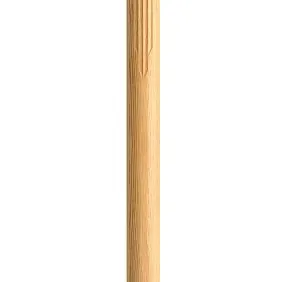
Pilaster— is a flat vertical projection on a wall that imitates a column but lacks its three-dimensional fullness. It consists of three mandatory parts, each carrying its own semantic and visual load.




Base: Support and Beginning
The base of a pilaster is the lower part that contacts the floor or baseboard. Its function is to create an impression of stability, to declare: here begins the vertical, here is the point of support. The base is always wider than the pilaster's shaft, which visually stabilizes the structure. Without a base, a pilaster looks unfinished, hanging in the air, devoid of roots.
In classical orders, the base has a complex profile: torus (convex molding), scotia (concave groove), astragal (thin molding). These elements create a play of light and shadow, adding plasticity. In a modern interpretation, the base can be simplified, but the principle remains — it must be noticeable, it must emphasize the beginning of the vertical.
The material of the base is critical. Wood is preferable here to polyurethane or MDF. The base is in the risk zone — an accidental hit from a vacuum cleaner, contact with a wet mop during cleaning, mechanical impacts.Wooden itemswithstand this better, they do not dent, do not crumble, and retain their shape for decades.
Our factory also produces:


Shaft: Vertical Extent
The shaft is the main, longest part of the pilaster. It can be smooth, fluted (with vertical grooves), or decorated with carved ornamentation. It is the shaft that sets the height of the pilaster, and therefore influences the perception of the height of the entire room.
A tall pilaster from floor to ceiling (2.7-3.0 meters) visually elongates the space, making it more solemn, ceremonial. A short pilaster with a height of 1.5-2.0 meters creates a more intimate effect, suitable for living spaces where palatial monumentality is not needed.
The width of the shaft is also important. A too narrow pilaster (less than 60 mm) looks fragile, unserious. A too wide one (more than 150 mm) visually consumes space and is only appropriate in large halls. The optimal width for a residential interior is 80-120 mm.
The texture of the shaft defines the style. A smooth shaft is strict neoclassicism, minimalism, modernity. A fluted shaft is a reference to antiquity, the severity of the Doric or the elegance of the Ionic order. A carved shaft with ornamentation is Baroque, Rococo, the luxury of historical styles.
Get Consultation
Capital: The Crown and Completion
Capital— is the upper part of the pilaster, its crown, the finale of the vertical movement. The capital is always richer in decoration than the shaft and base. It can be decorated with acanthus leaves, volutes, geometric patterns, rosettes.
The function of the capital is the visual transition from vertical to horizontal. The pilaster rises from the floor, and above it begins the frieze, cornice, entablature — horizontal elements. The capital softens this transition, creating smoothness in the composition.
In classical architecture, the form of the capital defines the order. The Doric capital is simple: a round cushion (echinus) and a square slab (abacus). The Ionic capital has volutes — spiral scrolls. The Corinthian capital is the most complex — two tiers of carved acanthus leaves, between which stems and volutes emerge.
In a modern interior, simplified capitals can be used, stylized to resemble classical ones but without archaeological precision. The main thing is to preserve the principle: the capital must be noticeable, it must crown the pilaster, it must be richer than the base and shaft.
Balusters: the vertical rhythm of the staircase
Balusters for staircase— are vertical posts that support the handrail and form the railing. They perform a dual function: they ensure safety (prevent falls) and create a visual rhythm, turning the staircase into an architectural object, not just a functional structure.
The Form of Balusters: From Simplicity to Complexity
Balusters can be turned and carved. Turned balusters are created on a lathe — the workpiece rotates, the cutting tool removes material, forming a round profile with alternating thickenings and narrowings. This creates rhythm, dynamism, and variety of forms while maintaining production efficiency.
The simplest turned baluster is a cylinder of constant diameter. Boring, but reliable and cheap. A classic turned baluster has several belts: a base (thickened part at the floor), a central part (with decorative transitions, balls, moldings), and an upper part (transition to the handrail attachment). This creates visual variety.
Carved balusters are manufactured using 3D milling on CNC machines. The milling cutter moves along three axes, removing material and creating complex three-dimensional forms — acanthus leaves, rosettes, geometric patterns, twisted elements. CarvedWooden balustersare more expensive than turned ones, require more production time, but the result is impressive.
Proportions and Scale
The height of a baluster is determined by building codes. For residential premises, the height of the staircase railing must be at least 900 mm from the surface of the tread to the top of the handrail. This ensures safety. The typical height of a baluster is 800-850 mm, plus a handrail height of 50-70 mm gives the required 900 mm.
The diameter of a baluster affects its visual massiveness. Thin balusters with a diameter of 40-50 mm look elegant but may seem fragile. Thick balusters with a diameter of 80-100 mm create a sense of solidity but visually weigh down the staircase. The optimal diameter for a classic interior is 60-70 mm.
The installation pitch of balusters — the distance between their centers — is usually 100-150 mm. This creates visual density, rhythm, and reliability. A pitch that is too wide (200 mm or more) makes the railing visually sparse, unsafe (a child could squeeze between the balusters). A pitch that is too narrow (less than 80 mm) creates a feeling of a fence, of massiveness.
Material: Why Wood
Balusters are made from various materials: wood, metal, concrete, polyurethane, composites. But for a classic interior, wood remains the only choice.
Wood is warm to the touch. When a hand slides along a wooden handrail, rests on a wooden baluster, tactile comfort arises. Metal is cold, especially in winter. Polyurethane is indifferent, synthetic. Wood is alive.
Wood has texture — the pattern of annual rings, which is unique to each piece. Even paintedWooden itemsretain a subtle visibility of the texture beneath the paint layer, adding depth. Polyurethane is uniform, lacking this individuality.
Wood ages beautifully. Over the years, it develops a patina, a noble darkening that is perceived as value, as history. Metal rusts (if not stainless steel), polyurethane yellows and dulls. A wooden staircase after 20 years looks vintage and valuable, a metal one looks worn out.
Symmetry as the Foundation of Composition
A classic interior is unthinkable without symmetry. This is not merely an aesthetic preference; it is a deep-seated need of human perception. Symmetrical objects are processed faster, perceived as more stable, reliable, harmonious.
Symmetry of pilasters on walls
The simplest scheme is two pilasters at the edges of a wall, framing an opening (door, window, fireplace, shelving unit). This creates a frame, accentuates the central element, and gives the composition completeness.
A more complex scheme involves several pairs of pilasters dividing the wall into equal or rhythmically alternating sections. For example, a long 6-meter wall is divided by three pairs of pilasters into four 1.5-meter sections. In each section, there is a painting, mirror, or decorative panel. This creates rhythm, structures the space, and prevents the wall from looking monotonous.
Important: pilasters must be identical in shape, size, and finish. A difference of even 5 mm in width or height is perceived by the eye as an error, a violation of symmetry. Therefore,pilastersit is better to order them as a set from one manufacturer to eliminate discrepancies.
Symmetry of balusters on a staircase
A staircase with a 180-degree turn (two flights with a landing between them) creates natural symmetry. When viewed from bottom to top, the left and right flights mirror each other. Balusters on both flights must be identical, installed with the same spacing, and painted the same color.
A straight staircase lacks mirror symmetry but possesses rhythmic symmetry—the uniform alternation of baluster verticals creates orderliness, which is perceived as harmony.
A break in the rhythm is immediately noticeable. If one step has three balusters and another has two, the eye registers this as an error. Therefore, it is important to calculate the baluster spacing so that the number per step is the same (usually 1-2 balusters per step, depending on the step width and baluster diameter).
The vertical axis as the center of composition
In a classic interior, there is often a central vertical axis—a line running through the middle of the room. Key elements are placed on this axis: fireplace, chandelier, painting, window. On either side of the axis—symmetrical arrangement of furniture, decor, architectural details.
Pilasters can emphasize this axis by framing the central element. For example, a fireplace with two pilasters on the sides. Or a doorway with pilasters, positioned exactly on the room's axis.
A staircase placed on the central axis (a grand staircase in a hall) becomes the main vertical accent of the entire interior. ItsWooden balusterscarved handrail, massive stringers—all work to create an impression of grandeur, status.
Combining pilasters and balusters in a single interior
When both pilasters on walls and balusters on a staircase are present in one interior, it is important to coordinate them stylistically and compositionally.
Unity of Form
If pilasters have Corinthian capitals with acanthus leaves, balusters should also have carved decoration with acanthus. If pilasters are smooth, in a strict Doric style, balusters should be laconic, turned, without excess.
Unity does not mean identity. A pilaster and a baluster are elements different in function and size; exact copying is impossible. But they should speak the same language of forms: if a pilaster has strict geometric profiles, a baluster cannot be twisted in the Baroque style.
Unity of Material and Finish
If pilasters are made of oak with a natural lacquer finish, balusters should also be made of oak with a similar lacquer. A difference in shade is acceptable (oak is a living material, each batch of wood has its own tone), but it should be minimal.
If pilasters are painted with white enamel, balusters are also painted with white enamel. It is important to use paint from the same manufacturer, the same series, so that the shade of white matches. Warm white (with a yellowish undertone) and cool white (with a bluish one) next to each other look like different colors.
Coordinating scale
A massive pilaster 150 mm wide and 3 meters high requires corresponding balusters—at least 70 mm in diameter, 900 mm high. A delicate pilaster 80 mm wide pairs with thin balusters 50-60 mm in diameter.
A lack of scale coordination creates disharmony. Imagine: monumental pilasters with massive capitals frame a fireplace, and next to it is a staircase with thin, almost fragile balusters. It looks as if the elements are taken from different interiors and randomly combined.
Color solutions: classic and contemporary
A classic interior traditionally operates with a restrained palette: white, cream, beige, gray, brown. Bright colors are used as accents, in textiles, furniture upholstery, decor, but not in architectural elements.
Natural wood
PilasterPilasters and balusters made of oak, coated with clear lacquer or oil, retain the natural color of the wood—from light golden to rich brown. This creates warmth, coziness, a sense of naturalness.
Natural wood pairs well with neutral walls (white, beige, gray), with stone or ceramic floors, with textiles in natural shades (linen, cotton, wool).
Variation: tinted wood. Stain changes the shade of the wood, making it darker (like walnut, wenge, rosewood) or altering the tone (gray stain gives oak a noble graphite hue). The wood grain remains visible, but the color becomes more dramatic.
White enamel
Painting pilasters and balusters white is the most common solution in modern neoclassicism. White is universal; it visually expands the space, creates a feeling of freshness, cleanliness, and airiness.
WhiteWooden itemsThey pair with any walls, any floors, any furniture. They don't compete for attention but create a neutral architectural framework against which the life of the interior unfolds.
The painting technology is important. The wood is first primed with white acrylic primer, then sanded with fine sandpaper, then painted with enamel in 2-3 coats with intermediate sanding. This creates a smooth, even surface without drips or roughness.
Gray shades
Gray is the color of modern classicism. It is calm, elegant, not as prone to showing dirt as white, not as heavy as black. Gray pilasters and balusters create a feeling of restrained luxury, aristocracy without pretentiousness.
Gray can be cool (with a bluish undertone) or warm (with a beige undertone). Cool gray pairs well with marble, metal, glass — materials of a modern interior. Warm gray is closer to classicism; it is softer, cozier.
Contrasting solutions
A bold option: dark pilasters and balusters (painted graphite, dark gray, black) against light walls. This creates drama, expressiveness, emphasizes the architectural lines.
But contrast requires flawless execution. The slightest inaccuracy in installation, crooked lines, uneven painting — all of this will be glaring. Light colors forgive mistakes, dark ones reveal them.
Manufacturing technology: from blank to finished product
The quality of pilasters and balusters is determined not only by design but also by production technology.
Selection of wood
Hardwood species are used for manufacturing: oak, beech, ash. Oak is the most popular; it combines high hardness (3.7 on the Brinell scale), dimensional stability, and expressive grain. Beech is slightly softer (3.8 on the Brinell scale) but lighter in color, with a more uniform grain. Ash is hard (4.0 on the Brinell scale), has contrasting grain, but is less common.
The wood must be dry — moisture content no more than 8-12%. If the moisture content is higher, the product will begin to dry out after installation, leading to cracks and deformations. Drying wood in kilns takes 2-4 weeks, depending on the species and thickness of the blanks.
Mechanical processing
Pilasters are milled on CNC machines. The program controls the movement of the cutter, which removes material, forming the profile of the base, shaft, and capital. Complex carving (acanthus leaves, volutes) is created by 3D milling — the cutter moves along three axes, creating three-dimensional forms.
Balusters are turned on lathes (for simple shapes) or milled on 3D machines (for carved ones). After mechanical processing, the products are sanded — first with coarse sandpaper (grit 80-120) to remove large irregularities, then medium (150-180), then fine (220-320) to create a smooth surface.
Final finishing
Varnishing: water-based varnish or polyurethane varnish is applied to the sanded surface. Varnish emphasizes the wood grain, protects against moisture, dirt, and mechanical damage. Applied in 2-3 coats with intermediate sanding.
Enamel painting: the wood is primed, sanded, then painted with acrylic enamel. Enamel hides the grain, creates a uniform color. For a quality result, 2-3 coats with sanding between them are needed.
Patination: a complex technique that creates an aging effect. Dark paint (brown, gray) is applied to the product and rubbed into the recesses of the carving. Then the raised parts are sanded, the paint is removed from them, remaining only in the recesses. This creates contrast, emphasizes the relief, and adds depth.
Installation: from theory to practice
Quality installation is no less important than the quality of the products themselves.
Installing pilasters
Pilasters are installed on a flat, vertical wall surface. If the wall is uneven (variations of more than 2 mm per meter), it needs to be leveled with plaster or drywall.
Combined fastening: adhesive + mechanical fastener. Polyurethane adhesive or liquid nails are applied to the back of the pilaster. The pilaster is pressed against the wall, aligned vertically (checked with a level). Then holes are drilled (through the pilaster into the wall), dowels are inserted, and screws are driven in.
Screws are driven in places where they will be hidden: in the base (at the bottom), in the capital (at the top), in the recesses of the carving (if present). The holes are filled with putty, sanded, and painted to match the product.
Installing balusters
Balusters for staircaseare attached to the steps from below and to the handrail from above. There are several fastening methods.
Fastening with dowels: holes 8-10 mm in diameter, 30-40 mm deep are drilled into the step and the end of the baluster. A wooden dowel (round rod) with adhesive is inserted into the holes. The baluster is placed onto the dowel. This creates a strong, invisible connection.
Fastening with threaded rods: holes are drilled into the step and the end of the baluster. A metal threaded rod (stud) 6-8 mm in diameter is screwed into the step. The baluster is screwed onto the rod. This is stronger than dowels but requires precision — the slightest misalignment, and the baluster will stand crooked.
Fastening to a handrail sub-rail: the tops of the balusters are attached not directly to the handrail, but to a wooden rail that runs the entire length of the staircase. Balusters are fixed to the rail with screws (driven in at an angle from below). Then the handrail is attached to the rail. This simplifies installation and allows easy adjustment of baluster positions.
Care and longevity
Wooden architectural elements last for decades but require proper care.
Regular cleaning
Dust is removed with a dry, soft cloth or a vacuum with a soft brush attachment once a week. This prevents dust accumulation in the recesses of the carving and preserves the appearance.
Wet cleaning — no more than once a month, with a slightly damp (not wet) cloth. Water should not get into joints or cracks. After wet cleaning, wipe the item with a dry cloth.
Recoating
Varnished items can be refreshed every 3-5 years: lightly sand the surface with fine sandpaper (320-400 grit), remove dust, and apply a new coat of varnish. This restores shine and protective properties.
Items painted with enamel are refreshed less often — every 7-10 years. The surface is sanded, primed (if there is damage), and repainted.
Protection against damage
Wood does not like sudden changes in humidity. In rooms with central heating, humidity drops to 20-30% in winter and rises to 60-70% in summer. This causes wood to shrink and swell. The solution is to maintain a stable humidity of 40-55% using humidifiers.
Wood does not like direct sunlight — it fades, lightens (or darkens, depending on the species). If pilasters are placed near a window, it is advisable to use curtains or blinds to diffuse the light.
Cost and Budgeting
How much does it cost to furnish an interior with wooden pilasters and balusters?
Pilasters
Price depends on size, complexity of carving, and wood species. A simple smoothPilasteroak pilaster, 2 meters high, 80 mm wide, costs 2500-4000 rubles per piece. A carved pilaster with a capital and base of the same height — 7000-15000 rubles.
For a 20 sq.m room with four pairs of pilasters (8 pieces), the budget will be from 20,000 to 120,000 rubles for pilasters only, plus capitals (3000-8000 rubles each) and bases (1000-5000 rubles each).
Balusters
Price for one baluster — from 1700 to 6000 rubles, depending on complexity and species. A turned oak baluster, 900 mm high — 2000-3000 rubles. A carved baluster with acanthus — 4000-6000 rubles.
For a staircase with 15 steps and two balusters per step (30 balusters total), the budget will be from 60,000 to 180,000 rubles for balusters only, plus handrails (1500-3000 rubles per linear meter), plus stringers or treads, plus installation.
Installation
Installation of pilasters — 1000-2000 rubles per piece (depends on complexity, ceiling height, need for wall leveling). Installation of balusters — 500-1000 rubles per piece. Finishing (putty, painting, varnishing) — 30-50% of the product cost.
In total, fully furnishing a room with pilasters and a staircase with balusters will cost 150,000 - 400,000 rubles, depending on the complexity level and material choice.
Frequently asked questions
Can pilasters be used in small spaces?
Yes, but proportions must be observed. In a room with a height of 2.7 meters and an area of 12-15 sq.m, use narrow pilasters (60-80 mm) with minimal decoration. Massive carved pilasters will visually consume space.
Which wood species is better for balusters — oak or beech?
Oak is stronger, has a pronounced texture, and ages more beautifully. Beech is slightly softer, lighter, and more uniform in texture. For classic interiors, oak is preferable; for light Scandinavian interiors — beech.
Do wooden products need to be varnished before installation?
Absolutely. Unprotected wood quickly absorbs dirt, moisture, and changes color. Varnish or enamel creates a protective layer, extends service life, and simplifies maintenance.
Can natural wood be painted white independently?
Theoretically yes, but a quality result requires experience. Proper primer, proper paint, proper application technique (brush, roller, or spray gun), and sanding between coats are needed. Mistakes lead to drips, unevenness, and paint peeling.
How often should varnish coating on balusters be refreshed?
With intensive use (large family, children, active staircase use) — every 3-5 years. With moderate use — every 7-10 years. Signs that refreshing is needed: loss of shine, appearance of small scratches, surface roughness.
Can wooden balusters be combined with metal ones?
Yes, but carefully. For example, a wooden handrail on metal balusters is a common modern solution. Or alternating wooden and metal balusters. But fully metal balusters with wooden pilasters in the same interior create stylistic dissonance.
What is the optimal spacing for baluster installation?
Building codes require that the distance between balusters (clear, not center-to-center) be no more than 100-150 mm — this prevents a child from slipping through. Usually, 1-2 balusters are installed per step, depending on step width.
Conclusion: Verticals as the foundation of interior
The classic interior of 2026 does not abandon fundamental principles — symmetry, proportion, order logic. But it interprets them more freely, combining them with modern materials, technologies, and stylistic techniques.Pilasteron the wall creates a vertical accent, structures the space, and gives it monumentality.Wooden balusterson the staircase create rhythm, ensure safety, and transform a functional structure into an architectural object.
Together, these elements form the framework of the interior—an invisible grid of verticals and horizontals upon which color, textiles, furniture, and decor are overlaid. This framework defines the character of the space: whether it will be majestic or intimate, strict or cozy, formal or private.
Wood as a material is irreplaceable. It is warm, living, textured, and durable. It ages beautifully, acquiring a patina of time. It is tactilely pleasant—a hand touching a wooden baluster feels a comfort that neither metal nor plastic can provide.
STAVROS Company has specialized for over twenty years in the production of wooden architectural elements for classical interiors. The assortment includespilasters of various styles—from the strict Doric simplicity to Corinthian luxury,handcrafted capitalswith carving of the highest detail, bases, connecting elements. A particular pride is the collection ofbalusters for staircases, comprising over 50 models—from laconic turned ones to carved ones with acanthus leaves and volutes.
All STAVROS products are made from dry wood with a moisture content of 8-12%—oak, beech, ash. CNC machines are used for geometric precision, and 3D milling complexes for creating intricate carvings. Each product undergoes multi-stage sanding and is ready for finishing. Both standard catalog models and custom production based on individual sketches are offered.
Create interiors where the verticals of pilasters and balusters set the rhythm, where symmetry calms and organizes, where wood brings warmth and nobility. This is true classicism—not a museum reconstruction, but a living tradition, relevant here and now, in 2026 and beyond.


