Article Contents:
- Why a terrace needs railings: more than just safety
- Building codes and common sense
- Space zoning and visual completeness
- Psychological comfort
- Features of railing operation outdoors
- Moisture: wood's main enemy
- Ultraviolet radiation: fading and degradation
- Temperature fluctuations: from minus thirty to plus sixty
- Mechanical impacts: snow load, wind, impacts
- Choosing wood species for outdoor railings
- Larch: the champion of bio-resistance
- Oak: the classic of reliability
- Thermowood: technology versus nature
- Exotic species: ipe, teak, merbau
- Pine and spruce: budget option requires protection
- Terrace railing construction: elements and connections
- Support posts: the foundation of strength
- Handrail: tactile and visual accent
- Infill: balusters, slats, cables, glass
- Protective treatment: extending the life of wooden railings
- Antiseptic treatment: the first line of defense
- Oils for exterior use: natural protection
- Varnishes for exterior use: maximum protection
- Paints for exterior use: color and protection
- Installing railings on a terrace: step-by-step instructions
- Planning and marking
- Installing Support Posts
- Handrail Installation
- Installing the infill
- Final finishing
- Care and maintenance of terrace railings
- Regular Cleaning
- Annual coating renewal
- Winter Care
- Cost and Economic Viability
- Material Costs
- Installation Costs
- Comparison with alternatives
- Frequently Asked Questions
- Which Wood Species to Choose for Terrace Railings
- Should Wooden Railings Be Painted or Left Natural
- How Long Do Wooden Railings Last on an Open Terrace
- Can Railings Be Installed Independently
- How to Protect Wooden Railings from Moisture and Rot
- What Handrail Diameter is Optimal
- Are Balusters Needed or Are Horizontal Slats Enough
- How to Care for Railings in Winter
- Can Wood Be Combined with Metal or Glass
- How Much Does Restoring Old Railings Cost
- Conclusion: Investment in safety and beauty
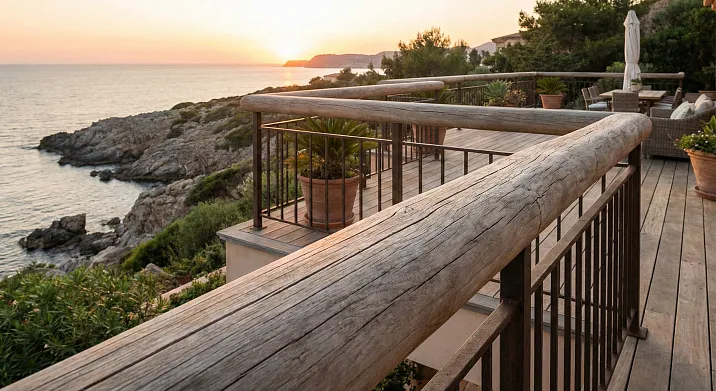
A terrace is a place where the boundary between home and nature blurs. Here, morning coffee is accompanied by birdsong, evening gatherings are lit by sunset, and Sunday lunches bring the whole family together at one table in the fresh air. But a terrace elevated even half a meter above ground level transforms from a relaxation spot into a risk zone without reliableround railings for the terrace. Children play, adults relax, guests stroll with a glass in hand—safety is paramount. And here, wooden railings become not just a functional element, but an architectural statement that defines the character of the entire space.
Why wood specifically? Why round handrails fifty millimeters in diameter? Why not metal, not plastic, not composite? Wood is alive, warm even on a frosty day, doesn't overheat in summer sun, and feels pleasant to the touch in any weather.round wooden handrailsThey create visual and tactile harmony with the natural surroundings—forest, garden, lake, field. Metal railings are cold, industrial; plastic ones are cheap; composite ones are artificial. Wood is the choice of those who value authenticity, naturalness, and connection to the traditions of country living.


Why a Terrace Needs Railings: More Than Just Safety




Building Codes and Common Sense
According to SP 118.13330.2012 'Public Buildings and Structures,' any platform elevated more than forty-five centimeters above ground or floor level must be equipped with railings at least ninety centimeters high (for children's institutions—one hundred twenty centimeters). For private homes, these norms are advisory, but common sense suggests the same: a terrace one meter high without railings is a hazardous place, especially for children, the elderly, and guests unfamiliar with the layout.
Round wooden handrails 50 mm—is the optimal diameter for an adult hand. Fifty millimeters is comfortably grasped, fingers close, and the grip is secure. A smaller diameter (thirty-five to forty millimeters) is inconvenient for larger hands, while a larger one (sixty to seventy) is poorly grasped by children and women with smaller palms. Ergonomics tested over decades—fifty millimeters became the standard for a reason.
Our factory also produces:


Space Zoning and Visual Completion
Railings not only protect against falls but also visually define the terrace's boundaries, separating it from the lawn, garden, and pathways. Without railings, a terrace looks unfinished, like a stage without curtains or a painting without a frame. The rhythm of vertical balusters and the horizontality of the handrail create an architectural structure that organizes space and sets the scale.
In the evening, railing lighting (LED strips at the base of the handrail or spotlights in the posts) transforms the terrace into a magical zone floating in the darkness of the garden. Light gliding along the cylindrical surface of a wooden handrail creates soft highlights, a play of light and shadow—metal railings produce harsh reflections, plastic ones give flat light.
Get Consultation
Psychological comfort
People subconsciously feel uncomfortable on an elevation without a barrier. Even if the terrace is only a meter high, the self-preservation instinct keeps them away from the edge. With reliable railings, this limitation is removed—people freely approach the edge, lean on the handrail, admire the view without experiencing anxiety.
For children, railings are support when ascending the terrace steps and protection from falls during play. For the elderly, they are a necessary point of support, reducing the risk of falls from dizziness or loss of balance. For everyone, they are a symbol of the host's care for the safety and comfort of guests.
Features of Outdoor Railing Use
Moisture: The Main Enemy of Wood
Unlike interior stairs, whichround wooden handrails 50operate in stable conditions (temperature twenty to twenty-five degrees, humidity forty-five to sixty-five percent), terrace railings are exposed to all weather whims. Rain, fog, dew, snow—wood is in constant contact with water.
Moisture penetrates the wood, causing swelling. During drying, shrinkage occurs. Swelling-shrinkage cycles lead to warping (bending, twisting), cracking, and weakened joints. The ends of components are especially dangerous—through open capillaries, water is absorbed ten times faster than through side surfaces.
Wet wood is an ideal environment for fungi (mold, blue stain, rot) and insects (wood-boring beetles, bark beetles, termites in southern regions). Without protective treatment, wooden deck railings will begin to darken, become covered with black mold spots, and soften from rot within two to three years.
Ultraviolet radiation: fading and degradation
Sunlight contains ultraviolet rays that break down lignin—the natural polymer that binds cellulose fibers in wood. Under UV exposure, wood becomes gray, rough, and loses strength in the surface layer (to a depth of one to two millimeters). This process is called photodegradation.
Light-colored species (pine, spruce, linden) fade faster, turning gray-yellow within a year or two. Dark species (oak, larch, walnut) darken, acquiring a noble silvery-gray patina—some value this patina, while others consider it a sign of neglect.
Modern protective coatings contain UV filters (titanium oxide, zinc oxide, organic UV absorbers) that block harmful radiation, preserving the wood's natural color for years.
Temperature fluctuations: from minus thirty to plus sixty
In winter, wooden railings cool to the ambient air temperature (minus twenty to minus thirty degrees Celsius in central Russia). In summer, the surface heats up to plus fifty to plus sixty degrees in the sun. Daily fluctuations can reach forty degrees (cold night, hot day).
Wood responds to temperature changes with dimensional changes: it expands when heated (linear expansion coefficient of three to five times ten to the minus sixth power per degree Celsius along the grain) and contracts when cooled. These changes are small (less than one millimeter for a three-meter handrail with a forty-degree fluctuation), but combined with moisture cycles, they can cause stress in joints.
Mechanical impacts: snow load, wind, impacts
In winter, snow accumulates on horizontal railing elements (handrail, top rail). A snow layer twenty to thirty centimeters thick creates a load of ten to fifteen kilograms per linear meter. Wet spring snow is even heavier—up to thirty kilograms per meter.
Wind load depends on the railing design. Solid infill (boards, polycarbonate) acts like a sail, with wind creating significant pressure. Openwork infill (balusters with gaps, cables, lattice) allows wind to pass through, minimizing load.
Mechanical impacts (dropped tools, a child hitting with a toy, bumping with a garden cart) leave dents, scratches, and chips. Wood is softer than metal and more brittle than plastic, but wood damage is easier to restore—sanding, filling, and painting can restore the original appearance.
Choosing wood species for outdoor railings
Larch: the champion of biostability
Larch (Larix sibirica—Siberian, Larix decidua—European) is a coniferous species that is not afraid of moisture. The wood contains a high concentration of gum (natural resin), making it practically impermeable to water and toxic to fungi and insects. Larch density is six hundred fifty to seven hundred fifty kilograms per cubic meter—similar to oak, with high hardness.
Larch piles in Venice have stood in water for over a thousand years, turning to stone from constant contact with water. For deck railings, larch is an ideal choice: it does not rot, does not blacken, and lasts thirty to fifty years without replacement even with minimal protection.
Larch color is reddish-brown, with expressive texture and clear annual rings. Over time in the sun, larch darkens, acquiring a noble silvery-gray patina—if this is undesirable, a coating with UV filters is required.
Disadvantages of larch: high price (comparable to oak), tendency to crack during rapid drying (requires slow kiln-drying regime), resinousness (resin may exude during processing, staining tools and hands).
Oak: the classic of reliability
Oak is a universal species for any joinery, including outdoor use. High tannin content (tannic substances) provides natural biostability—fungi and insects avoid oak. Density, hardness, and strength are at a high level. The service life of oak deck railings is twenty-five to forty years with proper treatment.
Oak requires protection from moisture—without coating, it blackens from tannins reacting with iron (fasteners, brackets). It is recommended to use stainless or galvanized fasteners and treat oak with moisture-protective oils or yacht varnishes.
Oak color varies from light yellow to dark brown, darkening in the sun to golden-brown or silvery (if not protected by UV filters). The texture is expressive, creating visual depth.
Thermowood: technology versus nature
Thermowood is wood treated with high temperature (one hundred ninety to two hundred twenty degrees Celsius) in an oxygen-free environment. As a result of thermomodification, the chemical structure changes: hemicellulose (a nutrient medium for fungi) breaks down, the wood becomes biostable, and hygroscopicity decreases by three to four times.
For deck railings, thermowood from pine, ash, or birch is suitable. It does not rot, does not swell from moisture, does not crack, and lasts twenty to thirty years. Thermowood color is a uniform dark brown (processing temperature determines the shade) and does not fade in the sun.
Disadvantages: strength decreases by twenty to thirty percent (the wood becomes brittle), price is high (processing adds fifty to one hundred percent to the cost), impossibility of local repair (damaged areas are lighter than the rest of the material).
Exotic species: ipe, teak, merbau
Tropical species (ipe, teak, merbau, cumaru, massaranduba) naturally contain oils, resins, and toxins that protect against moisture, fungi, and insects. Density is eight hundred to one thousand two hundred kilograms per cubic meter (they sink in water!), with extreme hardness. Service life in outdoor conditions is fifty to eighty years.
Exotic wood colors are diverse: ipe—olive-brown, teak—golden-brown, merbau—reddish-brown. The texture is dense and oily to the touch.
Disadvantages: exorbitant price (three to five times more expensive than oak), difficulty in processing (quickly dulls tools), environmental concerns (deforestation of tropical forests), long delivery times (import from Asia, Africa, South America).
Pine and Spruce: Budget Option Requires Protection
Pine and spruce are the most affordable species, but are only conditionally suitable for outdoor railings. They have low density (500–550 kg per cubic meter), are soft (easily scratched and dented), and have low biostability (without protection, they blacken and rot within 3–5 years).
If the budget is limited, pine railings are possible provided they receive high-quality protective treatment: deep-penetration antiseptic impregnation, primer, and 2–3 coats of weather-resistant varnish or paint. Refinishing every 3–4 years is mandatory. Service life is 10–15 years.
Deck Railing Structure: Elements and Connections
Support Posts: The Foundation of Strength
Support posts (newels, stanchions) are vertical elements that bear all loads from the railing. They are installed at intervals of 1.5–3 meters (the shorter the span, the stronger the structure, but the greater the material consumption). The cross-section of posts for deck railings is typically 90x90 mm or 100x100 mm—sufficient for reliability without looking bulky.
Posts are attached to the deck surface or to the supporting beams beneath the deck. Three attachment methods:
Through-bolt. An M10-M12 bolt passes through the deck and beam, pulling the post tight. Maximum strength, but requires access from below (the underside of the deck) to tighten the nut.
Anchor. A metal stud or anchor is glued into the base of the post and screwed into the beam. High strength, no access from below needed.
On a support plate. A steel plate (flange) is attached to the deck with bolts or screws, and the post is fastened to the plate. Simple installation, but less sturdy—suitable for low decks (up to 1 meter).
Handrail: tactile and visual accent
The handrail is the top horizontal rail that people hold onto.buy round wooden handrailsA diameter of 50 mm is recommended—this is an ergonomic standard ensuring a comfortable grip.
The handrail is attached to the posts in several ways:
On dowels. Holes are drilled into the end of the handrail and the top end of the post, an 8–10 mm diameter, 40–50 mm long wooden dowel (cylindrical rod) is inserted, and the joint is glued. Aesthetic (fasteners are hidden), but requires precision—the slightest misalignment of axes will cause splitting.
On through-bolts. A bolt passes through the handrail and post, tightened with a nut. Maximum strength, but the bolt head is visible—requires a decorative cap or countersinking with a plug.
On brackets. The handrail rests on metal or wooden brackets, fastened from below with screws. Simple installation, allows handrail replacement without disassembling the entire structure.
For outdoor railings, sealing joints is important—water must not penetrate the seams. Polyurethane or silicone sealants are used, which are elastic (compensate for thermal expansion).
Infill: Balusters, Slats, Cables, Glass
The space between the handrail and the deck surface must be filled so that a person (especially a child) cannot slip through. Building codes require that the gap not exceed 120 mm (for children's institutions—100 mm).
Classic infill iswooden balusters for terracebalusters. Balusters are installed vertically at intervals of 100–150 mm on center (considering the baluster's own thickness, the gap is 90–120 mm). Balusters can be turned (cylindrical, with a shaped profile), milled (flat with ornamentation), or carved (exclusive with hand carving).
Alternative infill options:
Horizontal slats. Planks with a cross-section of 30x40 mm or 40x50 mm are installed horizontally at intervals of 100–120 mm. Modern minimalist look, visually expands the space.
Vertical slats. Thinner than balusters (20x40 mm, 25x50 mm), create a lighter, more delicate appearance.
Stainless steel cables. 3–6 mm in diameter, stretched horizontally at intervals of 50–70 mm. Industrial style, visually almost invisible, do not obstruct the view. The combination of wooden posts and handrails with cables is popular in modern country houses.
Tempered glass or polycarbonate. 8–12 mm thick sheets are inserted into grooves in the posts, creating a solid transparent barrier. Do not obstruct the view, provide wind protection (relevant for open decks on elevated sites). Drawback—glass requires frequent cleaning (dust, fingerprints), cost is high.
Protective Treatment: Extending the Life of Wooden Railings
Antiseptic Treatment: The First Line of Defense
Antiseptic is a chemical composition toxic to fungi, mold, and insects, but safe for humans and animals after drying. Antiseptics can be surface types (forming a film on the surface) or impregnating types (penetrating the wood to a depth of 3–10 mm).
For terrace railings, deep-penetrating water-based impregnating antiseptics are recommended (Tikkurila Euro Eko Wood, Pinotex Wood Primer, Senezh Ecobio). Apply with a brush or sprayer in two to three coats with intermediate drying of twelve to twenty-four hours. The first coat is applied to untreated wood, the second and third to completely dry wood after the first.
Antiseptic protects against biological damage but not against moisture and UV — a finish coating is required.
Oils for exterior work: natural protection
Wood oils (linseed, tung, Danish, specialized formulations like Osmo, Biofa, Remmers) penetrate wood pores, displacing water, and create a hydrophobic (water-repellent) layer. Oil enhances the grain, enriches the color, and leaves the wood warm to the touch (unlike varnish, which forms a cold film).
For outdoor railings, oils with UV filters and wax additives (to increase water repellency) are used. Apply in two to three coats, each coat thoroughly rubbed in with a soft cloth, excess removed. Drying time is twenty-four to forty-eight hours (depends on temperature and humidity).
Pros of oil: natural, easy to apply and renew (just clean the surface and apply a fresh coat, sanding is not required), pleasant tactile feel. Cons: requires renewal every one to two years (more often than varnish), does not provide gloss (only matte or silky surface).
Varnishes for exterior work: maximum protection
Varnishes form a durable film on the surface, protecting against moisture, dirt, and mechanical damage. For outdoor railings, yacht varnishes (originally developed for wooden yachts in constant contact with water) based on alkyd-urethane or polyurethane are used.
Yacht varnish contains UV filters (prevents fading), plasticizers (the film remains elastic, does not crack with thermal expansion), and antifungal additives. Apply in three to four coats with intermediate sanding using P280-P320 abrasive. Each coat dries for twelve to twenty-four hours.
Pros of varnish: durability (lasts five to seven years without renewal), high protection (moisture practically does not penetrate), glossy or matte surface to choose from. Cons: if the film is damaged, water penetrates under the varnish, rotting begins (requires complete sanding and re-varnishing), cold to the touch, complicates local repair.
Paints for exterior work: color and protection
If the natural wood color is not essential, painting is an excellent option. Exterior paints (acrylic, alkyd, oil-based) form an opaque colored film that completely hides the grain but provides maximum protection against moisture and UV.
Painting technology: sanding P120-P180 → primer (adhesion primer, improves paint adhesion to wood) → two to three coats of paint with intermediate sanding P240. Any color — from white to black, matte, semi-matte, or glossy surface.
Painted railings are popular in Scandinavian style (white), American country (dark green, gray, brown), Mediterranean (blue, turquoise). Paint lasts seven to ten years, then renewal is required.
Installing railings on a terrace: step-by-step instructions
Planning and marking
Determine the railing height. Standard is ninety centimeters from the decking to the top of the handrail. For terraces where children are often present, one hundred to one hundred ten centimeters is recommended.
Determine the placement of support posts. Optimal spacing is one and a half to two meters. Posts are mandatory at terrace corners. If the terrace has steps, posts are installed on both sides of the stairs.
Mark the post installation locations on the decking. Use a string stretched along the terrace edge and a tape measure for accuracy. Ensure the posts will stand on the supporting beams under the decking (not between them — the fastening will be unreliable).
Installation of Support Posts
If through-bolt fastening is used, drill holes in the decking and beam with a diameter one millimeter larger than the bolt diameter. Insert the bolt from below (from under the terrace), put on a washer, tighten the nut. The post will be placed over the protruding bolt (pre-drill a hole exactly in the center of the post base), tightened with a nut on top.
For anchor fastening, glue a metal stud or anchor bolt into the post base to a depth of fifty to seventy millimeters (use two-component epoxy glue). Drill a pilot hole in the beam, screw in the post with the stud.
For flange mounting, screw the flange to the decking with screws or bolts (minimum four attachment points), secure the post to the flange with bolts or screws.
Check the verticality of each post with a level (deviation no more than two millimeters per meter of height). Temporarily brace the posts with props (inclined planks resting on the decking).
Handrail installation
Measure the distance between posts at a height of ninety centimeters from the decking (top of posts). Cut the handrail to the required length with a three to five centimeter allowance (for fitting).
If using dowel joints, drill holes in the handrail ends and the top ends of the posts (depth twenty-five to thirty millimeters, diameter eight to ten). Apply glue to the dowel and holes, insert the dowel into the post, place the handrail over it. Clamp, let the glue dry for forty-eight hours.
For through-bolt connection, drill a hole through the handrail and post, insert the bolt, tighten the nut. Sink the bolt head into the wood, cover with a wooden plug glued in.
If the handrail is longer than three to four meters (standard blank length), splicing will be required. Make the splice on a support post, cutting the handrail ends at a forty-five-degree angle (miter joint), glue, reinforce with dowels.
Installing infill
For balusters: mark the placement with equal spacing (usually one hundred to one hundred fifty millimeters on center). Drill holes for dowels in the bottom end of the balusters and on the decking (or on the bottom rail, if provided), assemble with glue. The top end of the balusters is attached to the handrail similarly or secured with angled screws (with countersunk heads).
For horizontal or vertical rails: secure to posts with screws (with pre-drilling) or insert into grooves routed into the posts with a router.
For cables: install fittings (threaded bushings) on the posts, run the cable through, tension it with a turnbuckle (tensioning device), and secure with clamps.
Final finishing
After installation, sand all connections, joints, and fastener areas with P180-P240 abrasive. Remove dust (vacuum, damp cloth, let dry). Apply protective coating according to the chosen technology (antiseptic + oil, antiseptic + varnish, primer + paint).
Pay special attention to the ends of components — apply two to three additional coats of finish (moisture is absorbed ten times faster through the ends).
Terrace railing care and maintenance
Regular cleaning
In spring (after snow melts) and autumn (before cold weather sets in), thoroughly wash the railings. Use a soft brush, water with mild soap (no aggressive surfactants, acids, or alkalis). Rinse off dirt, dry with a soft cloth.
Check the condition of the finish: look for cracks, peeling, or darkening. If the varnish is cracked and water penetrates under the film — re-sanding and re-coating is required. If the oil has dried out (wood has lost its shine, become rough) — apply a fresh coat.
Annual finish renewal
For railings with an oil finish, once a year (in spring) clean the surface of dirt and old oil residue (you can use special cleaners or fine P320 sandpaper), apply one to two coats of fresh oil. The process takes several hours but is critical for longevity.
For varnished railings, renewal is required every five to seven years. When the varnish begins to wear in areas of frequent contact (top of the handrail), lightly sand the entire surface with P320, remove dust, apply one coat of varnish.
For painted railings, renewal every seven to ten years. Old paint does not need to be completely removed — just sand with P180 (so new paint adheres better), prime, and paint with two coats.
Winter care
In winter, regularly clear snow from handrails (do not let it accumulate in thick layers). Use a soft brush or broom (not a metal scraper — it will scratch the finish). Do not use salt or de-icing agents near wooden railings — they damage the protective coating and wood.
If railings become icy (after a thaw and subsequent freeze), do not try to chip the ice off — you will damage the finish. Wait for natural thawing or pour warm (not hot!) water.
Cost and Economic Justification
Material cost
The cost of wooden terrace railings depends on wood species, design complexity, and finish type. Approximate prices (2026, Russia):
-
Pine handrail, fifty millimeters in diameter: four hundred to six hundred rubles per linear meter
-
Oak handrail: two thousand two hundred to two thousand eight hundred rubles
-
Larch handrail: one thousand eight hundred to two thousand four hundred rubles
-
Simple pine baluster: fifty to one hundred rubles per piece
-
Turned oak baluster: five hundred to one and a half thousand rubles
-
Pine support post 90×90: two hundred to three hundred rubles per piece (one meter height)
-
Oak post 100×100: eight hundred to one thousand two hundred rubles
For a terrace with a perimeter of twenty meters (five meters by four meters) you will need: twenty meters of handrail, fourteen support posts (at corners and spaced one and a half meters apart), about one hundred forty balusters (spaced one hundred forty millimeters apart). Material cost (pine): eight to twelve thousand rubles, oak: thirty-five to fifty thousand rubles, larch: twenty-five to thirty-five thousand.
Plus fasteners (screws, bolts, dowels, glue): two to three thousand. Protective coating (antiseptic, oil or varnish): three to five thousand for twenty meters.
Installation cost
Professional railing installation costs from one thousand to three thousand rubles per linear meter (depends on design complexity, region, crew reputation). For twenty meters: twenty to sixty thousand rubles.
DIY installation saves this money but requires tools (drill, screwdriver, miter saw, level, clamps — kit cost fifteen to thirty thousand if purchased), time (two to four days of work), and skills.
Comparison with alternatives
Metal railings (stainless steel, aluminum) cost from three to eight thousand per linear meter (material + labor). More durable than wood (last thirty to fifty years without maintenance), but cold, industrial, and do not create coziness.
Composite railings (wood-polymer composite) cost from two and a half to five thousand per meter. Do not rot, do not require painting, but look artificial, are less durable than wood or metal, and fade in the sun.
Wooden railings offer the optimal balance of price, aesthetics, and tactile comfort. With proper treatment and care, they last twenty to forty years and create a warm, natural atmosphere.
Frequently asked questions
Which wood species to choose for terrace railings
For maximum durability without maintenance — larch or exotic species (teak, ipe). For a balance of price and quality — oak with protective treatment. For a budget option — pine, but with mandatory high-quality protection (antiseptic + varnish or paint) and regular renewal.
Should wooden railings be painted or left in their natural color?
Depends on the terrace style and personal preference. Natural color (oil, varnish) highlights the wood grain and creates a natural atmosphere. Paint offers better protection and allows color matching to the overall concept, but hides the grain. Inexpensive wood (pine) can be used under paint, while beautiful wood (oak, larch) is suitable for oil/varnish.
How long do wooden railings last on an open terrace?
With proper protective treatment and regular maintenance: pine ten to fifteen years, oak twenty-five to forty, larch thirty to fifty, exotic woods fifty to eighty. Without protection and maintenance, any wood (except larch and exotics) will begin to rot within three to five years.
Can railings be installed independently?
Yes, if you have basic carpentry skills and tools. Installing railings does not require high qualifications—the key is accurate marking, careful drilling, and thorough connections. Follow the instructions, don't rush, and check vertical and horizontal alignment with a level.
How to protect wooden railings from moisture and rot?
Three-step protection: deep-penetration antiseptic impregnation (two to three coats) → final coating with oil, varnish, or exterior paint (three to four coats) → regular coating renewal (oil once a year, varnish every five to seven years). Pay special attention to end grains—apply three to four coats of coating.
What is the optimal handrail diameter?
Fifty millimeters is the gold standard, comfortable for most people. Forty-five millimeters suits people with smaller hands (women, teenagers). Sixty millimeters is for robust railings in a classic style but is less comfortable to grip.
Are balusters needed, or are horizontal slats sufficient?
From a safety perspective, both options are equivalent (the main thing is a gap no larger than one hundred twenty millimeters). Balusters are classic, create a vertical rhythm, and visually slenderize. Horizontal slats are modern minimalism, visually expand space, and block the view less. Choose based on the terrace style.
How to care for railings in winter?
Regularly clear snow with a soft brush, don't let it accumulate. Do not use salt or de-icing agents. In spring (after the snow melts), wash thoroughly, inspect the coating, and renew if necessary.
Can wood be combined with metal or glass?
Yes, and it should be—combined railings are popular in modern design. Wooden posts and handrails + steel cables or glass infill create a light, transparent structure that doesn't block the view. Wood provides warmth and tactile comfort, metal/glass provides strength and modernity.
How much does it cost to restore old railings?
Depends on the extent of damage. If the wood is not rotten, only darkened and the coating has peeled—resanding and recoating cost three hundred to five hundred rubles per linear meter. If there is rot—damaged elements are replaced, cost is individual. If the railings are completely rotten—it's easier to dismantle and install new ones.
Conclusion: Investment in safety and beauty
Round wooden handrails 50 mmfor a terrace is not just a functional safety structure but an architectural element that defines the character of the entire space. The right choice of wood species, quality protective treatment, and professional installation create railings that will last for decades, pleasing the eye and providing safety every day.
Natural wood creates a warm, natural atmosphere that cannot be reproduced with synthetic materials. Touching a wooden handrail is pleasant in any weather—it doesn't overheat in the summer sun or freeze hands in winter. Wood lives, breathes, changes over time, acquiring a noble patina, becoming part of your home's history.
Company STAVROS manufactures all elements for terrace railings: round handrails with diameters of forty, forty-five, fifty, fifty-five, sixty millimeters made of pine, oak, larch; turned, milled, carved balusters with heights from eighty to one hundred twenty centimeters; support posts with cross-sections of ninety by ninety, one hundred by one hundred millimeters of any height.
The wood undergoes chamber drying to a moisture content of ten to twelve percent (each blank is checked with a moisture meter), is processed on modern CNC lathes and milling machines (dimensional accuracy plus-minus zero point two millimeters), and is sanded in five stages (P80-P120-P180-P240-P320) to a silky surface.
Protective treatment is performed with E1 class compounds (safe for humans and the environment): Tikkurila Euro Eko Wood antiseptic (Finland), Osmo oil with UV filters (Germany), Tikkurila Unica Super yacht varnish (elastic, doesn't crack with temperature changes), Teknos Nordica Eko paint (Finland, matte, wide color range).
The assortment includes ready-made railing kits for standard terraces (three by four meters, four by six meters, five by eight meters) and custom manufacturing to individual sizes and sketches. Production time for standard kits is five to seven days, for custom ones—ten to fourteen days.
STAVROS warranty is five years against manufacturing defects (cracking, warping, rot provided proper installation and use). Specialist consultations help select the optimal wood species, railing design, and coating type for specific operating conditions. Recommendations for trusted installation crews with experience installing terrace railings.
Logistics organizes delivery to Moscow, Moscow region, and other regions of Russia. Railings are packaged in protective film and cardboard boxes to prevent damage during transport. For large projects, delivery by truck with on-site unloading is possible.
Invest in quality. A terrace with reliable, beautiful wooden railings is a space where you want to spend time, where children are safe, adults are comfortable, and it's pleasant to invite guests. Don't skimp on safety and aesthetics—choose railings from STAVROS, which will last for decades, preserving beauty and functionality.