Article Contents:
- What Are Wooden Frame Panels
- Types of Wooden Frame Panels
- Solid Wall Panels
- Slatted Panels on Frame
- Combined Decorative Panels
- Panels for partitions and zoning
- Modular Panels for Accent Zones
- What Materials Are Used for Wooden Frame Panels
- Solid Wood Frame
- MDF filling
- Veneered surfaces
- Paint-ready panels
- Combined Solutions
- Where to use panels on a wooden frame
- In the living room
- In the bedroom
- In the entryway
- In the study
- In the dining room
- In the TV area
- In kitchen-living rooms and studios
- Panels on a wooden frame for space zoning
- How to choose panels according to interior style
- Modern style
- Minimalism
- Scandinavian interior
- Jatoba
- Neoclassicism
- Warm modern interior
- How to choose panel size, filling, and appearance
- What to choose: a regular panel or a panel on a wooden frame
- Advantages of panels on a wooden frame
- Common mistakes when choosing panels on a wooden frame
- How to care for panels on a wooden frame
- FAQ: Answers to Frequently Asked Questions
- Conclusion

Let's be honest: most interiors are forgettable. They're normal, decent, skillfully executed—and completely unmemorable. Because there's not a single solution in them that speaks to the space. There's no volume. No architectural thought. No construction behind which you can feel the hand of a professional.
Decorative panels on a wooden frame are exactly that kind of construction. Not just a flat board on a wall, not just a set of battens glued on level. But a thoughtful interior module with a wooden frame, internal geometry, and a surface that simultaneously carries decorative, functional, and architectural weight. It's precisely the frame base that makes such a panel what it is: a complete object, not just a cladding element.
Wall panels on wooden frames are actively used in living rooms, bedrooms, studies, hallways, restaurants, and commercial spaces. They create accent zones, divide open layouts, and form the architectural rhythm of surfaces. And at the same time, they are mounted significantly more conveniently than any alternative construction from manual carpentry work.
This article is a detailed breakdown: what a frame panel is, what formats exist, what materials they are made from, where they are used, and how to choose the right solution for a specific task.


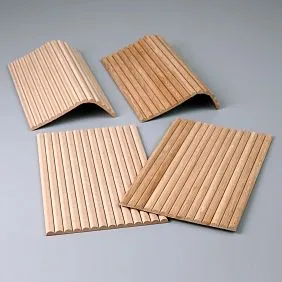

What are panels on a wooden frame
To understand the essence, you need to break down the construction. A panel on a wooden frame is an interior module where the base is a frame made of wooden timber or profile, and the surface is filled with decorative material: battens, MDF board, veneered panel, fabric, or a combination of elements. The frame sets the geometry, carries the load, and determines the mounting capabilities of the panel. The surface is responsible for aesthetics.
How does a frame panel fundamentally differ from a solid one? A solid panel made of MDF or solid wood is one homogeneous object. It is flat, lacks internal structure, and at large formats (from 1200×2400 mm and above) starts to 'play': warp, sag, lose geometry. A wooden frame eliminates this problem radically—the internal frame construction holds the shape at any size, providing rigidity without adding weight.
What elements does such a construction consist of? In the classic version:
-
External frame made of dry planed timber (cross-section 40×40 mm, 50×40 mm or wider depending on the module size)
-
Internal stiffening ribs—transverse or diagonal crosspieces inside the frame
-
Surface shield or infill — MDF, veneer, slats, fabric, acoustic material
-
Finish — painting, varnishing, tinting, oil
When is the frame especially important? For large formats (panel height from 2 meters and above). When used as a partition or zoning element, where the panel must stand independently. For slatted infill, where the frame holds the slats in a single plane without substrate deformation. For mounting 'in the air' — as a suspended or cantilevered decorative module.
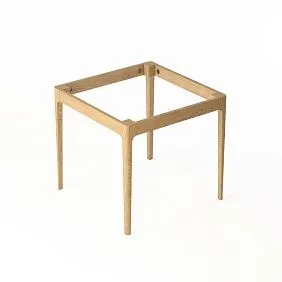
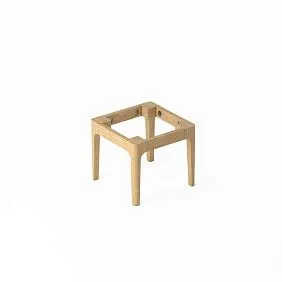
It is this constructive principle that makesframed furniture structures and solid oak table basesa universal building block for interior design — from wall panels to partitions and decorative screens.




What types of panels on a wooden frame exist
Our factory also produces:




Solid wall panels
A solid wall panel on a wooden frame is a module with a timber frame and a solid shield infill. The front surface can be smooth MDF for painting or veneered for tinting and varnish. This is the most 'calm' solution visually: a flat plane in a molding frame, clear geometry, architectural rigor.
Solid panels work well in boiserie systems and classic wall layouts, where the wall is divided into geometrically precise fields with molding framing. For thiswall panels boiserie— a ready-made system solution where the frame, moldings, and panels are designed as a unified ensemble.
Typical dimensions of solid frame panels: width 400–900 mm, height from 600 mm to full-height 2400–2700 mm. Installation uses adhesive, finish fasteners, or a hidden stud system through the frame into the wall.
Get Consultation
Slatted panels on a frame
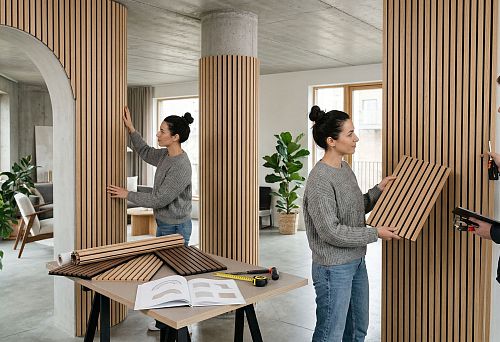
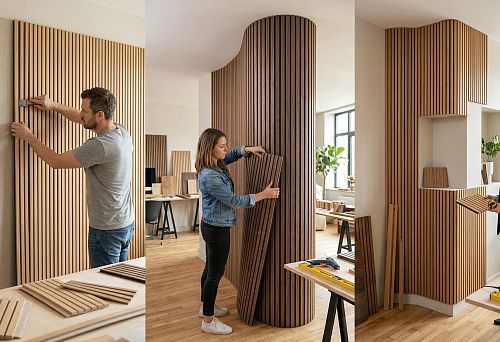
A slatted panel on a wooden frame is a structure with a timber frame into which parallel slats are mounted at uniform intervals. The slats can be open (with visible space between them) or mounted on an MDF backing within the frame. In both versions, it is the frame that holds the structure in a single plane and provides rigidity around the perimeter.
Slatted infill creates a linear graphic rhythm that, with side lighting, transforms into a volumetric chiaroscuro pattern. This is one of the most expressive formats in contemporary interiors:slatted panels made of MDF and solid oakthey establish an architectural rhythm for the surface, which functions both as decoration and as a zoning element simultaneously.
The advantage of the slatted format on a frame over a slatted panel without a frame: a clear architectural finish around the perimeter. The frame 'packages' the slats into a finished module that looks like a self-contained interior object, not like a fragment of unfinished cladding.
Combined decorative panels
A combined frame panel is a structure in which the frame combines several types of infill or surfaces. For example: a central slatted panel + smooth MDF inserts on the sides within a single frame. Or: a veneered panel with molding framing inside the frame. Or: an open frame structure with fabric or acoustic infill.
Such panels are used in design projects requiring custom wall geometry. Combining surfaces within a single frame allows for designing complex multi-level walls without complicated construction intervention.
Panels for partitions and zoning
This is a separate structural class: a frame panel designed for independent vertical positioning—without mandatory attachment to a load-bearing wall. Such modules can be installed on legs or attached to a ceiling beam, forming a lightweight decorative partition without construction work.
A zoning panel on a wooden frame is not a wall, but a boundary. A visual barrier that tells the space: here one functional zone ends and another begins. At the same time, air, light, and acoustics remain shared for the entire room. More details on this are in a separate section.
Modular panels for accent zones
An accent module is a freestanding or suspended frame decorative object placed at a specific functional point: above a fireplace, behind a sofa, in a niche, above a bed. It is not a system covering the entire wall, but an architectural accent in a specific location. The frame makes such a module self-sufficient: it has boundaries, internal geometry, and completeness.
For TV zones: a frame accent panel wider than the TV by 200–400 mm on each side, with slatted or veneered filling, concealing the bracket and cables. For a bed headboard: a frame panel width equal to or wider than the bed, with a soft fabric or slatted insert. For a fireplace: a portal framefrom solid oakwith decorative filling, visually enlarging the hearth area.
What materials are used for panels on a wooden frame
Frame made of solid wood
The frame of a frame panel made of solid wood is a structural foundation that simultaneously serves as a visible decorative element. Which wood species are used for frames? Primarily oak, beech, ash. These are species with sufficient density and geometric stability after kiln drying.
Oak frame (density 700–750 kg/m³) is the most durable and long-lasting. With an open frame decor—staining and varnish reveal the natural grain pattern, and the frame becomes part of the decorative concept. It is precisely an oak frame combined with slatted filling that creates that 'luxurious,' natural look, which is difficult to achieve with synthetic materials.
Beech is slightly lighter, with a finer grain pattern, and can be well tinted to resemble ash or Scandinavian gray. Ash is light, pale, naturally neutral. It is excellent for Scandinavian, minimalist, and Japandi concepts.
A rule of good manufacturing: the moisture content of the wood for the frame should not exceed 10–12%. At higher moisture levels, shrinkage will begin after installation, leading to deformation of the structure.solid oak and beech productswith controlled moisture content — this guarantees the geometric stability of the finished panel throughout its entire service life.
MDF infill
MDF is the most technologically advanced choice for infilling a frame panel. A density of 750–850 kg/m³, perfect structural uniformity, absence of natural defects, excellent machinability — all this makes MDF a universal panel for insertion into a wooden frame.
MDF is used in a frame panel in two capacities. First — as a finished decorative surface for painting: a smooth, sanded panel perfectly flush with the frame, ready for the application of any enamel. Second — as a substrate for slatted infill: the slats are attached to the MDF panel, which itself is fixed within the frame.
When using MDF for painting in frame panels, one technical point is important: the edges of the MDF at the joint with the wooden frame must either be covered with a wooden molding or carefully primed before painting — the MDF edge absorbs paint and varnish materials significantly more intensely than the face, which can result in uneven coverage.
Veneered surfaces
Veneer in a frame panel is a slice of natural wood 0.6–3 mm thick, glued onto an MDF base. The result: the natural grain and tone of real wood with the stability of an engineered material. A veneered panel in a wooden frame is the correct choice for large formats, where uniformity of texture across the entire surface is critical for the design outcome.
The 'book-matching' veneer selection technique creates a mirror-symmetrical natural grain pattern — a technique characteristic of high-end interiors and irreproducible when installing individual boards. On a large accent wall made of veneered frame panels, such a pattern works as an independent natural ornament.
Panels for painting
It seems like the simplest option—a timber frame plus an MDF panel for white enamel. But this is precisely where immense design potential lies. A monochrome frame panel matching the wall color is architectural relief without color decoration: only the geometry of the frame and subtle shadows at the joints. This is a technique used by professional designers, creating a sense of a 'luxurious' interior without visible effort.
Contrast painting, on the contrary, turns the frame panel into a color accent. A dark blue frame on a white wall, terracotta infill in a gray frame, matte black on a cream background—color solutions for such panels are limited only by the design concept.
Combined Solutions
Professional interiors are increasingly built on material combinations. An oak frame plus an enameled MDF slatted infill—this is the contrast of natural and industrial in one structure. A painted MDF frame plus a veneered central panel—a natural insert in a geometric frame. Preciselymoldings and cornices made of solid oakcomplement frame panels, creating an architecturally complete wall system with ceiling and floor transitions.
Where to Use Wood-Frame Panels
In the living room
Living room—the space where the frame panel works at full capacity. An accent wall behind the sofa with slatted infill in an oak frame—this is the axis around which the entire interior is organized. Wall panels on a wooden frame here are not just decor: they set the scale, rhythm, and natural tone for the entire room.
For a living room with an area of 25–40 m² and ceilings of 2.7 m, a full-height panel format (2700×800–1200 mm) with vertical slatted infill is optimal. A frame matching the floor tone + slats with a neutral tint + side spotlights providing angled lighting—this is a formula that works in 90% of modern living room concepts.
In living rooms with high ceilings (from 3 meters), a two-tier system is possible: a lower tier with solid frame panels 100–120 cm high, an upper tier with slatted or open modules up to the ceiling. It is precisely such a vertical layout that creates a sense of luxurious architectural space.
In the bedroom
In the bedroom, the decorative frame panel works more delicately, more intimately. The main application point is the wall behind the bed headboard. The panel here should be 'warm': solid oak in a natural tint, a soft veneered panel in walnut tones, light slats in white oil.
Headboard panel size: typically equals the bed width plus 200–400 mm on each side. For a 180 cm bed — panel width is 2000–2600 mm. Height — from 80 cm to the ceiling depending on room height and design intent.
Important nuance: a framed panel behind the bed with a solid wood frame requires secure wall mounting through the frame — this is a heavier structure than a thin MDF panel without a base.
In the hallway
The hallway — the zone of first impression. And it is here that a framed panel solves tasks that a regular flat one does not: protects walls from mechanical damage (walls suffer the most in hallways), creates a visual anchor that sets the style of the entire home, and manages the proportions of a narrow corridor.
For a narrow hallway (1.2–1.5 m): vertical slats in a framed structure, 1.5–2 meters high on one long wall — a classic technique for visually stretching the space upward without construction work. For a square hallway: a framed panel on the central wall as a decorative focal point with a mirror or console in front of it.
In the study
Study — a space with the highest concentration of 'meaningful' solutions. Panels on a wooden frame here speak of seriousness and taste. Dark oak, dense slat rhythm, directional lighting — the image of a study where one wants to work.
Full cladding of the work wall (behind the desk) with framed panels featuring slat infill + integrated lighting through the slats = a professional home office that is in no way inferior to the meeting rooms of leading offices.
In the dining room
The dining room benefits from framed panels primarily acoustically. The slat infill of framed modules scatters sound waves, reducing reverberation at the dining table — an indispensable feature for family dinners in rooms with high ceilings. Simultaneously — a warm, natural image is created, matching the spirit of a space where people eat together.
In the TV area
TV zone — one of the main 'points' for applying framed decorative panels in a residential interior. Several tasks are addressed here at once: conceal the bracket, cables, and mounting elements; create a natural 'warm' background for the dark screen; form a decorative axis for the living room. A framed panel solves all three tasks simultaneously — and initially provides for technological holes or voids for communications within the frame.
Frames for the TV zonefrom solid oak— are a ready-made architectural framing for the television, turning a technical element into a design object.
In the kitchen-living room and studio
Open floor plan is the main architectural challenge of modern housing. How to functionally divide space without destroying its openness? Frame panels here are a tool for visual zoning without solid walls. More details in the next section.
Wooden frame panels for space zoning
Zoning an open floor plan is a challenge faced by 80% of owners of modern apartments. And it is wooden frame panels that offer the most elegant answer to this question.
Working principle: a frame panel-partition is a three-dimensional decorative module that creates a visual and psychological boundary between zones without blocking the movement of air, natural light, and visual connection of the space. This fundamentally distinguishes it from a solid wall: you feel like you're in a 'different' zone, but the room doesn't become smaller.
Kitchen / living room. Frame panel-partition with a height of 90–120 cm (bar counter level) or full-height with open slat filling. The first option creates a physical barrier with the possibility of communication through the upper open level. The second — visual separation while maintaining spatial unity.
Studio. Frame panel with slat filling and wide spacing between slats (80–150 mm) — a boundary between the work and living area that doesn't create a feeling of being caged. Light passes through the slats, conversation is heard through the gaps, but psychologically the zones are clearly separated.
Bedroom with walk-in closet. Frame panel as a partition between the sleeping area and the closet. With slat filling — visually 'shows' the walk-in closet as part of the design concept. With solid filling — completely hides the storage area.
When to choose a panel instead of a drywall partition? Always when there's no desire to engage in construction work. Always when it's important to preserve the possibility of layout transformation. Always when an immediate and beautiful result is needed without dust, putty, and long waiting.
How to choose panels based on interior style
Modern style
Modern interior is a contrast of natural and geometric. Oak frame with slat filling against a neutral background of plaster or painted drywall is the perfect 'warm' accent in a neutral concept. Frame shape — rectangular, without decorative profiles. Tone — natural oak, warm walnut, cold graphite. Slats — vertical, with moderate spacing.
Minimalism
Minimalism requires impeccable execution and complete discipline of form. A frame panel in a minimalist interior: an MDF frame without a profile, painted to match the wall color. The infill is slats with perfect, uniform spacing or a smooth, textureless panel. Only the shadow of the frame on the wall plane is visible—and that is enough. Installation: hidden fasteners with no visible elements.
Scandinavian interior
Scandinavian style—natural materials, light tones, minimal decor. The frame panel here: a frame of light ash or beech in whitewashed oil, infill—light slats or a smooth panel with matte white enamel. The format is moderate, without monumentality. Combination: white walls, light plank flooring, natural textiles.
Japandi
Japandi—Japanese emptiness plus Scandinavian warmth. Narrow slats with uniform spacing, beige or warm gray tone, natural oil on the wood surface. The frame is minimal in width or completely without visible framing. Nothing superfluous: only rhythm, the space between the rhythm, and the silence of the surface.
Neoclassicism
Neoclassicism—architectural completeness, symmetry, and profile complexity. The frame panel in this context is the foundation of a boiserie system: a frame with molding trim, geometric divisions within the panel, a ceiling cornice from the same wood species. The tone is creamy white under enamel or natural oak with a tint.Wall panels, moldings, and cornices for boiseriemade of solid oak—this is a systemic solution for a neoclassical interior, where each element is designed as part of a unified architectural ensemble.
Warm contemporary interior
Warm contemporary—a demand for naturalness, coziness, and visual comfort with modern geometry. Frame panels on a wooden frame of oak in 'cognac,' 'tobacco,' 'warm walnut' tints—precisely meet this demand. Earthy tones, living texture, soft light from directional fixtures. It is this combination that creates a 'warm' contemporary interior that one wants to call home.
How to choose the size, infill, and appearance of a panel
The correct choice of parameters is not a matter of taste, it is a matter of professional understanding of space. Let's examine the key variables.
Module width. Narrow vertical modules (300–500 mm wide) create a frequent rhythm of vertical lines—fragmented, saturated, 'active.' Wide modules (700–1200 mm)—a calm, monumental rhythm. In small rooms up to 20 m², narrow modules overload the space. Wide ones work harmoniously.
Height. Full-height panels (floor to ceiling) create maximum visual elongation of space. Lower-tier panels (up to 100–120 cm) are the traditional wainscot system, keeping the area above the panel open. Two-tier systems with a horizontal transition are a professional technique for high-ceilinged rooms.
Solid or slatted infill. Solid — for a calm, monolithic surface without visual noise. Slatted — for volume, chiaroscuro, and architectural rhythm. Combination: solid lower part + slatted upper part in one frame module — creates a multi-level surface.
Frame: visible or hidden? Visible solid oak frame — an architectural accent, part of the decor. Hidden frame in the infill color — a structural foundation without visible presence. In neutral minimalist interiors, a hidden frame is preferable. In natural and neoclassical ones, a visible frame is part of the decor.
Light or dark wood? A rule rarely broken: dark finishes require room volume and quality lighting. In a room up to 15 m² with one small window, dark frame panels will create visual heaviness. Light finishes work in any space.
Three color anchor points: flooring, doors, key furniture. The frame panel should either support their tone (natural theme) or intentionally contrast with them. Random color conflict is the most common mistake when choosing without reference to the interior.
What is better to choose: a regular panel or a panel on a wooden frame
Honest comparison without marketing promises:
| Parameter | Regular flat panel (MDF/veneer) | Panel on a wooden frame |
|---|---|---|
| Structural rigidity | Depends on thickness | High due to frame |
| Visual volume | Flat surface | Frame adds depth |
| Large formats | Risk of deformation above 2400 mm | Stable in any format |
| Use as partition | Only with additional frame | Self-sufficient |
| Architectural completeness | Requires molding framing | Frame already serves as framing |
| Installation | On adhesive or screws | On adhesive, hidden studs, legs |
| Cost | Below | Higher (includes frame) |
| Best scenario | Small formats, even walls | Large formats, partitions, accent objects |
Conclusion: standard panel is optimal for small surfaces in stable wall mounting. Frame panel — when large formats, self-supporting structures, architectural accents, and zoning partitions are needed.
Advantages of panels on wooden frame
Briefly — but without empty declarations:
-
Constructive stability. The wooden frame maintains its shape at any panel size — this is especially important for heights from 2 meters and above.
-
Precise geometry. The frame defines an exact rectangle along the perimeter, ensuring a flawless architectural result upon installation.
-
Visual volume. The frame adds depth to the surface — it's not a flat panel, but a three-dimensional interior module with shadows along the perimeter.
-
Convenient zoning. The self-supporting frame structure can be used as a partition without construction work.
-
Flexibility in filling choice. One frame — different options: slats, MDF, veneer, fabric, combination.
-
Natural aesthetics. The solid oak frame is a visible natural element that sets a warm tone for the entire structure.
-
Durability. A properly manufactured wooden frame maintains its geometry for decades in a stable indoor microclimate.
Common mistakes when choosing panels on a wooden frame
These mistakes cost more than they seem at first.
-
Choosing based solely on a photo without understanding the construction. The photo doesn't convey the actual weight, depth of the frame, or base material. Before ordering — study the technical specifications and look at samples.
-
Ignoring room dimensions. A monumental panel with a wide frame in a 12 m² room creates a feeling of being caged. The scale of the module must correspond to the scale of the room.
-
A visually heavy construction in a poorly lit space. Dark oak plus solid infill plus one small window = a dark corner instead of an accent. Dark panels require good natural or accent lighting.
-
Confusion between a wall panel and a partition module. These are different constructions with different requirements for rigidity and mounting method. A partition module requires a more massive frame and different installation.
-
Lack of systematic thinking. A frame panel without a molding transition to the ceiling, without a ceiling cornice, and without a floor baseboard looks unfinished. Think through the entire wall as a system: panel +baseboards and moldings+ ceiling cornice made from the same material.
-
Technical utilities not thought through. In TV zones and work walls, pre-plan openings in the frame for cables and sockets — it's significantly more difficult after installation.
How to care for panels on a wooden frame
Care is not difficult — but it's worth knowing a few rules in advance.
Dry cleaning. A soft brush or anti-static microfiber cloth — for regular removal of dust from the surface of the slats and frame. Dust accumulates faster in the niches between slats and in the corners of the frame than on a flat surface — the cleaning frequency is slightly higher.
Wet cleaning. Only for stubborn stains, with a barely damp cloth. Never use a wet sponge on the wooden frame: wood absorbs moisture through the ends, especially at joints. Dry immediately after wiping.
Microclimate control. Optimal conditions for wooden frame structures: temperature 18–22°C, humidity 40–60%. During the heating season, if air dryness drops to 20–25%, micro-cracks appear in wooden elements. An air humidifier in winter is not a luxury, but a necessity for interiors with wooden structures.
Coating care. Oak frame elements with oil finish are renewed every 3–5 years: can be applied directly over the existing coating without removing panels. MDF surfaces under enamel with scratches are restored by local touch-up painting — precise color matching using the same composition.
Joints and connections. The joint between the wooden frame and wall or ceiling needs monitoring: seasonal wood movement may cause gaps. Decorative flexible sealant matching the coating tone — a 10-minute solution that maintains the structure's neat appearance.
FAQ: Answers to Frequently Asked Questions
What are panels on a wooden frame?
These are interior modules where a frame made of wooden beams serves as the structural base, and the surface is filled with decorative material — slats, MDF, veneer, or fabric. The frame provides rigidity and shape, the surface provides aesthetics.
How do frame panels differ from regular wall panels?
A regular flat panel is a homogeneous sheet without internal structure. A frame panel is a frame module with a rigid wooden base. Advantages: stability of large formats, visual volume, possibility of independent use as a partition.
Are such panels suitable for room zoning?
Perfectly suitable. A self-supporting frame module with slat filling divides space without a solid wall, preserving natural light and the airiness of an open layout.
Which materials are best for a frame panel: solid wood, MDF, or veneer?
It depends on the task. Solid oak offers maximum aesthetics and durability. MDF provides perfect geometry and color flexibility. Veneer gives the natural look of wood with the stability of engineered material. The optimal choice is a solid wood frame with MDF or veneered infill.
Can frame panels on a wooden frame be used in the living room and bedroom?
Yes. In the living room, use full-height slatted accent panels behind the sofa. In the bedroom, use a frame module behind the bed headboard in a warm tint.
Which panels are better for an accent wall?
Slatted frame panels made of solid oak with side lighting create maximum architectural effect. For a more subdued accent, use a veneered panel in an oak frame.
What to choose: a solid panel or a slatted frame construction?
Solid panels are for a monolithic architectural surface without visual noise. Slatted panels add volume, light and shadow, and a natural rhythm. In a living room with accent lighting, the slatted format is more expressive.
Which interior styles do such panels complement?
Most contemporary styles: modern, minimalism, Scandinavian, Japandi, neoclassical, warm modern. A wooden frame panel is a stylistically versatile element.
Is it difficult to care for panels on a wooden frame?
No. Regular dry cleaning, humidity control in the room, renewing the oil finish every few years — minimal care with maximum results.
What's better: a regular panel or a frame panel?
For standard small formats on straight walls — a regular panel is simpler and cheaper. For large formats, partitions, accent architectural objects, and self-supporting structures — a frame panel has no alternative.
Conclusion
Panels on a wooden frame are not just a finishing material. It's a structural principle that allows creating interior objects with real architectural logic: the frame defines the form, the infill defines the character, the finish defines the style. Unlike flat cladding, a frame panel is a complete module that works independently.
For an accent wall in the living room — slatted frame panels made of oak with side lighting. For the bedroom — a warm frame module in veneer behind the headboard. For the study — a dense oak rhythm with directional lighting. For an open plan — a self-supporting slatted partition on a wooden frame. For neoclassicism — solid frame panels with molding framing as the basis of a boiserie system.
The main rule when choosing is to think systematically. A frame panel reveals its potential in an ensemble with moldings, cornices, baseboards, and lighting. Only within this system does it become what it should be: an architectural object, not just decor on a wall.
If you are looking for panels on a wooden frame with impeccable production quality and a professional approach — the company STAVROS has been working in this direction since 2002. STAVROS produces slatted panels from solid oak and MDF, moldings, cornices, baseboards, decorative overlays, frames for TV zones, and portals — a full range for creating systematic wall solutions with a wooden frame. Over 4,000 models, 20,000 modifications, production with chamber drying, showrooms in Moscow and St. Petersburg. STAVROS — wooden frame panels that maintain shape, style, and quality.View STAVROS product catalog