Article Contents:
- Why Lift Furniture on Legs: Function vs. Bulkiness
- Visual Lightness as the Foundation of Modern Design
- Practicality: Cleaning and Ventilation
- Protecting Floors from Damage
- Typology of Furniture Supports: From Classic to Avant-Garde
- Turned Legs: A Tradition Tested by Centuries
- Tapered Supports: Scandinavian Elegance
- Cabriole: The Curved Elegance of Baroque
- Square and Rectangular Supports: Minimalist Functionality
- Metal Legs with Wooden Overlays: Industrial Aesthetic
- Slatted Partition: Zoning Without Isolation
- What is Slatted Zoning and Why It Works
- Vertical Planks: Visual Ceiling Lift
- Horizontal Laths: Expanding Space
- Diagonal Arrangement: Dynamism and Unconventionality
- How Furniture Legs and Slatted Partitions Work Together
- Creating Visual Rhythm Through Repetition of Forms
- Managing Light and Shadows
- Unity of Material as the Foundation of Harmony
- Practical Guide: How to Lift a Sofa on Legs
- Assessing Sofa Construction
- Choosing the Type and Height of Supports
- Methods of Attaching Supports
- Placement of Supports and Weight Distribution
- Final adjustment and stability check
- Installing a Slatted Partition: Step-by-Step Technology
- Design and Material Calculation
- Preparing Materials and Surface Treatment
- Assembling the Partition Frame
- Attaching Planks to the Frame
- Installing the Partition in the Space
- Coordinating Styles: Legs and Partitions in a Unified Key
- Minimalism: Purity of Lines and Naturalness
- Scandinavian style: light wood and functionality
- Loft: industrialism and deliberate simplicity
- Classic: carving, patina, nobility
- Mistakes to avoid
- Mismatch of leg height to furniture proportions
- Using different wood species without a concept
- Ignoring the load-bearing capacity of supports
- Insufficient rigidity of the slatted partition frame
- Lack of Expansion Gaps
- FAQ: answers to common questions
- Conclusion: air, light, and wooden harmony

Have you ever wondered why some interiors breathe freedom while others feel oppressive with their massiveness? The secret lies in the details: furniture raised on elegant legs creates a sense of lightness, and a slatted partition divides space without cutting it into blind compartments. Today, we'll explore how to skillfully use furniture supports and slatted zoning to turn a standard apartment into a model of modern design.
When a sofa, armchair, or chest of drawers seems to float above the floor, the room visually expands. The space beneath the furniture remains visible—this tricks perception, making one think the room is more spacious. And when this is complemented by a slatted partition made of natural wood, which divides the space into zones but allows light and sight to pass through, the magic of a modern interior emerges.




Why raise furniture on legs: function versus massiveness




Visual lightness as the foundation of modern design
Massive furniture standing directly on the floor creates a sense of heaviness and staticity. Imagine a sofa without legs—a giant parallelepiped literally fused to the floor. Now imagine the same sofa raised on elegant wooden supports ten to fifteen centimeters high. The space beneath it becomes visible, the floor line remains unbroken—and suddenly the room seems larger, airier, freer.
This technique is especially valuable in small apartments where every square meter counts. When the gaze glides under the furniture, the brain registers the continuity of space. This creates an illusion of greater area, even though the room's physical size hasn't changed.Furniture Supportsbecome not just a functional element, but a tool for managing perception.
Our factory also produces:


Practicality: cleaning and ventilation
Beyond aesthetics, furniture raised on legs solves purely practical tasks. Dust inevitably accumulates under sofas, beds, and chests of drawers. When furniture sits on the floor, reaching these areas is nearly impossible—requiring regular moving of heavy items, which is inconvenient and labor-intensive.
Furniture supports ten centimeters or taller create sufficient clearance for a robot vacuum or mop. Cleaning becomes quick and efficient. This is especially relevant for families with children and pets, where cleanliness requires daily attention.
Ventilation is another argument in favor of legs. Upholstered furniture—sofas, armchairs, poufs—needs air circulation from below. This prevents mold formation, musty odors, and extends the lifespan of upholstery and filling. In high-humidity areas—such as ground floors or homes near bodies of water—ventilation under furniture is critically important.
Get Consultation
Protecting the floor from damage
Heavy furniture without legs creates point pressure on the floor. Linoleum gets dented, parquet deforms, tiles may crack at weight concentration points. Furniture supports evenly distribute the load across multiple points, reducing pressure per square centimeter. The result—the floor maintains integrity for decades.
Modern wooden furniture legs often come with felt or rubber pads on the support surface. These additionally protect the flooring from scratches when moving items, dampen vibration, and prevent slipping on smooth surfaces.
Typology of furniture supports: from classic to avant-garde
Turned legs: tradition tested by centuries
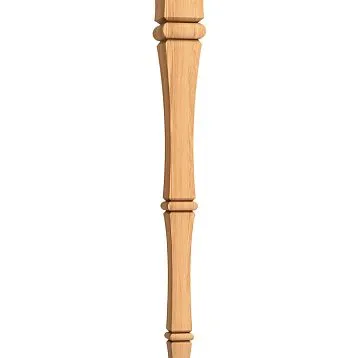
Turned wooden legs are a classic of furniture making. On a lathe, from a solid block of oak, beech, or ash, forms are born that adorned aristocratic palaces and continue to inspire modern designers. Smooth curves, vase-like expansions, fluting, collars—every detail is thought out to create visual harmony.
Such furniture supports are ideal for classic interiors: English style, Victorian era, American neoclassicism. They add nobility to an item, emphasize status, and create a connection with historical heritage. Oak turned legs, coated with clear varnish, showcase the wood grain—each annual ring, each swirl becomes part of the design.
Tapered supports: Scandinavian elegance
The tapered form—where the leg smoothly narrows from top to bottom—is characteristic of Scandinavian and mid-century modern styles. Minimal decoration, maximum functionality. Such legs are visually light, don't overload space with details, and create a sense of upward aspiration.
The height of tapered supports usually ranges from twelve to twenty centimeters—sufficient for visual lightness and convenient cleaning. Material—light wood (beech, ash) or stained to resemble walnut, wenge. In Scandinavian interiors, preference is given to natural light tones, which enhance the feeling of airiness and spaciousness.
Cabriole: curved elegance of Baroque
The cabriole leg is a curved S-shaped form that mimics an animal's leg (usually a horse or deer). This type of support is characteristic of Baroque, Rococo, and Louis XV styles. Cabriole adds dynamism, grace, and aristocratic flair to furniture.
Crafting such legs requires high skill — every curve is precise, proportions calculated to create visual balance. Modern manufacturers use CNC milling for shape accuracy, but final finishing remains in the hands of a master. Oak or beech cabriole legs, coated with patina or gilding, become works of applied art.
Square and rectangular supports: minimalist functionality
Concise supports with square or rectangular cross-sections — a choice for modern minimalist interiors. No curls, no carvings — only pure geometry and functionality. Cross-section typically from thirty to sixty millimeters, height from ten to twenty-five centimeters.
Such furniture supports are worth buying for furniture in loft, industrial, Scandinavian minimalism, Japanese design styles. They create a clear vertical accent, emphasize the constructiveness of the item, without drawing attention to themselves. Material — oak, ash, birch, painted black, white, gray, or left in a natural tone under oil.
Metal legs with wooden overlays: industrial aesthetics
Hybrid solutions — metal frame with wooden decorative elements — are popular in loft interiors. Metal provides maximum strength and stability, wood adds warmth and coziness. This combination creates an interesting visual contrast: the industrial brutality of metal is softened by the naturalness of wood.
Typical construction: steel pipe with square or round cross-section, onto which an oak or ash wooden overlay is fitted. The overlay may cover the entire height of the leg or only its upper part, creating a decorative accent at the attachment point to the furniture body.
Slatted partition: zoning without isolation
What is slatted zoning and why it works
Slatted partition— is a structure of vertical or horizontal wooden slats, fixed on a frame at a certain interval. Unlike a solid wall, a slatted partition allows light to pass through, enables seeing through the space, creates visual separation while maintaining a sense of a single volume.
This solution is ideal for modern open layouts, where functional zones need to be separated — living room and dining room, bedroom and workspace, hallway and living room — while preserving a sense of spaciousness. The slatted structure outlines a boundary but does not isolate. It allows light to penetrate from one zone to another, which is critical for rooms with one window or insufficient natural lighting.
Vertical planks: visual ceiling lift
Vertical arrangement of slats creates an upward directionality of the gaze. This visually increases the height of the room — the ceiling appears higher, the space is perceived as more voluminous. The effect is enhanced if the slats run from floor to ceiling without interruption.
Width of vertical slats typically from thirty to eighty millimeters, thickness from fifteen to thirty millimeters. Distance between slats — a key parameter: too dense installation (five — seven centimeters) creates an almost solid wall, too sparse (twenty — thirty centimeters) is hardly perceived as a partition. Optimal interval for zoning — ten — fifteen centimeters between slats.
Horizontal boards: expanding space
Horizontal arrangement of slats, conversely, creates a sense of width and extension. Lines running parallel to the floor make the gaze slide along the wall, expanding the perceived space. This is useful in narrow rooms — corridors, elongated rooms, where proportions need to be visually balanced.
Horizontal slats are often used for accent wall design, when a textured surface needs to be created while maintaining connection with the rest of the space. Combining horizontal slats with lighting — a popular technique: LED strip, hidden between slats, creates soft diffused light, emphasizes wood texture, adds depth to the composition.
Diagonal arrangement: dynamism and unconventionality
Diagonal slats — a solution for bold projects where dynamism and movement are important. Slanted lines create visual tension, attract attention, set rhythm. This approach requires precise calculation of the angle of inclination and distances — an error will lead to visual imbalance.
Diagonal slatted zoning is often used in commercial spaces — restaurants, offices, showrooms, where a memorable visual effect is needed. In residential interiors, this technique is appropriate in youth, modern projects where experimentation is welcomed.
How furniture supports and slatted partitions work together
Creating visual rhythm through repetition of forms
When wooden furniture legs and slatted partitions made from the same wood species are used in an interior, a visual rhyme arises. The verticals of sofa, armchair, and table legs echo the verticals of partition slats. This creates rhythm, organizes space, connects disparate elements into a single composition.
Imagine a living room where a sofa stands on conical oak legs, a coffee table — on cylindrical supports of the same shade, and the relaxation zone is separated from the dining area by an oak slatted partition with similar surface treatment. Repetition of material and form creates harmony, makes the interior cohesive, well-thought-out.
Managing light and shadows
Raised furniture and slatted zoning work with natural and artificial light, creating a play of shadows. Light passing through intervals between slats casts parallel stripes of shadows on the floor and walls, which change throughout the day with the movement of the sun. This adds dynamism, liveliness to the interior.
The space under furniture on legs also participates in the light composition. When light falls at an angle, the gap between the floor and the sofa body is illuminated, creating a floating effect. This technique is enhanced by adding an LED strip along the perimeter of the furniture base — so-called under-furniture lighting. Soft light flowing from under the sofa or bed visually lightens the item, creates atmospheric lighting.
Unity of material as the foundation of harmony
Using one wood species for furniture supports and slatted partition — key to creating a harmonious interior. Oak — an ideal choice due to strength, expressive texture, noble color. Beech legs and slats provide a more uniform, calm surface, appropriate in minimalist interiors. Ash with its contrasting growth ring pattern suits modern eco-friendly spaces.
Unity of shade and type of treatment is also critical. If furniture supports are coated with matte oil preserving natural texture, partition slats should have a similar coating. If legs are tinted walnut, the slatted structure requires the same tinting. Mismatch of shades creates visual dissonance, destroys integrity.
Practical guide: how to raise a sofa on legs
Assessment of sofa construction
Before installing legs, assess whether the sofa's construction allows for it. Some models are originally designed for mounting on supports—threaded bushings or mounting plates are provided in the lower part of the frame. Other sofas have a solid base, and adding legs will require modifying the structure.
Inspect the lower part of the sofa. If the frame is wooden or plywood with sufficient thickness (at least fifteen millimeters), installing legs is feasible. If the base is thin, made of low-quality particleboard, or lacks a rigid frame, structural reinforcement will be needed. The frame corners should have corner blocks or sufficiently strong joints to support the weight of the sofa and operational loads.
Selection of support type and height
furniture legsmust match the weight of the sofa and the interior style. For a heavy three-seater sofa with a massive frame, sturdy legs with a diameter of sixty to eighty millimeters or a square cross-section of fifty by fifty to sixty by sixty millimeters are needed. For a compact two-seater sofa, conical legs with a diameter of thirty-five to fifty millimeters are sufficient.
The height of the support determines the visual effect and practicality. Low legs (five to eight centimeters) lift the sofa minimally, add lightness, but do not provide enough space for cleaning. Medium legs (ten to fifteen centimeters) are the optimal choice: the sofa looks airy, and a vacuum cleaner can easily pass underneath. High legs (twenty to twenty-five centimeters) create a retro effect, characteristic of 1960s furniture, but can disrupt the proportions of modern low sofas.
Methods for attaching supports
There are several ways to attach furniture legs to the sofa frame:
Threaded connection—a classic method. A thread (usually M8 or M10) is cut into the leg, and a corresponding bushing with an internal thread is installed in the frame. The leg is screwed into the bushing, providing a strong connection. Advantages: simplicity of installation and removal, ability to adjust height (if the leg has a long threaded section). Disadvantage: precise placement of bushings is required, and the thread may loosen over time.
Mounting with a mounting plate—a universal method. A metal plate with a threaded hole in the center is attached to the lower part of the sofa frame with screws. A leg with a threaded pin is screwed into the plate. This method is suitable for sofas without pre-installed mounts. The plate distributes the load over a larger area, preventing the soft frame material from being crushed.
Through-screw fastening—for wooden legs without threads. Holes are drilled at an angle in the upper part of the leg, through which long screws are driven into the sofa frame. This method provides maximum strength but requires drilling precision and access to the mounting location.
Placement of supports and weight distribution
The number and placement of legs depend on the size of the sofa and the frame construction. The minimum configuration is four legs at the corners. This is sufficient for a compact two-seater sofa with a total weight of up to one hundred and fifty kilograms.
For three-seater and larger sofas, additional supports in the center are needed. The standard scheme is six legs: one in each corner plus two along the center of the long side. This distributes weight evenly, preventing sagging of the central part of the frame.
The distance from the edge of the sofa to the center of the leg is usually five to ten centimeters. If the legs are flush with the edge of the upholstery, they visually support the body. If set further inward (fifteen to twenty centimeters), a floating volume effect is created, but stability is reduced.
Final adjustment and stability check
After installing all legs, check the stability of the sofa. Place it on a level floor, press on different parts of the seat. The sofa should not wobble; all legs should stand firmly on the floor. If one leg does not reach the floor, adjust its height (if the design allows) or use a shim.
On uneven floors—common in older houses—adjustable plastic glides are placed under short legs. They compensate for irregularities of up to ten to fifteen millimeters, ensuring firm contact of all supports with the surface.
Check the fastening strength: grab the leg, try to wiggle it. A securely fastened support does not wobble or rotate. If there is play, tighten the fastener.
Installation of a slatted partition: step-by-step technology
Design and material calculation
Before purchasing materials, determine the parameters of the future partition: height, width, distance between slats, thickness and width of the planks. Draw a sketch with dimensions. Calculate the number of slats: divide the width of the partition by the sum of the slat width and the interval between slats.
Example: partition width three meters, slat width forty millimeters, interval one hundred millimeters. Repeat step—one hundred forty millimeters. Three meters (three thousand millimeters) divided by one hundred forty—gives twenty-one slats. Standard height—from floor to ceiling (usually two point five to two point seven meters). Total needed: twenty-one slats, each two point six meters long.
For the frame, you will need bars with a cross-section of forty by sixty or fifty by fifty millimeters. Two vertical bars the height of the partition plus two to three horizontal bars for connection (at the top, bottom, and in the center if the height exceeds two meters).
Preparation of materials and surface treatment
Wooden itemsrequire preliminary treatment. Slats and bars must be sanded—first with 120-grit abrasive, then 180–240 grit. This removes burrs, smooths out irregularities, and prepares the wood for the final coating.
If painting or staining is planned, conduct a test application on a scrap piece. Oak and ash accept water- and alcohol-based stains well; beech requires preliminary priming for even absorption. After staining, a protective layer—varnish or oil—must be applied.
To preserve the natural texture, use oils with hard wax. They highlight the wood grain, create a matte velvety surface, and protect against moisture and dirt. Apply in two coats with an intermediate drying time of six to eight hours. Full drying in twenty-four hours.
Assembly of the partition frame
The frame is the foundation of the structure, providing rigidity and load-bearing capacity. Connect the vertical and horizontal bars into a rectangular frame. Connection methods: mortise and tenon (strongest), using metal brackets, or with screws and pre-drilling.
For a mortise and tenon joint, a tenon is cut into the end of the horizontal bar, and a mortise is routed into the vertical bar. The joint is glued with wood glue and clamped with clamps until dry. Such a joint withstands significant loads and does not loosen over time.
Metal brackets—a quick method. The bracket is screwed from inside the frame with screws to both bars. Two brackets per joint (on both sides) provide sufficient rigidity. Disadvantage: the metal is visible from the inside, which may be unsuitable for some interiors.
Attaching planks to the frame
The slats are attached to the horizontal frame battens. There are two main methods: concealed fastening and exposed fastening.
Concealed fastening – screws are driven from the back side of the horizontal batten at an angle into the end grain of the slat. This requires precision and experience, but the result is aesthetically pleasing – the fasteners are not visible on the front surface of the partition. Pre-drill thin pilot holes to prevent the wood from splitting.
Exposed fastening – screws are driven through the front side of the slat into the frame. The screw heads are countersunk, covered with wooden plugs, and sanded. The plugs are selected from the same wood species, matching the grain direction. After sanding and finishing, the plugs are almost invisible.
Control the distance between slats using a gauge – a wooden batten of the required width. Insert it between an installed slat and the next one to ensure a uniform gap along the entire height.
Installing the partition into the space
The assembled slatted partition is attached to the floor, ceiling, or only to the floor (for movable structures). Attaching to both the floor and ceiling provides maximum stability – the partition becomes stationary.
Drill holes for fasteners in the bottom and top frame battens at intervals of sixty to eighty centimeters. Install plastic anchors in a concrete floor, or drive screws directly into a wooden subfloor. When attaching to a suspended ceiling, it is necessary to install mounting blocks beforehand – this must be planned before the ceiling installation.
For temporary or movable partitions, use floor-only attachment with a weighted base. The frame is mounted on a platform made of thick plywood or solid wood, which provides stability through its weight.
Style coordination: supports and partitions in a unified concept
Minimalism: clean lines and naturalness
In minimalist interiorsfurniture legsand slatted zoning should be as concise as possible. Square or round legs without decoration, painted black, white, or gray. The partition slats are the same shade, with wide intervals (fifteen to twenty centimeters), creating transparency and lightness.
Wood is treated with matte finishes; gloss is inappropriate. The wood grain can be visible (natural oil) or completely hidden under enamel. Perfect geometry is important: all slats are strictly vertical, intervals are absolutely uniform, and the surface is smoothly sanded.
Scandinavian style: light wood and functionality
Scandinavian interiors use light woods – ash, birch, light beech. Furniture supports are conical, medium height (twelve to fifteen centimeters), coated with natural oil or white pigmented oil, which preserves the grain but lightens the tone.
A slatted partition in a Scandinavian interior is light, with large gaps, often not floor-to-ceiling but zoning only part of the height (for example, one hundred fifty centimeters from the floor). This maintains maximum openness but creates a visual boundary between zones.
Loft: industrial style and deliberate simplicity
Loft spaces combine rough finishes with quality accents. Furniture legs can be metal with wooden overlays made of dark oak or ash, tinted in cool graphite tones. Slatted partitions made of untreated or brushed wood, with emphasized texture, coated with matte oil or left without any finish at all.
In a loft, asymmetrical solutions are appropriate: slats of different widths, irregular intervals, diagonal placement. Lighting the slatted structure with cool white light enhances the industrial character.
Classic: carving, patina, nobility
Classic interiors require turned or carved legs with decorative elements. Vase-shaped swellings, fluting, carved capitals – each detail emphasizes status. Oak supports, tinted in noble shades of walnut, mahogany, coated with glossy varnish or patina.
Slatted partitions are used less often in classic style – here preference is given to solid walls or sliding doors. But if slatted zoning is appropriate, the slats are made wide (eighty to one hundred millimeters), with profiled edges, possibly with carved inserts. Intervals are narrow (five to seven centimeters), creating an almost solid surface with an ornamental rhythm.
First mistake - unstructured mixing. A classic chair, loft table, Scandinavian chest, and minimalist cabinet in one room is not eclecticism, but visual chaos. Each item draws attention to itself, not creating cohesion. A system, logic, unifying idea is needed. Choose one dominant style, add a second as an addition, and possibly a third as an accent. But no more than three, and all should have something in common - color, material, era, or functionality.
Mismatch between leg height and furniture proportions
Too high legs on a low, squat sofa create a visual imbalance – the furniture looks unstable, as if on stilts. Too low legs on a massive, tall piece of furniture do not provide a sense of lightness – the effect of elevation is lost.
Proportion rule: the height of the legs should be from five to fifteen percent of the total height of the furniture piece. For a standard sofa eighty centimeters high, legs ten to fifteen centimeters are optimal.
Using different wood species without a concept
Oak sofa legs, ash armchair legs, beech slatted partition – this is visual chaos. Different species have different shades, textures, and grain patterns. Without a thoughtful concept, such a combination destroys the harmony of the interior.
Either use one wood species for all wooden elements, or consciously combine contrasting species considering the color scheme (for example, dark walnut and light ash in a black-and-white interior).
Ignoring the load-bearing capacity of supports
Elegant conical legs with a diameter of thirty millimeters will not support the weight of a heavy three-seater leather sofa with a massive frame. Overestimating decorativeness at the expense of strength leads to leg deformation, cracking, and fastener failure.
Calculate the load: the weight of the sofa plus the weight of seated people (on average seventy to eighty kilograms per person, multiplied by the number of seats) plus a twenty percent safety margin. Divide by the number of legs – you get the load on one support. The leg manufacturer usually specifies the maximum load for the product.
Insufficient rigidity of the slatted partition frame
Thin frame battens (twenty by forty millimeters) for a high partition (two meters seventy centimeters) will not provide sufficient rigidity. The structure will wobble, and the slats may detach from the frame. For high partitions, use battens with a minimum cross-section of forty by sixty millimeters and add additional horizontal stiffening elements.
Lack of Expansion Gaps
Wood is a living material; it reacts to changes in humidity by expanding and contracting. A slatted partition rigidly fixed from floor to ceiling without expansion gaps can deform during seasonal humidity fluctuations. Leave a gap of five to ten millimeters at the top and bottom, covering it with decorative strips.
FAQ: answers to frequently asked questions
Can legs be installed on a sofa without pre-installed mounting points?
Yes, by using mounting plates or reinforcing the sofa frame with additional battens. It is important to assess the strength of the base and distribute the load across several mounting points.
What height of legs should be chosen for a sofa in a small room?
To visually expand the space, choose medium-height legs—twelve to fifteen centimeters. They create a sense of lightness without overloading the sofa's proportions and provide enough space for cleaning.
How many slats are needed for a partition three meters long?
It depends on the slat width and spacing. With a slat width of forty millimeters and a spacing of one hundred millimeters, approximately twenty-one to twenty-two slats will be needed. Exact calculation: partition width divided by (slat width plus spacing).
Should a slatted partition be painted or left as natural wood?
It depends on the interior style. Natural wood with oil finish emphasizes eco-friendliness, texture, and the warmth of the material. Painting allows the partition to be integrated into the room's color scheme, creating contrasts or harmony with wall finishes.
Does a slatted partition block light?
Partially, but much less than a solid wall. The wider the spacing between slats, the more light passes through. With a spacing of ten to fifteen centimeters, about thirty to forty percent of light is blocked, which is sufficient for zoning while maintaining illumination.
What type of wood is best for furniture legs?
Oak is the optimal choice for strength, durability, and aesthetics. Beech is cheaper, easy to work with, and suitable for painting. Ash provides a distinctive texture for modern interiors. Birch is economical for enameled legs.
How to care for wooden supports and a slatted partition?
Regularly wipe with a damp, soft cloth to remove dust. Once a year, renew the oil finish with a thin layer for protection. Avoid aggressive cleaning agents, abrasives, and excessive moisture.
Can a slatted partition be made sliding?
Yes, by installing it on a track system similar to those used for sliding doors. This allows the partition to be moved, changing the space configuration as needed.
How much does it cost to install legs on a sofa?
The cost consists of the price of the legs (from five hundred to three thousand rubles per piece depending on material and design) and the installation work (from one thousand to three thousand rubles per sofa). Total from six to twenty thousand rubles for a standard three-seater sofa.
Is a slatted partition suitable for a studio apartment?
Perfectly suitable. It zones the space while maintaining a sense of openness, does not steal light, and does not visually reduce the volume. An optimal solution for separating the kitchen area from the living area, or the bedroom from the living room.
Conclusion: Air, Light, and Wooden Harmony
Furniture raised on elegant supports and a light slatted partition are not just design techniques. They represent the philosophy of modern living space, where air, light, and freedom of movement are valued. Massiveness gives way to elegance, solid walls to transparent boundaries, and static to dynamic.
When the gaze slides under the sofa, seeing the continuation of the floor, the brain registers the continuity of space. When light penetrates through the gaps in the slatted structure, the room fills with a play of light and shadow. All this creates a sense of spaciousness even in a compact apartment, making the interior lively, breathing, and comfortable.
Using natural wood—oak, beech, ash—for manufacturingof furniture legsand slatted structures adds eco-friendliness, warmth, and a connection to nature. The texture of the wood, its tactile qualities, and its ability to age beautifully—all this transforms functional elements into objects of aesthetic enjoyment.
The company STAVROS has specialized for over two decades in the production ofsolid wood productsfor interiors. In-house production with modern equipment, chamber drying of wood to a moisture content of eight to twelve percent, multi-stage quality control—all this guarantees dimensional stability and durability of each product.
The STAVROS catalog features over one hundred thirty models of furniture legs made from solid oak, beech, and ash—from classic turned to modern geometric, from miniature conical to massive carved. Each support is manufactured with an accuracy of up to half a millimeter, ensuring perfect fit and stability.
For creating slatted partitions, STAVROS offers high-quality battens and slats of various cross-sections, processed on modern equipment. All products undergo final sanding and can be finished with oil, varnish, or tinted to any shade as desired. Custom manufacturing to individual sizes for non-standard projects is possible.
STAVROS works with private clients, interior designers, furniture factories, and construction companies across Russia. Professional consultations will help you select optimal solutions for your project, calculate material quantities, choose wood species and treatment types. Delivery is available to all regions of the country via reliable transport companies with cargo safety guarantees.
Visit STAVROS showrooms in Moscow and Saint Petersburg to see the full variety of furniture supports, evaluate wood treatment quality, and obtain material samples for visualization in your interior. Experienced specialists will answer all questions, show examples of product applications in real projects, and help you make the right choice.
STAVROS combines traditions of woodworking craftsmanship, modern wood treatment technologies, strict quality control at every production stage, and an individual approach to each client. Create interiors that breathe freedom, are filled with light, and delight with the beauty of natural materials. Choose quality tested by time, choose STAVROS.