












































































Article Contents:
- Anatomy of a Baluster: From Base to Neck
- Main Elements of a Baluster
- Stylistic Types of Balusters
- Proportions and rhythm
- Adapting the Baluster Shape for Furniture Supports
- Scaling: From 90 cm to 15-25 cm
- Diameters and Structural Strength
- Attaching the Support to the Furniture Carcass
- Choosing Supports: Ready-Made Solutions or Custom Manufacturing
- Ready-Made Supports: Catalogs and Assortment
- Custom Manufacturing: Exact Replication
- Hybrid Option: Modifying Ready-Made Supports
- Examples of Replicating the Motif: From Dresser to Console
- Dresser at the Foot of the Stairs
- Buffet in the Dining Room Under the Stairs
- Console Table in the Hallway
- Coffee Table in the Living Room with a View of the Stairs
- Materials and Finish: Complete Match with Balusters
- Wood Species: Only Identical
- Tone: Absolute Match
- Type of Coating: Oil or Varnish
- Patina and Artificial Aging
- Technical Aspects of Installing Supports on Furniture
- Attachment to the Carcass Bottom
- Leveling and Height Adjustment
- Reinforcing Supports for Heavy Furniture
- Frequently Asked Questions
- Can Balusters Be Used Directly as Furniture Supports?
- What is the Minimum Functional Height for a Furniture Support?
- What to Do If the Balusters Are Antique and Such Supports Are Not Produced?
- Is an Exact Match Necessary, or Is General Stylistic Similarity Sufficient?
- How much does a set of supports that replicate balusters cost?
- Is it possible to make supports yourself on a lathe?
- How to care for supports so that they last a long time?
- Are baluster-style supports suitable for modern interiors?
- What to do if the supports are visually too bulky for the furniture?
- Is it possible to combine wood with metal in supports?
- Conclusion: from staircase to furniture — a unified language of wood

A staircase in a two-level apartment or country house is not just a path between floors. It is an architectural dominant, a vertical element that gathers the space around itself.Wooden baluster, turned from solid oak with characteristic constrictions, thickenings, smooth transitions — this is the staircase's signature, its language of forms. What if this language is transferred to the furniture standing in the same space? When theFurniture Supports silhouette of a chest of drawers, sideboard, or console replicates the silhouette of a baluster, the interior gains a rare integrity — the bottom and top speak the same dialect, furniture and architecture become parts of a single composition. This is not a decorator's trick, but a fundamental principle of classical design, where each element is connected to others by invisible threads of proportions, rhythms, materials.
Repeating the staircase motif in furniture works on several levels. The first is visual rhythm. The vertical posts of balusters on the staircase create a frequent rhythm of supports, which the eye perceives as structure. When the four legs of a chest of drawers, standing at the foot of the staircase, have the same profile as the balusters, this rhythm continues, descends from the staircase to the furniture, creates a visual flow. The second level is material unity. Oak balusters and oakfurniture legs — this is not just a coincidence of wood species, but a coincidence of texture, density, and processing method. The third level is proportional kinship. A baluster 90 cm tall and a furniture support 20 cm tall are proportionally related — the latter as a reduced copy of the former, preserving all the characteristic features of the form.
Creating such a connection requires understanding both the structural features of balusters and the functional requirements for furniture supports.Furniture support is not just a decorative element. It bears load, ensures stability, affects furniture height, creates a gap for ventilation and cleaning. You cannot simply cut off a piece of baluster and screw it under a chest of drawers — you need to adapt the form while preserving recognizability. How to do this? Let's break it down step by step.


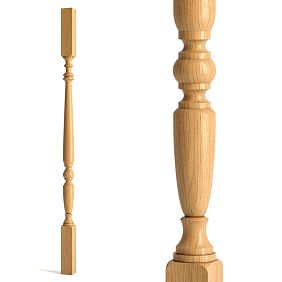


Anatomy of a baluster: from base to neck
To replicate the baluster motif in a furniture support, you need to understand the structure of the baluster itself.




Main elements of a baluster
A classic turned baluster consists of several functional and decorative zones:
Base — the lower part that attaches to the step or floor. Usually a cylinder or square section with a diameter/side of 70-90 mm, height 50-80 mm. The base is massive, creating visual support and stability.
Body of the baluster — the central part, where the main decoration is concentrated. Height 60-80 cm (for a standard staircase with a railing height of 90 cm). The body includes various turned elements: balls, vases, cones, cylinders, constrictions, grooves. This is the most expressive part, defining the style of the baluster.
Neck — the upper narrow part, transitioning to the attachment to the handrail. Diameter 40-50 mm, height 50-100 mm. The neck can be a simple cylinder or with light decorative elements (rings, constrictions).
Crown — the topmost element that fits into the handrail groove or attaches to it from below. Usually a cylinder with a diameter of 30-40 mm.
Our factory also produces:


Stylistic types of balusters
Classical baluster — symmetrical, with smooth transitions between elements. Main motifs: vases (forms expanding downward and upward), balls (spherical thickenings), constrictions (narrow rings separating elements). Classical balusters suit interiors in Empire, Classicism, English Classic styles.
Baroque baluster — more complex, with carved elements on top of the turned form. May include spiral flutes (fluting), carved acanthus leaves, rosettes. Baroque balusters require hand or CNC carving, are more expensive, and suit luxurious interiors.
Modern baluster — laconic, often consisting of simple cylinders and cones without excessive decoration. May have a square section or minimal constrictions. Modern balusters suit Neoclassical, Scandinavian, Minimalist styles.
Get Consultation
Proportions and Rhythm
The diameter of the main elements of a baluster varies from 40 mm (thin necks) to 90 mm (base). Transitions are smooth, with rounding radii of 10-30 mm. Rhythm of elements: alternation of thick-thin creates visual dynamics, which the eye perceives as harmony.
The distance between balusters on a staircase is usually 120-150 mm (center to center). This creates a frequent vertical rhythm. Four legs of a chest of drawers, placed at the corners, create a sparse rhythm, but the shape of each leg should echo the shape of the baluster.
Adapting the baluster form for a furniture support
A direct copy of a baluster as a furniture support does not work. A 90 cm tall baluster under a chest of drawers would turn it into a bar counter. Adaptation is needed, preserving recognizability while changing scale and function.
Scaling: from 90 cm to 15-25 cm
Standard furniture leg heights for case furniture:
-
For low dressers, nightstands, beds — 10-15 cm
-
For standard dressers, buffets — 15-20 cm
-
For high consoles, bar cabinets — 20-30 cm
When scaling a baluster to these heights, it is important to maintain the proportions of the main elements. If a vase-shaped expansion on a 90 cm high baluster occupies 20 cm (22% of the height), then on an 18 cm high leg, this expansion should occupy about 4 cm (also 22%).
Technically, this is done in one of the following ways:
Proportional reduction — the entire baluster is reduced by 4-6 times. The leg becomes an exact miniature of the baluster. Plus: complete preservation of character. Minus: small details (thin collars, narrow necks with a diameter of 7-8 mm) become fragile and lose structural strength.
Selective copying — 2-3 of the most characteristic elements of the baluster are taken (e.g., base + central vase + top ring), scaled, and assembled into a shortened leg. Plus: preservation of recognizability with sufficient strength. Minus: requires design work for assembly.
Simplification of details — complex baluster elements are simplified into larger, more technological forms. Carved leaves are replaced with simple collars, thin necks — with cylinders of larger diameter. Plus: strength, manufacturability, reduced cost. Minus: partial loss of decorativeness.
Diameters and structural strength
Minimum diameter of the load-bearing part of a furniture leg — 30 mm for furniture weighing up to 50 kg (nightstands, light dressers), 40 mm for furniture up to 100 kg (standard dressers, buffets), 50 mm for heavy furniture (cabinets, sideboards).
If a baluster has a thin neck with a diameter of 40 mm, scaling it by 5 times results in 8 mm — this is a non-functional diameter, the leg will break. Solution: increase the diameter of thin sections to the structural minimum (30-40 mm), while preserving the overall silhouette — the narrow section remains narrow relative to the wide parts, but the absolute value is increased.
Attaching the leg to the furniture case
Unlike a baluster, which is attached by mortising a tenon into the step and handrail, a furniture leg is attached to the case bottom with screws, confirmat screws, or built-in threaded inserts.
The top part of the leg must have a flat platform with a minimum diameter of 50 mm for attachment with four M6-M8 screws. This platform can be hidden inside the case (the leg fits into a recess in the bottom) or exposed (the leg stands under the bottom, fasteners from below).
For heavy furniture, reinforced fastenings are used: an 80×80 mm metal plate screwed to the bottom, with a central M10 screw that screws into a threaded insert inside the leg. This provides a load-bearing capacity of up to 200-250 kg per leg.
Choosing legs: ready-made solutions or custom manufacturing
There are two ways to obtain furniture legs that replicate the baluster motif: purchasing ready-made ones or ordering custom ones.
Ready-made legs: catalogs and assortment
Manufacturers of wooden interior elements offerfurniture legsvarious forms, many of which are originally created based on balusters.
In the catalog, you can find legs 15-25 cm high with turned elements: vases, balls, collars — the same motifs as in balusters. If your home already has balusters on the staircase from a specific collection, you can try to find legs that replicate their profile.
Search criteria:
-
Wood species (oak, beech, ash — should match the balusters)
-
Main profile elements (if the baluster has a central vase — look for a leg with a vase)
-
Proportions (ratio of diameters of wide and narrow parts)
-
Finish tonality (natural wood, tint, color)
Pros of ready-made legs: fast delivery (from stock in 1-3 days), guaranteed quality (products are serial, refined), low price (5000-15000 rubles for a set of 4 pieces depending on wood species and complexity).
Cons: limited selection (may not have an exact match with balusters), standard sizes (if a non-standard height is needed, you will have to trim or give up).
Custom manufacturing: precise replication
If your staircase balusters are unique (carved, custom-designed, antique), ready-made supports won't work. You need to order custom manufacturing.
Process:
-
Photographing the baluster (from all sides, with a ruler for scale).
-
Creating technical specifications (description: which elements of the baluster should be present in the support, what support height is needed, what diameter the top platform for attachment should be).
-
Development of a 3D model of the support by the manufacturer (the designer adapts the baluster into a furniture support while preserving its character).
-
Model approval (you approve or request changes).
-
Manufacturing a prototype (a CNC lathe turns one support from solid wood).
-
Final prototype approval (you inspect the actual product).
-
Series production (manufacturing the required number of supports — typically 4 for one piece of furniture, but can be more).
Timeline: 3-6 weeks from order to receipt. Cost: 8000-25000 rubles for a set of 4 supports depending on complexity (simple turning is cheaper, carving is more expensive) and wood species.
Pros: exact match to balusters, any height and diameter, full control over the result.
Cons: long lead times, high price (1.5-2 times more expensive than ready-made), need for detailed communication with the manufacturer.
Hybrid option: modification of ready-made supports
Intermediate solution: buy ready-made supports that are close in style to the balusters and modify them.
Modifications may include:
-
Height adjustment (sawing the bottom part to the required size)
-
Adding decorative elements (applying carved overlays, turned rings)
-
Tone adjustment (re-staining, painting, patinating)
This requires carpentry skills and tools (a lathe for sawing while maintaining coaxiality, stain and varnish for finishing), but is cheaper and faster than full custom manufacturing.
Examples of motif replication: from a chest of drawers to a console
Let's consider specific types of furniture where replicating the baluster motif in supports works especially effectively.
Chest of drawers at the foot of the stairs
A chest of drawers standing in the hall next to the stairs is a classic place to apply the motif replication principle. Chest height 80-90 cm, width 100-120 cm, depth 45-50 cm. Four supports 15-18 cm high.
If the staircase balusters have a classic profile with a central vase and collars, the chest supports replicate this scheme: base diameter 60 mm, central vase expanding to 70 mm, top collar 50 mm, attachment platform 60 mm. All elements are turned, from the same oak, in the same tone as the balusters.
Visual effect: when you enter the hall and see the staircase with balusters, and next to it a chest of drawers on supports of the same profile, it creates the feeling that the chest and staircase are parts of a single ensemble, designed by one craftsman. Even if the chest was purchased separately and the staircase was made by builders, the supports create the illusion of a cohesive project.
Buffet in the dining room under the stairs
In duplex apartments, the dining room is often located under or next to the staircase flight. A buffet — a tall cabinet with display cases and drawers — stands against the wall, with its four front supports visible.
Buffet height 180-200 cm, supports 20-25 cm (taller than those of a chest, for proportionality with the large body). The support profile replicates the balusters but with simplification: if the baluster has 5-6 decorative elements, the support has 3-4 of the most characteristic ones. This preserves recognizability without overloading.
A buffet often has carved fronts, panels, overlays. Baluster supports enhance the classical theme, making the furniture monumental, resembling an antique sideboard from the 18th-19th century.
Console table in the hall
A console is a narrow table, 30-40 cm deep, placed against a wall, often beneath a mirror. In a hallway with a staircase, a console on baluster-like supports creates an elegant composition.
Console height is 75-85 cm, supports are 25-30 cm (the tallest among furniture supports, approaching the proportions of full-sized balusters). If the console is narrow (80-100 cm wide), two front supports are sufficient (the tabletop is attached to the wall with brackets at the back). Two supports with a baluster profile create a symmetrical composition, supporting the tabletop like a portico on columns.
A console is often used to display decor: vases, sculptures, lamps. Baluster supports add a vertical element that connects the horizontal tabletop with the verticality of the staircase.
Coffee table in a living room with a view of the staircase
In open-space layouts, the living room and hallway with a staircase are combined. A coffee table in the living room can repeat the baluster motif, linking the relaxation area with the architectural focal point of the staircase.
Coffee table height is 40-45 cm, supports are 12-15 cm (the shortest). At this height, detailing is minimal: a support can be a simple turned cylinder with one or two collars, but its silhouette repeats that of a baluster.
Four supports at the corners of an 80×120 cm tabletop create a light, airy structure. The material—light oak or beech, like the balusters—creates unity.
Materials and finish: complete match with the balusters
For the principle of motif repetition to work, matching not only the form but also the material and finish is critical.
Wood species: only identical
Ifbuy balustersIf oak was chosen, the supports must also be oak. Oak grain (large-pored, with contrasting annual rings) is unique and cannot be confused with beech or ash even after staining.
Beech has a more uniform, fine-pored texture with a pinkish hue. Beech balusters require beech supports. Mixing species (oak balusters + beech supports) destroys unity, even if the stain is the same.
Ash is similar to oak but lighter, with less contrasting rings. Ash balusters + ash supports—good. Ash balusters + oak supports—acceptable with identical staining, but a professional will see the difference.
Tone: absolute match
Natural oak without stain has a light golden hue. Walnut stain gives a medium-brown tone. Wenge stain gives a dark brown, almost black tone.
Balusters and supports must be in the same tonal range. Even a half-tone difference is noticeable: light walnut balusters and medium walnut supports will contrast, destroying the illusion of a unified ensemble.
Solution: order balusters and supports from the same manufacturer, from the same wood batch, and stain them with the same stain. If the balusters are already installed, provide the manufacturer with a sample (a piece of a baluster or a photo with a color scale) when ordering supports to match the shade as closely as possible.
Type of finish: oil or varnish
Balusters on staircases are usually coated with wear-resistant varnish (semi-matte or matte) because a staircase is a high-traffic area; varnish protects against abrasion.
Furniture supports experience less load, but for unity, they must have the same type of finish. Varnished balusters require varnished supports. The level of sheen must match: matte varnish (10-20% sheen) on balusters = matte varnish on supports.
Oil finish is rarely used on staircases (oil is less wear-resistant), but if balusters are oiled (e.g., on a lightly used decorative staircase), the supports should also be oiled with the same brand of oil.
Patina and artificial aging
If balusters are patinated (gold, silver, or black paint in the recesses of turned elements for an antique effect), the supports must be patinated similarly. The degree of patination may differ (more pronounced on balusters, light on supports), but the presence of patina is mandatory.
Artificial aging (brushing—removing soft fibers, leaving hard ones for texture; soaking—creating dark spots) is applied equally to balusters and supports.
Technical aspects of installing supports on furniture
Installing furniture supports that replicate balusters has specific features related to their shape and weight.
Attachment to the cabinet bottom
For supports with a diameter of 50-70 mm at the top, use four M6×40-50 mm screws (if the bottom is made of solid wood or 18-20 mm plywood) or M6×60-70 mm screws (if the bottom is 16 mm particleboard with a reinforcing plate).
Marking holes: at the corners of a square with sides 40-50 mm, the center of the square aligns with the center of the support. Drill 5 mm holes for M6 countersunk screws. Screws are inserted from above (inside the cabinet), entering the top platform of the support, where blind holes 30-40 mm deep have been pre-drilled for them.
For heavy furniture (a sideboard, cabinet weighing 100-150 kg), an additional central M10×80-100 mm screw is used, which passes through the center of the bottom and screws into a metal threaded insert pressed into the body of the support along its axis. This reinforces the attachment and prevents loosening.
Leveling and height adjustment
The four supports must have absolutely identical height with an accuracy of 0.5 mm, otherwise the furniture will wobble. When turning supports, an accuracy of ±0.2 mm is achieved, but deviations are possible.
Solution: adjustable glides. An M8 or M10 threaded insert is installed on the bottom end of each support, into which an adjustment screw with a plastic or felt pad (to avoid scratching the floor) is screwed. By rotating the screw, the effective height of the support can be changed by ±5-7 mm, leveling the furniture even on an uneven floor.
Alternative for lightweight furniture: self-adhesive felt pads of different thicknesses (1, 2, 3 mm), which are glued to the ends of the supports for leveling and protecting the floor from scratches.
Reinforcement of supports for heavy furniture
A 50 mm diameter oak support can withstand a vertical load of about 150-200 kg (depending on the height of the support and the presence of thin sections). For furniture weighing more than 150 kg (a heavy sideboard filled with dishes weighs 200-250 kg), reinforcement is needed.
Internal reinforcement: a blind hole with a diameter of 12-16 mm and a depth of 80-100 mm (almost the entire height of the support) is drilled along the axis inside the support, into which a 10-12 mm diameter steel rod is glued with epoxy resin. The rod protrudes 20-30 mm from the top, passes through the bottom of the furniture, and is secured with a nut on top. The entire load is transferred to the steel rod, and the wood acts as a decorative shell.
Externally, the reinforced support looks identical to a regular one, but its load-bearing capacity increases to 300-400 kg per support, ensuring absolute reliability even for the heaviest furniture.
Frequently Asked Questions
Can balusters be used directly as furniture supports?
Technically possible if you cut the baluster to the required height (15-25 cm). But problems: 1) the top platform of the baluster may be too narrow (30-40 mm) for reliable attachment to the furniture, requiring modification; 2) if you cut from the middle of the baluster, you need to create a new top platform; 3) the cost of a baluster (2000-6000 rubles) is higher than that of a specialized furniture support (1200-3500 rubles).
What is the minimum functional height for a furniture support?
10 cm is the minimum for low cabinets and beds. Below 10 cm, the support turns into a glide, not providing clearance for cleaning under the furniture. For dressers and sideboards, the optimum is 15-20 cm.
What to do if the balusters are antique and such supports are not produced?
Order custom manufacturing based on a photo. A master turner or a manufacturer with a CNC machine can replicate any profile. If the baluster has hand carving, a carver can reproduce it on the support. The cost is high (5000-8000 rubles for one support with hand carving), but the result is an exact copy on a reduced scale.
Is an exact match necessary, or is a general stylistic similarity sufficient?
Depends on the level of requirements. For professional design, an exact match of the main elements (vase, ball, transitions in the same sequence) is mandatory. For amateur level, it is sufficient that the supports are turned, made of the same wood, and in the same style (classic, baroque, modern). The main thing is to avoid obvious conflicts (baroque carved balusters + minimalist cylindrical supports).
How much does a set of supports that replicate balusters cost?
Ready-made supports from a catalog: 5000-12000 rubles for 4 pieces (oak, beech, height 15-20 cm, turned). Custom manufacturing of simple turned supports: 8000-18000 rubles for 4 pieces. Custom manufacturing of complex carved supports: 20000-40000 rubles for 4 pieces. Reinforced supports with a metal rod: +30% to the cost.
Can supports be made by hand on a lathe?
Yes, if you have a wood lathe and skills. Based on a photo of the baluster, a drawing of the support (a reduced version) is created, and it is turned from an oak or beech block with a cross-section of 80×80 mm. The difficulty: achieving precise repeatability of the four supports (they must be identical). A professional on a CNC machine makes 4 identical supports in 2-3 hours. Manually on a regular lathe — 8-12 hours, and absolute identity will not be achieved (deviations of ±1-2 mm), but it is acceptable for an amateur level.
How to care for supports so they last a long time?
Wipe with a dry cloth once a week. Avoid excessive moisture (washing with a wet rag). Check the tightness of the fastening screws once a year (they may loosen from vibrations). Renew the varnish coating every 5-7 years (light sanding with 320-grit sandpaper, a new coat of varnish). Renew the oil coating every 2-3 years (apply oil, let it soak in, remove excess).
Are baluster-style supports suitable for modern interiors?
Yes, if the balusters are laconic, without excessive decoration. Modern classic, neoclassical, and Scandinavian styles allow turned forms if they are not overloaded with details. Simple cylinders with one or two transitions made of light wood are a universal solution that works in modern interiors.
What to do if the supports look too massive for the furniture?
Reduce the diameter. If a 70 mm diameter support looks bulky on an elegant dresser, order supports with a diameter of 50-60 mm. The proportions of the profile are preserved, but the overall scale is reduced. Alternative: paint the supports a light color (white, cream), which visually lightens them even if the diameter remains the same.
Is it possible to combine wood with metal in supports?
Possible if it is stylistically justified. A wooden upper part of the support (replicating the baluster profile) + a metal base and glide is an option for loft, industrial style, and eclecticism. But for classic interiors where balusters are entirely wooden, combining with metal would disrupt the unity.
Conclusion: from staircase to furniture — a unified language of wood
Repeating the motif of staircase balusters in the supports of case furniture is not a passing trend, but a centuries-old principle of classic design. The great interiors of the past — from the palaces of Versailles to Victorian-era English mansions — were built on such echoes: the form of columns was repeated in table legs, the ornament on a mantelpiece was repeated in the carving on chair backs, the profile of a terrace balustrade was repeated in the supports of a sideboard in the dining room.
WhenFurniture Supportsrepeat the silhouetteWooden balustersFrom your staircase, the interior gains that elusive integrity that cannot be created by purchasing disparate items. This is a space where architecture and furniture speak the same language, where the verticals of balusters continue in the verticals of supports, where the oak wood on the staircase echoes the oak on the chest of drawers.
Technically, this is achievable: through the selection of ready-made supports from a catalog, through custom manufacturing based on photos of balusters, through modification of existing supports. Each path has its own difficulties and advantages, but the result is the same — furniture that doesn't just stand in the space with the staircase, but is part of that space, its organic continuation.
Materials are critical: one wood species, one tonal range, one type of finish. Form is important: preserving the characteristic elements of the baluster (vases, balls, collars) while adapting the scale. Installation requires precision: proper fastening, alignment, and reinforcement for heavy furniture if necessary.
STAVROS is a company that understands the philosophy of a unified wood language in the interior and implements it in production. Since 2002, STAVROS has been creating wooden interior elements: balusters for staircases, furniture supports, decorative overlays, moldings — all made from solid oak and beech, all produced in-house in St. Petersburg.
The STAVROS collection includes over 50 baluster models and over 130 furniture support models. Many supports are initially designed as scaled-down versions of balusters, simplifying the creation of a unified ensemble. But STAVROS goes further: the company offers a custom support manufacturing service based on your balusters.
The process is simple: you send a photo of the baluster, specify the required height and number of supports. STAVROS designers create a 3D model of the support, adapting the baluster profile to furniture requirements (reinforcing thin areas, creating a top platform for fastening, optimizing proportions). You approve the model. CNC machines carve the supports from solid oak or beech, craftsmen sand them (from 80 to 600 grit), apply tinting (if needed, matching your baluster sample) and a final finish (Osmo oil or Sayerlack lacquer — the same compositions used for balusters).
The result is a set of 4-6-8 supports (depending on your furniture) that are identical to the balusters in material, tonal range, and character of forms, but adapted for furniture use. Production time is 4-6 weeks, cost is 8000-25000 rubles per set depending on complexity.
STAVROS production is equipped with 19 CNC machines, including lathes for turning rotational bodies (balusters, supports) and milling machines for creating carvings. Each product undergoes geometry control (deviation no more than 0.2 mm), sanding quality control (tactile and visual), and coating uniformity control. This guarantees that the four supports in a set are absolutely identical — the furniture won't wobble, height is precise, and the form is replicated with millimeter accuracy.
STAVROS logistics cover all of Russia. Furniture supports are packed in reinforced cardboard boxes with bubble wrap, shipped via transport companies (SDEK, PEK, Delovye Linii) with a guarantee of safe delivery. For Moscow and St. Petersburg — courier delivery with the possibility of fitting (the courier brings the supports, you check the match with the balusters, and if everything is satisfactory — you accept).
STAVROS prices are honest, without markups. Ready-made oak furniture supports 18 cm high — from 1900 rubles per piece (7600 for a set of 4). Custom manufacturing of supports based on balusters — from 2800 rubles per piece (11200 for a set of 4). Carved supports with manual refinement — from 5500 rubles per piece (22000 for a set). This is 1.5-2 times lower than European analogues with comparable quality.
By choosing STAVROS, you get not just furniture supports, but elements of a unified wooden language system for the interior. A system whereWooden balusteron the staircase andFurniture supporton the chest of drawers are connected by invisible threads of proportions, materials, and craftsmanship. A system that transforms a collection of items into an interior, a space into a home, wood into art. And STAVROS masters this art to perfection.


