Article Contents:
- What Holds the Table: The Role of Furniture Support in Construction
- Load Calculation on Supports: Engineering Formula for Stability
- Support-Beam Joint: Construction Enduring Decades
- Diagonals and Braces: Geometry Transforming Frame into Monolith
- Tabletop Thickness: How It Affects Support Calculation
- Support Materials: Wood, Metal, Combined Solutions
- Table Base: Ready-made Support Structure for Professional Results
- Tabletop Attachment to Frame: Accounting for Wood Expansion
- When Additional Reinforcements Are Needed
- Calculation Examples for Different Types of Tables
- Dining Table 160×80 cm, Wooden Tabletop 40 mm
- Workbench in Workshop 200×100 cm, Tabletop 50 mm
- Bar Counter 120×40 cm, Height 110 cm, Tabletop 30 mm
- Coffee Table 100×60 cm, Glass Tabletop 12 mm
- Errors in Support Calculations and Their Consequences
- Choosing Between Custom Fabrication and Purchasing Ready-made Supports
- Additional Elements for Structural Reinforcement
- FAQ: Answers to Popular Questions
- Conclusion: STAVROS — Supports and Components for Ideal Tables

Any table does not begin with the tabletop. It begins with what holds it — supports, beams, braces, connection nodes, which transform a set of wooden elements into a structure capable of serving for decades. You can choose the perfect tabletop, but if the support system is incorrectly calculated, the table will start to wobble, creak, and sag under the weight of daily use. The engineering logic of furniture support is not an abstraction — it is an exact balance of mass, force distribution, connection geometry, and safety margin.


What Holds the Table: The Role of Furniture Support in Construction
Furniture support is a vertical element that bears the entire load of the tabletop and everything placed upon it. Without supports, the tabletop is useless — it will sag, crack, and lose its shape.table legIt transforms a plane into a functional object, transferring load from the surface to the floor, ensuring stability, rigidity, and longevity.
But a single support does not work independently. It connects to beams — horizontal crossbars that link all vertical elements into a single frame. The beam prevents supports from moving sideways, fixes the frame’s geometry, and distributes lateral forces. The "support-beam" joint is the heart of the table’s entire structure — the point where vertical and horizontal loads meet.
Diagonal braces add additional rigidity, especially when the table is tall, wide, or subjected to uneven loads. Braces work under tension and compression, preventing lateral displacement of supports and transforming the frame into a triangular system — the most stable in nature.
Tabletop thickness also affects requirements for the support system. A thin tabletop (20–25 mm) may sag between supports if the distance between them is too large. A thick tabletop (40–50 mm and above) is inherently rigid, but it is heavier, increasing the load on supports. Choosing the correct tabletop thickness and corresponding support structure is always a compromise between strength, weight, aesthetics, and cost.




Load Calculation on Supports: Engineering Formula for Stability
How many supports does a table need? How to calculate what weight each one can bear? Why can't you simply divide the total mass by the number of legs? Because in reality, the load is never distributed perfectly evenly. When a person leans on the edge of the table, the weight is transferred to the nearest supports. When a heavy object is placed off-center, near a corner, the corresponding support bears more load than the others.
The basic formula for calculating maximum load per support accounts for this unevenness. It looks like this: total load (table mass plus useful load) divided by the number of supports minus one, then multiplied by the safety factor (usually 1.5). This gives a realistic estimate of the mass each individual support must bear in the worst-case scenario.
Assume the tabletop and frame weigh 40 kilograms, and the useful load (dishes, appliances, elbows of seated people) is 60 kilograms. Total load — 100 kilograms. If there are four supports, divide 100 by 3 (4 minus 1), yielding approximately 33 kilograms per support. Multiply by safety factor 1.5 — results in 50 kilograms. Each support must withstand at least 50 kilograms to ensure the table remains stable and safe under any usage conditions.
This formula works for standard dining and writing tables. For workbenches in workshops with heavy equipment, the safety factor is increased to 2 or even 2.5. For lightweight coffee tables, conversely, a factor of 1.3 can be used if the tabletop is thin and light. But never calculate supports without a safety factor — wood may have hidden defects, fasteners weaken over time, and operating conditions change.
The number of supports is also critical. Three supports — minimum for stability, but this scheme is rarely used, mostly for small round or triangular tables. Four supports — standard for rectangular and square tables up to 1.5–1.8 meters long. Longer tables require six supports to prevent the tabletop from sagging in the center. The distance between supports should not exceed 100–120 centimeters; otherwise, even a thick tabletop will sag under load.
Choosinglegs for the tableThe supports' load-bearing capacity depends not only on aesthetics but also on their cross-section, material, and wood quality. Round legs with a diameter of 60–70 mm or square legs with a cross-section of 70×70 mm can withstand the loads described above. Thinner legs (40–50 mm) are suitable only for lightweight tables with small tabletops and minimal useful load.
Our factory also produces:


Support-Beam Joint: Construction Enduring Decades
Table strength is determined less by the supports themselves and more by how they are connected to the beams. The "support-beam" joint is a critical point in the structure where vertical forces meet horizontal forces, where wood works under bending, compression, and shear simultaneously. Improper fastening leads to loosening, creaking, and joint failure.
The classic mortise-and-tenon joint is considered the best option. The beam has a tenon at its end, which fits into a mortise cut into the support. The joint is glued with woodworking glue, providing twice the strength compared to metal brackets. The tenon can be through (passing through the entire thickness of the support) or blind (inserted to a certain depth). Through tenons are stronger but visible from the back of the support, which is not always aesthetically pleasing. Blind tenons are invisible but require precise fitting and quality glue.
An alternative method — attaching the beam to the support using metal angle brackets or wooden blocks. Brackets come in single-sided (for connecting two elements at a right angle) and double-sided (for more rigid fixation). They are installed from within the frame, so they are not visible from the outside. This method is easier to execute, does not require high precision, and allows the table to be disassembled and reassembled as needed. However, it is inferior to mortise-and-tenon in strength and durability — over time, the fasteners may loosen, and the table will start to wobble.
Direct attachment of the beam to the support using screws is used less often, mainly for simple constructions where high strength is not required. The beam's edges are drilled at an angle, and screws are screwed into the support's end. This method is fast and inexpensive but cannot withstand significant loads or lateral forces. Suitable for lightweight coffee tables, children's furniture, or temporary structures.
The quarter on the support — a carved step into which the beam rests — is also important. The quarter increases the contact area, ensures precise beam positioning, and prevents displacement under load. Supports with quarters are used in quality furniture, where both strength and long-term joint durability are essential.furniture legsTables with such a construction cost more but are fully justified by their reliability.
For stone tabletops, requirements for the support-beam joint are even higher. Stone does not bend — it cracks. Any uneven load distribution can lead to tabletop failure. Therefore, the frame for a stone table must be absolutely rigid, without play, with reinforced connections. Double beams, metal reinforcements, and additional cross braces are often used.
Get Consultation
Diagonals and Braces: Geometry Transforming the Frame into a Monolith
A frame made of four vertical supports and four horizontal beams forms a rectangle. But a rectangle is an unstable figure: under lateral load, it easily deforms into a parallelogram. Applying force to one corner causes the entire frame to move. To prevent this, diagonal elements — braces — are added to the construction, transforming the rectangle into a system of triangles, the most stable geometric shape.
Diagonal braces are installed between opposite supports at the lower part of the frame, at a height of 15–25 centimeters from the floor. They work under tension and compression, preventing lateral displacement of supports and fixing the table's geometry. Two types of braces are most common: X-shaped (two diagonals intersecting at the center) and H-shaped (horizontal beam between two supports). X-shaped braces are more effective as they form four triangles, but are more complex to manufacture. H-shaped braces are simpler but less rigid.
For tall tables (bar counters, workbenches over 90 centimeters high), braces are critically important. The higher the table, the longer the supports, and the greater the lever for lateral forces. Without braces, such a table will wobble even under minor force. Braces also serve as a footrest for seated users, further increasing comfort.
Brace cross-sections are usually smaller than beam cross-sections — 40×30 mm or 50×40 mm is sufficient. Braces do not carry vertical loads, so they can be relatively lightweight. Braces are attached to supports using tenons, bolts, or metal angle brackets. It is important that the connection is rigid, without play — otherwise, the brace will not perform its function.
Perimeter braces — a square or rectangular frame connecting all four supports at the lower part of the table. This construction provides maximum rigidity but increases weight and manufacturing complexity. Used in commercial furniture where enhanced strength and durability are required.Furniture SupportsTables with perimeter braces withstand intensive use, multiple moves, impacts, and lateral loads.
Cross braces — additional horizontal beams installed between beams in the middle of the table. They prevent tabletop sagging over long spans, strengthen the frame, and provide additional attachment points for the tabletop. Cross braces can be longitudinal (along the long side), transverse (along the short side), or cross-shaped. Cross-brace cross-sections are usually equal to or slightly smaller than beam cross-sections. Attachment to beams — via tenons, bolts, or metal angle brackets.
For stone tabletops, cross braces are critically important. Stone does not bend — it cracks. A cross brace installed in the middle of an 180-centimeter-long table converts two 90-centimeter spans into four 45-centimeter spans, reducing bending load by four times. This prevents stone from cracking under its own weight and useful load.
Tabletop Thickness: How It Affects Support Calculations
The tabletop is not just a surface. It is a load-bearing element working under bending between supports. The thicker the tabletop, the higher its stiffness, and the greater the load it can withstand without sagging. But simultaneously, weight increases, requiring stronger supports. Choosing tabletop thickness is always a compromise between strength, weight, cost, and aesthetics.
Thin tabletops (18–20 mm) are suitable for lightweight furniture — coffee tables, consoles, children's tables. They are economical, easy to process, but poorly withstand load. On spans over 60 centimeters, such a tabletop will begin to sag under its own weight. Therefore, thin tabletops require more supports, closer spacing, and mandatory use of cross braces.
Standard tabletops (25–28 mm) — the golden middle for writing and work tables. They have good strength, withstand daily loads, and do not require additional reinforcement for lengths up to 120–140 centimeters. Moderate weight, acceptable cost. Such tabletops are used in most office and home furniture.
Thick tabletops (38–40 mm) are recommended for kitchens, dining tables, and high-load work surfaces. They withstand the weight of heavy equipment, dishes, and tools without sagging or deformation. Increased thickness enhances structural stiffness and distributes load more evenly across the surface. Visually, such a tabletop appears more substantial and prestigious. However, weight is significantly higher, requiring stronger supports and fasteners.
Very thick tabletops (50–60 mm and above) are used in premium furniture, where both functionality and aesthetics are important. A solid natural wood tabletop creates a sense of reliability, solidity, and longevity. It can be sanded multiple times when scratches and wear appear, extending service life for decades. However, excessive thickness without necessity creates unnecessary load on the frame and unjustifiably increases product cost.
Thickness imitation — a technique where a 20-mm-thick tabletop visually appears as 40–50 mm due to a strip of the same material glued along the edge. This reduces weight and cost while preserving the aesthetic of a thick tabletop. Often used for acrylic and composite materials.
Supports under such a tabletop are easier to choose — lighter supports can be selected since the actual weight is lower.buy legs for a tableFor such a tabletop, it's easier — you can choose less bulky supports since the actual weight is lower.
Support material: wood, metal, combined solutions
The choice of support material is determined not only by aesthetics but also by functional requirements. Wood, metal, and combined structures have different load-bearing characteristics, durability, and cost. Understanding these differences allows selecting the optimal solution for a specific project.
The cross-section of wooden supports must correspond to the calculated load. For a standard dining table, the minimum cross-section for square supports is 60×60 mm, and for round supports, the diameter is 60 mm. For heavier structures, supports of 70×70 mm or 80×80 mm are used. Thinner supports (40×40 mm, 50×50 mm) are suitable only for light tables with minimal load.
The cross-section of wooden supports must correspond to the calculated load. For a standard dining table, the minimum cross-section for square supports is 60×60 mm, and for round supports — diameter 60 mm. For heavier structures, supports of 70×70 mm or 80×80 mm are used. Thinner supports (40×40 mm, 50×50 mm) are suitable only for light tables with minimal load.Buy furniture legs for a 200-room hotel project — this is not an ordinary deal, but a partnership requiring a special approach.can be made in various versions — from simple geometric forms to carved designs with decorative elements.
Metal supports are used in modern and industrial furniture. They have high load-bearing capacity with smaller cross-sections, do not deform over time, are resistant to rot and moisture. Steel pipes with round or square cross-sections, profiled elements, and forged structures all ensure strength and longevity. Metal supports can be painted, chrome-plated, or patinated to create various aesthetic effects.
Combined structures combine the advantages of both materials. A metal frame ensures strength and rigidity, while wooden elements provide aesthetics and warmth. For example, a steel pipe can serve as a central support to which wooden aprons are attached. Or, metal angles reinforce joints of wooden elements. Such solutions are especially popular in loft interiors, where the combination of wood and metal creates a distinctive industrial style.
Support base: ready-made support structure for a professional result
Base: ready-made support structure for a professional result
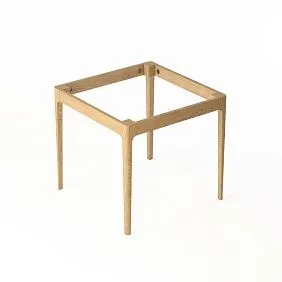
Support base — this is a ready-made frame consisting of supports, aprons, and braces, connected into a single structure. Using a support base significantly simplifies table manufacturing, ensures precise geometry, and guarantees strong joints. Instead of carving slots, fitting tenons, and assembling the frame from individual parts, you can simplyBuy a pedestaland attach the tabletop to it.
Support bases are available in various sizes, styles, and configurations. Classic support bases with turned supports are suitable for traditional interiors. Modern minimalist frames with straight lines are for minimalist spaces. Support bases can be painted, lacquered, or patinated, allowing you to choose a variant that matches any design.
Advantages of using a support base:
Precise geometry: all elements are manufactured on professional equipment, joints are assembled with high precision, eliminating misalignment and play.
Strength of joints: support-apron joints are made using the tenon-mortise technique with glue, ensuring maximum durability.
Time-saving: you do not need to manufacture and assemble the frame yourself — simply attach the tabletop.
Guaranteed quality: support bases are made from selected wood that has undergone drying and treatment, eliminating deformation.
Support bases are especially convenient for those who make custom tables with unique tabletops — from slabs, exotic solid wood, stone, or glass. Instead of designing a frame from scratch, you can choose a ready-made support base that matches the size and style, and focus on working with the tabletop.
must provide comfortable seating for users. Aprons should not interfere with feet, and the height of the support base should comply with the standard (72–75 cm from floor to top of apron). If braces are used, they should be positioned at a height convenient for footrests (25–30 cm from floor).
Base for Dining TablesIt must provide comfortable seating for people. The aprons should not interfere with legs, and the base height should correspond to the standard (72-75 cm from the floor to the top of the apron). If braces are used, they should be positioned at a height convenient for foot placement (25-30 cm from the floor).
How to attach the tabletop to the frame: accounting for wood expansion
After the frame is assembled, the question arises: how to attach the tabletop? It seems simple — just screw it to the aprons — and done. But this approach leads to problems, especially if the tabletop is wooden. Wood is a living material — it expands and contracts with changes in air humidity. Rigid attachment does not allow the tabletop to move, leading to cracks, warping, and detachment of fasteners.
Correct attachment of the tabletop to the frame must provide vertical fixation (tabletop does not detach from the frame), while allowing horizontal expansion (tabletop can slightly shift relative to the frame). There are several ways to achieve this:
Metal Z-shaped brackets are screwed into the tabletop on one side and into a groove on the inner side of the apron. The groove allows the bracket to slightly shift when the wood expands.
Wooden dowels with oval holes: the dowel is inserted into a groove on the apron, and a screw passes through an oval hole in the tabletop. When the wood expands, the screw can slightly shift within the hole.
Clamps (metal plates) are inserted into special grooves on the aprons and screwed to the tabletop. They allow the tabletop to expand longitudinally.
For stone and composite tabletops, such problems do not exist — these materials do not expand with humidity changes. Attachment is done rigidly, using epoxy glue, silicone sealant, or mechanical fasteners (screws, bolts). It is important to evenly distribute attachment points across the entire tabletop surface to avoid stress concentration.
Distance from the edge of the tabletop to the attachment point depends on the material. For wood — 50–70 mm (less distance may cause chipping during fastener installation). For MDF — 70–100 mm (material is more brittle at the edge). For stone — 100–150 mm (stone should not be loaded at the edge; all fasteners are placed closer to the center).
When additional reinforcements are needed
Not every table requires maximum strength. A light coffee table in the living room, where you place a cup of coffee and magazines, does not require strong supports and braces. However, there are situations where additional reinforcements are necessary:
Long tables (over 180 cm): require additional supports in the middle or reinforced cross braces to prevent tabletop sagging. The distance between supports must not exceed 100-120 cm.
Heavy tabletops: massive slabs or stone slabs create significant load on the frame. Require supports with increased cross-section, reinforced stringers, and additional cross braces.
High tables (bar counters, worktables over 90 cm): long supports are more susceptible to lateral loads. Diagonal or perimeter bracing is mandatory.
Commercial tables (cafes, restaurants, offices): intensive use, frequent movement, impacts require increased strength. Use reinforced connections, metal elements, and increased safety factor.
Tables with cantilevered sections (extending beyond supports): the cantilever creates an overturning moment. Requires increased base support, additional bracing, and ballast at the base.
Legs for countertopsMust be selected considering all these factors. Sometimes it is better to choose heavier supports rather than later reinforcing the structure with additional elements. Safety factor is never unnecessary — the table must serve for decades, and its operating conditions may change.
Examples of calculations for different types of tables
Let's consider several practical examples of calculating the support system for different types of tables. This will help understand how theory translates into specific solutions.
Dining table 160×80 cm, wooden tabletop 40 mm
Tabletop mass (oak, 40 mm): approximately 35 kg.
Frame mass: about 15 kg.
Useful load (dishes, food, 6 people resting elbows): 60 kg.
Total load: 110 kg.
Calculation: 110 kg / (4 supports - 1) × 1.5 = 55 kg per support.
Solution: four supports with 70×70 mm cross-section made of oak or beech, stringers 70×40 mm, mortise-and-tenon joints. Braces are not required, as height is standard (75 cm) and length is moderate. Tabletop attachment — Z-shaped brackets in mortises on stringers.
Workbench in workshop 200×100 cm, tabletop 50 mm
Tabletop mass (beech, 50 mm): about 60 kg.
Frame mass: about 25 kg.
Useful load (tools, vices, equipment): 100 kg.
Total load: 185 kg.
Calculation: 185 kg / (6 supports - 1) × 2 = 74 kg per support.
Solution: six supports with 80×80 mm cross-section, placed in pairs at 100 cm intervals. Stringers 80×50 mm, two longitudinal cross braces 80×50 mm in the middle. Perimeter brace at 20 cm height from floor. All joints are mortise-and-tenon with glue and additional bolt fastening. This structure will withstand not only static load but also impacts and vibrations from tool use.
Bar counter 120×40 cm, height 110 cm, tabletop 30 mm
Tabletop mass (MDF, 30 mm): about 12 kg.
Frame mass: about 10 kg.
Useful load (bottles, glasses, elbows of resting people): 30 kg.
Total load: 52 kg.
Calculation: 52 kg / (4 supports - 1) × 1.5 = 26 kg per support.
Solution: four supports with 60×60 mm cross-section, stringers 60×40 mm, X-shaped brace at 25 cm height from floor (convenient as a footrest). The counter height requires mandatory use of braces — without them, the structure will wobble. Tabletop attachment — rigid, via screws into stringers (MDF does not expand).
Coffee table 100×60 cm, glass tabletop 12 mm
Countertop mass (glass, 12 mm): about 18 kg.
Frame mass: about 5 kg.
Useful load (books, vases, decor): 10 kg.
Total load: 33 kg.
Calculation: 33 kg / (4 supports - 1) × 1.3 = 14 kg per support.
Solution: four light turned supports with 50 mm diameter, 50×30 mm aprons, without braces. The glass countertop is secured via rubber washers preventing direct contact between glass and wood. The construction is minimalist, visually light, yet strong enough for its purpose.Buy table legsDecorative, carved, or painted — here aesthetics matter more than maximum strength.
Errors in calculating supports and their consequences
Incorrect calculation of the support system leads to problems that do not manifest immediately but inevitably become apparent. Here are the most common errors:
Insufficient safety factor: calculation only for static load without accounting for dynamic factors (impacts, lateral forces, uneven weight distribution). Result — loosening of connections, frame deformation, failure of fasteners.
Excessive distance between supports: saving on the number of supports leads to countertop sagging, especially with thin materials. Sagging may not be noticeable immediately but intensifies over time, causing deformation and cracking of the countertop.
Absence of braces for tall tables: tall supports without diagonal reinforcement inevitably start to wobble. Support-apron joints cannot withstand lateral loads, connections loosen, and the table becomes unsafe to use.
Rigid attachment of wooden countertop: ignoring wood expansion leads to countertop cracks, fastener detachment, warping. Especially critical for wide solid wood countertops.
Use of supports with insufficient cross-section: thin supports may withstand vertical load but perform poorly under bending and torsion. Under lateral forces, they bend, making the table unstable.
Poor quality connections at support-apron joints: saving on technology (direct screwing instead of dowel joints) leads to rapid loosening. After several months of intensive use, the table begins to creak, wobble, and requires repair.
Each of these errors is avoidable, but it is much easier to consider all factors during the design phase. Using proven calculation methods, quality materials, and correct fastening technologies guarantees that the table will serve for decades without repair or reinforcement.
Choosing between manufacturing and buying ready-made supports
Should you manufacture the support system yourself or is it simpler to buy ready-made components? The answer depends on skills, equipment, design requirements, and project budget.
Self-manufacturing provides maximum design freedom. You can create supports of any shape, cross-section, with unique carving or decorative elements. However, this requires professional equipment (turning lathe for turned supports, router for cutting slots), experience working with wood, and understanding of joint technology. Manufacturing errors lead to weak connections, misalignment, and the need for rework.
Buying ready-made supports saves time, guarantees manufacturing quality, and offers a wide range of design choices. Modern manufacturers offer supports in various styles — from classic turned to contemporary geometric, from simple painted to carved with patina.buy furniture legs and supportsAvailable separately or as a set with aprons, which simplifies frame assembly.
Compromise option — using ready-made supports with self-manufactured frame. Purchase quality supports of the required cross-section and style, while aprons, braces, and transoms are manufactured individually to fit the specific table size. This is simpler than building the entire frame from scratch, yet offers more freedom than buying a ready-made base.
For commercial projects (custom furniture manufacturing, small-batch production), using ready-made supports and bases is practically mandatory. This ensures consistent quality, reduces manufacturing time, and allows offering clients a wide range of options.Furniture Support MoscowAvailable with delivery, simplifying logistics for furniture manufacturers.
Additional elements for strengthening the structure
In addition to basic elements (supports, aprons, braces), there are additional components that enhance the table’s strength and functionality:
Metal brackets and plates reinforce connection joints, especially when using soft wood species. Installed inside the frame, they are invisible from the outside.
Threaded inserts and triple nuts allow disassemblable attachment of supports to aprons. Convenient for tables that need to be transported or stored in disassembled form.
Adjustable supports (with threaded feet) compensate for floor unevenness and prevent table wobbling. Especially important for heavy tables with stone countertops.
Felt or rubber pads on the lower part of supports protect the floor from scratches, reduce noise when moving the table, and provide better grip on smooth surfaces.
Decorative inserts and carved elements (rosettes, moldings, trim) transform a functional structure into a piece of furniture art.— everything must correspond to the chosen era.Made from polyurethane, they can be used to decorate supports and aprons, creating a classical furniture style.
decorative rose outletsMade from solid wood, they are applied at connection points, hiding fasteners and adding elegance. They look especially effective in classical interiors, baroque, and empire styles.
FAQ: Answers to popular questions
How to calculate how many legs a table needs?
The minimum number of legs for stability is three, but for even load distribution, four are usually used. For long tables (over two meters), six or more legs are recommended. Calculation depends on table length, tabletop thickness, and expected load. General rule: the distance between legs should not exceed 120 cm, otherwise the tabletop may sag.
What cross-section of supports is needed for a dining table?
For a standard dining table with a wooden tabletop of 30-40 mm thickness, the minimum cross-section for square supports is 60×60 mm, and for round supports — diameter 60 mm. For heavier structures or intensive use, supports of 70×70 mm or 80×80 mm are used. Thinner supports are suitable only for light tables.
Are braces needed for a regular table?
For standard tables 75 cm high and up to 150 cm long, braces are not necessary if quality mortise-and-tenon joints are used. However, for tall tables (bar counters, work tables over 90 cm), long tables (over 180 cm), or tables with thin supports, braces are critically important for stability and to prevent rocking.
How to properly attach a wooden tabletop to the frame?
Wooden tabletops expand and contract with changes in humidity. Rigid attachment leads to cracks. The correct method is using Z-shaped brackets, wooden dowels with oval holes, or clamps that fix the tabletop vertically while allowing slight horizontal movement. For stone and composite tabletops, rigid attachment is used.
Can ready-made bases be used for non-standard tabletops?
Yes, ready-made bases are suitable for most tabletops if their dimensions match. Bases are manufactured in standard sizes, but the assortment is wide. For slabs, heavy stone slabs, or very wide tabletops, a reinforced base with additional crossbeams and increased-section supports may be required.
How to reinforce an old table that is starting to wobble?
Wobbling is most often caused by weakened connections between supports and aprons. You can disassemble the table, clean off old glue, re-glue the joints with wood glue, and clamp them until dry. Additionally, install metal brackets inside the frame. If the distance between supports is large, add diagonal or perimeter braces. Sometimes simply tightening the fasteners is enough.
Which material is better for supports — oak or beech?
Both materials are excellent for furniture supports. Oak is stronger, more moisture-resistant, has a pronounced grain, but is more expensive and harder to work with. Beech is slightly softer, but still very strong, easy to process, and cheaper. For most projects, beech is the optimal choice in terms of price-to-quality ratio. Oak is used for premium furniture where maximum durability and status are important.
Can a table be made without aprons, only on supports?
Theoretically, yes — if the tabletop is very thick and strong (at least 60 mm), and the supports are bolted or screwed directly to it. However, such a construction is less reliable — supports will rock, and the tabletop will gradually deteriorate at the attachment points. Aprons distribute the load, connect supports, and provide rigidity. Giving them up is justified only in minimalist designer tables with metal supports and small dimensions.
Which is better for a tall table — X-shaped or H-shaped brace?
An X-shaped brace is more effective in terms of rigidity — it forms a system of triangles, preventing support displacement in all directions. However, it is more complex to manufacture and requires precise fitting at the diagonal intersection. An H-shaped brace is simpler but less rigid, effective only against displacement in one plane. For bar counters and tall work tables, an X-shaped brace is better. For regular tables with a slight height increase, an H-shaped brace is sufficient.
How to account for the weight of appliances when calculating a kitchen table?
The weight of built-in appliances (cooktop, oven, dishwasher) is added to the useful load. For example, a dishwasher weighs 30-40 kg, an oven — 25-35 kg. If they are installed under the tabletop, the supports must account for this additional weight. Often, in such cases, the cross-section of supports is increased or additional supports are added at the appliance installation points.
Conclusion: STAVROS — supports and components for ideal tables
Correct calculation of load on table supports, proper design of support-apron joints, use of diagonal braces and crossbeams, and consideration of tabletop thickness — all this transforms a set of wooden elements into a strong, stable, long-lasting structure. Knowledge of engineering principles, calculation formulas, and material characteristics allows creating furniture that serves for decades without repair or reinforcement.
and much more for creating exclusive furniture and interior solutions. Delivery to Moscow, St. Petersburg, and throughout Russia makes STAVROS products accessible to professional furniture makers and private craftsmen.Furniture legs, Aprons, balusters for staircases, Wooden cornices, Brackets, Outletsand much more for creating exclusive furniture and interior solutions. Delivery throughout Moscow, Saint Petersburg, and all of Russia makes STAVROS products accessible to professional furniture makers and private craftsmen.