Article Contents:
- Fireplace as a stage center: the psychology of space
- The hearth archetype: why the fireplace attracts
- Symmetry as the law of the fireplace zone
- Molded portal: framing the fire
- Pilasters: vertical axes of the portal
- Mantelpiece: horizontal dominant
- Frieze: decorative insert between pilasters
- Corbels: mantelpiece support
- Furniture group: theater of fire contemplation
- Armchairs: front row by the hearth
- Console table: elegance by the wall
- Coffee table: center of gravity
- The role of furniture handles: a detail that creates connection
- Walls around the fireplace: creating context
- Molding panels: symmetrical frames
- Pilasters in room corners: architectural framing
- Decorative overlays: point accents
- Composition completion: baseboards, cornices, color
- Wooden baseboard: warm base
- Ceiling cornice: completing the vertical
- Color scheme: warm and cool
- Practical solutions: dimensions, budgets, installation
- Material calculation for the fireplace zone
- Installation: work sequence
- Mistakes to Avoid
- Frequently Asked Questions
- Conclusion: create the heart of the home

The fireplace has long ceased to be just a source of heat. In a modern home, it has become a symbol of coziness, a focal point for gazes, an architectural dominant in the living room. But by itself, a cast iron or steel hearth, built into the wall or standing separately, is merely a functional appliance—a cold iron box with tongues of flame. The magic begins when a composition is built around the fireplace: a molded portal frames the fire, pilasters create vertical axes, classic furniture forms a cozy group for flame contemplation, and wall moldings connect the fireplace with the rest of the space.Buy polyurethane molding for the fireplace— means transforming a technical appliance into a work of art, and the fireplace zone into the heart of the home, a place where all household members are drawn on cold winter evenings. In this article, we will detail how to create a full composition around the fireplace using polyurethane molding, classic furniture, and wooden accents, turning a simple hearth into an interior focal point that delights the eye and warms the soul.
Fireplace as a stage center: the psychology of space




The hearth archetype: why the fireplace attracts
The attraction to fire is ingrained in humans at an instinctual level. For hundreds of thousands of years, fire meant warmth, protection from predators, cooked food, and a gathering place for the tribe. Even in the 21st century, when heating is provided by radiators and underfloor heating, the living fire of a fireplace evokes a primal sense of safety, comfort, and unity. A fireplace gathers the family around it, just as a campfire gathered ancient people.
The psychology of interior perception is built on hierarchy: there is a dominant element (the main feature that catches the eye upon entering a room) and secondary elements. A fireplace is the natural focal point of a living room. Upon entering a room, a person instinctively seeks a source of light and warmth with their eyes. If the fireplace is well-designed (with a molded portal, symmetrical furniture, decor around it), it holds attention, creates a compositional center around which the rest of the space is arranged.
A fireplace without a surround is a hole in the wall with a black firebox, which detracts from the interior rather than enhances it. A fireplace with a molded portal is an architectural object, a small temple of fire, perceived as a work of art. The difference is colossal and is achieved by adding 4-6 elements of molding (two pilasters, a mantel shelf, possibly a frieze and appliqués) with a total cost of 40,000-120,000 rubles depending on size and complexity.
Our factory also produces:


Symmetry as the law of the fireplace zone
A fireplace is inherently symmetrical: the firebox is in the center, the left and right sides are mirror images. This symmetry demands continuation in the decor. If there is an armchair to the left of the fireplace, a similar one should be placed to the right. If a decorative element hangs on the wall to the right, an identical one should be on the left. Asymmetry around a symmetrical fireplace creates visual dissonance, a feeling of incompleteness, randomness.
A molded portal enhances symmetry: two pilasters or columns on the sides of the firebox, a mantel shelf above the firebox, possibly a ceiling rosette above the fireplace—all this creates a vertical axis of symmetry that organizes the space. Furniture is arranged symmetrically relative to this axis: two armchairs on either side of the fireplace, a sofa opposite, a console table precisely centered opposite the fireplace or behind the sofa. Symmetry creates calm, stability, classical harmony.
Get Consultation
Molded portal: framing the fire
Pilasters: the vertical axes of the portal
Pilasters are flat columns that protrude 30-70 mm from the plane of the wall or fireplace portal, creating vertical articulation. Two pilasters are installed on either side of the fireplace firebox, framing the fire, creating the impression that the firebox is within a classical portal, like a temple door framed by columns.
The structure of a pilaster consists of three parts: the base (the lower part, 15-30 cm high, usually square or rectangular in cross-section, with simple relief), the shaft (the middle part, the main height of the pilaster from the base to the capital, smooth or with vertical flutes—grooves), the capital (the upper part, 15-35 cm high, the most decorative, with ornamentation). The total height of the pilaster equals the height of the fireplace portal from the floor to the mantel shelf: typically 100-150 cm for standard fireplaces.
The style of the capitals defines the character of the portal. A Doric capital (simple, in the form of a square slab on a circular cushion) suits strict classical interiors, minimalist portals. An Ionic capital (with volutes—spiral scrolls on the sides) suits elegant neoclassical interiors, balanced portals with moderate decorative richness. A Corinthian capital (lush, with acanthus leaves, roses, complex multi-tiered ornamentation) suits luxurious classical interiors, richly decorated portals.
The material for fireplace pilasters is polyurethane. Polyurethane pilasters are 10-15 times lighter than wooden ones, 3-5 times cheaper, moisture-resistant (not afraid of temperature and humidity fluctuations near the fireplace), and easy to install (glued with mounting adhesive in an hour). After painting, they are visually indistinguishable from plaster or wooden ones. The color is usually white (a classic solution, a white portal against a colored wall or brickwork) or marble-like (painted with imitation marble veining—luxurious, monumental).
Mantel shelf: the horizontal dominant
The mantel shelf is a horizontal element installed above the firebox at a height of 100-130 cm from the floor, crowning the pilasters and creating the upper boundary of the portal. The shelf serves practical functions (clocks, candlesticks, photographs, decorative objects are placed on it) and aesthetic ones (completes the portal, creates a horizontal line that balances the verticals of the pilasters).
Shelf dimensions: length 15-30 cm greater than the firebox width (if the firebox is 80 cm wide, the shelf is 95-110 cm), depth (projection from the wall) 15-30 cm, thickness 8-15 cm. The shelf profile can be simple (a rectangular slab with a single rounded front edge) or complex (a multi-stepped profile with cavettos, beads, dentils along the lower edge).
Mantel shelf material: polyurethane (lightweight, inexpensive, easy to install, supports decorative items weighing up to 15-20 kg), wood (solid oak, ash—heavy, durable, natural, supports any weight, but 4-7 times more expensive than polyurethane), artificial stone or marble (monumental, cold, expensive, requires powerful mounting). For most projects, polyurethane is optimal—a balance of aesthetics, practicality, and budget.
Shelf mounting: to the wall with anchor bolts or dowels, hidden under the shelf. The shelf must support the weight of the decor plus a safety margin (accidental leaning with a hand, children's play). For a 1-meter polyurethane shelf, three to four mounting points are sufficient. For a 1.5-meter wooden shelf—five to six points.
Frieze: a decorative insert between pilasters
A frieze is a horizontal decorative element placed between pilasters under the mantel shelf or above the firebox, creating an additional layer of decor. Frieze width is 10-20 cm, length equals the distance between the inner edges of the pilasters (if pilasters are 90 cm apart, the frieze is 90 cm long).
Frieze ornament is classical: meander (a continuous broken line forming a pattern of right angles), acanthus leaves (stylized leaves of the Mediterranean acanthus plant, a symbol of classical architecture), garlands (floral or laurel wreaths), dentils (small rectangular teeth arranged rhythmically). For strict portals, choose meander or dentils (geometrically correct, restrained). For luxurious portals—acanthus leaves or garlands (lush, decorative).
The frieze is attached to the wall or to the back plane of the portal (if the portal is assembled as a separate structure) with mounting adhesive. After installation, the frieze is painted the same color as the pilasters and shelf, or in a contrasting color (a gold frieze on a white portal—luxury, an accent).
Corbels: support for the mantel shelf
Corbels (brackets) are decorative elements that visually support the mantel shelf, creating the illusion that the shelf rests not on hidden anchors but on these beautiful carved supports. Two corbels are installed at the edges of the shelf (left and right) or on the sides of the firebox under the shelf.
Corbel shape: a curved S-shaped plank with carved ornamentation (leaves, scrolls, volutes) or a geometric stepped shape (for Art Deco, modern classicism). Corbel height is 20-40 cm, depth (projection) 12-25 cm. Polyurethane corbels are glued to the wall under the shelf, creating three-dimensional relief, play of light and shadow.
Corbel color either matches the portal tone (white corbels on a white portal—unity) or is contrasting (dark corbels on a light portal or gold corbels—an accent, emphasizing the structural logic).
Furniture grouping: the theater of fire contemplation
Armchairs: the front row by the fire
Classic FurnitureThe furniture arrangement in the fireplace zone begins with armchairs. Two armchairs, placed symmetrically on either side of the fireplace at a 30-45° angle to the firebox, create seats for contemplating the fire, reading, leisurely conversations. The armchairs should be comfortable (deep seat 55-65 cm, backrest with a 105-110° incline, armrests 60-70 cm high) and beautiful (classical shapes, quality upholstery, carved wooden elements).
The style of armchairs for the fireplace zone is classic with softness. Frame made of solid oak, beech, ash with carved legs (cabriole—a curved leg, widening at the top), carved armrests (scrolls, plant motifs), possibly a carved backrest. Upholstery is dense, noble: velvet (tactilely soft, visually luxurious, deep saturated colors—burgundy, emerald, sapphire), jacquard (durable, with classic patterns—damask, monograms), genuine leather (for masculine interiors, studies with a fireplace—cognac, dark brown leather, aged, with patina).
The color of the armchair upholstery is coordinated with the overall palette of the fireplace zone. If the walls are dark (deep blue, green, gray), the upholstery is light (cream, beige, light gray)—contrast, the armchairs stand out. If the walls are light, the upholstery can be dark or bright (burgundy, emerald against white or cream walls)—the armchairs become color accents.
The distance from the armchair to the fireplace is 1.5-2.5 meters — close enough to feel the warmth and see the play of flames, but far enough to avoid excessive heat and ensure safety (sparks won't reach). Armchairs are placed not strictly parallel to the wall with the fireplace, but at an angle to each other (forming a V-shaped composition open towards the fireplace), which creates a cozy, intimate grouping.
Console Table: Elegance by the Wall
A console table is a narrow (depth 30-50 cm), tall (height 75-85 cm) table placed against the wall opposite the fireplace or to the side of the fireplace area. The console serves a decorative function (displaying lamps, vases, photographs, books) and a compositional one (fills the space against the wall, creates symmetry if there are two consoles — one on each side of the fireplace).
The console style is classic: a tabletop made of solid wood or marble, legs are carved or turned (cabriole, balusters, straight with carved bands), possibly with an apron (horizontal rail between legs) featuring carving or a frieze. The console's finish is coordinated with the finish of the armchairs and other furniture: if the armchairs have dark oak armrests, the console is also made of dark oak. If the armchairs are made of whitewashed oak, the console is light.
Console placement: if the fireplace area is in the center of a long living room wall, the console is placed against the opposite wall, creating a compositional axis (fireplace — coffee table — sofa — console). If the fireplace area is shifted towards a corner, the console can stand to the side of the fireplace, balancing the composition (an armchair to the left of the fireplace, a console to the right — asymmetry, but balanced in visual weight).
Coffee Table: The Center of Gravity
The coffee table is placed between the fireplace and the sofa (or between the fireplace and armchairs), at a distance of 40-60 cm from the seating. The table serves for placing cups, books, remotes, decorative objects. Height is 40-50 cm (for convenient placement and retrieval of items while seated in an armchair), tabletop size is 80×120 cm, 100×150 cm depending on the size of the fireplace area.
The style of the coffee table for the fireplace area is classic with possible variations. Classic option: tabletop made of solid wood (oak, walnut) with a shaped edge or inlay, carved or turned legs, possibly a lower shelf for magazines. Neoclassical option: glass tabletop (clear or tinted), metal frame (bronze, brass with patina) or wooden frame with a simple profile. Modern classic: marble tabletop (white, gray, black marble), geometric base (metal or wooden beams forming a laconic structure).
The tabletop material determines practicality. Wood is warm, pleasant, but requires care (a hot cup leaves a mark). Glass is cold but practical (easy to clean, not afraid of moisture and temperature). Marble is luxurious, cold, heavy, practical (not afraid of water, but sensitive to acids — red wine, lemon juice leave stains).
The Role of Furniture Handles: A Detail That Creates Connection
Furniture HandlesHandles on consoles, chests of drawers, sideboards in the fireplace area are not just functional elements for opening drawers and doors. They are decorative accents that either enhance the impression of the furniture or ruin it. A console made of oak with bronze carved handles looks like an antique. The same console with plastic handles looks like a fake.
For a fireplace area in a classic style, bronze or brass handles with patina (an antique effect, darkening, oxidation of the metal), with ornamentation (floral motifs, volutes, geometric patterns) are suitable. Handle size is medium or large: knobs with a diameter of 35-50 mm for small drawers, pulls 100-150 mm long for doors and large drawers. Small handles 20-30 mm get lost against the background of massive classic furniture.
The color of the handles is coordinated with the metal hardware of the fireplace (if there are bronze candlesticks on the mantel, the furniture handles are also bronze — unity) or with the color of decorative elements (if the portal's stucco has golden patination, the furniture handles also have a golden hue).
Walls Around the Fireplace: Creating Context
Molding Panels: Symmetrical Frames
Moldings made of polyurethaneMoldings on the walls around the fireplace create decorative panels — rectangular frames that structure the space, add volume, and connect the fireplace with the rest of the interior. The layout of the moldings is symmetrical relative to the vertical axis of the fireplace: two-three panels to the left of the fireplace, the same mirrored on the right.
Panel size depends on wall height and style. For classic interiors with wall heights of 2.8-3.2 meters, vertical panels 80×150 cm, 100×180 cm are suitable, arranged in one tier from a level of 30-50 cm from the floor to a level of 200-230 cm. For neoclassical styles with wall heights of 2.7-2.9 meters, panels 70×130 cm, 80×150 cm are suitable.
Molding width for panels is 50-80 mm, profile is classic (cavetto, torus) or simplified (rectangular cross-section with one rounded edge). Molding color is white (a universal solution, moldings lighter than the walls, stand out) or matches the wall color (moldings blend in, visible due to relief and shadows — a restrained solution).
Molding panels on the wall with the fireplace create a frame around the portal. The fireplace portal is positioned in the center, molding panels are installed on either side at equal distances — resulting in a symmetrical composition where the fireplace is the central element, the panels are the side elements, all connected by a unified rhythm and style.
Pilasters in Room Corners: Architectural Framing
If the fireplace area occupies an entire wall, full-height pilasters (from floor to ceiling, 2.5-3.0 meters) are installed in the room corners (where the wall with the fireplace meets the side walls). Pilasters create an architectural frame for the entire wall, define the boundaries of the composition, enhance the impression of solidity, as if the fireplace wall is the facade of a classic building with columns.
Pilasters in the corners should be similar in style to the pilasters of the fireplace portal (if the portal has Corinthian capitals, the corner pilasters also have Corinthian capitals), but can be larger (if the portal pilasters are 10 cm wide, corner pilasters are 12-15 cm wide). The color is the same — white or matching the tone of the portal's stucco.
Decorative Appliques: Point Accents
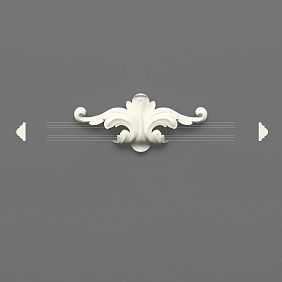
Decorative appliques (cartouches, rosettes, ornamental inserts) sized 20×30 cm, 30×40 cm are installed in the centers of molding panels or above the fireplace (if the space between the top of the portal and the ceiling is 50+ cm). Appliques add decorative richness, enhance the classic character of the interior, create points that the eye notices after examining the fireplace and furniture.
The ornament of the appliques is coordinated with the ornament of the portal capitals and frieze: if the capitals have acanthus leaves, the appliques also have floral ornamentation. If the capitals are simple geometric, the appliques have geometric motifs (concentric circles, rays, stepped forms).
The color of the appliques either matches the tone of the stucco (white on white, visible due to relief) or is contrasting (gold or silver appliques on white stucco — luxury, accent).
Completing the Composition: Baseboards, Cornices, Color
Wooden Baseboard: A Warm Base
Wooden baseboardThe baseboard in the fireplace area is not only a functional element covering the joint between the floor and wall, but also a compositional base that connects the fireplace, furniture, and walls into a unified system. A tall baseboard 120-160 mm made of solid oak or ash, stained in noble shades (walnut, fumed oak, natural oak with oil), creates a warm wooden frame at the bottom, which contrasts with the cold white stucco at the top.
The baseboard profile is classic: cavetto (concave part, transition from the vertical plane of the baseboard to the floor), torus (convex part in the middle zone), straight vertical plane. A complex profile creates play of light and shadow, visual richness, and consistency with the profile of the moldings and cornices.
The baseboard in the fireplace area can wrap around the projection of the portal (if the portal protrudes from the wall by 10-15 cm), creating a plinth for the fireplace. The baseboard is cut at an angle, wraps around the projection, and continues along the walls. Effect: the fireplace stands on a plinth, like a sculpture on a pedestal, which enhances its significance.
Ceiling cornice: completion of verticality
A polyurethane ceiling cornice, 120-150 mm wide with a classic profile (cavetto, torus, possibly dentils), is installed around the perimeter of the fireplace area (along the entire wall with the fireplace or along the entire room perimeter). The cornice completes the vertical composition from above, creates a transition from the wall to the ceiling, and connects the stucco of the portal with the wall stucco.
If a ceiling rosette (a decorative circle with a diameter of 60-100 cm, framing a chandelier or light fixture) is installed on the ceiling above the fireplace, the cornice wraps around the rosette, creating a frame for the ceiling composition. The rosette becomes a vertical extension of the fireplace: the portal at the bottom, the rosette at the top, all on the same axis — classic symmetry.
The cornice color is white (a classic solution, the cornice is lighter than the walls and ceiling) or matches the tone of the moldings and portal (if all the stucco is cream, the cornice is cream — color unity).
Color scheme: warm and cool
A classic color scheme for the fireplace area: warm elements (wood — baseboards, chair legs, consoles, coffee table) + cool elements (white stucco — portal, moldings, cornice) + neutral background (walls in beige, gray-beige, cream). The contrast of warm and cool creates visual richness, depth, and balance.
An alternative scheme is monochromatic: everything light (white stucco, light walls in cream or beige, light wood like whitewashed oak or ash, chair upholstery in light gray or cream). Effect: lightness, airiness, Scandinavian elegance. Suitable for small living rooms of 18-25 m², where dark colors would create a cramped feel.
A luxurious scheme is contrasting: dark walls (deep blue, emerald, graphite), white or gold stucco, dark wood (walnut, wenge, stained oak), chair upholstery in burgundy, emerald, sapphire. Effect: drama, depth, luxury, intimacy. Suitable for spacious living rooms of 30-50 m² with high ceilings of 3.0+ meters.
Practical solutions: dimensions, budgets, installation
Material calculation for the fireplace area
Example: living room 25 m² (5×5 meters), ceiling height 2.8 meters. Electric fireplace, built into the wall, firebox size 70×50 cm. Budget for decorating the fireplace area: 320,000 rubles.
Stucco portal:
-
Two polyurethane pilasters, height 120 cm, width 12 cm, Corinthian capitals: 2 × 8,500 rub = 17,000 rub
-
Polyurethane fireplace mantel, length 110 cm, projection 25 cm, complex profile: 12,000 rub
-
Frieze with acanthus leaves, length 80 cm: 4,500 rub
-
Two console brackets for the mantel: 2 × 3,200 rub = 6,400 rub
-
Total portal: 39,900 rub materials, installation 8,000 rub
Molding panels on the wall:
-
Four panels 80×140 cm (two to the left of the fireplace, two to the right): perimeter of one panel (80+140+80+140) = 440 cm = 4.4 meters. Four panels = 17.6 meters of molding 70 mm × 700 rub/m = 12,320 rub
-
Corner overlays for panels 16 pcs × 850 rub = 13,600 rub
-
Total panels: 25,920 rub materials, installation 14,000 rub
Ceiling cornice:
-
Room perimeter 20 meters, cornice 130 mm: 20 × 850 rub/m = 17,000 rub materials, installation 12,000 rub
Baseboards:
-
Room perimeter 20 meters, oak baseboard 140 mm: 20 × 1,400 rub/m = 28,000 rub materials, installation 7,000 rub
Furniture:
-
Two classic armchairs with carved armrests, velvet upholstery: 2 × 68,000 rub = 136,000 rub
-
Console table, oak, length 100 cm: 42,000 rub
-
Coffee table, oak top 100×70 cm: 38,000 rub
Total: stucco and baseboards 110,820 rub materials + 41,000 rub installation = 151,820 rub. Furniture 216,000 rub. Total 367,820 rub (overrun 47,820 rub). Adjustment: choosing simplified console brackets instead of carved ones saves 3,000 rub, using a 110 mm cornice instead of 130 mm saves 4,000 rub, choosing more budget-friendly armchairs saves 20,000 rub. Total 340,820 rub (acceptable).
Installation: work sequence
Day 1-2: Wall preparation. Leveling the wall around the fireplace (plaster or drywall), priming, base painting (if the wall is colored). If the fireplace is already installed, protect the firebox with film from construction dust.
Day 3: Installation of portal pilasters. Marking the position of pilasters (strictly vertical, symmetrical relative to the fireplace). Gluing pilasters with mounting adhesive. Setting time 2-4 hours, during which pilasters are supported by temporary props.
Day 4: Installation of the mantel shelf and frieze. The shelf is attached to the wall with anchors or dowels (hidden under the shelf), additionally glued. The frieze is glued between the pilasters under the shelf. Corbels are glued under the edges of the shelf.
Day 5-6: Installation of molding panels. Marking the position of panels on the walls, gluing moldings around the perimeter of the panels, cutting corners at 45°, sealing joints with sealant.
Day 7: Installation of cornice and baseboards. The cornice is glued around the perimeter of the room. Baseboards are attached to the floor and wall. Corners are cut, joints are sealed.
Day 8-9: Painting. Priming all stucco elements, two-coat painting (interior acrylic paint). Baseboards are either not painted (if natural oak, factory-coated with oil), or stained and varnished.
Day 10: Furniture arrangement. Armchairs, console, coffee table are arranged symmetrically. Decorating the mantel shelf (clock, candlesticks, photographs).
Total time for installation and finishing of the fireplace zone: 10-12 days with a crew of 2 people.
Mistakes to avoid
Disproportion of the portal and the fireplace. If the fireplace is 60 cm wide, and the pilasters are spaced 120 cm apart, the portal is too wide and looks empty. Optimal: pilasters 10-15 cm wider than the fireplace on each side (fireplace 60 cm, pilasters spaced 80-90 cm apart).
Low mantel shelf. If the shelf is installed at a height of 80 cm from the floor, it visually presses down, seems squat. Optimal height 110-130 cm — shelf at chest level of a standing person, creates correct proportions.
Asymmetry of furniture. If there is an armchair to the left of the fireplace, and empty space or a floor lamp to the right — symmetry is broken, the fireplace loses its centrality. Symmetry is mandatory: two armchairs, two consoles, two lamps — everything in pairs.
Overloading with decor. If the portal is lavish (Corinthian capitals, carved frieze, corbels), walls are covered with numerous molding panels, furniture is also carved — visual chaos results. Balance: if the portal is lavish, walls should be restrained (one or two panels on the sides). If the portal is minimalist, walls can be more decorated.
Frequently asked questions
Can polyurethane stucco be installed next to a real wood-burning fireplace?
Yes, if fire safety distances are observed. Polyurethane is combustible (class G1 — low combustible or G2 — moderately combustible), but with proper installation it does not pose a danger. Pilasters and the mantel shelf must be spaced at least 30 cm from the fireplace on the sides and 40 cm above (from the top edge of the firebox to the bottom of the shelf). At these distances, the surface temperature of the stucco does not exceed 50-60°C, which is safe for polyurethane (begins to soften at 110°C). For electric and bio-ethanol fireplaces there are no restrictions — they do not produce high temperatures.
How much does a ready-made polyurethane portal cost?
A ready-made portal (two pilasters + mantel shelf + frieze, assembled into a single structure) costs 45,000-95,000 rubles depending on size and style. Portal width 100 cm, height 110 cm, neoclassical style (simple capitals, smooth frieze) — 45,000-60,000 rub. Portal width 130 cm, height 130 cm, classical style (Corinthian capitals, carved frieze) — 70,000-95,000 rub. Buying a ready-made portal saves time (installation in 1 day), but limits size choice (standard sizes for typical fireplaces).
What furniture is suitable for a fireplace zone in a modern style?
For a modern fireplace zone (minimalist fireplace without a stucco portal or with a minimalist portal made of smooth panels), modern classic furniture is suitable: armchairs with simple lines (straight legs, minimal carving), upholstery solid-colored (gray, beige, black leather), geometric coffee table (glass top on a metal frame), laconic console (rectangular top on straight legs). Stucco is minimal: smooth ceiling cornice, rectangular molding strips on the walls. Baseboards with a rectangular profile 80-100 mm.
Is a ceiling rosette needed above the fireplace?
Not mandatory, but desirable for classic interiors. A rosette with a diameter of 70-100 cm above the fireplace creates a vertical axis of symmetry (portal below, rosette above), frames a chandelier or light fixture, adds decorative richness to the ceiling. For neoclassical and modern interiors, a rosette is not necessary — a cornice around the perimeter is sufficient.
Can a fireplace portal be made of wood instead of polyurethane?
Yes, but more expensive and complex. A wooden portal made of solid oak (two pilasters with capitals, mantel shelf) costs 150,000-280,000 rubles (3-5 times more expensive than polyurethane). Wood is heavy (portal weighs 40-80 kg), requires powerful fastening. Advantage of wood — naturalness, tactile warmth, possibility of deep carving. Advantage of polyurethane — lightness, moisture resistance, ease of installation, budget. For most projects, polyurethane is optimal.
How to care for a stucco portal?
Polyurethane portal is wiped with a damp cloth once a month (dust accumulates in the relief of capitals and frieze). If the portal is painted with matte paint, wet cleaning with a mild detergent is possible. If the portal has a gold patina, cleaning is only dry (cloth or vacuum with a soft brush attachment) to avoid rubbing off the patina. The mantel shelf, on which items stand, is wiped more often — once a week. No complex care is required.
Conclusion: Create the heart of the home
A fireplace without decoration is a functional appliance that heats but does not inspire. A fireplace with a stucco portal, surrounded by classic furniture, framed by moldings on the walls, completed with a cornice on the ceiling and a wooden baseboard at the bottom — this is an architectural work, the heart of the home, a place where the family gathers, where leisurely conversations are held, where coziness and warmth reign.
Polyurethane stucco for the fireplace makes it possible to create portals of any complexity and style for reasonable money and reasonable timeframes. Polyurethane is 6-8 times lighter than plaster, 4-7 times cheaper than wood, moisture-resistant, easy to install, and after painting is visually indistinguishable from noble materials. A wide assortment (pilasters of all orders, mantel shelves of all sizes, friezes of all ornaments) allows creating unique portals for any fireplace and any interior style.
Classic furniture in the fireplace zone is not the luxury of aristocrats, but an accessible way to create a cozy group for contemplating the fire. Two armchairs with carved armrests and velvet upholstery, a console table made of solid oak, a coffee table with a marble top — these items turn the fireplace zone into a theater where the main actor is the fire, and the audience are people sitting in comfortable armchairs with cups of hot tea.
Moldings on the walls, cornice on the ceiling, wooden baseboard at the bottom — these elements create the context into which the fireplace fits. The fireplace ceases to be a standalone object, becomes part of an architectural composition where everything is connected — the stucco of the portal rhymes with the wall moldings, the wooden legs of the armchairs rhyme with the wooden baseboard, the bronze furniture handles rhyme with the bronze candlesticks on the mantel shelf.
The cost of fully decorating a fireplace zone in a 25 m² living room is 250,000-450,000 rubles (stucco portal + wall moldings + cornice + baseboards + furniture). This is 12-20% of the cost of renovating the living room, but it is precisely these percentages that create the difference between an ordinary room with a fireplace and a fireplace zone that becomes the heart of the home.
Company STAVROS offers a full range of materials and services for decorating fireplace zones. Polyurethane stucco for fireplaces — over 150 specialized elements — pilasters of all orders (Doric, Ionic, Corinthian) with heights from 80 to 250 cm, mantel shelves with lengths from 80 to 200 cm with various profiles, friezes with classic ornaments (acanthus, meander, garlands), corbels and brackets for supporting shelves, decorative overlays for enriching the portal.
Ready-made fireplace portals over 40 models in different styles and sizes. Neoclassical portals with simplified decor for modern interiors. Classical portals with lush capitals and carved friezes for traditional living rooms. Art Deco portals with geometric ornaments for eclectic spaces. All portals are made of high-quality polyurethane, ready for painting, installed in 1 day.
Custom portal design for non-standard fireplace dimensions. If you have a fireplace 95 cm wide or 65 cm high (non-standard sizes), STAVROS will develop a portal for specific parameters, manufacture the elements, and install. 3D visualization before production allows you to see the result and make adjustments.
Classical solid wood furniture for fireplace areas — armchairs with carved elements and high-quality upholstery (velvet, jacquard, genuine leather), console tables made of oak, ash with carved legs and shaped tops, coffee tables with wooden or marble tops. Furniture is produced by European factories or custom-made to individual sizes.
Wooden and bronze furniture handles for classical furniture — carved knobs, brackets with ornaments, rings on decorative rosettes. Over 200 models in different styles and sizes. Patination, gilding, artificial aging to create an antique luxury effect.
Moldings, cornices, baseboards for finishing the fireplace area — polyurethane moldings of all widths and profiles for creating wall panels, ceiling cornices for framing above, wooden baseboards made of solid oak, ash for a warm base below.
STAVROS design studio develops fireplace area design projects with 3D visualization. You see how the portal, furniture, moldings, and cornices work together in a unified space. Selection of compatible elements by style, proportions, color. Material calculation, estimate preparation, furniture arrangement recommendations.
When ordering a fireplace area kit (portal + moldings + cornice + baseboards + furniture) for an amount from 180,000 rubles, STAVROS provides a 10% discount on decorative elements (moldings, baseboards). For orders from 350,000 rubles — a 12% discount plus free delivery to Moscow and Moscow Region, St. Petersburg and Leningrad Region. Savings of 20,000-45,000 rubles.
STAVROS installation teams — specialists in installing fireplace portals and decorative elements. Portal installation with precise alignment, fastening, joint sealing in 1 day. Installation of moldings, cornices, baseboards with corner cutting, finishing. Painting all elements in the chosen color. Work in Moscow, St. Petersburg, travel to regions, 3-year warranty.
Choosing STAVROS, you get a partner in creating a fireplace area that becomes the heart of the home. Where the fireplace is not just an appliance, but an architectural work. Where furniture creates coziness and comfort. Where moldings, cornices tie everything into a unified composition. Create spaces that warm not only the body but also the soul. With STAVROS, it's real, beautiful, for decades.