Article Contents:
- Table height: ergonomics by formula
- Standard and its limitations
- Relation to chair height
- Types of tables: different standards
- Calculating leg length
- Leg cross-section: strength under load
- Load calculation: what legs carry
- Cross-section depending on material
- Leg length and resistance to bending
- Precision profiles: accounting for tapers
- Structure stiffness: aprons and base
- Aprons: foundation of stability
- Apron band: height and ergonomics
- Apron braces: additional stiffness
- Corner reinforcements: concentration of strength
- Dampers: vibration damping
- Materials: thickness of solid wood and properties
- Oak: Classic Strength
- Oak: elegant reliability
- Ash: elastic viscosity
- Solid wood thickness: solid or glued
- Types of tables: calculation specifics
- Classic dining table
- Kitchen table: work surface
- Work table: for computer and writing
- Foldable table: compromise of functions
- Practical calculation examples
- Example 1: Dining table for a family of four
- Example 2: Kitchen table for cooking
- Example 3: High-height desk
- Conclusion: Engineering in Simplicity
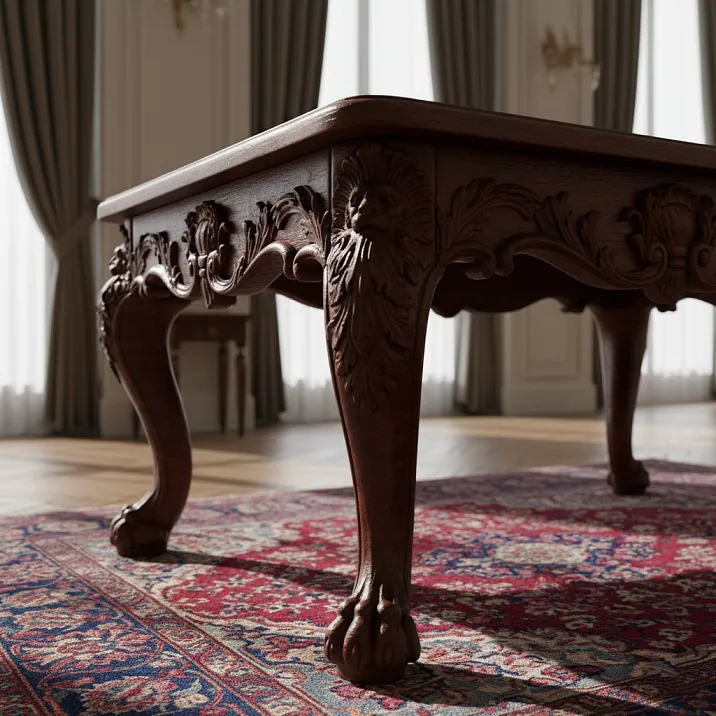
Table. The most familiar piece of furniture. Dining, work, kitchen — a significant part of life passes behind it. We eat, work, communicate, create. And rarely think about what holds this horizontal surface, makes it stable, reliable, comfortable. It’s the legs — four verticals on which everything else rests. Their height determines ergonomics, seating comfort, spine health. Their cross-section — strength, ability to withstand load. Their connection via aprons — rigidity, absence of wobbling and vibration.
Incorrectly calculatedLegs for tablescreate problems. Too high a table — hands hang in the air, shoulders tense, after an hour of work neck begins to ache. Too low — one has to hunch over, bend the back, the lumbar spine tires within half an hour. Insufficient cross-section — legs bend under weight, the table vibrates with every movement, standing on it with a hot pot is dangerous. Weak apron system — the table wobbles, creaks, requires repair after a year.
This article is a guide to calculating table legs. Not abstract theory, but practical knowledge that allows you to create or order a table that will serve for decades. We will examine formulas for calculating height based on specific height. We will learn how to determine the required cross-section based on load and material. We will understand how the apron system is constructed and why aprons are critical for rigidity. We will learn the characteristics of different types of tables — kitchen, dining, work tables. Because correct calculation is not complex engineering, but understanding simple patterns verified by centuries of carpentry practice.
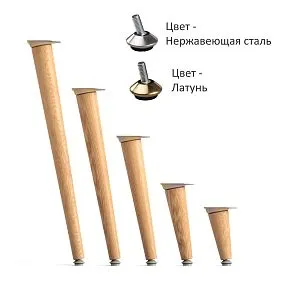

Table height: ergonomics by formula
Table top height from the floor — not an arbitrary value. It is the result of studying human biomechanics, searching for the optimum between comfort and functionality.




Standard and its limitations
GOST 13025.3-85 regulates the height of dining tables — 710-780 millimeters, the most common value being 750 millimeters. Where does this number come from? From the anatomy of an average person with a height of 165-170 centimeters. At this table height and standard chair height of 450 millimeters, the distance from the seat to the tabletop is 300 millimeters — optimal for placing legs and arms.
But average height changes. Modern people are taller than half a century ago when GOST was developed. Men on average 178 centimeters, women 165. For tall people, standard 750 millimeters are too low — one has to lean forward, hunch over. For short people — too high, hands hang uncomfortably, shoulders tense.
Individual calculation provides accuracy. The formula is simple: table height = height × 75 / 165. For a person 180 centimeters tall: 180 × 75 / 165 = 81.8 centimeters. For a height of 160 centimeters: 160 × 75 / 165 = 72.7 centimeters. Round to the nearest convenient value — 82 and 73 centimeters respectively.
Alternative formula — table height = height × 0.46 for seated work. At a height of 170 centimeters: 170 × 0.46 = 78.2 centimeters. Results are close, difference within 2-3 centimeters. Both formulas work, choose the convenient one.
Our factory also produces:


Connection with chair height
Table height does not exist separately from chair height. They are connected by the distance from the seat to the tabletop, which should be 280-320 millimeters. This space for thighs allows free sitting, standing, and changing posture.
At standard chair height of 450 millimeters and table height of 750 millimeters, the distance is 300 millimeters — the golden middle. If the table is higher — 800 millimeters, the chair should be 480-500 millimeters. If the table is lower — 700 millimeters, the chair should be 380-420 millimeters.
For families where members’ heights vary significantly, a reasonable compromise is needed. Calculate the average height of adult family members and use it to determine the height. Or orient yourself toward the person who uses the table most frequently. A kitchen table, where the housewife spends several hours a day, logically should be made to her height. A work desk in an office — to the height of the worker.
Get Consultation
Types of tables: different standards
Dining table — 750 millimeters standard. But there are variations. In European tradition, tables are slightly lower — 720-740 millimeters. In American — 760-780 millimeters. If you purchase imported furniture, consider this nuance.
Work table for computer work — 720-750 millimeters. Slightly lower than dining tables, so elbows rest comfortably, shoulders do not rise. The keyboard should be positioned so that forearms are horizontal or slightly angled downward. Monitor — at eye level or slightly below. This requires precise height adjustment.
Kitchen table for cooking — 850-900 millimeters. Significantly higher, because people work standing at it. Height is calculated so that one does not need to lean — hands rest freely on the tabletop, back is straight. Formula: height = height × 0.52-0.54. For a height of 170 centimeters: 170 × 0.53 = 90 centimeters.
Bar table — 1000-1200 millimeters. It requires bar stools 750-850 millimeters high. Distance from seat to tabletop is the same — 300-350 millimeters. Legs rest not on the floor, but on the stool’s footrest, which changes ergonomics.
Calculating leg length
Tabletop height is not leg length. You must subtract the thickness of the tabletop and apron. A solid wood tabletop has a thickness of 30-40 millimeters. A plywood tabletop — 25-35 millimeters. The apron under the tabletop adds another 20-30 millimeters to the apron height.
If the required tabletop height is 750 millimeters, tabletop thickness is 35 millimeters, apron height is 25 millimeters, then the leg length from floor to bottom of apron will be: 750 - 35 - 25 = 690 millimeters. Plus the depth of connection between leg and apron — usually 20-30 millimeters of tenon entering the apron. Total leg length — 710-720 millimeters.
For tables without aprons, where legs are attached directly to the tabletop, calculation is simpler. Leg length = tabletop height - tabletop thickness. At a height of 750 and thickness of 40 millimeters, the leg should be 710 millimeters total length, of which 20-30 millimeters go into attachment to the tabletop.
Leg cross-section: strength under load
Diameter or cross-section of the leg determines its load-bearing capacity. Too thin legs bend, the table vibrates, there is a risk of breakage. Excessively thick legs — visually heavy, material usage is excessive, cost is unnecessarily high.
Load calculation: what legs carry
Basic load on a dining table — weight of dishes, food, and elbows of people leaning on it. For a four-person table, this is approximately 30-50 kilograms total. Distributed among four legs — 7.5-12.5 kilograms per leg. Seems little.
But the load is uneven. A heavy pot on the edge of the table overloads the nearest leg. A person leaning on the corner creates a localized load. The unevenness coefficient is 1.5–2. One leg may carry 20–30 kilograms under a total load of 50 kilograms.
Dynamic loads occur during impacts and sudden movements. Dropping something heavy onto the tabletop — impact load can be several times greater than static load. Someone leaning their full weight while moving something — peak load on two legs can reach 60–80 kilograms.
The load for a work table is higher. Computer, monitor, books, documents, and the worker’s elbows — easily 50–70 kilograms. For a kitchen table serving as a work surface — heavy pots, cutting boards, and food — 80–100 kilograms is not uncommon.
Safety and durability critically depend on the safety factor.Table legs made of solid woodmust withstand not only calculated load but at least two- to threefold higher load. If the maximum load on a leg is 30 kilograms, it must support 60–90 kilograms without deformation. This ensures long service life and prevents sudden failure.
Cross-section depending on material
Leg strength is determined by material and cross-sectional geometry. For a round leg, load-bearing capacity is proportional to the square of the diameter. A 60 mm diameter leg is 2.25 times stronger than a 40 mm diameter leg ((60/40)² = 2.25).
Oak has a compressive strength of about 60 MPa, beech — 58 MPa, pine — 40 MPa. An oak leg with a 50 mm diameter is approximately equivalent in strength to a pine leg with a 65 mm diameter. But oak visually appears lighter, more noble, and more durable.
Approximate minimum diameters for round legs of dining tables depending on wood species:
-
Pine: 60–70 mm for load of 30–50 kg per leg
-
Birch: 55–65 mm
-
Beech: 50–60 mm
-
Oak: 45–55 mm
-
Ash: 45–55 mm
For square legs, the equivalent cross-section is approximately 0.9 times the diameter of a round leg. A 50 mm diameter round leg is equivalent to a square leg with a 45 mm side.
For conical legs tapering downward, the critical minimum cross-section is essential. If a leg has a 60 mm diameter at the top and 40 mm at the bottom, strength is determined by the lower cross-section. Tapering provides visual lightness but requires an increased top diameter to maintain strength.
Leg length and resistance to bending
For short legs (up to 600–700 mm in length), compressive strength is critical. The leg acts as a column compressed by vertical load. Failure occurs due to material crushing.
For long legs (over 700–800 mm), longitudinal bending — loss of stability — is critical. Under load, the leg bends sideways like a thin ruler standing vertically. The critical force at which bending begins depends on the material’s modulus of elasticity, the cross-sectional moment of inertia, and the length.
For an oak leg 700 mm high and 50 mm in diameter, the critical force is about 12–15 kN, corresponding to a load of 1200–1500 kg per leg. Huge safety margin. But if the length is increased to 1000 mm, the critical force drops by (1000/700)² = 2 times — to 600–750 kg. Still substantial, but the safety margin decreases.
For bar tables with legs 900–1100 mm high, larger cross-sections are required. Round leg diameter — minimum 60–70 mm of oak or beech. Pine is not recommended for such height — the risk of longitudinal bending is too high.
Precision-turned profiles: accounting for tapers
Precision-turned legs with complex profiles have variable cross-sections. Thickenings alternate with reductions. Strength is determined by the minimum cross-section — the narrowest reduction.
If a precision-turned leg has a maximum diameter of 70 mm but narrows to 35 mm at its narrowest point, its strength corresponds to a 35 mm diameter leg throughout its length. Thickenings have little effect on load-bearing capacity, but increase weight and material consumption.
Classic precision-turnedtabletop supportsare designed so that the minimum cross-section is not less than the calculated value. If strength equivalent to a 50 mm diameter is required, the narrowest reduction must be at least 50 mm. The blank should be 65–75 mm in diameter.
Deep rounded profiles creating an elegant silhouette weaken the leg. This is acceptable for decorative tables not subjected to heavy loads. For working, kitchen, and dining tables subjected to daily intensive use, the profile must be restrained, with shallow reductions.
Structural stiffness: aprons and base
The strength of individual legs is important, but insufficient. Four legs connected only by the tabletop form an unstable system prone to loosening. Rigidity is provided by the substructure system — braces, aprons, and corner reinforcements.
Braces: the foundation of stability
Braces are horizontal connections between legs beneath the tabletop. They transform four separate legs into a rigid frame. Without braces, a rectangular frame of four legs may deform into a parallelogram — the angles remain connected, but the geometry is compromised. The table wobbles, creaks, and quickly fails.
Braces work under tension and compression. When pressure is applied to a corner of the table, the two adjacent legs tend to move apart or closer together. The brace holds them in place, counteracting lateral forces. The stiffer thebrace connection, the more stable the table.
The cross-section of a brace for a dining table is typically 20-30 mm thick and 60-100 mm high. Thickness determines tensile-compressive strength. Height determines bending stiffness. A brace functions as a beam, and its ability to resist deflection is proportional to the cube of its height. A brace 80 mm high is (80/60)³ = 2.37 times stiffer than a 60 mm high brace of the same thickness.
Brace attachment to legs — pegged, metal, or hybrid. Pegged — traditional and strong. The brace ends in a peg that fits into a socket in the leg. It is glued. A properly executed peg joint is stronger than the wood itself.
Metal — corner plates, euro screws, threaded connections. Faster, more technologically advanced, and disassemblable. Preferred for mass-produced furniture. For elite joinery — pegged, as it is more aesthetic and traditional.
Brace band: height and ergonomics
Braces form a brace band — the upper part of the substructure to which the tabletop is attached. The height of brace placement determines the free space for the seated person’s legs.
GOST regulates the minimum distance from the floor to the bottom edge of the brace — 610 mm. This ensures comfort for a person up to 180 cm tall with a standard chair height of 450 mm. Knees are not cramped, and legs are freely positioned under the table.
For tall people, 610 mm is insufficient. Knees hit the brace, making sitting uncomfortable. Recommended height is 640-660 mm. If the tabletop height is 750 mm, tabletop thickness is 35 mm, and brace height is 80 mm, then the bottom edge of the brace will be at 750 - 35 - 80 = 635 mm. Suitable for heights up to 190 cm.
For children’s tables, the brace band is lower — 450-500 mm depending on the child’s age. For bar tables, where legs rest not on the floor but on the chair’s apron, brace height is not critical and can be higher.
The width of the opening between braces determines seating comfort. Between side braces — minimum 520 mm, comfortable 600-700 mm. This is the width for free placement of hips. Less — feels cramped, especially for larger individuals.
Aprons: additional rigidity
Aprons are lower horizontal connections between legs, located 100-250 mm above the floor. They further increase the structure’s rigidity, especially against twisting and lateral displacement.
For light tables — coffee, toilet, or bedside — aprons are not necessary. Braces are sufficient. For heavy dining and kitchen tables subjected to significant and uneven loads, aprons are desirable. They transform the brace frame into a spatial truss, whose rigidity is many times higher.
Apron cross-section is smaller than braces — 15×40 or 20×50 mm is sufficient. It does not bear direct load but maintains geometry, so it does not require massiveness. Attachment to legs — usually pegged or with metal angles.
Aprons also serve as footrests, which is ergonomically convenient. One can place feet on the apron, partially transferring weight to it and reducing load on hips. This is comfortable for prolonged sitting.
Corner reinforcements: concentration of strength
The corners of the substructure, where a leg connects to two braces — are stress concentration zones. Here, loads are maximal, and connections are subjected to the greatest stress. Reinforcing corners increases reliability.
Traditional method — wooden corner blocks. A triangular insert is glued into the angle between the leg and braces, distributing load over a larger area and increasing gluing surface area. Corner block size — approximately 50×50×80 mm, triangular in shape.
Modern method — metal corner plates. Thickness 2-3 mm, shoulder size 50-70 mm. Screwed onto legs and braces with self-tapping screws. Stronger than wooden, not susceptible to drying. Standard solution for heavily used tables — in cafes, dining halls, offices.
Diagonal braces — wooden or metal struts connecting opposite corners of the frame beneath the tabletop. They transform a rectangle into two triangles, sharply increasing rigidity. For large tables over 1500 mm long, diagonal braces are desirable. They prevent frame twisting under uneven loads.
Dampers: vibration absorption
For tables on which sensitive equipment — sewing machines, lathes, precision scales — is placed, vibration damping is important. Dampers — rubber or polymer inserts in joints — absorb vibrations.
Simplest damper — rubber pads under leg ends. Thickness 2-5 mm. They dampen vibrations transmitted from the floor and reduce noise during table movement. Not necessary for home tables, but useful for commercial tables in restaurants where furniture is frequently moved.
More complex dampers — rubber-metal inserts in leg-brace joints. They dampen vibrations generated during work on the table. Rarely used, in specialized furniture for workshops and laboratories.
Materials: thickness of solid wood and properties
The wood species determines not only strength but also durability, stability, and aesthetics. Hardwoods are used for table legs, capable of bearing loads for decades.
Oak: Classic Strength
Density 700-800 kg/m³, compressive strength 60 MPa. Oak legs — the benchmark of reliability. They withstand enormous loads, do not deform, and serve for centuries without losing properties.
Oak's stability is legendary. It reacts less to humidity changes than other species. Oak legs do not crack in winter, do not swell in summer. Joints remain tight, and the table retains its geometry under any climate.
Oak's texture is expressive — clear growth rings, medullary rays. Color ranges from light honey to dark brown. Weathered oak, aged for decades underwater, has a noble gray-black hue.Oak legs for tablesDo not require complex finishing — oil or transparent lacquer is sufficient.
Processing oak requires powerful equipment and sharp tools. Hardwood quickly dulls chisels. But the result is worth the effort — the turned profile is precise, carving lasts for centuries. An oak table is an investment for generations.
Beech: elegant reliability
Density 700-720 kg/m³, compressive strength 58 MPa. Beech does not fall short of oak in strength, but has a different aesthetic. Structure is uniform, texture calm, without sharp patterns. Color is rose-beige, warm.
Beech bends excellently after steaming. Bent beech legs combine the elegance of curved forms with the strength of solid wood. This technology, perfected over centuries in Viennese furniture production, remains relevant today.
Beech stains beautifully — from whitewashed wood to dark wenge. You can choose a shade to match any concept while preserving the visibility of the texture. For light Scandinavian interiors, whitewashed beech is ideal. For classic dark interiors, stain it to match walnut or redwood.
Processing beech is simpler than oak. The wood is more pliable, tools dull more slowly. Turning is faster, details are crisp. For mass production, this is important — higher productivity, lower cost at comparable quality.
Ash: elastic viscosity
Density 700-750 kg/m³, bending strength 15-20% higher than oak. Ash legs are exceptionally elastic — they bend under load but do not break. For tables subjected to impact and dynamic loads, ash is optimal.
Texture resembles oak but is lighter and softer in contrast. Color ranges from light gray to light brown. Ash stains well, which is relevant for modern interiors where light wood is prized.
Ash is ideal for kitchen tables, where heavy pots are placed, objects are dropped, and impact loads occur. The wood’s elasticity absorbs impacts, and legs do not crack. For dining tables in large families with children, where the table experiences active use, ash is more reliable than oak.
Solid wood thickness: solid or glued
Solid wood legs can be solid — turned from a single piece of wood — or glued — assembled from several sections glued along length or width.
Solid wood — tradition, aesthetic ideal. Texture is continuous, fibers run from top to bottom without breaks. Strength is maximum — no glue joints that could weaken. But solid wood requires premium timber — free of knots, cracks, or splits. Cost is higher.
Glued wood — modern technology. Several sections are glued along length or width. Advantage — ability to use short wood segments, discarding defective areas. Stability is higher — internal stresses are partially compensated. Price is lower.
Strength of properly glued wood does not fall short of solid wood. Modern glues — polyurethane, epoxy — create joints stronger than wood. When broken, the wood breaks, not the glue layer. For heavily loaded table legs, glued wood is quite suitable.
Visually, glued wood may reveal itself — joints between sections are noticeable, especially if the texture is not matched. For luxury furniture, solid wood is preferable. For utilitarian furniture, where function matters more than status display, glued wood is more economical without sacrificing quality.
Table types: calculation specifics
Different table types have different requirements for legs. Kitchen, dining, and work tables differ in load, ergonomics, and usage mode.
Classic dining table
Height 750 mm — standard, suitable for most. Load is moderate — dishes, food, elbows of seated people. Total 40-60 kg per table, 10-15 kg per leg. Safety factor of two to three times is ensured by legs 50-60 mm in diameter made of oak or beech.
Legs are mandatory — 70-90 mm high, 25-30 mm thick. They create rigidity and prevent loosening. Leg supports are desirable for tables longer than 1200 mm — they additionally stabilize the structure.
Leg shape — classic turned profiles or simple conical. Turned profiles create traditional aesthetics, suitable for classic interiors. Conical — modern interpretation, minimalist, elegant.
Material — oak, beech, ash for durability. Birch for budget solutions, pine is not recommended — too soft, quickly loses appearance under daily use.
Kitchen Table: Work Surface
The kitchen table serves a dual function — dining area and cooking work surface. Loads are higher than for dining tables. Heavy pots, cutting boards, meat grinders, mixers — a total of 80-120 kilograms is not uncommon.
Legs must be stronger — diameter 60-70 millimeters from oak or ash. The cross-section of the apron is increased — 30×90 or 35×100 millimeters. Corner reinforcements are mandatory — wooden blocks or metal plates at each corner.
Standard height — 750 millimeters for seated work. But if the table is primarily used for standing cooking, the height increases to 850-900 millimeters. Legs are correspondingly longer, requiring increased cross-section to compensate for the risk of longitudinal bending.
Material — hardwoods are mandatory. Oak, ash, beech. Moisture resistance is critical — kitchen is a humid place, splashes, steam, regular wet cleaning. Oak is optimal — it does not fear moisture, only hardens over time.
Work table: for computer and writing
Height 720-750 millimeters, slightly lower than dining table. Significant load — computer, monitor, books, documents, hands of the user. 50-80 kilograms depending on equipment.
Feature — requirement for rigidity. The table must not vibrate when typing on the keyboard, moving the mouse, or resting elbows. Vibration causes fatigue and distracts from concentration. Apron height 80-100 millimeters, diagonal bracing under the tabletop. Legs diameter 55-65 millimeters.
Apron band must leave space for legs — minimum 620 millimeters from floor to bottom edge of apron. For tall people 650-670 millimeters. Width of opening between side aprons — minimum 600 millimeters, comfortable 700.
Material — oak, beech for stability. The work table stands for years in one place, experiencing constant load. Wood must not change geometry due to humidity changes, otherwise the table will start rocking and joints will loosen.
Folding table: compromise of functions
Folding tables are compact when folded, accommodate more people when unfolded. Construction is more complex, loads are distributed differently.
When folded, the table rests on main legs — usually two heavy or four standard legs. Load on them is the same as for a regular table. When unfolded — additional supports for insertion are added. They can be folding, extendable, or removable.
Additional supports are often made thinner — diameter 40-50 millimeters instead of 60 for main legs. They carry only the weight of the insert and what is placed on it. But the folding mechanism creates additional stresses, requiring reinforcement of connection joints.
Material — hardwoods, as moving joints wear faster than rigid ones. Oak, beech. Mechanisms — metal, reliable, with minimal play. A quality folding table costs 30-50% more than a regular one due to complex construction.
Practical calculation examples
Theory without practice is dead. Let’s examine several real examples of calculating legs for different tables.
Example 1: Dining table for a family of four
Input data: family — two adults 175 and 168 centimeters tall, two school-age children. Table rectangular 1400×800 millimeters. Material — beech. Style — modern classic.
Height calculation: average adult height (175+168)/2 = 171.5 centimeters. By formula: height = 171.5 × 75 / 165 = 77.9 centimeters. Round to 78 centimeters. This is the tabletop height.
Leg length calculation: tabletop thickness 35 millimeters, apron height 80 millimeters. Leg length from floor to bottom of apron: 780 - 35 - 80 = 665 millimeters. The leg tenon enters the apron by 25 millimeters. Total leg length 690 millimeters.
Cross-section calculation: assumed load — dishes for 6-8 people, food, elbows of seated users — 60 kilograms total. Maximum per leg (accounting for unevenness) 25 kilograms. Threefold safety margin — leg must support 75 kilograms. For beech, diameter 55 millimeters is sufficient with safety margin.
Under-table structure: aprons 25×80 millimeters, tenon joint with legs. Corner blocks 50×50×80 millimeters for reinforcement. Under-table brace at 200 millimeters from floor, cross-section 20×40 millimeters.
Result: table 780 millimeters high with legs 55 millimeters in diameter made of beech, 690 millimeters long, connected by aprons and under-table brace. Will last decades, withstand any household load.
Example 2: Kitchen table for cooking
Input data: table for active cooking, homeowner’s height 165 centimeters. Size 1000×600 millimeters. Material — oak. Style — minimalism, square legs.
Height calculation: for standing work height = 165 × 0.53 = 87.4 centimeters. Round to 87 centimeters.
Leg length calculation: tabletop thickness 40 millimeters (reinforced for work surface), apron height 90 millimeters. Leg length from floor: 870 - 40 - 90 = 740 millimeters. Tenon 30 millimeters. Total length 770 millimeters.
Cross-section calculation: high load — heavy pots, food, cutting boards — 100 kilograms. Maximum per leg 40 kilograms. Threefold safety margin — 120 kilograms. For square oak legs, cross-section 50×50 millimeters is sufficient.
Under-table structure: aprons 30×90 millimeters, reinforced with metal corner plates at each corner. No under-table brace needed — table is compact, aprons are sufficient for rigidity.
Result: work table 870 millimeters high with square oak legs 50×50 millimeters, 770 millimeters long. Will withstand any kitchen load, stable, long-lasting.
Example 3: Desk for a tall person
Input data: height 190 cm. Computer workstation desk, 1400×700 mm. Material — ash. Style — Scandinavian, conical legs.
Height calculation: 190 × 75 / 165 = 86.4 cm. Round to 86 cm.
Leg length calculation: tabletop thickness 30 mm, apron 80 mm. Leg length: 860 - 30 - 80 = 750 mm. Tenon 25 mm. Total length 775 mm.
Cross-section calculation: moderate load — computer, monitor, documents — 50 kg. Maximum per leg 20 kg. Safety factor threefold — 60 kg. For conical ash legs, top diameter 60 mm, bottom 45 mm. Minimum cross-section of 45 mm ensures required strength.
Base: aprons 25×90 mm, diagonal bracing under tabletop for maximum rigidity. Toe kick at 150 mm height — serves as footrest.
Result: desk 860 mm high with conical ash legs (60-45 mm), 775 mm long. Ergonomic for tall users, rigid, no vibration during work.
Conclusion: engineering in simplicity
The desk appears a simple item — horizontal surface on four supports. But behind this simplicity lies engineering, ergonomics, materials science. Correctly calculatedTable legsmake it comfortable, strong, long-lasting. Incorrect — create discomfort, instability, risk of failure.
Height determines ergonomics. The calculation formula is simple — height × 75 / 165 or height × 0.46. Result — optimal tabletop height, where sitting, working, and eating are comfortable. Deviation of 3–5 cm is already noticeable. Deviation of 10 cm creates constant discomfort, back pain, fatigue.
Cross-section determines strength. Calculation depends on load and material. For household desks under normal load, a diameter of 50–60 mm from oak or beech is sufficient. For heavy loads — kitchen tables, work surfaces — 60–70 mm is required. A safety factor of two to three times ensures longevity and prevents sudden failure.
Rigidity is determined by the base system. Aprons are mandatory — they turn four separate legs into a single frame. Toe kicks are desirable for large and heavily loaded desks, additionally stabilizing. Corner reinforcements are necessary for intensive use, distributing load and preventing loosening.
Legs for solid wood desks
Company STAVROS has been creatingSolid Wood Table LegsIn-house full-cycle production — from timber roughing to final finishing — ensures quality control at every stage. Modern equipment, experienced craftsmen, premium timber guarantee a result worthy of serving for decades.
The assortment includes all types of legs for desks. Cylindrical, conical, square, turned — any shape. Diameters from 40 to 100 mm, lengths from 600 to 1200 mm. Non-standard sizes are manufactured to order — precisely to your project, taking into account height, load, and style.
Materials — oak, beech, ash, birch. Kiln-dried to 8–12% moisture content guarantees stability. Legs won’t crack, deform, and joints will remain tight. Solid or glued panel thickness is selected based on the task. For premium projects — solid, for practical — glued without loss of strength.
Also available: aprons, toe kicks, base components. Full kit for creating a desk of any configuration. Cross-sections from 20×60 to 40×120 mm. Custom lengths. Tenons prepared, joints precisely fitted — only assembly remains.
Custom design services. STAVROS designers will calculate optimal leg parameters for your height, load, and tabletop size. Select material, shape, style to match your interior. Technicians will develop a base structure ensuring required rigidity. Result — a desk designed personally for you.
Delivery across Russia. Legs packed in sturdy cardboard boxes protecting against damage. Proven logistics, optimal delivery times, guarantee of safety. Self-pickup from warehouses in Moscow and St. Petersburg — see samples, evaluate finish quality, wood texture, and receive consultation.
Competitive pricing. Direct work with the manufacturer eliminates middleman markup. Yet, no compromise on materials, technology, or quality control. Each leg is a result of professional craftsmanship, worthy of supporting a tabletop for decades without deformation or loosening.
Technical support at all stages. Before purchase — consultations on height, cross-section, rigidity calculations. Assistance in selecting material, shape, base structure. During assembly — recommendations on joints, reinforcement, finishing. After — assistance with maintenance, option to purchase additional parts, or order restoration.
buy legs for a table221.43 $