Article Contents:
- Is neoclassicism suitable for a small apartment?
- Mechanics: why moldings work instead of overwhelming
- Main mistakes: what makes a small apartment look overloaded
- Mistake 1: molding that is too wide
- Mistake 2: too many frames on one wall
- Mistake 3: complex ornament in a small area
- Mistake 4: contrasting heavy color
- Mistake 5: decor on all walls at once
- Error 6: heavy furniture plus heavy decor at the same time
- Which moldings are suitable for small spaces
- Cross-section: 15–22 mm — working range
- Relief: less is more
- Frame height: vertical as an ally
- What to do with baseboard and cornice
- Where to place an accent wall in a small apartment
- Wall behind the bed: a safe choice with maximum effect
- Wall behind the sofa in the living room or kitchen-living room
- Narrow wall section: small format with big effect
- Wall with mirror or sconce: decor that serves a function
- How to choose proportions for a small room: specific numbers
- One frame on the wall: proportions
- Bottom edge of the frame: where to place it
- Gaps from wall corners
- Color: How to Choose a Solution for a Small Apartment
- Monochrome — the first choice for a small apartment
- Nuanced contrast: acceptable with caution
- Sharp contrast: only in exceptional cases
- Dark moldings on a light wall: an unexpected choice
- Neoclassics in a Panel Building: What to Consider Separately
- Why a Panel Building is Not a Death Sentence for Neoclassics
- Ceilings 2.4–2.5 m: How to Work with the Limitation
- Standard Layout: How to Place Accents
- Ready-Made Kit or Independent Layout: What's Better for a Small Apartment
- Assembling Yourself: When It's Justified
- Ready-Made Kit: The Optimal Choice for a Small Space
- How to Choose a Ready-Made Kit for a Small Apartment: By Scenarios
- Neoclassic Light Collection: Ready-Made Solutions for a Compact Interior
- What Else Will Support Neoclassics in a Small Apartment
- Mirrors
- Furniture Symmetry
- Light Textiles
- Neat Ceiling Cornice
- Delicate Baseboard
- Three Ready-made Scenarios for Different Small Apartments
- Scenario 1: Panel Two-room Apartment with 2.5 m Ceilings
- Scenario 2: 35 m² Studio
- Scenario 3: Small Apartment with a 'Rental-ready' Renovation That Needs to Be Made More Interesting
- About the Company STAVROS
- Frequently Asked Questions
Admit it honestly: you want neoclassicism, but you're afraid. Afraid that three frames on the wall of a nine-meter bedroom will turn it into a storage room with pretensions. Afraid that moldings will 'lower' an already low ceiling. Afraid that stucco in a Khrushchyovka is unserious, ridiculous, inappropriate.
All these fears are understandable. And they all stem from one misconception: that neoclassicism is about scale. About large halls, high vaults, and square footage. In reality, neoclassicism is about principles. About symmetry, proportion, moderation, and structure. And all three of these qualities work in any space—including a standard two-room apartment with 2.5-meter ceilings.
Moldings in a small apartment—this is not a paradox or a design experiment. It is a solution that, with the right approach, makes a compact space visually larger, richer, and more cohesive. There is one condition: know which profile to choose, how much decor is appropriate, and where the line between 'enough' and 'too much' lies.
This is exactly what this material is about.



Is neoclassicism suitable for a small apartment?
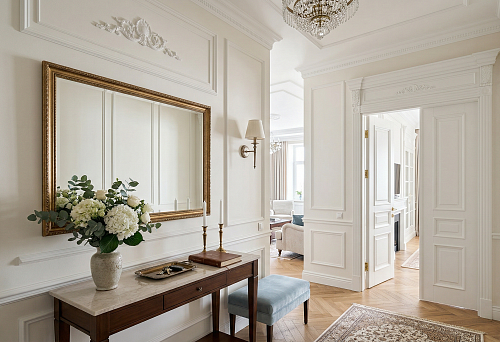
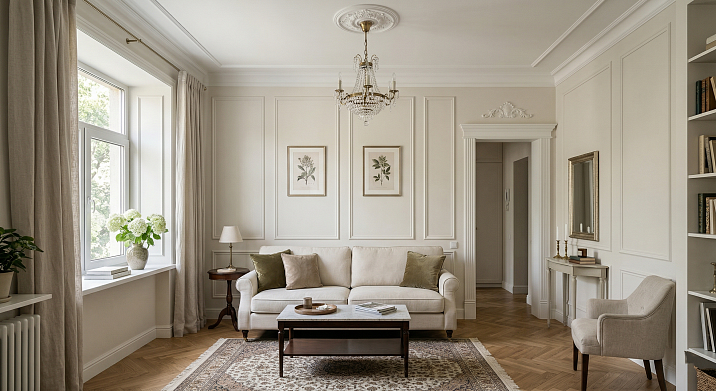
The answer is unequivocal: yes. But with a caveat—its lightweight version is suitable. Not classic with twenty layers of decor, not a 'palace-style,' but a modern interpretation of classical principles, where the emphasis is on structure, not saturation.
What is neoclassicism at its core? It is organized space. Walls with logic, symmetry, architectural lines, moderate decor in the right proportions. None of these qualities require large square meters. Symmetry works just as well in a 12 m² room as in a 40 m² hall. A molding frame on a wall 200 × 2500 mm creates exactly the same architectural effect as a 1000 × 2300 mm frame—just on a different scale.
The flip side of this truth: it is precisely in a small apartment that mistakes are more noticeable. An incorrect scale of decor in a large hall can be 'dissolved' by the space. In a 14 m² room—it cannot. Here, every element carries more weight, and that is precisely why the choice of profile, number of frames, and color scheme are not secondary questions, but key ones.




Mechanics: why moldings work and don't overwhelm
The fundamental question: under what condition do moldings visually expand and ennoble a small space, rather than compress it?
First condition — slim profile. A molding with a cross-section of 20–22 mm, when painted monochromatically, creates a subtle architectural graphic on the wall. It reads as a line, not as an object. A molding with a cross-section of 50 × 25 mm in the same small room becomes a massive relief that consumes space.
Second condition — monochromatic painting. Molding in the same tone as the wall or half a tone lighter is decoration through volume and chiaroscuro, not through contrast. A contrasting white frame on a dark wall in a small room fragments the space into parts, visually reducing it. Monochrome works differently: the frame is present — the space remains unified.
Third condition — limited quantity. One frame per wall. Or a maximum of two — if the wall is truly wide. Not three, not four. In a small space, less is more.
Fourth condition — vertical format. A vertical frame draws the eye upward. In a room with low ceilings, this is literal assistance: a tall, narrow panel makes the space subjectively taller.
It is precisely on these principles that theNeoclassic Light collectionis built: delicate profiles, moderate relief of corner elements, systematic coordination of molding and stucco — all designed exactly for the task we are analyzing.
Our factory also produces:


Main mistakes: why a small apartment looks cluttered
Before discussing what works — let's analyze what goes wrong. This is not theory: these mistakes constantly appear in real interiors.
Get Consultation
Mistake 1: molding that is too wide
A molding with a cross-section of 40–50 mm in a room with a 2.5 m ceiling is a disproportionate choice. It visually weighs down the wall, consumes volume, and turns a decorative frame into a massive relief that feels oppressive.
For a small room — a profile no wider than 22–25 mm. This is the limit beyond which overload begins.
Mistake 2: too many frames on one wall
Three to four frames on a 250 cm wall is fragmentation. The wall ceases to be read as a single surface and turns into a fine pattern. In a compact room, such a solution additionally 'compresses' the space.
Rule: one frame per wall. In exceptional cases — two, if the wall is wide and the frames are small.
Mistake 3: complex ornament in a small area
A polyurethane corner element with deep relief of 40–50 mm in a 10–12 m² room is a mismatch of scales. A large, rich ornament is designed for viewing from a great distance. In a small room, it ends up 'too close' and feels oppressive.
For small rooms — corner elements with a projection of 15–18 mm, delicate geometric or small floral ornament.
Mistake 4: contrasting heavy color
A dark wall and white moldings — a beautiful solution. But in a 10 m² room, the contrast becomes aggressive: a lot of dark + a lot of white fragments the space, making it restless.
For small rooms, use a monochrome or nuanced color scheme. A dark wall is acceptable provided that the moldings are painted in the same shade or half a tone lighter.
Mistake 5: Decor on all walls at once
Four walls with moldings in a small room is a prison. Decorative frames around the entire perimeter completely enclose the space.
The principle of a compact interior: one accent wall with decor, the rest neutral. This creates depth: the gaze goes to the accent wall, making the space feel more voluminous.
Mistake 6: Heavy furniture plus heavy decor simultaneously
A massive sofa, a heavy cabinet, voluminous classic furniture, and also saturated frames on the walls—this is an addition of overloads. In a small apartment, one of the elements must 'step back.' Light furniture—you can allow saturated decor. Heavy furniture—the decor should be delicate.
Which moldings are suitable for small spaces
Let's move on to the specific choice. For a small apartment or compact room, specific profile parameters work.
Cross-section: 15–22 mm — the working range
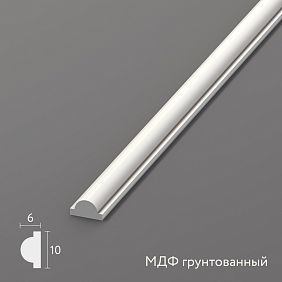
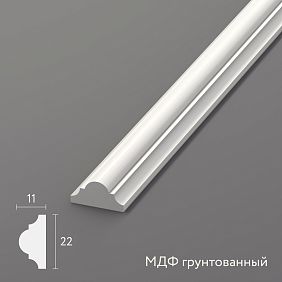
A molding profile 15–22 mm wide is the optimal range for a small space. It is wide enough to be clearly readable from a distance of 2–3 m (a typical viewing distance in a small room). It is narrow enough not to create a massive relief.
Molding MLD-002-MGwith a cross-section of 22 × 11 mm — exactly within this range. A delicate line, factory priming, ready for final painting — exactly what's needed for a small interior without extra steps.
Relief: less is more
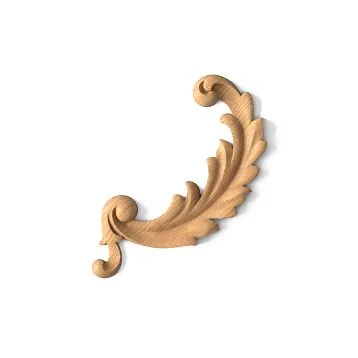
Corner decorative elements for a small room: symmetrical, with a projection of 12–18 mm, with geometric or light floral ornamentation. No baroque swirls, life-size acanthus leaves, or saturated sculptural forms.
Wide selectionpolyurethane decorative overlaysof different relief levels allows you to find exactly the right scale: from minimalist geometric to moderately classic.
Frame height: vertical as an ally
In a room with ceilings of 2.4–2.7 m, a vertical frame works better than a square one. A tall, narrow frame visually 'raises' the ceiling — the eye follows the vertical upward and stops closer to the ceiling line, subjectively increasing the height.
For a 2.5 m ceiling — a frame height of 1800–2100 mm. Leave a 15–20 cm strip at the top to the cornice or ceiling; at the bottom — a symmetrical strip to the baseboard. The frame 'breathes' within the wall field, not compressing the space.
What to do with the baseboard and cornice
For a small apartmentSkirtingchoose a restrained profile: height 60–80 mm, without a pronounced classical projection. A massive 120 mm skirting board with several shelves in a small room 'eats up' the height.
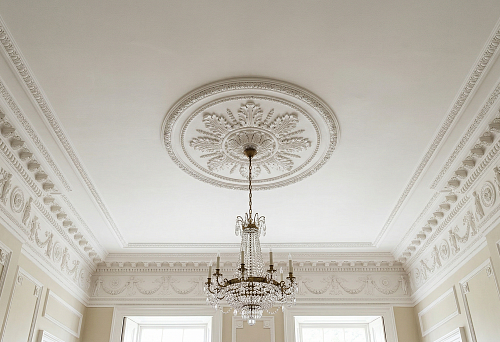
CeilingCornice— narrow, up to 50 mm in height. It creates a transition from the wall to the ceiling without a heavy horizontal element that visually lowers the ceiling.
Where to place an accent wall in a small apartment
In a small room, decor should be concentrated. Do not scatter it around the entire perimeter, but choose one wall and make it truly strong.
Wall behind the bed: a safe choice with maximum effect
For a bedroom, this is the only correct place. The wall behind the headboard is the functional and visual center of the room by default: it is looked at upon entry, and it is what a person sees upon waking up. One vertical decorative frame in the center of this wall — and the bedroom transforms from a 'room with a bed' into a designed space.
Frame width — equal to the width of the bed or 5–10% wider on each side. No decor on the other three walls: cornice and skirting board — yes, molding frames — no.
This scenario is analyzed in detail in the articleMoldings in the bedroom: how to design the wall behind the bed in neoclassical style— there are also examples of color solutions and proportions for different types of bedrooms.
Wall behind the sofa in the living room or kitchen-living room
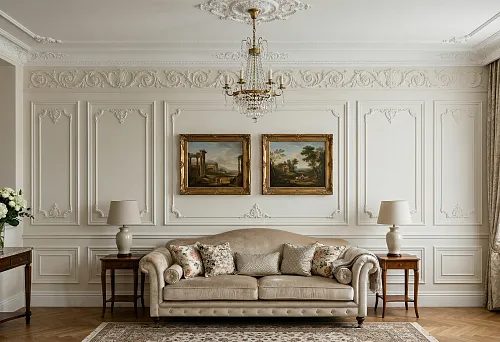
In combined spaces — kitchen-living room, studio — the wall behind the sofa is the main accent surface. It visually delineates functional zones: the relaxation area gets an architectural background, while the kitchen area remains neutral.
For a small living room — one frame centered on the wall behind the sofa. The width of the frame is equal to or slightly less than the width of the sofa. If the sofa length is 210 cm, the frame is 100–120 cm centered. Not three frames in a row, not a wide panel across the entire wall: one, precise, symmetrical.
Narrow wall section: small format with big impact
The hallway is a space where small formats work best. A narrow wall section between the door and the wall, the end wall at the end of the corridor, the space near the mirror — all these zones are perfect for small-format vertical decorative panels.
A frame 40–60 cm wide and 1500–2000 mm high at the end of the corridor creates a visual 'point' that draws the eye. The space is perceived as deeper and intentionally organized.
Wall with a mirror or sconce: decor that serves function
For a small apartment, a technique is especially good where a decorative frame integrates an existing item — a mirror, light fixture, painting — into the architectural context. The frame is not added on top of the functional object: it becomes its architectural framing.
A mirror in the hallway is the most common example: a wall frame around the perimeter of the mirror or surrounding it turns a utilitarian object into part of the interior concept. At the same time, the mirror itself expands the space—and a decorative frame doesn't hinder this if it matches the wall color.
How to choose proportions for a small room: specific numbers
The most common question when working with small spaces is not 'what style' but 'what size'. Here are specific guidelines.
One frame on the wall: proportions
-
Frame width = 40–60% of wall width
-
For a 200 cm wall — frame 80–120 cm
-
For a 250 cm wall — frame 100–150 cm
-
Frame height — wall height minus 30–40 cm (15–20 cm from top and bottom)
-
With a 2.5 m ceiling: frame height 1600–2000 mm
Lower edge of the frame: where to place it
In the bedroom: the lower molding is at the level of the upper edge of the mattress or 10–15 mm higher. The frame 'starts' from the level of the bed.
In the living room: the lower molding is at the level of the upper edge of the sofa back or 10 mm higher. The frame and furniture do not conflict.
In the hallway: the lower molding is 10–15 mm above the level of the baseboard. The frame starts practically from the floor, emphasizing the height.
Gaps from wall corners
From the outermost vertical line of the frame to the wall corner — at least 20–25 cm. A frame 'pressed' against a corner looks accidental, not intentional. The space around the frame gives it air and makes it a visible architectural object.
Color: how to choose a solution for a small apartment
The color scheme in a small space is not a matter of taste. It is a matter of strategy.
Monochrome is the first choice for a small apartment
Moldings and stucco in the tone of the wall: decor through volume and chiaroscuro, without color contrast. This is the best option for a compact room for several reasons.
First, monochrome keeps the space visually unified. No contrasting lines — no fragmentation. The room is perceived as a solid volume, not as a collection of multi-colored fragments.
Secondly, the relief of the molding in monochrome painting is perceived through chiaroscuro—especially under evening lighting. This is a delicate, sophisticated technique that speaks more about the interior than any contrast.
Thirdly, monochrome does not limit the choice of wall tone. Want a deep sage—moldings in sage. Warm cream—moldings in cream. Dark blue—moldings in dark blue. The scheme works with any base tone.
Nuanced contrast: permissible with caution
Moldings half a tone lighter than the wall or half a tone darker—an acceptable option for a small apartment. It creates a slight visual distinction without fragmenting the space.
For example: wall warm gray Pantone 427C, moldings white Pantone 9180C. The difference is minimal, but the decor is perceptible. This is a 'soft contrast' solution that gives a bit more expressiveness while preserving visual integrity.
Sharp contrast: only in exceptional cases
White moldings on a black or very dark wall—this is a strong technique. In a large room, it works for formality. In a small one—it breaks the space into contrasting parts, making it visually smaller and more restless.
If you choose a deep, saturated wall tone in a small apartment and want decorative frames—stick to monochrome. A wall the color of the night sky with moldings of the same tone—that's an interior. The same wall with white frames—that's potential overload.
Dark moldings on a light wall: an unexpected choice
Inversion: dark anthracite or graphite moldings on a light wall. In a small apartment, this works better than it seems at first glance—provided there are few frames (one or two) and the profile is delicate. A dark line on a light background creates graphics reminiscent of an architectural drawing—strict, precise, modern.
Neoclassicism in a Panel Building: What to Consider Separately
A separate and very widespread topic. Millions of people live in houses built in the 1960s–1990s: ceilings 2.4–2.7 m, standard layouts, often small rooms and corridors. Is it possible to do neoclassicism here?
Yes — and it is precisely here that lightweight neoclassicism with moldings reveals itself especially strongly. We'll explain why.
Why a Panel Building is Not a Death Sentence for Neoclassicism
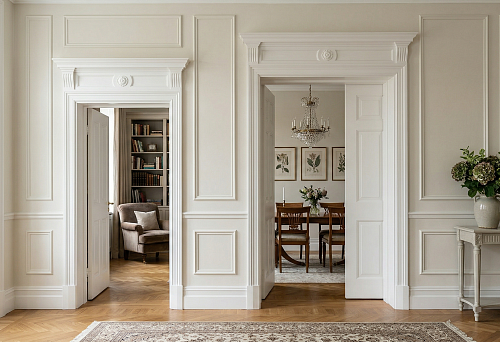
Standard housing has one architectural quality that aligns well with the principles of neoclassicism: rectangular rooms with straight walls and right angles. No complex slanted surfaces, columns, or non-standard niches. A rectangular room is the perfect canvas for symmetrical molding decor.
A Khrushchyovka with decorative frames, a properly chosen cornice, and a neat baseboard — this is not 'kitsch'. It's the smart use of classical principles in an affordable context.
Ceilings 2.4–2.5 m: How to Work with the Limitation
Low ceilings are the main challenge of a panel building. Several rules for working with them:
No horizontal division of the wall. A horizontal molding belt in the middle of a wall in a room with a 2.4 m ceiling is a literal 'cut', dividing the space in half. Not allowed.
Only verticals. Vertical frames from the baseboard to the cornice or almost to it — this is the only working principle in a room with a low ceiling. The gaze goes upward, the room feels taller.
Cornice — narrow. A ceiling cornice in a panel building should be no more than 40–50 mm in height. A wide cornice 'lowers' the ceiling. A narrow one creates a transition to the ceiling without compressing the space.
Baseboard — moderate. 60–80 mm in height, without overhanging shelves. A tall baseboard in a room with a 2.4 m ceiling consumes precious centimeters of height.
Light walls. In a panel building with low ceilings, dark walls are a luxury that only very large rooms can afford. In a 12–14 m² room with dark walls and additional molding decor, there is a high risk of claustrophobia. Light wall + monochrome moldings = visual height and volume.
Typical layout: how to place accents
In a typical 'two-room apartment' (kitchen 8 m², bedroom 12 m², living room 16–18 m², hallway), the logic for placing decor looks like this:
Bedroom: one frame behind the bed. Delicate 22 mm profile, monochrome, no additional decor on the remaining walls.
Living room: one frame behind the sofa. Or two symmetrical small-format frames on either side of the accent zone — TV, fireplace, console.
Hallway: one vertical panel on the end wall of the corridor. Or a delicate frame around the mirror.
Kitchen: moldings are rarely used in the kitchen — a high backsplash, furniture, and appliances leave almost no free wall space. The exception is the wall of the dining area, if the kitchen is large enough.
Ready-made set or DIY layout: which is better for a small apartment
For a compact space, this issue is more critical than for a large one. The cost of a mistake is higher: correcting an incorrect scale in a small room is more difficult than in a spacious hall.
Assembling yourself: when it's justified
Independent selection of molding and decorative elements makes sense if:
-
you have a non-standard wall size or non-standard configuration;
-
you are a designer with experience working with molding and a clear vision of proportions;
-
you need a specific complex profile or specific relief that is not available in ready-made kits.
Risks of independent selection for a small apartment:
-
molding and corner elements may be inconsistent in relief—the ornament of the decor 'does not read' next to the profile;
-
there may be an error in calculating the quantity;
-
when cutting profiles to a non-standard size—material loss.
-
Without a ready-made calculation set — risk ordering too much or too little.
Ready-made set: optimal choice for a small room
Ready-made set of wall molding decor— is a system where everything is already calculated and coordinated. Molding and decorative elements are matched by style, proportions, and relief. The set composition is calculated for a specific frame format. One SKU in the order instead of several items.
For a small apartment, this is especially valuable for three reasons.
First: elements are already coordinated to the required scale. For a small room, the upper limit of decor is strictly defined — and the ready-made 'light neoclassicism' set is initially calculated for this range.
Second: the risk of mismatched proportions is eliminated. In a small room, a mismatch between the molding profile and the scale of corner elements is immediately noticeable. A ready-made set is a system where every element is matched to every other.
Third: faster and easier for first-time use. For those working with molding decor for the first time, a ready-made set provides a predictable result without lengthy fittings and erroneous orders.
How to choose a ready-made set for a small apartment: by scenarios
| Room | Scenario | Recommended format | Remarks |
|---|---|---|---|
| Small bedroom (up to 12 m²) | One frame behind the bed | 70–100 × 1600–2000 mm | Monochrome, 20–22 mm profile |
| Narrow bedroom | Vertical panel | 60–80 × 2000–2300 mm | Emphasis on height |
| Small living room | One frame behind the sofa | 90–120 × 1800–2200 mm | Centered on the wall behind the sofa |
| Hallway | Vertical panel or mirror frame | 40–60 × 1500–2000 mm | On the corridor end wall |
| Kitchen-living room | One frame on the dining wall | 80–100 × 1800 mm | Only if there is a free wall |
| Room with a 2.4 m ceiling | Tall narrow frame | 60–80 × 1800–2100 mm | Without horizontal division |
Neoclassic Light Collection: ready-made solutions for compact interiors
SetsNeoclassic Light collectionare designed according to the principle of lightweight neoclassicism: delicate profiles, moderate relief of corner elements, a unified stylistic system. This is precisely the scale that works in small apartments—without overload and without losing architectural character.
Different formats in the catalog: vertical panels for narrow walls, symmetrical frames with four identical corner elements, directional compositions with emphasis on the upper or lower part. The choice is determined by wall size, room type, and stylistic task.
What else supports neoclassicism in a small apartment
Moldings are not the only tool. In a small space, a system works where wall decor is coordinated with other interior elements.
Mirrors
A mirror on an accent wall is a classic technique for visually expanding space. Combined with a molding frame, the mirror gains architectural context and ceases to be merely a utilitarian object.
For a small hallway — a mirror in a decorative frame centered on the end wall: double effect (architectural decor + visual depth).
Furniture symmetry
Neoclassicism is a style of symmetry. Even in a small bedroom, symmetrical placement of bedside tables and lamps creates a sense of designed space. Moldings on the wall enhance this symmetry — they literally fix it architecturally.
Light-colored textiles
Light curtains, neutral bedding, a delicate rug — in a small space, textiles should 'help' the wall decor, not compete with it. A bright, colorful textile plus moldings is a battle for attention that both lose.
Neat ceiling cornice
NarrowCeiling cornice— the final element of the decorative program. It creates a transition from wall to ceiling, completes the vertical logic of the decor, and adds an architecturally finished look to the room. For a small apartment — a profile no more than 50 mm in height.
Delicate baseboard
SkirtingIn a small apartment, it is chosen according to the same principle as molding: a delicate profile, moderate height, a neutral or floor-matching tone. A baseboard of 60–80 mm in a classic or neoclassical profile is a sufficient lower horizontal belt that does not overload the space.
On how to build a full-fledged decorative system 'from floor to ceiling' — in the article'Wall moldings and furniture legs: How to assemble the perfect set for an interior in the neoclassical style'.
Three ready-made scenarios for different small apartments
Scenario 1: Panel 'two-room apartment' with 2.5 m ceilings
Bedroom: the wall behind the bed — warm gray-beige. One frame 90 × 2000 mm. Molding 22 mm matching the wall color. Four identical corner elements with a geometric pattern. No additional decor. Two brass sconces symmetrically in the center of the frame.
Living room: the wall behind the sofa — the same warm gray-beige. One frame 110 × 1900 mm in the center of the wall. Monochrome. No side elements.
Hallway: end wall — vertical panel 50 × 1800 mm by the mirror. Monochrome.
Cornice and baseboard: throughout the apartment — identical delicate profiles. Cornice 40 mm, baseboard 70 mm, tone — matches the walls.
Result: a unified decorative system with accents in three key points. No overload. Everything reads as intentional.
Scenario 2: 35 m² Studio
Bedroom accent wall: one 100 × 2200 mm frame behind the headboard. Deep sage + moldings in the same sage.
Sofa zone: wall without frames. The cornice around the entire perimeter and baseboard create neoclassical support.
Entryway zone: mirror with a framing border 60 × 1600 mm.
Result: three architectural points in the open space create zoning without partitions.
Scenario 3: Small apartment with a 'rental-ready' renovation that needs to be made more interesting
Budget-friendly but effective scenario. One frame in the bedroom behind the bed. Monochrome painting in warm cream. Cornice around the bedroom perimeter. Delicate baseboard. Everything — one tone.
Result: the apartment transformed from 'gray' to 'classical'.
About the company STAVROS
Lightweight neoclassicism in a small apartment is not a compromise. It's smart design that works with limitations and turns them into advantages. And for such design to succeed, you need the right manufacturer with the right product.
STAVROS — Russian manufacturer of architectural decor: MDF moldings, polyurethane decorative elements, cornices, baseboards, ceiling rosettes. Production — in Russia. Quality control — at every stage. Delivery — throughout Russia.
STAVROS produces to order — meaning each batch is made fresh, with no warehouse leftovers or quality compromises. Whether it's one set for a small bedroom or a batch for nine rooms in a small hotel — the approach is the same.
Full catalog, includingthe 'Neoclassic Light' collection, moldings of all profiles, Polyurethane decorative appliquesandcornices with baseboards— on the STAVROS website. For selecting a ready-made solution for a specific wall and room — a manager consultation with no obligations.
Frequently asked questions
Is neoclassicism suitable for a small apartment?
Yes. Lightened neoclassicism with thin profiles, monochrome painting, and one accent wall works perfectly in compact spaces — making them visually richer, taller, and more cohesive.
Which moldings to choose for a small room?
Profile 20–22 mm wide, projection 10–12 mm. Corner decorative elements with relief 12–18 mm. No baroque ornamentation, no profiles wider than 25 mm.
Can molding be used with low ceilings?
Yes. Key principles: only vertical frames (no horizontal wall division), narrow ceiling cornice (no more than 50 mm), moderate baseboard (60–80 mm), monochrome painting.
Is one frame better or several?
In a small room — one frame on an accent wall. This provides maximum architectural effect without the risk of overload. Multiple frames are only permissible in larger rooms and with a delicate approach to scale.
Is a contrasting color needed for moldings in a small apartment?
No. A monochrome solution (moldings matching the wall color) is the optimal choice. Contrast fragments the space. Monochrome keeps it visually unified and adds decoration through light and shadow.
Which ready-made kit to choose for a small bedroom?
A vertical frame 70–100 cm wide and 1600–2000 mm high. Profile 22 mm. Delicate corner elements with a projection of 15–18 mm. All four corners — identical, for complete symmetry.
Can neoclassicism be done in a panel building?
Yes — and it's one of the best ways to enhance standard housing. Light walls, monochrome delicate moldings, one accent frame in the bedroom or living room, a narrow cornice around the perimeter — and the 'panel building' gains architectural character.
Is it worth getting a ready-made kit for a compact room?
Definitely yes. A ready-made kit eliminates the risk of mismatched molding and decorative element scales, which is critically important in a small room. The elements are already coordinated, the composition is calculated—a predictable result without lengthy fittings.