Article Contents:
- Philosophy of Window Framing: Window as Boundary of Worlds
- Sacred Significance of Threshold
- Regional Traditions and Their Uniqueness
- Anatomy of Beauty: Constructive Elements of Mullion
- Structural Organization of Window Framing
- Rhythm and Proportions in Window Decoration
- Ornamental Language: Symbols and Their Meanings
- Floral Symbolism in Mullion Decoration
- Geometric Ornaments and Their Cosmogonic Significance
- Materials and Technologies: From Traditions to Modernity
- Wood Species and Their Decorative Properties
- Modern wood processing technologies
- Composite Materials in Modern Mullion Decoration
- Design and Manufacturing: From Sketch to Finished Product
- Architectural Measurements and Creation of Technical Specifications
- Artistic Design of Ornamentation
- Technologies of Modern Production
- Installation and operation: secrets of longevity
- Preparation of Window Opening
- Mounting methods and their features
- Maintenance and Care of Mullions
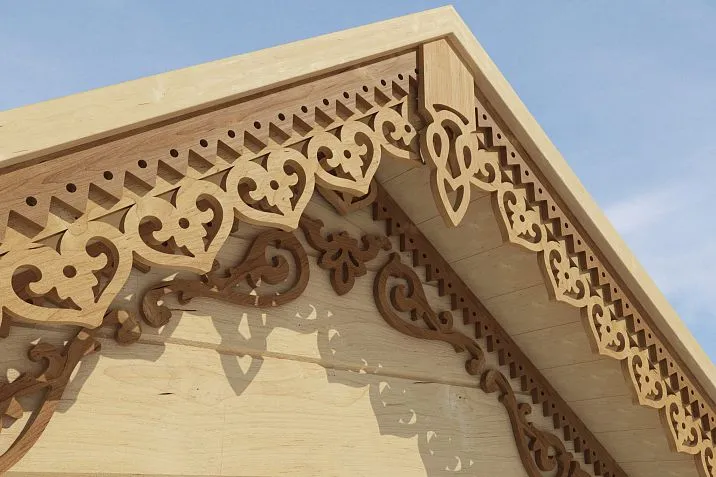
What transforms an ordinary window into a portal between worlds? What causes a passerby to stop and stand in awe before a seemingly simple facade? The secret lies in magic. mullions in Russian style — these wonderful works of folk art that transform architecture into a living fairy tale.
Imagine: a frosty morning, the first rays of sunlight touch the carved patterns on the window frame, and suddenly the entire house comes alive, speaking the language of symbols and ornamentation, telling the story of its inhabitants, their dreams and beliefs. This is how true beauty is born—not from the desire to impress, but from a deep understanding of harmony between man, home, and the surrounding world.
Today, when urban culture strives for uniformity and standardization, returning to the traditions of Russian wooden architecture is not merely a fashion statement, but an act of cultural self-awareness. Each Carved Window Trim — is a manifesto of individuality, a declaration that beauty can and should be accessible to everyone.


Philosophy of Window Framing: Window as Boundary of Worlds




Sacred Significance of Threshold
In ancient Russian worldview, a window was never merely an opening in the wall for light to enter. It was the boundary between the inner, protected space of the house and the outer world, full of dangers and the unknown. That is why window framing required special attention and craftsmanship.
The mullion served not only as a decorative element but also as a powerful talisman. Every swirl, every line in the ornament had deep meaning. Solar symbols were meant to attract solar energy into the house and repel dark forces. Plant motifs symbolized fertility and abundance. Geometric patterns created a protective network through which evil could not penetrate.
Master carpenters understood the psychological impact of beauty. A person living amidst beauty became more beautiful, kinder, wiser. Therefore, no time, effort, or materials were spared in creating window casings. This was an investment in the family's mental well-being and the harmony of the home.
The technology of making was passed down from master to apprentice as sacred knowledge. Young carvers spent years studying not only woodworking techniques but also the symbolic meaning of ornaments, rules for their combination, and the connection between form and content.
Our factory also produces:


Regional traditions and their uniqueness
Russia is an immense country, and different regions developed their own window decoration traditions. Northern casings were distinguished by strictness and monumentality, corresponding to the harsh climate and character of Pomors. Central regions preferred more elegant, detailed forms. Southern regions introduced steppe freedom and Cossack boldness into window decoration.
Each region had its favorite motifs and techniques for their execution. Vologda masters were renowned for their delicate carving, creating a lace-like effect in wood. Kostroma artisans preferred relief compositions with rich play of light and shadow. Nizhny Novgorod craftsmen combined carving with polychrome painting, creating festive, ornate casings.
Climate conditions also influenced the style of casings. In northern regions, more closed, protective forms prevailed. In southern regions, casings were more open, airy, emphasizing connection with nature and joy of life under generous sunlight.
The social status of the house owner was also reflected in window decoration. Merchant homes were adorned with lavish, richly decorated casings with gilding and painting. Peasant dwellings had more modest, yet no less expressive decoration, where each element carried both functional and symbolic significance.
Get Consultation
Anatomy of beauty: structural elements of the casing
Structural organization of window framing
Traditional Russian casing represents a complex compositional system, where each element has its own name and purpose. Understanding this structure is necessary for creating harmonious and authentic modern window decoration using decorative elements of casings.
The upper part of the casing, called the 'ocel', serves as the architectural crown of the window. It was here that the most expressive and symbolically significant decorative elements were placed. The ocel could be triangular, semicircular, or complex shaped. Solar symbols, bird images, and plant ornaments were often used in its decoration.
The side posts of the casing, or 'kozak', framed the window on the right and left sides. They could be simple, geometrically correct, or adorned with carved ornamentation. Often, vertical plant compositions — stylized trees, climbing plants, floral garlands — were placed on the kozak.
The sill — the lower part of the casing — completed the composition and simultaneously served as a functional element diverting water from the wall. Its decoration was usually more restrained, but necessarily harmonized with the overall stylistic solution.
The 'sandr' — a small overhang above the window — protected the upper part of the casing from atmospheric precipitation and created additional play of light and shadow. In southern regions, sandriks were more pronounced, while in northern regions, they often merged with the ocel into a single composition.
Rhythm and proportions in window decoration
Harmony of the Russian casing was achieved through precise adherence to proportions based on the principles of the golden section and folk understanding of beauty. Masters intuitively sensed correct size relationships, creating compositions pleasing to both eye and soul.
The width of the casing was usually 1/5 to 1/3 of the window opening width. This ensured visual balance between the window itself and its decorative frame. Too narrow a casing disappeared on the facade, while too wide a casing overwhelmed the building's architecture.
The height of the ocel varied from 1/4 to 1/2 the height of the side posts, creating different emotional effects. A high ocel gave the casing a solemn and monumental character. A low ocel created a sense of coziness and intimacy.
Repetitive decorative elements linked the casing into a unified whole and created a musical harmony of forms. These could be repeating rosettes, wavy lines, geometric shapes. It was important to find a balance between uniformity and variety, between order and freedom of creative expression.
The scale of ornamentation should correspond to the overall size of the casing and the architectural scale of the building. Fine decoration was well-suited for close viewing, but disappeared when viewed from afar. Large elements created expressive accents, but could overwhelm the composition if overused.
Ornamental language: symbols and their meanings
Plant symbolism in casing decoration
The world of plants provided Russian masters with a rich arsenal of decorative and symbolic motifs. Each plant had its own meaning in folk culture, and this meaning was transferred into architectural decoration, transforming simple window decoration into a complex symbolic text.
Oak leaves and acorns symbolized strength, courage, longevity. These motifs often appeared in the decoration of homes of family heads, emphasizing their status and responsibility for the family's well-being. Oak branches could intertwine with other plant elements, creating complex compositions symbolizing generational ties.
Birch motifs — leaves, catkins, stylized trunks — embodied the feminine principle, purity, motherhood. They often decorated windows of the female side of the house, creating an atmosphere of tenderness and care. Birch was considered in folk consciousness as a tree protecting women and children.
The grapevine, although not native to northern latitudes, entered Russian ornamentation through Christian symbolism. Grape represented spiritual nourishment, communion, connection with the divine. Grape clusters and leaves often adorned casings of clergy homes and especially religious families.
Roses and other garden flowers symbolized beauty, love, and the joy of life. Their depictions created a festive mood, transforming even a modest peasant house into a semblance of a palace. Roses could be either naturalistic or highly stylized, simplified into geometric forms.
Field flowers — cornflowers, daisies, bellflowers — brought into architectural decoration the spirit of Russian nature, memories of summer meadows and forest clearings. These motifs were especially popular in rural areas, where the connection with nature was most keenly felt.
Geometric ornaments and their cosmogonic significance
Geometric forms in Russian decorative art were never mere abstractions. They embodied ancient concepts of the world's structure, the connection between man and the cosmos, and harmony with spheres.
The circle — symbol of the sun, time, and eternity — appeared in the design of window casings in numerous variations. Simple circles, concentric rings, rosettes, and solar discs created solar compositions intended to bring light and warmth into the home. Design of window casings in the Russian style often based specifically on circular motifs.
The square and rhombus symbolized the earth, the material world, sown fields. Rhombic grids, square frames, checkered patterns created a sense of order, stability, and connection to agricultural traditions. These motifs were especially popular in peasant architecture.
The triangle had dual symbolism. Pointed upward, it denoted fire, aspiration toward the sky, the masculine principle. Pointed downward — water, the feminine principle, fertility. Combinations of triangles created complex compositions expressing the unity of opposites.
The spiral embodied the idea of development, the movement of time, life energy. Spiral curls, snails, volutes created a sense of dynamism, the living breath of ornament. They were often used in transitions between different parts of a composition.
The cross — a universal symbol of protection — appeared in Russian decoration in countless variations. Simple equal-armed crosses, diagonal crosses, complex crosses with additional elements — all served as protective charms safeguarding the home and its inhabitants from evil forces.
Materials and Technologies: From Traditions to Modernity
Tree species and their decorative properties
The selection of wood for making window casings was determined not only by material availability, but also by its symbolic properties, technical characteristics, and decorative potential. Each tree species had its own area of application and specific processing requirements.
Spruce — the most accessible and popular species for making window casings. Its wood is easy to work with, has an expressive texture, and natural antiseptic properties due to resin content. Spruce casings were known for durability and ability to retain carving details even under significant climatic loads.
Linden was prized for its exceptional softness and pliability, allowing the creation of the thinnest and most detailed ornaments. Linden casings were masterpieces of high art, but required careful protection from moisture and more frequent renewal of protective coatings.
Oak was used to create especially prestigious and long-lasting casings. Its hard wood was poorly suited for fine carving, but ensured a century-long service life of the product. Oak casings were a symbol of wealth and social status of the home's owner.
Birch, especially Karelian with its unique texture, was used to create elite decorative elements. Birch casings were distinguished by elegance and nobility, but required special processing skills and protection from moisture effects.
Aspen, despite its reputation as "unclean" wood, was widely used for outdoor applications due to its remarkable resistance to rot in humid environments. Aspen casings could serve for decades without any protective treatment.
Modern wood processing technologies
Modern production of window casings in the Russian style uses advanced woodworking technologies, enabling the achievement of quality unattainable by traditional methods, while preserving the authenticity of the artistic solution.
Kiln drying of wood ensures uniform moisture content at 8–12%, guaranteeing geometric stability of the product and absence of deformation during use. Modern drying chambers allow precise control of moisture removal, preventing cracking and warping of wood.
CNC milling opens new possibilities for creating complex profiles and ornaments. Moldings and cornices for window casings can be manufactured with jewel-like precision, ensuring perfect repeatability of elements and the possibility of creating complex compositions.
Laser cutting allows creating intricate elements of any complexity, reproducing the finest details of traditional ornaments, and realizing original artistic concepts. The quality of laser cutting, in terms of line clarity and purity, surpasses handwork.
Modern protective coatings — oils, lacquers, varnishes — ensure the longevity of products while preserving the natural beauty of wood. Special formulations protect wood from UV radiation, moisture, and biological damage, maintaining the original appearance for many years.
Technologies of artificial aging allow modern casings to acquire a noble patina of age, creating the impression of antique value. Brushing, patination, toning open wide possibilities for creating unique decorative effects.
Composite materials in modern window casing decoration
The development of the chemical industry has provided manufacturers of window casings with new materials combining the advantages of natural wood with improved performance characteristics.
High-density polyurethane allows creating baseboards and appliqués in the Russian style, indistinguishable in appearance from wooden ones, but superior in durability and resistance to external influences. Polyurethane elements are moisture-resistant, do not rot, and are not attacked by insects.
Wood flour-based composites retain the natural wood texture but offer enhanced dimensional and shape stability. These materials are ideal for creating large fascia elements that operate under complex climatic conditions.
Fiberglass allows the creation of particularly complex and detailed decorative elements that cannot be made from natural wood. Modern coloring and texturing technologies make fiberglass products visually indistinguishable from wood.
Metal-polymer composites combine the lightness of polymers with the strength of metals, which is especially important for large architectural elements. These materials do not deform under their own weight and do not require heavy fastenings.
Design and manufacturing: from sketch to finished product
Architectural measurements and technical specification development
Each fascia project begins with a careful study of the building's architectural features, window opening dimensions, and facade stylistics. Only by understanding the context can one create a harmonious solution that enhances, rather than detracts from, the architecture.
Measurement drawings must reflect not only the geometric dimensions of windows but also their construction features, mounting methods, and the presence of various protrusions and recesses. Measurement accuracy is critically important, as even minor errors may prevent the installation of finished products.
Photographic documentation of the existing facade condition helps assess the building's color palette, wall texture, and presence of other decorative elements. This information is essential for making decisions regarding the stylistic approach, proportions, and finishing methods of future fascias.
The technical specification must include not only dimensions and materials but also a clear description of the artistic concept of the project. What symbols and ornaments should be used? What mood should the fascias convey? How should they interact with the building's architecture?
Project coordination with the client is a critically important stage, as fascias will become part of people's daily lives for many years. It is essential to ensure that the artistic solution aligns with the tastes and needs of future users.
Artistic design of ornaments
Creating an ornamental composition for a fascia is a creative process requiring a deep understanding of folk art traditions and the ability to adapt them to modern conditions.
Studying historical analogs is the first step in design. Museum collections, folk art albums, and on-site surveys of preserved monuments provide rich material for creative reinterpretation. It is important not to copy blindly, but to understand the logic behind traditional ornament construction.
Sketching is the primary method for finding an artistic solution. Multiple variations, detailed development, and searching for optimal proportions—all of this requires time and patience. The best solutions often emerge not immediately, but as a result of prolonged searches and experiments.
Computer modeling allows quickly calculating various composition variants, checking their harmony, and creating precise templates for manufacturing. Modern graphic programs open new possibilities for creative experimentation.
Creating scale models helps evaluate the volumetric and spatial qualities of the future product, test ornament readability from various distances, and find optimal light and shadow relationships.
Author supervision at all manufacturing stages ensures the accurate realization of the artistic concept in the material. Wood is a living material, and during the process, nuances may arise requiring adjustments to the original design.
Modern production technologies
Modern manufacturing mullions in Russian style represents a complex technological process combining advanced wood processing methods with traditional artistic carving techniques.
Wood cutting takes into account the direction of fibers, location of knots, and texture characteristics. Proper cutting is the key to the beauty and longevity of the finished product. Modern band saws allow obtaining blanks with minimal material loss.
Basic profile formation is performed on CNC milling machines using pre-developed programs. This ensures perfect dimensional accuracy and enables the production of large batches of identical elements.
Artistic carving is performed either by machine or manually, depending on the ornament's complexity and quality requirements. The most critical elements are always refined manually by experienced master carvers.
Sanding and preparation for finishing require special attention to details. Every surface must be perfectly smooth, transitions between elements must be smooth, and all carving edges must be sharp and expressive.
Finishing and protective treatment complete the manufacturing cycle. The choice of final coating depends on the conditions of use, aesthetic requirements, and project budget. Quality finishing not only protects the product but also highlights its beauty.
Installation and operation: secrets of longevity
Window opening preparation
Quality fascia installation begins with careful preparation of the window opening. This stage largely determines the longevity and aesthetic effect of the installation.
Checking the opening geometry is the first and most important stage of preparatory work. Windows in older buildings often deviate from rectangularity, which must be considered during fascia manufacturing and installation. Modern laser levels and measuring instruments allow identifying all inaccuracies.
Cleaning surfaces of old paint, dust, and contaminants ensures reliable adhesion of fascias to the wall. Special attention should be paid to removing peeling coatings, which may cause premature fastener failure.
Treating the wood of the wall with antiseptic compounds prevents decay and insect damage. This is especially important for houses made of round logs or beams, where casings are attached directly to the wooden wall.
Installing a vapor barrier at the junctions between casings and walls prevents condensation and related issues. Modern vapor-permeable membranes provide moisture protection without hindering the natural ventilation of the structure.
Marking mounting points must be done with maximum precision. Errors at this stage may result in casing misalignment, disruption of the composition's integrity, and the need to redo the work.
Methods of mounting and their characteristics
The choice of mounting method depends on the wall material, the weight of the item, climatic conditions, and aesthetic requirements. Each method has its advantages and limitations.
Through mounting with self-tapping screws is the most reliable and universal method. Screws pass through the casing and penetrate the wall to a depth of at least 40-50 mm. Screw heads are countersunk into the wood and covered with wooden plugs or filled with putty.
Mounting on metal clamps allows for removal of casings without damage. Clamps are mounted to the wall, and the casing is hung on them. This method is convenient for periodic maintenance and repair of items.
Adhesive mounting is used for lightweight decorative elements that do not bear significant mechanical loads. Modern polyurethane and epoxy adhesives provide reliable bonding with most construction materials.
Combined mounting combines mechanical fasteners with adhesive compounds. This ensures maximum connection reliability and even load distribution across the entire contact area.
Hidden mounting using special systems allows complete elimination of visible fasteners. Such systems are more expensive than traditional methods but provide a flawless appearance.
Care and maintenance of casings
Regular care of casings is the key to their longevity and preservation of their original beauty. The maintenance program must consider the material of the items, operating conditions, and intensity of external factor exposure.
Inspection of casings should be conducted no less than twice a year — in spring and autumn. Special attention is paid to joints, mounting points, and areas most susceptible to moisture exposure.
Cleaning from dust and dirt is performed using a soft brush or vacuum cleaner with a brush attachment. Wet cleaning is permissible only with special compounds that do not damage the protective coating of the wood.
Updating the protective coating is the most critical operation in caring for casings. The frequency of renewal depends on the quality of the initial finish and operating conditions. Typically, reapplication is required every 3-5 years.
Minor damage should be repaired immediately upon discovery. Small chips and scratches can be fixed using special wax pencils or wood putty.
Seasonal maintenance includes snow and ice removal in winter, insect treatment in spring, and protection against drying out in summer. Each season presents specific tasks for casings, requiring appropriate care.
In the era of standardization and unification Russian-style casings remain a symbol of individuality and cultural uniqueness. Each window adorned with carved casings becomes a portal to a world of beauty and harmony, where modern technologies serve the preservation and development of centuries-old traditions.
Choosing traditional window framing is choosing quality over quantity, beauty over functionality, culture over commerce. It is an investment in creating an environment that will delight not only us, but also our children, grandchildren, and great-grandchildren.
Modern masters continuing the traditions of Russian wooden architecture create not just decorative elements, but works of art capable of transforming any home, street, or city. In their hands, ancient craftsmanship regains new life, proving that true beauty transcends time and trends.
The company STAVROS makes an invaluable contribution to preserving and developing traditions of Russian architectural decoration, creating products of exceptional quality and artistic expressiveness. Every casing produced by STAVROS is the result of deep study of historical samples, creative reinterpretation of traditions, and application of the most modern woodworking technologies. Choosing STAVROS means not just acquiring decorative elements, but becoming part of the great tradition of Russian craftsmanship, which has lived and evolved for many centuries.