Article Contents:
- Style unity: how to match elements in one color scheme
- Material as the foundation of unity
- Color and finish: natural wood or tinting
- Profile and style: from simple to carved
- Doorways: framing with moldings for a formal appearance
- Polyurethane portals: architectural door frame
- Arches: semicircular framing of an opening
- Molding color: white, wood-like or contrasting
- Floor baseboard: wooden baseboard as the foundation of the composition
- Baseboard height: scale and proportions
- Baseboard profile: rhyme with door casings
- Baseboard finishing: unity with door casings
- Solid wood door casings: carved casings for classic interiors
- Door casing width: door proportions
- Door casing profile: from smooth to carved
- Door casing installation: 45-degree miter cuts
- Classic furniture: how furniture supports wooden finishing
- Furniture material: oak to oak, unity of wood species
- Furniture style: carving, patina, classic forms
- Furniture color: natural, tinted, patinated
- Frequently Asked Questions
- Conclusion: set for a holistic interior
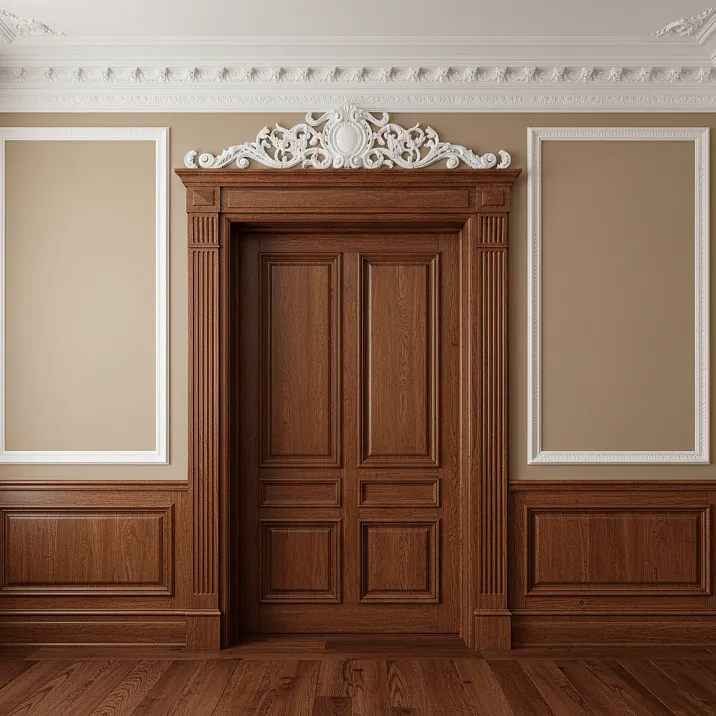
An interior is assembled from details. Expensive parquet, exquisite furniture, designer lighting create the foundation, but without proper finishing of doorways, without harmony of baseboards and door casings, the composition falls apart.Wooden door casings and baseboardsmade of solid oak, beech, ash — not just framing for doors and floors, but architectural elements that set the style, connect verticals and horizontals of space, create material unity (wood to wood, texture to texture, color to color).Polyurethane moldings for doorways— portals, pediments above doors, pilasters on the sides of openings, overlay elements — transforms an ordinary doorway into an architectural composition, adds formality, solemnity, characteristic of classic interiors.wooden baseboardmade of solid oak with a height of 100-180 mm — the foundation of the composition that frames the floor, rhymes with door casings in material and finishing, creates the lower tier of the interior.Classic Furnituremade of solid oak — tables, chairs, dressers, beds — supports wooden finishing, completes the composition with unity of material, style, color. In this article, we analyze comprehensive interior finishing (how to select door casings, baseboards, moldings in a unified style), framing doorways with polyurethane moldings (portals, pilasters, pediments — techniques for creating formal openings), the role of wooden baseboard as the foundation of the composition (height, profile, color — how baseboard sets the scale of the interior), solid wood door casings for classic interiors (carved, shaped, smooth — selection to match door and furniture style), the role of classic furniture as support for wooden finishing. Prepare to create interiors where every element — from door casing to chair leg — works for the common idea, where classic is alive, not museum-like, but comfortable, modern in functionality, classic in spirit.


Style unity: how to match elements in one color scheme




Material as the foundation of unity
Interior unity begins with material. Wood is the universal material of classic interiors (Baroque, Classicism, Empire, English style, Neoclassical), used for floors (parquet, solid wood flooring), finishing (door casings, baseboards, moldings, cornices), furniture (tables, chairs, dressers, beds, cabinets). When all wooden elements are made from the same wood species (oak to oak, beech to beech), with the same finishing (oil to oil, tint to tint), material unity is created — the eye perceives the space as holistic, harmonious, well-thought-out.
Wooden door casings and baseboardsmade of solid oak — the perfect pair. Oak (density 700-800 kg/m³, Brinell hardness 3.7-3.9, expressive texture with medullary rays, color varies from light beige to dark brown) — the leader among wood species for classic interiors (durability 80-120 years without loss of strength, beauty of natural texture, prestige of the material). Oak door casings frame doors (width 70-120 mm, thickness 18-25 mm, profile simple rectangular or shaped with a torus), oak baseboards frame the floor (height 100-180 mm, thickness 18-25 mm, profile classic with torus and grooves or carved with ornaments). Oak of door casings and oak of baseboards — one species, one texture, one shade (if both are oil-finished in natural color) — unity of verticals (door casings) and horizontals (baseboards).
Beech (density 650-700 kg/m³, hardness 3.5-3.7, fine uniform texture, pinkish-cream color) is an alternative to oak, 20-30% cheaper, visually lighter and warmer. Beech architraves and skirting boards create unity in interiors requiring a light, warm palette (Scandinavian interiors, Provence, Mediterranean style — beech suits better than dark oak). Ash (density 680-750 kg/m³, hardness 3.8-4.0, expressive texture with wide annual rings, light yellow color) is a third option, lighter than oak, stronger than beech, suitable for modern classic interiors where lightness is needed, not the heaviness of oak.
Our factory also produces:


Color and Finish: Natural Wood or Staining
The color of wooden elements determines how they interact with each other and with the rest of the interior. Natural wood under oil (oak beige-brown, beech pinkish-cream, ash light yellow — finished with linseed or tung oil, annual ring texture visible, natural color) creates a warm, lively, natural palette. Oak architraves under oil + oak skirting boards under oil + oak furniture under oil — a monochrome wooden palette, everything warm, everything natural, absolute unity.
Stained wood (coated with stain that changes the shade while preserving the texture — stained in wenge dark brown almost black, in walnut medium brown with a red undertone, in mahogany reddish-brown) is used when a dark palette is needed, contrasting with light walls and ceiling. Architraves stained in wenge + skirting boards stained in wenge + furniture stained in wenge — a monochrome dark palette, graphic, modern, but classic in the style of elements (carved architraves, shaped skirting boards, classic furniture — dark color does not make the interior modern, style is defined by forms, not color).
Combined scheme: dark architraves and skirting boards (stained in wenge or walnut) + light furniture (oak or beech under oil in natural color) or vice versa — light architraves and skirting boards (oak under oil) + dark furniture (wenge). The combination creates contrast, visual dynamics, but requires balance (if architraves and skirting boards are dark, furniture should be light to avoid overloading the space; if furniture is dark, architraves and skirting boards should be light to create airiness, lightness).
Get Consultation
Profile and style: from simple to carved
The profile of architraves and skirting boards defines the interior style. Simple rectangular profile (architrave and skirting board with rectangular cross-section, one or two chamfers, no decorative elements) — minimalist, modern, neutral. Rare in classic interiors (too simple, does not create architectural interest).
Classic profile with ogee (convex semicircular element along the top of the architrave or skirting board, protrudes 8-12 mm, creates play of light and shadow) — traditional profile for classic, neoclassical interiors. Architrave with ogee + skirting board with ogee — stylistic unity, both elements rhyme in profile, create vertical (architraves) and horizontal (skirting boards) lines of the same style.
Shaped profile with flutes (several parallel grooves along the architrave or skirting board, creating rhythm, relief) enhances decorativeness. Architrave with ogee and two flutes + skirting board with ogee and two flutes — enhanced stylistic unity, profiles identical, visual connection of verticals and horizontals obvious.
Carved profile (ornaments — dentils, egg-and-dart, acanthus leaves, meander — executed by hand carving or CNC machines) — the highest level of decorativeness, used in luxurious, palatial, Baroque interiors. Carved architraves + carved skirting boards — maximum stylistic unity, both elements lush, decorative, require spacious rooms with high ceilings (in small rooms carved elements will overload the space).
Doorways: framing with moldings for a formal look
Polyurethane portals: architectural door frame
Polyurethane moldings for doorwaystransforms an ordinary doorway into an architectural portal. A portal (architectural framing of an opening — vertical elements on the sides, horizontal element on top) references ancient architecture (temple portals, palaces, public buildings — formal entrances framed by columns, pilasters, pediments). In an interior, a portal creates solemnity, formality, highlights the doorway as an important element (entrance to a living room, dining room, study — portals frame main openings, not technical doors to bathrooms, storerooms).
Portal with pilasters and pediment: pilasters (vertical overlays from floor to top of doorway, width 80-150 mm, with a capital on top — decorative finish in the form of volutes, acanthus leaves, egg-and-dart) mounted on the sides of the opening on the wall (pilasters do not bear load, this is a decorative element imitating columns). Pediment (horizontal element above the opening — triangular, arched, straight — width equal to opening width plus 20-40 cm on each side) mounted above the opening, visually rests on the pilaster capitals (physically attached to the wall with adhesive). A portal of two pilasters and a pediment creates a classic composition that works in any classic interior.
Portal with moldings: vertical moldings (width 80-120 mm, profile classic with ogee or Baroque with ornaments) mounted on the sides of the opening from floor to top, horizontal molding (same width, same profile) mounted above the opening, connecting the vertical moldings. Moldings are mitered at 45 degrees at corners (like skirting boards), joined tightly, creating a rectangular or square frame around the opening. A portal with moldings is simpler than a portal with pilasters and pediment (fewer elements, easier installation), but decorativeness is lower (no capitals, no pediment, no volume of pilasters).
Portal with applied elements: basic portal (pilasters or moldings + pediment) supplemented with applied decorative elements — consoles (brackets under the pediment, imitating support), rosettes (round or oval overlays on pilasters or moldings, with floral or geometric ornament), corner elements (overlays at molding joints, masking 45-degree miter cuts, adding decorativeness). Applied elements enhance the portal's luxury, suitable for Baroque, palatial interiors.
Arches: semicircular framing of an opening
Arched opening (doorway with semicircular top instead of rectangular) is framed by an archivolt (semicircular molding along the arch curve), imposts (vertical moldings on the sides of the arch), keystone (decorative overlay at the arch's apex, imitating the central stone of arched masonry). An arched opening with moldings creates formality, softness (smooth arch curve vs. sharp angle of rectangular opening), suitable for classic, Mediterranean, Eastern interiors.
Archivolt mounted along the arch curve (semicircular molding width 80-120 mm bent to the arch radius, attached with polyurethane adhesive). Polyurethane is flexible (unlike plaster or wood, which do not bend), molding can be bent to an arch radius from 80 cm and more (radius less than 80 cm requires special flexible moldings or composite elements from several parts). Imposts (vertical moldings from floor to start of arch curve) mounted on the sides, connected to the archivolt (joint of vertical molding and semicircular archivolt mitered at required angle — not 45 degrees, but at an angle corresponding to the point of tangency of the curve and vertical). Keystone (overlay height 15-25 cm, width 10-15 cm, with relief ornament) mounted at the arch apex on the archivolt, creates a focal point, accent.
Color of moldings: white, wood-tone, or contrasting
White moldings — classic choice for interiors with wooden architraves and skirting boards. White pilasters, pediments, moldings contrast with warm wood (cool white polyurethane + warm wooden architraves and skirting boards — classic scheme, creates freshness, lightness, visually enlarges space). White moldings stand out on light walls (white pilasters on light beige walls create relief, play of light and shadow, but do not contrast sharply).
Moldings painted to match the color of wooden elements (if architraves and skirting boards are natural oak beige-brown color, moldings painted with acrylic paint in beige, close to oak color; if architraves and skirting boards stained dark wenge, moldings painted dark brown) — creates unity of color of verticals, horizontals, doorway framing. Moldings and wooden elements of the same color are visually connected, create a monochrome wooden palette (everything warm beige-brown or everything dark wenge).
Contrasting moldings (gold, silver, black — polyurethane moldings painted in a contrasting color or coated with patina) used in luxurious, Baroque, palatial interiors. Gold pilasters and pediments on white or cream walls create luxury, opulence, characteristic of Baroque. Black moldings on white walls create graphic contrast, modern interpretation of classicism (forms classic, color modern).
Floor skirting board: wooden skirting board as the foundation of the composition
Skirting board height: scale and proportions
wooden baseboard— not just wall protection from impacts and dirt, but an architectural element that sets the scale of the interior. Skirting board height determines how space is perceived vertically. Low skirting board 60-80 mm (standard for most modern interiors) visually increases room height (the smaller the skirting, the higher the ceiling appears), creates lightness, airiness. In classic interiors such skirting is rare (too small, visually lost against large-scale furniture, tall architraves, wide moldings).
Medium skirting board 100-120 mm — universal choice for classic interiors with ceilings 2.7-3.0 m. Skirting 100 mm visually balanced (not lost against the wall, but does not dominate, does not weigh down space), sufficient to create an architectural base (skirting perceived as the wall's plinth, on which the wall stands — stability, solidity). Skirting 120 mm more monumental (visually lowers ceiling, creates coziness, intimacy), requires architraves also to be wide 90-120 mm (narrow architraves 70 mm + wide skirting 120 mm — imbalance, skirting dominates, architraves lost; wide architraves 100-120 mm + skirting 120 mm — balance, harmony).
High skirting board 140-180 mm — choice for rooms with high ceilings 3.2-3.5 m and above (old Stalin-era apartments, private houses, townhouses, cottages). High skirting creates monumentality, solemnity, characteristic of palatial, Baroque interiors. Skirting 160-180 mm occupies 5-6% of wall height with ceilings 3.2 m (visual support noticeable but not oppressive), requires tall architraves 120-150 mm (wide architraves + high skirting — proportions balanced, verticals and horizontals of the same scale).
Skirting board profile: rhyme with architraves
Skirting board profile should rhyme with architrave profile. If architraves are simple rectangular (profile with one or two chamfers, no decorative elements), skirting boards also simple rectangular (stylistic unity, restraint, minimalism — rare for classic interiors where decorativeness is important). If architraves classic with ogee (convex semicircular element along the top of the architrave), skirting boards also classic with ogee (ogee on architrave + ogee on skirting — profiles identical, verticals and horizontals rhyme, create unity of style).
If architraves are shaped with ogee and flutes (several parallel grooves along the architrave, creating rhythm, relief), skirting boards also shaped with ogee and flutes (number of flutes on architrave and skirting should match — two flutes on architrave, two on skirting; three on architrave, three on skirting — exact profile correspondence creates maximum stylistic unity).
If the architraves are carved (ornaments include dentils, egg-and-dart, acanthus leaves), the skirting boards should also be carved (the same ornaments or similar in style — carved architraves + carved skirting boards — maximum decorativeness, luxury, suitable for Baroque, palatial interiors). A carved skirting board 140-180 mm high with ornaments along its entire height is a large-scale element, requiring spacious rooms (in small rooms, a carved skirting board will overload the space, feel oppressive).
Skirting board finish: unity with architraves
The skirting board finish should match the architrave finish. If the architraves have a natural oak oil finish (beige-brown, wood grain visible), the skirting boards should also have a natural oil finish (the same oil — linseed or tung, the same shade, the same texture). If the architraves are stained wenge (dark brown, almost black), the skirting boards are stained wenge with the same stain (color identical, texture preserved, but shade altered).
If the architraves are patinated (gold, silver, green patina on carved elements — imitation of noble antiquity), the skirting boards are patinated similarly (gold patina in the recesses of the ovolo, on the carved elements of the skirting board — echoes the architraves). If the architraves are painted with opaque paint (white, gray, black enamel, wood texture not visible), the skirting boards are painted with the same paint (color identical, surface smooth, unity is absolute).
Solid wood architraves: carved architraves for classical interiors
Architrave width: door proportions
The width of the architraves determines how they relate to the door leaf. Narrow architraves 60-80 mm (traditional standard for typical interior doors 70-90 cm wide) are visually light, non-dominant, serving as a delicate frame. In classical interiors with large-scale furniture, tall skirting boards, wide moldings, narrow architraves can get lost (visually small compared to other elements).
Medium architraves 90-110 mm — a universal choice for classical interiors. A 100 mm architrave is visually balanced (doesn't get lost against the door, but also doesn't dominate the door leaf, proportions are harmonious), echoes a skirting board 100-120 mm high (100 mm architrave + 100-120 mm skirting board — proportions are close, verticals and horizontals of the same scale). A 110 mm architrave is more massive (suitable for doors 90-100 cm wide, for spacious rooms with high ceilings 3.0-3.5 m).
Wide architraves 120-150 mm — a choice for luxurious, palatial interiors with tall doors (opening height 2.4-2.8 m, width 100-120 cm — double doors, grand entrances). A wide architrave 140-150 mm creates monumentality, solemnity, requires a wide skirting board 140-180 mm (narrow skirting board 80-100 mm + wide architrave 140 mm — imbalance, architrave dominates, skirting board gets lost; wide skirting board 160 mm + wide architrave 140 mm — balance, proportions are balanced).
Architrave profile: from smooth to carved
Smooth architrave (rectangular cross-section with one or two bevels, no relief, no decorative elements) — a simple, laconic, neutral element. Rare in classical interiors (too simple, doesn't create architectural interest, visually cheap). Used in neoclassical interiors, where decorativeness is restrained, forms are simple, but materials are premium (solid oak, natural oil finish — simplicity compensated by material quality).
Architrave with an ovolo (convex semi-circular element along the edge of the architrave, protrudes 8-12 mm, creates play of light and shadow) — a classic profile for most classical interiors. The ovolo references ancient architecture (Ionic and Corinthian order columns have similar elements), creates relief, volume. An architrave with an ovolo 100 mm wide is visually richer than a smooth architrave of the same width (relief adds depth, decorativeness).
Figurative architrave with ovolo and flutes (several parallel grooves along the architrave, running along or below the ovolo, creating rhythm, relief) enhances decorativeness. Two or three flutes on an architrave create vertical stripes, visually increase the height of the opening (vertical lines draw the eye upward, the opening seems taller, more solemn).
Carved architrave (with carved ornaments — plant elements: grapevines, oak leaves, acanthus leaves, laurel branches; geometric elements: meander, dentils, egg-and-dart) — the highest level of decorativeness, used in luxurious, palatial, Baroque interiors. Carving is done by hand by a woodcarver (each architrave is unique, cost 8000-20000 rubles/set per door — two vertical architraves + one horizontal) or by CNC machines (high precision, perfect repeatability, cost lower than hand-carved 4500-12000 rubles/set). A carved architrave requires a wide leaf 120-150 mm (carving requires space, on a narrow architrave 70-80 mm the carving will get lost, won't be noticeable).
Architrave installation: mitering corners at 45 degrees
Architraves are mounted around the door opening (two vertical architraves on the sides of the opening, one horizontal architrave above the opening). At the corners, architraves are joined at a 45-degree angle (mitered at 45 degrees, like skirting boards, creates a tight joint without gaps, a beautiful corner). Mitering architraves is done with a miter box (for small volumes of work, one or two doors) or a miter saw (for large volumes, ten to twenty doors in an entire apartment — miter saw is faster, more precise).
Architrave fastening: with liquid nails (construction adhesive applied in a zigzag pattern on the back of the architrave, the architrave is applied to the wall around the opening, pressed for 2-3 minutes — adhesive sets, holds; method suitable for even walls, with variations not exceeding 2-3 mm) or with finishing nails (nails 30-40 mm long with a small head diameter of 1.5 mm are driven through the architrave into the wall or door frame, heads are countersunk, filled with putty — fastening is invisible, reliable, suitable for uneven walls where adhesive may not hold).
Classical furniture: how furniture supports wooden trim
Furniture material: oak to oak, unity of wood species
Classic FurnitureFurniture made of solid oak, beech, ash — dining tables, chairs, sideboards, chests of drawers, beds, wardrobes — should rhyme with wooden architraves and skirting boards in material. Oak furniture + oak architraves + oak skirting boards — unity of wood species, unity of texture (oak medullary rays on furniture, architraves, skirting boards — identical, recognizable, create a visual connection between elements), unity of color (if all elements have a natural oil finish, shades are identical).
Beech furniture + beech architraves + beech skirting boards — an alternative to oak, 20-30% cheaper, visually lighter, warmer. Beech is suitable for interiors requiring a light, warm palette (Scandinavian interiors, Provence, Mediterranean style — beech creates lightness, airiness, not the heaviness of dark oak).
Mixed scheme: furniture from one species (oak), architraves and skirting boards from another (beech) — possible if colors are close (light beige oak + pinkish-cream beech — shades are close, visually combine; dark brown oak + light cream beech — shades contrast, visually conflict, not recommended).
Furniture style: carving, patina, classical forms
The furniture style should rhyme with the style of the architraves and skirting boards. If the architraves and skirting boards are carved (ornaments — dentils, egg-and-dart, acanthus leaves), the furniture should also be carved (dining table with carved legs, chairs with carved backs, chest of drawers with carved overlays — the furniture carving rhymes with the carving on architraves and skirting boards, creates stylistic unity). If the architraves and skirting boards are patinated (gold, silver patina on carved elements), the furniture is also patinated (gold patina on the carved legs of a table, on the carved overlays of a chest of drawers — rhymes with the patina on architraves and skirting boards).
If the architraves and skirting boards are simple with an ovolo (no carving, no patina, natural wood with oil finish), the furniture can also be simple neoclassical (forms laconic, without excessive carving, facades smooth or with light milling — restrained elegance, not luxury). Simple architraves + simple furniture — a neoclassical scheme, modern in its restraint, classical in forms and materials.
Furniture color: natural, stained, patinated
The furniture color should harmonize with the color of the architraves and skirting boards. Natural furniture with oil finish (oak beige-brown, beech pinkish-cream, ash light yellow) + natural architraves and skirting boards with oil finish (same shades) — a monochromatic natural palette, everything warm, everything wooden, unity is absolute.
Stained furniture (wenge, walnut, mahogany) + stained architraves and skirting boards (same shades) — a monochromatic dark palette, graphic, modern, but classical in style of elements. Dark furniture + dark architraves + dark skirting boards + light walls and ceiling — contrast of dark wood and light surfaces, visually expressive.
Patinated furniture (gold, silver patina on carved elements) + patinated architraves and skirting boards (same patina) — a luxurious palette, Baroque, palatial. Gold patina on furniture, architraves, skirting boards + white or cream walls + white plasterwork (pilasters, pediments, cornices) — a classic palatial scheme, white + gold + natural wood.
Frequently asked questions
Is it possible to combine wooden architraves with polyurethane moldings on door openings?
Yes, it is possible and recommended. Wooden architraves frame the door leaf itself (attached to the door frame, covering the joint between the frame and the wall), while polyurethane molding (pilasters, pediments, moldings) frames the opening on the outside of the architraves (mounted on the wall 5-15 cm from the edge of the architrave, creating an additional architectural frame, a portal). Wood is used where it is most valuable and noticeable (architraves are an element seen up close, touched when opening the door—the materiality of wood is important). Polyurethane is used where decorative volume is needed without high cost (pilasters, pediments—elements that add formality but don't have to be made of wood; polyurethane is 3-5 times cheaper than wood, lighter, and easier to install). Colors harmonize: natural oak architraves in beige-brown + white polyurethane pilasters and pediment—a classic scheme, a contrast of warm wood and cool white.
Is it mandatory for the profiles of architraves and skirting boards to be identical?
Preferable, but not mandatory. Perfect stylistic unity is achieved when the profiles are identical (a torus on the architrave + a torus on the skirting board, two grooves on the architrave + two grooves on the skirting board—exact profile matching). However, similar profiles are acceptable (a torus on the architrave + a torus with one groove on the skirting board—profiles are similar, stylistically compatible, but not identical). Contrasting profiles are unacceptable (a smooth rectangular architrave + a carved skirting board with ornaments—profiles are stylistically incompatible, clash, and disrupt the unity of the interior).
What skirting board height is suitable if the architraves are 100 mm wide?
The optimal skirting board height for 100 mm wide architraves is 100-120 mm (proportions are close, verticals and horizontals are of the same scale, balance, harmony). An 80 mm skirting board with 100 mm architraves is acceptable, but the skirting board is slightly too small (visually gets lost against the architraves, slight imbalance, acceptable). A 140-160 mm skirting board with 100 mm architraves creates a noticeable imbalance (the skirting board dominates, the architraves get lost; either increase the architrave width to 120-140 mm or reduce the skirting board height to 120 mm).
How much does a set for one room cost—architraves, skirting boards, molding?
Room 20 m² (size 5×4 m, ceilings 3.0 m, perimeter 18 meters, one door). Set: solid oak wooden skirting board 120 mm high (18 m × 2800 rub/m = 50400 rub), solid oak wooden architraves 100 mm wide with a torus (set for one door—two vertical architraves 2.2 m each, one horizontal 1.0 m, total 5.4 m × 1800 rub/m = 9720 rub), polyurethane door portal (two pilasters 2.4 m high × 2200 rub/pc = 4400 rub, pediment 1.5 m wide = 3500 rub, total 7900 rub). Total materials: 68020 rub. Labor (skirting board installation 18 m × 450 rub/m = 8100 rub, architrave installation 5.4 m × 380 rub/m = 2052 rub, portal installation = 2500 rub, painting skirting board and architraves 8 m² × 220 rub/m² = 1760 rub). Total labor: 14412 rub. Total cost of the set for one room: 82432 rub (with professional installation) or 68020 rub (DIY installation).
Can MDF skirting boards be used instead of wooden ones in a classic interior with wooden architraves?
Yes, if the budget is limited, but the visual quality is lower. Oak-veneered MDF skirting board (a thin slice of oak 0.5-0.8 mm thick glued onto an MDF base, oak grain visible) is visually close to solid oak (indistinguishable from a distance of 2-3 meters), 40-60% cheaper than solid oak (veneered MDF skirting board 1200-1800 rub/m vs. solid oak 2200-3800 rub/m). Painted MDF skirting board (white or colored enamel, wood grain not visible) does not visually resemble wood; suitable if the architraves are also painted (white architraves + white MDF skirting boards—unity of color, material is not important as there is no grain). MDF skirting board with oil finish (imitation of natural wood, but with MDF grain, not oak) looks cheap (MDF lacks wood grain, under oil a smooth surface is visible, not growth rings—visually artificial, not recommended in classic interiors with wooden architraves).
Conclusion: a set for a cohesive interior
The integrity of a classic interior is achieved through a comprehensive approach. Wooden elements—architraves, skirting boards, furniture—are made from the same wood species (oak to oak, beech to beech), the same finish (oil to oil, stain to stain), and the same profile (torus to torus, carving to carving). Polyurethane molding—portals for door openings, wall moldings, ceiling cornices, rosettes—complements the wooden elements, creating an architectural structure (vertical architraves + horizontal skirting boards + door portals + wall moldings + ceiling cornices—multi-level architecture dividing the space vertically and horizontally). Colors are harmonious: natural wood + white molding—a classic scheme of warm and cool contrast; stained wood + molding in the wood color—a monochrome scheme of unity.
Wooden door casings and baseboardsMade from solid oak, beech, ash—not just framing for doors and floors, but architectural elements that define the style (classical profile with a torus, carved elements, patina—evoke classical architecture of the 18th-19th centuries), scale (skirting board height 100-180 mm, architrave width 90-150 mm—proportionate to furniture, molding, creating balanced proportions), materiality (warm wood with oil finish or stained—tactilely pleasant, visually noble, durable).
Polyurethane moldings for doorways—pilasters, pediments, moldings, applied elements—transforms an ordinary opening into an architectural portal (a formal entrance framed by vertical pilasters and a horizontal pediment, complemented by applied decorative elements—consoles, rosettes, corner elements). Polyurethane is 3-5 times cheaper than wood (a portal made of wooden pilasters and pediment would cost 25000-45000 rub, a polyurethane portal 7000-12000 rub—saving 60-75%), lighter (weight of polyurethane pilasters 3-5 kg, wooden 12-20 kg—polyurethane can be glued without screws), moisture-resistant (can be installed in high-humidity areas—kitchens, bathrooms, hallways).
wooden baseboardMade from solid oak—the foundation of the composition, framing the floor, rhyming with architraves in material (oak to oak), profile (torus to torus), finish (oil to oil), creating the lower tier of the interior (a dark or light horizontal line on which the walls stand, visually stabilizing the space). Skirting board height of 100-180 mm determines the scale of the interior (100-120 mm for rooms with ceilings 2.7-3.0 m, 140-180 mm for ceilings 3.2-3.5 m and higher—proportions must correspond to the room height).
Classic FurnitureMade from solid oak, beech, ash—dining tables with carved legs, chairs with carved backs, chests of drawers with carved overlays, beds with carved headboards, wardrobes with carved fronts—supports the wooden finish, completes the composition with unity of material (oak furniture, architraves, skirting boards—one species, one grain), style (carving on furniture rhymes with carving on architraves and skirting boards), color (natural wood furniture, architraves, skirting boards—a monochrome warm palette or stained wood—a monochrome dark palette).
Company STAVROS has been creating classic interiors for over twenty-three years, offering a complete set of elements from architraves to furniture. Architraves made from solid oak, beech, ash—width from 60 to 150 mm (standard 70, 90, 100, 120, 140 mm), profiles from simple rectangular (for neoclassical, restrained interiors) to carved (dentils, egg-and-dart, acanthus leaves, grapevines—for Baroque, palatial interiors), finish natural with oil (linseed, tung oil emphasizes the grain, natural beige-brown color for oak, pinkish-cream for beech), stained (wenge, walnut, mahogany—stain changes the shade while preserving the grain), patinated (gold, silver, green patina on carved elements—imitation of noble antiquity, luxury). Cost of architraves: 1500-5500 rub/m depending on width (wider is more expensive), profile (carved is 2-3 times more expensive than smooth), finish (patina is 40-60% more expensive than staining).
Wooden skirting boards made from solid oak, beech, ash—height from 80 to 200 mm (standard 100, 120, 140, 160, 180 mm), profiles from simple with a torus (for most classic interiors) to carved (for luxurious, palatial interiors), finish natural with oil, stained, patinated (same options as architraves—unity of finish). Cost of skirting boards: 2200-7500 rub/m depending on height (taller is more expensive—more material, more complex milling), profile (carved is 1.5-2 times more expensive than smooth), finish (patina is 30-50% more expensive than staining).
Polyurethane molding for door openings and walls—pilasters (height from 180 to 280 cm, width 80-150 mm, with classical or Baroque capitals, cost 2000-5500 rub/pc), pediments (width from 100 to 200 cm, height 20-40 cm, triangular, arched, straight, cost 2500-8500 rub/pc), moldings (width 40-150 mm, plank length 2.0-2.4 m, profiles simple, classical, Baroque, cost 320-1450 rub/m), applied elements (consoles, rosettes, corner elements, cost 450-3500 rub/pc depending on size and complexity of ornament). Polyurethane from European manufacturers (Belgium, Germany, Italy) density 180-250 kg/m³ (high density ensures whiteness without yellowing for decades, sharp relief, strength), moisture-resistant (can be installed in kitchens, bathrooms, hallways), lightweight (a 240 cm high pilaster weighs 3-5 kg, glued with polyurethane adhesive without additional fasteners).
Classic furniture made from solid oak, beech, ash—dining tables (extendable, for 6-12 persons, carved or turned legs, massive table tops 40-50 mm thick, prices from 85000 rub), chairs (carved backs 100-110 cm high, upholstery natural fabrics—velvet, linen, leather, frame solid oak or beech, prices from 28000 rub/pc), sideboards and display cabinets (three-four compartments, carved fronts, glass doors with beveled edges, patination, prices from 180000 rub), chests of drawers (three-five drawers, carved overlays, brass or bronze handles, patina, prices from 95000 rub), beds (tall carved headboards 120-150 cm, solid wood rails, turned or carved legs, prices from 125000 rub), wardrobes (swing or sliding doors, three-four compartments, carved fronts or smooth with milling, prices from 220000 rub). Furniture finish: natural with oil (emphasizes wood grain, natural color), stained (wenge, walnut, mahogany—changes the shade), patinated (gold, silver, green patina on carved elements—luxury, antique effect).
Comprehensive approach: STAVROS offers to select architraves, skirting boards, molding, and furniture so that all elements harmonize stylistically (a unified classic style—neoclassical, English, French, Baroque, Empire), in material (oak to oak, beech to beech, wood + polyurethane—traditional material combination), in color (natural wood + white molding, stained wood + molding in wood color, patinated wood + patinated molding). Designer consultations (element selection, material quantity calculation, layout planning for molding, furniture arrangement planning), technical support (installation instructions for architraves, skirting boards, molding, care recommendations for wood, polyurethane, furniture), quality guarantee (on solid wood architraves and skirting boards 24 months, on molding 36 months, on furniture 24-60 months).
Choosing STAVROS means choosing quality materials (kiln-dried solid wood with 8-10% moisture content, polyurethane from European manufacturers, handcrafted furniture with carving), a complete assortment (everything for a classic interior—from architraves to furniture—in one place), professional consultations (help in creating a cohesive interior where every detail works towards the overall idea), honest prices without markups. Create interiors where classic is not a museum piece but alive, where traditions of European architecture combine with modern comfort, where every element—from architrave to skirting board, from portal to chair leg—is thoughtful, precise, harmonious. With STAVROS, a classic interior becomes a reality.